A Single Father Picked Up a Nurse in the Rain — But What She Was Hiding Shocked Him to His Core…
A Single Father Picked Up a Nurse in the Rain — But What She Was Hiding Shocked Him to His Core
At six in the morning, Tom Parker stopped his truck for a nurse standing alone in the pouring rain.
She was carrying a folder that could destroy one of the most powerful hospitals in the state.
But when Tom discovered what was hidden inside, he realized the hospital’s darkest secret involved his own ten-year-old son.
PART 1 — THE WOMAN WHO CARRIED A SECRET
The rain was coming down so hard that Tom Parker could barely see the road beyond his windshield.
His old Chevrolet pickup rattled through the empty streets of Mason Creek, Pennsylvania, its wipers squeaking against the glass.
At thirty-seven, Tom had learned to live with exhaustion, but that morning, something about the silence between thunderclaps made him uneasy.
He had been awake since four-thirty, making scrambled eggs and packing a lunch for his ten-year-old son, Danny.
The boy had fallen asleep again at the kitchen table, his cheek resting beside a half-finished drawing of a blue sailboat.
Tom had gently carried him to Mrs.
Alvarez’s apartment downstairs before leaving for the construction site.
Three years earlier, Danny’s mother had walked away from their marriage, leaving behind a suitcase-sized hole in their lives.
Since then, Tom had been the one attending parent-teacher conferences, learning to cook vegetables his son would actually eat, and sitting beside Danny whenever nightmares woke him.
He had become very good at pretending he wasn’t tired.
At exactly six, Tom noticed a woman standing beneath a bus shelter near Memorial Central Hospital.
She wore a white nurse’s uniform soaked almost transparent with rain, and her dark hair clung to her forehead.
Both arms were wrapped protectively around a thick folder covered in plastic.
The strange thing was that she wasn’t watching the road.
She stood motionless, staring at the hospital’s illuminated windows several blocks away, as though something inside that building had broken her.
Tom drove another twenty yards before pressing the brakes.
For a moment, he considered continuing.
He had an early shift, a truck that needed repairs, and barely enough money to cover next month’s rent.
But then he looked in the rearview mirror and saw the woman lower her head against the rain.
He reversed.
“Hey!” he called, rolling down his passenger window. “You waiting for the bus?”
The woman looked up sharply.
“The first one doesn’t come through here until seven,” Tom continued. “You’ll freeze before then.
Can I give you a ride?”
She studied him through the rain, her expression guarded.
There was something almost frightening about the exhaustion in her eyes.
She looked like a person who had spent the entire night deciding whether she could trust anyone again.
“Why?” she asked.
Tom blinked. “Why what?”
“Why would you stop for a stranger?”
He glanced at the rain pouring onto his dashboard.
“Because you’re getting soaked,” he answered. “And because my mother raised me better than to drive past somebody who needs help.”
Something changed in her face.
Not quite a smile.
More like the painful memory of one.
She opened the passenger door and climbed inside.
“Thank you,” she whispered.
Tom turned the heater higher.
“I’m Tom,” he said, pulling away from the curb. “Where can I take you?”
“Somewhere cheap.
A motel, maybe.”
“There’s a place called the Sundown about ten minutes from here.”
“That would be fine.”
She kept the folder pressed against her stomach.
Even when Tom offered her a clean towel from behind the seat, she accepted it with one hand, refusing to release the documents with the other.
The radio crackled beneath the sound of the rain.
A morning news reporter was discussing allegations against Memorial Central Hospital, including claims that staffing shortages had endangered pediatric patients.
Hospital representatives denied the accusations and described a recently dismissed employee’s statements as misleading.
The woman immediately reached toward the radio.
Then she stopped herself.
Tom noticed.
“You work at Memorial?” he asked.
Her fingers tightened around the plastic.
“I did.”
“Long night?”
She turned toward the window.
“The longest of my life.”
Tom understood when a person wanted silence.
He had spent enough nights staring at his own ceiling to recognize that particular kind of tiredness.
So he left her alone.
When they reached the Sundown Motel, she finally looked at him properly.
“My name’s Kiara Lewis,” she said. “I hope somebody does something kind for you someday, Tom.”
He smiled faintly.
“Somebody already did.
My kid made me pancakes last Sunday.
Nearly burned down the kitchen, but they were pretty good.”
For the first time, Kiara’s expression softened.
“You have a child?”
“A boy.
Ten years old.”
Her smile disappeared so quickly that Tom wondered whether he’d said something wrong.
Before he could ask, she opened the door.
“Take care of him,” she said.
Then she stepped into the rain.
Tom watched her disappear through the motel’s front entrance, the folder still clutched against her chest.
He couldn’t have known that those four words would return to haunt him.
Inside Room 12, Kiara locked the door and rested her forehead against the peeling wood.
Her legs were trembling.
She had spent seven years working at Memorial Central, including the last two in pediatric care.
She had learned to recognize dangerous changes in a child’s breathing, comfort terrified parents, and remain steady when everything around her was falling apart.
But nothing in nursing school had prepared her for being fired because she refused to lie.
She placed the folder on the table and carefully removed its plastic covering.
The first document was her termination letter.
Employment terminated effective immediately due to professional misconduct and violation of organizational policy.
Beneath it were staffing schedules, copies of incident reports, photographs documenting overcrowded treatment areas, and a detailed complaint she had submitted to state health authorities.
There were handwritten notes about delayed medications, missing equipment, and nurses assigned more patients than they could safely monitor.
Some pages were marked in red.
Others had dates circled repeatedly.
And near the bottom lay a small, folded piece of blue construction paper.
Kiara opened it.
A child’s drawing.
A sailboat beneath three uneven yellow stars.
She stared at it until her vision blurred.
Her phone vibrated.
Thirty-seven missed calls from Ryan, the man who had promised he would stand beside her no matter what happened.
His newest message filled the screen.
I spoke to their attorney.
You need to stop before they ruin both of us.
I can’t do this anymore.
Kiara turned the phone facedown.
She hadn’t eaten since the previous afternoon.
Her checking account held $412, and the motel clerk had already warned her that weekly payment was required in advance.
Yet it wasn’t losing her job that frightened her most.
It was the possibility that everything she had sacrificed would accomplish nothing.
By eleven that morning, Tom’s construction shift had been canceled.
Rain had flooded the excavation site, making the foundation work impossible.
He stood beneath a temporary awning beside his coworker Mike, holding a paper cup of coffee that had gone cold.
“You hear about Memorial?” Mike asked.
Tom looked up.
“What about it?”
“Some nurse blew the whistle.
Says kids were left waiting for treatment because the hospital cut staffing and equipment budgets.” Mike shook his head. “Management says she’s lying.
Lawyers are already involved.”
Tom thought about the woman at the bus stop.
“What’s her name?”
“Kiara something.
Lewis, I think.”
The name settled heavily in Tom’s stomach.
He remembered how she had clutched that folder, how her voice had changed when the hospital appeared on the radio.
Twenty minutes later, he was driving toward the Sundown Motel with two hot sandwiches and a cup of coffee.
He told himself he was only checking on someone who needed help.
But some part of him already knew that wasn’t entirely true.
Kiara opened the motel door with the security chain still attached.
“Tom?”
“Sorry to bother you.” He lifted the paper bag. “I figured you probably hadn’t eaten.”
She stared at him.
“You came back?”
“Yeah.
I hope that’s okay.”
For several seconds, she didn’t move.
Then she unhooked the chain and stepped aside.
The motel room smelled of damp carpet and stale cigarette smoke.
Kiara had arranged her documents across the small table, and Tom noticed the hospital’s name printed on several pages.
He placed the sandwiches near the window.
“I heard about what happened,” he said.
Kiara became still.
“Then you know why nobody wants to be associated with me.”
“I know what they’re saying.”
“And you believe them?”
Tom considered his answer.
“I don’t know enough to believe anybody yet.”
For some reason, that answer seemed to surprise her.
She sat down slowly.
“At least you’re not pretending.”
Tom pulled up the second chair.
“My last name’s Parker,” he said. “Tom Parker.
I’ve got a son, a mortgage-sized pile of bills without the benefit of owning a house, and a construction job that keeps getting canceled whenever it rains.”
Kiara’s face lost its color.
“Parker?”
“Yeah.”
Her eyes moved toward the folder.
“Your son,” she said carefully. “What’s his name?”
Tom felt an unexpected chill.
“Danny.”
Kiara closed her eyes.
“Daniel Parker?”
He stopped breathing for a moment.
“How do you know his full name?”
She didn’t answer.
Instead, she reached into the folder and removed the folded blue paper.
Tom watched her open it.
A sailboat.
Three yellow stars.
And beneath them, written in uneven pencil letters:
For the nice nurse.
From Danny.
Tom stood so abruptly that his chair scraped against the floor.
“Where did you get that?”
Kiara’s lips trembled.
“Your son gave it to me.”
“When?”
“At Memorial.
Eighteen months ago.”
Tom felt the walls of the motel room pressing inward.
Eighteen months earlier, Danny had been hospitalized after a severe respiratory emergency.
Tom had spent two nights beside his son’s bed, terrified that the little boy who loved toy boats and terrible jokes might never come home.
He remembered doctors, machines, bright lights, and a young nurse who had stayed beside Danny until morning.
But the hospital had told him that nothing unusual had happened.
That Danny’s condition had simply been difficult to stabilize.
“Why do you have this?” he demanded.
“Because I never forgot him.”
Kiara drew a shaky breath.
“And because what happened to Danny was one of the reasons I reported Memorial.”
Tom stared at her.
“What happened to my son?”
Kiara opened the folder to a page covered with handwritten times and medical observations.
“Tom, there is something you need to understand.
Your son’s records don’t tell the whole truth.”
His heart began pounding.
“What truth?”
She looked directly into his eyes.
“Your son waited forty-seven minutes for treatment that should have begun much sooner.”
Tom shook his head.
“No.
They told me—”
“I know what they told you.”
Kiara’s voice broke.
“And when the hospital realized how serious the delay was, someone changed the records.”
Tom could barely hear the rain anymore.
“Changed them how?”
Tears filled Kiara’s eyes.
“They made it look as though you were the one who refused the treatment your son desperately needed.”
For several seconds, Tom couldn’t move.
Then Kiara whispered the sentence that would change everything.
“Tom, the hospital didn’t just hide what happened to Danny.
They made you responsible for it.”
PART 2 — THE FORTY-SEVEN MINUTES THEY STOLE
Tom Parker had spent eighteen months believing his son’s hospitalization was a terrible night no one could have prevented.
Now a stranger was telling him that someone had rewritten it.
He remained standing beside the motel table, one hand gripping the chair so tightly that his knuckles turned white.
“Show me,” he said.
Kiara hesitated.
“Tom—”
“Please.
Show me what happened to my boy.”
She moved the sandwich bag aside and opened a small notebook.
Unlike the hospital documents, its pages were filled with observations written in her own handwriting.
She had kept it after the first incident in which management questioned her account of patient care.
“Your son arrived at Memorial with severe breathing difficulties,” she began. “He had a respiratory infection that made his existing asthma much worse.”
Tom remembered.
Danny had been sitting on the kitchen floor, struggling to draw air into his lungs.
His small fingers had gripped Tom’s shirt while his lips trembled.
“Daddy,” he had whispered, “why can’t I breathe?”
Tom had driven to the emergency department through sleet, one hand on the steering wheel and the other reaching toward Danny in the passenger seat whenever the boy called his name.
At the hospital, he had begged the staff to help.
“I remember them taking him into a room,” Tom said. “Then they told me to wait.”
Kiara nodded.
“At that morning, his oxygen saturation was dangerously low.
I requested immediate support and contacted the supervising nurse.”
“What happened?”
“We were short on staff.
Two pediatric nurses had been sent to another floor, and equipment had been moved between departments because there wasn’t enough available.”
Tom looked at her.
“You’re saying nobody could find oxygen?”
“Not exactly.
The equipment was available elsewhere in the hospital, but the process of getting it to his room was delayed.
I kept asking for help.”
Her voice grew quieter.
“I should have escalated beyond the supervisor sooner.”
Tom looked down at the notebook.
“And that took forty-seven minutes?”
“Yes.”
He turned away.
The motel’s air conditioner hummed against the window, making an irregular clicking noise.
For months after Danny came home, Tom had blamed himself for not recognizing the boy’s symptoms earlier.
He had replayed every minute of that night, wondering whether he should have called an ambulance instead of driving.
He had never imagined that after reaching the hospital, his son had been left waiting.
“Why didn’t you tell me?” he asked.
Kiara lowered her eyes.
“I was instructed not to discuss the internal incident review with you.
They told me the attending physician would explain everything once the records were complete.”
“And you believed them?”
“For a while, I wanted to.”
The admission hung between them.
Kiara could have defended herself with explanations about protocols and supervisors.
Instead, she looked at the blue drawing beside her notebook.
“I was afraid of losing my job,” she said. “And I told myself that if I kept working there, I could protect the next child.”
Tom’s expression hardened.
“Did you?”
She didn’t answer immediately.
“Sometimes.”
That single word hurt more than an excuse would have.
Kiara described the months that followed.
An eight-year-old girl named Olivia Soto had experienced a serious delay in receiving care after the hospital reduced overnight staffing.
Another child had waited too long for reassessment when his condition worsened.
The incidents weren’t identical, but the patterns were difficult to ignore.
Nurses were reporting shortages, treatment delays, and unsafe patient loads.
Yet official performance reports repeatedly showed that the department was meeting its targets.
“When I compared what actually happened with the electronic records,” Kiara explained, “I found entries that had been modified after the shifts ended.”
Tom leaned toward her.
“By whom?”
“The electronic audit trail should answer that.
I’ve asked state investigators to preserve it before anything else changes.”
“And the hospital fired you for asking?”
“Not at first.”
Kiara gave a humorless smile.
“First they offered me a transfer.
Then they said I was having trouble adjusting to administrative procedures.
When I submitted the formal complaint, they accused me of violating confidentiality.”
She pointed to the documents.
“They’re threatening legal action now.
My nursing license hasn’t been revoked, but they’ve filed allegations against me.
Until the investigation is resolved, employers are afraid to hire me.”
Tom looked at the dismissal letter.
Seven years reduced to a single page.
“Do you have proof they changed Danny’s records?”
“I have my original observations, some internal communications, and copies of staffing complaints I submitted.
But the strongest proof is in the hospital’s electronic system.”
“So they control it.”
“For now.”
He rubbed both hands over his face.
“Did you recognize me in the truck?”
“Not at first.
I remembered Daniel, but you looked different.
I didn’t know your last name until you told me here.”
She looked toward the window.
“And when you mentioned you had a son, I remembered how Danny talked about his father.
I was afraid to ask.”
Tom turned back.
“What did he say about me?”
Kiara’s eyes softened.
“He told me you could fix anything.”
The words struck with unexpected force.
“Anything?”
“He said you fixed his bicycle with a spoon because you couldn’t find the right tool.
And he told me you were making him a wooden sailboat.”
Tom lowered himself into the chair.
He remembered that little project.
A sailboat carved from scrap pine, its mast slightly crooked and its blue paint uneven.
Danny still kept it beside his bed.
“He thought I could fix him too,” Tom whispered.
Kiara shook her head.
“Children don’t need us to fix everything.
Sometimes they just need to know we’re still there.”
Tom looked up.
“That’s not going to make what happened okay.”
“No,” she answered. “It isn’t.”
For the first time since he entered the room, he believed she understood him.
Tom drove directly to Mrs.
Alvarez’s apartment after leaving the motel.
Danny was sitting at the kitchen counter doing math homework while the smell of cinnamon bread filled the room.
“Dad!”
The boy jumped off his stool and ran toward him.
Tom crouched and held him longer than usual.
“You okay?” Danny asked.
“Yeah, buddy.”
“Then why are you squeezing me like a suitcase?”
Tom laughed, but the sound caught in his throat.
He released his son and studied his face.
Danny still had a faint pale mark on his wrist where an intravenous line had been placed during his hospitalization.
Most days, Tom barely noticed it.
Now he couldn’t stop looking.
“Hey, Danny,” he said. “Do you remember the nurse who used to fold paper stars for you at the hospital?”
Danny’s eyes brightened.
“Miss Kiara?”
Tom’s chest tightened.
“You remember her name?”
“Of course.
She stayed when the lights went out.”
Tom glanced at Mrs.
Alvarez.
“What lights?”
Danny shrugged.
“One night my room got dark for a little while.
I got scared.
She sat beside me and showed me how to make stars.”
Tom remembered a brief power interruption during the storm that night.
He hadn’t realized Danny had been frightened afterward.
“She told me to count them when I couldn’t sleep,” Danny continued.
He looked down at his math worksheet.
“Is she okay?”
Tom couldn’t answer immediately.
“I think she’s having a hard time,” he said.
Danny considered that.
“Maybe we should help her.”
Tom closed his eyes.
Sometimes the most difficult thing about raising Danny was discovering that the boy still believed helping people was simple.
That evening, Tom sat alone at his kitchen table after Danny had gone to bed.
A stack of hospital bills lay beside his coffee.
Eighteen months earlier, he had spent weeks arguing with Memorial about charges for services he couldn’t identify.
The financial assistance department had eventually reduced part of the balance, but Tom was still paying off the remainder.
He remembered signing forms at three in the morning, exhausted and frightened.
He remembered a hospital administrator telling him the treatment had been appropriate.
And he remembered being assured that no preventable delays had occurred.
Now he knew at least one of those assurances was false.
He opened his laptop and submitted a request for Danny’s complete medical records, including consent forms, treatment timelines, and the incident documentation that could legally be released to him as Danny’s father.
Then he sent an email to Kiara.
I’m going to find out what they did.
But I need you to promise me something.
No more secrets.
Her response came less than a minute later.
I promise.
Tom was about to close the laptop when another email arrived.
It was an automated acknowledgment from Memorial’s records department, with a previously issued parental authorization document attached.
He opened the file.
Halfway down the second page was a statement indicating that Thomas Parker had declined an offered treatment pending further explanation.
Beneath it appeared a handwritten signature.
His signature.
Or something that looked remarkably like it.
Tom stared at the document, then reached for the forms he had kept from that night.
The signatures were nearly identical.
Except for one detail.
On the hospital document, the final stroke of the letter r ended with a small upward curl.
Tom had stopped signing his name that way years before Danny was born.
His stomach dropped.
He enlarged the document.
There, directly beneath his supposed signature, was a timestamp corresponding to the missing forty-seven minutes.
Someone had used his name to explain away the delay, and he had just found the first sign that the evidence might have been forged.
PART 3 — THE NURSE NOBODY WANTED TO HIRE
The following morning, Tom arrived at Kiara’s motel with a copy of the disputed hospital document and a question he had barely slept enough to ask.
“Can they really get away with this?”
Kiara examined the signature under the light beside the window.
She didn’t immediately call it a forgery, and Tom appreciated that she wasn’t telling him only what he wanted to hear.
Instead, she photographed the page with his permission and suggested that he speak to an attorney before accusing anyone publicly.
By afternoon, Tom had contacted a legal aid office that handled medical disputes.
An attorney named Evelyn Brooks agreed to review the records and help him request authenticated copies of the relevant documents.
She explained that the original electronic audit history might reveal whether information had been changed, but obtaining it could require formal legal proceedings.
“Preserve everything,” Evelyn told him over the phone. “Every message, every bill, every note you wrote after that night.
And don’t let anybody pressure you into signing something new.”
Tom wrote those instructions on the back of an unpaid electricity bill.
The irony wasn’t lost on him that uncovering an old wrong might cost money he didn’t have.
Still, when Danny came home from school, Tom put the paperwork away and helped him finish a wooden model airplane.
That evening, Kiara called about a job application she had submitted.
Another healthcare employer had declined to interview her after asking about her departure from Memorial.
She tried to sound indifferent, but Tom heard the exhaustion beneath her voice.
“I know a place that could use someone who understands first aid,” he said.
Kiara gave a small laugh. “Tom, construction companies don’t generally hire nurses who are being threatened with disciplinary complaints.”
“Mine might.
We’ve had three minor injuries this month, and the safety trailer’s practically empty.”
“That doesn’t mean I can just show up and practice nursing.”
“I know.
Let me ask what they actually need.”
For once, Tom didn’t make promises he couldn’t keep.
Two days later, site manager Gabe Mercer agreed to meet Kiara.
He was a broad-shouldered man in his fifties with a habit of reading every document twice.
After reviewing her active nursing license, qualifications, and the information she provided about the pending allegations, he offered her a temporary position coordinating first-aid readiness and worker safety education.
The arrangement was limited.
She would organize supplies, teach basic emergency response, and help arrange proper medical attention when injuries occurred.
Any clinical nursing responsibilities would require additional authorization and appropriate coverage.
It wasn’t the position Kiara had trained for, but it was honest work.
Her first morning in the trailer, she found expired bandages, an empty eyewash container, and emergency telephone numbers that hadn’t been updated in nearly two years.
She spent the first hour documenting missing supplies and preparing an order.
By lunchtime, she had reorganized the emergency cabinet and convinced Gabe that the workers needed a proper safety briefing.
Dave Henderson, a tall concrete finisher with a weathered face, watched her skeptically from the doorway.
“You’re the new nurse?”
“I’m the new safety coordinator,” Kiara corrected. “And if you keep leaning against that cabinet, you’ll be wearing the contents when it falls.”
Dave stepped aside.
“Guess you know how to talk to construction workers.”
“I learned to talk to people who don’t enjoy being told what to do.”
That earned the smallest possible smile.
Later that morning, a young apprentice named Owen stumbled into the trailer with a nail lodged through his work glove and into his palm.
Dave supported him by the elbow, his face unexpectedly pale.
“Owen tried pulling it out,” he explained.
Kiara immediately stopped the young man from touching the nail again.
She assessed his circulation and sensation, stabilized his hand without removing the object, and arranged urgent medical care.
Through it all, her voice remained calm enough that Owen stopped shaking.
“Am I going to lose my hand?” he whispered.
“We’re getting you to people who can examine it properly,” Kiara told him. “Right now, I need you to keep still and breathe.”
When the ambulance arrived, she gave the paramedics a concise account of the injury and the first aid provided.
They thanked her, and Owen looked back from the stretcher with tears of relief in his eyes.
Dave watched the ambulance pull away.
“I owe you an apology,” he said.
Kiara folded her arms. “For what?”
“For thinking you were another office person who’d tell us to be careful and then disappear.”
She smiled.
“Apology accepted.
But you’re still coming to tomorrow’s safety briefing.”
Within two weeks, the little trailer had changed.
Workers no longer approached it with suspicion.
They came to report hazards, ask about first-aid procedures, or sit for a moment when a difficult shift left them overwhelmed.
Kiara listened without treating their worries as foolish.
Dave started calling her “Doc,” despite her repeated reminders that she wasn’t a physician.
Mike brought her a desk lamp because the overhead light flickered.
Gabe approved new supplies after she showed him the gaps in their emergency preparedness.
Tom repaired the trailer’s broken step on his lunch break, pretending not to notice when Kiara left him a cup of coffee.
One Saturday, the company held a family safety open house away from active construction areas.
Tom brought Danny.
The boy recognized Kiara immediately and ran toward her with a grin so wide that she forgot, for one precious second, everything she had lost.
“Miss Kiara!
Dad said you were working here!”
She crouched in front of him.
“Look at you.
You’re almost as tall as I am.”
Danny laughed.
“You weren’t very tall before.”
Tom watched their conversation from a few feet away.
He saw Kiara’s face brighten as Danny explained the paper-star collection he had kept beside his bed.
She remembered details about his favorite drawings that even Tom had forgotten.
That frightened him in a way he couldn’t explain.
He had spent three years protecting his son’s heart from disappointment.
He knew how quickly a child could begin depending on someone who made him feel safe.
And Kiara, however kind, was still fighting a battle that might force her to leave.
On a Thursday morning, a black sedan appeared outside the construction office.
Two men in dark suits stepped out carrying briefcases.
They spoke privately with Gabe for nearly twenty minutes before heading toward the safety trailer.
Mike found Tom near the cement mixers.
“Something’s wrong.
Corporate sent people from risk management.”
Tom looked toward the office.
“About what?”
“Medical credentials.
Liability.
Somebody’s been making complaints.”
Tom was already moving.
He reached the trailer as Kiara was completing the supply inventory.
“There’s trouble,” he said.
She looked up and immediately understood.
The door opened behind him.
Gabe entered with the two visitors, his expression strained.
“Ms.
Lewis,” one man said. “I’m Richard Sloan, regional corporate counsel.
This is Mr.
Bennett from risk management.”
Kiara stood.
“How can I help you?”
Sloan placed a document on her desk.
“We’ve received allegations that you’ve been performing clinical duties without the proper company authorization.”
“That’s false,” Kiara replied. “My assignment is limited to first-aid readiness and safety education.”
“There’s also an unresolved professional complaint involving your previous employer.”
“My nursing license remains active.”
“Nevertheless, you’re a potential liability.”
Tom stepped forward.
“She helped get an injured worker to the hospital safely.
That’s what we hired her to do.”
Sloan turned toward him.
“Mr.
Parker, I understand you recommended Ms.
Lewis.
That creates an additional concern.”
“What concern?”
“The company cannot afford employees involving us in an active hospital dispute.”
Gabe looked down.
Kiara gathered the papers showing the limits of her assignment, but Sloan barely glanced at them.
“Effective immediately, your temporary position is suspended pending further review.”
The words seemed to drain the light from the room.
Tom looked at Gabe.
“You approved her position.
You signed the agreement.”
“I know,” Gabe said quietly.
“Then tell them.”
Sloan closed his briefcase.
“Mr.
Parker, your continued employment may depend on how you handle this situation.”
He placed a second document on the table.
It was a prepared statement claiming Kiara had represented herself as an authorized site nurse and that Tom had knowingly encouraged the arrangement.
Sloan offered Tom a pen.
“Sign this, and we can put the matter behind us.”
Tom read the first paragraph.
Then he looked at Kiara, who stood beside the emergency cabinet with her hands clasped tightly in front of her.
He had spent years swallowing his pride to keep a roof over Danny’s head.
But now they were asking him to buy that security with another person’s reputation.
And the signature they wanted from him would make Kiara responsible for something she had never done.
PART 4 — THE PRICE OF DOING WHAT WAS RIGHT
Tom looked at the pen for a long moment.
He thought about his rent, the truck’s failing transmission, and the school shoes Danny would need before winter.
He thought about how many construction workers in Mason Creek had lost jobs and spent months trying to find another.
Then he pushed the statement back across the table.
“I’m not signing something that isn’t true.”
Richard Sloan’s expression barely changed.
“Mr.
Parker, I strongly advise you to consider your responsibilities.”
“I am.”
“Then you understand the consequences.”
Tom nodded toward Kiara.
“You hired her for a specific job.
She did that job.
Now you’re trying to make her take the blame because somebody complained.”
Sloan folded his hands.
“The company has to protect itself.”
“So do I.”
Tom removed his hard hat and placed it on the desk.
“If keeping this job means lying about her, I’m done.”
Kiara took a step toward him.
“Tom, don’t.”
He turned.
“I’ve made my decision.”
“You have a son.”
“I know exactly what I have.”
His voice wasn’t loud.
Somehow that made the words harder to ignore.
Gabe rose from his chair, his jaw tight.
“Tom, can we speak outside?”
They walked beneath the awning where rainwater dripped from the gutters.
Gabe looked older than he had that morning.
He told Tom he couldn’t promise the decision would be reversed, but he would refuse to sign any statement that contradicted the assignment he had approved.
“You’ve got a good heart, Parker,” he said. “But a good heart doesn’t pay rent.”
Tom stared at the muddy construction site.
“No,” he answered. “But neither does a conscience you can’t live with.”
He handed Gabe his work keys.
Kiara was packing her belongings when Tom returned.
She removed the small desk lamp, a photograph of her late grandmother, and a collection of handwritten thank-you notes.
Her movements were controlled, almost mechanical.
“I didn’t ask you to sacrifice your job,” she said.
“I know.”
“Then why did you?”
Tom leaned against the doorway.
“Because I remember what it felt like when nobody believed me about Danny.”
She stopped packing.
“When the hospital told me everything had been done properly, I wanted somebody to listen.
Somebody who didn’t assume I was just a tired father who didn’t understand medicine.”
Kiara lowered her eyes.
“I should have spoken sooner.”
“Maybe.” Tom swallowed. “But you’re speaking now.”
For a moment, neither of them moved.
Then Dave appeared outside with Mike and several other workers.
“We heard,” Dave said.
Tom attempted a smile.
“News travels fast around here.”
Dave entered and placed a white envelope on the table.
“Some of the guys put a little something together.”
Kiara shook her head.
“You don’t have to do that.”
“I know we don’t,” Dave replied. “That’s why it counts.”
Inside were several hundred dollars and a folded card covered in signatures.
Owen had written a message near the bottom.
Thank you for treating me like I mattered when I was scared.
Kiara pressed the card against her chest.
For the first time since Memorial fired her, she cried in front of people without trying to hide it.
Losing his job frightened Tom more than he admitted.
He spent the next week contacting contractors, filling out applications, and calculating expenses at the kitchen table.
Every rejected call felt heavier because Danny had started pretending his winter jacket wasn’t too small.
Kiara found temporary administrative work helping a neighborhood assistance organization organize referrals, but the hours were limited.
She used part of her earnings to pay Mrs.
Alvarez for a spare room after her motel money ran out.
When Tom discovered the arrangement, he felt an unexpected wave of relief.
Mrs.
Alvarez was practical, warm, and entirely uninterested in gossip.
She treated Kiara as a tenant rather than a rescue project, which Kiara seemed to appreciate more than anything.
The following Friday, Tom received an offer from a lumberyard outside town.
The pay was lower, and the hours started earlier, but the owner liked his construction experience.
Tom accepted before the man finished explaining the schedule.
That evening, Danny insisted they celebrate with boxed macaroni and cheese.
“Because that’s what rich people eat when they’re happy,” he announced.
Kiara, invited downstairs by Mrs.
Alvarez, laughed so hard that Tom nearly forgot how worried he’d been all week.
They ate around the tiny table while Danny explained an elaborate plan to build a treehouse despite the fact that their apartment complex had no suitable trees.
After dinner, he fell asleep on the couch with his head against Tom’s shoulder.
Kiara watched them quietly.
“He’s a wonderful boy,” she said.
Tom brushed hair off Danny’s forehead.
“He’s the best thing I ever did.”
“His mother doesn’t know what she’s missing.”
Tom’s smile faded.
“She left when he was seven.
At first, she called.
Then less often.
Eventually, she stopped.”
Kiara looked away, embarrassed that she’d opened a wound.
Tom noticed.
“It’s okay.
We don’t talk about it much, but it happened.”
“Does he still ask about her?”
“Sometimes.”
He glanced toward Danny’s sleeping face.
“That’s the part I can’t fix.”
Kiara reached for the empty plates, giving him a moment to recover without being watched.
Tom realized that she understood silence better than most people understood words.
Later that night, Kiara found a familiar car waiting outside Mrs.
Alvarez’s house.
Ryan stepped onto the sidewalk when he saw her.
He wore the same navy coat he had worn on the night they celebrated her promotion.
For a second, she remembered the man who had once brought her dinner during double shifts and listened patiently while she described difficult days at work.
Then she remembered his final message.
“What are you doing here?” she asked.
“I came to return some things.”
He held out a cardboard box containing books, photographs, and a framed nursing certificate.
Kiara accepted it without inviting him inside.
Ryan studied her.
“You’re really staying here?”
“For now.”
“I heard about the construction job.”
“People seem very interested in where I’m working.”
Ryan exhaled.
“Kiara, I never wanted this to happen.”
“You wanted me to withdraw the complaint.”
“I wanted us to have a future.”
She held the box against her hip.
“So did I.”
He looked toward the apartment windows.
“Is that the construction worker?”
“His name is Tom.”
“Are you involved with him?”
Kiara’s expression hardened.
“That’s none of your business.”
Ryan rubbed his forehead.
“Listen, Memorial’s lawyers contacted me again.
They’re asking questions about your notes, your complaints, the documents you kept at home.”
“Did you give them anything?”
“No.”
She waited.
Ryan looked ashamed.
“But I told them you’d talked about concerns with hospital records before you reported anything.”
Kiara felt cold.
“You made it sound as though I’d been planning to collect confidential information.”
“I thought if I cooperated, they’d leave me alone.”
For a moment, she saw how frightened he was.
It didn’t make what he’d done hurt less.
“You always told me you loved that I cared about people,” she said.
“I do.”
“Until caring started costing you something.”
Ryan opened his mouth, then closed it.
Kiara took a step backward.
“Goodbye, Ryan.”
She entered the house without looking back.
The next morning, Tom found her sitting on Mrs.
Alvarez’s porch, holding a cup of coffee that had gone cold.
She told him about Ryan.
Tom listened without interruption.
When she finished, he sat beside her on the wooden step.
“I’m sorry,” he said.
Kiara stared at the sidewalk.
“I thought if I did the right thing, eventually someone would understand.
But every time I try to help people, somebody finds another reason I shouldn’t.”
Tom considered that.
“Maybe we’re asking the wrong people for permission.”
She turned toward him.
“What do you mean?”
He looked at his old pickup parked along the curb.
“We keep talking about jobs and hospitals and whether someone will hire you.
But there are people around here who can’t afford medical care, don’t know where to go, and don’t have anybody to help them navigate the system.”
“Tom, we can’t just open a clinic in your truck.”
“No,” he agreed. “Not a clinic.
But maybe a free community information table.
First-aid education, help finding affordable doctors, assistance with applications.
We could ask a community organization to let us use its parking lot.”
Kiara studied him.
“You’ve thought about this?”
“A little.”
“How little?”
Tom grinned.
“Enough to know my truck needs a better tarp.”
For the first time that morning, she smiled.
It was an idea full of problems, and they both knew it.
But it was also the first idea in weeks that made Kiara feel hopeful.
Two Saturdays later, a handwritten sign stood beside Tom’s truck in the parking lot of a neighborhood community center.
FREE HEALTH INFORMATION — FIRST AID GUIDANCE — HELP FINDING CARE.
They had arranged permission to use the space, gathered supplies, and contacted nearby clinics about low-cost referrals.
For nearly an hour, nobody approached.
Then a woman hurried across the parking lot carrying a frightened little boy.
“Please,” she said, her voice shaking. “My son fell at the playground.”
The child held his arm against his chest.
Kiara immediately noticed the swelling near his elbow.
The mother looked from the sign to Kiara.
“We don’t have insurance.
I don’t know where else to go.”
And as Kiara knelt beside the boy, Tom realized their little roadside project was about to face its first real test.
PART 5 — THE LITTLE TRUCK THAT GAVE PEOPLE HOPE
The boy’s name was Lucas.
He was five years old, with freckles across his nose and a terrified expression that reminded Tom of Danny during his hospitalization.
Kiara introduced herself, then carefully assessed the boy’s arm without forcing it into a different position.
The swelling and pain made her concerned about a possible fracture or dislocation, and she explained to his mother that an examination and imaging were necessary before anyone attempted further treatment.
“Is it broken?” Lucas whispered.
“I don’t know yet, sweetheart,” Kiara replied. “But we’re going to help you get it checked.”
His mother, Elena, covered her mouth.
“I’ve been putting off going to the doctor myself because I lost my insurance.
I can’t afford an emergency room bill.”
Kiara recognized the panic in her eyes.
It was the same expression she had seen on countless parents who were more frightened of the financial consequences than of the medical treatment itself.
She contacted Lincoln Community Clinic, which had an arrangement with a nearby urgent-care facility for patients needing discounted imaging.
After explaining the situation and confirming an appointment, she helped Elena understand the assistance paperwork.
Tom offered them a ride.
At the clinic, Lucas was diagnosed with a dislocated elbow.
The clinician treated it after appropriate evaluation, and the little boy left holding a bright green sticker, looking immensely proud of himself.
Elena cried when Tom drove them home.
“I kept thinking I’d have to choose between paying rent and getting him help,” she said.
Kiara sat beside her in the back seat.
“You shouldn’t have to make that choice.”
The next Saturday, Elena returned to the parking lot with a tray of homemade muffins and a message for Kiara.
“I told three other mothers about you.”
Tom laughed.
“Three?
We might need more chairs.”
Within six weeks, the little Saturday table had become a familiar sight.
There were still days when only a handful of people arrived.
Other mornings, families lined up before Tom had finished unfolding the chairs.
They came with questions about medical bills, medication assistance, chronic conditions, and where to find clinics accepting uninsured patients.
Kiara helped them identify services, understand instructions they had received from healthcare professionals, and recognize when a problem required urgent medical evaluation.
Tom handled transportation arrangements, forms, and the endless work of carrying supplies.
He learned that helping people wasn’t always dramatic.
Sometimes it meant spending forty minutes on hold with a billing department so an elderly man could understand a charge.
Other times, it meant finding someone who spoke Spanish to help a grandmother explain her needs.
Danny became their unofficial welcome committee.
He arranged children’s books on a small folding table and drew pictures with kids waiting for their parents.
Whenever someone seemed nervous, he told them that Miss Kiara was the smartest person he knew.
Tom always pretended to be offended.
“Smarter than your dad?”
Danny gave him a serious look.
“Dad, you once tried to fix the television by hitting it with a shoe.”
Kiara laughed, and for a little while, the world felt ordinary.
But ordinary moments were precious precisely because none of them trusted how long they would last.
One afternoon, Kiara found a child’s drawing tucked beneath the supply box.
It showed an old blue truck, a woman with dark hair, a man holding an umbrella, and several smiling children.
Across the bottom were six uneven words.
Thank you for seeing me.
Kiara held the paper for several minutes.
When Tom found her, she was crying quietly.
“Bad news?” he asked.
She shook her head and handed him the drawing.
He studied it, then sat beside her.
“They see you, too,” he said.
Kiara looked at the people gathered across the parking lot.
She had once believed that without her hospital badge, she would have nothing left to offer.
Now she understood how wrong she’d been.
Still, their little project was growing beyond what two volunteers and a pickup could responsibly manage.
They needed reliable funding, professional partnerships, proper facilities, and a clear way to ensure that people received clinical care when they needed it.
Tom worried about those things constantly.
Kiara worried about something else.
What would happen when Memorial discovered how many people were beginning to trust her again?
The answer came on a cold Sunday afternoon.
A silver luxury sedan stopped near Tom’s pickup, and a middle-aged man in a tailored gray suit stepped out.
He watched the volunteers for several minutes before approaching.
“Ms.
Lewis?”
Kiara was explaining a medication-assistance application to an elderly woman.
“Yes.
I’ll be with you in a moment.”
The man nodded and waited.
When she finished, he handed her a business card.
“Dr.
Martin Chen.
Medical Director, Riverside Community Health Center.”
Kiara’s expression became guarded.
“If you’re here because of complaints about what we’re doing, I can explain our services.”
“I’m here because I’ve heard good things.”
He glanced toward the sign.
“You’re careful about the limits of your program, and you’ve helped patients reach our clinic who might never have found us otherwise.”
Tom stepped closer.
“Is there a problem?”
“Not from my perspective,” Dr.
Chen said. “But there is an opportunity.”
He explained that Riverside was expanding its community outreach work.
It needed experienced nurses who understood the practical obstacles facing families without insurance.
“I’ve read your account of what happened at Memorial,” he told Kiara. “I’ve also spoken to a former colleague who says your concerns deserve serious investigation.”
Kiara looked at the ground.
“Most employers stop listening when they hear I was fired.”
“I’m aware of the allegations.
I’m also aware your license is active and that an allegation is not a finding.”
He offered her a formal interview for a salaried position at Riverside, subject to normal credentialing requirements.
For several seconds, Kiara couldn’t speak.
The last job offer she had received had come with conditions that made her feel as though her own integrity was negotiable.
Now someone was offering her a chance to practice nursing in a legitimate clinical setting again.
Tom smiled.
“That’s incredible.”
But Kiara looked toward the little truck.
She thought about Lucas, Elena, and all the people who had finally found somewhere they weren’t embarrassed to ask for help.
“Could I have some time to think?” she asked.
“Of course.”
Dr.
Chen handed her a second card.
“There’s something else you should know.
Memorial is under renewed scrutiny after additional staff came forward.”
Kiara’s eyes widened.
“Who?”
“I can’t disclose everything I’ve heard.
But the evidence is accumulating.”
He hesitated.
“Unfortunately, the hospital has also filed a formal complaint with the state nursing board.”
Kiara’s smile disappeared.
“About what?”
Dr.
Chen looked at Tom, then back at her.
“According to the allegations, you falsified clinical documentation during a pediatric patient’s treatment.”
Tom felt his heartbeat accelerate.
“Which patient?”
Dr.
Chen answered carefully.
“Daniel Parker.”
PART 6 — THE ACCUSATION THAT COULD DESTROY THEM
For a moment, Kiara looked as though someone had struck her.
Tom stepped beside her, searching her face for an explanation.
“That’s impossible,” she whispered.
Dr.
Chen remained calm.
“I’m not saying the allegation is true.
I’m telling you what has been filed.”
Kiara gripped the edge of the folding table.
The hospital had spent months defending its records.
Now it was claiming that the discrepancies were her fault.
She looked at Tom.
“They’re trying to make me responsible for changing the entries.”
He didn’t answer immediately.
That silence frightened her more than anger would have.
Finally, Tom turned to Dr.
Chen.
“Can they prove it?”
“That is what the board will have to determine.
Ms.
Lewis will have an opportunity to respond, and her attorney can request relevant evidence.”
Kiara looked away.
“I don’t have an attorney.”
“Then I suggest we find one,” Tom said.
Evelyn Brooks agreed to represent Kiara with assistance from a professional accountability organization.
When she examined the complaint, she recognized its strategy immediately.
Memorial wasn’t merely denying that records had been altered.
It was asserting that if inaccurate entries existed, Kiara had entered them improperly or failed to correct them.
Tom sat across from Evelyn in her cramped office.
“So first they say I refused care,” he said. “Then they say she made the record wrong?”
Evelyn nodded.
“Those positions create serious questions.
But organizations sometimes advance alternative explanations while an investigation is ongoing.”
Kiara looked at the hospital’s formal complaint.
“I told them the entries were incorrect.
I gave my supervisor the original timeline.”
“Do you have proof?”
“I have copies of the concerns I submitted through the internal reporting system.”
“Good.
We need the audit logs, staffing records, and communications showing who had access to the chart.”
Tom rubbed his forehead.
“How long will this take?”
“Longer than any of us would like.”
Evelyn’s honesty was uncomfortable, but Kiara preferred it to another promise that everything would work out.
During the following weeks, the little roadside program continued.
Kiara attended legal meetings between outreach days, while Tom worked long shifts at the lumberyard.
Their conversations became shorter, interrupted by phone calls, bills, and the logistics of keeping everything running.
They were exhausted.
One night, Tom found Kiara standing alone outside Mrs.
Alvarez’s house, staring at the moon.
“Can’t sleep?” he asked.
She shook her head.
“I keep wondering whether you regret stopping that morning.”
Tom leaned against the porch railing.
“Sometimes I wonder what would’ve happened if I’d driven past.”
Kiara looked wounded.
He noticed and continued.
“Then I think about Danny.
About how many times I’ve told him that doing the right thing matters even when it’s inconvenient.”
He turned toward her.
“If I’d passed you in the rain because helping you might cause trouble, what kind of father would that make me?”
Kiara lowered her face.
“You’re allowed to be angry with me.”
“I am angry.
I’m angry about what happened at that hospital, and I’m angry you were put in a position where you felt you couldn’t tell us.”
He waited until she looked up.
“But I don’t think you’re the person who did this.”
Her eyes filled.
Tom had never offered her blind forgiveness.
That was one of the reasons his trust mattered so much.
It was built from difficult questions, evidence, and the things he had watched her do when nobody was paying attention.
Several days later, Dr.
Chen invited them to Riverside.
He showed them the clinic’s outreach department, introducing staff members who worked with uninsured families, older residents, and patients who struggled to navigate assistance programs.
Kiara noticed how much paperwork supported even the simplest service.
There were clinical policies, privacy procedures, supervision arrangements, insurance requirements, and carefully documented referrals.
For years, she’d considered such systems necessary but frustrating.
Now she began to understand that when designed well, those same systems could protect the people doing the work.
Dr.
Chen renewed his offer.
“I’d like you to join Riverside,” he said. “We can work through the credentialing questions properly.
And we’d be interested in discussing a more formal community outreach partnership.”
Kiara thanked him but admitted she wasn’t ready to abandon what she’d helped build.
“Then don’t think of it as abandoning anything,” he replied. “Think of it as giving that work a foundation.”
Those words stayed with her.
That evening, Tom took her to an empty storefront near the workers’ apartment complex.
The windows were dusty, and weeds grew through cracks in the sidewalk.
Inside, the old floorboards creaked, and the heating system looked as though it belonged in a museum.
Kiara glanced around.
“What is this place?”
“Used to be a neighborhood pharmacy.
Mr.
Santos owns it.
He told me he’d consider renting it at a reduced rate if it became something useful.”
She turned toward him.
“Useful how?”
Tom opened his hands.
“A community clinic.”
Kiara stared.
“Tom, we can’t run a clinic by ourselves.”
“I know.
We’d need Riverside to provide the licensed medical services, supervision, and insurance.
We’d need funding, inspections, and probably about a thousand forms with words I don’t understand.”
She laughed despite herself.
“You’ve really thought about this.”
He nodded.
“I used to imagine building something big someday.
A house, maybe.
Something Danny could be proud of.”
He looked around the empty storefront.
“Then I started thinking about all the people who came to our truck because they had nowhere else to go.”
Kiara walked toward the front window.
Through the dusty glass, she could see the apartment complex where Tom lived and the grocery store where many of their visitors shopped.
It was an imperfect neighborhood, but it was theirs.
“We could call it Sunrise,” she said.
Tom smiled.
“Danny suggested that name.”
“Why?”
“Because he says after a bad night, everybody deserves another morning.”
Kiara covered her mouth.
Tom watched her carefully.
For the first time, the future looked like something they might build instead of merely survive.
But the hospital investigation was still hanging over them.
That Friday evening, Kiara received a phone call from an unfamiliar number.
“Kiara?
It’s Marta Greene.”
Kiara stood up so quickly that her chair fell backward.
Marta had worked the same pediatric shift during Danny’s hospitalization.
She was a careful, experienced nurse who rarely questioned authority in front of other staff.
“How did you get my number?” Kiara asked.
“From an old contact list.
I’ve been trying to decide whether to call.”
Kiara moved into the hallway.
“Are you okay?”
“No.”
Marta’s breathing sounded uneven.
“They’ve been asking me to confirm the staffing records from that night.
They want me to say there weren’t any equipment delays.”
Kiara closed her eyes.
“Marta, you were there.
You remember what happened.”
“I remember everything.”
There was a long silence.
Then Marta whispered, “I kept copies of the original staffing reports.
And I still have the messages from Patricia Voss.”
Patricia Voss was the hospital’s nursing director.
Kiara felt the floor shift beneath her.
“What messages?”
Marta began crying.
“They show who ordered the records changed.”
Kiara gripped the phone.
“Marta, are you willing to speak to my attorney?”
“I don’t know.
My daughter needs the health insurance from my job.
I’m afraid they’ll fire me.”
Kiara could hear the desperation in her voice.
Then Marta said something that made every other sound disappear.
“Kiara, they didn’t just cover up what happened to Danny.
They used your login to make it look like you helped them do it.”
PART 7 — THE WITNESS WHO REFUSED TO STAY SILENT
Marta Greene arrived at Evelyn Brooks’s office carrying a worn canvas bag and an expression that suggested she hadn’t slept in days.
She had worked at Memorial for nineteen years.
Her husband had died five years earlier, and her daughter was completing college while relying on the family’s health insurance.
Losing her job would mean losing far more than a paycheck.
Evelyn didn’t promise that speaking out would be painless.
Instead, she explained the protections available to workers who reported patient safety violations and the practical steps Marta could take if the hospital retaliated.
Then Marta opened her bag.
Inside were printed staffing schedules, messages from hospital supervisors, and notes she’d written after Danny’s hospitalization.
Kiara recognized one message immediately.
It had been sent at that morning.
Pediatric oxygen equipment request remains pending.
Supervisor notified.
Additional staff unavailable.
Another message, sent later by Patricia Voss, instructed staff to use standardized treatment times while completing the incident documentation.
Marta pointed to the page.
“They told us it was an administrative correction.
But we knew the treatment hadn’t started at the time they wanted recorded.”
Tom sat perfectly still.
For eighteen months, he had carried the memory of Danny struggling to breathe while doctors and nurses moved around him.
Now there was proof that staff members had recognized a dangerous delay while it was happening.
“Why didn’t anyone tell me?” he asked.
Marta looked at him.
“Because we were afraid.”
Tom looked away.
“I was afraid too,” he said. “But he was eight years old.”
Marta began crying.
There was nothing useful Kiara could say to erase what had happened.
She simply moved her chair closer and placed a hand beside Marta’s on the table.
It took several minutes before Marta could continue.
The evidence gave Evelyn a stronger basis for challenging the hospital’s account.
Through the formal investigation, additional records were obtained and preserved.
An independent review of the electronic audit history showed that entries had been modified after Danny’s treatment, using Kiara’s authenticated session on a nursing-station computer.
Kiara remembered the night clearly.
She had been documenting a patient’s condition when another child required urgent attention.
She left the workstation without properly securing her session, something she immediately admitted had been a mistake.
But she insisted she had not made the disputed changes.
Marta’s testimony placed Patricia Voss at that workstation shortly afterward.
Other access records and internal messages supported the possibility that Voss had intervened in the documentation.
The distinction mattered.
An unsecured session was a legitimate concern, but it did not establish that Kiara had falsified a treatment record or fabricated a parent’s refusal.
Evelyn began preparing their case around that difference.
Meanwhile, the plans for Sunrise Community Clinic continued.
Mr.
Santos agreed to a reduced lease, provided they secured the necessary approvals and maintained the building properly.
Riverside offered to explore operating the clinical services through its existing organization, with Kiara joining its outreach team if credentialing was completed.
Tom spent evenings repairing damaged walls and replacing broken fixtures.
Dave and Mike volunteered on weekends, joking that Tom had found a way to make them work construction without paying them.
One Saturday, Danny arrived carrying a painted wooden sign.
It read:
SUNRISE — EVERYBODY DESERVES HELP.
Tom studied the crooked letters.
“Did you make that yourself?”
Danny nodded.
“Miss Kiara said it doesn’t have to be perfect to be good.”
Tom looked across the unfinished room.
Kiara was helping Mrs.
Alvarez assemble a bookshelf.
For a moment, he let himself imagine what life might look like when the hospital dispute was finally over.
Then his phone vibrated.
Evelyn had sent the date for Kiara’s administrative hearing.
The evening before the hearing, Tom found Danny sitting on his bed with the small wooden sailboat they’d made years earlier.
“Dad, can I ask something?”
“Anything.”
“Is Miss Kiara going to get in trouble because she helped me?”
Tom sat beside him.
“No, buddy.
She reported something that wasn’t right at the hospital.
Some people are upset about that.”
Danny traced the blue paint with his thumb.
“Was I really sick because somebody made a mistake?”
Tom considered his answer carefully.
“You were sick because you had a bad infection and asthma.
But some people at the hospital should have helped you faster.”
Danny looked down.
“I thought maybe I did something wrong.”
The words nearly broke Tom.
He placed a hand over his son’s.
“You didn’t do anything wrong.
Not then.
Not now.”
Danny leaned against him.
“Miss Kiara told me that too.”
Tom held him until the boy fell asleep.
The hearing began the following morning.
Kiara sat beside Evelyn while Memorial’s representatives arranged their documents across a polished table.
The hospital’s attorney acknowledged that some records had been amended but argued that the alterations resulted from nursing documentation errors rather than deliberate concealment.
Then he presented a report bearing Kiara’s electronic credentials.
“Ms.
Lewis,” he said, “you acknowledge that these entries were made through your authenticated session?”
“Yes.”
“And you acknowledge leaving that session unsecured?”
“Yes.”
The attorney paused.
“Then how can this board be certain that you weren’t responsible for the information recorded under your own name?”
Kiara felt every eye turn toward her.
For one terrible instant, she was back in the nursing director’s office, being told that her concerns were unprofessional and her memory unreliable.
But this time, she wasn’t alone.
Evelyn rose and placed a folder on the table.
“Because,” she said, “we have evidence showing who accessed that workstation after Ms.
Lewis walked away.”
PART 8 — THE TRUTH THAT REFUSED TO DISAPPEAR
Evelyn presented the records without dramatics.
There were authenticated access logs, staffing communications, and testimony establishing when Kiara had left the workstation.
More importantly, the hospital’s own electronic records and security information placed Patricia Voss at the same nursing station during the period when Danny’s chart was altered.
Marta described the instructions she had received.
She spoke quietly, occasionally stopping to steady herself, but she didn’t retreat from a single answer.
When asked why she hadn’t reported the discrepancies sooner, she looked toward Kiara.
“Because I was afraid of losing everything,” she admitted. “Then I watched someone else lose almost everything because she did what I couldn’t.”
The hearing officer listened carefully.
The records did not establish every person’s motive, and additional investigation would be necessary.
But they seriously undermined the accusation that Kiara had fabricated the pediatric treatment information.
Tom testified about his son’s hospitalization and the supposed authorization bearing his signature.
He explained that he had never knowingly refused the treatment described in the document.
He also submitted the forms he had retained from the hospital and the discrepancies his attorney had identified.
“I trusted them,” he said. “When they told me they’d done everything properly, I believed them.
Even when my son woke up crying because he remembered not being able to breathe, I kept telling myself nobody could have helped him faster.”
His voice faltered.
“I don’t need anybody to tell me every person at that hospital was bad.
I know that isn’t true.
But somebody knew something went wrong, and instead of telling me, they wrote down that it was my fault.”
Kiara lowered her head.
Tom looked toward the officials.
“My son was eight.
He deserved better than that.”
The hearing didn’t end with dramatic arrests or instant victory.
It ended with more records being requested, additional testimony scheduled, and the hospital’s allegations subjected to serious scrutiny.
But something had changed.
Marta had spoken.
Tom’s account was documented.
And the story Memorial had told about Kiara was no longer the only version being heard.
Over the following months, the state health investigation expanded.
Other nurses provided accounts of unsafe staffing and inaccurate documentation.
Independent reviewers identified failures in pediatric care procedures, record integrity, and oversight.
Patricia Voss was placed on administrative leave while the hospital conducted its own review and cooperated with regulatory authorities.
The matter was referred for further professional and legal examination.
Eventually, the nursing board dismissed the allegations against Kiara that had arisen from Danny’s altered treatment record.
Memorial issued a public statement acknowledging documentation failures and announcing corrective measures.
Tom received an amended explanation of Danny’s care, and the hospital agreed to review the disputed charges on his account.
Evelyn continued pursuing appropriate remedies for Tom and Kiara.
There were still unanswered questions and no guarantee that every responsible person would face the consequences Tom wanted.
But the lie no longer stood unchallenged.
On the day Kiara received the board’s decision, she stood outside Riverside holding the letter in both hands.
She read it three times.
Then she called Tom.
“It’s over,” she whispered.
He was working at the lumberyard, standing beside a stack of fresh pine boards.
“What is?”
“They dismissed the allegations about Danny’s chart.”
Tom closed his eyes.
For a moment, he couldn’t speak.
Then he heard her crying.
He set down his work gloves.
“I’m proud of you, Kiara.”
She laughed through her tears.
“I didn’t do it alone.”
“No,” he said. “You didn’t.”
That evening, they celebrated at Mrs.
Alvarez’s apartment.
Danny insisted on chocolate cake, and Dave brought enough pizza to feed twice the number of people present.
For once, nobody discussed lawyers, evidence, or hospital administrators.
They talked about the future.
But as the gathering ended, Danny noticed Kiara carrying a box toward the front door.
He had overheard adults discussing her formal job offer at Riverside and hadn’t understood that the proposed outreach position would keep her working nearby.
All he knew was that people often packed boxes before they left.
He retreated to his bedroom.
Tom found him sitting on the floor beside his wooden sailboat.
“What’s wrong, buddy?”
Danny looked up with wet eyes.
“Miss Kiara got her job back, right?”
“She has a new opportunity.”
“So she doesn’t need us anymore?”
Tom sat down.
“That’s not how caring about someone works.”
Danny wiped his face.
“Mom said she needed a new life.
Then she left.”
Tom felt the old ache return.
“I know.”
Danny swallowed.
“Miss Kiara was sad when we found her.
Now she’s happy.”
He stared toward the hallway.
“Dad, does that mean she’s going to leave us too?”
PART 9 — SUNRISE AFTER THE STORM
Tom didn’t answer with a promise he couldn’t control.
He sat beside Danny on the bedroom floor and picked up the small wooden sailboat.
“Buddy, you remember when we built this?”
Danny nodded.
“The sail kept falling off.”
“And we got frustrated.
You wanted to throw it away.”
“But we fixed it.”
Tom smiled.
“We did.
But people aren’t boats.
We can’t fix them and then decide they belong to us.”
Danny looked confused.
“Miss Kiara has her own life,” Tom continued. “We helped her when she needed it, and she helped us when we needed it.
None of that means she owes us anything.”
Danny stared at his father.
“But do you want her to stay?”
Tom thought about the woman he’d met in the rain.
He remembered her trembling hands at the motel, the courage it had taken to admit her mistakes, and the quiet way she listened whenever Danny wanted to talk.
“Yes,” he answered. “I do.”
Danny leaned against him.
“Me too.”
Later that evening, Tom found Kiara standing outside the apartment building.
She had just finished carrying donated supplies into Mrs.
Alvarez’s storage room.
The box Danny had seen was filled with toys and books for the clinic’s children’s waiting area.
Tom explained what had happened.
Kiara’s expression softened.
“I never meant to scare him.”
“You didn’t do anything wrong.
He’s just afraid of people leaving.”
She looked toward the light in Danny’s bedroom.
“Sometimes I am too.”
Tom stood beside her.
For several seconds, the only sound was the occasional passing car.
“Dr.
Chen wants me to join Riverside’s community outreach team,” Kiara said. “And he’s willing to help establish Sunrise as a partner location once the requirements are met.”
Tom nodded.
“That’s what we’ve been hoping for.”
“It is.”
“Then what’s worrying you?”
She turned toward him.
“I’m afraid that if I build my whole future around you and Danny, one day you’ll feel responsible for keeping me happy.”
Tom considered her words.
“I don’t want you staying because you think you owe us something.”
“Good.”
“I want you to stay because it’s the life you choose.”
Kiara studied his face.
“And if I choose you?”
Tom’s expression changed.
He’d spent three years believing that loving someone meant eventually watching them walk away.
He had buried those fears beneath work, responsibilities, and a determination never to let Danny see how lonely he sometimes felt.
Now the woman standing beside him was offering something he hadn’t allowed himself to imagine.
“Then,” he said softly, “I’d be a very lucky man.”
Kiara stepped closer.
For a long moment, she rested her forehead against his shoulder.
Neither of them made grand promises.
They simply stood together beneath the porch light, allowing the possibility of happiness to become real.
Five months later, Sunrise Community Clinic opened its doors.
The old pharmacy had been transformed into a modest but welcoming healthcare space.
Tom and the volunteers had repaired the walls, installed accessible fixtures, built shelves, and painted the waiting room a soothing green.
Riverside provided the licensed clinical services through its approved outreach arrangement, including medical oversight, qualified staff, appropriate coverage, and referral pathways.
Community donations and charitable support helped fund the assistance programs for patients who could not afford ordinary costs.
Kiara had accepted a salaried position with Riverside and now helped coordinate Sunrise’s nursing and community outreach services.
Tom continued working part-time at the lumberyard while managing the clinic’s maintenance, volunteer schedules, and transportation network.
The clinic wasn’t a miracle that made every illness disappear or every bill vanish.
It was something more practical.
A place where people could receive appropriate care, be connected with affordable services, and ask for help without feeling ashamed.
On opening morning, a light rain began falling over Mason Creek.
Tom stood outside the clinic adjusting a wooden sign above the entrance.
SUNRISE COMMUNITY CLINIC.
Beneath it, in smaller letters, were the words Danny had chosen.
Healing begins with listening.
Mr.
Santos arrived carrying a basket of oranges from his garden.
Dave and Mike brought a handmade bookshelf, proudly announcing that it was almost level.
Elena and Lucas came with flowers, and several former construction workers appeared wearing their cleanest shirts.
Mrs.
Alvarez organized the refreshments with the authority of someone who had decided the entire neighborhood needed feeding.
Dr.
Chen arrived shortly before ten.
He shook Kiara’s hand and looked around the crowded waiting room.
“You built something special here.”
Kiara smiled.
“We had a lot of help.”
“That’s generally how the best things are built.”
Near the entrance, a wall displayed children’s drawings collected during the months beside Tom’s truck.
There was Lucas’s picture of his family, a bright red house, and a drawing of a nurse beneath an enormous yellow sun.
At the center was Danny’s latest creation.
Three people stood holding hands outside a small green building.
Above them, in careful blue letters, he had written:
My Family’s Clinic.
Kiara stared at the drawing.
She felt Tom step beside her.
“He worked on that all week,” he said.
Kiara swallowed.
“It’s beautiful.”
Tom reached into his jacket.
“Actually, there’s something else.”
He held out a small velvet box.
Kiara looked at him in surprise.
“Tom?”
“It’s not what you think,” he said quickly, then laughed nervously. “Well, not exactly.”
Inside lay a delicate silver necklace.
Its pendant was shaped like a slightly uneven heart, made from a small salvaged metal ring that Tom had carefully reshaped, smoothed, and polished.
Kiara lifted it with trembling fingers.
“You made this?”
“Yeah.
I’m better with lumber than jewelry, but I tried.”
She laughed softly.
“It’s perfect.”
Tom shook his head.
“It’s crooked.”
“That’s why it’s perfect.”
He watched her turn it beneath the morning light.
“I wanted to give you something that wasn’t expensive or fancy,” he explained. “Just something that reminds you we’re not asking you to become a different person.”
Kiara looked up.
“And what person do you think I am?”
“The woman who helped my son when she was exhausted.
The woman who told the truth even when she was afraid.
And the woman who somehow made an old pickup truck feel like the beginning of something good.”
His voice grew quieter.
“I love you, Kiara.
Not because you saved anybody, and not because I think I saved you.
I love you because of the person you are when nobody’s asking you to be brave.”
Tears slipped down her cheeks.
For a moment, she remembered Ryan telling her that caring too much would destroy their future.
She remembered the hospital administrator placing a termination letter in front of her.
She remembered sitting alone in that motel room, counting the money in her wallet and wondering whether she had ruined her life by refusing to stay silent.
Then she looked at Tom.
“I love you too,” she whispered.
He smiled, relief spreading across his face.
Kiara let him fasten the necklace around her neck.
When he finished, she took his hand and held it against her heart.
“Dad!
Miss Kiara!”
Danny came running through the doorway.
“Everybody’s waiting!
Dr.
Chen says we’re supposed to cut the ribbon!”
Tom glanced at Kiara.
“You ready?”
She looked around the room.
Marta Greene stood near the reception desk, speaking with former colleagues who had supported the investigation.
She had since left Memorial and was helping with Sunrise’s patient education program.
Elena was showing Lucas where the children’s books were kept.
Dave was trying to convince Mrs.
Alvarez that he deserved two pieces of cake because he’d built the bookshelf.
The room was filled with laughter, ordinary conversation, and people whose lives had crossed because someone had chosen not to look away.
Kiara felt something inside her settle.
“Yes,” she said. “I think I finally am.”
Danny grabbed one of her hands and one of Tom’s.
Together, they walked toward the clinic entrance.
Outside, the rain had grown slightly heavier.
Tom paused beneath the awning and looked toward the street.
He remembered that October morning when he’d seen a thin figure standing alone at a bus shelter.
He’d almost kept driving because he was late for work, worried about money, and tired of carrying everyone else’s problems.
He had believed he was offering a stranger a simple ride.
He hadn’t known she was carrying the evidence that would force him to confront one of the most painful nights of his son’s life.
He hadn’t known that helping her would cost him his job, threaten his family’s security, or lead him through months of doubt and anger.
And he certainly hadn’t known that the same woman would one day stand beside him outside a clinic they had helped build together.
Kiara noticed his expression.
“What are you thinking about?”
Tom smiled.
“The rain.”
She looked toward the gray sky.
“What about it?”
“Just remembering how much I hated it that morning.”
Kiara laughed.
“And now?”
He looked at Danny, who was impatiently pulling them toward the ribbon, and then at the woman wearing the imperfect silver heart.
“Now I think it brought me somewhere I needed to be.”
Kiara squeezed his hand.
They stepped forward together.
Danny stood between them as Dr.
Chen handed him the ceremonial scissors.
With a proud grin, the boy cut the ribbon, and the people gathered beneath the awning began applauding.
Tom looked down at his son.
For the first time in years, Danny wasn’t watching the door to see whether someone he loved was about to leave.
He was looking through an open doorway, surrounded by people who had chosen to stay.
And as the rain continued to fall over Mason Creek, Tom finally understood something he hadn’t known when he stopped his pickup beside that lonely bus shelter.
He hadn’t rescued a helpless woman from a storm.
He had met someone who was fighting one.
And together, they had built a place where neither of them had to face the rain alone.
THE END
Recommended Stories

My Neighbor Caught Me Looking at Her… Then She Asked Me Something Unexpected…
My Neighbor Caught Me Looking at Her… Then She Asked Me Something Unexpected… My neighbor caught me staring at her...
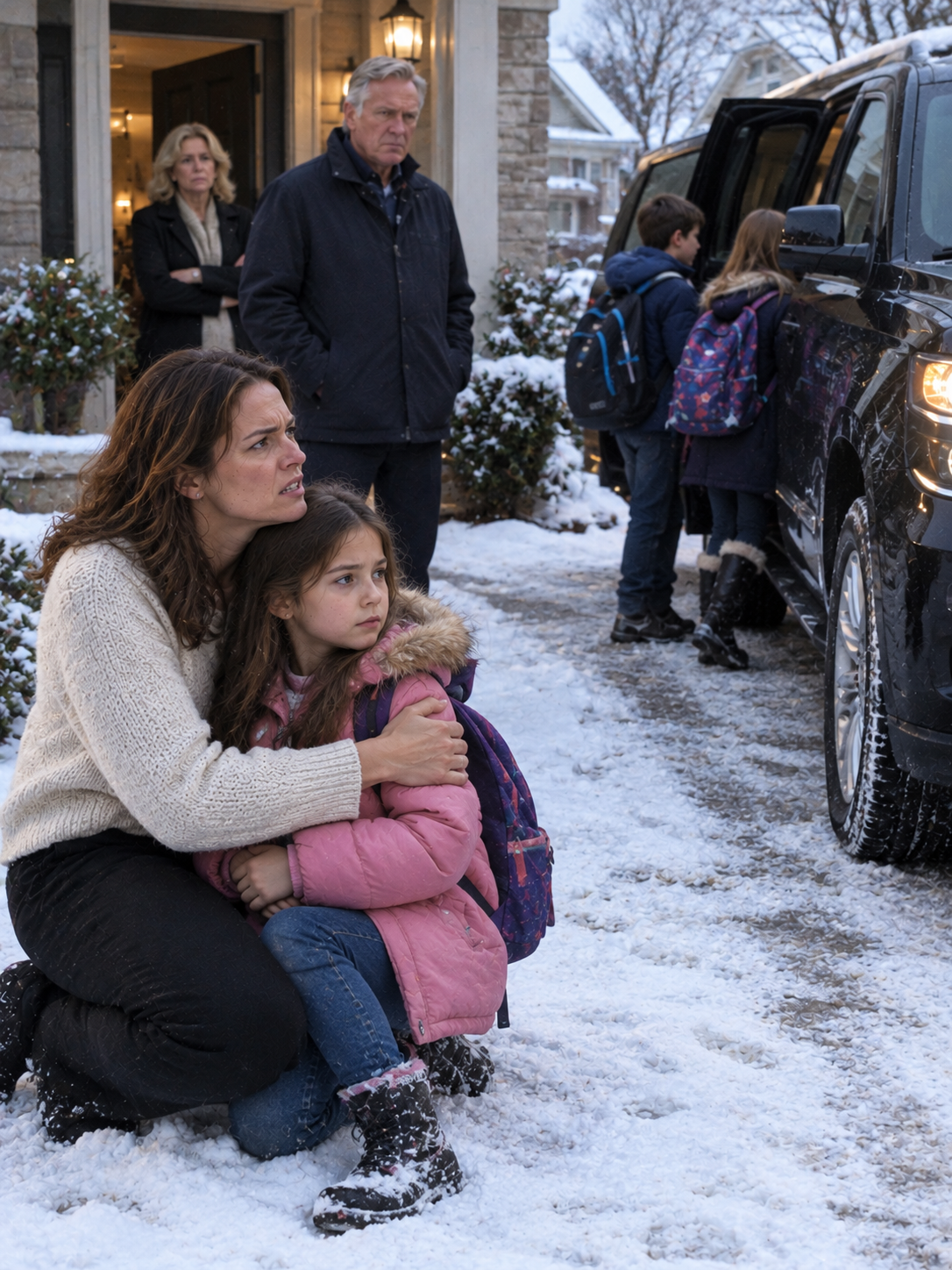
“My nine-year-old daughter was walking three miles to school through heavy snow while my brother’s two sons rode past her in a heated SUV I was paying $1,700 a month to keep on the road.
“My nine-year-old daughter was walking three miles to school through heavy snow while my brother’s two sons rode past her...
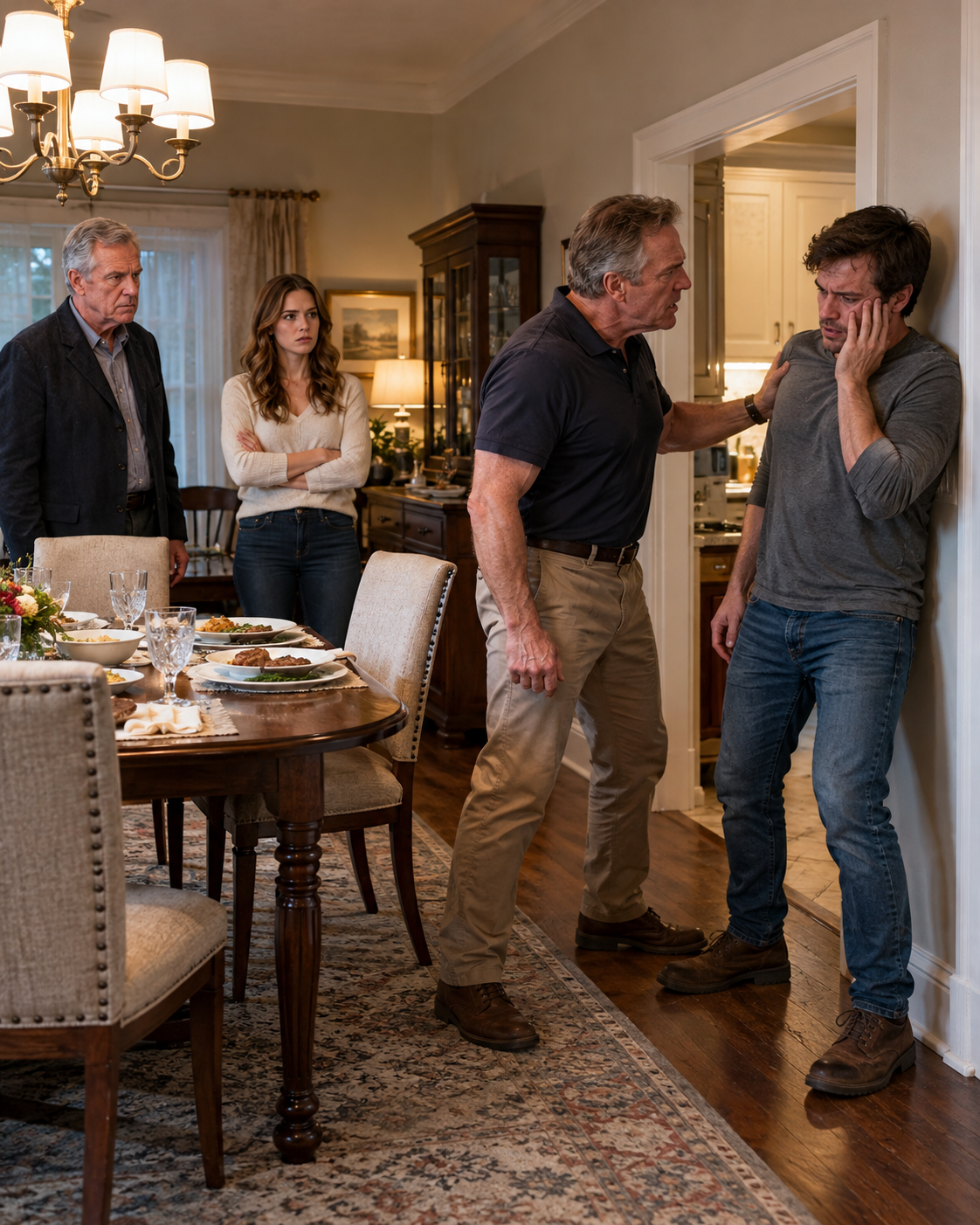
My daughter-in-law thanked her father after he shoved my son—and I quietly reached for my phone. “MAYBE NOW YOU’LL START ACTING LIKE A MAN.”
Part 1: Scene 1: The dinner invitation My daughter-in-law’s father put his hands on my son at Sunday dinner, shoved...