I Helped My Veteran Neighbor Repair His Fence… Then He Said, “There’s Someone I Want You to Meet.”
I Fixed My Veteran Neighbor’s Fence—Then His Daughter Asked Me To Risk The Life I’d Built
My neighbor introduced me to his daughter while I was bleeding through a work glove.
Six weeks later, she asked me to cross the country—and I nearly lost her before she ever boarded the plane.
But the man who brought us together was keeping a decision of his own behind his kitchen door.
PART 1 — The Woman On The Other Side Of The Fence
The first time Walter Brooks tried to change my life, I was using my shoulder to keep six feet of cedar from crushing his tomatoes.
Blood had started working through my right glove, the clamp above my head had slipped, and Walter stood on the other side looking as unhurried as a man waiting for toast. “There’s someone I want you to meet,” he said.
I tightened my grip on the post and told him that unless she was a paramedic, his timing needed work.
“He usually waits until after dessert to ambush people,” a woman said behind me.
I turned toward the voice, which was a mistake, because the panel shifted and drove a fresh splinter through my sleeve.
Before I could swear, she stepped beside me, planted both palms against the cedar, and took enough weight that I could breathe again. “Dad,” she said, “maybe secure the fence before your introduction kills him.”
That was how I met Laya Brooks: shoulder to shoulder, holding up something neither of us had broken.
At the time, I thought the blood on my glove would be the most memorable part of the morning.
I was twenty-eight, old enough to know that good things rarely announced themselves, and apparently still young enough to think I could recognize trouble before it smiled at me.
Laya looked over her shoulder, smiled, and ruined that theory immediately.
Eleven months earlier, I had bought the small brick house beside Walter’s because its problems were visible.
The kitchen drawers dragged, the porch listed slightly, and one bedroom window refused to close when the weather turned damp.
I made custom cabinets for a living, so those things felt less like warnings than introductions.
A house could tell you exactly what hurt if you knew where to put your hands.
People were less cooperative.
My former fiancée had returned her ring three months before our wedding, sitting at the kitchen table while I explained the shelving I had planned for our bedroom.
She said our future felt like a room I had finished without asking whether she wanted to live in it.
I remembered the sentence because I had spent two years pretending it was unfair instead of admitting I understood it.
After she left, I replaced floors that did not need replacing and rebuilt a porch that had already been perfectly sound.
I could spend fourteen hours solving a cabinet problem and call that a productive day.
Sitting alone with the possibility that someone had loved me and still felt lonely seemed considerably less useful.
By the time Walter became my neighbor, I had a beautiful house and very few reasons to leave it.
Walter was sixty-eight, a retired Army veteran and former history teacher who ironed shirts he intended to wear while mowing.
He kept peppermints in a bowl by the door and claimed that did not make him elderly.
Our friendship developed through borrowed sockets, weather complaints, and the sort of practical favors men can exchange without admitting they enjoy each other’s company.
He insulted my coffee every Sunday and finished the entire cup.
The night before Laya arrived, a storm had dropped a maple limb across his back fence.
At seven that morning, I found him trying to lift the broken panel while standing on the gate he was supposed to be moving.
When I pointed this out, he inspected his boot and called it a temporary complication.
I told him to let me help, and he said he had not asked for a supervisor.
“Good,” I said, fetching my tools. “I need somewhere to test an impact driver.” Walter studied the tool and informed me that model had been available for several years. “Still new to me,” I said, which earned the smallest movement at one corner of his mouth.
He accepted the explanation because it allowed us both to pretend he was doing me a favor.
By ten, we had removed the crushed boards and dug out one ruined footing.
Walter measured with the concentration of a man preparing evidence for court, but every few minutes his left hand drifted toward his knee.
I noticed the careful way he lowered himself onto an overturned bucket.
Instead of saying anything, I handed him the tape measure and announced that his handwriting was more trustworthy than mine.
He watched me take the shovel, knowing exactly what I was doing.
Then he gave me the measurements without arguing, which should have told me more than it did.
Walter ordinarily objected to help on principle, especially when he needed it.
That morning, he was too tired to make the objection convincing.
Around noon, he brought out lemonade and asked whether I was always so quiet.
I said only around people who asked questions. “That explains why you’re single,” he replied, and I nearly inhaled an ice cube.
Before I could decide whether to defend myself, a silver hatchback turned into his driveway and Walter checked his watch.
I remembered that glance later.
At the time, I was more concerned with the panel we were lifting and the clamp that had begun sliding down the new post.
Then the weight shifted, my glove tore, and Walter announced his introduction as though he had rehearsed it.
A moment later, Laya was standing beside me, sleeves rolled to her elbows, telling her father to stop talking and tighten something.
Once the clamp held, I stepped back and finally looked at her properly.
She wore jeans, white sneakers, and a rust-colored blouse with a loose thread at one cuff.
Dark blonde hair had been twisted into a knot that was clearly losing an argument, and a small scar interrupted one eyebrow.
Her hazel eyes moved from the fence to my hand with immediate, practical attention.
“This is my daughter,” Walter said. “She’s twenty-seven.” Laya stared at him and asked whether I was conducting a census.
He ignored her and told me she worked as a physical therapist in Raleigh, which prompted her to point out that she had successfully introduced herself before.
I laughed, and her expression warmed as though she had been waiting to find out whether I knew how.
She had driven up because her father mentioned a branch coming down during the storm.
When she saw the damaged section, she turned slowly toward him. “You said a branch, Dad.” Walter looked at the heap of broken cedar and explained that the number of branches remained one, regardless of the consequences.
Laya helped us finish instead of standing nearby offering encouragement.
She held a rail, passed screws, and caught a measurement neither Walter nor I wanted to admit we had misread.
When I accused her of enjoying herself, she said watching two men discover she was right was a perfectly respectable way to spend a Saturday.
Walter muttered something about an inherited condition and checked the level again.
By late afternoon, the fresh cedar stood gold against the old boards.
Walter went inside for bandages, leaving us beside the gate while somewhere beyond the fence a mower started and stopped.
Laya ran her hand along the top rail and told me I did good work.
I said her father had described me as adequate, and she assured me that from Walter, adequate practically required an acceptance speech.
Then she took my injured hand.
She did it easily, without a performance of concern, turning my palm toward the light while I suddenly forgot what to do with the rest of myself.
The cut was shallow, but she studied it with a small crease between her eyebrows.
When she looked up, her thumb stayed beneath my knuckles.
“You show up for him,” she said.
It was not quite a question, so I told her he usually disguised the need well enough that we both got to keep our pride.
Her smile thinned, and for the first time I saw the worry underneath her quickness. “Thank you for noticing anyway,” she said, and the gratitude in her voice made me wish I had noticed more.
Walter called from the kitchen, demanding to know where he had put his first aid kit.
Laya rolled her eyes, but her hand remained around mine for one more second. “Come to dinner,” she said. “He’s making chili, which means I’ll be cooking while he describes how he would have done it.”
I asked whether dinner was part of the ambush. “Almost certainly,” she said, “but I’m asking for myself.” That distinction landed somewhere beneath my ribs.
I said yes before I could make the answer cautious, and Walter immediately appeared at the door to announce six-thirty.
Laya watched him retreat, then glanced at the kitchen window.
Something changed in her posture, her shoulders drawing inward as though the afternoon had suddenly turned cold. “There’s something he hasn’t told you,” she said.
I thought she meant a dietary restriction or a particularly strong opinion about cornbread, until she added, “He thinks I came home for the weekend.”
“You didn’t?” I asked.
She shook her head and stared at the new fence as though it complicated what she had come to do.
In three weeks, she said, she intended to bring Walter to Raleigh, where he could get help with his knee and stop trying to manage the house alone.
The only problem was that he did not know any of this yet.
I told her that Walter would probably rather negotiate with a firing squad than discover he had been assigned a moving date.
Her face tightened, and she asked whether I thought she was interfering.
I said I thought she was frightened, which seemed to surprise both of us.
Before she answered, Walter came outside with a bandage and asked if we were discussing him.
“Yes,” she said, at exactly the same time I said no.
He looked between us and suggested we coordinate better if this arrangement was going to work.
Then he handed over the bandage, entirely too pleased with himself.
Laya pressed it into my palm and reminded me about dinner in a voice that gave nothing away.
At six-fifteen, I changed my shirt for the third time and resented every version of myself involved.
Walter opened his door in a blue button-down and looked me over. “You own an iron,” he observed.
I threatened to go home, and Laya called from the kitchen that she had already seen me through the window, although her father was probably lying about everything else.
Her hair was down now, and the green sweater she wore made me wish I understood colors better.
I handed over a bottle of wine with more ceremony than the bottle deserved.
She called my transformation adequate, and Walter gave her a look of such shameless satisfaction that I pointed at him. “This is your fault,” I said, and he answered, “Most worthwhile developments are.”
Dinner began with chili hot enough to punish dishonesty and cornbread Laya had brushed with honey.
She asked about the walnut table waiting in my workshop, and I explained that the customers were celebrating forty years of marriage. “What makes a table worth waiting that long for?” she asked.
I said the people around it, and then concentrated on my bowl because neither Brooks was looking away.
For a little while, it felt simple.
Laya stole the corner piece of cornbread from my plate, Walter complained that everyone ignored his authority, and the kitchen windows reflected three people instead of one.
I had forgotten how quickly ordinary warmth could make a person hungry.
Then Walter asked about the clinic, and Laya put down her spoon.
She told him about the expanded rehabilitation program, then asked how his knee had felt after the morning’s work.
Walter said fine, with the particular firmness people use when accuracy is beside the point.
She mentioned the trouble he had standing after church.
He blamed the pew, and she mentioned the garage.
My eyes went to him.
Walter’s hand stopped beside his glass, and he looked at his daughter with an expression I had not seen before. “Who told you?” he asked. “Mrs.
Alvarez,” Laya said, then added that she knew there had been two falls, and the kitchen went so quiet I could hear the refrigerator switch on.
Walter folded his napkin into a careful rectangle.
Laya laid out her idea: a few months in Raleigh, an assessment, a rehabilitation center near her apartment, and time to decide what came next. “We can work this out,” she said.
Her father looked down at the napkin and answered, “I’m not a group project.”
She flinched but kept talking.
He heard a decision disguised as a discussion; she heard stubbornness disguised as independence.
When she turned to me and asked whether I had seen him favoring his knee, I felt both their gazes settle on my face.
I admitted I had, then added that seeing the difficulty did not mean I knew what he should do about it.
Laya pushed back her chair. “That isn’t an answer,” she said, and I told her it was the honest one.
She carried her plate into the kitchen with the controlled care of someone afraid any quick movement might undo her.
A moment later, the back door opened and closed, leaving Walter staring at the place where she had been.
I found her on the steps, arms around her knees, looking at the fence we had repaired.
She said I could have supported her, and I answered that agreeing was not always the same as helping.
For a moment, I thought she would ask me to leave.
Instead, she rubbed her sleeves and told me her mother had died six years earlier.
It had been sudden, a brain aneurysm, while Laya was away at graduate school.
Her father had called that morning about a headache, and she had said it sounded like a migraine because there was an exam and ordinary life still seemed reliable.
By the time she reached the hospital, ordinary life had ended.
She described the coffee cup she had left on her desk more clearly than anything that happened afterward.
“I know I couldn’t have known,” she said. “I can explain that to other people.” Her voice broke on the difference between explaining something and believing it.
I moved closer, slowly enough that she could decide, and she leaned her head against my shoulder.
Through the kitchen window, Walter washed the same bowl for a very long time.
I told her about the porch I had rebuilt twice after my engagement ended.
She asked whether the first one had been unsafe, and I admitted it had been excellent.
A laugh escaped her, small and surprised, and I realized I wanted to hear that sound on days when she had no reason to be afraid.
Then I admitted that making myself useful had sometimes been my way of avoiding being known.
“And now?” she asked.
I looked at our knees touching on the cold step. “Now I’m telling a woman I met under a falling fence something I’ve avoided saying for two years.” Her hand found my wrist, and when she kissed me, it was gentle enough to leave room for an answer.
I gave her one.
For a moment there was only the warmth of her cheek, the cedar smell drifting from the yard, and the astonishing fact that neither of us was pulling away.
Then Walter knocked on the kitchen window.
Laya closed her eyes and said she was choosing the first retirement facility she found, and I told her he would escape before breakfast.
At the door, she asked me to come to Raleigh the following Saturday for a real date.
I said yes, and she threaded her fingers through mine as though the answer mattered more than she wanted to show.
We stepped inside together, still smiling.
Walter stood beside the table with a brochure in his hand, and something in his face made her stop.
“Good,” he said, looking at our joined hands. “Because before either of you starts planning my future, there’s something you need to hear.” Laya’s fingers tightened around mine.
Walter set the brochure facedown and announced that he was selling the house—and that he had already chosen where he would go.
PART 2 — She Said “Come With Me,” And I Told Her Everything I Was Afraid To Lose
Laya let go of my hand so quickly that the empty space felt cold. “You’re selling it?” she asked, looking past her father at the familiar kitchen, the scuffed doorway, the small mark on the wall where someone had once measured her height.
Walter said yes, but this time he offered no joke to soften the answer.
She stood very still, absorbing the possibility that a place could remain in front of her while already beginning to disappear.
When she asked where he was going, he said forty acres outside Charlottesville.
Her face changed before he added that the acres belonged to an independent living community, not an isolated cabin. “You enjoyed that pause,” she accused him, and he admitted a little enjoyment.
But when he turned the brochure over, his hand shook just enough that I stopped smiling.
The photographs showed private cottages, shared meals, exercise rooms, medical support, and a woodworking shop Walter pointed out twice.
He had toured the community the previous week, asked questions, and spoken with a resident who had also served in the Army.
Laya stared at the brochure as though someone had left her out of a conversation conducted in her own language. “You knew the house was getting difficult,” she said, and he answered, “Yes.”
That single word undid more of her anger than any argument could have.
Walter rested both hands on the table and explained that the falls had frightened him too, although admitting it had taken longer than he liked.
He wanted help without making his daughter responsible for every ordinary hour of his day. “You have a life,” he told her, “and I’d like you to have it before you turn it into a waiting room for mine.”
Laya sat down as if her knees had forgotten their work.
She said she would never consider him a burden, and he reached for her hand. “I know,” he said, “which is why I’m telling you before you offer me everything.” His voice softened when he admitted he should have involved her sooner, and she finally looked up, tears bright but no longer falling.
I sat beside them while the chili cooled and the house settled around us.
Walter could choose to leave and still love the years he had spent there; Laya could be frightened without having the right to make the choice for him.
Neither truth made the conversation easy.
When he walked around the table and held her, she folded into him with the sudden relief of someone who had been bracing for a loss that was not happening tonight.
Later, she walked me home beneath porch lights blurred by a thin mist.
We stopped on the stairs I had built twice, and she asked whether this was the famous structure produced by emotional avoidance.
I said the workmanship was excellent regardless of the motivation.
She laughed, caught the front of my shirt, and kissed me with enough certainty that I forgot to defend the porch.
The next morning, her car was gone before I finished my first cup of coffee.
An hour later, my phone lit up with a photograph of a travel mug and the complaint that her coffee had failed to dissolve the spoon.
I sent a picture of my workbench and told her standards were collapsing everywhere.
For the rest of the week, ordinary moments acquired an audience: a crooked parking job, a difficult client, a dog she saw wearing rain boots.
By Wednesday, we were talking until our phones grew warm.
She told me about the satisfaction of seeing a patient trust a recovering leg again and the exhaustion of knowing progress could not be hurried.
I told her about learning my trade, the first cabinet I had sold, and how terrified I still felt whenever a customer asked whether I was sure.
She said competence and fear seemed to coexist more often than people admitted.
On Thursday, Walter came into the workshop carrying a screwdriver he did not need repaired.
He watched me sand the same corner until I asked whether he planned to grade the process. “She likes you,” he said, and the simplicity of it made me set down the sandpaper.
When I told him I liked her too, he nodded, then cautioned me against turning her unhappiness into another project I could finish with the right tool.
I wanted to tell him I knew better, but my own history made that difficult to argue.
Walter said grief had taught Laya to anticipate disaster and call anticipation responsibility.
Then he looked at the beautiful cabinet between us and said people could become very accomplished at staying busy around the things that frightened them.
I asked whether retirement had made him unbearably observant, and he told me that part had always been free.
Saturday, I drove to Raleigh with a clean shirt on a hanger and far too much awareness of the miles.
Laya waited outside a used bookstore in a navy dress and ankle boots, holding two paper cups.
When she saw me, she smiled before she seemed to remember that smiling could reveal something.
I took the coffee, set both cups on a low wall, and kissed her properly before either of us could make a joke.
Our date began among books that smelled of paper, dust, and rain carried in on other people’s coats.
She owned three editions of the same novel and defended every one with impressive seriousness.
I bought a battered book about American furniture, and she discovered a handwritten dedication inside it: a husband promising his wife he would finally build the shelves.
She read it aloud, then looked at me with an expression I felt long after the book was closed.
We ate lunch standing beside a food truck and spent the afternoon walking without much agreement about direction.
Laya told stories with her hands, stopped to watch a squirrel struggle with a biscuit, and listened so closely when I spoke that I sometimes lost the sentence.
At dinner, she stole potatoes from my plate despite having her own.
I began imagining how she might look across my kitchen table on an ordinary Tuesday, which frightened me more than kissing her had.
Afterward, she slipped her hand into my jacket pocket and found my fingers.
We walked past lit apartment windows where other people were rinsing dishes or lowering blinds. “I haven’t had a day like this in years,” she said, and when I asked what she meant, she answered that she had not spent it measuring what everyone needed from her.
Her voice was happy, but the happiness seemed unfamiliar enough to make her careful.
I stopped beneath an oak tree near her building.
Walter’s warning returned, and I told her I did not want her rearranging her life around me out of obligation. “You barely know my coffee preferences,” I said, trying to make the sentence lighter than it felt.
Laya looked down at our joined hands and said there was another option neither her father nor I knew about.
Her clinic had offered her a program director position in Portland.
She would help lead an expanded rehabilitation service, mentor therapists, and do work she had been preparing for since graduate school.
The decision was due Monday.
She described the responsibilities with a brightness that vanished when she finally looked at me, as though she expected to find the price written across my face.
For several seconds, I could hear traffic at the next intersection and nothing useful inside my own head.
Raleigh was a drive; Portland was flights, schedules, expenses, and the possibility of becoming a voice someone called when a day was already over. “What do you want?” I asked.
She looked almost angry at the question before admitting she had spent so long considering everyone else that her own answer felt disloyal.
I told her to consider the job seriously.
Her hand loosened, and she asked whether it was really that easy for me to imagine her leaving.
I said no, then made myself tell her I had counted the days until this one and already hated the idea of driving home. “But I don’t want you turning down your future because we might have something,” I said, and watched her struggle to decide whether that was kindness or distance.
She asked whether I thought we had something.
I moved closer and told her yes, enough to make the conversation difficult, enough that I would rather hear what she wanted than guess the answer that kept her near me.
She kissed me beneath the tree, one hand at the back of my neck, and afterward rested her forehead against mine.
Neither of us pretended the kiss had made Oregon any closer.
At her apartment door, she asked whether I wanted to come upstairs.
I said yes, then asked if she was sure, and she smiled with a tenderness that made the question feel welcome.
Her apartment held books beneath the windows, pens in a chipped mug, and a photograph of her between her parents at the beach.
We talked for another hour before the room grew quiet and the evening became something we kept for ourselves.
Later, she traced the healing cut across my palm.
We agreed we did not want to date anyone else, which was a small promise by most measures and enormous by ours.
When she asked what happened Monday, I said she decided about Portland and we kept talking.
She squeezed my hand in the darkness, and I understood that being hopeful did not protect either of us from being scared.
On Monday afternoon, she called while I was fitting a drawer. “I accepted,” she said, and the drawer stopped halfway into its opening.
Her start date was six weeks away.
I told her I was proud, meaning every word, but she heard what else was in my voice and asked me not to hide it from her.
“I want you here,” I admitted.
She let out a breath that sounded almost relieved, until I immediately added that she should still go.
The silence afterward was brief and difficult to name.
I thought I was making room for her choice; she heard me putting a lid back on the feeling she had finally persuaded me to show.
Still, we built six weeks out of weekends.
I drove south with pastries on the passenger seat; she came north with laundry, a laptop, and complaints about the coffee in my kitchen.
She left a sweater over my desk chair and a toothbrush beside mine without asking permission to make those spaces warmer.
I started buying the yogurt she liked, then pretended it was something I had always kept in the refrigerator.
We learned the harmless details first.
She slept with one foot outside the blanket and read the final page of novels before beginning them, an act I regarded as grounds for a public inquiry.
I needed music while cooking and arranged the dishwasher with unnecessary precision.
She would move one spoon after I finished just to watch my face, and I would wait until she left the kitchen before moving it back.
The harder details arrived without the courtesy of being funny.
When she worried, she made plans for people who had not asked for them.
When I worried, I found work that could expand to fill any available silence.
One Thursday, I missed our call while finishing a sideboard, then used the deadline as though it explained why I had failed to send a ten-second message.
“You knew I was working,” I said the next morning.
Laya stood very still on the video call, wearing the blouse she wore for difficult meetings. “I knew where you were,” she answered. “I didn’t know whether I still belonged in your evening.” I wanted to defend myself until I saw how small she had made the request, and how hard I was working to avoid it.
I apologized without offering the drawer joints as evidence.
She admitted she had nearly called Walter to ask whether I was all right, then stopped because she recognized the old panic looking for a new address.
We agreed to send messages when plans changed and to ask questions before deciding what silence meant.
It was not a sweeping romantic moment, but that night I called before starting the last coat of finish.
Walter accepted an offer on the house during the fifth week.
The buyers were expecting their first child, and the husband crouched beside the repaired fence to admire the posts.
Walter repeated that detail three times while claiming he was unmoved by sentiment.
Laya helped pack her mother’s mixing bowls, and I wrapped the framed photographs, discovering how heavy a small cardboard box could become when someone kept reaching inside it.
We drove Walter to his cottage the weekend before Laya’s flight.
He inspected the cupboards, complained about a light switch, and introduced himself to a neighbor before we had unloaded the truck.
By late afternoon, his books occupied the shelves and his wife’s picture stood beside his chair.
Laya watched him argue cheerfully about parking with a man across the path, and some of the tension finally left her shoulders.
That evening, we returned to the empty house to collect the cleaning supplies.
We ate pizza on the living room floor because the table Walter had left for the new owners felt like something already belonging to strangers.
Laya pointed out where she had done homework and where her mother used to sit with a cup of tea.
Without curtains or furniture, even her laughter sounded as if it had farther to travel.
“My flight leaves Tuesday,” she said, and I said I knew.
She suggested October for a visit, then Christmas, and I answered each question with some version of “We’ll figure it out.” At the third answer, she put down her slice. “I know you mean that,” she said, “but I can’t see what you’re imagining.”
I told her I was imagining us staying together.
She asked what that looked like beyond calls and tickets, and I felt the familiar urge to become practical before becoming exposed. “You chose the job,” I said. “I supported you.” Her face changed, and I knew before she answered that I had turned something loving into a receipt.
“I didn’t ask you to stop feeling things so I could go,” she said.
I stood because sitting still with that sentence was suddenly impossible.
She followed me to the window, where the new fence made a pale line through the dark yard. “I need to know there’s someone on the other end of the distance who wants more than to be reasonable.”
“I love you,” I said, so abruptly she went quiet.
The words frightened me less once they were outside me, and I told her I had been holding them back because six weeks seemed too soon and Tuesday seemed too near.
Tears slipped down her face before she answered.
When she said she loved me too, I held her as if the empty room had finally given us something it could keep.
We kissed with all the tenderness we had been using caution to postpone.
Then she rested her hands against my chest and whispered, “Come with me.” My first thought was yes, a fierce, uncomplicated yes that lasted until my workshop, mortgage, customers, and employees of no one but myself crowded in behind it.
I started listing them aloud, and with every item her expression closed a little further.
She said she was asking whether we could imagine a way, not demanding that I put the house on the market overnight.
I said it sounded easy when she described it that way. “It isn’t easy for me either,” she answered, and the hurt in her voice sharpened mine instead of softening it.
Soon we were arguing about an ultimatum she said she had never made and a refusal I insisted I had not given.
Then she said I built solid things because they could not leave unless I carried them out.
The sentence hit exactly where she aimed it, and her face changed as soon as she saw that it had.
I stepped away before I could answer with something equally cruel.
She reached for her coat and told me she was going to stay with her father, her hands shaking while she tried to find the sleeves.
At the door, she turned back. “I love you, Owen,” she said, “but I don’t know how to build this if we can’t even talk about what might change.” I wanted to ask her to stay, yet every sentence I found was another argument about why I was right to be afraid.
She left before I said anything, and the latch clicked with a small, ordinary sound I knew I would remember.
Walter found me an hour later beside the cold pizza.
He listened while I described the fight, then said neither of us sounded particularly proud of our best work.
When I asked whether he thought I should abandon my business for someone I had known six weeks, he shook his head. “I think you should find out what she actually asked before deciding you already refused it.”
I walked home after midnight and switched on the workshop lights.
The familiar smell rose around me, comforting and suddenly insufficient, and I stood among the things I had built while thinking about the woman I had not known how to answer.
Then I opened my laptop and typed “shared woodworking shop Portland” into the search bar.
Before dawn, I found a space ten minutes from her new clinic—and a button that could turn my promise into a risk.
PART 3 — The Things We Could Keep, And The Life We Could Build
I clicked the button before I could turn the decision into another cabinet that needed finishing first.
The message I wrote was brief: a description of my work, photographs of recent commissions, and a question about renting bench space for three months.
Sending it did not move me to Oregon.
It simply made one of the possibilities real enough that fear could no longer dismiss it as impossible.
The owner replied shortly after seven.
He had professional equipment, room for an independent maker, and an opening that matched the dates I had suggested.
I read the email twice, expecting the catch to announce itself somewhere between the rent and the deposit.
Instead, I found practical questions, a telephone number, and the unnerving discovery that this might actually work.
By eight, I had called a carpenter I trusted who sometimes helped with larger installations.
He had been looking for better workspace, and sharing mine while I tested a new market interested him immediately.
Nothing was signed, nothing was guaranteed, but the conversation turned my workshop from an anchor into something that might remain standing without me inside it every morning.
I felt relief, followed by the uncomfortable realization that I had mistaken familiarity for necessity more often than I wanted to admit.
By nine, I had a spreadsheet.
By ten, I had freight estimates, a calendar, and the beginnings of an operating budget.
Then I looked at the empty chair across from my desk and understood that I was about to repeat the same mistake with more impressive paperwork.
I had found a solution to a conversation I still had not finished having.
I shut the laptop and drove to Walter’s cottage.
He answered in sweatpants, holding a mug that said RETIRED, NOT EXPIRED, and informed me that I looked terrible.
I said I had been awake all night.
He stepped aside, surveyed my face, and asked whether I had come for coffee or to practice an argument before saying it to the person who mattered.
“Possibly both,” I admitted.
Inside, the cottage smelled of fresh toast and the furniture polish he had used in the old house.
His wife’s photograph stood beside a small vase Laya had filled the day before, and seeing it there made the move seem less like an ending.
Walter poured coffee, waited, and let me tell him about the workshop without interrupting.
When I finished explaining the arrangement, he asked whether I wanted to go.
I started answering with the rental period and the Virginia commissions I could still complete.
Walter raised one hand. “I didn’t ask whether the numbers can stand up,” he said. “I asked whether you want to be there.”
I looked into my cup until the answer stopped sounding embarrassing.
I wanted to know how Laya’s first day went while we were making dinner, not hours later when we were both tired.
I wanted the sweater on my chair to belong to someone coming back for it that evening.
I wanted to find out whether the life we kept imagining could survive groceries, bad moods, and a Wednesday when neither of us felt particularly charming.
“Then tell her that,” Walter said.
He reminded me that she had things to apologize for too, and that a difficult conversation was not a debt one person repaid by surrendering everything.
Three months could be an experiment we chose together, if we could discuss it without making love a test.
He took a sip, grimaced at his own coffee, and told me mine remained worse.
I laughed for the first time since the fight.
Walter asked whether the people in Portland had seen my work, and when I said they liked it, he nodded as if that had never been in question.
Then he grew serious again. “A good plan gives you room to tell the truth,” he said. “It shouldn’t become a reason you can’t change your mind.”
The front door opened before I could answer.
Laya came in carrying a paper bag and stopped at the sight of me, one hand still on the handle.
She looked tired, and I hated knowing we had spent the same night feeling lonely ten minutes apart.
Walter took the bag, discovered blueberry muffins, and announced that he urgently needed to be somewhere else.
“Where?” Laya asked.
He looked around his small cottage with theatrical consideration, then chose the bedroom and closed the door.
We stood across the living room from each other, both of us briefly smiling despite ourselves.
Then her expression changed, and she said she had gone by my house that morning because she did not want Tuesday to arrive with the fight still standing between us.
She apologized first, before I could offer the sentence I had practiced in the truck.
What she said about my work had been cruel, she told me, and she knew building a business had already required risks.
She had been frightened of leaving and turned that fear into an accusation about how much I loved her. “I wanted you to hear an invitation,” she said. “I made it sound like a verdict.”
I told her I had helped turn it into one.
When she asked me to come, I heard my former relationship inside the question and answered a demand she had not actually made.
I had wanted credit for supporting her career while keeping every difficult feeling safely beyond her reach. “You weren’t wrong to ask,” I said. “And I wasn’t wrong to need time, but neither of us gave the other much room to be scared.”
Her shoulders lowered.
For the first time since she entered, she looked directly at me without preparing for the answer to hurt.
I told her I wanted to try Portland, then described the rented bench, the arrangement back home, and the three months I could manage without pretending money did not matter.
When she started crying, I stopped explaining and crossed the room.
“You don’t have to do this to prove anything,” she said.
I told her I knew, and that was why I had come to talk before putting down the deposit.
I wanted us to discuss rent, work, space, and what would happen if the experiment failed.
I wanted to be able to say I was unhappy without her hearing that she had ruined my life, and I wanted her to be able to ask for something without bracing for my disappearance.
She nodded against my chest.
We sat on the couch and talked through things no romantic speech could responsibly skip: my existing deadlines, her new schedule, how much each of us could contribute, and the visits I would need to make to Virginia.
Three months would end with a conversation, not an automatic decision.
If either of us needed a different arrangement, telling the truth would be part of keeping our promise.
Only then did she ask whether I had made a spreadsheet.
I admitted I had made a very good one, and her laugh broke through the tears in a way I hoped to remember forever.
She put both hands around my face and said she loved me.
I told her I loved her enough to imagine another version of my life, and she kissed me before I could make the sentence safer.
From the bedroom, Walter called that the muffins were going stale.
Laya rested her forehead against mine and whispered that he was listening.
I said he had retired from teaching but apparently not supervision.
She laughed again, and when we opened the bedroom door, he was sitting in a chair with a book held upside down.
Tuesday morning, we drove her to the airport together.
Walter hugged her without pretending the goodbye was casual, and she made him promise to keep the assessment appointment he had arranged near his cottage.
Then she turned to me and pressed something small into my hand.
It was a key, warm from being held in her palm while she waited.
“Twenty-two days,” she said.
I told her I had counted, and she smiled as if she already knew.
At the security line, she looked back once, lifting her hand before the crowd carried her around the corner.
This time, the ache of watching her leave did not feel like evidence that I had failed; it felt like missing someone I had finally let matter.
The next three weeks were less cinematic than the airport.
I completed commissions, revised shipping plans, spoke with customers, and discovered that even sensible freight estimates could change.
Laya called from her new apartment surrounded by boxes and admitted her first days at the clinic had been harder than she expected.
We listened instead of racing to make each other feel better, a skill neither of us performed perfectly and both of us kept practicing.
When I arrived in Portland, I brought two suitcases, a crate of hand tools, and less confidence than the photographs of my finished work might suggest.
Laya waited beyond baggage claim holding a coffee she insisted would meet basic human standards.
I dropped my suitcase when she reached me.
For a moment, the long flight and the unfamiliar city disappeared into the simple relief of being able to hold her without calculating when I had to leave.
The city did not reward our courage by becoming easy.
I worked at a borrowed bench with drawers I could never find and learned that customers would not appear merely because I needed them.
Laya came home exhausted from meetings that had made leadership feel very different from the promotion letter.
Some nights, we ate toast because cooking seemed beyond both our abilities, and some nights we argued about whose tiredness had become the center of the room.
Once, after a slow week, I stayed late at the workshop without calling.
Her message arrived before my old habit could become an entire evening: “Are you working, or are you hiding?” I stared at the screen, then called and admitted the second answer.
She listened while I explained how frightened I was about money, and when I went home, she had left my place at the table clear.
She had her own difficult evenings.
After a demanding day at the clinic, she reorganized my schedule, found two potential clients, and began telling me which commissions I should prioritize.
I waited until she took a breath and asked whether she wanted to help me or stop feeling afraid.
Her eyes filled, then she sat beside me and admitted she had no idea how to watch someone struggle without reaching for the nearest plan.
We learned to ask permission before solving things.
Sometimes the answer was yes, please help me; sometimes it was sit here while I complain.
It made our lives less efficient in ways that turned out to matter.
I began understanding that being available could take more courage than being useful, and Laya began discovering that allowing someone a difficult day did not mean abandoning them inside it.
At the end of three months, we sat at the kitchen table with the same spreadsheet, now stained with coffee.
My work was growing slowly, the arrangement in Virginia was functioning, and neither of us wanted the experiment to end.
I renewed the workshop lease.
We celebrated with inexpensive takeout and a bottle of wine that tasted better than it had any right to, mostly because no one at the table was pretending to know the future.
By six months, the carpenter using my old workshop had become my business partner.
We divided commissions, planned installations around the jobs that needed us, and discovered advantages neither of us could have managed alone.
I hired help in Portland when the work justified it.
Keeping what I had built and changing how I lived inside it turned out to be possible, although possible required more phone calls than a romantic story usually mentions.
Walter visited in the spring with a stronger knee and opinions about the local rain.
He inspected my workspace, met the owner, and told me a cabinet door needed adjusting solely to see whether I would check.
I did, and he laughed for a full minute.
That evening, Laya watched him walk comfortably to a neighborhood restaurant, and I saw her put her phone into her bag instead of keeping it ready in her hand.
A year after I moved west, we bought a small Craftsman house together.
We reviewed the budget, argued amiably over the inspection, and agreed that several repairs could wait even if I found them personally offensive.
The back fence leaned badly enough to interest Walter before he had finished looking at the photographs.
He booked another visit and announced he was coming to prevent a public embarrassment.
By the time he arrived, I had bought cedar boards, concrete, and a ring.
The ring remained hidden in my tool bag while the three of us worked under a pale afternoon sky.
Laya wore old jeans and one of my shirts, and Walter measured the posts twice while pretending not to know why I kept touching the bag.
When he finally wandered toward the gate, he did it with the same unhurried expression I remembered from the morning we met.
Laya and I stood holding a panel between us.
She looked from the wood to my shoulder and said I seemed to have improved my technique since Virginia.
I told her I had learned the importance of choosing good help.
Then I set my end down, reached into the bag, and watched her smile disappear when she saw what was in my hand.
I had planned a speech about the fence, but standing there, I found I wanted to tell her something simpler.
I did not know where we would live in forty years or which parts of our careful plans would need changing.
I knew I wanted her at the table while we discussed them. “I want to build every version of home with you,” I said, lowering myself onto one knee.
She looked at the damp ground, then at me, laughing and crying at once. “You’re doing this beside wet concrete?” she asked.
I told her the location seemed structurally appropriate.
Her yes arrived before I finished the sentence, and when I slid the ring onto her finger, she knelt beside me instead of waiting for me to stand.
Walter cheered from the gate with absolutely no respect for the neighbors.
Laya kissed me with sawdust on my shirt and dirt on her hands, and the life I had once been so determined to protect suddenly seemed much larger from that patch of unfinished yard.
Behind us stood a house with repairs waiting.
Beside us stood a man who had shown us both that leaving a familiar home did not have to mean losing one.
By sunset, the fence stood straight.
Laya leaned against me, her ring catching the last light, while Walter collected the clamps and complained that romance had delayed the work.
I looked at the two people a storm had brought into the center of my life and thought, for one peaceful second, that all our difficult questions had finally been answered.
Then Walter cleared his throat, gave his daughter a look I recognized immediately, and said, “Now, about the wedding…”
Recommended Stories

I Accidentally Saw My Roommate Changing — She Said, “Help Me Finish.”
I Agreed to Be My Roommate’s Fake Boyfriend for One Dinner—Then Her Ex Threatened to Expose the One Thing We...
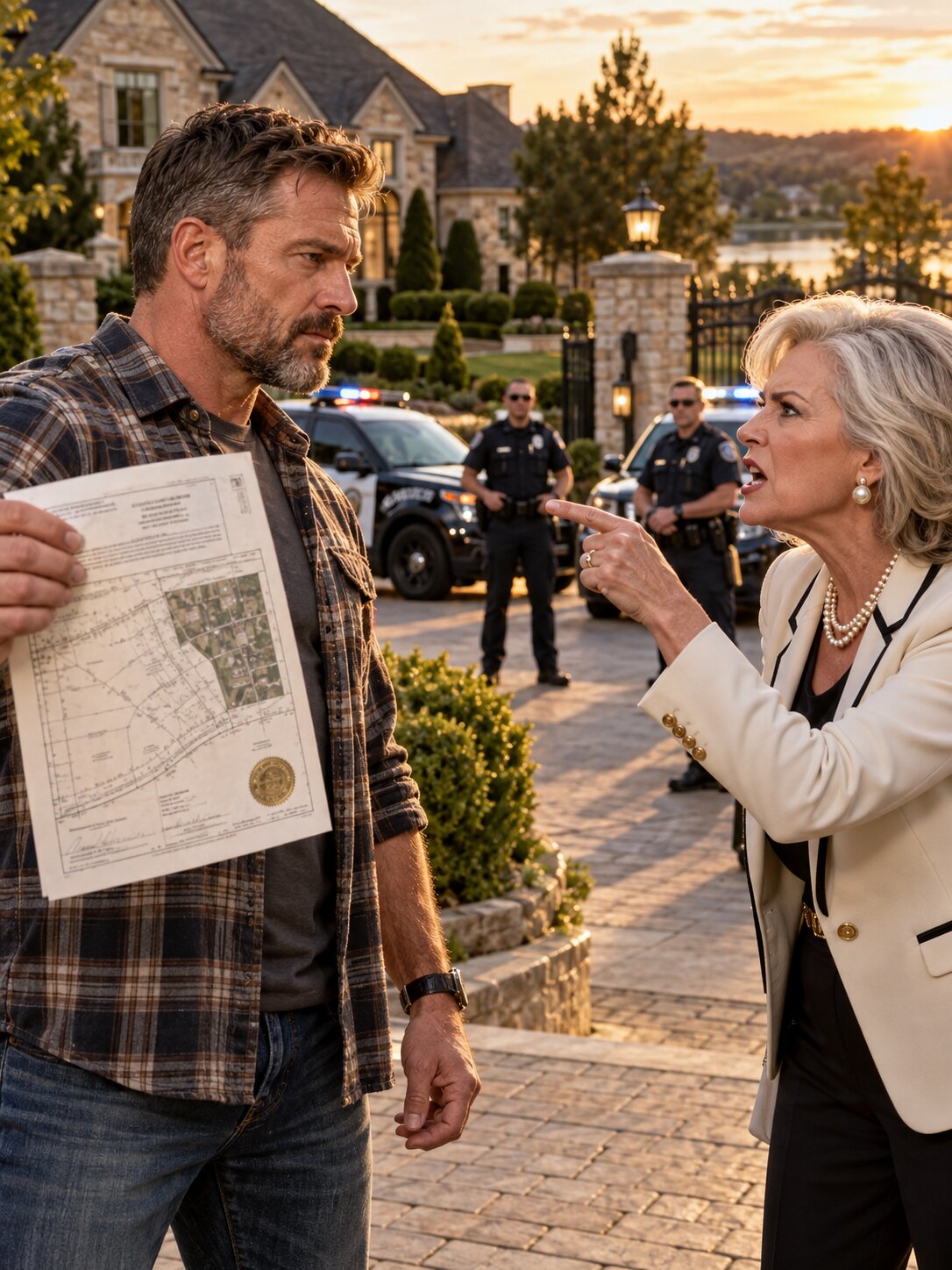
The HOA President Called Police When I Said I Wasn’t Under Her Rules—Then My Uncle’s Old Road Agreement Put Her Entire Board on Notice – Life Story
Two patrol cars rolled into my driveway because I told Vivien Ashworth five words: “I’m not in your HOA.” She...

THE PROFESSOR HUMILIATED A TEN-YEAR-OLD BLACK BOY FOR CLAIMING HE COULD SETTLE A THIRTY-TWO-YEAR MATH DEBATE—THEN GAVE HIM A FINAL-ROUND QUESTION NO ONE ELSE COULD ANSWER – Life Story
The professor held Preston Davis’s battered notebook above the registration table as if it were something dirty. A crowd of...