The Army buried him three years ago. Then he came home—and found his son had been writing letters to a dead man.
Part 1:
Two things were true about Wesley Davidson on the night this story reaches its worst hour.
He was standing in a garage in Calder County, Ohio, breathing.
And according to every office that keeps a file on a person, he was 3 years dead.
I’m Nathan, and I tell these stories because the gap between those two facts is where this one lives.
A government can write a man out of existence in an afternoon.
It takes a clerk, a form, and a box that says deceased.
Getting him written back in turns out to take far longer.
And in that gap, other people have room to work.
Wesley was a land surveyor.
He spent his whole career measuring where one person’s property ends and anothers begins.
So when he came home from the one place no map showed and found the lines of his own life redrawn by somebody else, he already knew how to read them.
Stay with me for this one.
Somebody in it is chained to a pipe and somebody is going to need a name.
And the paperwork says he doesn’t have one.
Wesley Davidson was 38 years old the spring the army sent him to a place it would never put on a map.
He was a captain in the Army Reserve, an engineer and in his civilian life, a licensed land surveyor with an office above a hardware store in Dunore, Ohio.
People in Calder County hired him when a fence went up in the wrong place.
When a farm was being split between three brothers who were no longer speaking.
When a bank needed to know exactly what it was lending against.
The story is far from over.
Part 2:
He was a quiet, steady man with a wind creased face, a tape measure clipped to his belt, even at church, and a habit of saying the same thing to every angry landowner.
The ground does not take sides.
It was the sentence that ended more feuds than any lawyer in the county.
People trusted him because he cared more about the line than about who was standing on either side of it.
His wife, Amanda, was a dental hygienist with a laugh you could hear through two walls.
They had met at a county fair the summer.
He was 26 when she had asked him why a grown man was kneeling in the dirt with a brass pin and a steel rod and he had said he was finding out where the fairground actually stopped.
She had said that sounded like the loneliest job in the world.
He had said it was until now.
They were married the next fall.
Their son Ethan was nine that spring.
Ethan had his father’s way of going quiet when he was thinking and his mother’s way of being impossible to stay mad at.
He rode a blue bike with a bent fender along the gravel shoulder of Alder Lane.
And every evening he waited at the mailbox because every week or so a letter came from wherever his father was.
And his father had a rule that each letter must include one drawing of something he had measured that day.
A bridge abutment, a culvert, a wellhead with a donkey standing next to it for scale.
Ethan taped them to his bedroom wall in order so that the wall became a kind of slow map of a country he had never seen.
The mission was a bridge survey.
That is all Wesley was ever allowed to say about it, even years afterward.
A small team of engineers and a few contract interpreters were to walk a river crossing in the northeast of Syria and assess whether a span could carry heavy vehicles.
It was a location his own government had not acknowledged being near, which meant that the usual comforts did not apply.
No flag on the compound, no named base.
His address was an APO box that routed through two cities before it went anywhere real.
Amanda wrote to that box every Sunday in blue ink on cream colored paper she bought in a pack of 50, and she numbered each letter in the corner so he would always know if one had gone missing.
On the ninth week, at a dry Wii crossing, the survey team had been told was clear.
The lead vehicle disappeared inside a flash of white.
Wesley was walking the bank with a rod when the second blast lifted him off his feet.
He remembers the sound arriving late the way thunder does.
He remembers a hand pulling at his collar and a voice in Arabic saying, “No, this one is breathing.”
Then a cloth bag over his head and the floor of a truck against his cheek and the strange ordinary thought that he had left his tape measure on the bank.
The men who took him were not an army.
They were a family business of the worst kind.
A local militia that had learned that foreigners could be sold and that a foreigner nobody was looking for could be held cheaply for a very long time.
They had no interest in his politics.
They wanted a buyer and the buyer who might have paid for him never made the call because the American government had already concluded there was nobody left to buy.
700 m away and nine time zones back on a Tuesday afternoon, a gray government sedan turned onto Alder Lane.
Amanda saw it from the kitchen window.
She would tell people later that she understood before the car even stopped that the angle of the light on the windshield was the same as the light on every movie she had ever skipped past.
Two officers got out.
One of them carried his cap under his arm.
She was already on her knees on the lenolium when the doorbell rang, and she stayed there until Ethan came down the stairs and asked her why she was on the floor.
The notification said that Captain Wesley Davidson had been killed in action during a vehicle-born attack at a location the letter did not name.
Recovery had been difficult.
Remains had been identified through personal effects.
In the burned wreck of the lead vehicle, the team had found a set of identification tags stamped with his name and a charred wallet and beside them, a body that could not be anything else.
What the notification did not say, because the army itself did not yet know it, was that those tags had been torn from Wesley’s neck by the man who dragged him out of the dust.
The body in the wreck belonged to Sammy Hadad, a 29-year-old interpreter who had worn Wesley’s spare jacket that morning because the dawn had been cold and Sammy had forgotten his own.
Sami was buried at Dunore Cemetery under the name of a man who was sitting in a sistern 90 m away.
Being counted by his capttors like inventory, the funeral drew nearly everybody in the county.
The American Legion sent a color guard.
The mayor read a proclamation.
A flag was folded in 13 precise creases and handed to Amanda, who held it against her chest as though it were something that could still be injured.
Ethan, small and stiff in a borrowed blazer, stared at the closed casket and asked quietly whether there was anything in it at all.
One man at that funeral noticed Amanda more than he noticed the casket.
He arrived late wearing a charcoal suit that was a half-size too nice for the occasion, and he carried a foilcovered casserole dish held out in front of him like a passport.
He introduced himself to Amanda’s sister, then to her mother, then with a gentle two-handed shake to Amanda.
His name was Kirk Patton.
He was 44, tanned in the wrong season, with the practiced warmth of a man who spent his working life in other people’s living rooms.
His business card, which he pressed into her hand along with the casserole, read, “Patent Legacy Estate Services: Compassionate Transitions for Military Families.”
“When you’re ready,” he told her in a low voice. “There’s a lot of paperwork nobody warns you about.
Bank accounts, the mortgage, the benefits office.
I do this for families like yours every month.
You don’t have to carry it alone.”
Amanda, who had not eaten in 2 days, did not hear the careful phrase every month.
She heard only the word alone, and she nodded, and she put the card in the pocket of her black dress because it was the nearest place to put something she did not understand.
In the sistern, meanwhile, Wesley Davidson had begun to learn that a mind can be used as an instrument.
There was no light and no paper and no steel rod.
But there was a head full of every property line he had ever walked.
And a man who cannot be released from a hole can still in the dark set out a parcel from memory, corner to corner, bearing to bearing, 160 acres of Calder County at a time.
He started with his own backyard.
He ran the boundaries of Alder Lane until he could feel the gravel.
Somewhere in the first months, he understood that the line was all he had left and that as long as he could still find the corner of his own lot in the dark, a part of him had not been declared anything.
Back in Ohio on the Friday after the funeral, a woman from the benefits office called Amanda to say that a death gratuitity of $100,000 would be paid within days and that a life insurance settlement of 400,000 would follow.
She wrote the figures on the back of an envelope and stared at them for a long time.
Then she went upstairs, found the cream colored letter pad on Wesley’s desk, and saw that the last page was still blank because the following Sunday’s letter had not been written yet.
She held it for a while.
She did not know that downstairs, in the pocket of a black dress hung over a chair, a business card was waiting to turn her grief into a transaction.
She did not know that the casserole dish Kirk had left behind would be returned, scrubbed clean on a day when it would be the only thing on her porch that she could still recognize.
Kirk Patton did not rush.
That was the first thing that made him good at what he did.
He waited 6 days before he called, and when he did, he asked only whether the casserole dish had survived the funeral.
Amanda laughed for the first time since the Tuesday of the sedan.
A short, wet surprise sound, and that was the door he walked through.
He came by the following afternoon with a folder and he was careful not to open it until she asked him to.
Over the next weeks, he became the person who made the paperwork stop hurting.
He sat at her kitchen table and explained the survivor benefit plan in a voice like warm water.
He found the form that closed Wesley’s phone line.
He drove her to the bank and stood a respectful step behind her while she signed things she could not afterward remember reading.
When the mortgage serer sent a cold letter, Kirk made one call and the letter stopped.
He never pushed.
He just kept being the one steady thing in a house where every other object reminded her of a man.
He was careful with Ethan, too.
In the beginning, he brought a baseball glove.
He asked about the blue bike, but boys can feel the shape of an adult who is performing, and Ethan watched him with the same quiet stillness his father used on a boundary dispute.
On the third visit, Kirk picked up the framed photograph on the mantle.
Wesley in his uniform with a rod over his shoulder and said kindly that it might be healthier for the family if some of these were put away for a while.
Ethan took the frame out of his hand and put it back on the mantle without a word.
Kirk smiled and the smile did not move anything above his cheekbones.
Amanda’s sister, Lindsay, noticed.
She said so over coffee in July.
“He’s very available,” she said. “Doesn’t that strike you as odd?
Man’s got a business.
He’s at your table 4 days a week.”
“He’s helping me.”
“I know he is.
I’m asking what he’s getting.”
Amanda put down her cup harder than she meant to.
She said that her husband was in the ground and her sister was accusing the only person who had shown up.
And Lindsay, who loved her, let it go.
She would regret that for a long time.
There was a thing Kirk did not tell Amanda, and it was the entire foundation of his work.
Patent Legacy Estate Services was not a charity and it was not really an estate service.
It was a machine for finding the newly bererieved of the armed forces, a population with a large lump of sudden money, no experience with probate, and a government that sent its condolences in the form of a thick envelope.
Kirk read the casualty lists the way another man reads racing forms.
He sent casserles.
He sat at kitchen tables.
He took a fee here, a management arrangement there.
And when a grieving widow was ready to sell the family home because the rooms were too full of memory, Kirk always had a buyer, a limited liability company with a bland name that he happened to own.
He had done it six times before Amanda.
Six houses, six families, six widows who thought a kind man had saved them.
In the register of deeds at the Calder County Courthouse, a patient reader could have found each sale on a different page.
Nobody was reading.
14 months after the funeral, Kirk proposed in the parking lot of a restaurant on one knee on cracked asphalt, holding out a ring he had been careful to buy slightly too small so that she would have to come back to the shop and be fussed over.
Amanda said yes because she was lonely and because she was tired and because the alternative was a house that echoed.
Ethan, 10 now, sat in the back of the car through the whole thing and stared at his own knees.
They were married at the county courthouse on a Thursday.
Kirk’s brother-in-law, Darren Hatch, a heavy, watchful man who ran a towing yard on Route 9, stood up as his witness and kept looking at his phone.
Lindsay refused to attend.
Ethan wore the same borrowed blazer from the funeral, now too short in the sleeves.
When the judge said, “You may kiss the bride,” Ethan went out into the hallway and stood at the window, and a clerk who saw him there would remember it years later.
A small boy with his forehead against the glass, watching the parking lot for a car that had not come.
By autumn, the house on Alder Lane belonged on paper to a different household.
Kirk moved in and began to change it.
He took down the wall of Wesley’s drawings.
He told Ethan it was time to let go.
Ethan said they were not his to take down, and Kirk for the first time did not smile at all.
He said evenly that in this house one person made the decisions and that Ethan could choose whether his life under that roof was easy or hard.
Ethan slept that night with the drawings folded under his mattress one at a time.
A bridge abutment, a culvert, a wellhead with a donkey until the whole country was hidden between the springs.
Meanwhile, Ethan did the only thing that still belonged to him.
Every Sunday evening, he sat at the kitchen table and wrote a letter to the APO address because it was the one thing his mother had taught him to do, and nobody had told him to stop.
He did not tell her he was doing it.
He used the cream paper from the pack of 50.
He numbered each one in the corner.
He wrote about the bike and about school, and in the fall, he wrote in pencil that there was a man in the house now, and that he did not like him, and that he was sorry if that was wrong.
He carried the letters to the mailbox himself before Kirk came home.
In February, the first one came back.
It was stamped across the front in violet ink.
Address e deceased.
Returned to sender.
The post office had forwarded it through its two cities and then decided at last that there was nobody at the other end.
Ethan stood at the mailbox in the cold holding the envelope and understood that the thing he had been sending his letters into had been for a very long time empty.
He did not cry.
He carried the envelope upstairs and slid it under the mattress with the drawings.
Then he went back down and wrote another letter because the habit was by then stronger than the evidence.
In a sistern in northeastern Syria in the same month, a thin man with a shaved skull and a beard to his collarbone lay on a concrete floor and ran the north line of the Dunore Fairgrounds in his head for what he guessed was the 900th time.
He did not know it was February.
He did not know he had been married to a woman whose husband was now someone else.
He knew only that he had been declared nothing, and that the line he was walking was the one thing that proved otherwise.
There was a sound above him on the iron lid of the pit.
Boots, many, and a voice raised in a language he did not speak, and then, impossibly, gunfire.
Wesley rolled against the wall and covered his head.
The lid shuttered.
Dust sifted down onto his face.
Above him, someone was shouting in Kurdish and then in an accent he had not heard in a very long time, in English, flat and Midwestern and impatient.
“Anybody down there?
Say something.
Anybody?”
Wesley opened his mouth.
Nothing came out.
It had been so long since he had made a word that his throat did not remember the shape.
He tried again, and what escaped him was not a word at all, but it was loud enough.
The lid came off.
Light fell into the pit like a blow.
A man leaned over the edge with a rifle slung and a headlamp strapped over a wool cap.
And for a long second, neither of them spoke.
“What’s your name?” the man said.
And Wesley Davidson, who had been written out of the world in an afternoon, realized that this was the first time in over a thousand days anybody had asked.
They told him afterward that it took 19 days to establish who he was.
The men with the rifles were Kurdish fighters, and the flat Midwestern voice belonged to an American liaison officer named Puit, who had spent his tour in a wool cap trying to look like the locals.
The militia compound had fallen to a rival faction overnight, and in the sweep of its store rooms, they had found the pit.
Wesley had no tags, no papers, and a beard so thick that his face was a
Recommended Stories

The night before my company’s beach party, I discovered several revealing lace swimsuits hidden in my wife’s second bag. When I confronted her, she laughed. “Are you seriously afraid other men might find me attractive?” – Family
The message on my phone came from someone I hadn’t spoken to in six months, and the first sentence made...
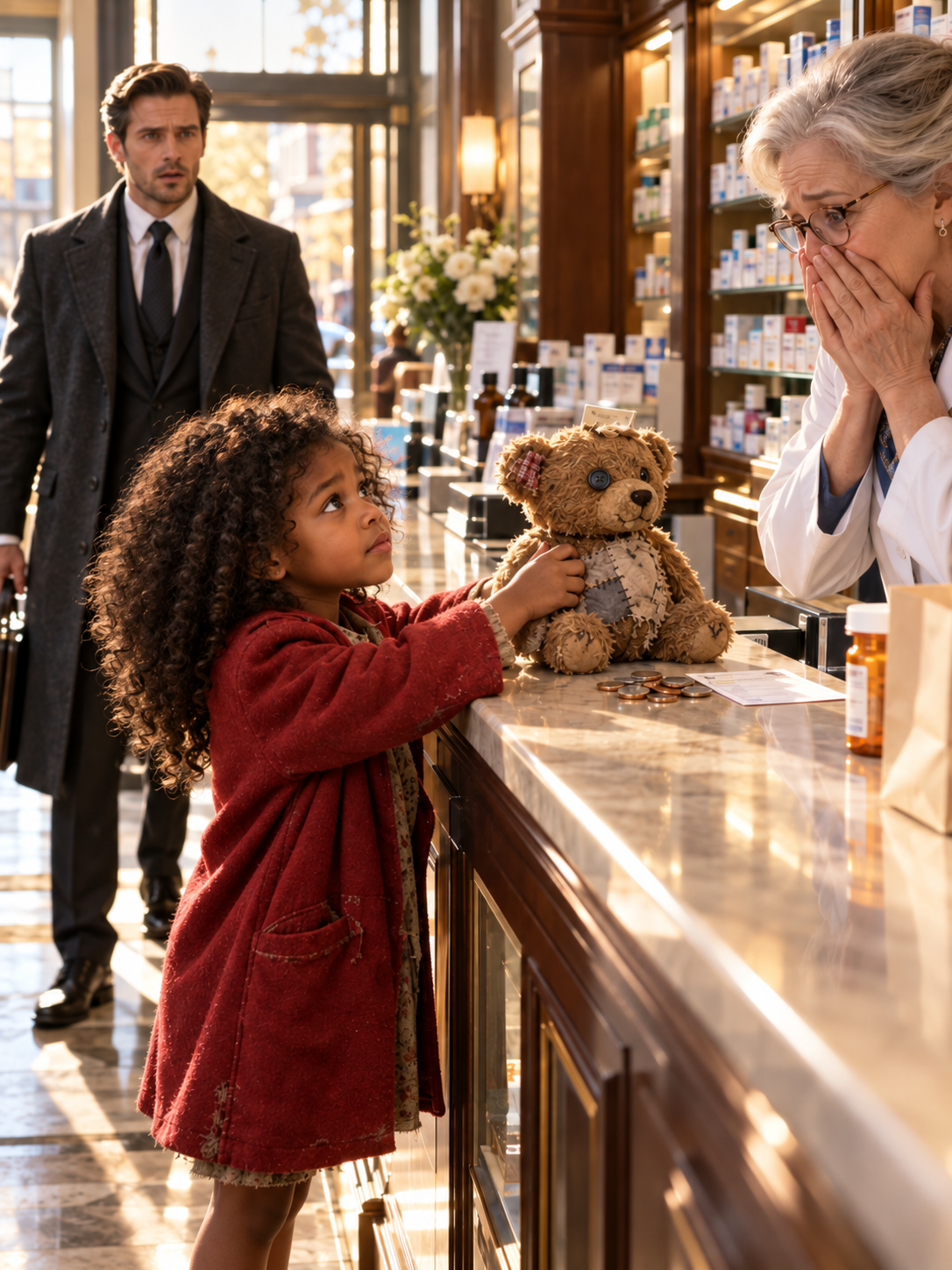
A SIX-YEAR-OLD TRADED HER ONLY TEDDY BEAR FOR GRANDMA’S MEDICINE—THEN THE BILLIONAIRE WHO TOOK IT DISCOVERED THE WOMAN HE’D BEEN TRYING TO FORGET SINCE CHILDHOOD – Life Story
At a.m., a six-year-old girl placed her dead mother’s teddy bear on a pharmacy counter because her coins were not...

My wife pretended to be ill so that she could go to a meeting with her lover while I was away!
My Wife Faked Being Sick to Meet Her Lover—Then I Walked Into the One Restaurant She Never Expected Me to...