The Mafia Boss Saved His Mistress, Leaving His Pregnant Wife Behind… Years Later He Found Her
THE MAFIA BOSS SAVED HIS MISTRESS, LEAVING HIS PREGNANT WIFE BEHIND… YEARS LATER HE FOUND HER
Damian Viscari had three seconds to choose which woman lived.
He saved his mistress.
Four years later, the wife he had buried in an empty coffin sent him a photograph of the son he never knew had survived.
PART ONE — THE THREE-SECOND CHOICE
The rain came sideways across downtown Chicago, hard enough to make the armored SUVs shudder beneath it.
Damian Viscari sat in the back of the lead vehicle with one hand resting on his thigh and the other around a glass of bourbon he had barely touched.
Outside, Wacker Drive dissolved into silver streaks beneath the storm.
Inside, Vivien Cross sat beside him in a burgundy evening dress, one long leg crossed over the other, looking as though the rain, the guards, the convoy and perhaps the entire city existed merely to provide atmosphere.
Two vehicles behind them rode Damian’s wife.
Elena.
Seven months pregnant.
Five years married to him.
And still wearing the diamond ring he had placed on her finger before he became powerful enough to forget what promises were supposed to cost.
Vivien tilted her head.
“You’re quiet.”
Damian glanced at her.
“Thinking.”
“That’s rarely good news.”
The corner of her mouth lifted.
Vivien always knew exactly how much attention to demand and exactly when to withdraw.
She understood rooms, egos, loyalties.
Elena understood people.
Vivien understood power.
For the past two years, Damian had confused the second thing for the first.
He reached for Vivien’s wrist.
Then the first rifle shot cracked through the storm.
The lead SUV jerked violently.
The champagne flute flew from Vivien’s hand and shattered against the armored partition.
“What the hell—”
A second impact spiderwebbed the passenger window.
Damian was already moving.
“Bosko.”
“Taking fire, sir.”
The driver fought the wheel as the SUV swung across the slick pavement.
Behind them came more gunfire—disciplined bursts, not panicked shooting.
Professional.
The third shot killed the engine.
Their SUV rolled to a stop in the center lane.
Steam rose from beneath the hood.
Vivien’s carefully composed face changed.
For perhaps the first time since Damian had known her, there was nothing calculated in it.
Only terror.
His security chief shoved his door open and returned fire.
“North side!
Move!”
Damian grabbed Vivien’s arm.
Then his phone vibrated.
He looked down.
A message from Marco Bellini, head of Elena’s protection detail.
REAR CONVOY PINNED.
MRS.
VISCARI’S VEHICLE DISABLED.
NEED SUPPORT NOW.
Damian stared at it.
The gunfire behind them intensified.
Vivien clutched his sleeve.
“Damian.”
He barely heard her.
For one impossible second, two versions of his life existed at once.
Half a block north stood the parking structure where six armed men and three extraction vehicles waited.
South, behind the smoke and bullets, Elena sat inside a crippled SUV with their unborn son.
He saw her as she had been that morning.
Barefoot in their kitchen.
One hand beneath the curve of her stomach.
“You’ll be late tonight?”
“Probably.”
“Then I’ll leave the light on.”
She had smiled.
Not dramatically.
Elena rarely did anything dramatically.
That was part of how he had stopped seeing her.
Vivien pulled harder.
“Damian!”
His radio erupted with Marco’s voice.
“Boss, we need reinforcement at rear position.”
Damian’s security chief looked at him.
Waiting.
Three seconds.
That was all.
A lifetime could fit inside three seconds if a man made the wrong choice.
Damian pressed the radio button.
“All available units move to my position.”
There was silence.
Then Marco asked, “And Mrs.
Viscari?”
Damian’s jaw tightened.
He looked at Vivien.
Her fingers were white around his coat.
He looked toward the rear convoy.
He could not see Elena through the rain.
“Rear team holds.”
Another pause.
“How long?”
“Four minutes.”
Marco knew.
Damian heard it in the silence.
Four minutes under concentrated fire was not an instruction.
It was a sentence.
Still, Marco answered professionally.
“Copy.”
Damian lowered the radio.
His security chief opened the rear door.
They ran.
Vivien lost one heel immediately, kicked off the other and followed barefoot through an alley filled with rainwater and garbage.
Damian moved beside her, pistol drawn, bodyguards firing behind them.
He did not look south.
That would become important later.
He did not look back.
They reached the parking structure in less than four minutes.
The backup vehicles were waiting.
Doors opened.
Engines roared.
Damian shoved Vivien inside and climbed after her.
Only after they were moving did he check his phone.
Three missed calls.
All from Marco.
Then nothing.
Vivien sat beside him, shaking.
Mascara streaked beneath her eyes.
She reached for Damian’s hand.
He pulled away without thinking.
“What?” she whispered.
He stared through the window.
The gunfire had disappeared behind them.
The silence was worse.
Forty-eight hours later, Damian learned the rear SUV had caught fire after a second explosive strike.
Marco was dead.
Two other guards were dead.
One remained missing.
Elena’s body was never recovered.
Neither was the body of Damian’s unborn son.
The fire had been too intense.
That was what the report said.
That was what Damian repeated to police, attorneys, politicians and eventually himself.
A closed casket was buried on a cold Wednesday beneath November rain.
Six hundred people attended.
Judges.
Businessmen.
City officials.
Men who had killed for Damian and men who pretended they did not know he had ever ordered anyone killed.
Vivien stayed away.
It was one of the smartest decisions she ever made.
Damian stood beside the empty grave in a black overcoat while strangers told him Elena had been beautiful, loyal, gracious.
He knew all three things were true.
He also knew none of them had saved her.
That night, alone in his study, he poured whiskey and stared at the fireplace.
He told himself he had made the tactical decision.
He was the head of an organization employing hundreds of people.
His survival mattered.
The nearest extraction route had been north.
Going back would have risked losing both positions.
Elena would have understood.
That lie lasted almost until sunrise.
Then another thought arrived.
Not strategy.
Not survival.
Vivien had been beside him.
Elena had not.
And when three seconds demanded the truth from Damian Viscari, he had chosen the woman he desired over the woman who trusted him.
He threw the glass into the fireplace.
It broke against stone.
For the next four years, the sound followed him.
Vivien moved into the Viscari estate six months after the funeral.
Not all at once.
She left clothes first.
Then jewelry.
Then her preferred wine appeared in the cellar.
Then Elena’s staff began disappearing one person at a time.
By the end of the year, Vivien occupied the house as though she had always belonged there.
She changed the curtains in Elena’s bedroom.
Damian said nothing.
She replaced Elena’s desk.
He said nothing.
She moved the photograph from Damian and Elena’s wedding into a storage room.
That time Damian noticed.
But he still said nothing.
Silence became the architecture of his guilt.
His organization grew richer.
His reputation grew colder.
Rival crews tested him after the ambush and learned quickly that grief had not weakened Damian Viscari.
It had simply burned away whatever hesitation remained in him.
Men feared him more after Elena died.
He hated that there was something almost appropriate about it.
Then, four years after the funeral, Chester Price walked into the Viscari financial office on North Michigan Avenue carrying a manila envelope.
Inside was a photograph.
A woman stood at a farmers market in Madison, Wisconsin.
Short dark hair.
Sunglasses.
Canvas jacket.
A paper bag of vegetables under one arm.
Beside her stood a little boy of four, holding her hand.
Reyes, Damian’s financial officer, stared at the photograph for four seconds.
Then he called Damian.
Damian received the image while sitting in the back of his car.
At first, his brain rejected it.
The hair was wrong.
The clothes were wrong.
The woman looked harder.
Thinner.
Older.
Then he saw the way she tilted her head when watching something uncertain.
And the world narrowed.
“Where did you get this?”
“A messenger.”
“Who sent him?”
“He wouldn’t say.”
Damian enlarged the boy’s face.
Dark hair.
Dark eyes.
Approximately four years old.
His stomach turned cold.
“Find them.”
“Both?”
Damian’s voice dropped.
“Everything.”
That night, he sat alone beneath the portrait of a dead wife who was apparently not dead at all.
Upstairs, Vivien moved through the bedroom they now shared.
Damian stared at the boy in the photograph.
Seven months pregnant.
Four years ago.
The arithmetic was brutally simple.
Elena had survived.
And so had his son.
Then Reyes called again.
“There’s something else.”
“What?”
“The woman behind that photograph has been buying financial positions along the edges of our northern routes for almost three years.”
Damian sat straighter.
“How many?”
“We don’t know yet.”
“What does she own?”
“That’s the problem.”
Reyes paused.
“We can’t tell.”
Damian looked again at Elena’s face.
The woman he remembered had loved quietly.
Trusted carefully.
Forgiven too much.
The woman in the photograph had built a financial structure sophisticated enough to hide from men whose job was to find hidden money.
And then she had deliberately allowed Damian to see her.
She was not hiding anymore.
She was sending a message.
The realization came slowly.
Elena had not returned because she needed him.
She had returned because she was finally ready for him to know she had survived him.
And somewhere inside Damian’s house, a floorboard creaked.
He looked toward the study door.
Vivien was standing there.
Staring at the photograph.
And for one unguarded second, Damian saw fear cross her face.
PART TWO — THE WOMAN IN THE PHOTOGRAPH
Vivien recovered quickly.
She always did.
By the time Damian stood, the fear had disappeared behind controlled concern.
“Who is that?”
Damian watched her.
“You tell me.”
She looked down again.
“The hair is different.”
It was the wrong answer.
Damian felt something inside him shift.
An innocent person might have asked whether Elena was alive.
Vivien had immediately started evaluating identification.
“The face isn’t,” Damian said.
Vivien placed the photograph carefully on his desk.
“What are you going to do?”
“I haven’t decided.”
“If she’s alive…” Vivien walked toward the window. “That changes things.”
“For me.”
“For both of us.”
Damian said nothing.
Vivien turned.
“I’ve spent four years living in her house.
Sleeping in her bed.
I’m not stupid enough to believe she’d be pleased about that.”
Reasonable words.
Delivered reasonably.
But Damian had spent his entire adult life surviving men who lied for a living.
And suddenly he wondered why he had never applied that skill to the woman sharing his home.
Forty minutes later, while Damian was downstairs, Vivien locked herself inside the dressing room.
She turned on the shower.
Then she called Garrett Solless.
“He has the photograph.”
“How much does he know?”
“The photograph.
Some of the financial positions.”
A pause.
“Can you control him?”
Vivien looked at herself in the mirror.
“For now.”
“And Elena?”
Vivien’s jaw tightened.
“Move faster.”
She ended the call.
Deleted it.
Turned off the shower she had never entered.
Then she walked downstairs and kissed Damian on the cheek as though nothing in the world had changed.
Three hours north, Elena Ashcroft was already awake.
She had been awake since .
Sleep had become unreliable after the convoy.
At first it had been pain.
Then nightmares.
Then pregnancy.
Then Callum.
Eventually insomnia simply became part of the rhythm of being alive.
She sat at a small kitchen table in Madison wearing gray sweatpants and reading financial reports while coffee cooled beside her.
The house was quiet.
A monitor on the counter carried the soft breathing of her son from the room upstairs.
Callum.
Four years old.
Dark-eyed.
Serious.
Obsessed with drawing.
He had no idea Damian Viscari existed.
Not really.
Elena had chosen his name three weeks after the ambush, lying in a farmhouse bedroom while a retired combat medic named Walt Greer argued with a rural doctor about whether she needed to be transferred to a hospital.
She had survived the burning SUV because the impact had thrown her through a compromised side panel before the worst of the fire.
She remembered rain.
Mud.
Pain.
Crawling.
Then nothing.
Walt found her in a drainage ditch hours later.
Pregnant.
Bleeding.
Barely conscious.
He could have called Chicago authorities.
Instead, after hearing the name Viscari escape her lips, he had looked at the burns on the horizon and made the kind of decision men made after surviving wars.
He drove away from the city.
Three weeks later, Elena gave birth prematurely.
Callum survived.
So did she.
Neither should have.
For the first six months, survival itself was the entire job.
Then came questions.
Who had attacked the convoy?
Why?
How had they known the route?
And most painfully—
Why had Damian never come back for her?
Walt had eventually obtained the answer.
Damian had ordered extraction north.
He had saved Vivien Cross.
Elena heard the information sitting at Walt’s kitchen table.
She did not cry.
Walt watched her hands.
They simply stopped moving.
After a long time, she asked, “Did he know my vehicle was pinned?”
“Yes.”
“Did Marco ask for help?”
“Yes.”
“Did Damian answer?”
Walt hesitated.
Elena looked up.
“What did he say?”
“Hold the rear position.”
Her face went blank.
Walt did not try to comfort her.
Some pain was insulted by immediate comfort.
Elena lowered her eyes to the newborn sleeping against her chest.
Then she whispered, “All right.”
That was the last night she ever waited for Damian Viscari to rescue her.
She rebuilt from that point.
Slowly.
Not romantically.
There were no montages, no miraculous inheritance, no mysterious benefactor waiting to transform her grief into power.
There was bookkeeping.
Sleep deprivation.
Fake documentation.
A child who woke at a.m.
Physical therapy.
Fear whenever an unfamiliar vehicle parked twice on the same street.
And eventually, June Harlow.
June was sixty-one, formerly a federal forensic accountant, and possessed the unsettling ability to look at twenty pages of financial records and immediately notice the one number someone wanted overlooked.
Elena showed her the first irregular transfer eighteen months after Callum’s birth.
Twenty-two million dollars.
June studied it.
“Where did you get this?”
“My husband’s legitimate investment records.”
“Former husband?”
Elena’s mouth tightened.
“Complicated.”
June pushed the documents back.
“This isn’t random.”
“I know.”
“Do you want to destroy him?”
“No.”
June studied her.
“Kill him?”
“No.”
“Then what?”
Elena looked through the kitchen doorway where Callum was drawing a truck on the floor.
“I want to know what my death was supposed to protect.”
June leaned back.
“That’s worse.”
“What is?”
“Wanting the truth.”
Elena looked at her.
“Good.”
For the next three years, they followed money.
Shell company by shell company.
Trust by trust.
Cutout by cutout.
And eventually the truth took shape.
A parallel financial network had been built inside Damian’s organization without his authorization.
It connected three Viscari captains to the Navarro organization in St.
Louis.
And at the center of those connections appeared the same name repeatedly.
Vivien Cross.
Elena did not smile when she found it.
She sat very still.
Because suddenly the worst night of her life acquired a different shape.
Vivien had not merely benefited from Elena’s death.
Vivien had needed it.
The ambush had been designed around her.
And Damian’s betrayal had not been an unexpected gift.
It had been part of the plan.
Vivien had known he would choose her.
Elena closed the file.
June asked, “What now?”
Elena looked toward Callum’s bedroom.
“Now we let Damian find me.”
PART THREE — THE EMPIRE BEGINS TO BLEED
The northern territory did not collapse dramatically.
It began with a missed delivery.
Then a warehouse was inspected at precisely the wrong time.
A driver disappeared from a route he had used for twelve years.
Two supplier agreements collapsed within twenty-four hours.
By Saturday morning, seven separate points in Damian’s northern network had failed simultaneously.
He stood in the basement command room of the Viscari estate staring at a map covered with red marks.
Cruz, one of his longest-serving captains, folded his arms.
“This isn’t Milwaukee.”
“Why?”
“They can’t coordinate seven sites.”
Reyes looked up from his laptop.
“Someone knew every location.”
The room quieted.
Damian looked at the marks.
September 4.
The private reorganization meeting.
Chester Price’s message had specifically referenced it.
Elena had known what was discussed inside a secure room.
“Internal leak,” Damian said.
Cruz nodded.
“Has to be.”
Damian looked at him.
Something about the certainty bothered him.
That afternoon he found Vivien eating lunch in the east dining room.
Her phone lay facedown beside her plate.
“The northern routes are compromised,” he said.
Her expression shifted immediately to concern.
“How badly?”
“Seven positions.”
“My God.”
“Who did you tell about the September meeting?”
Her fork stopped halfway to the plate.
“What?”
“You heard me.”
“I didn’t tell anyone.”
“I spoke to three people afterward.
Cruz.
Marchetti.
You.”
Her eyes flattened.
It was subtle.
Years earlier, Damian had interpreted that look as confidence.
Now he recognized calculation.
“If you think I’m betraying you,” she said, “say it.”
“I think someone is.”
“That’s not an answer.”
“No.”
He stood.
“It’s a warning.”
Vivien watched him leave.
For the first time in years, she did not call after him.
That night, Damian drove to Reyes’s office alone.
They worked until nearly midnight.
At 11:47, Reyes placed a call log on the desk.
“Seventeen calls over nine months.”
“From where?”
“A secondary household phone registered to the estate.”
“Destination?”
“Routes through two anonymous services before terminating at a company controlled by Garrett Solless.”
Damian’s gaze lifted.
Solless.
A legal fixer connected indirectly to Navarro.
“Where inside the estate?”
Reyes hesitated.
“East wing.”
Vivien’s rooms.
Damian leaned back.
He thought again of the photograph.
The hair is different.
Not Is Elena alive?
Not How is this possible?
Identification first.
Containment first.
Then came another thought.
The attack four years earlier had separated the convoy instead of killing him.
Why?
If Damian had been the target, the first explosive round would have struck his SUV.
Instead, the rear vehicle had been disabled.
Elena’s vehicle.
His wife had been trapped.
And Vivien had been placed exactly where she needed to be to influence his choice without ever asking him directly to make it.
She had not screamed for him to abandon Elena.
She had not needed to.
She had simply known who he was.
Damian stood.
“Find Chester Price.”
“What are you going to do?”
“Ask him to deliver another message.”
He left Reyes behind and drove toward the estate.
For fifteen years Damian Viscari had built his survival on suspicion.
But he had committed the oldest arrogance of powerful men.
He had believed the person beside him could not manipulate him because he was the one with more power.
Halfway up his staircase, his phone buzzed.
Unknown number.
Wisconsin area code.
Four words.
DON’T COME HOME TONIGHT.
He stopped.
The east wing lights glowed above him.
Vivien was somewhere upstairs.
His thumb hovered over the message.
Then he turned.
Walked back down.
Left the house.
And never slept there again.
At 12:47 a.m., another message arrived.
Coordinates.
A storage facility near Cicero.
Unit 44.
Damian drove there alone.
The unit door stood unlocked.
Inside, a battery-powered work light illuminated a folding table stacked with folders.
And beside it stood Elena.
For four years Damian had imagined what he would say if impossible mercy ever gave him one more minute with his wife.
He had imagined apologies.
Confessions.
Explanations.
The woman standing before him made all of them sound obscene.
She was thinner.
Her hair was short.
There was a scar near one temple.
But the greatest difference was stillness.
The Elena he had known had always been gently moving—straightening something, touching his sleeve, brushing hair behind her ear.
This Elena stood perfectly still.
Her survival lived in that stillness.
“Elena.”
“Don’t.”
He stopped.
She opened a folder.
“Sit down.”
“I—”
“Damian.”
Her voice never rose.
“Whatever apology you’ve rehearsed for four years is not useful tonight.”
He sat.
She placed the first document before him.
“The ambush was commissioned fourteen months before it happened.”
Damian read the name.
VIVIEN CROSS.
He closed his eyes briefly.
Elena continued.
“Eighteen months before the attack, I found twenty-two million dollars moving through offshore accounts connected to your legitimate portfolio.
I followed it.”
She placed another sheet down.
“Then another transfer.”
Another.
“And another.”
“Total?”
“Just under two hundred million.”
Damian looked at the names.
Marchetti.
Dugan.
Cruz.
Navarro-linked entities.
“What were they doing?”
“Building a parallel structure inside your organization.
Revenue you didn’t control.
Territory arrangements you hadn’t authorized.”
“Vivien?”
“At the center.”
“Why kill you?”
“Because I found it.”
The words were simple.
That made them worse.
Damian stood abruptly and walked away from the table.
Elena watched him.
He turned.
“You survived four years with this information and never came to me.”
Silence.
Then Elena’s face changed.
Not dramatically.
Something older opened behind her eyes.
“Careful.”
Damian said nothing.
“You left me in a burning vehicle.”
Her voice remained controlled.
“You knew I was seven months pregnant.
Marco told you my vehicle was pinned.
You had a choice.”
“I know.”
“No.
You know what happened.
That’s different.”
She stepped closer.
“I woke in a drainage ditch thinking you were coming back.”
Damian’s jaw clenched.
“I waited.”
He lowered his eyes.
“I waited until a stranger found me.”
Her breath shook once.
Only once.
“I gave birth believing my husband had chosen his mistress while our son and I burned.”
“Elena—”
“You don’t get to ask why I didn’t trust you.”
He looked at her.
She continued.
“Vivien understood you better than I did.
That was her advantage.
She knew exactly what you would do.”
“What?”
“Choose her.”
Damian said nothing.
Elena’s next words landed harder than accusation.
“That was part of the design.”
The storage unit became unbearably silent.
Four years of guilt rearranged itself inside Damian.
He had thought his betrayal was simply cowardice.
Now he understood it had been predictable enough for someone else to build a murder around it.
Elena returned to the table.
“Vivien knows you’ve started investigating.”
“How?”
“Because she’s moving money.”
She showed him a transfer.
Fourteen million dollars.
“Eleven hours ago.”
“Can you stop it?”
“Already did.”
Damian looked up.
For the first time that night, something almost like surprise crossed Elena’s face.
“You still think I invited you here because I need you to save me.”
He looked at the folders.
“No.”
“Good.”
She slid another printout toward him.
A secure message.
SITUATION COMPROMISED.
V RECOMMENDS ACCELERATED TIMELINE.
CONFIRM RESOLUTION PROTOCOL.
BOTH TARGETS.
“Both targets?” Damian asked.
“Me and you.”
His eyes sharpened.
“My cover in Madison is burned,” Elena said. “Callum has already been moved.”
Damian froze.
“Callum.”
She reached for another folder.
Then stopped.
He saw her consider whether he had earned even this much.
Finally she removed a photograph.
A little boy sat at a kitchen table drawing.
Dark hair.
Serious expression.
Tongue pressed into the corner of his mouth in concentration.
Damian stared.
“His name is Callum.”
He could not speak.
“He draws constantly.
He hates peas.
He wakes before seven even on weekends.
And when he thinks he’s right about something, he’ll argue until every adult in the room gives up.”
Something broke through Damian’s composure.
A small breath.
Almost a laugh.
Almost grief.
Elena took the photograph back.
“You are not meeting him.”
Damian nodded.
“Not because you help me.
Not because you’re sorry.
Not because you’re his biological father.”
“I understand.”
“No relationship with him is a reward for doing the right thing once.”
“I understand.”
She studied him.
Then handed him a burner phone.
“The captains meet Tuesday.”
“Forty-four hours.”
“Vivien won’t give us forty-four if she knows how close we are.”
Damian looked at the files.
“What do you need?”
“Every compromised captain in one room.”
“And then?”
Elena’s eyes hardened.
“Then we make them choose which empire they want to watch fall.”
PART FOUR — TWELVE HOURS
Damian slept for less than ninety minutes in a hotel near Rosemont.
At a.m., the burner phone vibrated.
Elena.
MEETING MOVED.
TODAY. 10 A.M.
BROWER BUILDING.
WE HAVE TWELVE HOURS.
He called immediately.
“How?”
“Vivien contacted Marchetti.”
Elena sounded as though she had not slept at all.
“She’s accelerating.”
“Who can we trust?”
“Reyes.”
“Obviously.”
“Falcone.”
Anthony Falcone had run Damian’s South Side operations for eleven years and had survived largely because he possessed no interest in theatrics.
“What about the others?”
“Assume compromised.”
Damian called Falcone before dawn.
Falcone listened to the entire story without interruption.
When Damian finished, there was a long pause.
“Elena’s alive.”
“Yes.”
“And Vivien ordered the convoy hit.”
“Yes.”
Another pause.
“Marchetti called me at two-thirty,” Falcone said. “Claimed you moved the meeting.”
“I didn’t.”
“I know that now.”
Falcone’s voice cooled.
“I’ll be there.”
At 10:04 a.m., Damian walked into the fourth floor conference room of the Brower Building.
Elena entered on his left.
Falcone on his right.
Five men sat around the table.
Marchetti.
Dugan.
Cruz.
Marco and Stefano Richi.
For two seconds, nobody moved.
Then Marchetti stood so violently his chair skidded backward.
“What the hell is this?”
Elena set a messenger bag on the table.
“My name is Elena Viscari.”
Stefano Richi went pale.
Elena continued removing folders.
“I know some of you attended my funeral.”
She placed one in front of him.
“Thank you.”
No one smiled.
“Sit,” Damian told Marchetti.
Marchetti remained standing.
“Boss, whatever she’s told you—”
“Open the folder.”
“Damian—”
“Open it.”
The old authority returned to Damian’s voice.
Marchetti sat.
Five men began reading.
Thirty seconds later, the room felt completely different.
Dugan’s face lost color.
Marco Richi whispered something to his brother.
Cruz read the second page twice.
Then looked at Damian.
“How long?”
“Long enough.”
Elena placed both hands on the table.
“Eighteen months of transfers.
Navarro communications.
Authorization codes.
September fourth meeting details.
The fourteen million moved yesterday.”
She paused.
“And the resolution protocol.”
Marchetti slammed his palm down.
“This woman disappeared four years ago and suddenly we’re taking orders from her?”
“You’re not taking orders from me,” Elena said.
“Then what is this?”
“A choice.”
She looked around the table.
“The federal financial filing went in at six this morning.
They will follow the money.
When they do, they will find the cutouts.
After the cutouts come communication records.”
Cruz leaned forward.
“What do you want?”
“Full accounting.”
“Of what?”
“Everything connected to Navarro.
Every agreement.
Every payment.
Every contact.
Signed statements.”
Marchetti laughed harshly.
“Or?”
Elena looked at him.
“Or I deliver everything.”
“You already said you filed.”
“I filed enough.”
Silence.
Dugan understood first.
“You kept some out.”
“Yes.”
“The murder communications.”
“Yes.”
Cruz stared at her.
“You could destroy all of us.”
“I could.”
“Why haven’t you?”
Elena’s eyes moved to Damian.
Then back.
“Because there are people inside this organization who were not involved in trying to kill me.
I spent four years learning the difference.”
Marchetti rose again.
“She’s playing you.”
He pointed at Damian.
“You buried her.
You moved on.
Now she walks in with a ghost story and suddenly—”
Damian crossed the room.
“Finish that sentence.”
Marchetti looked at him.
Something old and bitter surfaced.
“You’re choosing her.”
Damian’s expression barely moved.
“No.”
A pause.
“I’m choosing the truth four years too late.”
Marchetti reached inside his jacket.
Falcone moved.
Damian moved faster.
The struggle lasted seconds.
A chair overturned.
Marchetti hit the wall.
His weapon slid beneath the conference table.
Nobody else moved.
Damian’s forearm caught a metal bracket and began bleeding through his sleeve.
He ignored it.
Then he looked at Cruz.
“Eighteen years.”
Cruz lowered his eyes.
“Damian—”
“Tell me.”
Cruz remained silent so long Damian could hear the fluorescent lights.
Finally:
“Vivien came to me fourteen months before the convoy.”
Elena’s face went still.
“She said Navarro could generate twelve million a year for northern operations.
She said you knew.”
“Did you ask me?”
“No.”
“Why?”
Cruz swallowed.
“Because the money was real.”
There it was.
Not loyalty.
Not ideology.
Not fear.
Money.
Damian looked around the table and realized his empire had not been destroyed by a brilliant external enemy.
It had rotted from ordinary greed.
Elena’s burner vibrated.
She checked the screen.
For the first time that morning, her composure shifted.
Damian saw it immediately.
“What?”
She looked at him.
“Walt.”
Her voice became very quiet.
“What about him?”
“Someone found the secondary location.”
Damian’s blood went cold.
Callum.
Elena was already moving.
Falcone stood.
“Where?”
“Walworth County.”
Damian turned toward him.
“Nobody leaves this room.”
Marchetti cursed.
Damian ignored him.
“If we’re not back within two hours, give every folder to Elena’s attorney.”
Falcone nodded.
Damian followed Elena toward the stairwell.
Behind them, Cruz called:
“Boss.”
Damian stopped.
Cruz’s face held eighteen years of shared history.
“I’m sorry.”
Damian looked at him for one second.
Then kept walking.
It was the first apology that morning he no longer had time to hear.
PART FIVE — THE SECOND TIME HE RAN TOWARD THE FIRE
Elena drove.
Too fast.
Not recklessly.
There was a difference, and Damian understood it.
“Call Walt.”
“No answer.”
“Backup?”
“No answer.”
Her hands were white around the steering wheel.
“Callum knows the emergency protocol.”
Damian looked at her.
“He’s four.”
“I know how old my son is.”
The words came sharper than intended.
Elena inhaled once.
“Walt trained him to hide in the storm shelter if someone unfamiliar comes onto the property.”
“Where?”
“Tree line.”
“And if Walt doesn’t reach him?”
Elena stared straight ahead.
“Then he stays.”
“For how long?”
“As long as it takes.”
Damian turned toward the window.
The city disappeared behind them.
For four years, he had imagined the night of the convoy endlessly.
Elena trapped in fire.
Him running away.
Now every mile north felt like the same decision being placed before him again.
Except this time, Vivien was gone.
Power was irrelevant.
There was only a child he had never held.
And a woman beside him who had every reason on earth not to trust him.
They smelled smoke before they saw the farmhouse.
Elena’s face emptied.
“No.”
The east corner of Walt’s property was burning.
His truck sat crooked in the yard with the door open.
Elena barely stopped before jumping from the car.
“Callum!”
Damian caught her arm.
“Don’t go inside blind.”
She ripped free.
“Do not tell me to wait for my child.”
“I’m not.”
He pointed.
“You take the front.
I’ll circle.”
She understood instantly.
They separated.
Damian moved behind the house.
His injured forearm throbbed.
He barely noticed.
At the rear foundation he found Walt sitting against the concrete, one hand pressed to his side.
A man stood several feet away holding a weapon.
The stranger turned.
Damian hit him before he fully raised it.
They went down hard.
The gun discharged harmlessly into the dirt.
The fight ended quickly and without elegance.
Damian left the man unconscious and crawled toward Walt.
“Walt Greer?”
The older man’s eyes narrowed.
“You Viscari?”
“Yes.”
Walt looked him over.
“She showed me a picture.”
Damian pressed a hand against Walt’s wound.
“How bad?”
“I’ve had worse.”
“Everyone says that right before an ambulance.”
Walt almost smiled.
Then Damian asked the only question that mattered.
“The boy?”
Walt lifted his chin toward the woods.
“Storm shelter.
Forty yards.”
Elena appeared around the corner.
Her eyes went to Walt.
Then the unconscious attacker.
Then Damian.
No words were necessary.
“North tree line,” Damian said. “Shelter.”
She ran.
Damian got Walt to his feet.
The older man leaned heavily against him.
“You’re bleeding,” Walt muttered.
“So are you.”
“Mine’s worse.”
“Congratulations.”
Walt gave a rough sound that might have been laughter.
They reached the truck.
Damian lowered him carefully against the passenger door and called emergency services.
Then he looked toward the trees.
Nothing.
One minute.
Two.
Three.
His chest tightened.
He had never met Callum.
He had no memories to lose.
That somehow made the fear worse.
Four years of birthdays existed somewhere he had not been.
First steps.
First words.
Nightmares.
Fevers.
Drawings.
Christmas mornings.
Every moment Elena had handled without him.
And now Damian was standing beside a burning farmhouse waiting to discover whether there would be any future moments left.
Five minutes.
Walt’s breathing grew rougher.
“She’ll find him.”
Damian said nothing.
Six minutes.
Movement appeared between the trees.
Elena emerged.
She was carrying a boy.
Callum’s arms locked around her neck.
His face was buried against her shoulder.
Elena moved carefully rather than running, whispering continuously into his hair.
When she reached the yard, she stopped beside Walt.
Callum turned his head.
Dark eyes met Damian’s.
The world became strangely quiet.
His son studied him with the solemn suspicion of a frightened child trying to decide whether a stranger belonged among safe things.
Damian did not step closer.
He did not say I’m your father.
He did not claim anything.
He simply stood there.
Callum watched him.
Then asked his mother quietly:
“Did he help Grandpa Walt?”
Elena looked at Damian.
“Yes.”
Callum considered this.
Then he looked back at Damian.
“Okay.”
One small word.
Damian felt it more deeply than anything anyone had said to him in four years.
Sirens approached.
Elena carried Callum toward the ambulance.
She passed Damian.
For half a second, they stood close enough that he could see ash on her cheek.
“Elena.”
She stopped.
Damian looked toward the burning house.
“I should have run toward you.”
Her expression did not soften.
“I know.”
“I knew it then.”
“No.”
She shook her head.
“You knew you felt guilty.”
He accepted the correction.
“What do I know now?”
Elena looked down at Callum.
“Now you know what running toward someone costs.”
Then she walked away.
Damian remained in the yard.
Behind him the farmhouse burned.
Four years earlier he had escaped a fire with Vivien Cross beside him.
Today he stood bleeding beside another one while Elena carried their living son to safety.
The symmetry would have felt like redemption in a simpler story.
But redemption did not erase consequences.
Damian understood that now.
This was not repayment.
It was merely the first time he had made the right choice while there was still something left to save.
PART SIX — VIVIEN’S LAST EXIT
By noon, the federal filing Elena had prepared had generated an emergency review.
By afternoon, the Navarro cutout accounts began freezing.
Cruz, Dugan and the Richi brothers signed statements.
Marchetti refused.
Forty-eight hours later, federal agents arrested him at O’Hare carrying four hundred thousand dollars in cash and a passport bearing another man’s name.
Garrett Solless disappeared.
His office was searched.
Files were seized.
Phones were cloned.
Every quiet arrangement Vivien had built for years began surfacing in government databases she had believed she could always remain one step ahead of.
Vivien understood before most of them that the game was over.
At 10:15 that morning, after the man sent to Walt’s property stopped answering, she activated a contingency identity prepared three years earlier.
Different driver’s license.
Different vehicle.
Cash.
Two banking cards.
A route toward Indiana and then south.
She left Chicago without returning to the estate.
She made it as far as a rest stop outside Gary.
At the pump, her card declined.
She tried the second.
Declined.
Vivien stared at the screen.
Then slowly closed her eyes.
Elena.
Of course.
The same woman Vivien had once dismissed as a quiet society wife had spent years positioning herself inside every financial escape route Vivien depended upon.
Vivien sat inside her car for twenty-two minutes.
Then called Damian.
He answered.
“I want to talk.”
“You should call a lawyer.”
“Damian.”
“Vivien.”
“You don’t understand why I did it.”
His voice remained calm.
“That’s the problem.”
Silence.
“I understand exactly why.”
“You were dying inside that marriage.”
“No.”
“Yes, you were.
Elena gave you stability.
I gave you what you actually wanted.”
“What I wanted wasn’t the same as what was good.”
Vivien laughed once.
Bitterly.
“Don’t become moral now.”
“I’m not.”
That stopped her.
Damian continued.
“Morality would be pretending I was innocent.
I’m not.”
Vivien stared through the windshield.
“You chose me.”
“Yes.”
“That night you chose me.”
“I did.”
Her breathing changed.
“Then don’t stand there now and act like everything was manipulation.”
“I won’t.”
He looked out through the hospital corridor window where Elena sat several doors away with Callum sleeping beside her.
“I betrayed my wife before you ever ordered anyone to hurt her.”
Vivien said nothing.
“My betrayal is mine.
Your crime is yours.”
“You loved me.”
“I wanted you.”
A pause.
“There’s a difference.”
Vivien’s voice hardened.
“You think Elena will take you back?”
“No.”
That answer came so quickly she seemed unprepared for it.
“I don’t expect her to.”
“Then why destroy everything?”
Damian looked toward Callum.
“Because it should be destroyed.”
Vivien breathed out.
“For her?”
“For what we made of it.”
She was silent for a long time.
Then:
“The ambush wasn’t supposed to happen like that.”
Damian closed his eyes.
There it was.
Not innocence.
Adjustment.
“It was supposed to look clean,” Vivien continued. “The rear vehicle was supposed to be disabled.
The documents destroyed.
Elena—”
“Stop.”
“You said you understood.”
“I do.”
His voice changed.
“And I don’t need you to make it easier for yourself.”
Vivien’s next words came quietly.
“I thought you’d forgive me.”
Damian almost smiled.
Not from amusement.
From disbelief at the symmetry.
Four years earlier he had assumed Elena would understand why he abandoned her.
Now Vivien assumed Damian would understand why she tried to kill Elena.
Selfishness always expected understanding from the person required to pay for it.
“Call a lawyer,” Damian said.
“Damian—”
“That’s the last useful thing I can tell you.”
He ended the call.
Vivien eventually contacted a criminal defense attorney.
Her cooperation agreement took a week to structure.
She provided financial histories.
Navarro contacts.
Communication systems.
And finally the original planning records for the attack that was supposed to kill Elena and destroy every document she had gathered.
Vivien Cross pleaded guilty to federal conspiracy charges.
She received a long prison sentence.
She never contacted Damian again.
He never visited.
Three months later, the Viscari estate went on the market.
Damian stood in Elena’s old study one final time while movers removed furniture.
Vivien’s decorations were gone.
The desk she had purchased was gone.
The enormous house looked strangely anonymous.
Reyes entered carrying documents.
“Final dissolution agreements.”
Damian signed.
“What about the legitimate companies?”
“Falcone wants to buy the logistics division.”
“Sell it to him below valuation.”
Reyes frowned.
“He won’t accept charity.”
“It’s not charity.”
“What is it?”
Damian looked through the window at Lake Michigan.
“Exit money.”
Reyes understood.
Within eight months, the Viscari criminal syndicate no longer existed in recognizable form.
Some men went to prison.
Others cooperated.
Some legitimate businesses survived under new ownership.
Falcone opened a legal logistics company on the South Side.
Dugan took a plea agreement.
The Richi brothers lost most of what they owned.
Cruz received eight years.
Damian never spoke to him again.
And Damian himself spent months giving investigators information about an empire that had once made him untouchable.
He did not become innocent because he helped dismantle it.
That was another distinction he had finally learned to make.
He simply stopped protecting what should never have existed.
One evening, Reyes asked him:
“What are you going to do when this is over?”
Damian looked at the cheap rental house application on his desk.
“Wisconsin.”
“Why?”
“Forty-five minutes.”
“From what?”
Damian folded the paper.
“My son.”
PART SEVEN — SATURDAYS
Elena did not allow Damian into Callum’s life immediately.
The first meeting happened months later in a public park.
Walt was there.
So was Elena.
Damian arrived ten minutes early.
Callum arrived holding three sheets of paper.
He recognized Damian from the farmhouse.
“You’re the man who helped Grandpa Walt.”
“Yes.”
Callum looked at his bandaged arm.
“You got hurt.”
“A little.”
“My mom said you shouldn’t have been fighting.”
Damian looked at Elena.
She had the faintest suggestion of satisfaction in her eyes.
“Your mom is right.”
Callum considered this.
Then handed him a drawing.
It showed a fire truck.
The wheels were enormous.
“This is for you.”
Damian stared at it.
“Why?”
“Because you helped Grandpa.”
Elena watched Damian carefully.
He crouched so he was closer to Callum’s height.
“Thank you.”
Callum nodded.
Then ran toward the playground.
Damian remained crouched for a second longer than necessary.
The drawing shook slightly in his hand.
Elena noticed.
She said nothing.
For the first four months, every visit happened with her present.
Damian accepted every boundary.
He did not ask for more time.
He did not buy expensive gifts.
He did not tell Callum who he was.
He arrived.
Every Saturday.
Rain.
Snow.
Headache.
Legal meeting.
Federal deposition.
Nothing changed Saturday.
Callum gradually stopped asking whether Damian was coming.
He began assuming it.
That terrified Damian more than mistrust had.
Trust was something a child gave without understanding how dangerous it could become.
Damian knew exactly what it cost when broken.
One Saturday in April, Elena and Damian sat on a bench while Callum climbed a playground tower.
“He asked about you,” Elena said.
Damian looked over.
“What did he ask?”
“Whether you’re going to keep coming.”
“What did you say?”
“Yes.”
Callum reached the top of the structure and lifted one arm triumphantly.
Damian watched him.
“When are you telling him?”
“When he’s ready.”
“Whatever you decide—”
“Stop.”
Damian looked at Elena.
“Stop making me the only authority here.”
He frowned.
“He’s your son too.”
The words landed strangely.
Elena continued.
“That doesn’t mean you get automatic access to everything.
It means you have responsibility.”
“I know.”
“No.
Responsibility isn’t waiting for me to tell you how to behave.”
She looked at him.
“It means choosing to be his father when being his father is inconvenient.”
Damian thought of the convoy.
“I understand.”
Elena’s gaze remained steady.
“Do you?”
“I will keep showing up.”
She studied him for a long moment.
Then looked back at Callum.
“I know.”
Two words.
Not forgiveness.
Not love.
Not reconciliation.
But Damian felt something loosen inside his chest.
For years, the loudest thing between them had been the moment he left her.
Now there was another fact.
He came every Saturday.
No excuses.
No drama.
Just presence.
It did not erase the past.
It created something beside it.
Elena rebuilt professionally under her birth name.
Elena Ashcroft.
Her financial consulting practice grew quickly.
Companies hired her to find the money everyone else missed.
She became especially good at identifying hidden liabilities inside complex corporate structures.
June occasionally joked that attempted murder had given Elena an unusually aggressive auditing philosophy.
Elena never laughed at that particular joke.
But she kept June as a partner.
Walt recovered and moved into a small house fifteen minutes away.
Callum called him Grandpa despite having no biological relationship with him.
No one corrected the terminology.
Some relationships were earned more honestly than blood relationships ever were.
Damian moved into a modest rented house forty-five minutes from Elena.
No guards.
No marble.
No gates.
He drove a pickup truck whose most impressive feature was reliability.
He began working with a legal nonprofit assisting families displaced by organized crime.
At first Elena assumed it was guilt.
Perhaps some of it was.
Then he continued after no one was watching.
That mattered more.
Years passed.
Callum became taller.
More curious.
More perceptive.
His drawings became startlingly good.
At nine, Elena decided he was ready for the truth.
They sat at the kitchen table.
Damian was there because Elena had decided he had no right to be absent from the consequences of his own history.
Callum listened without interruption.
Elena told him about the convoy.
The ambush.
Vivien.
Her escape.
Walt.
Damian’s decision.
The four years of hiding.
The investigation.
Everything necessary.
When she finished, Callum stared at the tabletop.
Then looked at Damian.
“You left her?”
Damian’s mouth went dry.
“Yes.”
“You knew Mom was in the car?”
“Yes.”
“And I was in her stomach.”
“Yes.”
Callum picked up a pencil.
Rolled it slowly between his fingers.
“Why?”
There were a thousand cowardly answers available.
Damian chose none.
“Because I was selfish.”
Callum waited.
“I cared more about what I wanted in that moment than what I had promised to protect.”
Elena looked at him.
Callum asked:
“Did you know she might die?”
Damian could barely force out the answer.
“Yes.”
The boy lowered his eyes.
For several seconds he said nothing.
Then:
“Are you sorry?”
“Every day.”
Callum absorbed that.
Finally he nodded once.
“Okay.”
Damian did not ask what okay meant.
He knew better.
Okay did not mean forgiveness.
It meant Callum had received the truth and would decide what to do with it himself.
That was his right.
Damian had forfeited the right to control the verdict.
PART EIGHT — WHAT SURVIVED
The strangest thing about Elena’s life afterward was how ordinary it became.
For years she had believed safety would feel dramatic.
A locked door.
A captured enemy.
A judge’s sentence.
An account frozen at exactly the right moment.
Instead safety eventually became grocery lists.
School pickups.
Coffee left unfinished on the counter.
Callum forgetting his jacket.
Walt arriving with too many tomatoes from his garden.
June complaining about clients who believed hiding money badly was somehow less offensive than hiding it well.
Ordinary life.
Elena discovered she loved it.
Saturday mornings were especially quiet.
Damian usually arrived at nine.
Never earlier without asking.
Never later without warning.
Callum would disappear into the passenger seat carrying pencils, sketchbooks and whatever book currently occupied his attention.
Sometimes Damian and Elena spoke for three minutes.
Sometimes twenty.
They did not become lovers again.
That possibility had existed in the expectations of almost everyone around them, because people liked symmetry.
Man betrays wife.
Wife survives.
Man suffers.
Man becomes better.
Woman recognizes change.
Love restores everything.
Elena had no interest in turning her trauma into a reward system for Damian’s improvement.
He understood.
That understanding was one of the reasons they eventually became something stranger and perhaps more durable than romance.
Family without possession.
History without denial.
Trust with boundaries.
One June morning, Damian came to collect Callum and found Elena kneeling in the garden.
He waited by the gate.
She looked over.
“You can come in.”
He entered.
The garden had expanded.
Tomatoes.
Rosemary.
Basil.
And a row of dahlias blooming in violent reds and oranges.
Damian stopped.
“You hated gardening.”
“I hated paying people to tell me my hydrangeas were stressed.”
He almost smiled.
“These aren’t hydrangeas.”
“I’ve evolved.”
Callum came running through the back door.
“Dad!”
The word no longer surprised Damian externally.
Internally, it still stopped him every time.
Callum dropped his backpack near the steps and bent over the flowers.
“That one’s new.”
“It opened yesterday,” Elena said.
Callum studied it.
Then went back inside for his sketchbook.
Damian stood beside Elena.
Neither spoke for a while.
Finally he said:
“I used to think the worst thing I did was leave you.”
Elena kept clipping dead growth from a stem.
“It was high on the list.”
He accepted the dry answer.
“But that wasn’t the whole thing.”
“No.”
“I stopped seeing you before that night.”
Elena’s hands paused.
Damian continued.
“I treated reliability like it had less value because it wasn’t exciting.”
She looked up.
“I know.”
“I treated your loyalty like a resource.”
“Yes.”
“Your forgiveness too.”
Another pause.
“Yes.”
He nodded.
The conversation hurt.
It was supposed to.
“I’m sorry.”
Elena went back to the plant.
After a moment she said:
“I know.”
He waited.
Nothing more came.
For years Damian had imagined apology as something that should produce a response.
Forgiveness.
Tears.
Release.
Now he understood the apology belonged to the person harmed.
They could do anything with it.
Even nothing.
Callum returned with his sketchbook.
“Can we go?”
Damian nodded.
“Ready.”
Callum looked at Elena.
“Can I take one flower?”
She handed him the shears.
“Cut above the next set of leaves.”
He carefully selected a dark red dahlia.
Then held it toward Damian.
“For your house.”
Damian stared.
“You sure?”
“You don’t have anything on your table.”
Elena looked away, but Damian saw the tiny smile she was hiding.
He accepted the flower.
“Thanks.”
Callum climbed into the truck.
Damian walked toward the gate.
Before leaving, he looked back.
Elena stood among the garden beds beneath the warm Wisconsin sun.
No guards.
No mansion.
No expensive dress.
No diamond announcing who she belonged to.
She looked more powerful than she ever had beside him in Chicago.
Because nothing around her had been given by him.
Not the house.
Not the business.
Not the garden.
Not the safety.
Not the woman she had become.
He had once believed loving someone meant making them part of his world.
Elena had survived long enough to teach him that sometimes love—if the word could still apply—meant accepting that another person’s world did not belong to you.
“Damian.”
He looked up.
Elena stood by the gate.
“Callum’s school thing is Thursday.”
“I know.”
“Six-thirty.”
“I’ll be there.”
She nodded.
“I know.”
Again those two words.
Once, Elena had trusted Damian because she loved him.
Now she trusted one specific thing because he had proven it repeatedly.
He showed up.
That was smaller than love.
And, in its own way, harder.
Damian got into the truck.
Callum was already drawing the flower.
They drove away.
Elena remained at the gate until the truck disappeared.
Then she returned to the garden.
She turned on the hose and watered the tomatoes at their roots.
The afternoon was warm.
Somewhere beyond the fence, a lawn mower started.
A dog barked.
Wind moved through the maple tree beside the house.
There had been a time when Elena believed the defining moment of her life would always be a burning SUV on Wacker Drive.
Damian choosing another woman.
The heat.
The smoke.
The terrible understanding that the person she trusted most had decided she was expendable.
For years, she had built everything in response to that moment.
Accounts.
Contingencies.
Evidence.
Escape routes.
Walls.
But survival had never been meant to become a permanent address.
Eventually the question changed.
Not How do I make them answer for what they did?
That answer had come.
Vivien was in prison.
Marchetti would grow old behind concrete walls.
The Navarro structure had collapsed.
The Viscari empire was gone.
Damian had surrendered the power that once mattered more to him than almost anything.
None of those consequences returned the four years Elena lost.
They did not erase the night she gave birth without her husband.
They did not remove the scars on her body.
Justice had limits.
So did revenge.
The real question became quieter.
What do I want my life to contain now that fear no longer gets to choose for me?
The answer was not Damian.
It was not Vivien.
It was not even the story of what happened.
It was Callum’s drawings on the refrigerator.
Walt’s terrible coffee.
June’s impossible spreadsheets.
Clients who trusted her.
The smell of basil on her hands.
Flowers that existed for no strategic reason at all.
And the deep, unremarkable peace of knowing that when darkness came, she did not have to calculate how quickly she could disappear.
Years later, Callum would understand everything.
He would understand that his father had once been powerful enough to make men disappear and weak enough to abandon the woman carrying his child.
He would also understand that his mother had been left for dead and refused to build her identity around being someone’s victim.
He would understand Walt had saved two strangers because it was the decent thing to do.
He would understand June helped build an empire of evidence rather than an empire of violence.
And he would understand that people could change without history changing with them.
Damian never received absolution.
What he received was harder.
Time.
Responsibility.
Saturdays.
A son who knew exactly what he had done and eventually chose to keep loving him anyway.
Not blindly.
Not because blood demanded it.
Because Damian remained when leaving would have been easier.
Elena never returned to being Mrs.
Viscari.
She remained Elena Ashcroft.
She built one of the most respected forensic financial consulting firms in the Midwest.
She helped unravel fraud schemes, hidden partnerships and corporate structures designed by arrogant people who believed complexity made them invisible.
It amused June endlessly.
“Your entire career,” she told Elena once, “is apparently built on your refusal to accept that a suspicious transfer might be nothing.”
Elena smiled.
“Sometimes it is nothing.”
June stared at her.
“When?”
Elena thought.
“I’ll let you know.”
They laughed.
Real laughter.
The kind Elena had once believed belonged to another version of herself.
That evening, after Damian returned Callum home, the boy placed a drawing on the kitchen table.
A dahlia.
Dark red.
Beside it, two smaller figures standing at opposite ends of a garden.
Elena studied it.
“Who’s that?”
“You.”
“And the other one?”
“Dad.”
“Why are we so far apart?”
Callum shrugged.
“Because that’s where you were standing.”
Elena smiled.
Accurate.
Always accurate.
She taped the drawing above the kitchen table.
Years later, sunlight faded the colors.
The paper curled slightly at the corners.
Elena never took it down.
Because the drawing was not about a marriage restored.
It was not about two people pretending betrayal had never happened.
It was simply a record of what remained after everything unnecessary had burned away.
A woman.
A man.
A child.
Separate enough to be honest.
Close enough to keep showing up.
And a red flower growing between them.
Once, Damian Viscari had been given three seconds to decide what mattered.
He chose wrong.
It cost Elena four years of her life.
It cost him an empire.
It nearly cost them their son.
But the final lesson of Damian Viscari’s life was not that one good choice erased a terrible one.
It was precisely the opposite.
Some choices could never be erased.
They could only be answered.
Again.
And again.
And again.
For as many Saturdays as remained.
Recommended Stories
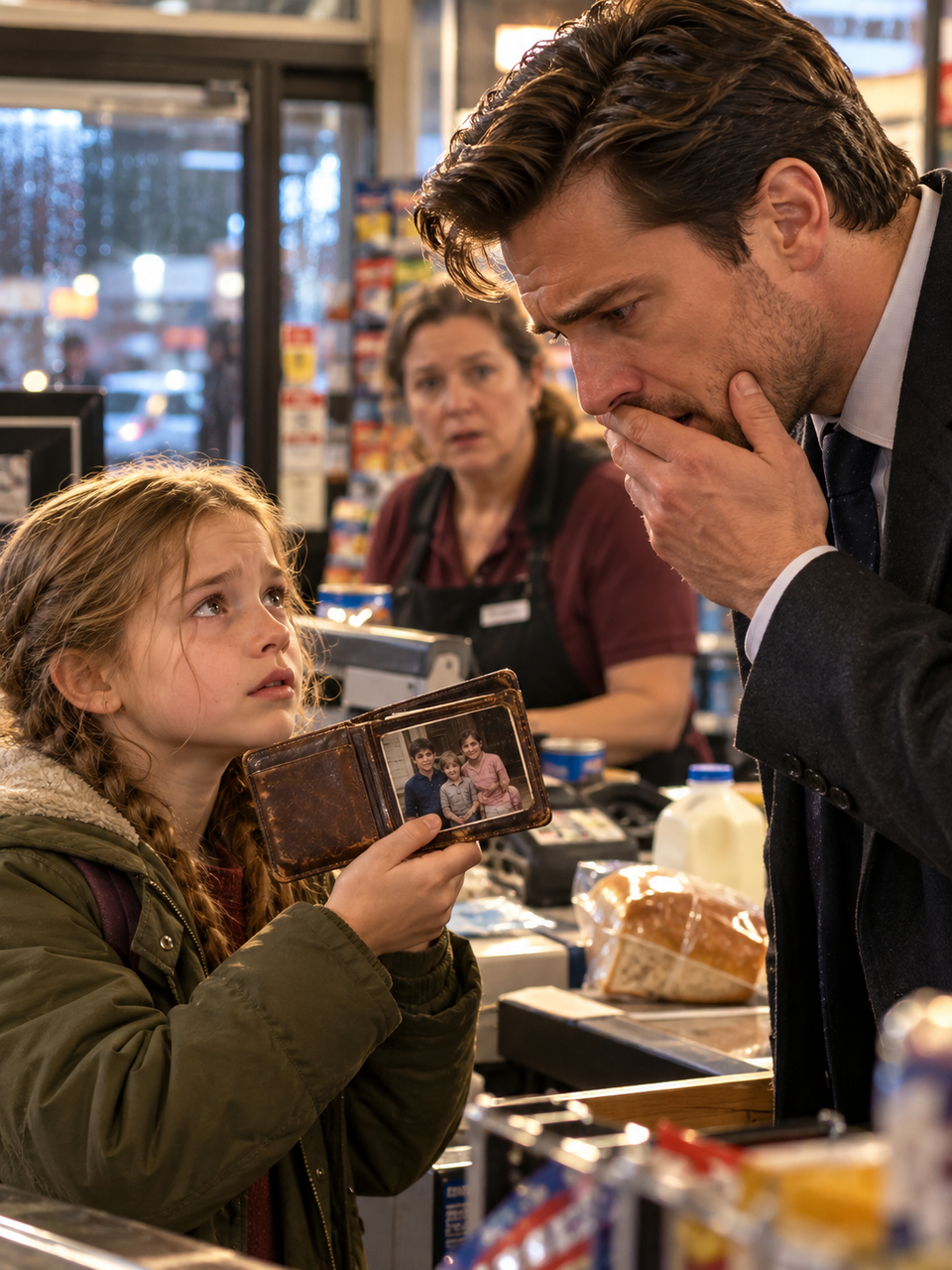
WHEN A LITTLE GIRL OPENED HER MOTHER’S OLD WALLET AT A CORNER STORE, A WEALTHY STRANGER RECOGNIZED THE PHOTOGRAPH—AND A FAMILY’S LONG-BURIED SEPARATION BEGAN TO UNRAVEL – Life Story
The cashier pushed three pennies back across the counter, and the little girl looked at them as though they were...

My Boss Pointed at My Cheating Wife, “Today She’s Mine.” Wife Said, “I Agree,” & They Left….
My Boss Pointed at My Cheating Wife, “Today She’s Mine.” Wife Said, “I Agree,” & They Left…. My boss pointed...

My mother brought a lawyer to steal 65% of my inheritance. Then someone knocked on the door.
Part 1: I am Julian, 28 years old. Last year, my own mother and stepdad cornered me in a private...