My Girlfriend Says She Loves Me… But She’s Out Partying With A Coworker At 1 AM
She Said He Was “Just a Friend”—Then I Asked If She Wanted Him Instead of Me, and Her Answer Changed Everything
She told me she loved me, then stayed out with another man until one in the morning.
I kept calling it my insecurity because admitting anything else meant I might lose her.
Then, on her birthday, I asked one question—and she finally stopped saying no.
PART 1: The Man Who Was Always There
At on a Wednesday morning, I was sitting on the edge of my bed, trying to convince myself that a man who trusted a woman would be able to fall asleep.
My alarm was set for , my work clothes were hanging from the closet door, and the apartment was so quiet I could hear the refrigerator cycle on down the hall.
On my phone, a message from Emily glowed against the dark: *Still out with Ryan.
Just talking.
Don’t wait up.*
I had already typed three different replies and deleted all of them.
The first sounded jealous, the second sounded wounded, and the third was an elaborate performance of a man who did not care.
Eventually, I sent, *Have fun.
Get home safe,* and placed the phone facedown beside me.
Less than a minute later, I turned it over again.
That was the part I hated most—not Ryan, not the bar, not even the hour.
I hated the way I had started monitoring my own breathing whenever her name appeared on the screen, as if every message might contain either relief or evidence.
I was thirty-four years old, with a steady job, a paid-off car, and enough experience to know that loving someone did not make you entitled to every minute of their life.
Yet there I was, bargaining with a glowing rectangle in the dark.
Emily was twenty-seven, and we had been seeing each other for a little over four months.
That was long enough to know how she liked her coffee, which side of the bed she claimed without asking, and the exact expression she made when she was pretending not to be upset.
It was also, apparently, not long enough for either of us to know what we were allowed to expect.
We had said *I love you* before we had managed to say *boyfriend* and *girlfriend* without hesitation.
I lived west of Chicago, in an apartment that was convenient for my job and inconvenient for almost everything else.
Emily lived in the city, in a second-floor place above a dry cleaner, where delivery trucks rattled the windows before sunrise.
Between work, traffic, and a commute that could turn forty miles into an evening, I usually saw her twice a week.
Three times felt like a small victory, the sort of week I would mentally replay while sitting behind brake lights on the way home.
Ryan did not have that problem.
He worked with her, ate lunch near her, knew which conference room was always freezing, and could meet her for a drink without first calculating how many hours of sleep it would cost him.
He had entered her life two months earlier and somehow become part of its daily infrastructure.
His name appeared in her stories so often that I began anticipating it before she said it.
“Ryan did the funniest thing in the meeting today,” she would tell me while taking off her coat.
Or, “You would have died if you’d heard what Ryan said to our manager,” while we stood in line for dinner.
At first, I listened the way you listen when someone you love is happy, grateful that the world had given them something worth smiling about.
Later, I began wondering when her happiness had acquired a voice I had never heard.
The first time she called him her best friend, we were making breakfast in my kitchen.
She was wearing one of my old T-shirts, standing barefoot at the counter while I tried to rescue scrambled eggs from a pan that was too hot.
Her phone vibrated, and she laughed so hard she had to put down her coffee. “He’s ridiculous,” she said, shaking her head. “Honestly, he’s becoming my best friend.”
I remember scraping the eggs onto two plates and asking what he had said.
She showed me a message about something at work, an inside joke that required three minutes of explanation and still was not funny to me.
That should have been ordinary; people were allowed to have experiences that did not include me.
But I noticed how easily she smiled at the screen and how carefully I was beginning to arrange my face.
There had been a time when I made her laugh like that.
On our second date, we stayed in a diner until the waitress started wiping down the tables around us, splitting cold fries and telling stories neither of us had intended to tell a near stranger.
Emily had a habit of looking directly at you when you spoke, as though the rest of the room had become unimportant.
After my previous relationship, that kind of attention felt like sunlight entering a room I had forgotten could have windows.
I had come out of something long and serious shortly before meeting her.
There was no single dramatic betrayal to point to, no smashed wedding photograph or late-night confession that neatly explained why I was afraid.
My former partner and I had worn each other down through postponed conversations, incompatible hopes, and the slow humiliation of realizing we were working harder to appear fine than to be honest.
When it ended, I promised myself that the next time I loved someone, I would be careful.
Careful sounded responsible when I said it aloud.
It sounded less impressive when Emily was curled against me on a Sunday morning, asking whether I thought we might take a weekend trip together in the summer.
I would tell her I wanted that, then add a qualification about taking things slowly.
She would nod, and I would mistake her understanding for the absence of disappointment.
We had talked about it early.
I told her I was not seeing anyone else and had no interest in dating apps, but I was still trying to recover from the feeling of having built a future that disappeared beneath me.
She said we could take our time, that she was not asking for a ring or a moving truck.
I heard permission to move slowly; I did not spend enough time asking what moving slowly would feel like for her.
At the same time, I was not imagining what was happening with Ryan.
Their lunches became happy hours, and their happy hours became the sort of evenings that continued after everyone else had gone home.
Four or five days a week, they seemed to find a reason to be together outside work.
Meanwhile, I was trying to protect two evenings on my calendar as if they were fragile objects.
Sometimes it was a group thing.
There would be coworkers, friends of coworkers, somebody’s roommate, somebody visiting from out of town.
But everyone else rotated through, appearing in one story and disappearing from the next.
Ryan remained, the one constant in plans that were supposedly spontaneous.
I first met him at a crowded neighborhood bar where Emily’s coworkers had gathered after finishing a project.
He was thirty-two, friendly, quick with names, and comfortable in the easy way of someone who had never needed to wonder whether he belonged at that table.
When Emily introduced us, he shook my hand and said, “Good to finally meet you, man.” The word *finally* stayed with me longer than it should have.
There was nothing overtly hostile about him.
He offered to get me a drink and asked about my work, and for several minutes I felt foolish for having built him into anything more than an ordinary person.
Then Emily came back from the restroom, and before she reached the table, he had moved her glass away from a wet patch and pulled out the chair beside him.
It was a small gesture, almost nothing, but it carried the confidence of repetition.
Later, while Emily was speaking to another coworker, Ryan mentioned how difficult dating had become.
He said he wanted someone funny, independent, smart enough to challenge him, and spontaneous enough to stay out without checking the clock every five minutes.
As he spoke, his eyes moved toward her, and I felt something settle heavily in my stomach.
I did not need a confession to recognize a description.
On the drive home, I asked Emily whether she thought he liked her.
She looked out the passenger window for a moment before saying, “Maybe a little, but that doesn’t mean anything.” When I asked whether anyone else had noticed, she admitted that a couple of friends had teased her about it. “They think it’s obvious,” she said, then reached over and rested her hand on my arm.
“What do you think?” I asked, keeping my eyes on the road.
She told me she was not attracted to him, that he felt more like an older brother, that she liked having someone around who understood the chaos at work.
Then she said she loved me, softly and with enough certainty that I felt ashamed of needing more.
I squeezed her hand and told myself the conversation was finished.
For a little while, she seemed to create distance on her own.
She mentioned meeting him mostly during the day or staying with a group because she did not want to give him the wrong idea.
I appreciated that, but I also hurried to reassure her that she did not have to rearrange her friendships around my insecurities.
I thought I was being generous, mature, the opposite of every controlling man either of us had ever known.
“I’m mostly jealous that he gets more time with you,” I told her one evening. “That’s my problem to work through, not yours.” She kissed me and said she wished the distance were easier too, and for a few minutes I felt like we had solved something.
What I had actually done was explain my pain and then instruct her not to respond to it.
The late nights returned gradually enough that I could talk myself out of noticing.
First, a group dinner ran long; then the others left, and she and Ryan stayed for another drink.
A week later, they went somewhere else after a work gathering because neither of them wanted the evening to end.
By the time she texted me at one in the morning, I had developed a whole vocabulary for describing things that hurt without admitting they hurt.
She told me one of their nights out had been educational.
Ryan was struggling with dating, and she had been showing him places he could take women and explaining how to make someone feel comfortable on a date. “I’m helping him,” she said, smiling as though that should have made the situation less complicated.
I looked at the woman I was struggling to plan dinner with and tried not to picture her teaching another man how to be romantic over drinks.
The sentence I wanted to say was simple: *Why does helping him date other women look so much like dating him?* Instead, I asked whether the place was good.
She told me about the music, the bartender, and a little booth near the back where they had talked for hours.
I nodded and learned the details of an evening I could not stop imagining.
The worst moments were not always dramatic.
Sometimes we would be watching a movie, her feet tucked beneath my leg, when her phone would light up and her attention would leave the room before her body moved.
She would type, smile, set it down, and then reach for it again before the scene had changed.
I started losing track of the movie because I was watching the space between us.
I did not want to become a man who asked to inspect messages.
I did not want to punish her for telling me about her day or teach her that honesty would be met with interrogation.
Part of me feared that if I brought Ryan up one more time, she would simply stop mentioning him.
Then I would have the same uncertainty with less information, which somehow seemed worse.
So I tried to improve myself around the problem.
I went to the gym after work, called friends I had neglected, and made an effort to stop staring at my phone.
On evenings when she was out, I would put mine in another room and congratulate myself on the decision, only to find a reason to walk past it ten minutes later.
There is a particular kind of exhaustion that comes from performing confidence for an audience of one.
One Friday, she told me she never got bored with Ryan because she never knew what he would do next.
We were standing in a grocery store checkout line, holding a basket with pasta, tomatoes, and a bottle of wine for the dinner we had planned.
She meant it as a passing observation, another funny detail about her friend.
I spent the rest of the evening wondering whether I had become the dependable stretch of road between her more interesting destinations.
That was unfair in ways I understood even then.
I was older, tired from work, still cautious about promises, and sometimes guilty of turning our limited time together into a recovery period from the rest of my life.
Emily had never demanded constant entertainment.
Yet the comparison had entered my head, and once it was there, everything began presenting itself as evidence.
I started considering things I had not admitted to her.
A position closer to the city had opened within my company, and I looked at it more than once, imagining a shorter distance between ordinary Tuesdays and her front door.
I checked rents in neighborhoods I had no other reason to consider.
Outwardly, I was the man asking for time; privately, I was rearranging possible futures around her.
But I had not told her any of that.
She could not see the job listing on my laptop or hear the conversations I had with myself while driving home.
What she could hear was my hesitation when someone asked what we were.
I was beginning to recognize the gap between what I felt and what I had made available for her to believe.
Still, that recognition did not make the late nights harmless.
Two people could be mishandling a relationship at the same time, and one person’s fear did not automatically explain away the other’s choices.
I knew that in theory, but when I tried to say it to myself, it sounded suspiciously like an argument I was preparing to lose.
I needed someone outside my own head to tell me whether I was seeing a problem or creating one.
So, after that Wednesday night, I wrote an anonymous post online.
I described the commute, the constant contact, the drinks, and the man she said was like a brother.
I explained that I loved her and did not want to control her, then asked how to stop feeling threatened.
Before posting, I deleted some of the history about my previous relationship and our uncertainty over labels because the post already seemed too long.
That omission would matter later.
At the time, I told myself I was shortening the story, not changing it.
But when you leave out the part where you have kept one hand on the door, strangers may reasonably assume you have been standing firmly inside the room.
I pressed submit and waited for people who knew neither of us to tell me what kind of man I was supposed to be.
The answers came quickly and with very little hesitation.
Some said she was already dating Ryan whether she called it that or not; others said I was volunteering to be someone’s backup plan.
A few asked the question I had kept trying to blur: Had we actually agreed to be exclusive?
I read that question several times before scrolling past it.
For perhaps an hour, I felt relief.
My discomfort had a shape other people could recognize, and I was not the only person who thought one-on-one drinks until two or three in the morning could complicate a supposedly uncomplicated friendship.
Then the relief became dread.
If the problem was real, I could no longer solve it by telling myself to be better at ignoring it.
Emily’s birthday was that weekend, and she wanted to go dancing.
Friends were busy, plans kept shifting, and by Saturday afternoon only two people had firmly committed to going with her.
One was me, arriving with a gift bag and a heart that had been beating too hard all day.
The other was the man I had spent weeks trying not to resent.
I had notes on my phone, sentences borrowed and rewritten until they sounded almost like something I could say without shaking.
I planned to ask about expectations, explain how I felt, and listen to her side.
It was a sensible plan, carefully built by a man who believed the right wording might protect him from the wrong answer.
Then she opened the door, smiled, and told me Ryan was excited for tonight.
PART 2: The Birthday Question She Couldn’t Answer
I nearly abandoned the conversation before I took off my coat.
Emily looked happy to see me, and the apartment smelled like the vanilla candle she saved for evenings she wanted to feel special.
Music played from a small speaker on the windowsill, and two pairs of shoes sat near the couch while she decided which ones would survive dancing.
For one weak, grateful moment, I wanted to put the gift down, kiss her, and spend the entire night pretending nothing was wrong.
She opened the bag and laughed at the card, then held the gift against her chest before hugging me.
I had chosen it weeks earlier, back when thinking about her birthday had made me happy without anything complicated attached.
Her cheek rested against my neck, and I could feel how easy it would be to mistake closeness for resolution.
I held her a second longer than usual because I knew what I was about to risk.
“Did anyone else decide to come?” I asked when she stepped away.
She mentioned a friend who might meet us later and another who had not answered, then said Ryan would probably get there around nine.
I looked down at the shoes by the couch and felt my carefully prepared opening dissolve into something smaller. “Can we talk about tonight before we go?”
She glanced at the clock, not impatiently at first, just automatically. “Sure,” she said, reaching for an earring on the coffee table.
I told her I was worried about feeling like a third wheel, and she stopped with the earring halfway to her ear. “A third wheel with who?” she asked.
“With you and Ryan,” I said, and the words changed the room.
The music kept playing, a cheerful song that suddenly seemed to belong to someone else’s apartment.
Emily lowered her hand and looked genuinely startled, which unsettled me more than defensiveness would have. “How would that even happen?” she asked.
I sat on the couch because I did not trust myself to have this conversation standing near the door.
She sat beside me, leaving enough space for the gift bag between us, and I moved it to the floor.
My phone was in my pocket, full of sentences I had rehearsed in the car, but I could not imagine pulling it out like a manual.
Instead, I held out my hands, and after a moment, she put hers in them.
“You’ve been spending a lot of time with him,” I began.
She nodded cautiously, and I could feel myself rushing toward an apology before I had said anything worth apologizing for.
I slowed down and told her I was not asking her to stop having friends or reporting every detail of her day to me.
Then I asked the question I had been avoiding: “Do you want us to take a break so you can see what happens with him?”
Her hands tightened around mine. “No,” she said immediately, and for a split second the relief was so strong it almost made me dizzy.
Then she added, “I’ve told you, I’m not attracted to Ryan,” and I realized we were back inside a conversation we had already had.
I did not need the familiar answer again; I needed us to examine what it was being used to explain.
“I know you’ve said that,” I told her. “But you’re with him all day, and then you’re out together at night, and when we’re together, he’s still there on your phone.” She looked toward the dark television screen rather than at me. “Sometimes he’s actually kind of annoying,” she said, as if that settled the question.
I wanted to accept it because accepting it would allow the evening to continue.
Instead, I heard myself say, “Emily, you don’t spend six hours talking to someone until three in the morning because you find him annoying.” Her eyes filled so quickly that I felt immediate guilt, the kind that makes you reach to undo your own words.
I kept holding her hands, but I did not take the question back.
“I’m not trying to hurt you,” I said, and she shook her head as tears slid down her face.
She told me she knew that, but she did not offer another explanation.
For several seconds, all I could hear was the speaker on the windowsill and the faint rush of traffic below.
I had spent weeks terrified of her anger; I had not prepared for her sadness.
I told her what the situation looked like from where I stood.
Ryan was at nearly every gathering, every last-minute plan, every evening that somehow extended after everyone else had gone home.
Other people came and went, but he kept getting the hours I wished I had with her. “Some weeks,” I said, trying to keep my voice steady, “it feels like you’ve been on more dates with him than with me.”
“They aren’t dates,” she said.
I nodded because arguing over a label would let us avoid everything underneath it. “Then help me understand what makes them different,” I asked, “because when you tell me you’re teaching him where to take women, and you’re alone with him at those places until the middle of the night, I don’t know what I’m supposed to do with that.” She wiped beneath one eye with the heel of her hand.
I got up to find tissues, partly because she needed them and partly because I needed to stand somewhere else for a moment.
In the bathroom mirror, I looked ordinary, which felt almost insulting: the same shirt, the same face, no visible evidence that I was trying not to lose someone.
I found a box beneath the sink and brought it back.
Emily had paused the music while I was gone, and the silence made the apartment feel smaller.
“We can still celebrate your birthday,” I told her as I sat down. “If you want to think about this tomorrow, or after the weekend, I’m not trying to turn tonight into something terrible.” She looked at me with wet, exhausted eyes and asked whether I really thought we could go dancing now.
I admitted that I did not know how to stop trying to make the conversation easier for her.
That was the first time she gave a small, broken laugh. “You keep telling me what I’m allowed to do,” she said, “but I don’t know what you want.” I started to answer that I wanted her, then stopped because I could hear how inadequate those words might sound.
Wanting her was not the same as telling her what kind of relationship I was prepared to build.
Still, I needed an answer to the question in front of us.
I told her to set aside the fact that Ryan was a coworker, the awkwardness if things went badly, and whatever she thought other people would say.
I asked her not to choose the response that would hurt me least. “If none of that mattered,” I said, “would you want to be with him?”
She opened her mouth, closed it, and looked down at our hands.
I could see her thinking, and that hurt more than the answer I had been bracing for.
Until that moment, I had believed there were only two possibilities: either I was wrong, or she was hiding something she already understood.
I had not considered that she might have been avoiding her own question as thoroughly as I had been avoiding mine.
“I don’t know,” she said at last.
The words were barely louder than the traffic outside, but they seemed to empty every other sound from the room.
I stared at her, waiting for the rest of the sentence, for a correction or an explanation that would return us to safer ground.
She cried harder instead.
“Do you like both of us?” I asked, and I hated how young I sounded. “Are you confused, or trying to decide, or—what is this?” She said she was not secretly choosing between us in the way I imagined, but then she struggled to explain what she was doing.
Her uncertainty did not prove an affair; it did prove that the certainty she had been giving me was not the whole truth.
We sat there for a long time, holding hands through a conversation that kept pulling them apart.
I told her I could survive hearing that she wanted someone else, even if I would be devastated.
What I could not do was keep investing while she assured me there was nothing to question and quietly kept another possibility nearby. “I don’t want to be your second choice,” I said.
Emily looked up then, and something in her expression changed.
She was still crying, but there was frustration beneath it now, and a hurt I had not made room for because I was so occupied with my own. “You keep talking like I’m the only person who hasn’t chosen,” she said. “But when did you actually choose me?”
I started to tell her that I had not been seeing anyone else.
She shook her head and said that was not what she meant, that absence was not always the same thing as commitment.
Then she reminded me of a dinner several weeks earlier, when someone had asked whether she was my girlfriend and I had answered, “We’re seeing each other.” I remembered the moment, but I had not remembered her going quiet afterward.
“I thought I was respecting what we agreed,” I said.
She told me she had thought that too, at first, and that she had wanted to be patient because she knew I was hurting from my last relationship.
But patience had gradually started feeling like a waiting room without a door she could see. “You say you love me,” she said, “and then you talk about us like you’re still deciding whether this counts.”
There was no clean defense against that.
I could explain the fear, the breakup, the promises I had made to myself about never rushing again, but none of those explanations could tell her when I would be ready.
I had wanted her to trust an internal process she could not observe.
Somewhere along the way, I had mistaken my private sincerity for shared security.
I admitted that I had been slow.
I told her I had not expected to meet someone I wanted so much, so soon, and that sometimes my feelings had moved faster than my ability to make promises without panic.
She listened, twisting a tissue between her fingers.
When I said, “I wasn’t trying to keep you in limbo,” she replied, “I know, but I was still there.”
Then I brought up the conversation we had already had about seeing other people.
I had told her that if my pace did not work for her, she could pursue someone else and I would understand.
To me, that had meant she would tell me, we would stop seeing each other, and I would step back far enough to heal.
I had believed I was offering freedom without resentment; she had heard a man explaining how easily he could let her go.
“You said I could date other people,” she said quietly. “I said you didn’t have to wait forever for me,” I answered, then heard how much interpretation lived between those statements.
I reminded her that I had also said I would probably need distance, maybe even block her for a while, because I would not be able to watch it happen.
She remembered that part too, but she said the whole conversation had left her feeling as though I was preparing for her departure.
We had both remembered the words.
What we had not shared was the meaning attached to them, and neither of us had checked because the conversation had already been uncomfortable.
I had walked away believing we understood the terms of our slow-moving relationship.
She had walked away wondering whether I was gently warning her not to expect one.
“So you started pulling away?” I asked.
She took a breath and admitted that maybe she had, that being wanted without having to ask for clarity had felt easier than continuing to wonder how much of me was available.
Hearing her say that hurt, but the precision of it was almost a relief.
For weeks, I had been feeling a change she had not named.
“Was that what Ryan was?” I asked, and she looked ashamed before she answered.
She said it was nice having someone nearby, someone who could go out after work and seemed happy whenever she said yes.
She liked being invited, liked not having to navigate schedules and traffic, liked feeling that somebody wanted her company without hesitation. “It was nice getting attention when you weren’t there,” she said.
I looked down because I did not want my face to punish her for telling the truth I had requested.
The sentence landed in places I could not protect, turning every late-night drive and carefully arranged evening into something suddenly insufficient.
At the same time, I knew she had not said I had never tried.
She had said that in the spaces between my efforts, something else had felt good.
“I can’t compete with someone’s location,” I told her.
She said she was not asking me to, and I believed that she believed it.
But availability had become part of the competition whether either of us intended one or not.
Ryan got ordinary time, the casual hours in which people build closeness without announcing that they are building anything.
I told her about the job opening then.
I had not planned to, and once the words were out, I worried they sounded like an invoice for sacrifices she had never requested. “I’m not saying you owe me anything because I looked at a listing,” I added quickly. “I’m saying I’ve been trying to move toward you, even if I’ve been terrible at making that visible.”
Her expression softened, but she looked sadder too. “Why didn’t you tell me?” she asked, and I had no answer that did not eventually return to fear.
If I named the future out loud, she could reject it; if I kept it in my head, I could pretend it was still protected.
Meanwhile, she had been making decisions based on the man in front of her, not the one I hoped to become.
For a moment, I thought we had found the explanation that would make everything easier.
Then I remembered the phone on the coffee table, the messages, the evenings, and how many times I had been told there was nothing to worry about.
Understanding why someone does something does not immediately change what it feels like to receive it. “I can own my part,” I said, “but I still need you to own yours.”
She nodded and told me she knew that the friendship had become difficult to defend as harmless when she already suspected Ryan wanted more.
She had not kissed him, had not slept with him, and had not told him they were building a relationship.
But she admitted that enjoying his attention while knowing what might be behind it was not as simple as saying he was just a friend.
It was the first time I felt we were looking at the same situation.
Then she said something that made my chest tighten all over again. “If anything ever happened with him, it would probably just be a rebound,” she said, almost thinking aloud.
I stared at her, and she immediately looked stricken, realizing what it meant to discuss a rebound while the man she might need to recover from was still holding her hand. “That came out wrong,” she whispered.
It had come out painfully, but perhaps not entirely wrong.
She tried to explain that she could not imagine a lasting relationship with Ryan, that their work situation would make a failed attempt miserable, that attraction was not something she could force.
The more she talked, the more I heard practical obstacles being mixed with emotional ones.
I did not know which category I was supposed to find reassuring.
“You keep telling me why it wouldn’t work,” I said. “I’m asking whether you want it.” She pressed the tissue against her eyes and told me again that she did not want to date him, that she had become confused about us, not secretly fallen in love with someone else.
I wanted the distinction to be enough, and for part of me, it was.
Another part was still sitting beside the moment she had said she did not know.
At some point, I admitted that I had asked strangers online for advice.
I regretted the phrasing almost immediately, because I described posting the things that worried me as posting “red flags.” Emily pulled one hand free and looked at me as though I had invited a roomful of people into her apartment without telling her. “So I’m a red flag now?” she asked.
“No,” I said, then had to acknowledge that I understood why she heard it that way.
I told her I had been afraid to trust my own reaction and had wanted perspective, not a crowd to sentence her.
When she asked whether I had explained my hesitation about commitment, I admitted I had shortened that part.
Her silence after that was deserved, and I let it stay.
“That changes things,” she said finally.
I told her she was right, that I had given people a clearer villain than the truth supported, even if the concerns I described were real.
Saying it made me uncomfortable in a way that felt necessary.
I could not ask her for complete honesty while protecting the flattering version of myself.
She picked up her phone and offered to show me the conversation with Ryan.
I had imagined that moment often enough to be ashamed of it, but when it came, I did not feel triumphant or relieved.
I felt tired, aware that a relationship could not become healthy through one person repeatedly proving innocence to the other.
Still, when she opened the thread and began scrolling, I looked.
What she showed me was mostly work: complaints about meetings, jokes about coworkers, links, practical questions, and messages from him that sometimes received only a short response.
There was no confession waiting on the screen, no obvious declaration that explained everything in one terrible sentence.
The thread did not erase the nights they spent together, and a phone could not settle every question about intention.
But it complicated the version of the story in which every smile I had seen was proof of romance.
She said their longest conversations had also been mostly about work.
I told her I believed work could fill hours, especially when two people shared the same frustrations, but that time still created closeness even when nobody announced an intimate topic.
She listened without saying I was imagining things.
That mattered more to me than I expected, because I had started to fear my feelings would be accepted only if I could prove wrongdoing.
“I know why this looks bad,” she said. “I know you’re not crazy.” I closed my eyes for a moment, not because the words solved anything, but because I had been carrying the opposite possibility alone for so long.
Then she added, “I just didn’t think you were going to get here.”
I knew what she meant by *here*: ready to ask for a relationship, ready to be hurt, ready to admit that the arrangement was no longer protecting me.
I told her I was not arriving with certainty about the future, only certainty that I did not want us to keep avoiding the present.
She nodded, and for the first time that night, neither of us tried to soften what had already happened.
We talked about what could change.
She said she could stop letting late-night one-on-one outings become routine, make more space between them, and be clearer if he was hoping the friendship would turn into something else.
I said I could stop making her infer my intentions from affection and actually tell her what I wanted.
We both used cautious words, because neither of us had enough confidence left for grand promises.
I asked whether there were things I could do that would help her feel safer with me.
She did not ask for constant access, a new job, or dramatic proof; she asked not to feel foolish for believing we had a future.
I told her I needed to stop feeling foolish for believing she wanted one with me.
For a while, we just sat with the terrible symmetry of that.
By then, the evening had passed without us noticing.
Her shoes were still beside the couch, the birthday gift remained in its bag, and the plans on her phone belonged to a night we were no longer going to have.
She let the people expecting us know we were staying in.
Neither of us said anything about dancing again.
We ended up beneath a blanket, exhausted enough that our bodies reached for comfort before our thoughts had agreed it was safe.
Emily rested her head against my chest, and I held her while looking at the ceiling.
It would have been easy to describe the scene as reconciliation.
From inside it, it felt more like two people resting beside the damage, grateful neither had walked away yet.
Just before we turned off the lamp, I said the thing I had been trying not to say all night. “I think I might want this more than you do now.” Emily lifted her head, and I waited for the immediate denial I had become used to hearing.
This time, she whispered, “Yeah.
Maybe.”
PART 3: I Finally Chose Her—Without Knowing Whether She Would Choose Me Back
I drove home the next morning with the radio off.
Traffic moved steadily, the city giving way to wider roads and familiar exits, while my mind replayed two words in a voice I could not shut out. *Yeah.
Maybe.* There had been tears, explanations, tenderness, and genuine progress, but those were the words that followed me through the toll lanes.
At a red light, I looked at the passenger seat and remembered how happy I had been the first time Emily sat there.
She had adjusted the air vent, teased me about the emergency umbrella behind the seat, and put her hand on my knee as if being close to me were the simplest decision in the world.
Now I was trying to determine whether that version of us still existed.
The light changed before I noticed, and someone behind me tapped a horn.
I wanted to feel proud that I had spoken honestly.
Instead, I felt exposed, as though I had removed something necessary and discovered I had no replacement.
The conversation had answered questions, but it had also taken away the comforting possibility that everything would be fine if I could just calm down.
We had both been afraid, and our fear had started shaping the relationship more decisively than our love.
For several days, we moved carefully around each other.
Her messages were still affectionate, but there was a heaviness beneath them, a sense that both of us were reading for meanings we had previously left unexamined.
I would type something playful, then worry it sounded as if I thought the problem was solved.
She would ask how my day was, and I would wonder whether she was reaching for me or simply being kind.
Nothing spectacular happened.
Ryan did not appear at my door, Emily did not make a dramatic confession, and no hidden photograph arrived to give me a clean reason to stay or leave.
There were only ordinary evenings, long commutes, unfinished conversations, and the unsettling knowledge that a relationship could remain uncertain even after everyone tried to tell the truth.
I found myself resenting how little clarity honesty guaranteed.
I reread the notes I had written before her birthday.
Some of the sentences were useful; others sounded like instructions for winning an argument I no longer wanted to win.
They assumed that if I asked the right question firmly enough, she would either reassure me perfectly or reveal herself as someone unworthy of my time.
The actual woman on the couch had been messier, sadder, and more recognizable than either option.
I had been messy too.
I had told her I loved her while avoiding a word that might make love feel binding.
I had offered her freedom while privately hoping she would prove her devotion by refusing to use it.
Then, when she began turning toward easier attention, I wanted her to understand boundaries we had discussed only through implication.
None of that made every choice she made acceptable to me.
I was still hurt that she had known Ryan probably wanted more and continued spending so much time with him.
I was still troubled by the way *not attracted to him* had become an answer to questions about availability, attention, and emotional priority.
But I could no longer pretend my uncertainty had existed in a sealed room, affecting only me.
One evening, I opened the job listing again.
The position was still available, and for a few minutes I let myself imagine applying as a way to demonstrate seriousness.
Then I closed it, because moving my career around in the middle of a frightened relationship would not prove the thing I wanted it to prove.
I needed to make a clear choice with my words and behavior before trying to make one with my address.
That distinction mattered.
There was a part of me that wanted a dramatic gesture because dramatic gestures have visible edges: you do the thing, the other person understands, and the story changes.
What Emily had actually asked for was more difficult to perform and easier to neglect.
She wanted consistent evidence that I was not merely enjoying the relationship while keeping its future at arm’s length.
I also had to ask myself a question I had avoided by concentrating on Ryan.
If he disappeared tomorrow—transferred departments, met someone else, stopped texting—would I suddenly be ready to call Emily my girlfriend?
Or would I find another reason to delay, another condition that had to be satisfied before I could risk looking foolish?
The answer made me sit still for a long time.
I wanted to believe I had been waiting for safety.
But safety, as I had defined it, required her to show complete commitment while I reserved the right to keep assessing whether commitment was wise.
That was not a balance either of us could live inside indefinitely.
It did not mean I owed her a relationship; it meant I could not honestly ask for one-sided certainty.
When we spoke on the phone later that week, I asked how she was really feeling.
She said she was sad, embarrassed, and unsure whether I now saw everything she did through suspicion.
I admitted that some moments had become harder for me, especially when I heard her phone in the background.
Saying it without accusation was difficult, but I wanted her to know what was happening before resentment started translating it into something cruel.
“I don’t want to spend every day defending myself,” she said. “I don’t want you to,” I answered, and then I told her I did not want to spend every day pretending I had no feelings either.
We were quiet for a moment, listening to the distance between our apartments through a phone connection.
Finally, she said, “Then we have to actually mean what we agree to.”
It was such an ordinary sentence that I nearly missed how much it asked of us.
No more arrangements built out of hints, no more saying we were fine because the alternative might make the evening uncomfortable.
If I wanted exclusivity, I needed to say so directly.
If she was unsure she wanted it with me, she needed room to say that without first inventing a softer answer.
I did not ask her to decide over the phone.
I told her I wanted to see her and talk about what I was prepared to offer, not just what I was afraid of losing.
She agreed, and after we hung up, I noticed I had not asked where she had been that evening.
For once, the conversation had concerned the relationship itself instead of the man standing near it.
Before we met, I went back to my anonymous post.
There were more responses waiting, some compassionate, some impatient, many entirely certain about the private motives of people they would never meet.
I understood the appeal of that certainty now.
It allowed everyone, including me, to feel as though pain could be avoided if the correct interpretation were chosen early enough.
But there was no comment that could tell me whether Emily would become a trustworthy partner.
There was also no comment that could turn me into someone ready to participate fully.
Advice could help me notice what I was minimizing, but it could not make the decision on my behalf.
Eventually, I put down the phone and let the quiet remain unanswered.
I tried to imagine leaving.
There would be grief, but also relief from the constant calculation, the checking, the feeling of being in a competition I had never agreed to enter.
I could tell myself I had recognized the warning signs and protected my peace.
Part of that would be true, and part of it might be another respectable name for escaping before I had to stand fully inside a choice.
Then I tried to imagine staying exactly as we were.
That picture was worse: more half-defined expectations, more affection followed by withdrawal, more late-night conversations in which neither of us could tell whether the other was asking for patience or permission to disappear.
Whatever happened next, the current arrangement could not be the plan.
I had reached the end of what vagueness could do for me.
The truth was embarrassing in its simplicity.
I loved her, and despite everything, I still wanted to try.
I did not want to win her away from Ryan, and I did not want her gratitude for finally choosing a label.
I wanted to find out whether the two of us could build something when both of us understood what we were attempting.
I went to see her without a script.
The lack of notes made me nervous, but I had begun to suspect that I used preparation partly to avoid being surprised by my own feelings.
Emily opened the door wearing jeans and an old sweatshirt, her hair pulled back, looking nothing like the birthday version of herself I had carried home in my memory.
I was relieved by the ordinariness of it.
We sat at her kitchen table with coffee neither of us finished.
I told her I had been thinking about the difference between being cautious and being unavailable, and how often I had confused them.
She listened without interrupting, her fingers resting around the mug.
Then I said, “I want to be your boyfriend, Emily.
I want us to be exclusive, and I want you to know I’m choosing this.”
Her eyes filled, but she did not immediately throw her arms around me.
I was grateful for that, though it frightened me, because I did not want another emotional moment to stand in for a real answer.
She asked whether I was saying it because I wanted her or because I was afraid of Ryan.
I told her the fear had forced the conversation, but it had not created the love.
“I wanted you before I knew he existed,” I said. “I’ve just been acting like wanting you and choosing you were separate things I could keep apart forever.” She looked down into her coffee, and I waited.
The waiting felt different this time because I was not trying to guide her toward a response that would calm me.
She said she wanted to try too.
There was hesitation in it, not a refusal, but an acknowledgment that the last week had changed how simple everything felt.
I told her I understood, even though a frightened part of me wanted enthusiasm strong enough to erase every previous doubt.
She could agree to build a relationship without being able to restore the version of herself who had felt certain at the beginning.
We talked explicitly about exclusivity.
We talked about what dating other people meant, what we would tell each other if our feelings changed, and why neither of us could rely on *I thought that was obvious* anymore.
It was less romantic than some of the conversations we had had in bed.
It was also more useful.
I told her I was not asking her to eliminate male friends from her life.
The issue had never been that men existed near her; it was the particular combination of his likely feelings, her awareness of them, and the amount of time and attention they were sharing.
She said she understood that difference.
I wanted to believe her, and I knew belief would have to be supported by what happened afterward.
She returned to what she had said on her birthday about changing the rhythm of the friendship.
She would be more careful about letting a group night become hours alone, and more honest with herself about enjoying attention that might carry expectations.
I did not demand a speech to Ryan performed for my approval.
If a boundary mattered only while I was watching it, it would not give either of us much security.
On my side, the changes were almost painfully ordinary.
I stopped answering questions about us with language designed to leave an exit unmarked.
I talked about future plans without attaching a warning to every sentence.
When I missed her, I said so instead of trying to sound pleasantly occupied, as though needing someone’s company were a failure of character.
None of this transformed me overnight.
There were still moments when my stomach tightened at a notification or when I caught myself counting how much time had passed since a message.
I had to distinguish between a feeling worth discussing and an impulse to make her repeatedly reassure me.
Sometimes I did that well, and sometimes I simply took a breath and waited until I could speak without turning anxiety into an accusation.
Emily began introducing me to more people in her life.
These were not grand ceremonies, just casual invitations, names becoming faces, a place beside her that no longer required an explanation.
The first time she called me her boyfriend in front of someone else, I felt both warmth and an uncomfortable awareness of how much that word might have meant to her earlier.
I wished I had understood sooner without pretending that understanding sooner would have guaranteed a different outcome.
I used little names for her that I had previously kept almost exclusively to private moments.
I asked about plans several weeks away instead of acting as though next month were an unreasonable subject.
These changes might sound small to someone who had never been afraid of commitment.
To me, they were ways of making my inner life visible enough that she no longer had to guess whether she occupied it.
But the doubts did not disappear just because I had decided to act differently.
Sometimes I wondered whether I was arriving at a place she had already left.
Had she wanted this before and become too tired to want it now?
Or had our ambiguity been a convenient explanation for enjoying two different kinds of attention at once?
I had no way to resolve those possibilities through more thinking.
I could ask questions, notice behavior, and remain honest about what I could live with.
I could not interrogate the future until it promised not to embarrass me.
That was the limit I had spent months trying to negotiate around.
The hardest thing to accept was that committing did not require me to declare everything that had happened harmless.
I could forgive imperfect choices without pretending they had not hurt.
I could take responsibility for my hesitation without assigning myself complete responsibility for hers.
We would have to see whether those distinctions held when life became ordinary again.
And ordinary life was coming.
There would be busy weeks, canceled plans, exhausting commutes, birthdays, work frustrations, and evenings when somebody nearby could offer companionship more easily than I could.
Our conversation had not changed geography.
It had only given us a clearer understanding of what we were responsible for protecting within it.
I thought often about the version of myself sitting awake at , composing a cheerful message while feeling sick.
I did not despise him anymore, but I could see how thoroughly he had confused having needs with being controlling.
Asking for a relationship that felt mutual was not the same as claiming ownership over another person.
The other person was free to say no, and I was free to decide what that answer meant for me.
I also thought about Emily on her birthday, dressed to go dancing and suddenly facing questions she had not prepared to answer.
It would have been easier to remember only her uncertainty and forget the hurt that came before it.
But if I wanted a future with her, I had to make room for the full person, including the parts that did not support my preferred version of events.
She owed me that same honesty in return.
When I posted a final update, I did not announce a victory.
I said I had decided to commit, that we were using the words we had avoided, discussing exclusivity, and making our intentions clearer.
I admitted that I still did not know whether we were equally ready.
It felt strange to describe progress without being able to certify the ending.
Some people would call my choice foolish.
Others would say it was overdue, and a few would insist that one of us had been entirely responsible from the beginning.
I had stopped expecting a verdict that would make the risk disappear.
If the relationship ended, I wanted to know I had participated honestly in it rather than standing outside, criticizing how unsafe it looked.
That did not mean I intended to stay through anything.
Trying was not a promise to ignore future dishonesty, repeat the same painful pattern forever, or make myself smaller to preserve a relationship.
It meant giving us a real chance with clear expectations and watching whether our actions matched them.
For the first time, the chance belonged to both of us.
I still loved her.
That was the inconvenient fact beneath every argument I made with myself, and love alone was not enough to answer all my questions.
But neither was fear.
I had spent months asking which feeling would protect me, when the more useful question was which choices I could make without abandoning myself.
One evening, after we had talked about a weekend plan that was still several weeks away, Emily leaned against me on the couch.
Her phone rested on the table, mine beside it, and neither of us reached for either one.
Nothing about the moment proved we would last.
Still, I let myself remain inside it instead of examining it for signs of collapse.
For a little while, there was no argument to rehearse.
There was only her weight against my shoulder, the soft sound of traffic outside, and a future we had finally admitted we wanted to try.
I knew how easily hope could make a person overlook things, but I was beginning to understand that suspicion could make him overlook things too.
I wanted to see what was there.
Maybe I had waited too long.
Maybe we had finally started speaking clearly enough to give ourselves a chance.
I could not make either possibility more true by rehearsing it in the dark.
All I could do was choose honestly and pay attention to whether she did the same.
I had finally stopped asking her to prove the ending before I agreed to begin.
I was her boyfriend, she was my girlfriend, and we had put our expectations into words.
But one question remained, and no promise made on a couch could answer it for us: **now that I had finally chosen her, would she keep choosing me?**
Recommended Stories

At Christmas, I was working a double shift in the ER. My parents and sister told my 16-year-old daughter there was “no room for her at the table.” She had to drive home alone and spend Christmas in an empty house. I didn’t make a scene. I took action. The next morning, my parents found a letter at their door and started screaming…
At Christmas, I was working a double shift in the ER. My parents and sister told my 16-year-old daughter there...
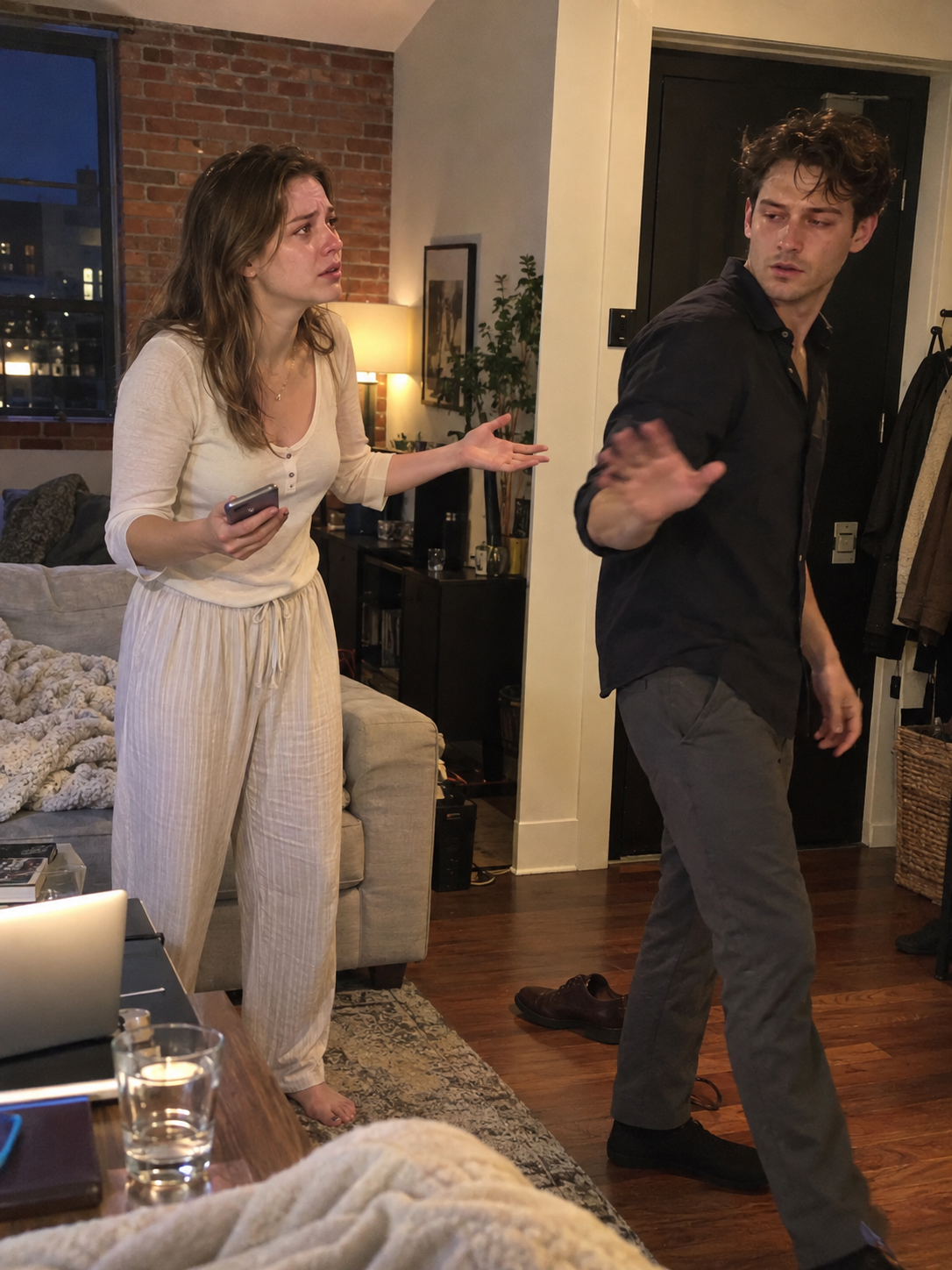
My boyfriend came home at 4:47 a.m. smelling like alcohol, smoke, and perfume that wasn’t mine,
My boyfriend came home at a.m. smelling like alcohol, smoke, and perfume that wasn’t mine, then told me, “Even if...

A Single Dad Flirted with the Woman Waiting in the Lobby—Until Everyone Stood Up for Their CEO…
A Single Dad Flirted with the Woman Waiting in the Lobby—Until Everyone Stood Up for Their CEO “If whoever you’re...