THREE OFFICERS BROKE INTO HER HOME AND PLANTED DRUGS IN HER PURSE—BUT THE QUIET WOMAN IN HANDCUFFS WAS THE FBI INVESTIGATOR WHO COULD EXPOSE THEIR ENTIRE DEPARTMENT – Life Story
The front door shattered at a.m., and three police officers entered a woman’s bedroom without a warrant.
One detective planted drugs in her purse while another officer’s camera quietly recorded what happened.
But why was their captain searching for a second phone nobody had mentioned—and what did he know about the woman they had arrested?
The front door broke inward at a.m., and three police officers stepped across the pieces as if the house had already been condemned.
Diana Marshall sat up so fast that her bedside lamp tipped against the wall. “Hands where I can see them!” a man shouted.
She raised both hands, the quilt sliding to her waist, while rain blew through the ruined doorway downstairs.
The detective entered first.
He was broad-shouldered, clean-shaven, and wearing a body camera with a small red light.
MORRISON was stitched above his pocket.
Behind him came a younger sergeant with a flashlight and, farther back, an older captain whose polished shoes looked absurd against the broken wood.
None of them asked whether she was injured.
“What’s happening?” Diana asked.
The detective yanked open her dresser instead of answering.
Socks and old receipts spilled across the carpet.
The sergeant swept his flashlight over the room, past a government phone charging on the nightstand and a navy jacket hanging inside the open closet.
Three gold letters shone on its back: FBI.
The sergeant stopped looking for a fraction of a second.
Diana noticed.
The detective didn’t; he had already lifted her leather handbag from the chair beside her bed.
He turned his shoulder toward the camera, reached into his jacket pocket, then slipped two fingers into the open bag.
Diana saw something clear and small pass between his fingers.
“Well, what have we here?” Morrison said, lifting a plastic packet filled with pale powder.
Diana’s stomach dropped.
She had handled enough investigations to recognize the movement, but recognizing it was not the same as being able to stop it. “That wasn’t in my purse,” she said. “You just put it there.”
Morrison gave her a practiced smile. “Everybody says that.” He held the packet toward the sergeant, whose flashlight shook slightly before settling on the evidence.
On the older man’s shoulder, another camera faced into the bedroom.
Diana could not tell whether it had caught Morrison’s hand, and she would not risk drawing attention to the angle.
“Do you have a warrant?” she asked. “We got a call about screaming,” the sergeant replied. “Someone could be hurt.” Diana looked around the bedroom.
No one was searching for a hurt person anymore.
Morrison was opening her jewelry case. “Then why are you going through my belongings?” she asked.
The captain stepped forward.
Silver threaded his hair, and his badge identified him as Robert Wilson.
Diana knew his name.
She knew it from files she wasn’t supposed to discuss and from interviews with people who lowered their voices before describing what his officers had done.
She kept that recognition off her face.
“Ma’am, we need you to cooperate,” Wilson said. “I am cooperating.” Diana pushed the quilt aside, careful to keep her hands visible. “I’m also telling you that I don’t consent to a search.” Morrison dropped the packet into an evidence bag.
He seemed almost pleased by how quickly the room was becoming his.
“Get her dressed,” Wilson ordered.
The sergeant reached for a gray sweater and jeans hanging over a chair.
Diana put them on while the men turned toward the doorway, then held out her wrists when Morrison produced handcuffs.
The metal closed too tightly.
She winced despite herself, and Morrison leaned close enough for her to smell stale coffee on his breath.
“Still think you know more than we do?” he asked. “I think your cameras should keep recording,” she answered.
His smile disappeared.
The sergeant glanced again at the FBI jacket, then at Diana, as if he had finally understood there was a question nobody had thought to ask.
Wilson was studying her nightstand.
He looked past her credentials wallet, past the charger, and toward the narrow space behind the lamp.
Diana followed his eyes.
He was not searching for an injured person or even for drugs.
He was searching for something specific—and she had never told him it existed.
Then Captain Wilson looked at the nightstand and asked, “Where’s the other phone?”
THE WRONG HOUSE
Diana stared at Wilson.
“What other phone?”
The captain’s expression changed so briefly that another person might have missed it.
His mouth tightened.
His eyes shifted toward Morrison, then returned to the nightstand.
“The caller reported two people inside,” Wilson said. “We need to make sure everyone is accounted for.”
Diana understood the maneuver.
He had asked about an object.
Now he was pretending he had meant another person.
“Then you should be looking for that person,” she replied. “Not searching through my belongings.”
Morrison stepped closer.
“Lady, you want to make this worse?”
“I want to know why you’re here.”
“We already told you.”
“No.
You told me somebody reported screaming.
Nobody has explained why you’re conducting a narcotics search.”
Bradley, the younger sergeant, glanced toward Wilson.
His name was Aaron Bradley.
Diana had seen it on incident reports during the eighteen months she had spent investigating misconduct inside the Eastbridge Police Department.
He had joined the force six years earlier, a young officer with a respectable service record and a reputation for following instructions.
Recently, his name had begun appearing beside Morrison’s far too often.
Wilson approached the bed.
“Ms.
Marshall, we received information indicating possible criminal activity at this address.”
“What information?”
“We’re not discussing confidential sources.”
“Then I need you to preserve the dispatch recording and identify the legal basis for your entry.”
Morrison laughed.
“You an attorney?”
“No.”
“Then stop trying to act like one.”
Diana held his gaze.
“I know what I consented to.
Nothing.”
The detective’s expression hardened.
“Take her downstairs.”
Bradley guided her into the hallway.
For the first time, Diana saw the extent of the damage.
The front door hung sideways from one hinge.
Rainwater darkened the floorboards beneath it.
Pieces of painted wood lay across the hall like scattered bones.
Her mother’s photograph had fallen from the living room wall.
The glass was broken.
Diana stopped.
The photograph showed a Black woman in a blue church dress, smiling beneath the broad brim of a matching hat.
Her name had been Evelyn Marshall, and she had spent thirty-two years teaching elementary school before leaving the house to her daughter.
Diana had kept the photograph beside the front door because her mother believed people should see a welcoming face when they entered a home.
Now that face lay beneath the officers’ boots.
“Can I pick that up?” Diana asked.
“Keep walking,” Morrison answered.
Something inside her tightened.
She had faced hostile witnesses, angry suspects, and men who thought a Black woman in a federal office must be someone’s administrative assistant.
She had learned how to endure condescension without surrendering authority.
But watching Morrison step past her mother’s photograph made the humiliation suddenly personal.
Outside, the rain had softened to a cold drizzle.
Blue patrol lights moved across the neighboring houses.
A curtain shifted in the window across the street.
Diana wondered how many people were watching.
Morrison opened the patrol car’s rear door.
“Watch your head.”
She lowered herself into the back seat.
Bradley climbed into the passenger seat while Morrison settled behind the wheel.
Through the window, Diana saw Wilson standing in her ruined doorway with a phone pressed to his ear.
His voice carried faintly across the driveway.
“No,” he said. “It wasn’t there.”
Diana closed her eyes.
Two nights earlier, a frightened woman named Evelyn Price had stood in that same doorway carrying a blue phone and a brown envelope.
Evelyn worked in the Eastbridge Police Department’s property division.
She had spent more than twenty years logging evidence, tracking transfers, and signing records that officers and prosecutors relied on.
She had also discovered something she could no longer bear to ignore.
Evidence was being altered.
Not once.
Not accidentally.
Repeatedly.
Evelyn had come to Diana because she believed somebody inside the department was protecting the officers responsible.
Diana had listened to her in the kitchen, documented the meeting, and arranged for Evelyn to return with an attorney before formally surrendering the phone.
Now Wilson was looking for it.
Morrison started the engine.
“Where do you work?” Bradley asked, turning around.
Diana looked at him through the partition.
“I’ll provide that information during booking.”
“Can’t even answer a simple question?”
“I’ve answered the questions necessary to identify myself.”
Morrison glanced at her in the rearview mirror.
“She’s been talking like this since we got there.”
Bradley looked away.
The car moved through Eastbridge’s quiet residential streets.
Neon signs reflected in the wet pavement.
A delivery truck idled outside a bakery.
Somewhere beyond the police radio, ordinary people were beginning an ordinary Monday.
Diana watched familiar intersections pass.
She knew this city.
She had grown up here before attending college in Maryland and beginning her federal career.
She remembered walking these sidewalks with her mother, who would stop to speak to every neighbor and sometimes bring groceries to elderly residents without being asked.
Eastbridge was not a corrupt city.
It was a city where certain powerful people had learned that the rest of the community was too busy surviving to question every official report.
That distinction mattered.
Morrison reached for his radio.
“Transporting one female, suspected possession.
Possible obstruction.”
“I did not obstruct you,” Diana said.
“See?” Morrison told Bradley. “Everything’s an argument.”
Diana leaned back.
She had spent fifteen years in federal law enforcement, the last eighteen months assigned to a public-corruption investigation involving Eastbridge.
Her work had included interviews, financial records, evidence discrepancies, and repeated attempts to understand why certain officers appeared in so many questionable arrests.
Tonight had not been part of an operation.
She had not invited the officers into her home.
She had not expected the raid.
And despite her training, she was afraid.
Her wrists ached inside the cuffs.
Her house was unsecured.
She had no idea whether Evelyn Price was safe.
The only advantage Diana possessed was that she knew how important it was to preserve facts before anyone could reshape them.
“Are your body cameras still recording?” she asked.
Bradley glanced down.
“Yes.”
“Good.”
Morrison shook his head.
“You really think a camera’s going to save you?”
Diana looked through the windshield.
“No,” she answered. “I think it may tell us what happened.”
Neither officer replied.
But in the passenger seat, Bradley touched the camera attached to his chest.
And for the first time, his confidence looked uncertain.
The Eastbridge Police Department occupied a low concrete building beside the municipal courthouse.
By the time they arrived, it was a.m.
Diana was brought through the booking entrance, where a fluorescent light buzzed above a desk covered in paperwork.
Sergeant Frank Delaney looked up.
“What have we got?”
“Possession,” Morrison replied. “Possible distribution.
Resisting.”
“I didn’t resist arrest,” Diana said.
Delaney looked at her.
“Ma’am, we’ll document your statement.”
Morrison rolled his eyes.
“Good luck.”
Delaney requested her name, date of birth, and identification.
Diana answered calmly.
When he opened her wallet, he found her federal credentials.
He stared at them.
Then he looked at her again.
“Special Agent Diana Marshall?”
“Yes.”
Delaney examined the identification more closely.
“Federal Bureau of Investigation?”
“Yes.”
The booking room grew quiet.
Morrison stepped forward.
“What’s the problem?”
Delaney turned the credentials toward him.
Morrison’s face lost its color.
For a moment, Diana saw the detective without his practiced confidence.
There was only a man discovering that the woman he had humiliated might know exactly how to challenge his account.
He recovered with a laugh.
“Well, that explains why she’s been such a pain.”
Delaney did not laugh.
“I need to notify the watch commander.”
“Wilson already knows about the arrest.”
“Does he know she’s a federal agent?”
Morrison hesitated.
Diana watched his eyes.
There it was.
The answer.
They had recognized the jacket.
They had seen her professional manner.
But they had not bothered to establish who she was before forcing their way into her house.
Delaney picked up the telephone.
Morrison leaned closer.
“Hold on.
Captain Wilson wants to review the report first.”
Delaney looked at him.
“I still have to record what you’ve brought me.”
The two men stared at one another.
Then Delaney made the call.
Diana stood beneath the fluorescent light, her wrists still cuffed, while the first fracture appeared in the story the officers had prepared.
And somewhere in the building, another officer was about to discover a second fracture.
THE CAMERA THAT DIDN’T BLINK
Officer Sarah Johnson disliked overnight evidence duty.
She had joined the department to investigate crimes, not to sit in a windowless room watching officers connect cameras to charging stations.
But after three years on patrol, she knew that routine paperwork often mattered more than dramatic arrests.
Every recording had a timestamp.
Every report had an author.
Every piece of evidence was supposed to have a documented history.
At a.m., she opened the video from Morrison’s body camera.
The screen showed Diana’s bedroom.
Johnson watched the detective enter, heard the woman ask what was happening, and saw the flashlight move across the closet.
She noticed the FBI jacket.
Then she watched Morrison pick up the handbag.
Something about his movements bothered her.
She replayed the clip.
Morrison’s body blocked the view just as his right hand moved toward the bag.
Johnson switched to Bradley’s recording.
The angle was different.
Bradley had stood several feet behind Morrison, near the bedroom doorway.
His camera showed Morrison reaching into his own jacket pocket.
A small clear packet appeared between his fingers.
Then his hand entered Diana’s purse.
Seconds later, he announced the discovery.
Johnson stopped the recording.
She felt her stomach turn.
For several years, she’d heard rumors about Morrison.
People said his arrest reports were unusually polished.
They said evidence always appeared when he needed it.
They said defendants accused him of things they could never prove.
Johnson had dismissed most of the stories.
Morrison was respected by supervisors.
He trained younger officers.
He had helped her during her first difficult arrest, staying late to explain how to write a report that could survive questioning in court.
She had once considered him a mentor.
Now she was staring at footage that appeared to show him placing narcotics in an innocent woman’s purse.
Johnson replayed it again.
And again.
The image was not perfect.
But the movement was unmistakably suspicious.
Her phone vibrated.
A message from Morrison appeared.
Mark the bedroom footage as equipment failure.
Wilson approved.
Don’t complicate this.
Johnson read it twice.
A cold pressure settled beneath her ribs.
She looked toward the door.
The evidence room was empty.
She opened the department’s recording-management system and placed an evidence-preservation hold on the files.
The system required her name, badge number, and reason for preserving them.
She typed carefully.
Possible evidence-handling irregularity.
Supervisor review required.
Then she saved the original files without altering them.
She did not know whether Wilson could override the hold.
She did know the system maintained an audit log.
That would matter if someone later tried to erase what she had seen.
Johnson opened the incident report.
The entry was described as an emergency response to a caller reporting screams from inside the residence.
She checked the dispatch timestamp.
a.m.
Then she checked the automatic location record from Morrison’s patrol vehicle.
His cruiser had arrived on Diana’s street at .
Eight minutes before the supposed emergency call.
Johnson stared at the screen.
Perhaps the officers had been assigned to another matter in the neighborhood.
Perhaps the location record was wrong.
But she could not ignore the possibility that the emergency had been invented after the officers were already in position.
She called the overnight supervisor.
He listened while she described the recording.
“Have you discussed this with Captain Wilson?” he asked.
“Captain Wilson was present during the search.”
A silence followed.
“Then you should take it to him.”
Johnson looked at Morrison’s message.
“He’s also the supervisor who allegedly approved classifying the recording as defective.”
The lieutenant’s voice changed.
“Officer Johnson, be careful about making accusations you can’t support.”
“That’s why I’m reporting what I saw.”
“Document it through the proper channels.”
“I am.”
He ended the call.
Johnson sat still for a long moment.
Then she contacted the FBI through the publicly listed duty number.
She identified herself and described the arrest.
The call was transferred to Supervisory Special Agent James Rodriguez.
“Start from the beginning,” Rodriguez said. “Tell me what you personally observed.
Don’t tell me what you think happened.”
Johnson appreciated the distinction.
She explained the footage, the timestamps, and Morrison’s instruction.
Rodriguez listened without interrupting.
When she finished, he asked one question.
“Is Agent Marshall still in custody?”
“Yes.”
“Have you preserved the original recordings?”
“Yes.”
“Good.
Do not alter them or send copies to an unauthorized destination.
We’ll arrange lawful collection and document the chain of custody.”
Johnson swallowed.
“Sir, am I going to lose my job?”
Rodriguez was quiet.
“I can’t promise you won’t face retaliation.”
She closed her eyes.
“But I can tell you something important,” he continued. “You don’t protect your profession by helping someone hide misconduct.”
Johnson looked again at the frozen screen.
Diana Marshall sat on the edge of her bed with her hands raised.
She looked frightened.
Not helpless.
Not defeated.
Just frightened, and determined to make someone listen.
Johnson knew what she had to do.
She saved Morrison’s message.
Then she wrote a detailed account of everything she’d observed.
Her pen shook so badly that she had to start the second page again.
James Rodriguez arrived at the federal field office just before four.
He had been Diana’s supervisor for three years.
He knew her strengths: patience, disciplined interviewing, and an extraordinary memory for inconsistencies in written records.
He knew her weaknesses too.
She sometimes took responsibility for witnesses long after her professional duties ended.
She had a habit of believing she could persuade frightened people to cooperate if she simply gave them enough time.
Those qualities made her a compassionate investigator.
They also created risks.
Rodriguez called Assistant U.S.
Attorney Lena Ortiz.
She answered sleepily.
“James, somebody better be in serious trouble.”
“Diana’s in custody.”
Ortiz was instantly alert.
“Where?”
“Eastbridge Police.
Morrison arrested her.”
A pause.
“Tell me she’s safe.”
“We’ve confirmed her location.
We’re arranging counsel.
A department officer reports possible evidence planting.”
Ortiz turned on her bedroom light.
“Is Wilson involved?”
“He was present.”
“Then this is no ordinary mistake.”
Rodriguez looked toward the conference room.
An investigation file lay open across the table.
For eighteen months, the task force had examined questionable arrests connected to Morrison, Bradley, and Wilson.
Dozens of complaints had described similar circumstances.
An aggressive entry.
A search that exceeded its stated purpose.
Narcotics discovered in places defendants insisted had been empty.
Reports that became more detailed after attorneys challenged them.
Individually, many allegations had been difficult to prove.
Together, they suggested a pattern that demanded investigation.
Now one of the alleged incidents involved their own investigator.
“Do we have grounds for an emergency evidence-preservation request?” Rodriguez asked.
“Probably,” Ortiz answered. “But don’t confuse urgency with authority.
We still need proper process.”
Rodriguez nodded, although she could not see him.
“Understood.”
“And James?”
“Yes?”
“Find out where Evelyn Price is.”
He looked toward the empty chair beside Diana’s desk.
Her notes about Evelyn’s meeting remained in the secure case system.
The evidence technician had been scheduled to meet federal prosecutors that afternoon.
Now she was not answering her phone.
Rodriguez felt a familiar sense of dread.
“I already have people looking.”
At a.m., Captain Wilson entered the interview room.
Diana sat beneath a buzzing fluorescent light.
A paper cup of water remained untouched on the table.
She had requested counsel.
No one had yet allowed her to speak privately with an attorney.
Wilson removed his coat and sat across from her.
“Ms.
Marshall.”
“Agent Marshall.”
His eyes narrowed.
“So I’ve been informed.”
Diana waited.
He placed his hands on the table.
“There’s been some confusion tonight.”
“About what?”
“The information we received.”
“Then preserve the original report.”
“We intend to.”
“And every communication preceding the entry.”
Wilson leaned back.
“You’ve made your position clear.”
“I’m glad.”
His jaw tightened.
“I have twenty-two years of service, Agent Marshall.
I’ve spent my career trying to keep this city safe.
I don’t appreciate being treated like a criminal because an investigation became complicated.”
Diana studied him.
She had seen his public speeches.
Wilson spoke persuasively about neighborhoods damaged by addiction and about officers asked to do difficult work under impossible conditions.
Some of those concerns were genuine.
That was what made him dangerous.
He had learned to place legitimate problems around illegitimate decisions until critics appeared to be attacking the entire profession.
“Then you should want an accurate record,” Diana said.
He tapped the table.
“Your detective found narcotics.”
“Your detective put something in my purse.”
“That is a serious accusation.”
“Yes.”
“You understand what could happen if you’re wrong?”
“I do.”
Wilson leaned forward.
“Then think carefully before you make it again.”
Diana looked toward the recording camera.
“I’d like my attorney now.”
He stood.
At the door, he paused.
“Whatever you think you know about my department, you don’t know the whole story.”
Diana held his gaze.
“Then let the evidence tell it.”
Wilson left.
For several seconds, she listened to his footsteps fade down the hallway.
She did not smile.
The captain was no longer trying to question her about drugs.
He was trying to learn how much she knew.
And she suspected the answer frightened him.
THE WOMAN WITH THE BLUE PHONE
Diana was released shortly after seven that morning.
The local prosecutor’s overnight representative had declined to approve the proposed narcotics charge on the information presented.
Morrison called it a misunderstanding.
Wilson called it an unfortunate procedural complication.
Diana called it what it was: an arrest that needed independent investigation.
She collected her wallet, keys, federal credentials, and phone.
At the exit, Sergeant Delaney handed her the completed property inventory.
“I’m sorry about your house,” he said quietly.
Diana studied him.
“You didn’t break the door.”
“No, ma’am.”
“But you documented what happened afterward.”
“Yes.”
“Then keep doing that.”
Outside, dawn spread gray light over the police station parking lot.
Rodriguez waited beside an unmarked sedan.
He held a blanket.
Diana nearly laughed at the sight.
“Do I look that bad?”
“You look like you spent the night in custody.”
“Fair.”
He handed her the blanket.
“Are you hurt?”
“My wrists are sore.
Nothing serious.”
“We’ll have the marks documented.”
Diana looked back at the station.
“Evelyn?”
Rodriguez’s expression answered before his words.
“We haven’t located her.”
Diana closed her eyes.
Two nights earlier, Evelyn Price had sat at her kitchen table with shaking hands.
The sixty-one-year-old evidence technician had worked in Eastbridge Police Department’s property division for twenty-three years.
She understood chain-of-custody procedures better than many detectives.
She also understood how easily incomplete paperwork could be used to protect a false account.
For years, she’d noticed discrepancies.
Evidence seals recorded as broken before the listed examination date.
Property transferred between lockers without corresponding signatures.
Packages associated with arrests that had no matching initial inventory entry.
She had reported some of the problems.
Her supervisors dismissed them as clerical mistakes.
Then Morrison began asking her to correct records after cases had already reached prosecutors.
At first, she believed she was fixing administrative errors.
Eventually, she understood that some corrections concealed evidence-handling problems.
By then, she was afraid to refuse.
During their kitchen conversation, Evelyn had removed a blue phone from her coat pocket.
“I recorded Wilson,” she whispered.
Diana had not touched the device.
“Were you part of the conversation?”
“Yes.”
“Did you change the recording?”
“No.”
“Then we need to preserve it correctly.
And you should have an attorney before we discuss any possible crimes you may have committed.”
Evelyn had looked shocked.
“Crimes?”
Diana remembered that moment vividly.
The woman wanted to expose corruption.
She had not yet accepted that helping cover it up could make her legally responsible.
“I changed records,” Evelyn admitted. “I did what they told me.”
“Then your attorney needs to know everything.”
Evelyn had stared at the blue phone.
“My son was arrested seven years ago,” she said.
Diana already knew the case.
Matthew Price had pleaded guilty to drug possession after Morrison reported finding narcotics during a vehicle search.
Matthew had maintained that the drugs were not his.
But he could not afford to remain in jail while waiting for a trial, and his attorney had advised him that accepting a plea might be less risky than challenging the officer’s account.
He lost his commercial driver’s license.
His marriage ended two years later.
He spent much of the next decade rebuilding his life.
Evelyn believed the arrest had been questionable from the beginning.
Then she discovered problems in the evidence records.
When she asked Morrison about them, he warned her that interfering with an investigation could create trouble for Matthew.
After that, she stopped asking.
But she started keeping private notes.
“I thought if I did what they wanted, they’d leave him alone,” Evelyn said.
Diana remembered the older woman’s face.
The guilt there was not theatrical.
It was exhausting.
“Did you alter the records in Matthew’s case?” Diana asked.
Evelyn nodded.
“I changed a transfer date.”
“Why?”
“Because Morrison told me to.”
Diana sat silently.
Evelyn had harmed the integrity of her own son’s case while believing she was protecting him.
It was a tragedy built from fear.
And fear had made her useful to men who understood it.
Back at the federal building, investigators were beginning to reconstruct the raid.
Diana’s home-security recorder had captured the sound of the entry.
A separate digital recorder inside the bedroom lamp had captured much of the conversation.
Neither device showed Morrison’s hand entering the handbag.
That made Bradley’s body-camera footage critical.
Sarah Johnson’s preservation hold had protected the originals from routine alteration or deletion.
With legal authorization, investigators obtained the relevant recordings and audit records.
They discovered that a review copy of Morrison’s footage had been shortened.
Fifty-four seconds were missing.
The original recording remained intact.
Its timestamps matched Bradley’s camera.
The missing interval covered the period when Morrison turned toward Diana’s handbag.
Rodriguez studied the two files side by side.
“Who edited the review copy?”
“An administrator account,” the technician answered. “We’re tracing the access records.”
Diana looked at the screen.
She felt anger rise.
Not because the edit was subtle.
Because somebody had looked at what happened and chosen to hide it.
That decision required thought.
It required intent.
It required a person to sit at a computer and decide the truth would be more inconvenient than another false record.
Rodriguez turned toward her.
“We’ll handle the investigation.”
Diana understood what he meant.
She had become a direct victim and a potential witness.
Her continued operational involvement could complicate the prosecution.
“I know,” she said.
But knowing did not make it easier.
Later that afternoon, Officer Johnson arrived at the federal building with her attorney.
She wore jeans and a dark green sweater instead of her uniform.
Without the badge, she seemed younger.
Diana passed her in the hallway.
Johnson stopped.
“Agent Marshall?”
Diana turned.
“I wanted you to know I preserved the video.”
“I heard.”
“I didn’t do anything extraordinary.”
Diana looked at her carefully.
“You did what the job required.”
Johnson swallowed.
“Then why does it feel like everyone I work with hates me?”
Diana considered the question.
“Because doing the right thing doesn’t guarantee people will thank you.”
Johnson looked down.
“My father was a cop.
Thirty years.
He says you never turn your back on your own.”
“And what do you think?”
Johnson took a breath.
“I think being loyal to somebody shouldn’t mean lying for them.”
Diana nodded.
“Then hold on to that.”
The young officer gave a small, uncertain smile.
But as she walked away, Diana noticed the way she kept looking over her shoulder.
She recognized that fear.
It was the same expression Evelyn Price had worn in her kitchen.
Two women from different generations.
Both had discovered that the system they trusted could punish them for speaking.
And one of them was still missing.
THE CAPTAIN’S PERFECT NUMBERS
By the end of the week, federal investigators had established that Morrison’s patrol car arrived outside Diana’s home before the reported emergency call.
The records did not immediately prove who placed the call.
But they contradicted the account that the officers had been dispatched there unexpectedly.
A search authorized by a federal magistrate judge produced department communications, relevant electronic records, and documents related to the raid.
The inquiry remained focused on specific officers and suspected offenses.
It did not give federal agents unlimited authority over the entire police department.
That distinction mattered to Rodriguez.
“We don’t get to ignore the rules just because we’re investigating people who did,” he told his team.
Diana heard the comment while passing the conference room.
She stopped outside.
For a moment, she wished she were still inside leading the briefing.
Then she continued walking.
Her new assignment involved reviewing older cases for potential evidence problems.
It was work she understood.
It was also work that felt painfully distant from the men who had entered her bedroom.
Three days later, investigators located Evelyn Price.
She was staying with relatives in Columbus.
Her car had been found near a bus station, where she had left it after becoming convinced someone was following her.
Her attorney contacted the U.S.
Attorney’s Office and arranged a protected interview.
Evelyn entered the conference room wearing a navy coat and carrying a small cloth bag.
Matthew walked beside her.
He looked older than his thirty-four years.
Diana was not allowed to participate in the formal interview because of her role as a potential witness, but Evelyn asked to see her briefly afterward.
They met in a supervised conference room.
Evelyn stood when Diana entered.
“I’m sorry,” she whispered.
Diana looked at her.
“For what?”
“For coming to your house.
For getting you involved.”
“I was already involved.”
“They broke your door.”
“Yes.”
Evelyn’s eyes filled.
“I saw it on the news.”
Diana pulled out a chair.
“Sit down.”
The older woman obeyed.
For several seconds, neither spoke.
Then Evelyn said, “I ran because I thought they would come for Matthew next.”
Diana nodded.
“I understand.”
“No,” Evelyn said quietly. “I don’t think you do.”
Diana waited.
Evelyn opened her cloth bag.
Inside was a black notebook with a cracked cover.
“I’ve been keeping this for thirteen years.”
Diana stared at it.
“What is it?”
“Every correction they made me enter.
Every package number.
Every date that didn’t match.”
Diana felt her pulse quicken.
“Have you shown your attorney?”
“Yes.”
“Then give it to the investigators through her.
Don’t hand it to me.”
Evelyn looked confused.
“Why?”
“Because I want every step documented.
I don’t want anyone to question what happened to that notebook after you brought it here.”
Evelyn slowly nodded.
“I used to think paperwork was boring.”
Diana gave a sad smile.
“Sometimes paperwork is the only thing that remembers.”
The notebook changed the investigation.
It did not prove every alleged crime.
But it identified specific records investigators could compare against other evidence.
A seal number in Evelyn’s handwriting matched an irregular entry in Matthew’s case.
Another page referenced Marcus Bell, a warehouse worker arrested during a traffic stop.
Another documented a narcotics package entered into the system hours after the officer claimed to have seized it.
The same names appeared repeatedly.
Morrison.
Bradley.
Two additional detectives.
Wilson’s name appeared beside several disputed approvals.
As investigators examined those entries, another pattern emerged.
The department had been under pressure to improve its public safety statistics.
Eastbridge’s city council had criticized rising crime complaints and questioned whether the specialized narcotics unit justified its overtime budget.
Wilson responded with increasingly impressive enforcement numbers.
More arrests.
More seizures.
More cases closed.
At public meetings, he stood beside colorful charts and described a department successfully reclaiming troubled neighborhoods.
His numbers helped him defend funding.
They also strengthened his reputation as the city’s most effective police commander.
Morrison became the unit’s celebrated detective.
Bradley became his reliable partner.
Meanwhile, people accused of drug offenses struggled to challenge evidence that appeared properly documented on paper.
The records suggested that the pressure to produce results had gradually become permission to manufacture them.
Wilson did not begin his career as a man who wanted innocent people convicted.
His early commendations described legitimate investigations and genuine acts of courage.
But somewhere along the way, he began treating the department’s image as more important than the integrity of its work.
Once that happened, every problem became a threat to be managed.
A questionable arrest became an inconvenient complaint.
A missing evidence entry became a clerical correction.
A frightened employee became a disloyal subordinate.
And an investigator asking questions became an enemy.
The most important discovery came from the blue phone.
Forensic specialists examined the device and preserved the original recording.
It contained an eleven-minute conversation between Evelyn and Wilson.
The discussion began with routine concerns about property records.
Then Wilson’s tone changed.
“You’ve already signed those corrections,” he told her. “You don’t get to pretend you didn’t know what they were.”
Evelyn’s recorded voice trembled.
“I won’t change another one.”
“You work for this department.”
“I work for the law.”
A silence followed.
Then Wilson said, “Don’t start talking like one of those federal people.”
Evelyn replied that she’d kept copies of several records.
Wilson asked where they were.
She refused to answer.
“Did you take them to the woman on Alder Street?” he demanded.
Diana’s address.
The room fell silent.
The recording continued.
“If those records are in that house,” Wilson said, “we’ll get them before she has a chance to do anything with them.”
Rodriguez stopped the audio.
He looked toward Ortiz.
“That’s why they searched Diana’s house.”
Ortiz nodded slowly.
The arrest had never been primarily about narcotics.
It had been an attempt to recover evidence that Wilson believed Evelyn had surrendered.
The packet in Diana’s purse was leverage.
If the officers found the phone, they could attempt to seize it.
If they did not, they could pressure Diana through criminal charges.
And because Wilson had failed to establish who lived at the address, he had walked into the home of the federal investigator assigned to his department.
The first great mistake was the raid.
The second was Morrison’s evidence planting.
The third was assuming that everyone who witnessed misconduct would remain silent.
But the recording also revealed something more troubling.
Wilson had known Evelyn was collecting evidence.
He had known she was frightened.
And he had believed the easiest solution was to make the evidence disappear.
The federal inquiry widened.
Not every suspicious case produced a criminal charge.
Some evidence had been lost.
Some witnesses could not remember important details.
Others had accepted plea agreements years earlier and no longer possessed the records necessary to reconstruct what happened.
Prosecutors began notifying appropriate defense counsel and courts about material evidence problems in affected cases.
A separate review process was created for convictions potentially compromised by misconduct.
For Diana, those names mattered as much as the investigation against Wilson.
Marcus Bell was among the first people contacted.
He had been arrested four years earlier.
At the time, he worked nights loading trucks and spent his mornings caring for his mother.
A disputed drug charge cost him his warehouse job.
He pleaded guilty after being advised that a conviction following trial might carry more serious consequences.
When Diana met him again, he was working at an auto-parts store.
He listened quietly as she explained that new evidence might support a challenge to his conviction.
Then he asked a question she could not answer.
“Will I get my old life back?”
Diana folded her hands.
“No.”
Marcus stared at her.
She continued.
“If the court vacates the conviction, that can help you rebuild.
But it won’t return the job you lost or the years you spent trying to explain yourself.”
He looked away.
“That’s what I thought.”
“I still believe it’s worth pursuing.”
Marcus’s jaw tightened.
“You believe a lot of things, Agent Marshall.”
She accepted the anger.
He had earned the right to it.
After a long silence, he asked what documents his attorney would need.
Diana gave him the contact information for the review team.
Marcus took the paper.
Before leaving, he stopped at the door.
“You know what the worst part was?”
Diana waited.
“My mother believed me.
She believed me even when the judge didn’t.”
His eyes shone.
“She died last winter.
I wanted her to live long enough to see somebody else believe me too.”
Diana had no answer.
She watched him walk away.
The investigation was no longer a question of whether a corrupt detective would lose his badge.
It was about how much damage could be done before anyone with authority was willing to look closely.
THE COST OF TELLING THE TRUTH
The backlash began quietly.
Sarah Johnson was placed on administrative leave pending an investigation into alleged violations of department information-security policies.
Her building-access card was disabled.
Her department laptop was collected.
She was instructed not to discuss the investigation with colleagues.
Two officers she had known since the academy stopped returning her messages.
Her father, a retired police lieutenant, called her decision a betrayal.
“You should’ve gone through the chain of command,” he told her.
“I did.”
“You went outside the department.”
“Because the captain was involved.”
Her father fell silent.
Then he said, “You don’t understand what this will do to people.”
Sarah looked at the framed photograph of him in uniform hanging in her apartment.
“I think I understand exactly what it will do.”
He ended the call.
Sarah sat on her kitchen floor long after the conversation ended.
She had imagined that reporting misconduct would make her feel brave.
Instead, she felt isolated.
She was frightened of losing her career.
She was ashamed of how badly she wanted the people who had abandoned her to approve of her decision.
And she was beginning to understand why others had remained silent.
Diana faced a different consequence.
An internal review found that she had met Evelyn at her private residence without following the approved witness-contact plan.
The decision had exposed both women to avoidable risk.
Diana did not deny it.
She had believed Evelyn would withdraw if forced to meet immediately at the federal building.
She had allowed sympathy to influence operational judgment.
Her supervisor asked why she had not arranged a secure alternative.
Diana answered honestly.
“I thought I could handle it.”
The words sounded smaller than she expected.
She had spent years teaching younger agents that good intentions did not excuse careless procedure.
Now she was hearing herself offer the same explanation she’d warned them against.
Pending the review, Diana was removed from operational responsibility for the Eastbridge case.
She remained employed.
She remained a witness.
But she would no longer direct interviews or make decisions about the investigation.
When Rodriguez told her, she stared at him across his desk.
“After everything I’ve done?”
“That’s not the issue.”
“It feels like it.”
“I know.”
“You think I compromised the case?”
“I think you made a decision we have to examine honestly.”
Diana looked away.
Rodriguez lowered his voice.
“You’re the person who taught half this office that integrity means following the rules when it’s inconvenient.
Don’t ask me to forget that because you’re the one who made the mistake.”
She knew he was right.
That made it hurt more.
The situation grew worse when Evelyn’s attorney reported that she was reconsidering whether to testify.
The older woman feared prosecution for the records she had falsified.
Matthew had lost work after reporters began contacting people connected to the investigation.
Their family’s address had circulated online.
Evelyn was exhausted.
She wanted the truth known.
She was terrified of what telling it would cost.
Ortiz explained the problem during a meeting with Rodriguez.
“The notebook is important, but it doesn’t authenticate every entry by itself.
The recording helps us understand Wilson’s intentions, but the defense will challenge its interpretation.
We need witnesses who can withstand questioning.”
Rodriguez nodded.
“And if Evelyn won’t testify?”
“We can continue with independently authenticated records and other evidence.
But some parts of the case become harder.”
Diana sat at the far end of the table, invited only to discuss her own potential testimony.
She looked at the documents.
“So Wilson may never face the full conspiracy charge?”
Ortiz considered her carefully.
“We will charge what the evidence supports.
Not what our anger demands.”
Diana lowered her eyes.
She hated the answer.
She also knew it was the only answer a responsible prosecutor could give.
That night, Diana returned to her mother’s house.
The front door had been replaced.
Fresh wood surrounded the frame.
A new lock gleamed beneath the porch light.
The contractor had done good work, but the new paint was slightly brighter than the old.
The repair made the damage more visible rather than less.
Inside, Diana found a stack of insurance papers waiting on the kitchen table.
She moved them aside and sat down.
For eighteen months, she had believed the Eastbridge investigation was the most important case of her career.
Now she was outside the investigative team.
Evelyn might refuse to testify.
Sarah might lose her job.
The department was describing the raid as an unfortunate mistake.
A local news article suggested Diana had provoked the confrontation by secretly working with a disgruntled employee.
The article quoted anonymous department sources.
It omitted the body-camera footage.
It omitted the suspicious dispatch timeline.
It omitted Wilson’s recorded threat.
But it spread quickly.
Diana’s phone filled with messages.
Some were supportive.
Others accused her of trying to destroy the police.
A few included photographs of her house.
She turned the phone facedown.
For the first time since the raid, she wondered whether she should leave Eastbridge.
Not because she was frightened of Morrison.
Because every room in the house now reminded her of the moment strangers entered and treated her dignity as something they could take.
She walked into the living room.
Her mother’s photograph stood on a repaired shelf.
Diana picked it up.
“You would’ve known what to do,” she whispered.
The photograph offered no answer.
Her mother had always believed that courage was not loud.
Sometimes it meant telling the truth when people were angry with you.
Sometimes it meant admitting you had made a mistake.
And sometimes it meant staying when leaving would be easier.
Diana set the photograph down.
Then she opened her original notes from Evelyn’s first visit.
One sentence caught her attention.
There were two meetings, Diana.
The first one scared me.
The second one made me record him.
Diana read it twice.
Evelyn had described the recorded meeting with Wilson.
But what was the first meeting?
Diana remembered assuming it referred to a confrontation years earlier.
Now she realized Evelyn might have meant another recent meeting.
A meeting nobody had investigated thoroughly.
She picked up her phone.
Then she stopped.
She was no longer assigned to the case.
She could not independently contact witnesses or collect evidence as though nothing had changed.
If she wanted the prosecution to trust her, she had to respect the boundary.
She called Ortiz.
When the prosecutor answered, Diana explained exactly what she had found and admitted that she had failed to follow up on the statement earlier.
Ortiz listened.
“Send your original notes through the secure channel,” she said. “Don’t contact Evelyn yourself.”
“I won’t.”
“And Diana?”
“Yes?”
“Thank you for telling me what you missed.”
Diana looked at the photograph on the shelf.
The case might still collapse.
Her reputation might never fully recover.
But she had made one decision she could live with.
She had chosen accuracy over pride.
And that choice would soon matter more than she imagined.
THE MISSING MINUTE
The first meeting took place nine days before the raid.
Evelyn had been summoned to Wilson’s office after refusing to sign a correction involving evidence from an old narcotics case.
According to the department calendar, the meeting lasted twenty minutes.
According to Wilson’s official notes, it concerned employee performance.
But another record told a different story.
A building-access log showed that Morrison had entered Wilson’s office shortly after Evelyn arrived.
Bradley entered twelve minutes later.
Neither officer appeared in the formal meeting summary.
Investigators obtained the relevant records through proper legal process.
Then they interviewed an administrative assistant who had worked outside Wilson’s office that afternoon.
She remembered hearing Evelyn crying.
She also remembered Wilson telling someone to close the door.
When investigators asked why she had never reported it, the assistant stared at her hands.
“Because everybody knew you didn’t question the captain.”
The interview did not prove a crime by itself.
But it gave prosecutors a reason to examine communications from that day.
They found a message Morrison had sent Bradley shortly after the meeting.
Captain wants the Price problem contained.
No more surprises.
Bradley replied.
What about the copies?
Morrison answered.
Find out where she took them.
Ortiz studied the exchange.
It connected the officers to Evelyn’s records before the raid.
The later recording showed Wilson’s concern about the house on Alder Street.
Together, the evidence began to establish why the officers had targeted Diana’s address.
But the prosecution still needed to connect Wilson directly to the false emergency report.
Then Sarah Johnson’s preserved message became important.
Morrison had instructed her to classify the footage as defective.
That text was recovered and authenticated through her phone and other records.
A separate audit showed that someone using an administrator account had created the shortened review copy.
Investigators traced the relevant access to a workstation routinely used by Wilson’s administrative staff.
The account had also accessed the dispatch incident record after Diana’s arrest.
The evidence did not identify every person involved.
But it made the explanation of innocent confusion increasingly difficult to sustain.
The decisive link came from an unexpected but thoroughly documented source.
The department’s dispatch system automatically retained records of when calls were received, when incident numbers were created, and when officers were assigned.
The emergency report listed a caller who claimed to hear screaming from Diana’s house.
Investigators traced the call to a prepaid phone.
Purchase and location records placed that phone near the department shortly before the incident.
A relevant communication between Morrison and Wilson occurred minutes before the emergency call.
The contents of that communication were not recorded.
But the timing was significant.
Most importantly, the original patrol-car location records showed Morrison and Bradley waiting outside Diana’s house well before the call.
The officers’ reports claimed they had been sent there only after dispatch notified them.
Those claims could not both be true.
Ortiz reviewed the evidence with Rodriguez.
“We have a planned presence,” she said. “We have a questionable emergency call.
We have a planted packet.
We have an attempt to alter the recording.”
Rodriguez nodded.
“And we have Wilson’s statement that he wanted records from the house.”
Ortiz looked toward the photograph of Diana’s broken doorway.
“Now we need to prove who made which decision.”
Bradley became the investigation’s most important unresolved question.
He had watched Morrison work for years.
He had participated in questionable searches.
He had signed reports that prosecutors now believed contained false statements.
But he had also hesitated during Diana’s arrest.
His body camera had preserved the clearest view of Morrison’s hand.
And unlike Morrison, he had not sent messages ordering anyone to delete evidence.
His attorney contacted federal prosecutors after learning the investigation had expanded.
Bradley was willing to discuss cooperation.
Ortiz made the conditions clear.
He would have to give a complete account.
He could not protect himself by placing all responsibility on Morrison.
He would not receive blanket immunity.
Any agreement would depend on truthful statements and approval through the appropriate process.
Bradley accepted.
During his first recorded interview, he cried.
Not dramatically.
He simply sat at the table, staring at a photograph of Diana’s bedroom, until tears began falling onto his hands.
“I knew it was wrong,” he said.
Ortiz waited.
“I knew when he opened the bag.”
“Did you see Morrison place the packet?”
“Yes.”
“Why didn’t you stop him?”
Bradley looked up.
“Because I’d seen him do it before.”
The room went silent.
Bradley explained that he had joined the narcotics unit believing Morrison was a gifted detective.
At first, he noticed only unusual paperwork.
Then he witnessed searches where evidence seemed to appear after suspects had already been searched.
Morrison told him the paperwork needed to match the result, not the other way around.
Wilson praised their arrest numbers.
Bradley was promoted.
He convinced himself that the people they arrested were probably guilty of something.
Eventually, he stopped asking whether the evidence was genuine.
Then came Diana’s house.
He knew they had been sent to look for records connected to Evelyn Price.
He believed they would pressure the resident into surrendering them.
He had not known the woman was an FBI agent.
When Morrison planted the packet, Bradley realized the situation had gone farther than he expected.
But he remained silent.
“Why?” Ortiz asked.
Bradley looked down.
“Because by then I was part of it.”
The admission did not excuse him.
It gave investigators a clearer picture of how the misconduct had spread.
Bradley’s cooperation also clarified Wilson’s role.
Before the raid, Wilson had instructed Morrison to investigate whether Evelyn’s records were inside the house.
He had approved using an emergency call as the basis for entry.
Bradley said he believed the caller would provide a report sufficient to justify a welfare check.
He also acknowledged that he knew they were not responding to a genuine emergency.
When Ortiz asked whether Wilson had specifically ordered evidence planting, Bradley shook his head.
“Not in front of me.”
“Did Morrison tell you Wilson wanted it?”
“He said the captain wanted leverage.”
That distinction mattered.
A jury would have to decide what Wilson knew and intended.
Bradley’s testimony would be challenged because he hoped to receive a reduced sentence.
Prosecutors could not rely on him alone.
But his account fit the contemporaneous records.
And every verified detail made it more difficult for Wilson to claim the raid was simply a misunderstanding.
Diana learned of Bradley’s cooperation through the official preparation process for her testimony.
She read the authorized summary and sat quietly for several minutes.
Rodriguez entered her office.
“You all right?”
She nodded.
Then she shook her head.
“I keep thinking about the people who asked for help before I ever got involved.”
Rodriguez sat across from her.
“We’re finding them.”
“Some of them have been waiting years.”
“I know.”
She looked at him.
“I wanted this case to end with everybody finally admitting what happened.”
“That’s not usually how it works.”
“No.”
He waited.
Diana folded her hands.
“I also wanted to be the person who brought them down.”
Rodriguez said nothing.
“I think that’s why being removed from the case hurt so much.
I started treating the investigation like it belonged to me.”
“It mattered to you.”
“That doesn’t make it mine.”
She looked toward the window.
“It belongs to the people whose lives were damaged.”
Rodriguez nodded.
“Then help us finish it the way they deserve.”
Diana drew a slow breath.
For the first time, she understood what that meant.
She would tell the truth.
Not as the hero of the story.
Not as the agent who always made the right decision.
As a witness who could account for what she saw, what she knew, and what she had gotten wrong.
And that was exactly the witness the prosecution needed.
THE DAY THE BADGES CAME OFF
Fourteen months after the raid, Diana entered the federal courthouse in a navy suit.
Rain fell outside.
For a moment, the sound carried her back to the night Morrison entered her bedroom.
She could still remember the flashlight.
The broken wood.
The small red light on the body camera.
She could still feel the handcuffs tightening around her wrists.
But the courthouse was different.
No one was shouting.
No one was pretending an accusation was proof.
The government had brought charges supported by grand-jury proceedings, witness testimony, and documentary evidence.
Morrison and Wilson faced trial on charges related to the raid, evidence falsification, and conspiracy.
Bradley had entered a guilty plea to offenses arising from his participation and was awaiting sentencing after cooperating with prosecutors.
Other questionable cases remained under investigation or review.
There was no single courtroom large enough to repair every wrong.
But this proceeding would determine whether the government had proved the charges against the two men beyond a reasonable doubt.
Diana walked inside.
Marcus Bell sat in the public gallery.
So did Matthew Price.
Evelyn was seated beside her attorney.
Sarah Johnson sat several rows behind them.
Diana saw each face.
They had all paid for telling the truth.
Some had paid long before anyone listened.
The prosecution began with the emergency call.
Jurors heard the dispatch recording.
They saw the timestamps.
They learned that Morrison and Bradley had arrived on Alder Street before the call was received.
The defense argued that officers sometimes positioned themselves near locations while investigating preliminary information.
That explanation was not impossible.
The prosecution then presented the communications connecting the officers to Evelyn Price and the search for her records.
The pieces began to fit together.
Next came the body-camera footage.
The courtroom lights dimmed.
On the screen, Diana’s bedroom appeared.
A flashlight crossed the wall.
The FBI jacket came into view.
Morrison lifted the handbag.
His hand moved toward his pocket.
The clear packet appeared.
Then his hand entered the purse.
The recording played without commentary.
The jurors watched.
One leaned forward.
Another took notes.
The prosecutor replayed the critical seconds from Bradley’s angle.
Then the two recordings appeared side by side.
The sequence was clear.
Morrison had a packet before he claimed to discover one.
Sarah Johnson testified about preserving the original files.
She described the message ordering her to classify the footage as an equipment failure.
She explained the preservation hold and the audit trail.
During cross-examination, defense counsel challenged her motives.
“You were facing possible discipline when you contacted federal authorities, correct?”
“No.”
“You believed reporting the incident might protect you from future accusations?”
“I believed the recording showed possible misconduct.”
“You didn’t personally see Detective Morrison place drugs in Agent Marshall’s purse, did you?”
“I saw the recording.”
“So you made an interpretation.”
“Yes.”
“An interpretation that could have been wrong?”
Sarah paused.
“I reported exactly what the recording showed.
I asked investigators to examine it.”
The attorney tried again.
“You’ve benefited from the attention this case brought you.”
Sarah looked toward the jury.
“I lost my assignment.
I lost friends.
My father stopped speaking to me for months.”
The courtroom grew quiet.
Then she added, “I reported it because it was the truth.”
When Bradley testified, Morrison refused to look at him.
The former sergeant described the raid.
He explained that the officers were searching for documents associated with Evelyn Price.
He admitted knowing the emergency call did not reflect a genuine threat to anyone inside the house.
He described Morrison placing the packet.
And he acknowledged his own decision to remain silent.
The defense questioned him aggressively.
“You’re cooperating because you hope to receive a lighter sentence.”
“Yes.”
“You’ve lied in police reports before.”
“Yes.”
“You’ve helped conceal evidence.”
“Yes.”
“Why should this jury believe you now?”
Bradley looked at the attorney.
“They shouldn’t believe me just because I’m saying it.”
He turned toward the jurors.
“They should look at the records.
That’s what finally made me tell the truth.”
The answer was not dramatic.
It was devastating because it did not ask anyone to forgive him.
Diana testified on the fourth day.
She described waking to the broken door.
She described Morrison’s movements.
She identified the packet.
She explained what she had seen and what she could not see.
The prosecutor asked why she had not reached for her credentials.
“Because I had officers pointing flashlights at me and ordering me to keep my hands visible,” Diana answered. “I was not going to make a sudden movement.”
“Were you afraid?”
“Yes.”
“Did you consent to the search?”
“No.”
“Did you place narcotics in your handbag?”
“No.”
“Did you resist arrest?”
“No.”
Her voice remained controlled.
But when the prosecutor asked about her mother’s photograph lying beneath the broken glass, Diana paused.
The courtroom seemed to disappear for a moment.
She remembered the blue church dress.
The smiling face.
The pieces of glass around the frame.
“I asked to pick it up,” she said.
“What happened?”
“Detective Morrison told me to keep walking.”
The prosecutor let the answer stand.
Then the defense began its cross-examination.
The attorney approached slowly.
“Agent Marshall, you were investigating the Eastbridge Police Department before this incident.”
“Yes.”
“You had formed suspicions about my clients.”
“Yes.”
“You met with Evelyn Price at your personal residence without following your agency’s approved witness-contact plan.”
“Yes.”
“You were later removed from operational responsibility for the investigation.”
“Yes.”
The attorney stopped.
“So you violated your own procedures.”
“I made a judgment that my agency reviewed and found inconsistent with the approved plan.”
“That’s a long way of saying you broke the rules.”
“I failed to follow the approved procedure.”
The attorney smiled faintly.
“And now you’re asking this jury to punish officers for procedural mistakes.”
Diana looked at him.
“No.”
The attorney waited.
“I’m asking the jury to consider what the evidence proves.
My mistake doesn’t make Detective Morrison’s actions imaginary.”
A juror looked up.
The attorney continued.
“You wanted to expose my clients, didn’t you?”
“I wanted to determine whether the allegations against them were supported.”
“You wanted them removed from the police department.”
“I wanted the misconduct to stop.”
“You were angry when they entered your home.”
“Yes.”
“So this is personal.”
Diana took a breath.
“Being arrested in my own bedroom was personal.
What happened on the recording is evidence.
Those are different things.”
The attorney stared at her.
“Nothing further.”
The final witness was Evelyn Price.
She entered slowly.
She wore a plain gray dress and carried no notebook.
Her attorney had advised her throughout the process.
She had entered into a written cooperation agreement that required truthful testimony and did not excuse all of her past conduct.
The prosecutor asked her why she had kept private notes.
“Because the official records were being changed,” Evelyn answered.
“Did you change some of them yourself?”
“Yes.”
“Why?”
“I was frightened.”
“Does being frightened make those changes acceptable?”
Evelyn looked down.
“No.”
She explained the threats involving her son.
She described Wilson’s demands.
She identified her handwriting in the notebook and described how she had made the entries.
Then the prosecution played the recording from the blue phone.
Wilson’s voice filled the courtroom.
If those records are in that house, we’ll get them before she has a chance to do anything with them.
The jurors listened without moving.
The prosecutor stopped the recording.
“Whose house was he referring to?”
“Diana Marshall’s.”
“Had you told him she was an FBI agent?”
“No.”
“Did Captain Wilson ask whether anyone inside might be injured?”
“No.”
“What did he ask you?”
Evelyn swallowed.
“He wanted to know where I’d taken the records.”
The prosecutor stepped back.
The motive behind the raid was no longer just an allegation.
It was supported by the recording, the department communications, the dispatch timeline, and the testimony of people who had participated in the events.
Wilson testified in his own defense.
It was his choice.
He appeared composed, wearing a dark suit and a silver tie.
He described a department under pressure from rising crime complaints and shrinking public trust.
He spoke about officers working overtime, victims demanding action, and city officials who wanted better results without paying for more resources.
Some of his testimony was persuasive.
Those pressures had existed.
The city had demanded improvements.
His department had faced genuine challenges.
But when the prosecutor asked whether those challenges justified creating a false emergency report, Wilson refused to answer directly.
He described confusion.
He described incomplete information.
He described decisions made under stress.
Then Ortiz displayed the message about the records.
Find out where she took them.
She asked Wilson whether the raid had been planned before the emergency call.
He denied directing an unlawful entry.
Ortiz showed the patrol-location record.
She asked why the officers were outside Diana’s home eight minutes before dispatch received the call.
Wilson said he had authorized preliminary surveillance.
Ortiz asked why the incident report described the officers as responding only after the call.
Wilson said he had not written the report.
Ortiz showed the approval record bearing his name.
He looked down.
The courtroom was silent.
“Captain Wilson,” Ortiz asked, “when you entered Diana Marshall’s bedroom, were you trying to find an injured person?”
Wilson did not answer immediately.
“I was trying to protect my department.”
Ortiz waited.
Then she asked quietly, “From what?”
Wilson stared toward the jury.
“From a scandal that would’ve destroyed years of good work.”
The answer hung in the room.
It was not an admission to every charge.
But it revealed the belief that had shaped his decisions.
He had treated the truth as a threat to the institution he claimed to protect.
And in doing so, he had become one of the greatest threats to it.
After closing arguments and legal instructions, the jury began deliberating.
Diana waited in a courthouse conference room.
She did not celebrate.
She did not predict the result.
She sat beside Sarah Johnson, who had brought two paper cups of coffee.
Sarah stared at the door.
“Do you think they’ll believe us?”
Diana looked at her.
“I think we gave them the truth as accurately as we could.”
Sarah nodded.
“That doesn’t answer my question.”
“No,” Diana said. “It doesn’t.”
Several hours later, the jury returned.
The courtroom filled.
Morrison stood beside his attorney.
Wilson rose more slowly.
The judge asked whether the jurors had reached unanimous verdicts.
The foreperson answered yes.
On the principal charges relating to the raid, evidence falsification, and conspiracy, the jury found Morrison and Wilson guilty.
Not every charge resulted in a conviction.
The jurors had distinguished between allegations they believed were proven and those the government had not established beyond a reasonable doubt.
That distinction mattered.
Justice did not require a jury to agree with every accusation.
It required a fair decision grounded in evidence.
Diana closed her eyes briefly.
She thought of the packet in Morrison’s hand.
She thought of the red recording light.
She thought of Sarah sitting alone in the evidence room.
And she thought of Evelyn standing in her kitchen, terrified that telling the truth would destroy her son.
The verdict could not undo what had happened.
But it meant the men responsible could no longer simply write a different version of the story and expect everyone to accept it.
THE DOOR THAT OPENED AGAIN
Sentencing took place several months later.
The court considered the proven offenses, the harm caused, the defendants’ backgrounds, and the applicable federal sentencing rules.
Morrison received a substantial federal prison sentence for his role in evidence falsification and the deprivation of rights.
Wilson received a longer sentence for the conspiracy and his leadership role in the misconduct.
Bradley received a reduced but still significant sentence after his guilty plea and cooperation.
None of them escaped consequences.
But the sentences were not the end of the story.
The convictions triggered renewed scrutiny of numerous Eastbridge cases.
Defense attorneys filed motions.
Prosecutors disclosed previously unavailable evidence.
Courts reviewed convictions individually.
Some were vacated.
Others remained under examination.
Civil claims moved forward separately.
The city began implementing reforms to evidence handling, recording retention, outside complaint review, and supervisory accountability.
Not every change was immediate.
Not every person received compensation.
Not every damaged reputation could be restored.
Diana understood that better than anyone.
Marcus Bell called her after his conviction was vacated.
He had been sitting in his car outside the courthouse when his attorney told him the order had been entered.
“I thought I’d feel different,” he said.
Diana listened.
“How do you feel?”
“Tired.”
She smiled sadly.
“That makes sense.”
“My mother would’ve liked to see this.”
“I know.”
He was quiet for a moment.
Then he said, “Thank you for not promising me everything would be fixed.”
Diana closed her eyes.
“You deserved the truth.”
“So did a lot of us.”
“Yes.”
After the call, she sat alone for several minutes.
It was not a victory that could be measured by applause.
It was one man’s record finally reflecting something closer to the truth.
And that mattered.
Sarah Johnson eventually left the Eastbridge Police Department.
An independent review found that she had acted appropriately in preserving the recording and reporting suspected misconduct.
She was offered a return to duty.
She declined.
Instead, she took a civilian investigative position assisting attorneys who represented people unable to afford private counsel.
Diana asked whether she would miss being an officer.
Sarah considered the question.
“I’ll miss the job I thought I was doing.”
“And the people?”
“Some of them.”
She smiled.
“My dad finally called.”
“How did that go?”
“He said he was proud of me.”
Diana raised an eyebrow.
“Just like that?”
“No.
First he spent twenty minutes explaining why he was still angry.”
They laughed.
It was the first easy laughter either had shared since the raid.
Evelyn Price also faced consequences.
Her cooperation did not erase the years she had helped falsify records.
She accepted responsibility through a negotiated plea, and the court imposed a sentence that reflected her conduct and cooperation.
Matthew did not forgive her immediately.
Their relationship remained complicated.
But he began visiting again.
One afternoon, Diana saw them together outside the courthouse.
Evelyn held a small paper bag containing sandwiches.
Matthew carried two cups of coffee.
They were not embracing.
They were not smiling.
They were walking side by side.
For the first time, that seemed enough.
Diana received a formal reprimand for her handling of the initial witness contact.
She accepted it.
Rodriguez asked whether she wanted to return to the public-corruption unit.
She took several days to decide.
Her house had been repaired.
Her records were clear.
Her credibility had survived cross-examination.
But she no longer believed being right about the larger case meant every decision she made along the way had been right.
That knowledge changed her.
It made her more careful.
It also made her more compassionate toward witnesses who struggled to do the right thing.
When she finally returned to work, she requested an assignment reviewing allegations involving public officials and vulnerable complainants.
Rodriguez smiled.
“More complicated cases?”
“Probably.”
“More people who won’t tell you the whole truth the first time?”
“Definitely.”
He leaned back.
“You know these can take years.”
Diana nodded.
“I’ve got time.”
On a rainy Sunday evening, Diana came home carrying groceries.
The porch light glowed warmly above the new front door.
She stopped beside the threshold.
For a moment, she remembered the night it had broken inward.
The noise.
The cold air.
The men who believed a badge allowed them to decide what truth would look like.
Then she heard footsteps behind her.
Her neighbor, Mrs.
Collins, stood at the bottom of the porch steps holding a covered casserole dish.
“I made too much again,” the older woman announced.
Diana laughed.
“You always make too much.”
“And you always forget to eat dinner.”
Mrs.
Collins glanced at the door.
“Still getting used to the new one?”
“A little.”
The older woman nodded.
“It’s a good door.”
Diana looked at the polished wood.
“Yes,” she said. “It is.”
She turned the key.
The lock clicked softly.
No shouting.
No splintering wood.
No strangers demanding that she prove she belonged in her own home.
Just the ordinary sound of a door opening.
Diana stepped aside and invited her neighbor in.
For the first time in a long while, the house felt like hers again.
And this time, the door opened from the inside.
Recommended Stories
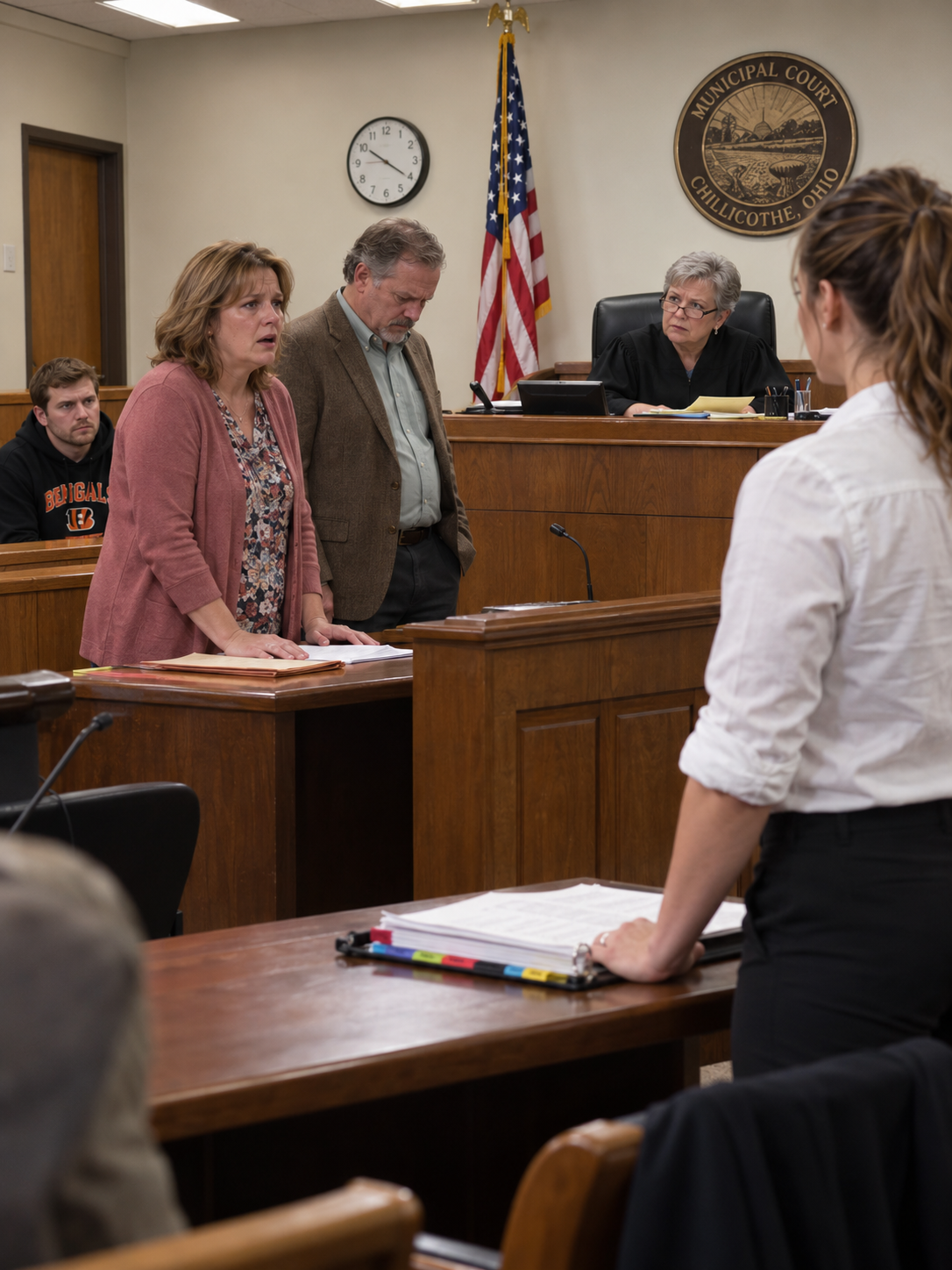
My parents demanded $6,000 to save their house and said my money had no other purpose
My parents demanded $6,000 to save their house and said my money had no other purpose because I didn’t have...
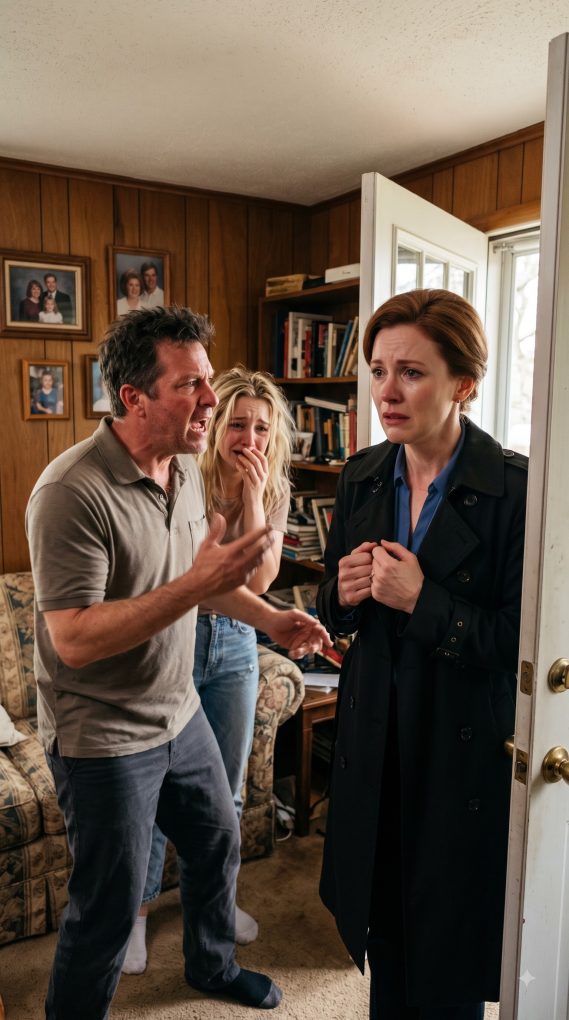
My parents skipped my wedding to attend my sister’s performance. But when my grand wedding aired live on national TV, they realized I was a millionaire. Days later, my family completely crumbled under guilt and jealousy. Dad threatened divorce, mom fell apart, and my sister exploded in rage.
My parents skipped my wedding to attend my sister’s performance. But when my grand wedding aired live on national TV,...

On our tenth anniversary, my wife left to spend the night with her ex, carrying an overnight bag. “He still knows how to make my heart race. You only know how to buy flowers,” she laughed. I glanced at his SUV and smiled. – Family
The woman in the photograph was my wife’s younger sister, Brooke.For several seconds, nobody spoke. Lauren stared at my phone...