THE SCHOOL TOLD AN EIGHT-YEAR-OLD GIRL TO LEAVE ITS GATE BEFORE THE CAMERAS ARRIVED—BUT THE NOTEBOOK SHE CARRIED EXPOSED A PROMISE THE TRUSTEES HAD BURIED – Life Story
The woman in the camel coat pointed at an eight-year-old girl as though she were a stain on the sidewalk.
Her mother had been told the school had never received their application—and now even standing outside its gates was apparently unacceptable.
But inside the girl’s battered notebook was a piece of paper the school had already tried to forget.
Outside the Photograph
The woman in the camel coat pointed at eight-year-old Wren Hartley as though she were a stain on the sidewalk.
“Can we move her before the admissions families arrive?”
The security guard looked at the girl, then at the school’s black iron gate. “She’s on the public sidewalk, Ms.
Reed.”
“Then ask nicely.” The woman lowered her voice, but not enough. “We cannot have that in the photographs.”
Wren did not cry.
She closed the worn notebook against her chest, stepped backward until her heels touched the curb, and whispered, “I’m sorry.”
At on a Thursday morning, Boston was cold enough to turn every breath white.
Parents in wool coats hurried children through the gates of Hawthorne Day Academy, whose stone entryway carried a banner reading EVERY MIND DESERVES A CHANCE TO GROW.
Beyond the glass doors, warm lights shone on polished floors and a display of paper planets made by third graders.
Wren looked at those planets longer than she looked at the woman who had embarrassed her.
Across the street, Sullivan Vale watched from the backseat of a dark sedan.
He had noticed the girl on previous mornings, always in the same square of pavement, always holding that notebook.
Until now he had assumed she was waiting for a ride.
What he had just heard made that explanation impossible.
“Should I keep going?” his driver, Mateo, asked.
Sullivan’s calendar showed a board call in nineteen minutes.
His phone was already vibrating with the impatience of people who considered an unanswered message an emergency.
He had built an education-software company by noticing neglected details.
Lately he had missed them outside spreadsheets.
“Pull over,” he said.
He crossed at the light.
Up close, the girl’s navy coat was carefully mended at one cuff.
Her shoes were clean, though the left toe had begun to separate from the sole.
Beside her stood a woman holding tea and an envelope bearing Hawthorne’s crest.
The woman was listening with tightly controlled politeness as Ms.
Reed spoke.
“We have no active application under that name,” Reed said. “And as I’ve explained, attending a scholarship information session does not constitute admission.”
“I understand the difference,” the woman replied. “I’m asking what happened to the paperwork I delivered.”
“The office has nothing to review.”
Wren tugged gently at the woman’s sleeve. “Mom, it’s okay.
We’re going to be late for Franklin.”
Franklin, Sullivan knew, was the neighborhood public elementary school.
Its bell rang forty minutes after Hawthorne’s.
The girl wasn’t missing school to stand here.
She had been making a detour on the way to a school she already attended.
Reed glanced toward a photographer arranging a family beneath the banner. “Then perhaps it’s time to go.”
The mother straightened. “We were already leaving.”
Sullivan stopped a few feet away. “Excuse me.
Did you say the application was lost?”
Both women turned.
Reed recognized him immediately; her shoulders changed before her expression did. “Mr.
Vale.
We didn’t know you were coming today.”
“I’m not coming inside.” He looked toward the mother. “Sorry to interrupt.
I heard you asking about a document.”
“Maris Hartley,” she said, making no move to shake his hand. “And I’d rather not discuss my daughter in front of an audience.”
It was a fair rebuke.
Sullivan moved back a step. “Of course.”
Wren, however, had opened her notebook.
Between multiplication problems, sketches of constellations, and a carefully lettered list titled THINGS I WOULD LEARN HERE, she kept a folded yellow sheet.
She held it out to her mother, not Sullivan.
“Maybe this is the one,” she said.
Maris stared. “Honey, where did you get that?”
“I kept it when we went to the office.
You said important papers need copies.”
Reed’s gaze moved to the yellow sheet.
For the first time, her practiced expression slipped.
Sullivan saw the school crest, a clerk’s initials, and the date printed beside a time stamp.
It was not an acceptance letter, nor a child’s wish disguised as evidence.
It was a receipt issued by Hawthorne’s own admissions office.
And across the bottom, in sharp black letters, were the words: APPLICATION RECEIVED — SEPTEMBER 9.
For several seconds, the only sound was the scrape of a rolling backpack across the pavement.
Reed recovered first.
“That acknowledges receipt at the front office,” she said. “It doesn’t establish that an application was complete or eligible for consideration.”
Maris looked at her. “You just told me nothing was received.”
“I said there was no active application.”
“Those aren’t the same thing.”
“No,” Reed replied, her voice becoming sharper. “They aren’t.”
Sullivan glanced at the photographer waiting near the gate.
The man had lowered his camera and was pretending to examine a lens cap.
“Could someone simply check the records?” Sullivan asked.
Reed turned toward him with renewed warmth. “Naturally.
If you’d like to come to my office, Mr.
Vale, I’d be happy to explain our process.”
“I’m not the applicant.”
The words landed quietly.
Reed blinked.
Maris folded the yellow receipt and returned it to Wren’s notebook.
Her hands were steady, but the skin around her knuckles had gone white.
“We have another school to get to,” she said. “Please send whatever explanation you have in writing.”
Reed promised she would.
Something in her expression suggested she was accustomed to promises being sufficient.
Maris took her daughter’s hand, thanked the security guard for allowing them to remain on the sidewalk, and walked toward the intersection.
Sullivan followed only far enough to speak without making the girl feel surrounded.
“Mrs.
Hartley?”
She turned reluctantly.
“I apologize for inserting myself into something personal.
I know the name of someone who might help clarify the scholarship rules, if you’d find that useful.”
Maris studied him.
“Are you offering to pay for her tuition?”
It was not the answer he expected.
“I hadn’t gotten that far.”
“Good,” she said. “Because I’m not standing here asking a stranger to buy my daughter a seat.”
Wren looked between them.
“Mom,” she whispered, “I only wanted to hear the bell.”
The warning bell rang behind them.
The girl turned instinctively.
Her expression softened as the sound traveled across the courtyard, bright and metallic against the cold air.
Then the doors closed.
Maris waited until the last echo faded.
“We appreciate your concern,” she told Sullivan. “But I need to get my daughter to school.”
He gave her his card without asking for a telephone number.
She accepted it, placed it inside her coat pocket, and walked away.
From the opposite curb, Sullivan watched Wren open her notebook once more while they waited for the crossing signal.
She made a tiny pencil mark beside Thursday on a hand-drawn calendar.
He wondered whether she was counting visits.
Or disappointments.
Back at the gate, Fiona Reed was speaking urgently into her phone.
She glanced toward the yellow notebook disappearing around the corner.
And whatever she was saying, she stopped when Sullivan looked at her.
The Girl Who Already Had a School
Franklin Elementary occupied a brick building six blocks south, with peeling green paint around its doors and a playground that smelled of wet leaves.
Wren liked Franklin.
That was the first thing Sullivan learned when Maris telephoned him two evenings later.
“She has a wonderful teacher,” Maris said. “She has friends.
She’s learning.
Please don’t turn this into some story about a child who has nowhere to go.”
Sullivan was standing in his home office overlooking the Charles River.
The room contained three monitors, a shelf of industry awards, and a framed photograph of his parents outside the public library where his mother had worked.
“I won’t,” he replied.
“Because that’s what people do.
They see the coat, the notebook, the expensive school, and they decide they understand everything.”
“I don’t understand everything.”
“That’s the first sensible thing you’ve said.”
He smiled despite himself.
Maris did not.
She explained that Wren attended Franklin every weekday, where her third-grade teacher, Mr.
Alvarez, challenged her with extra reading and science projects.
Hawthorne had become an object of fascination after they moved into the neighborhood in late August.
The academy had a larger library, a planetarium partnership, and an astronomy club that met twice a week.
Wren had discovered these things herself by reading publicly available material on library computers.
She wanted the school because of what she believed she could learn there, not because anyone had told her its name would make her important.
“And the scholarship?” Sullivan asked.
“Advertised as full assistance for children who show academic promise but whose families cannot afford private tuition.”
“Did you meet the financial requirements?”
“According to the public brochure.”
“Did they request documents?”
“Yes.
Income records, proof of residency, school reports.
Everything.”
“Did you submit them?”
“September ninth.”
Sullivan looked at the date he had written on a legal pad.
“Do you have copies?”
“I have every page.”
There was something almost defiant in her answer.
He liked that.
Maris explained that she worked in medical scheduling at a Boston hospital and handled evening inventory for a neighborhood pharmacy three nights a week.
She had left her former job in Worcester after the hospital department closed, and the relocation had consumed most of her savings.
Her rent was current.
Wren had food, clean clothing, books, and a safe home.
What Maris could not provide was a private-school tuition bill larger than her annual take-home pay.
“I don’t want you thinking we’re desperate for someone to rescue us,” she said.
“I’m beginning to understand that would be a mistake.”
A pause followed.
Then her voice softened.
“Wren made a schedule for Hawthorne before she ever applied.
She had reading on Monday, maps on Tuesday, science on Wednesday.
She even planned what she’d keep in a desk drawer.”
“Did she plan Thursday?”
“Astronomy.”
Sullivan looked toward the night sky beyond his windows.
The city lights had erased most of the stars.
“Would you be willing to meet someone who understands nonprofit education law?” he asked.
“Are you hiring a lawyer?”
“No.
I’m suggesting we find out what the school actually promised before deciding whether anything can be done.”
Maris considered that.
“I’ll talk to someone,” she said finally. “But Wren doesn’t become a publicity campaign.”
“She won’t.”
“And no photographs.”
“Agreed.”
“And don’t call my daughter extraordinary in front of her.”
That surprised him.
“Why?”
“Because she’s eight.
She shouldn’t have to be extraordinary to deserve a fair answer.”
The call ended.
Sullivan remained standing at his window for a long moment.
He had spent a decade telling investors that technology could make education more accessible.
It had taken a mother working two jobs to remind him that access was not a slogan.
The following afternoon, he visited a public library instead of his office.
He found Maris and Wren at a table near a window overlooking a small courtyard.
Wren was bent over her notebook, drawing the solar system with colored pencils so short that several barely extended beyond her fingers.
Maris had a folder beside her and hospital scheduling documents open on a laptop.
“Mr.
Vale,” Wren said, brightening.
“Sullivan is fine.”
“Mom says I shouldn’t call grown-ups by their first names unless they ask.”
“I just asked.”
She nodded gravely.
“Then hello, Sullivan.”
He sat across from them.
“What are you working on?”
“Saturn.”
“That looks complicated.”
“It’s mostly circles.”
“Some of my meetings are mostly circles.”
Wren laughed.
Maris lowered her eyes, though he caught the beginning of a smile.
A few minutes later, an attorney named Julian Cross joined them.
Julian wore a charcoal coat with a missing button and carried a leather bag that looked more experienced than expensive.
He had spent much of his career advising nonprofit organizations.
Unlike Sullivan, he did not introduce himself with an explanation of what he could accomplish.
He asked Maris what she wanted to know.
“Whether they rejected us,” she replied, “or simply stopped answering.”
Julian nodded.
“Those are different questions.
Let’s start there.”
He examined the receipt, the brochure, and the copies of the submitted documents.
He did not immediately announce wrongdoing.
Instead, he asked practical questions about dates, signatures, completeness requirements, and school policy.
Maris answered each one.
When she reached a particular page, she stopped.
It was a printed description of Hawthorne’s Open Gate Scholarship.
A paragraph stated that the program supported academically motivated children from families with substantial financial need.
Another promised individualized review.
At the bottom, in smaller print, was a sentence Wren had circled in blue pencil.
NO QUALIFIED APPLICANT WILL BE EXCLUDED FROM CONSIDERATION SOLELY BECAUSE OF FINANCIAL CIRCUMSTANCES.
Julian reread it.
“Interesting.”
Maris looked immediately wary.
“Interesting good or interesting bad?”
“Interesting enough that I want to find the documents behind it.”
Wren raised her hand.
Julian smiled.
“You don’t need permission, Wren.”
“I know.
I’m practicing.”
“What’s your question?”
“If the school already knows I can’t pay, why did they need me to tell them again?”
Nobody answered quickly.
Finally, Maris brushed a strand of hair behind her daughter’s ear.
“Sometimes forms ask the same thing in different ways.”
Wren considered that.
“Then they should use fewer forms.”
Julian laughed.
Sullivan didn’t.
He was looking at the brochure.
A wealthy donor had once given Hawthorne money specifically to prevent financial circumstances from keeping children away.
Somewhere between that promise and Wren’s yellow receipt, something had gone wrong.
Before leaving, Wren showed Sullivan the page where she kept a list of things she wanted to learn.
Cursive.
Fractions.
How library cards worked.
Why maps appeared different upside down.
The names of stars visible from Boston.
She had added one new question near the bottom.
WHO DECIDES WHEN A DOOR IS OPEN?
Sullivan pointed to it.
“Did your teacher give you that question?”
“No.”
“Where did it come from?”
Wren shrugged.
“Sometimes the front doors are open, but you still can’t go through them.”
She turned the page.
Sullivan watched her begin another careful drawing.
And he understood that the problem might be much bigger than one missing application.
The Promises Behind the Glass
Principal Evelyn Thorne did not resemble a villain.
That irritated Sullivan more than he expected.
She greeted him four days later in a bright office overlooking Hawthorne’s central courtyard.
Her gray hair was arranged in a neat twist, her navy suit was impeccably tailored, and the walls behind her displayed photographs of former students who had gone on to become physicians, scientists, artists, and teachers.
There was a handwritten thank-you note from a scholarship recipient among the awards.
She noticed him looking at it.
“One of our former students,” Evelyn explained. “She just finished medical school.”
“She was a scholarship student?”
“Yes.
Full tuition.”
“Through Open Gate?”
Evelyn’s fingers paused above a silver pen.
“No.
That was a different program.”
Sullivan sat.
He had asked Julian to accompany him, but Julian was delayed by a court appearance unrelated to the matter.
For once, Sullivan had to conduct a meeting without his preferred legal safeguard.
Evelyn offered coffee.
He declined.
“I’m here about the Hartley application.”
“Yes.
Fiona mentioned the misunderstanding.”
“Was it a misunderstanding?”
“That depends on how one characterizes an administrative error.”
“Was there an error?”
Evelyn folded her hands.
“We receive more applications than we have openings.
Some arrive incomplete.
Some families misunderstand scholarship qualifications.
Unfortunately, we cannot admit everyone.”
“I’m not asking you to.”
“Then what are you asking?”
“Where did her file go?”
Evelyn leaned back.
For the first time, Sullivan saw fatigue beneath her composure.
“Mr.
Vale, I run a school with four hundred and twenty students, seventy-two employees, aging facilities, and families who expect a level of service that becomes more expensive every year.
I don’t personally handle every admissions document.”
“Who does?”
“Ms.
Reed and her department.”
“Then why was Ms.
Reed unable to distinguish between no application and an inactive one?”
Evelyn’s jaw tightened.
“I’ll review the matter.”
Sullivan waited.
When no additional answer came, he removed the Open Gate brochure from his portfolio.
“Your school currently advertises this.”
Evelyn barely glanced at it.
“It’s one of our longstanding initiatives.”
“How many full scholarships has it awarded this year?”
She hesitated.
“I don’t have those figures in front of me.”
“Last year?”
“I would rather not guess.”
“Then send me the numbers.”
Her expression sharpened.
“Are you making a donor inquiry?”
“I’m making a factual inquiry.”
“That doesn’t automatically entitle you to confidential institutional information.”
“I’m not requesting student records.
I’m asking how many awards a publicly advertised program has made.”
The office became quiet.
Outside, a class crossed the courtyard in matching raincoats.
Evelyn looked toward them.
“I have devoted twenty-three years to this school,” she said. “I assure you, no one here wants children excluded because their families have less money.”
“I believe you.”
She looked back, surprised.
“Then perhaps you understand that good intentions still require budgets.”
“I understand budgets exceptionally well.”
“And?”
“And a budget tells people what they chose to protect.”
She did not respond.
When Sullivan left, he saw Fiona Reed standing near the reception desk.
She was speaking to a staff member and holding a stack of visitor badges.
At his approach, she stepped aside.
He noticed a yellow slip protruding from a folder on the counter.
The same paper stock as Wren’s receipt.
Fiona followed his gaze and closed the folder.
He walked out without commenting.
That afternoon, a third-grade teacher named Naomi Bell sent Maris an email.
It was brief.
She said she had seen Wren outside the gate and wondered whether Maris would be comfortable meeting at a café.
She also asked that Wren not be included in the initial conversation.
Maris forwarded the message to Sullivan with one sentence.
DO YOU KNOW HER?
He didn’t.
But he wanted to.
Naomi arrived at the café in a rust-colored sweater, carrying a canvas bag filled with graded spelling tests.
Her voice was calm and precise.
She explained that she had taught at Hawthorne for eight years.
She loved her students.
She believed in challenging work, patient instruction, and making children feel safe enough to ask difficult questions.
And she had become increasingly uncomfortable with the school’s scholarship announcements.
“Every September,” Naomi said, “we put a beautiful paragraph in the newsletter about welcoming talented children from every background.”
Maris watched her closely.
“What happens after September?”
Naomi looked down at her coffee.
“Most of the children who receive the larger tuition discounts were already enrolled.”
“Discounts?” Sullivan asked.
Naomi nodded.
“Families who can pay most of the tuition sometimes receive assistance to keep them from withdrawing.
It’s treated as enrollment retention.”
“That isn’t inherently improper,” Julian said.
He had joined them directly from his office.
“No,” Naomi agreed. “It isn’t.
But the Open Gate program was supposed to bring new students in.”
“How do you know?”
She reached into her bag and produced an old school newsletter.
On its faded cover, a retired teacher stood beside a smiling couple.
The headline announced a major gift establishing full scholarships for children who otherwise could not attend Hawthorne.
The donor’s name was Anton Beck.
Naomi tapped a paragraph near the bottom.
“His wife used to visit our reading classes.
She told us the purpose of the gift.
I remember because she said something that stayed with me.”
“What?”
“That a school isn’t generous when it lets a child through a door the child could already afford to open.”
Julian took the newsletter.
“Do you have evidence the fund was used improperly?”
“No.
And I won’t pretend I do.”
“Have you raised concerns internally?”
“Yes.”
“What happened?”
Naomi took a slow breath.
“I was thanked for my passion.”
Sullivan recognized that answer.
It was the kind of sentence organizations used when they wanted people to stop talking without making a threat.
Naomi continued.
“Two years ago, I asked whether teachers could nominate students for Open Gate awards.
The admissions office said nominations weren’t accepted anymore.”
“Why?”
“Financial review was centralized.”
“What does that mean?”
“I asked the same question.”
Maris opened Wren’s notebook to a drawing of the Hawthorne library.
There were careful rows of books and a tiny square marked MY DESK.
Naomi studied it.
Then she looked away.
“I’ve seen your daughter,” she said quietly. “And she’s not the only child I worry about.
She’s simply the one I can see from my classroom window.”
That evening, Sullivan and Julian examined Hawthorne’s public financial filings.
The academy was a nonprofit private school.
Its publicly reported scholarship spending appeared substantial.
But nonprofit financial statements did not always identify which individual restricted funds supported which awards.
Some spending was recorded as tuition assistance.
Some appeared as discounts.
Other figures reflected institutional grants funded from general operations.
Julian drew three columns on a legal pad.
“There’s what donors gave,” he said, “what donors were told the money would accomplish, and what the school actually did.”
Sullivan watched him write.
“Those numbers should match.”
“They should reconcile.
That’s not always the same thing.”
“Can we demand the records?”
“Not simply because you’re curious.
Donor restrictions are serious, but standing, privacy, and charitable oversight matter.
We need to find the people with the authority to request an accounting.”
“And if the fund was used exactly as permitted?”
“Then we’ll have learned something.
Don’t confuse disappointing policy with a legal violation.”
Sullivan was silent.
Julian removed his glasses.
“You’re used to finding a technical fault and fixing it.
This isn’t one of your software platforms.”
“I know.”
“Do you? Because there’s a child involved.
The minute you make this about winning, she becomes collateral.”
Sullivan looked toward the photograph of his mother outside the public library.
He remembered how proud she had been when her library received new books.
She had never asked whether the donors were wealthy.
She had only cared whether children could read them.
“I don’t want to win,” he said.
Julian closed the financial report.
“Good.
Then let’s find out whether someone else has already lost.”
The answer arrived the following morning.
Naomi forwarded a public event announcement to Maris.
Hawthorne’s library would be hosting a community literacy evening.
It was open to neighborhood families.
No application required.
No tuition payment.
No invitation from the admissions office.
Maris showed it to Wren.
The girl stared at the screen.
“Does that mean the library?”
“Yes.”
“The real library?”
“Yes.”
Wren closed her notebook.
For once, she had nothing to write.
A Name on the Inside
The first time Wren walked through Hawthorne’s doors, she did not run.
She stepped across the threshold with such care that Maris felt an unexpected ache beneath her ribs.
It was a Friday evening in November.
Rain polished the stone steps, and warm light spilled from the entrance onto the dark pavement.
Parents and children were arriving for the literacy event carrying umbrellas and library tote bags.
Hawthorne’s polished lobby smelled faintly of lemon cleaner, damp wool, and old paper.
Student artwork covered the walls.
A display of handmade constellations hung above a staircase.
Wren stopped beneath it.
“That’s Orion,” she whispered.
Maris smiled.
“Of course you know.”
“The three stars in the middle are his belt.”
“And what are the other ones?”
Wren began to answer, then looked toward the corridor.
“Mom.
Books.”
Naomi appeared beside the library doors.
“Welcome, Wren.”
The girl smiled shyly.
“Hi, Ms.
Bell.”
“Would you like to see the reading room?”
Wren nodded so vigorously that the blue ribbon in her hair moved.
Sullivan arrived a few minutes later and remained near the back of the group.
He had promised Maris he would not treat the event as a public demonstration.
He intended to keep that promise.
Inside the library, tables were arranged with picture books, novels, puzzles, and small projects for visiting families.
Tall windows overlooked the street.
Reading lamps cast warm pools of light across polished wooden surfaces.
Wren walked toward a shelf of astronomy books, then stopped when she recognized the view from one window.
She crossed the room slowly.
Beyond the glass stood the black iron gate.
And beyond the gate was the square of pavement where she had spent so many mornings.
“Mom?”
Maris joined her.
“That’s where we stand.”
“I know.”
Wren touched the window frame.
“It’s much closer from here.”
Maris swallowed.
“Yes, baby.”
“I always thought it was farther.”
Naomi approached carrying a blank cardstock name tag and a blue marker.
“For our book discussion tables,” she explained. “Everyone gets one.”
She placed the card beside Wren.
“Would you like to write your name?”
Wren looked down.
“Here?”
“Right here.”
The girl uncapped the marker.
Slowly, in her careful third-grade handwriting, she wrote ELOWEN HARTLEY.
Underneath, in smaller letters, she added WREN.
She positioned the card at the edge of the reading table.
Then she took a book from the shelf and sat down.
Maris watched her daughter settle into the chair.
Nothing extraordinary happened.
No music swelled.
No official made an announcement.
No photographer captured the moment.
A child sat down and opened a book.
Yet it took Maris several seconds to trust her own breathing.
Across the room, Sullivan noticed Evelyn Thorne speaking with two trustees.
She glanced toward Wren.
Her expression shifted almost imperceptibly.
Then Fiona Reed approached her and said something quietly.
Evelyn followed Fiona’s gaze to the table.
Sullivan looked away.
He would not make Wren’s first library visit another argument.
Twenty minutes later, he joined a small discussion about children’s science books.
Wren was explaining why the moon sometimes appeared during the day.
A boy in a green sweater disagreed.
“That doesn’t make sense.
The moon comes out at night.”
Wren considered his objection.
“The moon is still there when we can’t see it,” she said. “Sometimes the light is just wrong.”
The boy frowned thoughtfully.
Then he asked whether she wanted to help build a cardboard telescope.
She did.
For the next half hour, they worked together with tape, paper tubes, and colored pencils.
Maris stood nearby.
Sullivan joined her.
“She seems happy.”
“She is.”
“Would you consider accepting an individual scholarship if I could arrange one?”
Maris turned toward him.
He immediately regretted the question.
“I don’t mean to insult you.”
“I know you don’t.”
“It could be handled privately.”
“And the other children?”
He hesitated.
“What other children?”
“The ones Naomi hasn’t seen yet.
The families who were told not to bother applying.
The ones who don’t happen to stand somewhere a millionaire drives past.”
Sullivan glanced at the library table.
“I could establish a fund.”
“Maybe.
But I want to know what happened to the fund that already exists.”
He did not answer.
Maris folded her arms.
“I won’t pretend I haven’t imagined her walking through those doors every morning.
I have.
God, I’ve imagined it a thousand times.
But I don’t want her learning that rules only change when somebody important takes an interest.”
Sullivan looked at her.
“You’re right.”
“That must be painful to say.”
“More often than you’d think.”
She laughed softly.
It was the first easy moment they had shared.
Across the room, Naomi watched Wren finish decorating the cardboard telescope.
Then an announcement came over the library speaker.
The event would close in fifteen minutes.
Wren put her tools away carefully.
She returned her book to the correct shelf and checked twice that she had left nothing behind.
When Naomi approached, Wren handed her the name card.
“Can you recycle this?”
“You can keep it.”
“Really?”
“Of course.”
Wren slipped it between the pages of her notebook.
At the entrance, she turned for one final look at the library.
“It smells like I thought it would,” she said.
Maris squeezed her hand.
“What does it smell like?”
“Books and pencils and coats getting warm.”
Naomi smiled.
“That’s a good description.”
Wren looked up.
“Do you teach here every day?”
“Yes.”
“Then you’re very lucky.”
Naomi’s smile faltered.
She watched the girl walk away.
That night, Naomi remained at school to prepare Monday’s lessons.
The building was quiet except for the ventilation system and the occasional footsteps of the cleaning staff.
She was retrieving a shared curriculum file when she noticed a document attached to an internal staff announcement.
It was a revised admissions reference guide.
Most of the material concerned ordinary questions about deadlines and required forms.
Near the bottom was a new instruction.
APPLICANTS SEEKING FULL FINANCIAL SUPPORT SHOULD NOT BE ADVANCED TO COMMITTEE REVIEW WITHOUT PRIOR FINANCIAL CLEARANCE.
Naomi read it twice.
She knew the Open Gate brochure.
She knew what the donor had intended.
And she understood what this new instruction meant.
A child could satisfy the academic requirements and still never reach the people who decided scholarships.
All because the child needed the scholarship itself.
The following Monday, she requested a meeting with Evelyn.
Evelyn invited her into the office at lunchtime.
Naomi placed the admissions guide on the desk.
“Is this the current policy?”
Evelyn read the highlighted sentence.
“Yes.”
“Then what happens to applicants for the Open Gate program?”
“They’re assessed for funding availability.”
“Before academic review?”
“When necessary.”
“Doesn’t that reverse the process?”
Evelyn removed her glasses.
“Naomi, full scholarships are expensive.
They involve more than tuition.
Transportation, meals, books, additional support.
We have to be responsible.”
“I agree.”
“Then you understand the constraints.”
“I understand why constraints matter.
I don’t understand why we’re advertising a program while screening out the families it’s meant to serve.”
Evelyn’s expression hardened.
“Please be careful with that characterization.”
Naomi leaned forward.
“Has a child received a new Open Gate award this year?”
Evelyn said nothing.
“Last year?”
Still nothing.
“Evelyn, I’ve taught here eight years.
I love this school.
I’m asking because I don’t want us to become the kind of institution that mistakes its reputation for its purpose.”
The principal looked toward the courtyard.
“You think I don’t ask myself that?”
Naomi waited.
When Evelyn spoke again, her voice was quieter.
“We were operating at a deficit three years ago.
The board instructed us to stabilize enrollment.
Families were leaving after tuition increases.
We needed retention assistance to keep classrooms staffed.”
“So the fund was redirected.”
“I didn’t say that.”
“Then tell me what happened.”
Evelyn turned back.
“I’m not discussing financial decisions outside the appropriate process.”
Naomi understood that the meeting was over.
At the door, Evelyn added one final sentence.
“Please don’t let your concern for one child override your obligations to the students already here.”
Naomi stopped.
“I’m worried about all of them,” she replied.
That afternoon, Fiona Reed received an instruction to locate the Hartley application file.
She found it in an archived administrative folder.
The packet was complete.
Attached to the September ninth receipt was a note entered the following day.
FULL-AID DEPENDENT.
HOLD OUTSIDE COMMITTEE QUEUE PENDING DIRECTOR APPROVAL.
Beneath it were two initials.
F.R.
And E.T.
Fiona sat motionless at her desk.
Then she opened a new email.
What the Ledger Remembered
Lorraine Beck lived in a narrow brick townhouse overlooking a quiet garden in Beacon Hill.
She was eighty-one, wore dark green reading glasses, and served tea in porcelain cups that had belonged to her mother.
When Sullivan and Julian arrived, she did not ask about their careers.
She asked whether the little girl had gotten inside the library.
“Yes,” Sullivan said.
Lorraine smiled.
“Good.”
Then she placed a thick envelope on the table.
“My husband would have wanted her to see the books.”
Anton Beck had grown up in a working-class household outside Boston.
His mother cleaned offices at night, and he had completed much of his early education in public libraries.
He later founded a successful engineering company.
When he retired, he and Lorraine decided to establish a scholarship program at Hawthorne.
The original endowment agreement had been signed years earlier.
Lorraine still possessed the fully executed copy.
Julian opened it carefully.
The document described a restricted educational fund intended to support children with demonstrated financial need and strong academic motivation.
Its purpose was specific.
The program would provide full tuition assistance for qualifying new students, together with reasonable educational expenses necessary for attendance.
The agreement contemplated at least two new awards annually when funds and eligible applicants permitted.
It also required transparent reporting to the donors.
Sullivan read the provision twice.
“Did Hawthorne send you reports?”
“At first.”
“What changed?”
“My husband became ill.
Then he died.
I was told the program continued, though the reports became less detailed.”
Julian examined the schedules attached to the agreement.
“Have you ever approved a change in purpose?”
Lorraine shook her head.
“Never.”
“Did Anton?”
“No.”
Julian looked at Sullivan.
That mattered.
A restricted charitable gift was not the same as unrestricted operating revenue.
The school could face serious questions if it had used restricted scholarship funds for purposes inconsistent with the agreement.
But Julian remained cautious.
“We need the school’s accounting before drawing conclusions,” he said.
Lorraine tapped the document.
“Then request it.”
“They may not voluntarily provide every record.”
“Mr.
Cross, I am the surviving signatory to this agreement.
I’m prepared to ask formally.”
For the first time, Sullivan saw a clear route forward that did not depend on public outrage or his own wealth.
The donor could ask questions.
The board had fiduciary responsibilities.
And Massachusetts charitable authorities had oversight responsibilities if restricted charitable assets were being misused.
Lorraine opened another envelope.
Inside was a photograph of her husband sitting beside a group of students.
“He used to say that opportunity should not require an introduction to somebody important.”
She handed the photograph to Sullivan.
“Please don’t make this about you.”
He held it carefully.
“I won’t.”
Lorraine studied him.
“Men with your resources often believe good intentions excuse taking over.”
Sullivan smiled faintly.
“You and Mrs.
Hartley would get along.”
“I expect we would.”
The formal request went out two days later.
Julian prepared a letter identifying the restricted fund, the reporting provisions, and the records necessary to determine whether the school’s use of the money remained consistent with donor intent.
Lorraine signed it herself.
Meanwhile, Maris requested a written explanation of Wren’s application status.
The reply came from Fiona Reed.
It stated that the application had not advanced because full financial aid availability could not be confirmed.
Maris read the sentence several times.
Then she called Julian.
“Does that mean she’s rejected?”
“Not exactly.”
“Does it mean they reviewed her?”
“Apparently not.”
“Then what does it mean?”
Julian sighed.
“It means the school has made its process difficult to challenge by making the decision before its formal decision.”
Maris looked across the kitchen.
Wren was sitting at the table practicing cursive.
She had written her name six times.
The last version looked almost perfect.
Maris lowered her voice.
“I don’t know how much longer I can keep telling her to be patient.”
Julian paused.
“Then don’t tell her that.”
“What should I tell her?”
“The truth.
You asked.
The school hasn’t given you a fair answer yet.
And you’re deciding what to do next.”
That evening, Maris sat beside her daughter.
She explained that adults sometimes made rules that were confusing, and that the rules could take time to change.
Wren listened carefully.
“Am I bad at applying?”
“No.”
“Did I forget something?”
“No.”
“Then why won’t they read my schoolwork?”
Maris had no satisfying answer.
She took her daughter’s hand.
“I don’t know.”
Wren nodded.
Then she asked a question that hurt more than tears would have.
“Would you still be proud of me if I never went there?”
Maris pulled her close.
“Every single day.”
Wren rested her head against her mother’s shoulder.
“Okay.”
But after Maris went to wash the dishes, Wren opened her notebook.
She turned to the page titled THINGS I WOULD LEARN HERE.
For the first time, she erased something.
Friday — Astronomy Club.
The pink eraser left a pale mark on the paper.
Maris saw it from the kitchen doorway.
She did not ask why.
The next day, Sullivan received an unexpected call from Evelyn Thorne.
She sounded tired.
“Mr.
Vale, I understand you’ve contacted Mrs.
Beck.”
“Her decision.”
“I also understand you’re examining the school’s finances.”
“We’re asking for an accounting of a restricted fund.”
“Those records concern employees, families, and students who have done nothing wrong.”
“Then private information should be protected.”
“You make it sound simple.”
“I don’t think it’s simple.”
Evelyn was silent.
Then she spoke with a candor he had not heard before.
“Three years ago, we were facing the possibility of eliminating teaching positions.
We had families withdrawing because they couldn’t keep up with tuition.
The board wanted the scholarship budget used to stabilize enrollment.”
“Even the restricted funds?”
“I didn’t say that.”
“Then let the accounting answer it.”
Her breath caught slightly.
“Do you know what happens when a private school loses twenty families in one year? You don’t simply lose tuition.
You lose the ability to maintain class sizes.
Teachers leave.
Programs collapse.
And the children who remain pay the price.”
“I understand the argument.”
“Then you understand why we made difficult decisions.”
Sullivan looked at the photograph of Anton Beck on his desk.
“Difficult decisions still have to be lawful and honest.”
The call ended.
An hour later, Naomi contacted Maris.
Her voice sounded strained.
“I need to tell you something.”
“What happened?”
“There’s an internal directive about applicants who require full aid.
I raised concerns about it.
I’m not authorized to send you school documents.”
Maris listened.
“Then don’t.”
Naomi hesitated.
“I thought you should know there may be a separate screening step the brochure doesn’t describe.”
“Thank you.”
“I can’t promise this won’t affect my job.”
Maris closed her eyes.
“I don’t want you risking everything for us.”
Naomi was quiet.
Then she said, “It’s not only about you anymore.”
That afternoon, Hawthorne’s board chair called an emergency meeting.
The trustees received Lorraine Beck’s letter and a preliminary accounting summary.
Several members were shocked to discover that the Open Gate fund had been used, at least in part, to support tuition discounts for families already attending Hawthorne.
The finance committee maintained that these expenditures qualified as educational assistance.
Others disagreed.
A trustee named Margaret Sloan requested the original gift agreement.
When it was placed before her, she read the purpose clause.
Then she looked around the room.
“Where are the new students?”
No one answered.
She turned to the financial report.
“If this fund exists to open the door to children who cannot afford the school, why have we been using it to persuade families who are already inside not to leave?”
Evelyn sat at the far end of the table.
For the first time in years, she did not have a prepared response.
The Price of a Quiet Solution
The first newspaper article appeared on a rainy Wednesday.
It did not identify Wren by her full name.
It did not publish her photograph.
At Maris’s insistence, the reporter described her only as a Boston third grader whose family had applied for a need-based scholarship at a private academy.
The article focused on Hawthorne’s published claims, the dormant Open Gate awards, and donor questions about how the funds had been administered.
Sullivan gave no interview.
Lorraine Beck provided one carefully prepared statement.
She wanted the school to explain whether her husband’s gift had served the children it was intended to help.
By noon, the article had spread across local parent groups.
By evening, former applicants were contacting the reporter.
Some said they had received confusing instructions.
Others described being encouraged to postpone applying until they could demonstrate an ability to pay part of the tuition.
Not every account proved misconduct.
But together, they raised an uncomfortable question.
Was Hawthorne screening out the very families its scholarship materials appeared to invite?
At Franklin Elementary, Wren noticed the change before anyone explained it.
A classmate asked whether she was the girl on the news.
Wren said she didn’t know.
Another child said his mother thought rich schools were unfair.
Wren replied that Hawthorne had a very nice library.
By lunchtime, she wished no one had asked.
Mr.
Alvarez found her sitting alone near the classroom bookshelf.
He sat in the chair beside her.
“Rough morning?”
“A little.”
“Want to tell me?”
Wren considered him.
“Are people mad at the school because I stood outside?”
He leaned forward.
“People are asking questions because adults made decisions.
That’s different.”
“I didn’t want anyone in trouble.”
“I know.”
“Did I do something wrong?”
“No.”
Wren looked at the floor.
“Sometimes when everyone talks about something, it feels like it’s your fault even if nobody says so.”
Mr.
Alvarez sat quietly with her.
Then he opened a book of constellations.
“Would you help me choose a page for tomorrow’s science lesson?”
Wren nodded.
He did not ask her to be brave.
He gave her something useful to do.
That mattered more.
Across town, Fiona Reed was summoned to a meeting with the school’s outside counsel.
She arrived expecting to answer questions about recordkeeping.
Instead, she was shown an email she had sent to Evelyn in September.
The message listed several families whose applications had been held outside committee review because their financial-aid requests exceeded available allocations.
The Hartleys were among them.
Evelyn’s reply instructed Fiona to maintain the hold until the board established a funding position.
The attorney asked whether the families had received notice that their applications would not be considered.
Fiona lowered her eyes.
“They received standard status communications.”
“Were those communications accurate?”
“We didn’t intend to reject them.”
“That wasn’t my question.”
Fiona folded her hands.
“We didn’t want to tell families there was no path forward when the school hadn’t formally closed the program.”
The attorney made a note.
Fiona suddenly understood how that distinction sounded.
She had told herself she was following a process.
Now, looking at the correspondence, she could see that the process had allowed the school to avoid saying no while making yes nearly impossible.
Two days later, Maris received an invitation to meet with Evelyn and a representative of the board.
Julian accompanied her.
Sullivan did not.
Maris had asked him to stay away.
She wanted Hawthorne to speak to her as a parent, not as someone standing beside a wealthy benefactor.
The meeting took place in a conference room with cream-colored walls and a long oak table.
Evelyn looked exhausted.
The board representative, a man named Daniel Price, placed a folder before Maris.
“We believe there may be a constructive way to resolve your daughter’s individual situation,” he began.
Maris opened the folder.
Inside was an offer of a full tuition award for Wren beginning the following January, subject to normal enrollment requirements and available placement.
The scholarship would cover books and transportation.
For one overwhelming second, Maris imagined Wren at a desk near the library window.
Then she turned the page.
The agreement included confidentiality provisions regarding the application dispute and restrictions on public statements concerning the school.
Maris stared at the paragraph.
“Why is this here?”
Daniel spoke carefully.
“The school hopes to avoid unnecessary reputational damage while addressing your family’s concerns.”
“Are you asking me not to discuss what happened?”
“We are proposing mutual confidentiality regarding the dispute.”
Maris looked at Evelyn.
“Would my daughter still have the scholarship if I refused this paragraph?”
Evelyn did not answer immediately.
Daniel leaned forward.
“Mrs.
Hartley, this is a generous offer.”
Maris closed the folder.
“Then it shouldn’t need a price attached.”
Julian said nothing.
The decision belonged to her.
Daniel’s expression hardened.
“Perhaps we should consider the practical benefits before abandoning a mutually agreeable solution.”
Maris looked him directly in the eye.
“I have considered them.
Every night since September.”
“You’re turning down an opportunity most families would welcome.”
“I’m turning down silence.”
Evelyn shifted in her chair.
“Maris, nobody is asking your daughter to be silent.”
“No.
You’re asking me.”
The room became still.
Maris pushed the folder back across the table.
“I would be happy for Wren to attend Hawthorne through a fair process.
But I will not sign an agreement that makes our experience disappear.”
Daniel took the folder.
“Then we may not be able to proceed with these terms.”
Maris stood.
“I understand.”
Outside the building, cold rain struck the sidewalk.
She walked three blocks before stopping beneath the awning of a closed florist.
Her hands were shaking.
She called Sullivan.
“I said no.”
He was silent for a moment.
“Are you okay?”
“No.”
She laughed once, bitterly.
“I just turned down the thing my daughter has wanted more than anything.”
“You turned down a confidentiality agreement.”
“That distinction doesn’t feel very comforting right now.”
He let the silence remain.
Finally, she said, “Please don’t tell me I was brave.”
“All right.”
“Or that everything will work out.”
“I won’t.”
She stared at the rain.
“Tell me I didn’t make a selfish decision.”
Sullivan exhaled.
“I can’t decide that for you.
But I think you made a decision you could explain to your daughter without asking her to hide.”
Maris pressed her fingers against her eyes.
For several minutes, she stood beneath the awning.
Then she walked home.
When Wren asked about the meeting, Maris told her the school had offered a place but wanted her to agree not to discuss their experience.
Wren listened quietly.
“Did you say no because of me?”
“Yes,” Maris answered. “And because of the other families.”
Wren looked down at the notebook on her lap.
“Does that mean I can’t go?”
“I don’t know.”
The girl nodded.
She did not argue.
That was somehow worse.
At bedtime, Maris found the blue pencil case Sullivan had given Wren sitting unopened on her desk.
Wren was already beneath the blankets.
“Don’t you want your pencils?”
“I’m saving them.”
“For what?”
Wren turned toward the wall.
“In case I ever need them there.”
Maris sat beside her until she fell asleep.
In the dark, she wondered whether principles were easier to defend when you were not the one watching your child pay for them.
The next morning, Wren did not ask to visit Hawthorne’s gate.
She went straight to Franklin.
At , the familiar square of pavement stood empty.
When Hope Became a Liability
Naomi Bell was placed on paid administrative leave the following week.
The school stated that it needed to review internal communications and confidentiality procedures.
No public accusation was made against her.
But her classroom was assigned a substitute, and her school email access was restricted while the review proceeded.
Naomi spent her first morning at home sitting at the kitchen table, staring at a lesson plan she could no longer teach.
Her husband, David, placed a mug of coffee beside her.
“You did what you thought was right,” he said.
“That doesn’t mean I did it well.”
“Did you share student records?”
“No.”
“Did you fabricate anything?”
“No.”
“Then what are you afraid of?”
She looked at him.
“That they’re going to make the other teachers afraid to ask questions.”
At the hospital, Maris received a warning about her recent schedule changes.
She had used personal leave for meetings, but her supervisor needed dependable coverage.
The pharmacy also reduced her evening hours after a staffing reorganization.
Neither development involved Hawthorne.
That almost made it harder.
Life was continuing its ordinary demands while Maris was consumed by something she had not planned to fight.
A rent increase notice arrived that Friday.
She placed it beneath a stack of unopened mail.
That evening, Sullivan came by with Julian to discuss the next steps.
Wren was visiting a friend from Franklin.
Maris had made soup and left three mismatched bowls on the table.
Julian explained that Lorraine Beck’s formal request had prompted Hawthorne’s trustees to authorize a limited independent review.
The school’s legal advisers were examining the original gift restrictions and subsequent allocations.
Depending on the findings, the board might need to restore restricted assets or make other corrections.
Lorraine had also sought guidance from the Massachusetts Attorney General’s charitable oversight division.
Nothing was guaranteed.
There would be no instant courtroom decision requiring Hawthorne to admit Wren.
The law could help protect charitable funds and enforce applicable obligations.
It could not simply transform every disappointed applicant into an enrolled student.
Maris listened.
“So the review might prove the school mishandled the fund, and Wren could still be rejected?”
“Yes,” Julian said.
She looked away.
“Then what have we accomplished?”
Julian took his time.
“You’ve forced a question that should have been answered years ago.
But I won’t pretend that makes the next few weeks easy.”
Sullivan leaned forward.
“I could still fund a separate scholarship.”
Maris looked at him sharply.
He raised a hand.
“I’m not saying you should accept.
I’m saying the option exists.”
She studied the soup between them.
Then she asked quietly, “Why is it so hard for people to let someone struggle without buying an ending?”
Sullivan recoiled.
She immediately regretted the harshness.
But she did not retract the question.
He sat back.
“Because I don’t know what else to do when I can see a problem and have the resources to fix part of it.”
“And if the problem isn’t yours to fix?”
He was silent.
Julian rose to make another pot of tea.
He understood that neither of them needed a witness to the rest of the conversation.
Sullivan looked toward the worn notebook on the shelf.
“You’re right,” he said finally. “I’ve spent years being the person who signs the check.
It feels useful.
It also means I sometimes stop listening after I decide what the solution should be.”
Maris’s expression softened.
“I don’t want you to stop helping.”
“I know.”
“I just don’t want Wren becoming proof that generosity works when the institution itself hasn’t changed.”
He nodded.
“I hear you.”
For the first time, she believed he really did.
Two days later, Wren asked her mother to take her to the public library.
They sat near the children’s section while rain tapped against the windows.
Wren had stopped making marks on her Hawthorne calendar.
Instead, she was copying a map of the night sky.
Maris watched her for a while.
“Do you still want to go there?”
Wren kept drawing.
“Yes.”
“Why haven’t you asked to visit?”
The girl pressed her pencil too hard.
The tip broke.
She stared at it.
“Because I think they don’t want me looking anymore.”
Maris closed her eyes.
“Honey—”
“I heard the lady at the gate.
She didn’t want me in the picture.
Maybe if I stop coming, they won’t be mad.”
Maris moved her chair closer.
“You don’t have to earn the right to stand on a sidewalk.”
Wren nodded without looking up.
After a moment, she whispered, “But I don’t want everybody fighting because I like books.”
Maris took the broken pencil.
She sharpened it with the small metal sharpener from Wren’s case and handed it back.
“You’re allowed to like things,” she said. “Even things that other people make difficult.”
Wren looked toward the window.
“Mom?”
“Yes?”
“If they let me go, will Ms.
Bell still be there?”
Maris hesitated.
“I don’t know.”
“Then maybe I don’t want to go unless she can teach again.”
The sentence changed something inside Maris.
Until that moment, the struggle had seemed to be about winning a place for Wren.
Now she understood that her daughter had already formed attachments to people inside Hawthorne.
Those people could be hurt by the school’s decisions, too.
And Wren was beginning to see the cost.
That night, Maris called Naomi.
She did not ask her to speak to a reporter or reveal another document.
She asked whether Naomi wanted company.
An hour later, the two women sat at Naomi’s kitchen table, drinking tea while David prepared sandwiches.
They talked about teaching, children, shifts, exhaustion, and the ordinary humiliations of trying to do good work inside imperfect institutions.
At one point, Naomi said, “I’m afraid I won’t get my classroom back.”
Maris reached across the table.
“I’m afraid I won’t get my daughter’s hope back.”
They sat with that truth.
Neither tried to repair the other.
Before Maris left, Naomi gave her a small envelope.
Inside was a note addressed to Wren.
It contained no confidential information, no promise of admission, and no reference to the dispute.
Only a reading recommendation.
And beneath it, one sentence.
GOOD READERS DON’T NEED PERMISSION TO KEEP ASKING QUESTIONS.
Maris carried the note home.
Wren read it twice.
Then she taped it above her desk.
The next morning, she opened her notebook for the first time in several days.
She wrote a new question.
IF THE SCHOOL CHANGES, HOW WILL WE KNOW?
The Vote No One Could Buy
The independent review took eighteen days.
During that time, Hawthorne’s trustees discovered that the Open Gate scholarship fund had not been emptied or stolen.
The problem was more complicated.
For several years, distributions from the restricted endowment had supported tuition assistance for already-enrolled students, including families whose financial circumstances did not match the program’s original stated purpose.
Some expenditures had been classified as retention aid.
Other amounts had been held back because administrators anticipated future operating needs.
The reports sent to Lorraine Beck had combined the Open Gate program with broader institutional scholarship figures, obscuring the difference.
The review also found that the admissions office had used a preliminary financial screen to hold applications from families seeking full aid.
Those applicants had often received vague status notices rather than clear committee decisions.
Wren’s application was one of several affected files.
The reviewers did not claim every tuition discount was improper.
But they found serious departures from the scholarship’s documented purpose and weaknesses in the school’s controls over restricted gifts.
The board’s lawyers recommended corrective action.
The school’s finance committee objected to the cost.
Evelyn Thorne was called before the trustees again.
She arrived with a binder of budget reports and the kind of exhaustion that no makeup could conceal.
Margaret Sloan, now chairing the special review committee, spoke first.
“Evelyn, did you approve the September admissions hold?”
“Yes.”
“Did you understand that it would prevent certain applicants from reaching the academic committee?”
“Yes.”
“Why?”
Evelyn looked down.
“Because we had not authorized new full-aid awards.”
“Yet we continued advertising them.”
“Yes.”
“Did you raise the inconsistency with the board?”
“I raised budget concerns.”
“That isn’t what I asked.”
Evelyn removed her glasses.
For several seconds, she simply sat there.
Then she said, “No.
Not clearly enough.”
The room fell silent.
She continued.
“When the finances became difficult, we treated scholarships as an allocation problem.
We convinced ourselves that helping families stay was close enough to helping new families arrive.”
She looked at the original Beck agreement.
“It wasn’t.”
A trustee asked why she had not stopped the advertising.
Evelyn’s answer was painful in its simplicity.
“Because withdrawing it would have meant admitting we’d stopped doing what we told people we were doing.”
No one spoke.
At the far end of the table, Daniel Price stared at his notes.
The review committee then discussed the proposed corrective plan.
Hawthorne would restore the improperly allocated amounts to the restricted fund from unrestricted reserves over an independently supervised schedule.
It would publish clear financial-aid criteria, separate restricted scholarship reporting from general tuition discounts, and appoint an independent committee to evaluate need-based applications.
Admissions screening procedures would be revised.
Families would receive written explanations of application status and a defined appeal route.
The board would also establish a formal mechanism for reviewing compliance with donor restrictions.
Several trustees supported the recommendations.
Others worried about the financial consequences.
“Two new full scholarships each year create long-term obligations,” one argued. “We cannot promise what we cannot sustain.”
Lorraine Beck had been invited to address the trustees.
She stood slowly.
“My husband understood arithmetic,” she said. “He built a company.
He knew what recurring obligations meant.”
She placed the original agreement on the table.
“That is why he funded an endowment.
He didn’t give you a slogan.
He gave you resources with instructions.”
The trustee looked away.
Lorraine continued.
“If the resources cannot support the stated commitment in a particular year, then report that honestly and address it properly.
But don’t quietly change the beneficiaries because an honest explanation would embarrass you.”
The room was silent.
Then Margaret Sloan introduced one final item.
Maris Hartley had requested permission to submit a short statement.
She had been offered the opportunity to attend privately but declined to bring Wren before the trustees.
She did not want her daughter questioned as though she were responsible for proving the school’s failures.
Instead, she had written a letter.
Margaret read it aloud.
“My daughter attends Franklin Elementary, where she has a teacher who cares about her, friends who make her laugh, and books she loves.
We are grateful for that school.
“She also dreams of studying astronomy at Hawthorne.
She read your website, followed your curriculum announcements, and worked through lessons on her own because your school appeared to offer opportunities she could not find elsewhere.
“When we applied, we did not expect admission.
We expected consideration.
“We were told our documents had not been received.
Later, we learned they had been received but held outside the normal review process because we needed the financial assistance the scholarship supposedly existed to provide.
“I am not asking you to admit my daughter because someone wealthy noticed her.
“I am asking you to decide whether your published standards mean what they say.
“If she is not academically eligible, tell us honestly.
“If the program has no available funding, explain that honestly.
“But do not invite families to hope and then make their applications disappear because their need is inconvenient.
“My daughter once told me she wanted a place where people expected her to be there.
“I cannot make you give her that place.
“I can only ask you to become a school that keeps its word.”
Margaret lowered the letter.
Evelyn sat very still.
Then Maris’s second page was read.
It was a short note from Wren, included with her mother’s permission.
Wren had written it herself.
“Dear Hawthorne,
“I liked your library very much.
The books were nice, and the tables were big enough for drawing maps.
“I have a school already, and my teacher is good.
I don’t want people to think I don’t like Franklin.
“I wanted to go to Hawthorne because I thought I could learn more about the stars.
“I am not asking you to let everyone into every school.
I know classrooms have only so many chairs.
“But if you tell children they can try for a chair, I think you should read their papers before you decide.
“Also, I hope Ms.
Bell gets to teach again.
“Thank you for reading my letter.
“Wren Hartley.”
Margaret folded the page.
For a long time, nobody moved.
Then one trustee asked whether the Hartley application had ever received an academic review.
The answer was no.
Another asked whether other applicants had been held under the same preliminary screen.
The answer was yes.
A third asked whether the school could reasonably maintain its existing promotional statements without changing the process.
The independent reviewers said it could not.
Margaret looked around the room.
“Then we have a decision to make.”
The vote was not unanimous.
Several trustees argued for postponement, additional financial modeling, or narrower changes.
But a majority approved the corrective plan, including restoring the restricted scholarship assets, implementing independent financial-aid oversight, and reopening affected applications for genuine review.
The board also instructed the school to discontinue any application screening practice inconsistent with published criteria.
Existing students’ private financial information would remain protected.
The decision was institutional, not ceremonial.
No judge ordered a child admitted.
No millionaire purchased an outcome.
The school had been forced to confront its own records, and the people responsible for governing it had chosen to act.
Evelyn Thorne offered her resignation as principal.
The board accepted it, effective at the end of the term, while arranging an orderly transition.
Fiona Reed was removed from admissions decision-making duties pending completion of the personnel review.
The school also determined that Naomi had not improperly disclosed confidential student information.
Her administrative leave ended.
The board committed to establishing clearer protections for employees who raised good-faith compliance concerns.
After the meeting, Margaret called Maris.
“I can’t promise your daughter a place,” she said. “Her application still has to be reviewed against the standards and available openings.”
Maris closed her eyes.
“I understand.”
“But the committee will actually read it.”
For the first time in weeks, Maris felt the smallest movement of relief.
Not because the answer was yes.
Because the answer would finally be real.
The next day, Hawthorne began contacting families whose applications had been held outside review.
Several had moved on.
Some no longer wanted to apply.
Others requested reconsideration.
Wren’s academic records were submitted to the newly constituted committee.
Her teacher at Franklin provided an honest recommendation describing her strong reading skills, curiosity about science, and occasional tendency to rush through arithmetic when she became excited.
Naomi did not participate in the admissions decision.
She had already been involved in the dispute and wanted the process to remain independent.
Sullivan was not informed of the committee’s deliberations.
For once, he did not ask to be.
Two weeks passed.
Then, on a clear December afternoon, a letter arrived at the Hartley apartment.
Maris recognized the Hawthorne crest immediately.
Wren was sitting at the kitchen table, making a paper model of the moon.
“Is it from them?” she asked.
“Yes.”
“Can we open it together?”
Maris sat beside her.
Her fingers slipped beneath the envelope flap.
The letter explained that Wren’s application had been reviewed, that she met the academic and financial eligibility requirements, and that an opening was available for the January term.
She had been offered an Open Gate Scholarship covering tuition and the necessary school expenses identified in the program.
No confidentiality agreement was attached.
No statement was required.
No photograph had been requested.
Maris read the letter aloud once.
Then she read it again because Wren did not speak.
Finally, her daughter touched the page.
“Does that mean I can go?”
Maris nodded.
“If you still want to.”
Wren looked up.
“Will I have to stop being friends with people at Franklin?”
“No, sweetheart.
You can still see your friends.”
“Will Mr.
Alvarez be sad?”
“Maybe a little.
But he’ll be happy you’re getting something you worked hard for.”
Wren thought about that.
Then she asked, “Do I get to choose?”
Maris held her gaze.
“Yes.”
The girl looked toward her notebook.
For weeks, adults had spoken about access, accountability, charitable restrictions, and admission procedures.
Now the decision was hers.
She opened the page titled THINGS I WOULD LEARN HERE.
The erased Friday line was still faintly visible.
Wren picked up a pencil.
She wrote the words again.
FRIDAY — ASTRONOMY CLUB.
Then she looked at her mother.
“I want to go.”
Maris pulled her into an embrace.
They stayed that way while the afternoon sunlight spread across the kitchen table.
The letter lay open beside them.
This time, no one needed to hide it.
The Morning the Gate Opened
Wren’s final week at Franklin was harder than she expected.
Mr.
Alvarez gave her a small astronomy book with a note inside the cover.
KEEP ASKING GOOD QUESTIONS.
Her classmates signed a card decorated with crooked stars and a drawing of a rocket.
Wren cried when she read it.
She had spent so long imagining what Hawthorne could give her that she had barely considered what she would miss.
Maris let her grieve without trying to make the new beginning erase the old one.
On the evening before her first day, they packed her backpack together.
The worn notebook went in first.
Then the blue pencil case.
Then a library book she needed to return.
Wren examined her new uniform in the mirror.
It fit properly, though one sleeve was a little long.
Maris folded the cuff.
“There.”
Wren smoothed the fabric.
“Do I look like I belong?”
Maris turned her gently toward her.
“You looked like you belonged before you had the uniform.”
Wren considered that.
“Even when I was outside?”
“Especially then.”
The following morning, Boston was bright and cold.
A thin layer of frost silvered the edges of the sidewalk.
At , Wren arrived at the Hawthorne gate with her mother.
The same black iron bars stood against the winter sky.
The same banner hung above the entrance.
The same bell waited to ring.
But the square of pavement was no longer where she intended to stay.
Naomi stood inside the courtyard beside the new admissions director.
When she saw Wren, she smiled.
“Good morning, Elowen Hartley.”
Wren stopped.
Naomi stepped closer.
“We’ve been expecting you.”
The girl looked at her mother.
Maris nodded.
Wren walked through the gate.
She paused only once, resting two fingers against the cold iron.
On the other side, Sullivan stood beside Lorraine Beck.
Neither had been invited to give a speech.
They had come because Maris had said they could.
Sullivan watched Wren enter the courtyard.
“Your husband would have liked this,” he said.
Lorraine smiled.
“He would have liked the paperwork even more.”
Sullivan laughed.
She looked toward the school.
“The important thing is whether the next child gets a fair chance without needing this much attention.”
“That will take work.”
“Yes,” Lorraine said. “Most things worth keeping do.”
Wren crossed the courtyard toward Naomi.
She was no longer watching through a window.
She was carrying her own books toward a classroom.
Before entering, she turned back and waved.
Maris waved until her daughter disappeared inside.
Then she stood quietly on the sidewalk, feeling the strange emptiness of a morning that had finally changed.
Sullivan approached.
“How are you?”
Maris looked at the gate.
“Proud.
Relieved.
Terrified.
Probably late for work.”
He smiled.
“Sounds reasonable.”
She looked toward the entrance.
“Do you think they’ll keep their promises?”
Sullivan considered the question.
“The new oversight committee has real responsibilities now.
Lorraine will keep asking questions.
The teachers will, too.”
“And you?”
“I’ll keep supporting access programs where I can.
But I think I’ve learned to listen before deciding how.”
Maris nodded.
“Good.”
Several weeks later, Hawthorne published its revised scholarship guidelines and established a regular reporting process for restricted aid.
The independent review remained available to the appropriate oversight authorities, and the board continued correcting the financial practices it had allowed to drift.
The school’s reputation did not recover overnight.
Nor should it have.
Trust required evidence.
Naomi returned to her classroom.
Evelyn left Hawthorne at the end of the term, carrying both the consequences of her decisions and the knowledge that she had finally stopped defending them.
Fiona completed the personnel review and did not return to her former admissions role.
There were no dramatic public punishments.
Only difficult, ordinary accountability.
One Friday afternoon in February, Wren stayed after astronomy club to finish a drawing.
The library was nearly empty.
She sat at the window overlooking the street, her notebook open beside a small telescope diagram.
Outside, a woman and a boy were standing near the gate, studying a sign announcing the next scholarship information session.
The woman looked uncertain.
She checked a folded paper in her hand.
Wren recognized the expression immediately.
She packed her pencils and walked toward the entrance.
Naomi saw her from the circulation desk.
“Everything okay?”
Wren nodded.
“I think someone has a question.”
Outside, she approached the woman politely.
“Are you looking for the scholarship office?”
The woman smiled hesitantly.
“Yes.
Do you know where it is?”
Wren pointed through the gate.
“Go through those doors.
The office is on the left.”
The woman thanked her.
The boy looked at Wren’s notebook.
“Do you go here?”
Wren smiled.
“Yes.”
“Is it hard?”
“Sometimes.”
“Do they have good books?”
“The library is my favorite place.”
He glanced toward the building.
“Do you think they’d let me see it?”
Wren considered the question.
Then she looked toward Naomi, who had come to the doorway.
Naomi smiled.
“There’s a public library visit next Saturday,” she told the woman. “Everyone’s welcome.
I can give you the details.”
Wren watched the boy brighten.
She remembered standing on that same pavement, wondering whether the school would ever recognize her name.
Now she knew something she hadn’t understood then.
A gate could open for one child and still remain closed to others.
The important work was making sure it did not.
She stepped aside so the woman and her son could approach the entrance.
And this time, the door stayed open.
Recommended Stories
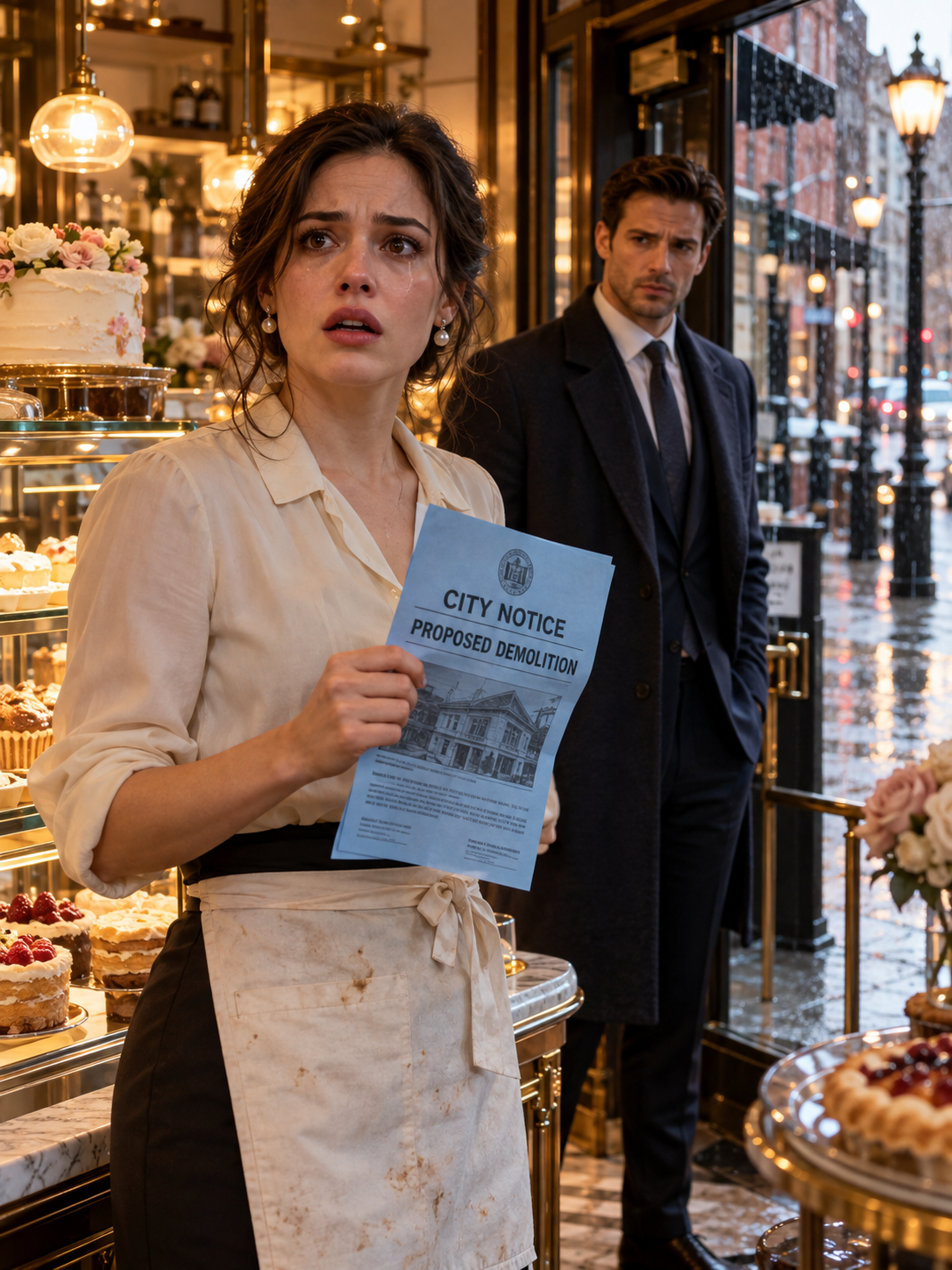
The Developer Offered to Save Her Grandmother’s Bakery in Exchange for Six Months of Her Time—Then a City Notice Exposed What His Company Still Planned to Demolish – Life Story
Regina Berry found the demolition notice taped to her grandmother’s bakery window five weeks after signing an agreement with the...

MY EX-HUSBAND TURNED OUR TEN-YEAR HIGH SCHOOL REUNION INTO A PUBLIC TRIAL OF MY NEW LIFE—THEN HE DISPLAYED THE ONE PAINTING HE SWORE I WOULD NEVER SEE AGAIN – Life Story
He raised his glass and called me a woman who had sold her dreams. By the time he finished, ninety...

THE MILLIONAIRE CAME TO BUILD A TOWER, BUT A LITTLE GIRL PLANTING FLOWERS ON HIS CONSTRUCTION SITE REVEALED THE CITY’S FORGOTTEN PROMISE AND A SECRET SOMEONE HAD BURIED – Life Story
The excavator’s bucket stopped above a little girl wearing a yellow coat. Blaze Ashford had come to break ground on...