A BROKE GRANDMOTHER RISKED HER LAST WORKING CAR TO SAVE NINE HELLS ANGELS IN A BLIZZARD—THEN ONE RIDER RECOGNIZED THE FACE EVERYBODY ELSE HAD FORGOTTEN – Life Story
Nine motorcycles lay like broken shadows across a frozen Montana highway.
Her car was dying, and the nine strangers in leather vests might not survive another hour.
But before the storm ended, one of those men would recognize a woman he had spent decades trying to find.
Her Buick was still sliding when Alice Brooks saw the first man lying faceup in the snow.
Eight motorcycles had gone down across the narrow mountain road.
Their headlights made crooked yellow tunnels through the blizzard.
Beyond them, figures in black leather lay scattered against the guardrail, barely moving.
Alice hit the brakes again, though she knew better.
The tires shuddered over ice.
Her car turned sideways, stopped within a few feet of a fallen bike, and died.
For a second, she heard nothing but the windshield wipers dragging uselessly over frozen glass.
“No,” she whispered, twisting the ignition. “Not here.”
The engine clicked.
She tried again.
Another click.
Her phone showed no service.
She was sixty-eight years old, seven miles from home, with a carton of discounted eggs, two bags of groceries, and twenty-six dollars in cash.
The doctor had told her last month that she needed to stop skipping follow-up appointments.
Her furnace had started making a noise like someone shaking nails inside a coffee can.
Now the only car she owned had quit in a storm that the radio announcer had called the worst of the season.
She could barely afford to save herself.
Yet someone outside was lifting one gloved hand, asking her to come closer.
Alice reached for the flashlight she kept beside the seat.
The leather vest nearest her headlights carried a winged skull and the words HELLS ANGELS.
She knew the reputation.
She also knew how to read a human face.
The man wearing that vest was trying to speak through lips gone pale with cold.
She opened the door.
Wind struck hard enough to push her against the frame.
Snow found its way inside the collar of Jerome’s old flannel shirt, the one she wore beneath her coat because she still couldn’t bring herself to put it away.
She took three careful steps and nearly went down.
“Can you hear me?” she called.
The man nodded once.
His beard was white with ice.
“How many?”
He tried to count on his fingers.
The effort seemed to confuse him.
Alice swept the flashlight across the road.
One man sat against a tree, holding his shoulder.
Two were huddled beside an overturned motorcycle.
Another had pulled a tarp over somebody lying on the shoulder.
Farther down, a man crawled toward the guardrail on his elbows.
The snow kept erasing the shapes as she found them.
“Listen to me,” she said, in the voice that had once quieted a cafeteria full of hungry children. “If you can answer, tell me your name.”
“Danny,” the closest man managed.
“Danny, can any of you walk?”
“Some.
Not all.”
A gust of wind swallowed the rest.
Something silver fluttered beneath the strap of a nearby bike.
Emergency blankets.
She recognized the packaging from the first-aid cabinet at Bent Creek Elementary, where she volunteered twice a week.
She could pull them free, cover the men, and make another attempt at the phone.
It wasn’t much of a plan.
Then again, she had spent thirty-five years feeding children with a cafeteria budget that never stretched far enough.
The first useful step often came before you could see the second.
Alice glanced toward the Buick.
The engine was silent, but its hazard lights still blinked—two red sparks in all that white.
She could go back inside, lock the doors, and hope a plow came before the battery died.
She could tell herself a woman with bad knees and an unreliable car had no business getting involved.
Instead she pulled off one glove and pressed her fingers against Danny’s wrist.
A pulse, fast and uneven beneath cold skin.
“I’m going to get help,” she said.
He caught her sleeve before she could stand.
“Don’t leave them.”
“I didn’t say I was leaving.”
Danny’s eyes shifted past her.
Toward a motorcycle she hadn’t counted, half buried where the road dipped toward the ditch.
Then he tightened his grip and whispered, “There’s one more beneath the motorcycle.”
THE ROAD THAT DIDN’T END
Alice turned the flashlight toward the ditch.
At first she saw nothing except the chrome edge of a motorcycle and a bank of windblown snow.
Then a black-gloved hand moved beneath the handlebars.
“Lord have mercy.”
She made her way down the shallow slope, using the guardrail to steady herself.
The man under the motorcycle was broad-shouldered, perhaps in his fifties, with a gray beard and a leather jacket open at the throat.
His right boot was trapped beneath a metal storage case attached to the bike.
He was conscious, but only barely.
“Sir, I’m Alice.
Can you tell me your name?”
“Jackson.”
“All right, Jackson.
I’m going to help you.”
He managed a faint smile. “Bad night for a drive.”
“Terrible night for a joke, too.”
His smile disappeared as he tried to move his leg.
Alice crouched, examining the motorcycle.
The storage case appeared to be bearing most of the weight.
She couldn’t lift the machine herself, but there were men nearby who could still move.
She returned to Danny.
“I need two people who can stand.
Not the ones who are confused or too cold to move safely.”
Danny pointed toward a man leaning against the guardrail and another who was helping someone beneath a tarp.
“Tommy.
Ray.
They can help.”
Alice called to them.
The two men approached slowly, their boots slipping on the ice.
Tommy was tall, with sandy-gray hair and a face made older by exhaustion.
He stared at Alice for a moment longer than seemed necessary.
She had neither the patience nor the warmth to wonder why.
“Your friend is trapped,” she told him. “We need to take some weight off that motorcycle.”
Ray looked down the slope. “Jackson?”
“He’s talking.
I don’t know about his leg.”
They worked carefully.
Ray and Tommy steadied the bike while Alice helped Jackson pull his boot clear.
His ankle was swollen, but he could move his toes.
“Don’t try standing yet,” she said.
Jackson looked at her. “You a nurse?”
“Thirty-five years in school cafeterias.”
He blinked.
“Believe me,” she added, “I’ve seen my share of trouble.”
Danny, who had managed to stand, reached into the motorcycle’s emergency bag.
He identified himself as an emergency medical technician and began assessing the men, using the supplies he could reach.
There were nine of them.
Some had bruises and minor injuries.
Several were shaking violently.
Two seemed dangerously drowsy, and their wet clothing made the cold more threatening with every minute.
Danny understood what was happening.
“We need shelter,” he said. “And emergency services.”
“I know.”
“Where’s the nearest house?”
“Mine.
Seven miles west.”
“Can you get a signal?”
“Not here.”
Alice looked toward the Buick.
She had owned that car for fourteen years.
Jerome had bought it secondhand from a mechanic in Kalispell and sworn it would outlive both of them.
She used to laugh every time something broke, telling him he was steadily losing his argument.
Now she needed his stubborn old car to prove him right.
She went back, climbed into the driver’s seat, and turned the key.
Nothing.
She tried again.
The engine coughed.
“Come on,” she whispered.
The starter caught with an ugly rattle.
The dashboard lights flickered, and the Buick began to idle.
Alice put her forehead against the steering wheel for a single second.
Then she raised her head.
She couldn’t transport nine men at once.
The car had room for three passengers without crowding the driver, and she couldn’t risk losing control of it on the mountain road.
Danny helped her decide who needed to get out of the cold first and who could still assist the others.
She left emergency blankets with the men who would remain at the roadside.
Tommy helped the first three into the Buick, making sure everyone was safely seated.
He leaned into the driver’s window.
“Ma’am, what’s your name?”
“Alice Brooks.”
His expression changed.
For a second, even the storm seemed to go quiet around him.
“Brooks?” he repeated.
“Yes.
Now tell me where your friends are hurt before my car decides to retire permanently.”
He swallowed.
“Right.
Yes, ma’am.”
Alice pulled onto the highway.
The first drive home was terrifying.
Snow erased the road markings.
The windshield wipers left streaks of ice across the glass, and the heater produced little more than lukewarm air.
One of the men in the backseat, a young rider named Patrick, kept apologizing.
“I’m getting your seat wet.”
“You can buy me a new seat when you become a millionaire.”
“I don’t think that’s happening.”
“Then hush and keep talking.”
She asked about his family, his job, and the dog whose photograph was tucked inside his phone case.
When his answers became slower, she called his name until he responded.
The man beside him said they had been returning from a rural charity event near the Idaho line.
Their motorcycles had reached the exposed stretch of Route 46 before the snow turned into a whiteout.
The first rider hit black ice.
The others went down trying to avoid him.
Alice didn’t ask why they had kept traveling despite the warning.
Their mistake was already lying in the snow behind them.
At p.m., she pulled into her driveway.
The front porch light shone through the storm.
She nearly cried at the sight of it.
Her house was small, a weathered single-story building with a sagging porch and a fence that Jerome had intended to repaint every summer.
It had never looked more beautiful.
The men helped one another inside.
Alice directed them toward the living room and called 911 from her landline.
The dispatcher took down the location, the crash details, and the condition of the stranded riders.
Alice described the route and the remaining men.
The dispatcher warned her that emergency vehicles were having difficulty reaching the area.
A county snowplow was being sent to help establish access.
“Ma’am,” the dispatcher said, “please don’t put yourself at further risk.”
Alice looked through the window.
Seven miles away, six men remained beside the road.
“I understand,” she answered.
But after placing the telephone down, she reached for her coat.
One of the rescued men struggled upright.
“Where are you going?”
“To get the others.”
“You heard the dispatcher.”
“I did.”
“Then why—”
“Because I know where they are.”
It was a foolish answer.
Alice knew that.
Yet she also knew how quickly exposed skin could freeze and how much colder the mountain became after dark.
Before leaving, she called her neighbor, Ruth Navarro.
Ruth was sixty-four, a retired school secretary with a sharp mind, sensible shoes, and a talent for responding to emergencies without wasting words.
“I’ve got three half-frozen men in my living room,” Alice said.
There was a pause.
“Are they breathing?”
“Yes.”
“Do you have emergency services coming?”
“Yes.”
“Then I’ll come help.”
“The roads are terrible.”
“I live four houses away, Alice.
I can walk.”
Ruth arrived carrying towels, dry clothes, and a first-aid kit.
She took one look at the three leather vests spread across Alice’s furniture.
“Well,” she said, “you’ve had an interesting evening.”
Alice gave her the briefest explanation possible.
Ruth inspected the old woman’s shaking hands.
“You’re freezing yourself.”
“I’ll be warmer when everybody’s inside.”
“That isn’t how body temperature works.”
“I know.
Keep them safe.”
Ruth caught her elbow.
“Alice, listen.
If you can’t make it back, turn around.
Nine people won’t be helped by making you the tenth patient.”
Alice nodded.
She meant to follow the advice.
Then she climbed into the Buick and drove into the white darkness again.
The second trip took longer.
Snow had piled across the road, and she had to stop twice to clear ice from the windshield.
At one point the tires spun uselessly on a gentle incline.
She thought the Buick was finished.
Then she eased the car backward, found a narrow stretch of gravel beneath the snow, and slowly made her way forward.
When she reached the crash site, Tommy was standing beside the guardrail, waving the flashlight.
“You came back,” he said.
“Did I say I wouldn’t?”
“No, ma’am.”
“Then let’s not waste time being surprised.”
With Danny’s help, three more men were moved into the car.
Alice checked that the remaining riders still had blankets and supplies.
Jackson was sitting upright now, but his injured ankle prevented him from walking comfortably.
He watched her carefully.
“You shouldn’t be doing this.”
“Neither should you have been riding motorcycles up a mountain in a blizzard.”
He gave a tired laugh.
“Fair point.”
The trip back was quieter.
Alice could feel fatigue settling into her shoulders and arms.
Her fingers were stiff around the wheel, and every turn made her back ache.
Yet when she pulled into the driveway, Ruth was waiting at the door.
“Three more,” Alice called.
Ruth looked past her.
“And three still out there?”
Alice nodded.
Ruth closed her eyes for a moment.
“Of course.”
Inside, the six rescued men were being monitored and warmed with dry clothing and blankets.
A kettle was steaming in the kitchen.
Ruth had arranged the living room so the men could sit or lie comfortably while awaiting medical assistance.
Alice took a drink of water.
She wanted to sit down.
She wanted to close her eyes for five minutes.
Instead she turned toward the door.
Danny stopped her.
“Let me go this time.”
“Can you drive that car?”
He hesitated.
“Not well.”
“Can you find the bad turn after mile marker thirty-two?”
“No.”
“Then you can help me get the last three inside.”
Their final trip was almost stopped before it began.
The Buick stalled at the end of the driveway.
Alice turned the key twice before the engine caught again.
Danny sat beside her with the flashlight and the emergency kit.
“You don’t have to prove anything,” he said.
Alice kept her eyes on the road.
“I’m not trying to prove anything.”
“Then why risk it?”
She thought about the twenty-six dollars in her purse.
The pills she’d been taking less consistently than prescribed because of the cost.
The furnace she prayed would survive another winter.
She thought about Jerome’s funeral and the empty chair across from hers.
“I spent a long time feeling like there wasn’t much use left for me,” she answered.
Danny looked at her.
“And tonight?”
“Tonight there are three people who need a ride.”
They reached the crash site just as distant headlights appeared through the snow.
A county plow was approaching from the eastern side of the mountain.
The driver stopped.
Behind him, an emergency vehicle followed slowly along the cleared track.
Alice climbed out and waved both arms.
The emergency workers took charge of Jackson and the two remaining men, evaluating their injuries and arranging appropriate transport.
The last three did not need to endure another dangerous trip in the Buick.
By the time everybody had been accounted for, Alice was shaking so hard she couldn’t button her coat.
Danny stood beside her.
“You got us found,” he said.
Alice watched emergency lights pulse across the snow.
“No,” she whispered. “We got lucky.”
But luck was only part of what had happened.
She had stopped when she could have kept driving.
She had gotten six men out of the cold and brought rescuers to the remaining three.
And somewhere behind the guardrail, an old motorcycle mirror lay buried in the snow, reflecting a tiny piece of the sky.
THE WOMAN IN THE PHOTOGRAPH
Alice woke the next morning to the smell of coffee.
For a confused moment, she thought Jerome was in the kitchen.
He had always been the first one awake, humming badly while he made breakfast and complaining that nobody in Montana knew how to sell decent coffee beans.
Then her back reminded her of the night before.
She opened her eyes.
A motorcycle helmet sat beside the television.
Two pairs of enormous boots were lined up near the door.
Someone had folded her blankets carefully on the couch.
The men who had not needed hospital observation had stayed until the roads were passable.
Others had been taken for examination, including Jackson, whose ankle injury and exposure required closer attention.
Alice had fallen asleep in her chair after the emergency workers left.
Now she heard unfamiliar male voices in her kitchen.
“Don’t touch that pan,” one said.
“It’s eggs, not surgery.”
“You’re burning them.”
“Then stop narrating and get a plate.”
Alice stood.
Her knees made a small, unhappy sound.
When she entered the kitchen, three bikers turned toward her.
Danny was holding a wooden spoon.
Ray had a dish towel over one shoulder.
Tommy stood beside the refrigerator, staring at the photographs attached to its door.
They all looked embarrassed.
“We were going to bring you breakfast,” Danny said.
“In my own kitchen?”
“Yes, ma’am.”
“Using my eggs?”
Another pause.
“Yes, ma’am.”
Alice looked at the skillet.
“You’re going to need more butter.”
The men laughed.
It was the first easy sound she had heard in almost twenty-four hours.
Ruth arrived minutes later with bread, milk, and a bag of oranges.
She had already spoken to the hospital.
Jackson was stable, as were the other riders who had been examined there.
The motorcycles were being recovered by a local towing company once the road was cleared.
Alice listened while pouring coffee into mismatched mugs.
“So all nine are alive?”
“All nine,” Ruth confirmed.
Alice closed her eyes.
“Thank God.”
She did not realize Tommy was watching her until he spoke.
“Mrs.
Brooks, can I ask you something strange?”
She opened her eyes.
“After last night, I don’t think strange questions are going to bother me.”
He gestured toward the refrigerator.
“Did you used to work at Jefferson Elementary in Denver?”
Alice froze with the coffee pot in her hand.
Nobody in Bent Creek asked about Jefferson Elementary.
It was another life, a thousand miles away.
“Yes.”
“What years?”
“Late seventies through the eighties.
Why?”
Tommy glanced at Danny.
Then he reached into the inside pocket of his leather jacket.
“I think I know you.”
Alice smiled politely.
“Son, I worked in schools for thirty-five years.
I’ve met enough people to fill a football stadium.”
“I know.”
He pulled out his phone and opened a photograph.
It showed a small school cafeteria.
The picture was faded, scanned from an old printed photograph.
A younger Alice stood behind a serving counter wearing a white apron.
Her hair was tied beneath a pale blue scarf.
A line of children waited with plastic trays.
Near the front was a skinny boy with sandy hair and an oversized brown sweater.
Tommy enlarged the image.
“That boy,” he said.
Alice leaned closer.
For a moment she saw nothing but the old lunch line.
Then her eyes settled on the sweater.
The sleeves were too long.
The boy had folded them back twice.
Something moved inside her memory.
“Tommy?” she whispered.
His face changed.
“Tommy Wilson?”
He nodded.
Alice set the coffee pot down before she dropped it.
“Oh, my goodness.”
The kitchen became very quiet.
Tommy’s eyes shone.
“You remember?”
Alice reached toward the photograph.
“Your mother worked at the laundry on Colfax Avenue.
Your father got hurt at the factory.
You liked mashed potatoes but wouldn’t touch green beans.”
A laugh escaped him.
“Still don’t.”
“And you used to save half your roll.”
“For my sister.”
Alice covered her mouth.
She had forgotten thousands of details from those years.
Names, faces, report cards, teachers who came and went.
But she remembered that thin boy standing at the end of the lunch line, pretending he wasn’t hungry.
He had been eight years old.
He used to say he had already eaten breakfast.
Alice knew he hadn’t.
She knew because children who had eaten breakfast did not stare at the bread basket as though it contained treasure.
“You always asked me if I was having a good day,” Tommy said.
Alice lowered her hand.
“You were having a hard time.”
He nodded.
“My dad couldn’t work for almost a year.
Mom was doing what she could.”
“I remember.”
“One afternoon, I dropped my tray.
Everything went onto the floor.”
Alice felt the memory returning.
The noise.
The children staring.
The little boy kneeling to collect his spilled lunch while his cheeks turned red.
“I thought I was going to get in trouble,” Tommy said.
She remembered kneeling beside him.
Remembered putting a hand on his shoulder.
Remembered telling him that food could be cleaned up, but children weren’t supposed to eat off the floor.
“You got me another tray,” he said.
“That was my job.”
“No.
It wasn’t just the tray.”
He looked down at his hands.
“After that, you made sure I had something for the afternoon.
You and the principal arranged the extra food program.
You asked my mom if she wanted help with groceries.
You gave us a little dignity when we didn’t have much.”
Alice swallowed.
“I couldn’t do nearly enough.”
Tommy shook his head.
“You did enough for me to remember.”
He told her that his mother had kept the school photograph in an album.
After her death, he had scanned it with the rest of her pictures.
For years he had wondered what happened to the woman who served him lunch.
He had tried searching when the internet became commonplace, but he hadn’t known whether Alice had changed her surname, retired, or moved out of Colorado.
He hadn’t spent forty years continuously looking.
Life had happened, and some years he barely made the effort.
That was part of what ashamed him now.
“I always thought I’d thank you someday,” he said.
Alice stared at the photograph.
“You never had to.”
“I wanted to.”
Tommy took a breath.
“Mrs.
Brooks, I’m a physician assistant now.
I work with a rural health outreach program.
I didn’t become one because of a single lunch tray.
But I remember what it felt like when someone noticed I needed help.”
He looked at her.
“Last night, when you kept coming back, I knew that voice sounded familiar.
Then I saw your photograph on the refrigerator.”
Alice glanced at the little picture beside the grocery list.
It showed her and Jerome at a school retirement dinner.
She looked younger, smiling beside a man with his arm around her shoulders.
Tommy gave a shaky laugh.
“I couldn’t believe it was you.”
Alice sat down slowly.
Ruth moved a chair closer without saying a word.
For a while, nobody spoke.
Then Tommy knelt beside Alice.
“Forty years ago, you made sure a hungry boy didn’t go home with an empty stomach.”
He paused.
“Last night, you brought that same boy home from a mountain road.”
Alice began to cry.
Not loudly.
At first it was a quiet, bewildered sound, as though she couldn’t understand why something forgotten by the world had suddenly returned to her kitchen.
Tommy took her hand.
“I never forgot you, Miss Alice.”
The old name broke whatever strength she had left.
She leaned forward and embraced him.
And in the narrow kitchen of a cold Montana house, the woman who had spent years believing her best days were behind her learned that one of those days had been carried forward by somebody else.
But the most difficult part of their reunion had not yet begun.
WHAT A PROMISE COSTS
Jackson Reeves returned two days later wearing a walking boot and an expression Alice recognized immediately.
He was a man about to make a speech.
She caught him studying the living-room ceiling, where a brown stain spread around the old light fixture.
“If you’re thinking about telling me this house needs repairs,” she said, “you can save your breath.”
Jackson looked amused.
“Am I that obvious?”
“I spent my career watching little boys try to hide broccoli.
Nobody’s subtle when they want something.”
He settled into a chair.
The other riders had gathered for a proper thank-you now that their medical evaluations were complete and the immediate danger had passed.
Alice learned more about the men.
Danny worked as an EMT.
Tommy was a physician assistant.
Jackson was a trauma surgeon who volunteered with rural outreach organizations during his time off.
Ray was a family physician approaching retirement.
Steven worked in pharmacy services.
Patrick was a physical therapist.
Two others worked in hospital operations and medical equipment logistics.
The youngest, Carl, maintained emergency vehicles.
Their connection began years earlier through charity rides and volunteer medical projects.
Their motorcycle club was part of their personal lives; their healthcare work had professional oversight through separate organizations.
They had just finished assisting with a rural outreach event when the weather closed in.
They should have stopped for the night.
Jackson admitted that without being asked.
“I misjudged the conditions,” he said. “I’m responsible for that decision.”
Alice appreciated the admission.
She had met too many people who would rather invent a convenient excuse than acknowledge a mistake.
Jackson set a manila folder on the coffee table.
“We’d like to help you.”
Alice’s smile disappeared.
“I’m not interested in being paid for stopping on that road.”
“This isn’t payment.”
“What is it?”
“Gratitude.”
He opened the folder.
Inside were estimates for replacing her furnace, fixing the worst roof damage, and repairing the drafty windows.
Tommy explained that some of their friends worked in construction.
Others had offered donations or labor.
A local contractor was willing to inspect the property and provide a realistic work plan.
They also wanted to help Alice connect with prescription-assistance programs and a pharmacist who could review her medication costs.
Jackson spoke carefully.
“We can’t promise to cover every medical expense for the rest of your life.
But we can help you find services you qualify for, and we’ll make sure someone follows through.”
That mattered more to Alice than an extravagant promise.
It sounded like something people could actually do.
Still, she pushed the folder back.
“I don’t want nine men thinking they owe me their futures.”
Tommy leaned forward.
“That’s not what we think.”
“Then listen to me.
I don’t need somebody arriving with a television camera and a giant cardboard check.”
Danny smiled.
“Noted.”
“And if you fix something in this house, I want to know who’s doing it and what it costs.”
Jackson nodded.
“Fair.”
Ruth, seated near the window, folded her hands.
“She’s going to ask for receipts.”
“Every single one,” Alice confirmed.
They all laughed.
Then Tommy brought up something that made Alice stop smiling.
Their outreach group had been discussing a mobile health service for the more isolated communities in the region.
They had volunteers, clinical partners, and preliminary interest from donors.
What they lacked was a dependable local organization that understood what residents needed and could coordinate practical access.
“We aren’t asking you to practice medicine,” Tommy explained. “We need somebody who knows which people aren’t making it to appointments and why.”
Alice looked out the window.
Across the street, Harold Harris was sweeping snow from his porch.
He had retired from the sawmill three years earlier.
His wife had died in the spring.
Alice knew he frequently postponed doctor visits because the trip was long and he hated asking neighbors for rides.
Two houses down lived a woman who cleaned motel rooms at night and slept during the hours when most clinics were open.
Beyond the church, three elderly couples shared one working truck between them.
Alice knew their names.
She knew their struggles because she had spent years seeing them at the grocery store, at church, at the school library, and in the line for community food distributions.
“People don’t always need somebody to tell them to see a doctor,” she said.
Tommy waited.
“Sometimes they need somebody to drive them there.
Sometimes they need a clinic open when they aren’t at work.
Sometimes they’re ashamed to say they can’t pay.”
“Exactly.”
“And sometimes,” Alice continued, “they don’t trust strangers who arrive with clipboards.”
Jackson nodded.
“That’s why we need community guidance.”
Alice considered the folder.
“What happens when donations run out?”
The room grew quiet.
It wasn’t the question Jackson expected.
He answered after a moment.
“Then we’d need a sustainable partnership and a realistic budget.”
“What happens to the patients halfway through treatment?”
“We’d have to arrange continuity with a licensed clinic.”
“And what if somebody can’t prove they live in the county?”
Tommy looked at Jackson.
“Those are the questions we should have been asking first.”
Alice leaned back.
She was not a physician.
She was not wealthy.
She had never chaired a foundation or written a medical grant.
But she understood the difference between feeding a child once and making sure there was food again tomorrow.
It was a lesson learned through decades of breakfast counts, supply invoices, free-meal applications, and mornings when the cafeteria refrigerator broke before six o’clock.
“I’ll help you talk to the community,” she said.
Tommy’s face brightened.
“But I’m not putting my name on something that hasn’t figured out how to keep its promises.”
Jackson reached across the table.
“Then help us figure it out.”
Alice shook his hand.
It was the first agreement she had made without knowing how much it would cost her.
A week later, a regional newspaper published a photograph of Alice standing beside all nine riders.
The article described the snowstorm, the rescue, and Tommy’s remarkable reunion with his former cafeteria worker.
It ended with a short paragraph about a proposed community health project.
The response was immediate.
People shared the story.
Readers mailed small checks.
A local heating company offered discounted equipment.
Volunteers contacted the group about helping with transportation and community outreach.
Alice found the attention bewildering.
At the grocery store, strangers thanked her.
At church, people stood to applaud.
A woman she had known for twenty years called her a guardian angel.
Alice asked her to stop.
“Angels don’t have overdue electric bills.”
The woman laughed, thinking it was a joke.
Alice didn’t correct her.
Then, on a cold Thursday morning, an envelope arrived from the North Valley Health Foundation.
Inside was an invitation to a fundraising reception.
The letter praised Alice’s courage and requested permission to feature her story in an upcoming rural health campaign.
It also mentioned a proposed partnership that could bring a mobile clinic to Bent Creek.
Alice read it twice.
At the bottom was the signature of the foundation’s executive director.
Meredith Shaw.
Ruth recognized the name.
“She runs most of the regional hospital’s private fundraising.”
“Is that good?”
“Depends what she’s fundraising for.”
Alice glanced at the letter again.
Under the signature was a sentence printed in small, formal type.
Participation in the proposed program will be subject to institutional eligibility and reporting requirements.
Alice tapped it with one finger.
“What exactly does that mean?”
Ruth took the page.
For the first time since the rescue, she looked genuinely uneasy.
“I think,” she said, “we’d better find out.”
THE NUMBERS ON THE CLIPBOARD
Meredith Shaw was waiting for Alice beneath the chandelier of the North Valley Conference Center.
She was fifty-three, composed, and dressed in a cream-colored suit that probably cost more than Alice’s monthly income.
Her smile was warm without being careless.
“Alice Brooks,” she said, taking both of Alice’s hands. “The woman everybody wants to meet.”
Alice glanced toward the reception room.
At least a hundred guests stood among white tablecloths and silver trays.
A large photograph of Alice and the bikers had been printed on a display near the entrance.
Beneath it was a proposed campaign slogan about courage and community.
Alice hadn’t approved the photograph for use at the event.
She kept her expression polite.
“That’s a lot of attention for somebody who stopped to help.”
Meredith smiled.
“People need stories that remind them generosity matters.”
“People also need appointments they can get to.”
“That’s what we’re hoping to address.”
Meredith guided her toward a quieter side room.
Tommy and Jackson were already there, along with two foundation staff members.
A presentation was prepared on a large monitor.
The proposed mobile service would visit rural communities twice a month, rotating between Bent Creek and neighboring towns.
A licensed healthcare partner would provide the clinical staff.
The foundation would help secure equipment funding, operating support, and transportation partnerships.
Alice listened closely.
Much of it sounded promising.
Then the presentation reached a slide labeled Patient Enrollment and Performance Measures.
The foundation wanted participants registered in advance through its online portal.
Patients would be asked for identification, proof of residence, insurance information where available, and several pages of demographic details.
Alice raised her hand.
Meredith blinked.
“You don’t have to raise your hand, Alice.”
“Habit.”
A few people smiled.
“What happens if a person doesn’t have all that?”
“We would help them complete the process.”
“What if they don’t have an internet connection?”
“Staff can assist.”
“What if they don’t have an address that matches the county record?”
Meredith hesitated.
“That would depend on the service and the funding source.”
Alice looked toward Tommy.
He appeared troubled.
“Could we still offer basic screening and connect them with other resources?” he asked.
The foundation’s operations manager answered cautiously.
“Some services might be available, but not all visits would qualify for reimbursement under the proposed arrangement.”
Alice lowered her hand.
“So a person could stand outside the clinic, need help, and be told they don’t count?”
Meredith leaned forward.
“It’s more complicated than that.”
“Usually is.”
The meeting continued.
Alice began taking notes in a small spiral notebook she had brought from home.
She wrote down every answer she didn’t understand.
She asked who would manage patient records, who would provide malpractice coverage, and what happened if a clinician recommended follow-up care a patient couldn’t afford.
By the end, Meredith’s smile looked strained.
Afterward, she walked Alice toward the reception.
“You’ve raised important concerns,” Meredith said. “But we need to be careful not to let perfect become the enemy of good.”
Alice considered that.
“I’m not asking for perfect.”
“Then what are you asking for?”
“A door that opens.”
Meredith studied her for a moment.
“I’d like to show you something.”
She led Alice to a window overlooking the hospital complex.
“Three years ago, we had two rural outreach nurses working full-time.
Last year, we had one.
This year, unless we can demonstrate measurable outcomes, we may lose the remaining program.”
Alice followed her gaze.
The buildings stood bright against the snowy evening.
Meredith continued.
“I’ve spent eleven years finding money for services people take for granted.
Donors want numbers.
Boards want results.
Government programs require documentation.
If we don’t show measurable impact, funding goes elsewhere.”
For the first time, Alice heard something beneath the polished presentation.
Fear.
Meredith was afraid of losing another service.
Alice understood that fear.
She had spent years defending school breakfast programs to people who thought a child could simply eat at home.
“I know what it feels like to fight for a budget,” Alice said.
Meredith looked relieved.
“Then you understand.”
“I understand why you need numbers.”
She turned from the window.
“I don’t understand why you think the people you can’t count should disappear.”
Meredith didn’t answer immediately.
Then she said, “We can work through those details.”
Alice wanted to believe her.
But as they returned to the reception, she noticed that the printed program already described the clinic as an approved North Valley initiative.
It listed Alice as its community ambassador.
She had agreed to neither title.
That night, she showed the program to Ruth.
They sat at Alice’s kitchen table while the furnace clicked and rattled.
Ruth read the document without speaking.
Finally she pointed to a line near the bottom.
“Look at this.”
Alice leaned closer.
The proposed community partnership described a pilot program administered through the foundation, with outreach sites subject to annual review and consolidation.
“Consolidation?” Alice asked.
“It can mean merging programs.
Moving services.
Closing one location to support another.”
“Can they move the clinic out of Bent Creek?”
“Possibly.
Depends on the agreement.”
Alice looked down at the glossy photograph.
Her own smiling face stared back at her.
She remembered a boy at Jefferson Elementary who used to save half his lunch because he couldn’t be sure there would be dinner.
A person could be standing right in front of you and still remain invisible to the people making decisions.
Alice closed the program.
“I’m not signing anything yet.”
Ruth nodded.
“Good.”
Outside, the wind pushed snow against the kitchen window.
And for the first time, the house felt cold in a way the furnace couldn’t explain.
THE DOOR MARKED ELIGIBLE
The first community health planning meeting took place in the basement of Bent Creek Community Church.
Alice insisted on an ordinary room.
No chandeliers.
No photographers.
No podium taller than the people sitting in the chairs.
She arranged folding tables in a square so everyone could see one another.
Ruth brought coffee.
Tommy brought blank forms.
Jackson arrived with an orthopedic walking boot, three pens, and a legal pad covered in questions.
Representatives from a licensed regional community health center joined them, including Dr.
Priya Mehta, a physician who had spent twelve years working with rural patients.
Priya was direct and practical.
“A mobile unit can do useful work,” she told the group. “But a van by itself is not a healthcare system.
Patients need records, appropriate referrals, medication access, and somebody responsible for following up.”
Alice liked her immediately.
“What do people do when a doctor tells them they need a test forty miles away?”
“That’s exactly the problem we need transportation partners to help solve.”
“How many patients can a clinician safely see in one day?”
“Depends on what services we’re providing.”
“And can somebody come for basic help without buying insurance from anyone?”
Priya shook her head.
“We wouldn’t require a person to purchase insurance.
But we do need an appropriate intake process and a way to identify the patient safely.”
Alice nodded.
That was the kind of answer she could work with.
The planning group developed a modest proposal.
One pilot clinic each month for three months, with supervised clinical services, community volunteers, a referral system, and clearly documented funding.
Alice would help coordinate outreach and transportation.
Ruth would organize appointments and volunteer schedules.
Tommy would work with Priya on clinical operations.
The biker group would supply volunteers and help raise funds, but the health center would remain responsible for medical care.
It was smaller than the grand plan the foundation had advertised.
Alice preferred it.
Then Meredith called.
The foundation board was considering a substantial contribution to the project, but wanted the pilot run under the hospital foundation’s administrative umbrella.
Alice requested the proposed agreement.
Meredith sent it the next morning.
Ruth printed every page.
They sat at the kitchen table with a yellow highlighter and a plate of cinnamon toast.
For two hours, they worked through the language.
Alice didn’t pretend to understand everything.
When they found a section involving financial reporting, she called the community health center’s finance manager and asked for an explanation.
Then she returned to the document.
A clause on page seven allowed the foundation to relocate or consolidate outreach services based on projected utilization and reimbursement.
Another required specific registration procedures.
A third described community ambassadors as representatives who would participate in promotional activities.
Alice pushed the agreement across the table.
“They want my face on a poster and somebody else’s rules on the door.”
Ruth read the clauses again.
“That’s one way to put it.”
“Is there another?”
“Not one I like.”
Alice called Meredith.
“I’ve read the agreement.”
“Wonderful.”
“I can’t sign it.”
Silence.
Meredith’s voice became careful.
“Would you explain your concerns?”
Alice did.
She described the patients most likely to need the service—people without reliable transportation, people who struggled with online forms, older residents who delayed treatment because they were embarrassed about unpaid bills.
Meredith listened.
Then she said something Alice hadn’t expected.
“Do you understand that without this partnership, the grant may not happen?”
“Yes.”
“Then you also understand what you’re risking.”
Alice looked toward Jerome’s photograph on the mantel.
“I do.”
“I’m trying to bring healthcare to your town.”
“And I’m trying to make sure the people who need it can actually use it.”
Meredith sighed.
“We can’t operate on feelings alone.”
“No,” Alice answered. “But you can’t operate on numbers alone, either.”
The foundation proceeded with a limited demonstration event while the partnership remained unresolved.
Alice reluctantly attended because the community had already been invited and licensed staff would be present.
The event was held in the parking lot of the community center.
The mobile unit arrived just after eight in the morning.
It was clean and professionally equipped, with examination space, medical supplies, and a small waiting area.
Patients began lining up before the doors opened.
Harold Harris stood near the front in his brown winter coat.
A young mother named Sarah Mitchell waited behind him, holding a folder of medical papers.
A man who lived outside the county line had driven thirty miles to ask about medication assistance.
Alice moved through the line offering directions, helping people complete forms, and finding chairs for those who couldn’t stand for long.
At nine-fifteen, a foundation staff member approached her.
“We have an issue.”
Alice followed her to the registration table.
A woman in a faded blue coat stood with her purse open, searching through a stack of papers.
Her name was Evelyn Carter.
She had been staying with relatives while her apartment was repaired after a plumbing failure.
She couldn’t produce a current utility bill in her name.
The receptionist explained that some enrollment pathways required additional verification.
Evelyn’s face flushed.
“I was told this was for people who needed help.”
“It is,” the receptionist said. “But we have procedures.”
Alice stepped closer.
“What kind of help does she need?”
“She’s asking about her blood pressure medication.”
A nurse from the health center came over.
After evaluating the situation, she explained that the team could assess Evelyn’s immediate needs and help arrange appropriate follow-up, even though certain funded services might require more documentation.
Evelyn nodded, grateful but visibly embarrassed.
Alice walked her to a chair.
Then she returned to the desk.
“This is exactly what I was talking about.”
The receptionist looked miserable.
“Mrs.
Brooks, I’m following the instructions I was given.”
“I know, honey.
I’m not angry with you.”
Alice looked at the registration form.
There were more than twenty fields.
Some requested information necessary for safe clinical care.
Others existed for reporting, eligibility screening, or administrative classification.
Those differences mattered, and Alice wanted them clearly explained.
By noon, dozens of people had visited the site.
Some received screenings.
Others were referred for follow-up.
Several completed assistance applications.
The staff worked hard, and much of the care was genuinely valuable.
But Alice also watched people leave without understanding what would happen next.
One older man folded his paperwork and said he would call the clinic later.
Alice knew he didn’t own a working telephone.
Another woman asked if transportation was available for a specialist appointment.
Nobody at the table could give her a definite answer.
The problem wasn’t that the clinicians didn’t care.
It was that the system still had gaps wide enough for people to fall through.
Near the end of the event, Meredith arrived with a photographer.
She stood beside the mobile unit, smiled, and thanked the volunteers.
The camera clicked.
A foundation employee handed her a clipboard.
“Excellent turnout,” he said. “We have fifty-two encounters.”
Alice looked up.
“Fifty-two?”
“Yes.”
“I’ve been keeping the community assistance count.”
Meredith glanced at her.
“The formal reporting may measure things differently.”
Alice opened her notebook.
She had recorded who requested transportation, who needed follow-up help, and which referrals remained unresolved.
She had not collected confidential medical details.
Her numbers distinguished between people who had checked in, those who received clinical services, and those who had only requested information.
“Your number doesn’t match what I saw,” Alice said.
Meredith’s expression tightened.
“We can review it later.”
“Then let’s review it before anybody announces it.”
A camera flashed.
The photographer had captured Meredith standing beside Alice with the clipboard between them.
Neither woman was smiling.
That evening, the foundation posted its report online.
The headline praised the successful launch of a rural outreach service.
It included the number fifty-two.
It also included a quotation attributed to Alice.
She read the words twice.
They described her as proud to support the foundation’s innovative approach.
Alice had never said them.
She called Meredith.
The call went to voicemail.
Then she called Ruth.
“Bring your reading glasses,” Alice said.
“What’s happened?”
“Somebody has been putting words in my mouth.”
THE SECOND STORM
Ruth arrived with her laptop and the kind of expression she usually reserved for school administrators who misplaced important records.
They compared the foundation’s public statement with Alice’s notes.
The number fifty-two appeared in three different places.
The language varied slightly.
One document described fifty-two attendees.
Another called them patient encounters.
A third implied that fifty-two people had received clinical services.
Those were not the same things.
Ruth opened a spreadsheet.
“Before we accuse anybody of doing anything wrong, let’s find out what they’re counting.”
Alice nodded.
She was angry, but she had no interest in making an accusation she couldn’t prove.
The next morning, she contacted Priya.
Priya explained that encounter definitions varied and that formal medical records were protected.
She couldn’t simply hand confidential patient information to volunteers.
Alice understood.
She asked instead for a review of the aggregate reporting and the procedures used to determine the foundation’s public figures.
Priya agreed to raise the concern with the appropriate staff.
Two days later, Tommy visited.
He looked exhausted.
“I spoke to the outreach coordinator,” he said.
Alice poured him coffee.
“And?”
“Some of the numbers were pulled from pre-registration and information visits.
They weren’t all clinical appointments.”
“Then why call them that?”
“I don’t know.”
He rubbed his forehead.
“I’m trying to get it corrected.”
Alice watched him.
There was something different about his manner.
He was choosing his words too carefully.
“What aren’t you telling me?”
Tommy looked down.
“The foundation board meets next week.
They’re deciding whether to commit funding for the rest of the pilot.”
“And?”
“If they think the project is controversial, they may walk away.”
Alice set down her cup.
“So we’re supposed to be quiet?”
“I didn’t say that.”
“Then what are you saying?”
“I’m saying we have patients who need the program.”
“I know that better than most.”
“And if the funding disappears—”
“Tommy.”
He stopped.
Alice spoke softly.
“When you were little, did I ever tell you to be grateful for whatever was left on your plate, even if you needed more?”
His expression changed.
“No.”
“Why not?”
“Because you didn’t want me to feel ashamed.”
“That’s right.”
She leaned forward.
“People shouldn’t have to pretend they’re being helped just so somebody will keep helping them.”
Tommy stared at his coffee.
For the first time since their reunion, he seemed unable to meet her eyes.
He had spent years in healthcare, learning to balance impossible needs with limited resources.
He knew the world did not run on good intentions.
But he also knew Alice was right about something he had been trying to avoid.
Numbers could make a program look successful while the people who needed it remained outside the system.
“I need you to give us a little time,” he said.
“How much?”
“A week.”
Alice hesitated.
She could wait a week for an accounting correction.
She could not agree to let the misleading report stand indefinitely.
“One week,” she said. “Then I want a public correction.”
Tommy nodded.
It should have been simple.
Instead, the situation became uglier.
A local opinion column questioned whether the mobile clinic was becoming a personal project centered on Alice rather than a sustainable healthcare service.
The writer quoted an unnamed source saying that volunteer interference was delaying essential funding.
Alice read the article at her kitchen table.
She knew what people would think.
An old woman who had enjoyed too much attention was now making demands.
Someone who had never run a hospital was trying to tell professionals how to do their jobs.
A charitable project was being slowed because she wanted control.
Her phone began ringing.
Some callers supported her.
Others asked why she couldn’t simply be grateful.
One man said she should have accepted the foundation’s help and stayed out of the administrative details.
Alice listened without arguing.
Then she said, “I wish it were that simple.”
The call ended.
She looked down at the unpaid electric bill beside her notebook.
For two weeks, she had been so busy helping with the clinic that she had neglected her own household paperwork.
The furnace repair estimate sat beneath the bill.
The contractor had found a serious fault in the old heating system.
It wasn’t safe to keep operating without repair.
The volunteers had started fundraising for a replacement, but the work wasn’t yet scheduled.
That evening, the furnace shut off completely.
The house became cold within hours.
Alice wrapped herself in Jerome’s flannel shirt and sat beneath a blanket.
She considered calling Tommy.
Then she put the phone down.
The thought embarrassed her.
She had organized rides, found volunteers, helped people fill out forms, and argued with foundation executives.
Yet she couldn’t fix her own furnace.
By morning, Ruth found her sitting in the kitchen, fully dressed, with the oven untouched and the thermostat reading fifty-four degrees.
“Why didn’t you call me?”
Alice shrugged.
“You have your own life.”
Ruth placed her grocery bag on the table.
“Don’t you dare.”
Alice looked up.
Ruth’s voice was firm.
“You helped nine strangers in a snowstorm.
That doesn’t mean you have to spend the rest of your life proving you never need help.”
Alice lowered her eyes.
The words hurt because they were true.
She had spent so much time being useful that accepting kindness felt like failure.
Ruth took off her coat.
“You’re staying at my house until this is repaired.”
“I don’t want to impose.”
“Good.
Then don’t argue with me.”
Alice managed a small smile.
Ruth made coffee.
They sat together while the kitchen cooled around them.
On the table lay the foundation’s public statement, the proposed agreement, and Alice’s notebook.
Ruth picked up the agreement again.
“There’s something I want you to look at.”
She turned to the financial schedule.
The document described a proposed two-year outreach contribution.
Only part of the money would support direct clinical services.
A significant portion was reserved for program administration, public communications, and institutional overhead.
Those expenses were not automatically improper.
Some administrative spending was essential.
But what troubled Ruth was a second line about possible consolidation of rural service sites.
If the program failed to meet the foundation’s preferred performance measures, it could be moved to a larger facility near the hospital.
Alice read the language twice.
“So Bent Creek could help them win the funding, and then the clinic could end up forty miles away.”
“Under these terms, yes.”
Alice looked at the photograph on the cover.
Her face.
The bikers.
The promise of rural healthcare.
“What do they expect the people without cars to do?”
Ruth didn’t answer.
Alice turned another page.
The agreement permitted the foundation to use promotional materials developed during the campaign, including the story that had drawn donors to the project, subject to the applicable permissions.
She realized that her image was becoming more valuable to the campaign than her questions.
For several minutes she said nothing.
Then she carefully closed the folder.
“I won’t let them use my name to close a door.”
Ruth studied her.
“What are you going to do?”
Alice looked toward the cold window.
“I don’t know yet.”
It was the first time in weeks she had admitted that.
And it frightened her more than the storm.
THE NAME ON THE PAPER
The foundation board meeting was scheduled for Tuesday evening.
Alice spent the preceding weekend doing something she had not done in years.
She made a list.
Not a grocery list.
Not a volunteer schedule.
A complete account of what she knew, what she could prove, and what she still needed to verify.
Ruth helped her separate documents from assumptions.
They placed the public statements in one folder.
The draft agreements went into another.
Alice’s outreach notes were copied and organized by date.
Priya agreed to provide a formal explanation of the services the health center had actually delivered, using appropriate aggregate information without exposing patient records.
Alice contacted the residents who had volunteered to discuss their experiences.
She asked each person for permission before recording a statement.
Some declined.
She respected that.
Others agreed.
Harold Harris was among them.
He came to Ruth’s house on Sunday afternoon wearing his brown coat and carrying a small envelope.
Inside was a referral form from the clinic.
“I got my blood pressure checked,” he said. “That part went fine.”
Alice nodded.
“But?”
“They told me to follow up in town.”
“Did you?”
Harold looked embarrassed.
“My truck’s been in the shop.”
“Did they offer transportation?”
“They gave me a number to call.”
“Did you call it?”
“Three times.
Nobody answered.”
Alice wrote that down.
Then she looked at him.
“Would you be willing to say that at the board meeting?”
Harold nodded.
“If it helps somebody answer that telephone.”
Sarah Mitchell arrived next.
She worked two jobs and had taken unpaid time off to bring her mother to the demonstration clinic.
Her mother had received a screening and referral, but Sarah didn’t know how to arrange the recommended follow-up around her work schedule.
“I don’t need anybody to feel sorry for us,” Sarah said.
Alice looked at her.
“What do you need?”
“An appointment we can actually get to.”
Alice wrote down the words exactly.
By Monday afternoon, she had enough information to explain a pattern.
The clinical staff had provided legitimate services.
The problem was not the absence of care.
It was the difference between a completed event and a system people could continue using.
Meredith called that evening.
“I understand you’re planning to attend the board meeting.”
“Yes.”
“Would you meet with me first?”
Alice considered refusing.
Then she agreed.
They met in Meredith’s office the following morning.
The room overlooked the hospital parking lot.
Framed certificates lined one wall, and photographs of donors stood on a credenza.
Meredith looked tired.
There were shadows beneath her eyes that makeup couldn’t completely conceal.
She closed the door.
“Alice, I want this program to succeed.”
“So do I.”
“Then why are we fighting?”
“Because you keep asking me to endorse something I haven’t agreed to.”
Meredith folded her hands.
“The outreach numbers were reported in good faith.
Our staff used the counting method from an earlier project.”
“Then correct the language.”
“We’re reviewing it.”
“It’s been more than a week.”
Meredith looked away.
Alice waited.
Finally Meredith spoke.
“Do you know how close this hospital came to eliminating our rural outreach budget last year?”
“No.”
“We had a deficit.
We lost a major donor.
Two grants weren’t renewed.”
She looked at Alice directly.
“Every time we announce a program, there are people ready to tell us we’re wasting money.
I need the board to see something worth protecting.”
Alice listened.
She understood how a person could begin by trying to save a program and gradually convince herself that an optimistic report was justified.
That did not make the report accurate.
“You’re trying to protect the program,” Alice said.
“Yes.”
“I’m trying to protect the people it’s supposed to serve.”
Meredith’s jaw tightened.
“Those aren’t opposing goals.”
“Then they shouldn’t require opposing stories.”
For a moment, neither spoke.
Meredith opened a drawer and took out a revised agreement.
“We could make you a formal community adviser.
You’d have a stipend, a role in outreach decisions, and a direct contact at the foundation.”
Alice glanced at the document.
“Would I be allowed to tell people when something isn’t working?”
“Of course.”
“In public?”
Meredith hesitated.
“A formal relationship would involve professional communication expectations.”
Alice pushed the paper back.
“I think we’ve already found the problem.”
Meredith looked wounded.
“I am offering you a chance to influence this from the inside.”
“And I’m telling you I won’t trade my voice for a title.”
Meredith leaned back.
The office became very quiet.
“Without our contribution,” she said, “the project will have to find another way forward.”
“Then we’ll find out whether another way exists.”
Alice stood.
Meredith did not try to stop her.
At the door, Alice turned.
“I know you aren’t trying to hurt those people.”
Meredith looked up.
“But you are asking them to disappear inside a number that makes your work look better.”
Alice walked out before the other woman could answer.
That afternoon, Jackson came to Ruth’s house.
He brought news that made Alice’s stomach sink.
The foundation had postponed its funding decision pending an internal review of the partnership dispute.
Without a signed agreement, the proposed next demonstration event could not proceed as advertised.
The health center would continue its regular services, but the mobile pilot needed another funding and staffing plan.
Tommy had already contacted several donors.
Their immediate offers were smaller than the foundation’s proposed contribution.
Not enough to promise everything.
“I’m sorry,” Jackson said.
Alice looked at the files spread across Ruth’s table.
“Don’t apologize for giving me the truth.”
He rubbed his hands together.
“I should have read those agreements more carefully before we announced anything.”
“Yes,” Alice answered.
He looked surprised.
She softened her voice.
“But you’ve learned.
So have I.”
Jackson nodded.
“I can ask people to contribute.”
“Only if we show them exactly where the money goes.”
“Agreed.”
“And no giant photographs of me.”
He smiled faintly.
“I’ll see what I can do.”
That night, Tommy came over.
He sat across from Alice, looking like the little boy who had once approached her lunch counter after dropping his tray.
“I owe you an apology,” he said.
“For what?”
“I was afraid we’d lose the money, and I started treating your concerns like obstacles.”
Alice watched him.
“I know.”
“You were right to ask the questions.”
“Some of them.”
“Most of them.”
She smiled.
Tommy reached into his jacket and pulled out a folded copy of the old cafeteria photograph.
“I’ve carried this on my phone for years.
Sometimes I’d look at it and think about how much I wanted to tell you.”
Alice waited.
“I always imagined finding you would be this perfect moment.
I’d say thank you.
You’d be happy.
Maybe I’d get to help you somehow.”
His voice grew quiet.
“I didn’t imagine you’d challenge me.”
Alice laughed softly.
“Tommy Wilson, you always were bad at eating your green beans.”
He laughed through wet eyes.
Then he became serious.
“You taught me that helping somebody means seeing the person in front of you.”
Alice nodded.
“I’ve been so focused on getting the clinic approved that I forgot to look closely at how it would work.”
She reached for his hand.
“Then look now.”
He squeezed her fingers.
“I will.”
Outside, a thin layer of snow covered Ruth’s porch.
Alice watched it settle beneath the streetlight.
The storm on Route 46 had lasted one night.
This one had taken weeks.
And unlike the first storm, nobody was coming with a snowplow to show her where the road was.
She would have to choose it herself.
THE CHOICE IN PUBLIC
The foundation board meeting began at six-thirty on Tuesday evening.
Alice arrived wearing a navy dress, comfortable shoes, and Jerome’s old gray cardigan.
Ruth walked beside her carrying a canvas bag filled with documents.
Tommy and Jackson sat near the back of the room.
Alice had asked them not to speak for her unless they were directly questioned.
She wanted the board to hear from the people the program was meant to serve.
Meredith sat at the front beside the board chair.
Her expression was controlled, though Alice could see she was nervous.
The meeting was open to community comment.
After routine business, the chair introduced the rural outreach proposal and explained that the funding arrangement remained under review.
Alice waited through the presentation.
The board discussed budgets, staffing, transportation costs, and reporting obligations.
There were reasonable questions.
There were also assumptions Alice knew were wrong.
One board member described the demonstration event as evidence that the region had successfully served fifty-two patients in a single day.
Alice raised her hand.
The chair recognized her.
She stood slowly.
“May I ask what you mean by served?”
The room became quiet.
The board member frowned.
“The number reported by the foundation.”
“I understand the number,” Alice said. “I’m asking what happened to the people.”
The chair invited her to the microphone.
Alice carried her notebook to the front.
She adjusted the microphone, then looked around the room.
There were doctors, donors, local officials, volunteers, and residents.
Some knew her.
Some recognized her from the newspaper.
Others looked impatient.
Alice placed the notebook on the podium.
“Forty years ago,” she began, “I worked in a school cafeteria in Denver.”
Meredith shifted in her chair.
Alice continued.
“We counted meals every day.
Breakfasts, lunches, extra milk, supplies, leftovers.
We had to keep accurate records because public money and children’s meals were involved.”
She paused.
“Sometimes the numbers were the only reason we could prove that a program was needed.”
Several board members leaned forward.
“But there was one thing those numbers couldn’t tell us.”
She opened the notebook.
“They couldn’t tell us which child pretended he wasn’t hungry because he was embarrassed.”
She looked toward Tommy.
“They couldn’t tell us who was saving half a roll to take home.”
Tommy lowered his head.
Alice turned back to the board.
“I am not here to tell you that numbers don’t matter.
I’m here because they matter enough to be accurate.”
She presented the copies of the foundation’s public statements.
One counted attendees.
Another described encounters.
The third described services delivered.
The language had changed while the headline number remained the same.
“I am asking you to review how these figures were compiled and to correct the public record where necessary,” she said.
“I am also asking you not to measure the success of a clinic only by how many people came through the door.”
The chair asked what else she believed should be measured.
Alice turned a page.
“How many patients got the follow-up care they needed? How many found transportation? How many couldn’t complete registration? How many referrals led to actual appointments?”
She paused.
“And how many people needed help but never came because they didn’t think the service was meant for them?”
Nobody interrupted.
Alice invited Harold Harris to speak.
He explained that the screening had been useful but that his follow-up appointment remained unresolved because transportation assistance had not materialized.
Sarah Mitchell described taking unpaid time off work and the difficulty of scheduling care for her mother.
Neither attacked the medical staff.
Both thanked the clinicians who had helped them.
That distinction mattered.
Alice wanted the board to understand that a flawed system could contain dedicated people doing good work.
When the residents finished, Priya gave a careful explanation of the clinical services and their reporting limitations.
She confirmed that the health center was reviewing the distinction between registrations, information visits, and actual clinical encounters.
She also outlined what a sustainable pilot would require: clinical oversight, transparent funding, clear referral pathways, transportation coordination, privacy safeguards, and appropriate tracking of outcomes.
The discussion moved from public relations to operations.
Alice felt the change in the room.
The questions became more specific.
The board wanted to know how the agreement handled patients who lacked ordinary proof of address.
They asked whether the community clinic could remain in Bent Creek after the pilot.
They asked who would be responsible for correcting the public statements.
Meredith answered some questions directly.
For others, she acknowledged that the documents needed revision.
Then the board chair addressed Alice.
“Mrs.
Brooks, what would you recommend?”
Alice looked toward Ruth.
Her friend gave a small nod.
Alice took a breath.
“I recommend that you stop calling this a successful program until you’ve agreed on what success means.”
A murmur spread through the room.
She continued.
“I recommend a smaller pilot that can actually keep its promises.
A licensed healthcare partner.
Real transportation support.
Clear eligibility rules.
Accurate records.
Follow-up appointments somebody answers the phone to arrange.”
She closed her notebook.
“And I recommend that the people living in these communities have a seat at the table before the agreements are signed.”
The chair asked whether Alice would be willing to serve on such a community advisory group.
Alice hesitated.
She thought about the stipend Meredith had offered.
About her cold house.
About the temptation to accept help quietly and avoid another difficult conversation.
Then she answered.
“I’ll serve if the group has a real voice, if its decisions and finances are transparent, and if we’re allowed to say when something isn’t working.”
The chair nodded.
“That seems reasonable.”
Meredith looked down at her papers.
The board moved into discussion.
Alice returned to her seat.
Ruth touched her hand.
“You did well.”
“I talked too long.”
“You’ve been waiting forty years to give that speech.
I think they can spare ten minutes.”
Alice laughed quietly.
The board did not solve everything that night.
There was no dramatic announcement that millions of dollars had suddenly been found.
No one was arrested.
No single vote transformed rural healthcare.
Instead, the board directed staff to correct the public reporting where necessary, review the use of Alice’s image and attributed quotations, and revise the proposed partnership terms before releasing the larger outreach contribution.
It authorized a limited planning grant to support an independently supervised pilot through the community health center, subject to a new agreement.
An internal review of the disputed reporting would proceed separately.
Meredith remained in her position during that review but was removed from sole responsibility for approving the pilot’s public communications.
It was a measured response.
Alice believed that was appropriate.
Meredith had made decisions that needed accountability.
She had also spent years working to keep services alive.
The board needed facts, not revenge.
After the meeting, Meredith approached Alice near the exit.
For a moment, Alice expected another argument.
Instead Meredith said, “You were right about the quotation.”
Alice waited.
“My staff adapted your remarks from a conversation.
They should have asked for approval.
I should have caught it.”
“Yes,” Alice said.
“I’ve directed them to remove it and publish a correction.”
“Thank you.”
Meredith looked toward the boardroom.
“I still think I was trying to protect something important.”
“I believe you.”
“That doesn’t make what happened acceptable.”
“No,” Alice answered. “It doesn’t.”
The two women stood in silence.
Finally Meredith asked, “Would you still work with us if we can agree on the terms?”
Alice considered the question.
“I’ll work with anyone who’s willing to tell the truth and listen to the people affected.”
Meredith nodded.
It wasn’t forgiveness.
It wasn’t friendship.
But it was an honest beginning.
Outside, Tommy was waiting beside the truck.
He opened the passenger door for Alice.
She smiled.
“I can climb into a truck by myself.”
“I know.”
“Then why are you standing there?”
“Because forty years ago you made sure I had a place at the table.”
He grinned.
“I’m just returning the courtesy.”
Alice shook her head and climbed inside.
For the first time in weeks, she felt the weight on her chest loosen.
The road ahead was still uncertain.
But this time, the people who needed the clinic would have a say in where it led.
A LIGHT LEFT ON
The first independently operated pilot clinic opened eleven weeks later.
It was smaller than the original publicity campaign had promised.
There was no giant ribbon cutting.
No celebrity guest.
No television crew waiting outside.
A professionally staffed mobile unit parked beside the Bent Creek Community Church, where volunteers had cleared the snow from the walkway.
A simple sign directed visitors toward registration, screening, transportation assistance, and referral services.
The health center handled clinical care.
A trained coordinator helped schedule follow-up appointments.
Ruth managed the volunteer roster and worked with a local transportation nonprofit.
Alice greeted people at the door.
She wore a blue cardigan instead of a medical coat.
She had insisted on that.
“I spent my life feeding children,” she told Tommy. “I’m not going to start pretending I’m a doctor.”
He laughed.
“Fair enough.”
The new program had carefully defined limits.
It could not provide every service.
It could not erase medical debt or guarantee free prescriptions for everybody.
But it could connect eligible patients with assistance programs, arrange screenings, coordinate referrals, and help people reach the next appointment.
The pilot’s funding came from several sources, each documented and supervised through the proper organizations.
The riders helped raise money and offered practical support, but licensed clinicians and administrators remained responsible for healthcare decisions.
Alice’s community group reviewed access problems and proposed changes.
She quickly discovered that governance was less exciting than a blizzard rescue.
There were agendas.
Meeting minutes.
Volunteer policies.
Insurance discussions.
Telephone calls about parking spaces and supply deliveries.
Some days she spent two hours arguing about transportation reimbursement.
She loved almost every minute of it.
Not because the work was glamorous.
Because it mattered.
On the first clinic morning, Harold Harris arrived with a neighbor who had volunteered to drive him.
His follow-up appointment had finally been arranged.
He handed Alice a small paper bag.
Inside were two homemade blueberry muffins.
“For you and Ruth.”
Alice smiled.
“You didn’t have to.”
Harold shrugged.
“Neither did you.”
She accepted the muffins.
That afternoon, Sarah Mitchell helped a new visitor find the referral coordinator.
Later, a retired mechanic volunteered to maintain the transportation vehicles.
A woman who had received help completing her enrollment paperwork returned to assist others with the same process.
The changes were small.
Sometimes frustratingly small.
But each one made the next person’s path a little easier.
Tommy visited whenever his schedule allowed.
On quiet afternoons, he and Alice drank coffee at her kitchen table and talked about the program.
He brought questions rather than grand promises.
She gave advice when she had it and admitted when she didn’t.
Their relationship no longer belonged entirely to a photograph from forty years earlier.
They had become friends in the present.
A friendship tested by disagreement, disappointment, and the choice to keep listening.
The volunteers replaced Alice’s furnace after funds and contractors had been properly arranged.
They completed essential roof repairs before the next heavy snowfall.
The work was documented.
Alice kept every invoice.
Ruth teased her about the enormous folder labeled HOUSE.
Alice didn’t care.
She had spent too many years afraid of unexpected bills to accept anything she couldn’t understand.
With help from a benefits counselor, she also reviewed her medication coverage and worked with her healthcare team on a safer, affordable plan.
She no longer tried to solve the problem by stretching prescriptions on her own.
One afternoon, she set the thermostat to seventy degrees.
Then she stood in the middle of her living room, feeling warm air drift across her hands.
The house made no rattling sound.
For a long moment, Alice said nothing.
She looked toward Jerome’s photograph.
“You’d like this,” she whispered.
She didn’t know whether she believed he could hear her.
She knew she wanted to tell him anyway.
By the following winter, the clinic had expanded cautiously to twice-monthly visits, supported by documented patient needs and a sustainable operating plan.
The wider foundation partnership had been rewritten with clearer reporting standards, a community advisory role, and protections against relocating the Bent Creek service without a formal review.
The independent pilot did not end rural healthcare shortages.
Some residents still traveled too far.
Some medications were still expensive.
Some referrals took too long.
But now there were people responsible for noticing those problems and trying to solve them.
The anniversary of the rescue arrived during the first week of December.
The nine riders returned to Bent Creek.
Their motorcycles were repaired, and every man was healthy enough to ride.
Jackson still complained about the ankle he’d injured, mostly when someone offered him an excuse not to help move chairs.
The town organized a modest gathering at the community center.
There were sandwiches, coffee, homemade pie, and photographs.
Someone had printed two pictures side by side.
The first showed Alice in a Denver school cafeteria forty years earlier, handing a tray to a skinny little boy.
The second showed Alice and Tommy outside the mobile clinic, both older, smiling beneath a bright Montana sky.
Between them were five simple words.
KINDNESS IS NEVER REALLY FINISHED.
Alice read them several times.
Then she found Tommy beside the coffee table.
“Did you do this?”
He smiled.
“Maybe.”
She reached up and straightened his collar.
“You were always such a skinny little thing.”
“I’m not skinny anymore.”
“No,” she agreed. “You’re certainly not.”
He laughed.
Then his face grew serious.
“I used to think I needed to find you so I could repay you.”
Alice shook her head.
“You never owed me.”
“I know that now.”
He looked around the room.
“But I think I understand what you gave me.”
Alice waited.
“You made me believe I was worth somebody’s time.”
Her eyes filled.
“You were.”
He hugged her carefully.
Across the room, Jackson raised a coffee cup.
“To Miss Alice.”
Nine voices answered.
“To Miss Alice.”
She waved them off, embarrassed and smiling.
“You boys had better save some of that enthusiasm for cleaning up afterward.”
They laughed.
And, true to their word, they stayed to stack the chairs.
Later that evening, Alice drove home along a freshly plowed road.
The Buick was still old.
It still made strange noises.
But a local mechanic had fixed the most urgent problems, and Alice had begun saving toward a replacement.
The heater worked.
Her groceries sat safely on the backseat.
She passed the turn toward Route 46.
For a moment, she remembered the blizzard.
The fallen motorcycles.
The hand rising weakly from the snow.
The desperate uncertainty of a road that seemed to disappear beneath her tires.
Then she saw something ahead.
A small car stood on the shoulder beneath a streetlight, its hazard lights flashing.
A woman stood beside it, speaking into her phone.
Alice slowed.
She pulled over at a safe distance, turned on her own hazard lights, and lowered the window.
“Everything all right, honey?”
The woman looked relieved.
“My battery died.
Roadside assistance is coming, but I wasn’t sure where I was.”
Alice smiled.
“Well, I know this road.”
She gave the woman the nearest mile marker and offered to wait nearby until assistance arrived.
The woman thanked her.
Alice settled back in her seat.
Warm air flowed across her hands.
Behind her, the groceries waited.
Ahead, the road was clear.
She thought of Jerome, of little Tommy Wilson, of nine men whose names had become part of her life, and of the patients who now walked into a clinic knowing somebody would listen.
Forty years earlier, she had served a hungry child because he needed lunch.
On a freezing mountain road, she had stopped because strangers needed help.
Everything that followed had required harder choices, careful questions, and the courage to say no when a promise wasn’t good enough.
Alice watched the woman’s hazard lights blink against the evening snow.
She had never needed a miracle to know what came next.
She stayed.
Recommended Stories

At the Party, My Wife Kissed My Best Friend Right in Front of Everyone — So I Quietly Took Off My Wedding Ring and Walked Away From the Lie They Had Built…
At the Party, My Wife Kissed My Best Friend Right in Front of Everyone — So I Quietly Took Off...
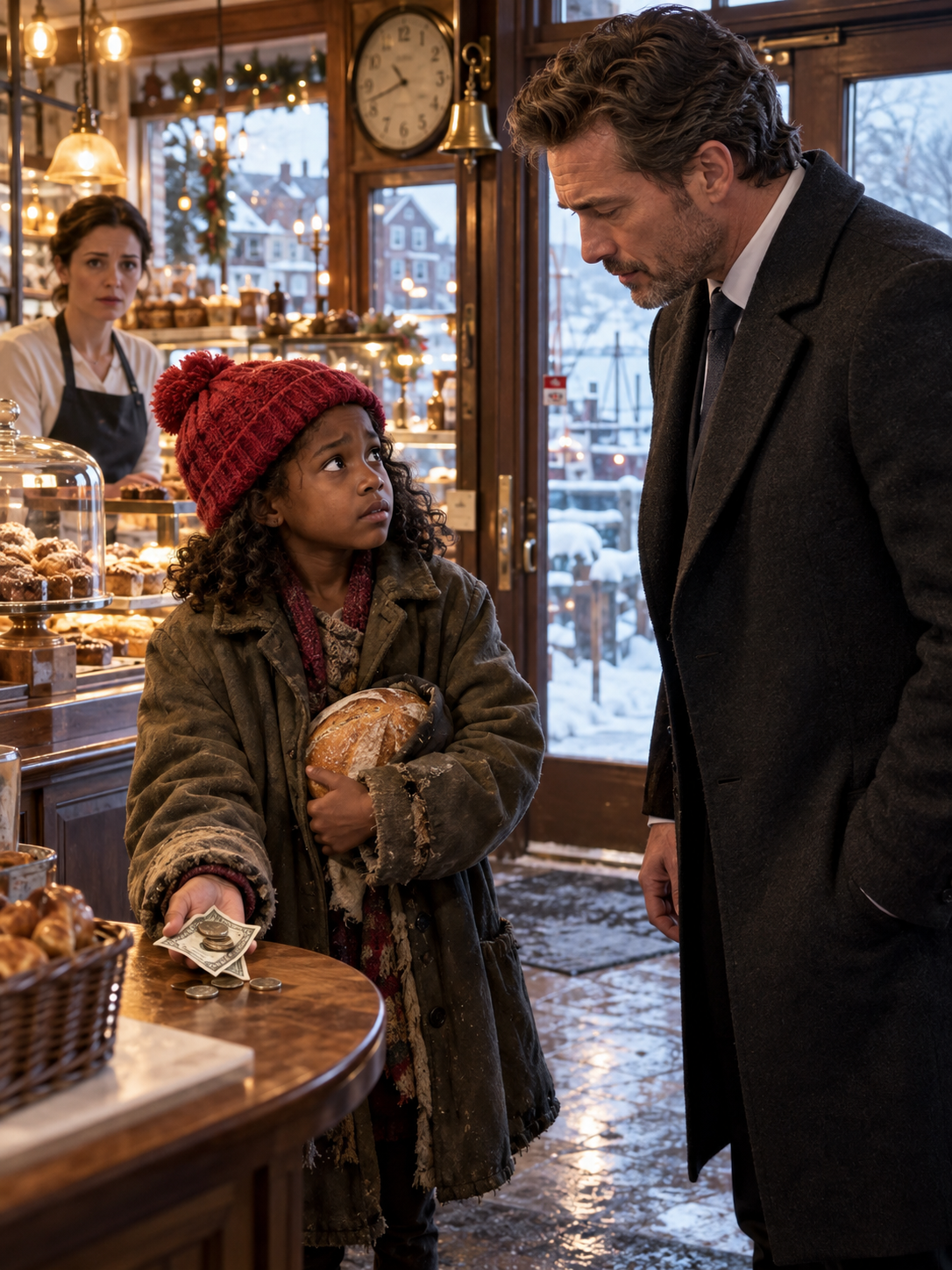
HE CAUGHT A LITTLE GIRL HIDING BREAD IN HER COAT AND THOUGHT SHE WAS STEALING UNTIL HE LEARNED WHO SHE WAS FEEDING AND WHAT HER FAMILY WAS AFRAID TO LOSE – Life Story
THE LOAF UNDER HER COAT The loaf disappeared inside the little girl’s coat while the bakery clerk was looking the...
A strange woman and three children cried “daddy” at my father’s funeral—louder than my own mother. She clutched my hand until her nails drew blood. Then the lawyer read the will, and my father’s final secret shattered our family…
My father’s oak casket hadn’t even touched the bottom of the vault when the wails shattered the silence. In the...