THE STORE MANAGER ACCUSED A HUNGRY EIGHT-YEAR-OLD GIRL OF STEALING CHARITY MONEY—THEN THE BILLIONAIRE WHO SAW HER LAST COIN FALL ASKED ONE DANGEROUS QUESTION – Life Story
The grocery manager lifted a charity box above an eight-year-old girl’s head and called her a thief.
Her last chance to buy bread was already lying at the bottom of that same box.
And the stranger who had watched her give it away noticed one thing the manager refused to explain.
“Take your hands out of your pockets,” the man said.
Allowyn Vale pulled both hands free so quickly that the torn lining of her left pocket came with them.
A few people outside Mercer’s Market stopped beneath the striped awning.
Snow gathered on the girl’s hair and on the shoulders of the man towering over her, but he seemed not to feel it.
“I didn’t take anything,” she said.
Gideon Pike, the market’s manager, shook the clear plastic collection box.
Coins rattled against the sides.
The little silver quarter Allowyn had dropped through the slot less than a minute earlier flashed among them.
“Then explain where the rest of the money went.”
“I don’t know.”
“Funny.
You were the one standing here.”
The bakery door across Maple Street swung open, spilling yellow light onto the snow.
Allowyn turned toward the smell of warm bread before she could stop herself.
Gideon followed her glance and his mouth tightened.
A tall stranger in a dark overcoat stepped away from a parked black sedan.
He had been crossing the street when Allowyn first approached the box.
He had seen her stretch up onto her toes, hesitate with the quarter balanced on one cold fingertip, and finally let it go.
She hadn’t known anyone was watching.
“That’s enough,” the stranger said.
His voice wasn’t loud, but Gideon looked at him.
“Unless you’re her father, stay out of it.”
“I’m a witness.”
“To what? A kid hanging around my donations?”
“To her putting money in.
And to you accusing her without answering a simple question.”
Gideon shifted the box from one hand to the other.
A narrow brass key was attached to his belt on a green cord.
Allowyn noticed it because she had watched him tuck it out of sight when he came through the market door.
“What’s your question?” Gideon demanded.
“When did you count the money you say is missing?”
“This afternoon.”
“What time?”
“Before the rush.
Look, this isn’t your business.”
Allowyn stared at the quarter through the scratched plastic.
She had found it beside the bus stop after school, half buried in gray slush.
For the length of her walk home she’d held it inside her mitten and thought about the day-old bread sold for twenty-five cents at Mercer’s after four o’clock.
Grandma Mara had spent the morning coughing into a kitchen towel.
The heater in their house clicked and clicked without warming the living room.
There was oatmeal for breakfast if Mara wanted it, but almost nothing for supper.
Allowyn had promised she’d find something.
Then she saw the sign on the collection box: HELP CHILDREN IN CRITICAL CARE.
She could read the words, but she couldn’t picture what critical care looked like.
She pictured a child somewhere under thin hospital blankets, wishing for her grandmother.
She had looked at the quarter until the edge pressed a white crescent into her thumb.
“Maybe someone needs it more,” she had whispered, and dropped it in.
Now Gideon was calling her a thief in front of people who knew which side of town she lived on.
“Please,” she said. “My grandma’s waiting.”
“Then she can come get you,” Gideon snapped.
He pulled out his phone and turned the screen toward her. “I’m calling the police.”
The stranger crouched so Allowyn no longer had to look up at both men. “What’s your name?”
“Allowyn.”
“I’m Caspian.” He paused, noticing how hard she was trying not to cry. “You don’t have to answer this man’s questions.
But I need you to remember one thing.”
She swallowed. “What?”
“Exactly what you saw.
Not what he says you saw.”
Beyond his shoulder, Gideon raised the phone to his ear.
Allowyn looked past him toward the market window, where a red security light blinked above the entrance.
She had seen that light blinking before the manager came outside.
THE SOUND OF A FALSE ACCUSATION
Officer Daniel Reeves arrived seven minutes later, without sirens or flashing lights.
The patrol car eased against the curb, its tires pushing dirty snow toward the storm drain.
By then, almost a dozen people had gathered beneath the market awning, and Gideon had repeated his accusation so many times that several customers were treating it as an established fact.
Reeves was a broad-shouldered man in his late forties, with graying hair and the measured movements of someone who disliked unnecessary surprises.
He took one look at Allowyn’s wet shoes and trembling hands before turning to Gideon.
“Who’s responsible for this child?”
“That’s what I’d like to know,” Gideon said.
“I asked who she’s here with.”
“She’s alone.
And she’s been stealing from our charity collection.”
Reeves looked at the box in Gideon’s hands.
“Have you seen her remove money?”
“I saw her touching it.”
“That wasn’t my question.”
Gideon’s expression changed.
The interruption seemed to offend him more than the presence of the officer reassured him.
Caspian stepped forward and identified himself as a witness.
He described what he had seen without embellishment: a child holding a coin, reading the sign, hesitating, and making a donation.
He did not claim to know what had happened to the missing money.
Reeves appreciated the distinction.
“What happened before you arrived?” he asked.
“I don’t know,” Caspian answered. “That’s why I’d like Mr.
Pike to explain when the money was counted.”
Gideon gave a short, irritated laugh.
“There was over six hundred dollars in this box.
Now most of it’s gone.
I don’t need a detective to understand what happened.”
“Then an exact count should be easy to provide.”
“I keep records.”
“Good.
We’ll need those.”
Allowyn stood beside the door, holding her torn pocket closed with one hand.
For the first time since Gideon had started shouting, the adults were talking about records instead of her face.
She wanted to tell Reeves about the key on the green cord and the blinking camera, but she was afraid that saying anything more would give Gideon another reason to shout.
Reeves noticed her hesitation.
“Allowyn, is there an adult I can call for you?”
“My grandma.”
“What’s her name?”
“Mara Vale.”
“Can I call her?”
Allowyn nodded, then suddenly grabbed the officer’s sleeve.
“Please don’t tell her I stole anything.”
Reeves looked down at her.
“I won’t tell her something I haven’t established.”
The answer sounded almost ordinary, but it was the first protection anyone in uniform had offered her.
While Reeves contacted Mara, Gideon took the opportunity to address the bystanders.
“People work hard for money they donate,” he announced. “We’re not going to let anyone take advantage of sick children.”
Caspian watched the manager, then glanced toward the collection box.
There was a thin scratch beside its lock.
The kind that might come from repeated use of a key.
He noticed it only because Gideon’s fingers kept covering that corner.
“Who else has access to the box?” Caspian asked.
“Employees.”
“How many?”
“That’s store business.”
“Then the list should be short.”
Gideon leaned closer, lowering his voice.
“Listen, whoever you are, you don’t understand this town.
I’ve worked here seventeen years.
People know me.”
Caspian met his eyes.
“Then they’ll know where to find you when the questions begin.”
Gideon looked ready to answer, but the market owner, Gloria Mercer, had appeared in the doorway.
She was a silver-haired woman wearing a wool cardigan over her store apron, and the expression on her face suggested she’d heard enough of the shouting.
“Gideon,” she said, “put the box down.”
“Gloria, this girl—”
“I said put it down.”
He obeyed, although reluctantly.
Gloria surveyed the crowd, the officer, the child and the stranger standing beside the patrol car.
Her gaze settled on Allowyn.
“Is she hurt?”
“No, ma’am,” Reeves said. “But she’s cold, and I’m waiting for her guardian.”
Gloria stepped inside and returned with a small paper bag.
“There’s a roll in here,” she told Allowyn. “Eat it while it’s warm.”
Allowyn reached for it, then stopped.
“I don’t have any money.”
“It’s not for sale.”
Allowyn looked uncertainly at Gideon.
His eyes were fixed on the bag.
Reeves spoke quietly.
“It’s all right to accept food.”
She took the roll with both hands.
Warmth seeped through the paper.
She wanted to bite into it, but she thought of Grandma Mara waiting at home.
“Can I save half?”
Gloria’s face changed.
“Of course you can, sweetheart.”
A few minutes later, Mara arrived in a neighbor’s aging pickup truck.
She emerged wrapped in a brown winter coat, her gray hair escaping from a knitted hat.
She was sixty-eight, but the coughing illness that had settled into her chest made her appear much older.
She walked quickly until she saw Allowyn, then stopped to catch her breath.
Allowyn ran toward her.
“Grandma, I didn’t take the money.”
Mara knelt despite the discomfort in her knees.
“I know, honey.”
“You weren’t there.”
“I know you.”
Those three words nearly broke the child’s determination not to cry.
Reeves explained the situation without treating the accusation as fact.
He also made it clear that Allowyn was not being arrested or taken anywhere.
He would collect statements, request security footage, and establish the donation records before deciding what had happened.
Gideon objected immediately.
“Are you seriously letting her walk away?”
“Mr.
Pike,” Reeves replied, “I haven’t seen evidence that she committed a crime.”
“I have a missing six hundred dollars.”
“Then we should find it.”
Mara placed a protective arm around Allowyn’s shoulders.
When Reeves asked whether the girl could answer follow-up questions later, she agreed, provided Mara was present.
Caspian offered his business card, and Mara examined it under the awning light.
Caspian Thorne.
She recognized the name from television reports about investments, manufacturing companies and the kind of financial transactions that rarely touched Ashbourne Ridge.
“Why are you involved?” she asked.
“Because I witnessed what happened.”
“People with your kind of money usually have somewhere more important to be.”
Caspian glanced toward Allowyn, who was dividing the roll carefully through the paper bag.
“Not tonight.”
Mara studied him for another moment before returning the card.
“Then tell the truth, Mr.
Thorne.
That’s all we need.”
She took Allowyn home.
Caspian watched the pickup turn onto Maple Street.
He felt an unfamiliar frustration, not because he lacked the resources to change the situation, but because money couldn’t make the accusation disappear from everyone who had heard it.
He turned toward Officer Reeves.
“Can you secure the original video?”
“I’ve requested it.”
“Not a clip.
The entire recording.”
Reeves looked at him more closely.
“Is there a reason?”
Caspian thought of Gideon’s answer to the simplest question of the evening.
“When someone claims money disappeared,” he said, “I want to know when it was last there.”
Inside Mercer’s Market, Gideon had already gone upstairs to the security office.
And he had closed the door behind him.
A TOWN THAT REMEMBERS THE WRONG THINGS
The following morning, Allowyn learned that an accusation could travel farther than the truth.
She was halfway through the school corridor when two fourth-grade boys stopped talking and looked at her.
One whispered something to the other, who laughed.
At her locker, a girl from her reading group asked whether the police had searched her house.
Allowyn shook her head.
“They didn’t.”
“My mother said you took money from sick kids.”
“I didn’t.”
The girl looked uncomfortable.
“I’m just saying what I heard.”
That was the worst part.
Nobody seemed to consider themselves responsible for the words they repeated.
By lunchtime, Allowyn had stopped trying to explain.
She ate the crackers the school cafeteria worker slipped onto her tray and pretended not to hear the conversation at the next table.
She was accustomed to being different from children who had two parents, new winter coats and money for field trips.
She had learned to endure comments about the patched elbows of her sweaters.
Being called a thief was different.
It followed her even when she said nothing.
At home that afternoon, Mara was sitting beside the kitchen window with a heating pad against her chest.
Their house stood on the edge of town, where the pavement ended and old ranch houses leaned toward empty fields.
The roof had been repaired twice with borrowed money.
A strip of clear plastic covered the kitchen’s cracked window.
Their furnace worked irregularly, and Mara had postponed a medical appointment because the car needed tires.
Allowyn hung up her coat.
“Did you have lunch?” Mara asked.
“Yes.”
“Enough?”
Allowyn looked at the pantry.
“Enough.”
Mara recognized the answer.
She had given it herself too many times.
“Come sit with me.”
Allowyn climbed onto the chair beside her.
“Grandma, can people make you into something you’re not?”
Mara set down her tea.
“People can say things.
They can even make other people believe them.”
“What if everybody believes them?”
“Then we keep telling the truth.”
“For how long?”
Mara had no easy answer.
Her granddaughter was looking at her with the exhausting seriousness of a child who had discovered that fairness wasn’t automatic.
“As long as it takes,” she said.
That evening, Caspian Thorne called Vivian Sloan.
Vivian was an attorney in Columbus whose practice included civil rights, reputation disputes and complex financial investigations.
She had represented one of Caspian’s companies during a contentious acquisition several years earlier, and their friendship had survived partly because she was unimpressed by his wealth.
“You don’t usually call about grocery stores,” she said.
“This one is accusing a child of stealing charitable donations.”
“Are you hiring me for the store or the child?”
“The child, if her grandmother agrees.”
“Then speak to the grandmother first.”
“I’ve met her.”
“That’s not an answer.”
Caspian walked toward the window of his hotel suite, overlooking the snow-covered town square.
“An eight-year-old girl gave away her last quarter yesterday.
She needed it to buy bread.
Less than a minute later, a manager accused her of taking six hundred dollars.”
Vivian was quiet.
“What did you actually witness?”
Caspian explained.
When he finished, Vivian asked, “Did you see anyone remove the money?”
“No.”
“Then don’t turn your certainty about her donation into certainty about everything else.
We need records.”
Caspian rubbed his forehead.
“That’s why I called you.”
“Good.
Because if this child is innocent, the last thing she needs is a rich man making promises the evidence hasn’t earned.”
The following afternoon, Vivian traveled to Ashbourne Ridge.
She did not arrive at Mercer’s Market with reporters or a camera crew.
She went first to the Vale house, where she introduced herself to Mara, explained who would pay her legal fees and offered a written agreement stating that her client would be the family, not Caspian.
Mara read every paragraph.
“I don’t want my granddaughter owing him anything.”
“She won’t,” Vivian said. “The arrangement doesn’t give him control over her decisions.”
“And you won’t put her on television?”
“Not without your permission.
Even with permission, I’d advise against it.”
Mara finally signed.
Allowyn watched from the kitchen doorway.
“Are you going to make Mr.
Pike say sorry?”
Vivian turned toward her.
“I can’t promise what he’ll say.
I can help make sure the right people hear what happened.”
Allowyn considered that.
“Will you believe me?”
“I’ll listen carefully,” Vivian answered. “Those aren’t exactly the same thing, but listening is where doing this properly starts.”
That response was not what Allowyn had expected.
After a moment, she nodded.
Vivian opened a notebook.
“I want you to tell me everything you remember.
Don’t worry about what sounds important.”
Allowyn described the sidewalk, the cold, the quarter and the donation box.
She remembered the blue stars around the charity sign and the manager’s green key cord.
Then she mentioned the red security light.
“It blinked while I was standing there.”
Vivian wrote that down.
“Was it on the store?”
“Above the window.
Near the door.”
“Anything else?”
Allowyn hesitated.
“The manager went outside with the box.
But when he came out, the key was already hanging from his belt.”
Vivian waited.
“He kept putting his hand over it.”
“Did you see him open the box?”
“No.”
“Then we’ll make that distinction.”
Allowyn looked disappointed.
“I thought it might help.”
“It does help.
But facts get stronger when we keep them exactly the size they are.”
When they finished, Vivian gave Mara a copy of the written statement and asked Allowyn whether anything needed correcting.
The girl read it slowly, tracing the words with one finger.
At the bottom, she found a sentence that said she had stood outside the market for several minutes before donating.
“That part’s wrong,” she whispered.
Vivian leaned forward.
“Tell me.”
“I stood there longer.”
“How do you know?”
“The bakery clock played a song while I was thinking.
It plays every quarter hour.
I heard it once before I put the coin in.”
Vivian looked up.
“Did you see the time?”
“No.
But it was after the school bus.
And the bread was supposed to be cheap after four.”
Vivian drew a small line in her notebook.
“That’s useful.
We can check the clock.”
The next morning, Officer Reeves obtained the store’s security footage through Gloria Mercer.
The recording Gideon provided showed Allowyn standing beside the donation box at p.m., raising her arm, and stepping away.
It ended shortly afterward.
Gideon had attached a written explanation stating that he noticed the shortage immediately after the girl handled the container.
Reeves watched the recording twice.
It showed no theft.
Still, Gideon insisted the child could have slipped bills into her sleeve before the camera captured her movement.
Reeves examined the clear donation box, its narrow slot, and the small locked panel through which the money was removed.
There was no reasonable way for a child to pull a stack of folded bills through the slot without damaging the plastic.
“Who had the key?” he asked Gloria.
“Gideon and me.”
“Where is yours?”
“In my office.”
“And his?”
“He carries it.”
Reeves turned back to the screen.
“Where’s the recording from earlier?”
Gideon looked annoyed.
“That is the relevant footage.”
“I’m not asking what you think is relevant.”
“The system archives in pieces.
I exported what I could.”
Gloria frowned.
“We paid to have automatic backup installed last summer.”
Gideon’s eyes moved toward her.
“That’s for emergencies.”
Reeves closed the video window.
“This qualifies.”
The store owner reached for her phone.
And for the first time, Gideon stopped arguing.
THE MINUTES THAT WENT MISSING
Three days after the accusation, Ashbourne Ridge woke beneath a hard white frost.
Vivian returned to the market with Officer Reeves and Gloria Mercer.
Caspian waited near the entrance, careful to remain a witness rather than behave like someone directing the investigation.
The store’s security contractor had confirmed that the original camera feeds were copied to an off-site archive.
Local managers could export short clips, but they could not modify the archived recordings.
The contractor also confirmed that a longer recording existed for the afternoon in question.
Reeves had obtained the appropriate authorization to collect it.
Gideon watched from the office doorway as a technician opened the archived footage on a monitor.
At p.m., the screen showed the entrance.
Customers came and went, leaving wet footprints on the tiled floor.
At , Gideon appeared carrying the charity box.
He placed it on the service counter, unlocked the lower panel and removed a thick bundle of bills.
Nobody spoke.
He counted the bills briefly, wrapped them with a paper band and placed them in the inside pocket of his jacket.
At , he locked the panel and returned the box to its stand.
At , Allowyn appeared.
The tiny figure on the screen hesitated beside the collection box.
She looked toward the bakery, stood on her toes and dropped something through the slot.
Caspian remembered the soft metallic sound.
Then Gideon appeared again.
This time, he carried the box outside and accused her of stealing from it.
Reeves paused the video.
“Mr.
Pike,” he said, “you removed money before the child arrived.”
Gideon’s expression hardened.
“I made a collection.
I’m authorized to do that.”
“Where was the money deposited?”
“I handled it.”
“Where?”
“Into the store’s charitable holding account.”
Gloria shook her head.
“We don’t have a charitable holding account.”
For one suspended moment, nobody moved.
The store was a small independent business, but its annual holiday collection supported a regional children’s medical assistance program.
Donations were supposed to be counted by two employees, recorded on a numbered collection sheet, sealed, and delivered to the program’s designated bank account.
Gideon had managed the process for years.
Gloria had trusted him.
“Show them the sheet,” she said.
Gideon stared at her.
“Gloria—”
“The collection sheet, Gideon.”
Reeves requested the store’s donation records through the investigation.
Gloria voluntarily provided the ledger and explained the established procedure.
The last completed deposit entry was dated two weeks earlier.
There was no entry for the bundle Gideon had taken on the afternoon of Allowyn’s donation.
Vivian stayed quiet while Reeves asked another question.
“Why did you accuse the child?”
Gideon looked at the paused image.
“Because money was missing.”
“But you had already removed it.”
The manager said nothing.
Caspian felt a flash of anger so sharp he had to look away from the screen.
This was no longer merely a misunderstanding caused by a careless assumption.
Gideon had handled the money himself, then pointed at a child who could barely afford food.
Vivian touched Caspian’s arm lightly.
“Let the officer work.”
He stepped back.
Reeves arranged for the archived recording and relevant store records to be preserved.
He also asked Gideon to provide any evidence of a legitimate transfer or deposit.
Gideon declined to answer further questions without counsel.
That was his right, and Reeves respected it.
Outside, the winter sun had begun melting ice from the awning.
Caspian turned toward Vivian.
“She was telling the truth.”
“Yes.”
“We can clear her name.”
“We have strong evidence that she didn’t take the money,” Vivian said. “But there’s a difference between proving that and repairing what happened to her.”
He glanced through the glass toward the narrow sidewalk.
“What do you recommend?”
“First, tell Mara privately.
Then let her decide what the family wants made public.”
Caspian didn’t like waiting.
His entire professional life had rewarded swift action, decisive language and control over outcomes.
He could arrange a press conference with a phone call.
He could put Gideon’s name in front of thousands of people.
Instead, he drove to the Vale house and parked beside the mailbox.
Allowyn was at the kitchen table finishing a spelling assignment when Mara opened the door.
Caspian removed his gloves.
“May I come in?”
Mara studied his expression.
“You found something.”
He nodded.
They sat at the table while he explained what the recording showed.
He kept his description simple and precise, carefully avoiding claims beyond the evidence.
Allowyn listened without moving.
“Mr.
Pike opened it?” she asked.
“Yes.”
“Before I came?”
“Yes.”
“And the police saw?”
“They did.”
The child looked at her grandmother.
“Then he knew I didn’t take it.”
Nobody answered immediately.
Mara placed her hand over Allowyn’s.
“He knew he had taken money out,” she said. “Why he blamed you is something the investigation still has to establish.”
Allowyn looked down at the spelling sheet.
She had expected relief to feel enormous.
She had imagined everyone apologizing, the school hallway becoming quiet and the strange pressure in her chest disappearing.
Instead, she felt tired.
“Can I go to school tomorrow without people looking at me?”
Caspian swallowed.
“I hope so.”
She raised her eyes.
“You don’t know.”
“No,” he admitted. “I don’t.”
It was the first time he had given her an answer she couldn’t mistake for a promise.
That evening, Reeves informed Mara that Allowyn was no longer under any suspicion based on the available evidence.
He offered to provide written confirmation to school administrators, subject to the family’s wishes.
Mara accepted.
By the following afternoon, the principal had asked teachers to stop rumor-sharing and address harassment without identifying Allowyn in classroom discussions.
The school could correct its own handling of the situation.
It could not change what parents had already said at dinner tables.
For several days, Allowyn still kept her eyes on the floor when she walked down the hallway.
Then something unexpected happened.
At recess, the girl from her reading group approached her by the fence.
“My mom says the manager might be in trouble.”
Allowyn waited.
“She says maybe you didn’t do it.”
Allowyn felt her cheeks grow hot.
“I told you I didn’t.”
The girl dragged her boot through the snow.
“I’m sorry.”
It wasn’t a perfect apology.
It sounded small and embarrassed, as if the words had been difficult to find.
Allowyn looked toward the playground.
“Okay,” she said.
Then she picked up her backpack and walked away.
At home that night, Mara found her folding the written confirmation from the police into a neat square.
“Why are you keeping it?” Mara asked.
Allowyn placed it in the drawer beside her schoolbooks.
“Because people asked me to prove something I never did.”
Mara sat on the edge of the bed.
“Sweetheart, you don’t have to carry that paper forever.”
Allowyn pulled the blanket over her knees.
“I know.”
But she closed the drawer carefully.
For now, knowing the truth was not the same as feeling safe.
WHAT THE MONEY WAS REALLY HIDING
The investigation uncovered something more complicated than a single stolen collection.
Gideon Pike had managed Mercer’s Market for seventeen years.
He knew which customers bought milk on credit, whose prescriptions were waiting at the pharmacy and which elderly residents needed groceries delivered during storms.
He had stayed late to unload trucks when employees were sick.
He had attended school fundraisers and organized food drives.
Those things were real.
So was the fact that, during the previous year, he had repeatedly removed donation money without following the required accounting procedures.
Gloria discovered irregularities only after reviewing the ledger with the police.
Several collection totals had been entered late.
Others did not match bank deposits.
A few were marked as pending without corresponding receipts.
A forensic accountant retained by the charitable organization began reconciling the records, while the investigating authorities reviewed whether the missing amounts constituted criminal theft.
Vivian explained the distinction to Mara during a meeting at the kitchen table.
“An accounting error isn’t automatically theft,” she said. “But a repeated pattern of money being removed and not delivered can become powerful evidence when it’s supported by records and witness testimony.”
Mara listened closely.
“And my granddaughter?”
“The video supports her account.
Whatever happens in the financial case, we will insist that nobody continues identifying her as a suspect.”
Caspian sat opposite them, holding an untouched cup of coffee.
“Is Gideon still working there?”
“He’s been suspended,” Vivian said.
Gloria had been devastated by the discovery.
The grocery store had belonged to her family for three generations.
It operated on narrow margins, and Gideon had managed most daily decisions since Gloria’s husband died.
She had trusted him with the register, the employees and the holiday charity program.
Now that trust had become a liability.
When Vivian met Gloria privately, the older woman looked ten years older than she had outside the store.
“I should have checked,” Gloria said.
“You should have had controls that didn’t depend on one person,” Vivian replied. “That’s different from taking responsibility for his decisions.”
“He told me the donation deposits were delayed.”
“Why?”
“Cash-flow problems.
He said the bank’s collection process had changed.”
“And you believed him?”
Gloria stared at the worn wooden desk.
“I wanted to.”
That admission stayed with Vivian.
The financial pressure was real.
The market had nearly lost its refrigeration supplier after several late payments.
Gideon had been quietly shifting money between accounts, convincing himself he could replace what he borrowed when sales improved.
But the charity funds were not his to borrow.
The deeper the shortage became, the more impossible it was for him to admit.
He had begun preserving the appearance of normal operations by making increasingly risky decisions.
And when Allowyn stood beside the donation box, she became an available explanation.
It wasn’t personal in the beginning.
That was one of the ugliest parts.
He hadn’t needed to hate her to use her.
For Caspian, the discovery carried an uncomfortable familiarity.
He had spent years evaluating executives who presented clean financial statements while hiding losses behind confident explanations.
He knew the language of temporary transfers and anticipated revenue.
He had heard powerful people describe improper decisions as necessary compromises.
Yet he had never seen that logic directed at an eight-year-old standing in wet shoes.
He wanted Gideon prosecuted immediately.
Vivian reminded him that criminal charging decisions belonged to the authorities, not to wealthy witnesses.
“Your influence doesn’t entitle you to a preferred outcome,” she told him.
“My influence can make sure people pay attention.”
“It can.
But if you’re careless, it can also make this about you.”
He didn’t answer.
Two days later, Mara called Vivian from an urgent-care clinic.
Her cough had worsened, and she had developed a fever.
The clinician suspected pneumonia and recommended further treatment at the hospital.
Allowyn sat beside her grandmother under fluorescent lights, clutching the sleeve of her sweater.
Caspian arrived after Vivian notified him with Mara’s permission.
He found the girl staring at a vending machine full of crackers, cookies and candy bars.
“Have you eaten?” he asked.
She shook her head.
He bought her a sandwich and a bottle of water.
She accepted them, but didn’t open the wrapper.
“Grandma’s going to be okay, right?”
Caspian sat beside her.
“The doctors are taking care of her.”
“That’s not what I asked.”
He looked at her.
“No.
It isn’t.”
Allowyn’s lower lip trembled.
“She always tells me things will be okay, even when she doesn’t know.”
Caspian rested his elbows on his knees.
“Sometimes adults say that because they want children to feel less afraid.”
“Does it work?”
“Not always.”
She watched a nurse wheel an empty chair past the waiting area.
“What happens if she has to stay here?”
“We’ll figure out what you need.”
“Who?”
He hesitated.
“Your grandmother will help decide.
Vivian can help her find someone you know and trust to stay with.
We don’t have to decide anything without talking to her.”
Allowyn looked relieved that he hadn’t said he would simply take her somewhere.
She finally unwrapped the sandwich.
Caspian sat beside her while she ate.
He did not check his phone or try to make conversation.
When the hospital staff later confirmed that Mara would need several days of treatment but was expected to recover, Allowyn leaned against his coat for one brief moment.
He remained still.
It was a small gesture, but it meant more to him than the gratitude he had received after any business deal.
The following morning, Caspian asked Vivian about paying for the Vale family’s medical bills, groceries and home repairs.
Vivian folded her arms.
“You can offer help.
But Mara must be free to refuse it.
And the assistance cannot depend on cooperation in the investigation.”
“I know that.”
“Then say it to her plainly.”
Mara accepted assistance with the immediate heating repairs after a social worker explained that several local aid programs could contribute and that Caspian’s donation could cover the remaining expense.
She declined his first offer to purchase a new house.
“This is our home,” she told him.
“It isn’t safe in the cold.”
“Then help us make it safe.”
Caspian considered the distinction.
For someone who had spent years solving problems by replacing inefficient systems, it was a difficult lesson.
He was accustomed to deciding what improvement should look like.
Mara wanted help without surrendering control of her life.
He agreed.
Over the next several weeks, licensed workers repaired the furnace, replaced the broken window and reinforced the porch.
The work was modest, documented and completed with Mara’s approval.
Allowyn watched from the kitchen as one contractor removed the old thermostat.
“Are we rich now?” she asked.
Mara laughed for the first time in days.
“No, sweetheart.”
“Then why is the house warm?”
“Because someone helped us fix what was broken.”
Allowyn thought about that.
“Does that mean we owe him?”
“No.”
“Are you sure?”
Mara looked across the table toward Caspian.
“That’s something we made very clear.”
He nodded.
“Very clear.”
The girl smiled.
But a few days later, she overheard something that threatened to change how she understood everything he had done.
THE PRICE OF BEING SEEN
Caspian had returned to Columbus for a board meeting when a business reporter contacted him about the Ashbourne Ridge incident.
The journalist had obtained Gideon’s name from public records and wanted to know whether a prominent investor was funding a legal campaign against a small-town grocer.
Caspian declined to discuss the child’s identity or private circumstances.
He did, however, mention that he was considering establishing a charitable program to help families facing emergency medical and housing needs.
The reporter asked whether the proposed program was connected to the little girl.
Caspian said it had been inspired by the situation.
He believed he had been careful.
The following morning, a headline circulated online: BILLIONAIRE PLANS CHARITY AFTER GIRL’S GROCERY STORE ORDEAL.
The article did not use Allowyn’s name, but people in Ashbourne Ridge knew exactly whom it described.
At school, the whispers changed.
Instead of thief, children began calling her the millionaire girl.
One boy asked when she was getting a limousine.
Another said his father thought she had invented the whole incident to attract attention.
Allowyn returned home with a headache and refused to eat supper.
Mara found the article on her phone and read it twice.
Then she called Caspian.
“I told you I didn’t want her made into a spectacle.”
“I didn’t give them her name.”
“You didn’t need to.
This is a small town.”
Caspian stepped away from his office desk.
“I was trying to create something useful.”
“Then you should have asked us before talking about her.”
There was a long silence.
He knew she was right.
“I apologize,” he said.
Mara didn’t soften.
“She was beginning to feel ordinary again.”
Caspian looked toward the city outside his window.
“I’ll ask the reporter to make sure nothing identifying is added.
I won’t discuss her again.”
“That should have happened before the article.”
After the call, he remained standing for several minutes.
For the first time, he understood that even well-intended attention could become another burden a child had never agreed to carry.
Vivian called him that evening.
“I warned you.”
“I know.”
“Good.
Then don’t waste time explaining why your intentions were good.
Change what you do next.”
He canceled a planned announcement.
He also instructed his staff not to use Allowyn’s experience in fundraising materials or presentations.
Any future program would require independent governance, clear consent procedures and assistance that did not depend on personal publicity.
Those decisions were necessary.
They did not repair the hurt immediately.
When Caspian next visited the Vale house, Allowyn stayed at the kitchen table instead of running to the door.
He brought no gifts.
“I owe you an apology,” he said.
She stared at the pencil between her fingers.
“For what?”
“For talking about helping people without thinking about how the attention might affect you.”
“Everybody thinks I asked you for money.”
“I know.”
“I didn’t.”
“I know that too.”
She looked up.
“Then why do they keep saying it?”
“Because people sometimes turn a story into something simpler than the truth.”
Allowyn pressed her pencil against the notebook.
“Like Mr.
Pike did?”
Caspian felt the comparison land.
“Yes,” he said quietly. “Not in the same way.
But I should have been more careful.”
She thought about his answer.
“Will you make a video telling them to stop?”
“I don’t think another video would help.”
“Why?”
“Because then more people might look at you.”
Allowyn nodded slowly.
She didn’t forgive him that afternoon.
But she let him sit with her while she finished her homework.
Several weeks later, Gideon Pike was formally charged after investigators completed their review of the available evidence.
The criminal case involved the missing charitable funds and allegations that he had knowingly made a false report.
He denied criminal intent, maintaining that the money had been temporarily moved to cover store expenses and that he planned to replace it.
His attorney challenged the interpretation of the footage and disputed whether the accounting records proved personal conversion of funds.
The case moved toward trial.
Allowyn had been expecting the news.
Vivian had explained that legal proceedings could take time and that the possibility of charges did not mean a court had decided Gideon was guilty.
Still, hearing the word trial frightened her.
“Will I have to go?” she asked.
“You may be asked to testify about what you saw and did,” Vivian said. “The prosecutor will discuss that with your grandmother.
We’ll make sure you understand the process.”
“Will Mr.
Pike talk to me?”
“Not directly while you’re giving evidence.
Lawyers ask questions in court.”
“What if I forget something?”
“Then you say you don’t remember.”
“What if they think I’m lying?”
Vivian sat beside her.
“You don’t have to sound brave or clever.
You only have to be accurate.”
Allowyn looked toward the drawer where she kept the police statement.
“What if I’m scared?”
“You can be scared and still tell the truth.”
Mara watched from the doorway, her face pale with worry.
She was recovering, but slowly.
Some days she could cook breakfast and take a short walk.
Other days she needed to sit after crossing the kitchen.
Allowyn had begun listening for her cough at night, counting the quiet intervals between each breath.
The prospect of a courtroom seemed enormous beside the ordinary struggle of keeping their household steady.
That weekend, a letter arrived for Mara.
It came from Gideon’s attorney.
The letter proposed a civil settlement related to potential claims arising from the public accusation.
It offered a confidential payment in exchange for releasing certain civil claims, with terms requiring legal review.
Mara did not sign it.
She took it directly to Vivian.
Vivian read it carefully and explained which terms might affect the family.
“The offer doesn’t control whether the state prosecutes him,” she said. “That’s separate.
But signing a broad agreement could limit what you can seek later for the harm caused.”
Mara looked at the amount.
It was enough to replace the car, cover several months of living expenses and leave a small emergency fund.
For a woman who had spent years deciding which bills could wait, it was not an insignificant offer.
“What would you do?” she asked.
Vivian closed the letter.
“I would decide what matters to your family before deciding whether the amount is adequate.
You don’t have to answer today.”
That evening, Mara told Allowyn about the offer in language she could understand.
“Someone wants to give us money so we won’t make any more complaints about what happened.”
Allowyn frowned.
“Do we need the money?”
Mara looked at the repaired kitchen window.
“We could use it.”
“Would it mean Mr.
Pike didn’t have to tell the truth?”
“No.
The criminal case is separate.”
“Would people know he was wrong?”
Mara considered the question.
“The police have already made that clear.
But the court case hasn’t finished.”
Allowyn was silent for a long time.
Then she said, “I don’t want money for being called bad.”
Mara reached across the table.
“Honey, sometimes people are paid because someone hurt them.
That doesn’t mean they’re selling their feelings.”
“I know.”
“Then what do you want?”
Allowyn looked toward the drawer containing her statement.
“I want him to stop saying I took it.”
Mara understood.
The family declined the proposed settlement as written.
It was a difficult decision.
There were bills on the table and days when Mara wondered whether she had chosen pride over practicality.
But Vivian reminded her that refusing the first offer did not eliminate every possible civil remedy.
It simply meant the family had not agreed to terms they could not accept.
Two weeks before the trial, Mara suffered a setback and returned to the hospital for observation.
Allowyn spent the evening beside her bed, listening to the pulse of equipment and the soft conversation of nurses in the hallway.
She had wanted the whole incident to end.
Instead, the trial was approaching, her grandmother was ill again and the town still had not completely stopped talking.
“Maybe I shouldn’t go,” she whispered.
Mara turned her head on the pillow.
“Why?”
“Because everything gets worse when people look at me.”
Mara reached for her hand.
“Your being seen isn’t what made this happen.”
Allowyn looked down.
“But if I’d just bought the bread—”
“No.”
Mara’s voice was firmer than it had been in weeks.
“You made a kind choice.
Mr.
Pike made his own choices afterward.
Those are not the same thing.”
Allowyn pressed her lips together.
Mara squeezed her hand.
“You don’t have to make yourself smaller to make somebody else’s wrongdoing easier to hide.”
The child stayed beside her until visiting hours ended.
Outside, snow was beginning to fall again.
And for the first time, Allowyn thought about going to court not because the adults expected her to, but because she wanted her own words to be heard.
THE TRUTH IN A ROOM FULL OF STRANGERS
The trial began on a gray Tuesday morning, nearly four months after the incident outside Mercer’s Market.
The county courthouse stood across from a narrow park, its stone steps wet from melting snow.
Reporters gathered on the sidewalk, but court staff had established procedures to protect the child witness from unnecessary exposure.
Vivian and Mara entered through a quieter side entrance with Allowyn.
Caspian arrived separately.
He wore a charcoal suit and carried a small notebook containing the dates and details of what he had personally observed.
He had reviewed his statement with the prosecutor, who had emphasized the same rule Vivian had given Allowyn: answer only what you know.
Inside the courtroom, Gideon sat beside his defense attorney.
He looked older than he had in the market doorway.
The confidence that had once made him seem impossible to question was gone, replaced by a guarded expression.
He had lost his position at Mercer’s Market.
Gloria had cooperated with investigators, instituted independent donation accounting procedures and publicly acknowledged that the accusation against Allowyn had been unsupported.
But Gideon continued to insist that he had not intended to steal charitable funds.
The prosecutor presented the state’s case in a measured sequence.
First came the records establishing how the charity collection was supposed to be handled.
A representative of the beneficiary organization explained that money from the box belonged to the charitable program and could not be used for store operations.
Then Gloria testified about the required counting process, the missing entries and her discovery that several reported collections had never reached the designated account.
The forensic accountant explained the discrepancies without suggesting that every error had necessarily been criminal.
Then the jury watched the original archived recording.
The screen showed Gideon approaching the donation box at p.m.
He unlocked the panel, removed the bills and placed the bundle inside his jacket.
Several minutes later, Allowyn appeared.
Her small figure stood before the charity sign, hesitated, and dropped a coin into the opening.
The courtroom remained quiet.
When Caspian testified, the prosecutor asked why he had paid attention to the child.
“She looked like she was deciding whether to buy food,” he answered.
“How did you know that?”
“I didn’t know it at the time.
I saw her looking toward the bakery, holding a coin, and hesitating.
Later, she told me she had intended to buy bread.”
“What did you observe?”
“She put the coin into the donation box.”
“Did you see her remove anything?”
“No.”
“Did you witness Mr.
Pike remove the missing bills?”
“No.
I learned about the earlier removal from the recording.”
The prosecutor nodded.
It was important that the billionaire’s testimony did not become something larger than what he had seen.
When Allowyn’s name was called, Mara stood with her.
Vivian had helped prepare the family for the procedure, and the court had approved appropriate measures to make the child’s testimony less intimidating without compromising the defendant’s rights.
Allowyn walked toward the witness stand wearing a navy dress Mara had altered herself.
Her shoes were polished but still slightly large.
The judge spoke gently and confirmed that she understood the importance of telling the truth.
The prosecutor began with simple questions.
“Allowyn, why were you at Mercer’s Market that afternoon?”
“To buy bread.”
“For yourself?”
“And my grandma.”
“Did you buy it?”
“No.”
“What happened?”
Allowyn looked toward the video screen.
“I saw the box.”
“What did the sign say?”
“That the money was for children who were very sick.”
“And what did you do?”
“I put my quarter in.”
“Did you open the box?”
“No.”
“Did you take any money out?”
“No.”
The prosecutor paused.
“Was anyone with you when you did that?”
“No.
I didn’t know Mr.
Caspian was watching.”
She glanced toward him briefly.
He gave her no signal or reassurance that might influence her testimony.
He simply sat still.
The prosecutor asked what happened next.
Allowyn described Gideon approaching, lifting the box, shaking it and demanding that she explain the missing money.
Her voice grew quieter.
“He told people I took it.”
“How did you respond?”
“I said I didn’t.”
“Did he believe you?”
“No.”
The prosecutor asked a few more questions about the key she had seen and the sequence of events.
Then the defense attorney stood.
He approached respectfully, keeping his voice even.
“Allowyn, you were hungry that day, weren’t you?”
“Yes.”
“And you wanted bread.”
“Yes.”
“You were upset when Mr.
Pike accused you.”
“Yes.”
“Is it possible you don’t remember every detail exactly?”
Allowyn thought about that.
“Some things,” she admitted.
“Then perhaps you could be mistaken about what happened at the box.”
She looked toward the screen.
“I know what my hands did.”
The attorney paused.
“You’re certain?”
“Yes.”
For a moment, Allowyn wondered whether she should say something impressive.
She had imagined giving an answer that would make everyone in the courtroom understand how frightened she had been.
Instead, she remembered Vivian’s advice.
Facts get stronger when we keep them exactly the size they are.
“I didn’t see who took the other money,” she added. “I only know I didn’t.”
The judge nodded slightly.
The defense attorney had no further questions.
When Allowyn returned to Mara, her grandmother wrapped an arm around her.
“You did well,” Mara whispered.
“I thought I was going to cry.”
“You were allowed to.”
The defense later called Gideon.
His attorney attempted to establish that the removed donations had been treated as a temporary transfer rather than a theft.
Gideon described financial pressure at the store, overdue supplier invoices and his belief that a short-term cash shortage could be repaired.
“I was trying to keep the business open,” he said.
The prosecutor asked whether the children’s charity had authorized him to borrow its money.
“No.”
“Did you tell the owner you had taken those funds?”
“Not at the time.”
“Did you record the transfer accurately?”
“I intended to.”
“Did you deposit the money into the charity’s designated account?”
“Not before the investigation.”
The prosecutor let the answers settle.
“Now let’s talk about the girl outside your store.”
Gideon shifted.
“I thought she’d interfered with the box.”
“You had already removed the bills.”
“Yes, but—”
“You knew that when you accused her?”
“I knew I’d taken some money out.”
“Did you tell the officer?”
Gideon looked toward his attorney.
“No.”
“Did you tell the crowd?”
“No.”
“Instead, you identified this child as the person responsible.”
“I was under pressure.”
The prosecutor stepped closer to the evidence screen.
“The pressure explains why you were worried about missing money.
Does it explain why you told the police a child had taken money you had already removed?”
Gideon’s mouth tightened.
He did not answer immediately.
The prosecutor waited.
Finally, Gideon said, “I thought if she had been near it, people would look at her first.”
The courtroom went silent.
The prosecutor did not raise his voice.
“So you wanted attention directed away from yourself?”
Gideon stared at the witness rail.
“Yes.”
Allowyn felt Mara’s hand tighten around hers.
The confession was not a dramatic shout.
It was worse in its plainness.
He had chosen her because she was there, alone and unlikely to be believed.
During closing arguments, the prosecutor asked the jury to judge the financial records, the archived video and the testimony together rather than rely on sympathy for the child or distrust of the manager.
The defense argued that Gideon’s conduct was negligent and dishonest but fell short of the charged criminal intent.
The jury deliberated for several hours.
Allowyn spent that time in a quiet room with Mara and Vivian.
She colored a picture of a house with yellow windows and a dog sleeping beside the porch.
Caspian waited in the hallway.
When the courtroom reconvened, the jury returned guilty verdicts on the theft charge and the related false-report offense.
Gideon closed his eyes.
Mara began to cry silently.
Allowyn looked toward the judge.
“Does that mean they believe me?” she whispered.
Vivian leaned closer.
“It means the jury found the charges proved.
And the evidence made clear you did not steal that money.”
Allowyn looked down at her hands.
They were the same small hands Gideon had ordered out of her pockets months earlier.
For the first time, she no longer felt the need to hide them.
At sentencing several weeks later, the judge considered Gideon’s financial circumstances, his prior history, the amount taken, and the harm caused by the false accusation.
He was ordered to make restitution, placed under supervised probation, and required to perform community service.
A custodial sentence was suspended subject to compliance with the court’s conditions.
His employment at Mercer’s Market was over, and the criminal convictions would remain a serious consequence of his decisions.
He was not ruined by a billionaire’s command.
He faced a legal judgment based on evidence.
Mara was invited to submit a victim-impact statement, but she asked Allowyn whether she wanted her own words included.
Allowyn agreed.
Vivian helped her write them without changing what she meant.
The statement was short.
She said she had wanted bread for her grandmother and had given away her coin because the hospital children seemed to need it more.
She said being called a thief had made her afraid to go to school.
And she said one thing that stayed with everyone who heard it.
“I want adults to ask what happened before they decide a child is bad.”
Gideon listened without looking up.
Afterward, he offered an apology through his attorney.
The words acknowledged that he had falsely blamed Allowyn and caused her harm.
Allowyn did not feel obligated to forgive him.
She simply wanted to go home.
Outside the courthouse, Caspian waited beneath the awning.
Snow was falling in small, wet flakes.
When Allowyn approached, he crouched beside her.
“You were very brave.”
She shook her head.
“I was scared the whole time.”
“I know.”
She looked at him seriously.
“Then maybe being brave doesn’t feel the way people say.”
Caspian smiled faintly.
“Maybe it doesn’t.”
She took Mara’s hand.
“Can we go get bread now?”
Mara laughed through her tears.
And they walked away from the courthouse together.
THE VALUE OF ONE SMALL COIN
Spring came slowly to Ashbourne Ridge.
At the Vale house, the patched kitchen window had been replaced with clear glass.
The furnace ran without its old metallic clatter, and Mara’s medicine rested beside a calendar marked with follow-up appointments.
Her recovery wasn’t instant.
She still became tired after long walks and needed help with some household tasks.
But she was home.
Allowyn’s days had become less complicated.
She returned to her reading group, learned long division and occasionally forgot to worry about what other children thought of her.
That mattered more than anyone outside the house could have understood.
Caspian continued visiting, although less frequently than during the investigation.
Sometimes he brought groceries.
Other times he arrived with nothing but an hour to spare and sat at the kitchen table while Mara criticized his inability to make decent coffee.
Their friendship developed without ceremony.
He learned that Mara disliked being treated as fragile.
She learned that Caspian, despite his financial success, was surprisingly helpless when asked to repair a dripping faucet without instructions.
Allowyn enjoyed watching them disagree.
One Saturday, Caspian arrived carrying a small envelope.
Inside was a letter from the charitable organization that had operated the original donation collection.
During the investigation, the distinctive scratched quarter had been identified in the documented contents of the box.
After the evidence was released, the organization agreed to transfer the coin for a symbolic public display, with its monetary value replaced in the charity account.
Caspian had not made the arrangement without consulting Mara.
Now he placed the envelope on the table.
“The coin is available,” he told Allowyn.
She looked up.
“My quarter?”
“The same one.”
“How do they know?”
“You remember the little crescent scratch?”
She nodded.
“It was photographed when the box was inventoried.”
Allowyn touched the envelope.
For months, the coin had seemed almost imaginary, a tiny piece of metal that had somehow caused an enormous change in her life.
“Can I keep it?”
“You can decide what happens to it.”
Mara watched her granddaughter carefully.
“What would you like to do?”
Allowyn thought for a long time.
Then she asked Caspian a question.
“You said you wanted to make a place that helps people.”
“I did.”
“Did you?”
“Not yet.”
“Why?”
“Because I learned that helping someone requires more than deciding what I think they need.”
Allowyn tilted her head.
“What does it require?”
“Listening.
Asking permission.
Making sure the help keeps working after the person offering it goes home.”
She considered his answer.
“Can the place help grandmas too?”
“Yes.”
“And kids who don’t have lunch?”
“Yes.”
“And can it be quiet?”
Caspian smiled.
“What do you mean?”
“Sometimes people need help, but they don’t want everyone at school knowing.”
That was the moment the proposed charity became something more specific than Caspian’s original plan.
Over the following months, he worked with an independent nonprofit attorney, local service organizations and experienced community representatives to establish the Allowyn Vale Hope Fund.
Mara agreed to the use of her granddaughter’s name only after reviewing the purpose, privacy safeguards and governance arrangements.
The fund would not simply distribute money in public ceremonies.
It would help families access emergency food, medical transportation, heating repairs and short-term housing assistance through established service providers.
It would maintain audited accounts and require more than one authorized person to approve disbursements.
No child receiving assistance would be required to appear in publicity.
Caspian supplied the initial financial support, but he did not control every decision.
An independent board would oversee the program and publish financial reports.
Gloria Mercer became one of its earliest community partners after demonstrating that her store had corrected its handling of charitable collections.
The market installed a new donation system with locked collection procedures, documented counts and independent reconciliation.
Gloria also wrote a personal letter to Mara and Allowyn.
She apologized for failing to act sooner and acknowledged that her employee had treated an innocent child unjustly.
Mara read the letter at the kitchen table.
“Do you want to answer?” she asked.
Allowyn thought about it.
“Can I just say thank you?”
“Of course.”
She wrote two sentences.
Thank you for telling the truth about what happened.
I hope the money helps the sick children now.
Mara folded the paper and placed it in an envelope.
At the fund’s opening ceremony, Caspian did not tell a sensational story about rescuing a poor child.
He spoke briefly about the importance of dignity and reliable assistance.
Then Mara took the microphone.
She was wearing a simple blue dress, and her voice trembled at first.
“For a long time,” she said, “I thought needing help meant I had failed to give my granddaughter the life she deserved.”
The audience grew quiet.
“I know now that families can work hard, love each other deeply and still need help.
None of those things should be a source of shame.”
Allowyn stood beside her, holding the edge of her dress.
Mara looked down at her.
“My granddaughter gave away a quarter because she believed another child might need it more.
I want her to grow up knowing that she is allowed to need things too.”
Caspian lowered his eyes.
He had spent months thinking about what Allowyn taught him.
Mara had just given the lesson its other half.
Kindness did not require a person to go hungry to prove that it was real.
After the ceremony, visitors walked through the newly opened assistance center.
The building had once housed a small bank branch, but its interior now contained bright offices, private consultation rooms and a welcoming waiting area.
Near the entrance stood a modest glass display.
Inside rested Allowyn’s quarter.
Beneath it was a plaque.
THE FIRST COIN.
There were no grand claims about its financial value.
The words simply told visitors that one child’s act of generosity had helped inspire a community program.
Allowyn stood in front of the display for a long time.
Caspian joined her.
“Do you like it?” he asked.
She nodded.
“But it looks lonely.”
He laughed softly.
“Lonely?”
“It’s just sitting there.”
“What would you have it do?”
She pointed toward a new transparent donation box near the reception desk.
“That one looks like it’s doing something.”
Caspian followed her gaze.
Families moved through the lobby.
A volunteer helped an elderly man complete a transportation request.
Another worker spoke quietly with a mother whose child needed regular medical appointments.
The building was filled with ordinary activity.
No applause.
No cameras following every conversation.
Just people getting help.
Caspian looked down at Allowyn.
“Would you rather have the coin in that box?”
She thought for a moment.
“No.
I think it’s okay where it is.”
“Why?”
“Because people can see what happened.”
She reached into her coat pocket.
“But I have another one.”
She opened her hand.
A quarter rested against her palm.
Mara had given it to her that morning, along with money for lunch.
This time, Allowyn had already eaten breakfast, and a sandwich waited in her bag.
Caspian glanced toward Mara.
“She has enough?” he asked quietly.
Mara smiled.
“She does.”
Allowyn walked toward the donation box.
The slot was at a comfortable height for children.
She didn’t need to stand on her toes.
She looked at the sign, then back toward her grandmother.
“Is it okay?”
Mara nodded.
“If it’s what you want.”
Allowyn smiled and slipped the quarter through the opening.
It struck the bottom with a clear metallic sound.
For a moment, Caspian was back outside Mercer’s Market in the snow, watching a hungry child choose someone else’s needs over her own.
But everything around that memory had changed.
This time, nobody accused her.
Nobody demanded to inspect her pockets.
Nobody mistook poverty for dishonesty.
Mara stood nearby, healthy enough to walk beside her granddaughter.
Caspian was no longer a stranger trying to intervene in a situation he barely understood.
And Allowyn was no longer afraid that doing something kind would cost her the right to be believed.
She turned away from the donation box and took her grandmother’s hand.
“Can we go home?”
Mara smiled.
“Of course, sweetheart.”
Outside, warm sunlight spilled across the sidewalk where the last traces of winter had disappeared.
And this time, the sound of one small coin meant hope.
Recommended Stories

My father broke my rib defending his pride, unaware of the secret my wife’s parents were keeping.
Part 1: I am Gavin and I am 32 years old. Exactly 3 days ago, my own father shoved me...
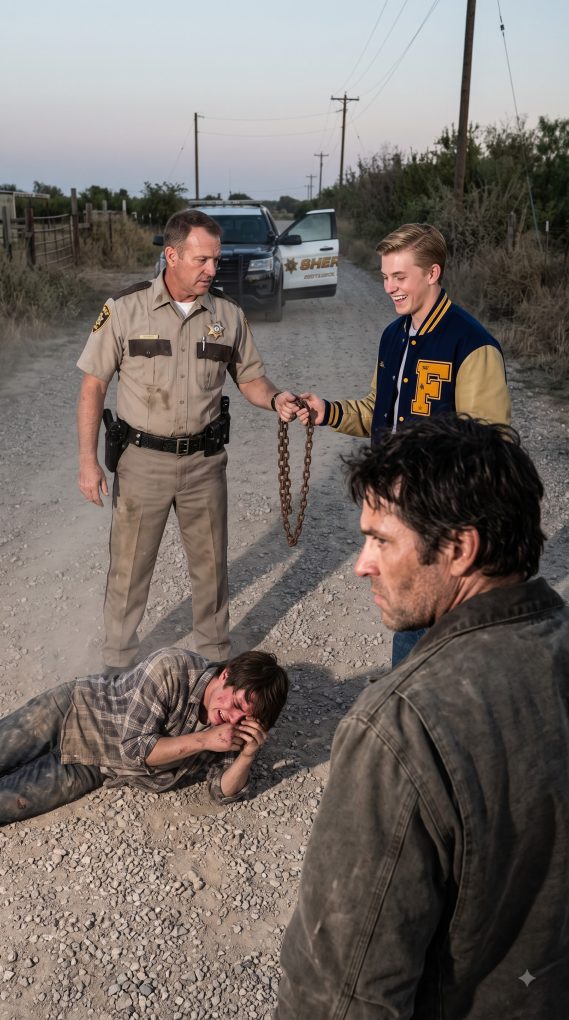
An oil billionaire’s son and his football team dragged my son a mile down a gravel road just for winning Valedictorian. The corrupt sheriff simply handed back their chain, while my brave boy gave his graduation speech from a hospital bed. They looked down on me as a helpless farmhand, unaware of my 17 years as a Green Beret. I quietly followed all of them three miles into the dark woods…
An oil billionaire’s son and his football team dragged my son a mile down a gravel road just for winning...

MY WIFE CLIMBED INTO MY SOCCER TEAMMATE’S CAR WHILE I WATCHED FROM OUR DRIVEWAY—THEN HER OLD IPAD EXPOSED A BETRAYAL THAT CONTINUED AFTER SHE BEGGED FOR FORGIVENESS – Life Story
My wife’s hand was already on another man’s passenger door when I told him to leave our driveway. By the...