A LONELY BILLIONAIRE BOARDED A PLANE TO ESCAPE HIS PAST—THEN A FIVE-YEAR-OLD BOY WITH HIS SAME GRAY EYES ASKED ABOUT THE FATHER HE’D NEVER MET – Life Story
The little boy buckled into seat 12B, looked straight into Beckett Langston’s face, and showed him the same silver-gray eyes Beckett had seen in his own mirror for thirty-seven years.
Beckett had boarded the flight to disappear after a humiliating privacy scandal; now a child who might be connected to the woman he’d abandoned was sitting within arm’s reach.
And when the boy asked whether his father ever thought about him, Beckett faced a question no amount of money could answer.
“Excuse me, sir.
This is Eli.
He’s traveling under our unaccompanied-minor service.”
The flight attendant’s hand rested lightly on the small boy’s backpack.
Beckett shifted out of his aisle-side slouch to let them pass, then noticed the boy’s eyes.
A few tiny silver flecks surrounded each gray iris, bright beneath the overhead cabin lights.
It was a resemblance, not proof of anything, but it made Beckett’s chest tighten so suddenly he forgot the attendant was waiting for an answer.
“Of course,” he said, moving his coat off the middle seat. “Hi, Eli.”
“Hi.” Eli was perhaps five, with dark hair that had resisted somebody’s attempt to comb it flat.
A stuffed blue elephant dangled by one ear from his backpack zipper.
He climbed into the seat, held the buckle with both hands, and clicked it shut with solemn satisfaction. “I know the rules,” he informed Beckett. “My mom practiced them with me six times.”
“Six sounds thorough.”
“She wanted seven, but we had to catch the airport car.”
The flight attendant smiled, checked Eli’s seat belt, and explained that she would return throughout the nonstop flight from New York to Portland.
Eli’s grandmother was listed as the adult collecting him.
Beckett nodded without offering his name or any information about himself beyond what the boy could already see.
“I’m Beckett,” he said after she moved down the aisle.
Eli considered that. “That’s a funny name.”
“So I’ve been told.”
“Mine means God answers.
Mom says names are promises, except sometimes you don’t find out what the promise means until later.” He took the elephant from his backpack.
Its sweater had been darned with green thread. “This is Captain Blue.
He’s not nervous.
I am, a little.”
Beckett watched Eli press the toy against his stomach.
The child looked remarkably like photographs of Beckett at the same age, but people could resemble strangers.
Six years without Callie had made his mind capable of inventing whole lives from glimpses on sidewalks.
He was not going to build another one around a little boy who needed an uneventful flight.
“I’m a little nervous too,” he admitted.
“About flying?”
“About going somewhere I haven’t been in a long time.”
Eli nodded as if this made complete sense.
The cabin doors closed, and the aircraft began moving backward from the gate.
Outside, rain traced thin gray rivers across the window.
Beckett had chosen an ordinary commercial flight because the photographers outside his Manhattan building could identify his private aircraft; he had not anticipated wanting to hide from his own thoughts at thirty thousand feet.
“My grandma Nora lives in Portland,” Eli said. “Mom’s working on a story in New York, so I’m going home first.
Grandma makes moon cookies.
Do you know those?”
“Can’t say I do.”
“Sugar cookies cut into moons.
They’re better when they’re a little crooked.” He pulled a tablet from his backpack. “Want to see a picture of Mom? She says she used to be really bad at taking pictures, but she’s a journalist now, so she has to get things right.”
Beckett’s fingers closed around the edge of his armrest.
He had not told the child anything about Callie.
He had not even allowed himself to say her name in his head.
Yet something about the way Eli said journalist, and the affectionate pride in his voice, brought back a woman standing in a Brooklyn kitchen, arguing that facts mattered even when they made people uncomfortable.
“Sure,” Beckett managed.
Then Eli turned the screen toward him, and Beckett saw a name he had spent six years trying not to remember.
A Name Above The Clouds
Callie Hart.
The photograph showed a woman standing outside a brick courthouse, holding a regional journalism award in one hand and a paper coffee cup in the other.
Her auburn hair was shorter than Beckett remembered.
There were faint lines near her eyes that had not existed when he last held her face between his hands.
But the smile was hers.
Not the professional smile she used with strangers.
The crooked, slightly uncertain expression she wore when she was proud of something and didn’t quite know how to accept the attention.
Beckett felt the cabin tilt.
“That’s my mom,” Eli announced. “She won a prize for writing about some people who were taking money from a hospital.”
Beckett stared at the photograph.
“She did?”
“Yep.
She made them give some of it back.
Grandma says Mom is a troublemaker for the right reasons.”
Despite everything, Beckett almost smiled.
That sounded exactly like Nora Hart.
He had met Callie’s mother twice during their relationship.
Nora had been polite but skeptical, the kind of woman who could tell when a man was accustomed to doors opening before he reached them.
During their second meeting, she had asked whether Beckett knew how to apologize without sending flowers.
He hadn’t understood why she was asking.
Now he did.
Eli swiped to another picture.
Callie stood beside a birthday cake shaped like a rocket ship.
Eli sat in front of it, grinning with five candles burning above the icing.
Five.
Beckett tried to calculate without appearing to calculate.
He and Callie had separated a little more than six years earlier.
She had moved away from New York several months afterward.
If she had discovered she was pregnant shortly after their breakup, the timing could fit.
But resemblance and timing were not proof.
And Eli was a real child, not an answer to a question Beckett was entitled to ask.
“Does your mom live in Portland?” he asked carefully.
“Uh-huh.
We have a blue house.
Well, mostly blue.
Some of the paint is coming off.” Eli examined the photograph. “Mom says we’ll fix it when her big story is finished.”
“Is that why she was in New York?”
“Yep.
I got to go with her for three weeks.
We stayed in an apartment with a tiny kitchen.
But Mom has to finish interviewing somebody, and I have kindergarten again, so Grandma is picking me up.”
Beckett nodded.
He was grateful the boy had a straightforward explanation.
He was also ashamed of the relief.
For years, Beckett had told himself that he had lost Callie because their lives were incompatible.
She believed in exposing uncomfortable truths.
He had built a cybersecurity company whose clients expected confidentiality, predictability, and strict control over information.
Callie wanted a relationship where difficult conversations happened before decisions became irreversible.
Beckett preferred solving problems alone and presenting finished solutions.
When they disagreed about the future, he treated her questions as demands.
When she asked whether there would ever be room for children, he said he couldn’t make promises he might fail to keep.
When she asked whether he loved her enough to try, he said he didn’t know.
He had known.
He simply hadn’t known how to say it without becoming responsible for what came afterward.
The plane climbed through a layer of clouds.
Eli leaned toward the window, watching the gray world outside turn bright and white.
“Wow,” he whispered.
Beckett looked with him.
Above the clouds, sunlight spilled across the wing.
For a moment, the cabin felt peaceful.
Then Eli asked, “Do you have any kids?”
Beckett’s throat tightened.
“No,” he said.
The answer was technically honest, as far as he knew.
It still felt wrong.
Eli nodded thoughtfully.
“Do you want some?”
Beckett considered the question.
“I think I might.”
“Then you should get one.
They’re fun.”
Beckett laughed softly.
“I’ll keep that in mind.”
Eli opened his apple juice with both hands.
After a while, he asked whether Beckett knew anything about computers.
Beckett admitted that he did, although he avoided explaining the company he had founded or the billions of dollars attached to his name.
Eli wanted to know whether computers could get sick.
“Sort of,” Beckett explained. “Sometimes something gets inside them that shouldn’t be there.”
“Like germs?”
“That’s a pretty good comparison.”
“Mom says people should be careful with their information.
She says strangers don’t get to know everything about us.”
Beckett looked at the tablet.
“Your mom is right.”
The irony settled heavily.
Only forty-eight hours earlier, a privacy breach involving one of Beckett’s personal cloud accounts had exposed photographs, private messages, and fragments of his personal life.
No customer records were implicated in the confirmed breach.
His company’s investigation was continuing.
But the public had already turned his embarrassment into entertainment.
A newspaper had published photographs of his almost empty refrigerator and described his penthouse as a monument to wealthy isolation.
A television host joked that the man who protected the world’s secrets could not protect himself from loneliness.
Beckett had fled New York because he couldn’t bear the thought of another reporter asking why a billionaire lived like a man waiting for somebody who never came home.
Now he was sitting beside a child who might explain the emptiness better than any journalist ever could.
Eli interrupted his thoughts.
“Beckett?”
“Yes?”
“Can I ask you something kind of important?”
“Sure.”
“Do you think dads remember their kids when they’re not together?”
Beckett turned toward him.
Eli was looking down at Captain Blue.
“My mom says my dad lives far away.
She says it’s grown-up stuff, and none of it is my fault.”
“She’s right about that.”
“I know.
But sometimes I wonder if he thinks about me.”
Beckett felt an ache move through his chest.
He wanted to tell Eli that any father who knew him would be proud.
He wanted to say that the absence of a father had nothing to do with the worth of a child.
Instead, he chose the only thing he could say with certainty.
“I think a father can make mistakes that have nothing to do with his child.”
Eli considered that.
“Like when I accidentally broke Grandma’s flowerpot?”
“Bigger mistakes than that.”
“Did he maybe get scared?”
Beckett looked toward the window.
“Maybe.”
Eli held Captain Blue more tightly.
“Mom says being brave doesn’t mean you’re never scared.
It means you do the right thing while you’re scared.”
Beckett closed his eyes briefly.
Callie had said almost the same thing to him six years earlier.
He had not listened then.
He was listening now.
The flight continued west.
Eli watched a movie, ate crackers, and fell asleep with his cheek resting against the little blue elephant.
Beckett remained awake.
He watched clouds move beneath the aircraft and tried to remember the final weeks of his relationship with Callie.
He remembered arguments about photographers, canceled weekends, and a dinner where he arrived two hours late without apologizing because he believed paying for an expensive restaurant should have been enough.
He remembered Callie standing in his kitchen, asking whether he wanted a future with her.
He remembered telling her that he couldn’t be what she needed.
What he did not remember was asking whether she was all right after she left.
When Eli woke, the aircraft had begun descending toward Oregon.
He pressed his face toward the window.
“Grandma’s down there!”
Beckett smiled.
“Somewhere.”
“Do you think she can see us?”
“Probably not yet.”
Eli laughed.
When the plane landed, a flight attendant returned to escort him through the airline’s unaccompanied-minor procedure.
The boy shouldered his backpack and turned toward Beckett.
“Thanks for being my airplane friend.”
“You’re welcome, buddy.”
“Maybe I’ll see you again.”
Beckett looked at him.
“I’d like that.”
Eli held out Captain Blue.
“You can give him a high five.”
Beckett gently touched the toy’s little paw.
Then the child walked away with the flight attendant.
Beckett sat alone until most of the passengers had left.
The empty middle seat seemed impossibly large.
He had built businesses across continents.
He had negotiated acquisitions with people who could bankrupt companies over lunch.
Yet he had no idea how to find out whether a five-year-old boy was his son without hurting the people involved.
And for once, he understood that not knowing what to do did not give him permission to do whatever he wanted.
The Six Years Between Them
Beckett found Nora Hart near the designated unaccompanied-minor pickup area.
He had not followed Eli there deliberately.
He was walking toward baggage claim when he heard the boy’s excited voice behind a low partition.
“Grandma! I made a friend!”
Nora knelt in front of him, fastening the collar of his blue jacket.
“Did you, sweetheart?”
“His name is Beckett.
He knew stuff about computers, and he was really nice.”
Nora’s hands stopped.
Beckett recognized her immediately.
Her silver hair was pinned in a neat bun, and she wore a dark green cardigan over a white blouse.
She looked older than when he’d last seen her, but her eyes still carried Callie’s sharp intelligence.
She slowly lifted her head.
Their gazes met across the terminal.
Recognition moved across her face.
Then anger.
Then something more difficult to read.
She looked away first.
Beckett did not approach.
He watched Nora take Eli’s backpack, show the required identification to the airline representative, and guide her grandson toward the exit.
Eli turned once and waved.
Beckett raised his hand.
Then they were gone.
He stood motionless for several seconds.
His phone vibrated.
His executive assistant, Simone, had sent the address of his hotel and a reminder about a cybersecurity consultation scheduled for the following afternoon.
Beckett barely remembered agreeing to it.
The trip had been arranged before the privacy scandal, but he had chosen to keep it because Portland seemed far enough from Manhattan to breathe.
Now he wondered whether the timing was another cruel accident.
He checked into a hotel overlooking the river.
The room was immaculate, with pale walls, expensive furniture, and a bed large enough for three people.
It felt like every other luxury hotel room he’d occupied during the last decade.
Beautiful.
Quiet.
Empty.
He unpacked his worn brown leather jacket.
Callie had bought it for him at a Brooklyn thrift store during the second month of their relationship.
He remembered complaining about the price, not because it was expensive but because he thought the stitching looked uneven.
Callie had laughed.
“Good,” she’d said. “Now you own something that doesn’t look like it was approved by a committee.”
He still wore it when he wanted to feel like the man he’d been before wealth began deciding his habits.
That evening, he called Simone.
“Cancel tomorrow’s consultation.”
There was a pause.
“Beckett, that meeting has been confirmed for six weeks.”
“I know.”
“Your board is already concerned about your absence.”
“I know that too.”
“Are you all right?”
He looked toward the dark window.
“No.”
Simone did not respond immediately.
She had worked with him for nine years.
She knew that his honesty usually arrived after he had exhausted every other option.
“What do you need?” she asked.
“A few days.
And someone competent to handle the privacy investigation without me directing every conversation.”
“That’s already happening.”
He rubbed his forehead.
“Then let them do it.”
After the call, Beckett stood by the window for a long time.
The city lights reflected against the glass.
For years, he had told himself that staying busy was the same as moving forward.
Now he was beginning to understand that he had been running in place.
At nine the following morning, his phone rang.
The caller ID displayed an Oregon number.
He answered.
“Beckett Langston?”
The voice was familiar.
“Yes.”
“This is Nora Hart.”
His heart began pounding.
“Mrs.
Hart.”
“Don’t call me that.
You lost the privilege of formality a long time ago.”
He swallowed.
“Nora.”
“I saw you at the airport.”
“I saw you too.”
“And Eli hasn’t stopped talking about you.”
Beckett closed his eyes.
“Nora, I need to ask—”
“Not over the telephone.”
She gave him the address of a coffee shop on Hawthorne Boulevard and told him to arrive alone.
Then she ended the call.
At ten-thirty, Beckett entered a small café with exposed brick walls, mismatched wooden tables, and the smell of fresh bread.
Nora sat near the back window.
She had a cup of black coffee and a paper folder resting beside her purse.
Beckett approached.
“Hello.”
“Sit.”
He sat.
For several seconds, she studied him without speaking.
“You look older,” she said.
“I am.”
“Six years will do that.”
Beckett looked down.
“I know.”
Nora folded her hands.
“My daughter came home after your relationship ended and tried very hard not to let me see how much she was hurting.”
His throat tightened.
“She didn’t want me worrying,” Nora continued. “She said the breakup was her decision.
She said you were both too different.”
Beckett stared at the table.
“I told her I couldn’t give her what she wanted.”
“Yes.
A future.”
He looked up.
Nora’s expression remained steady.
“Do you know what she wanted most?”
He shook his head.
“She wanted you to stay in the room when a conversation became uncomfortable.”
The words landed harder than anger would have.
Nora took a sip of coffee.
“She found out she was pregnant several weeks after leaving you.
She tried to call.
She sent messages.”
Beckett felt sick.
“I changed my number.”
“I know.”
“I didn’t know about the baby.”
“I believe that.”
He looked at her with sudden relief.
But Nora wasn’t finished.
“You didn’t know because you made certain she couldn’t reach you.”
Beckett lowered his eyes.
The distinction was devastating.
He had not knowingly abandoned a child.
But he had deliberately closed every door through which Callie might have told him about that child.
He remembered telling Simone not to forward personal calls.
He remembered deleting messages without listening because hearing Callie’s voice might persuade him to admit he had been wrong.
He had called it self-preservation.
Now he had another name for it.
Cowardice.
“Is Eli mine?” he asked quietly.
Nora looked at him.
“I believe he is.
But that isn’t something you’ll establish by looking into his eyes.”
Beckett nodded.
“I understand.”
“Callie deserves to make the decisions about how this is handled.”
“Of course.”
“And Eli is not an answer to your loneliness.”
Beckett looked up sharply.
Nora leaned forward.
“He is a little boy.
He has a school, friends, a dentist he doesn’t like, and a soccer team where he spends half the game looking at the clouds.
He has a life.
You don’t get to arrive and rearrange it because you’ve finally decided you’re ready to feel something.”
“I don’t want to hurt him.”
“Neither did Callie.”
Silence settled between them.
A barista called out an order.
Outside, a cyclist passed beneath the wet trees.
Beckett realized how ordinary the world remained while his own life was coming apart.
“I want to do this properly,” he said.
Nora watched him.
“What does that mean?”
“I want to speak with Callie.
I want to understand what happened.
If Eli is my son, I want to take responsibility.
But I won’t approach him without her agreement.”
Nora considered the answer.
“That would be a beginning.”
She picked up her purse.
“Callie is coming back from New York tomorrow.
She’s finishing an investigation she’s worked on for months.
She doesn’t need to arrive home and find you standing on her porch.”
“I won’t.”
“I’ll tell her I spoke with you.”
“Thank you.”
Nora stood.
Then she paused.
“Beckett?”
“Yes?”
“Eli is a happy child.
Callie worked very hard to make that possible.”
He nodded.
“Don’t mistake his happiness for proof that your absence didn’t matter.”
After she left, Beckett remained seated.
His coffee had gone cold.
He thought about the child who had asked whether fathers thought about their children when they were apart.
Eli had been trying to understand an absence that began before he was born.
And Beckett had been sitting beside him, knowing nothing about the nights Callie stayed awake, the birthdays he missed, or the questions she answered alone.
He opened his phone.
For the first time in six years, he typed Callie’s name into the search bar.
Her professional website appeared.
There were articles about unsafe housing, healthcare fraud, and families harmed by institutions that counted on people being too frightened to speak.
Her writing had grown sharper.
So had her reputation.
A photograph showed her accepting a regional journalism award.
In the corner of the image, a small boy’s hand reached toward her.
Beckett stared at it.
He had missed five birthdays.
He couldn’t change that.
But for the first time, he began to consider that regret might be useful only if it changed what he did next.
The Woman On Maple Street
Callie’s message arrived two days later.
We need to talk.
Laurelhurst Park.
Four o’clock.
Don’t approach the house.
Beckett read it three times.
Then he replied.
I’ll be there.
He arrived fifteen minutes early.
The park was wet from morning rain, its paths dark beneath enormous trees.
Families walked dogs around the pond, and children rode scooters past benches where older couples sat watching the water.
Beckett chose a bench near the path.
At precisely four, Callie appeared.
She wore faded jeans, dark boots, and a burgundy sweater beneath an old raincoat.
Her auburn hair fell just above her shoulders.
He stood.
She stopped several feet away.
“Beckett.”
“Callie.”
For a moment, neither moved.
Six years seemed to gather in the space between them.
She looked at his face carefully.
He wondered what she saw.
The man who had once made her laugh in grocery stores?
The billionaire whose photograph appeared in magazines?
Or simply someone she had worked very hard to stop missing?
“Nora told me you met Eli.”
“Yes.”
“On the plane.”
“Yes.”
Callie looked toward the pond.
“He talked about you the entire weekend.”
Beckett swallowed.
“He’s wonderful.”
She turned toward him.
“I know.”
The correction was gentle but unmistakable.
Beckett lowered his eyes.
“I’m sorry.”
“For which part?”
He looked up.
Callie’s expression did not change.
“For leaving,” he said. “For refusing your calls.
For making you carry everything alone.”
She sat on the bench.
After a moment, he sat beside her, leaving space between them.
“You didn’t know I was pregnant,” she said.
“No.”
“I tried to tell you.”
“Nora explained.”
Callie’s jaw tightened.
“I called your office.
Your assistant said you weren’t accepting personal calls.
I sent emails.
I wrote a letter.”
Beckett closed his eyes.
“I know.”
“No, you don’t.
You know now.
At the time, you made sure you didn’t have to know.”
He accepted the distinction.
Callie stared at the water.
“When Eli was born, I thought about trying again.
I imagined sending you a photograph.
I imagined showing up at your office with him.”
“Why didn’t you?”
She turned toward him.
“Because I remembered standing in your kitchen while you told me you couldn’t imagine a family with me.
I remembered how relieved you looked when I said I’d leave.”
Beckett felt the words settle.
“I wasn’t relieved.”
“You looked relieved.”
“I was terrified.”
Callie laughed once.
It was not a happy sound.
“You know what the difference is between fear and rejection, Beckett?”
He waited.
“Nothing, when you’re the person being left.”
A breeze moved across the pond.
Beckett watched a leaf drift beneath the surface.
He wanted to explain the pressure he had felt.
His father had been controlling, his childhood lonely despite extraordinary privilege, and his adult life organized around never depending on another person.
He had believed loving Callie would eventually make him cruel.
So he had ended the relationship before he could fail her.
At the time, the reasoning had felt almost responsible.
Now it sounded absurd.
“I thought I would become my father,” he admitted.
Callie looked at him.
“And instead, you became a man who disappeared.”
He nodded.
“Yes.”
That answer seemed to surprise her.
He did not argue.
He did not defend himself.
He simply accepted what she had said.
Callie folded her hands.
“I’ve spent six years building a life that works.
It isn’t perfect.
I worry about money.
I work too many hours.
Eli wants a dog, and I keep telling him our house is too small.”
Beckett almost smiled.
“He mentioned the dog.”
“Of course he did.”
She looked at him.
“But he knows he’s loved.
He knows where he’ll sleep.
He knows who picks him up from school.
When I say I’ll be there, he believes me.”
Her voice softened.
“I won’t let you make him doubt that.”
Beckett looked directly at her.
“Neither will I.”
“You don’t get to promise that yet.”
He nodded.
“Then tell me what I can do.”
Callie was quiet.
“First, we establish whether you’re his biological father.”
“Agreed.”
“We use a properly accredited laboratory.
We discuss the results privately.
And we don’t tell Eli anything until we’ve agreed on how to explain it in a way he can understand.”
“Whatever you need.”
“No,” she said.
He looked at her.
“I don’t want you saying whatever I need because you’re desperate to be forgiven.
I want you to understand the responsibility and make your own decision.”
Beckett considered that.
“I want the test,” he said. “And if I’m his father, I want to be part of his life in a way that is safe for him.
I know I haven’t earned your trust.
I’m willing to work on that.”
Callie studied him.
Then she nodded.
“All right.”
They sat quietly for several minutes.
A family passed, pushing a stroller.
Beckett watched the father stop to adjust the blanket around the baby.
Such a small gesture.
So ordinary.
He had spent his career making decisions worth millions.
Now he found himself wondering whether he would ever earn the right to perform ordinary acts of care without being treated as a visitor.
Callie stood.
“I have to pick up Eli.”
Beckett rose.
“Callie?”
She turned.
“Is he happy?”
Her expression changed.
“Yes.”
Beckett nodded.
“Good.”
He wanted to ask a hundred other questions.
What was Eli’s favorite food?
Did he sleep with a nightlight?
Had he ever asked whether his father didn’t want him?
Instead, he stepped aside and let Callie walk away.
She stopped after several paces.
“Beckett.”
He looked up.
“Thank you for not making this harder today.”
Then she continued down the path.
Beckett remained beside the pond until the light began to fade.
For the first time in his life, doing nothing had required more discipline than taking control.
But it was the right decision.
And he intended to remember that.
The Trust He Could Not Buy
The genetic testing process took longer than Beckett expected.
Callie insisted that both parties receive information about the procedure and that the results be handled privately.
Beckett agreed.
He also retained a family-law attorney in Oregon, not to begin a custody fight, but to understand his potential legal responsibilities and the steps required to establish paternity.
His attorney explained that biology was only one part of the situation.
If Beckett was Eli’s father, they would need to address formal recognition, support, and appropriate parenting arrangements.
The child’s welfare would remain central.
Beckett listened.
For once, he did not ask how much money would make the process move faster.
A week later, the laboratory results arrived.
The report established an extremely high probability that Beckett was Eli’s biological father.
He read it in his hotel room.
Then he read it again.
For several moments, he couldn’t move.
The document contained numbers, identifiers, and carefully worded conclusions.
It did not mention the little boy’s laugh.
It did not describe Captain Blue or moon-shaped cookies.
It did not explain how a person could become a father five years before he learned he had a child.
Beckett sat on the edge of the bed.
His phone lay beside him.
He thought of calling Callie immediately.
Instead, he waited until their agreed time.
When she answered, her voice was quiet.
“You saw the results?”
“Yes.”
A pause.
“How are you?”
Beckett looked toward the window.
“I don’t know.”
Callie exhaled.
“That’s fair.”
He pressed a hand over his eyes.
“I’m his father.”
“Yes.”
The words were simple.
They changed everything.
“I missed so much.”
“You did.”
“I don’t know how to make that right.”
“You can’t give him those years back.”
Beckett nodded, though she couldn’t see him.
“I know.”
“But you can decide what kind of person you’re going to be now.”
He looked at the report.
“I want to meet with you and talk about how we tell him.”
Callie was quiet.
“Not yet.”
He felt a flash of disappointment.
Then he remembered the park.
“All right.”
“I want him to know you first.
Not as a mysterious stranger who suddenly becomes his father, but as a person he can begin trusting.
He’s five, Beckett.
He doesn’t need an explanation before he has a safe relationship to attach it to.”
Beckett considered that.
It made sense.
“When can I see him?”
Callie hesitated.
“He’s been asking whether his airplane friend is still in Portland.”
A warmth moved through Beckett’s chest.
“Has he?”
“He wants to show you his playground.”
Beckett smiled for the first time that morning.
“I’d like that.”
“Saturday.
Two o’clock.
I’ll be there the entire time.”
“I understand.”
“And Beckett?”
“Yes?”
“Don’t buy him anything expensive.”
He looked down at the hotel carpet.
“I wasn’t going to.”
Callie laughed softly.
“You were absolutely going to.”
He couldn’t argue.
Saturday arrived with pale sunlight and a cool breeze.
Beckett reached the playground early and waited beside the swings.
When Eli saw him, the boy broke into a run.
“Beckett!”
Beckett knelt.
“Hey, buddy.”
“You’re still here!”
“I am.”
Eli looked pleased.
“Mom said maybe we could see you again.
I told Grandma you probably wouldn’t leave because you liked Portland.”
Beckett glanced toward Callie.
She stood several feet away, holding a thermos and watching them carefully.
“I do like it here,” he said.
Eli grabbed his sleeve.
“Come on.
I have to show you something.”
For the next forty minutes, Beckett followed Eli through the ordinary geography of childhood.
He admired a slide.
He counted the monkey bars.
He listened to an elaborate explanation of why the sandbox should have a bridge and two separate entrances.
Eli spoke with the seriousness of an engineer presenting plans to a committee.
Beckett listened as though every word mattered.
Because it did.
At the swings, Eli asked for a push.
Beckett looked toward Callie.
She nodded.
He placed his hands gently against the back of the swing.
“Ready?”
“Ready!”
The swing moved forward.
Eli laughed.
“Higher!”
Beckett pushed a little harder.
From the bench, Callie watched her son throw his head back in delight.
She had spent years imagining what would happen if Beckett ever appeared in their lives again.
In some versions, he arrived with lawyers.
In others, he offered money and disappeared once he understood the inconvenience of fatherhood.
She had never imagined him standing behind a swing, looking terrified of pushing too hard.
The sight unsettled her.
Not because it proved he had changed.
Because it suggested he might be willing to.
After the playground, Eli returned to a game with two other children.
Beckett sat at the far end of Callie’s bench.
“He’s fast,” he said.
“Only when you’re trying to catch him.”
Beckett smiled.
They watched the children play.
For several minutes, neither spoke.
Then Callie asked, “How long are you staying in Portland?”
Beckett looked at her.
“I’ve extended my hotel reservation.”
“That isn’t what I asked.”
He nodded.
“I know.”
“Your business is in New York.”
“My business has a management team.”
“You used to say that, then answer emails through dinner.”
Beckett looked down at his hands.
“I remember.”
Callie took a sip of coffee.
“Eli doesn’t care how many companies you own.
He cares whether you show up when you say you will.”
“I know.”
“Please stop saying that if you don’t.”
He looked at her.
Then nodded.
“All right.”
A small smile touched her mouth.
“There.
That sounded more believable.”
Over the next several weeks, Beckett began learning the rhythm of Eli’s life.
He attended a school art display after Callie invited him.
He sat through a library storytelling event where Eli whispered that the dragon in the book looked nothing like a real dragon.
He helped repair the chain on Eli’s bicycle, although Callie had to explain that owning expensive tools did not automatically mean knowing how to use them.
He learned that Eli disliked peas but would eat carrots if they were cut into circles.
He learned that the boy slept with Captain Blue during thunderstorms.
He learned that five-year-olds could ask seventeen questions before breakfast and still have energy to ask eighteen more on the way to school.
The learning was not always easy.
One afternoon, Eli became frustrated when Beckett couldn’t understand the complicated rules of a game he had invented.
“You’re doing it wrong!”
Beckett felt his old impatience rise.
Then he saw Callie watching from the kitchen doorway.
He stopped.
“Okay,” he said. “Show me again.”
Eli sighed dramatically.
“Beckett, you have to listen.”
Beckett nodded.
“You’re right.”
Callie looked away to hide a smile.
Later, after Eli had gone upstairs, she found Beckett standing beside the kitchen sink.
“You handled that well.”
He gave a tired laugh.
“I was negotiating with a five-year-old who changes the rules every twelve seconds.”
“He gets that from me.”
Beckett looked at her.
“I remember.”
For a moment, they smiled at each other as they had years earlier.
Then Callie looked away.
The distance between them remained.
And both knew it should.
Trust could not be rebuilt in a single afternoon, even when the afternoon was filled with laughter.
Small Things That Count
The first soccer game Beckett attended began beneath a gray Portland sky.
Rain had fallen overnight, leaving the grass damp and the sidelines muddy.
Eli wore an oversized blue jersey with the number seven on the back.
His shin guards were crooked.
He spotted Beckett near the field and immediately began waving.
“You came!”
Beckett raised a hand.
“Wouldn’t miss it.”
Callie stood beside him holding a folding chair.
“You’re early.”
“I didn’t know how bad parking would be.”
“It’s kindergarten soccer, Beckett.
Not the Super Bowl.”
He looked at the crowd of parents.
“Some of them seem to disagree.”
Callie laughed.
For twenty minutes, Beckett watched children chase a ball with enormous enthusiasm and very little tactical organization.
Eli spent much of the first half running in the wrong direction.
When a teammate fell, he stopped to help her up.
When the referee signaled halftime, he sprinted toward the sidelines and asked whether Beckett had seen him almost score.
“I saw you make a great pass,” Beckett said.
Eli considered that.
“That’s good too.”
Callie handed him a water bottle.
“Drink.”
Eli obeyed, then ran back toward the field.
Beckett looked at her.
“You’re very good at that.”
“At what?”
“Knowing what he needs.”
Callie shrugged.
“Sometimes I get it wrong.”
“I doubt that.”
She looked at him.
“Don’t put me on a pedestal.
It’s exhausting.”
Beckett smiled faintly.
“Fair.”
The second half began.
Near the end of the game, Eli received the ball in front of an open goal.
He ran toward it, concentrating so intensely that his tongue appeared at the corner of his mouth.
He kicked.
The ball rolled slowly past the goalkeeper.
For one suspended second, nobody moved.
Then the children erupted into cheers.
Eli turned immediately toward the sidelines.
“Mom! Beckett! Did you see?”
Callie was already standing.
“We saw!”
Beckett found himself cheering louder than anyone nearby.
Eli ran toward them after the final whistle, his cheeks flushed.
He threw his arms around Callie, then hugged Beckett’s legs.
“I’m so glad you both came.”
Beckett felt the words settle somewhere deep inside him.
He had received awards from governments and technology associations.
He had stood on stages while audiences applauded his success.
Nothing had prepared him for the importance of a small boy being happy that he had shown up.
After the game, Callie invited Beckett to join them for lunch.
They went to a modest diner near the park.
Eli ordered pancakes despite the fact that it was nearly two in the afternoon.
Callie ordered soup.
Beckett studied the menu with unnecessary seriousness.
“Why does everything have seventeen possible substitutions?”
Callie raised an eyebrow.
“You built software used by multinational corporations, and a diner menu defeats you?”
“Apparently.”
Eli giggled.
“Mom, he doesn’t know how to order lunch.”
Callie laughed.
The sound caught Beckett off guard.
He had missed it.
Not the polished laugh she used during interviews.
This one.
The laugh that arrived before she had time to decide whether she wanted to be vulnerable.
Later, when Eli went with Callie to wash his hands, Beckett paid for lunch.
She noticed when they returned.
“You didn’t have to do that.”
“I know.”
“Beckett.”
He looked at her.
“Next time, you can pay.”
She studied him.
Then smiled.
“Deal.”
It was a small agreement.
But unlike the promises he used to make, he intended to remember it.
The following week, Beckett was invited to Nora’s house for dinner.
Nora had agreed only after Callie explained that Eli wanted his airplane friend to meet the grandmother who made moon cookies.
Beckett arrived carrying a box of pastries from a local bakery.
Nora looked at the box.
“You could’ve brought a salad.”
“I can go get one.”
She sighed.
“Come inside.”
Her house smelled of cinnamon and roasted vegetables.
Family photographs covered the hallway walls.
Beckett recognized Callie at different ages: a little girl missing her front teeth, a teenager holding a debate trophy, a young woman in a graduation gown.
Then he saw a photograph of Eli as a newborn.
His chest tightened.
Callie stood beside him.
“He was three days old.”
Beckett looked at the tiny face.
Eli’s eyes were closed.
One small hand rested against Callie’s collarbone.
“You look tired,” he said.
“I was.”
“Were you alone?”
“Nora was there.”
He nodded.
Callie studied him.
“Don’t do that.”
“Do what?”
“Look at every picture like you’re calculating how much you’ve missed.”
Beckett looked toward her.
“I am.”
“I know.
But those memories aren’t a debt you can repay.
They’re part of our lives.”
He swallowed.
“I wish I’d been there.”
Callie’s expression softened slightly.
“I know.”
Nora called them into the kitchen before either could say more.
Dinner was noisy.
Eli explained his latest school project while Nora corrected Callie’s description of a family recipe.
Beckett helped clear the dishes.
When he began loading the dishwasher, Nora watched him with open suspicion.
“Do you actually know how to do that?”
He smiled.
“I can learn.”
“Good.
Because that plate doesn’t go there.”
Callie laughed from the doorway.
Beckett moved the plate.
It was the most comfortable evening he had spent in years.
And it frightened him.
Not because the family expected anything extraordinary.
Because they didn’t.
They expected him to listen, help, and stay until the dishes were finished.
Later, Callie walked him to his car.
A light rain had begun.
“Thank you for coming,” she said.
“Thank you for inviting me.”
She looked toward the house.
“Eli likes you.”
“I like him.”
“I know.”
Beckett waited.
She turned back toward him.
“He’s beginning to notice things.”
“What things?”
“That you look at him differently from other adults.
That you know me.
That Nora gets quiet when your name comes up.”
Beckett’s stomach tightened.
“Do you think it’s time?”
Callie looked toward the porch light.
“Soon.”
He nodded.
“I’ll follow your lead.”
She shook her head.
“We’ll decide together.”
The word lingered between them.
Together.
It was the first time she’d used it about their future without immediately correcting herself.
Beckett drove back to his hotel feeling hopeful.
Then his phone rang.
It was Simone.
“Beckett, we need you in New York.”
His stomach tightened.
“What’s happened?”
“The board is meeting tomorrow.
The privacy investigation has identified serious control failures, and several directors are demanding a formal review of your executive responsibilities.”
Beckett pulled into a parking lot.
He listened as Simone explained the situation.
His company was not collapsing.
But it required leadership.
The directors wanted him present, and his continued absence was making the problem worse.
For a moment, he felt the old instinct take over.
Fly back.
Assume control.
Solve the problem.
Make everything behave.
Then he thought of Eli’s next soccer game.
Of Callie’s cautious smile.
Of Nora telling him that fatherhood was not something a man could step into whenever it became convenient.
He closed his eyes.
“I’ll come to New York,” he said. “But we need to discuss a transition plan.”
Simone was silent.
“A transition?”
“Yes.”
“Beckett, you’ve spent fifteen years building this company.”
“I know.”
“Are you sure?”
He looked toward the dark street.
“No,” he admitted. “But I’m certain I can’t keep pretending I’m the only person who can run it.”
The following morning, he told Callie he needed to travel.
She listened quietly.
“How long?”
“Three days, possibly four.”
“Eli has a game Saturday.”
“I know.”
“You promised you’d be there.”
Beckett felt the words like a weight.
“I’ll do everything I can to return.”
Callie’s expression changed.
“Don’t tell him you’ll be there unless you know.”
He nodded.
“You’re right.”
Then she asked the question he had been avoiding.
“Is this going to happen every time your company needs you?”
He looked at her.
“I don’t know yet.”
Callie lowered her eyes.
It was an honest answer.
It was also one she had heard in different forms six years earlier.
And the old fear returned to her face.
When He Was Needed
Beckett’s meeting in New York lasted longer than expected.
The board reviewed the security incident, questioned the safeguards around executive accounts, and demanded changes to the company’s internal governance.
Beckett accepted the findings.
His personal data exposure had not been caused by a failure in the company’s primary customer systems, but it revealed complacency in how certain executive accounts and devices were managed.
The distinction mattered legally and technically.
It did not make the embarrassment disappear.
Beckett had spent years lecturing clients about protecting information while treating parts of his own digital life as an afterthought.
He could not dismiss the hypocrisy.
During the meeting, a director asked whether his judgment had been affected by personal circumstances.
Beckett looked around the conference table.
Then he answered honestly.
“Yes.”
The room fell quiet.
“I’ve been dealing with private matters that require my attention.
I haven’t handled the transition well, and I should have communicated that sooner.”
One director leaned forward.
“Are you resigning?”
“I’m proposing that we begin an orderly leadership transition.
The company needs someone prepared to be present without pretending every decision depends on them.”
There were questions.
Some directors resisted.
Others were relieved.
By the end of the day, they had agreed to begin evaluating permanent leadership arrangements while Beckett remained involved in a limited capacity.
It was not a dramatic departure.
There was no public announcement that he had abandoned billions of dollars for love.
He still owned significant equity.
He still had obligations.
But he had begun separating his identity from the company he created.
That evening, he called Eli.
Callie placed the phone on speaker.
“Hi, Beckett!”
“Hey, buddy.”
“Are you in New York?”
“Yep.”
“Did you see any skyscrapers?”
“Quite a few.”
“Did you see the one that looks like a pencil?”
Beckett smiled.
“Not today.”
Eli told him about school, a spelling test, and a classmate who had brought a pet turtle for show-and-tell.
Then he asked, “Are you coming to my game?”
Beckett looked at the meeting schedule on his desk.
“I don’t think I’ll be back by Saturday.”
The silence on the other end was brief but unmistakable.
“Oh.”
Beckett closed his eyes.
“I’m sorry, Eli.”
“It’s okay.”
The boy’s voice was small.
“Mom says grown-ups get busy.”
Beckett felt something twist in his chest.
“I still want to hear all about it afterward.”
“Okay.”
Callie came back on the line.
“We need to go.
It’s bedtime.”
“Of course.”
When the call ended, Beckett sat alone in his office.
The glass walls reflected his face back at him.
He had chosen responsibility to his company.
That was not inherently wrong.
But the disappointment in Eli’s voice revealed how easily a child could interpret absence as something personal.
Beckett had not expected to feel this much pain over a soccer game.
Perhaps that was part of becoming a father.
Understanding that the small promises were the ones children remembered.
The following morning, Simone found him reviewing the board’s transition materials.
“You look terrible.”
“Thank you.”
“You should sleep.”
“I’ve been thinking.”
“Dangerous.”
He almost smiled.
“Simone, how many meetings have I insisted on attending because I thought nobody else could handle them?”
She considered the question.
“A lot.”
“How many actually required me?”
“Fewer than you’d like to believe.”
He nodded.
“I’ve made my work dependent on my presence.
Then I’ve used that dependence as an excuse to avoid everything else.”
Simone leaned against the doorframe.
“That sounds familiar.”
He looked up.
She did not explain.
She didn’t need to.
By Friday afternoon, Beckett had delegated the remaining meetings and arranged to return to Portland the next morning.
He would miss the beginning of Eli’s game but hoped to arrive before it ended.
Then Callie called.
It was nearly midnight in New York.
Her voice sounded strained.
“Beckett.”
He stood immediately.
“What’s wrong?”
“It’s Eli.”
His stomach dropped.
“He’s at the hospital.”
“What happened?”
“He had a fever for two days.
We saw his pediatrician, but tonight his breathing became difficult.
They think he has pneumonia.”
Beckett reached for his coat.
“Where are you?”
“At the children’s hospital.
They’re monitoring his oxygen levels.”
“I’m coming.”
Callie took a shaky breath.
“You don’t have to make a dramatic entrance.
He’s stable right now.”
“I know.”
“Beckett—”
“I want to be there.
Not because I can fix it.
Because he’s scared, and you’re there alone.”
Silence.
Then Callie whispered, “Okay.”
Beckett booked the earliest available flight and called Simone to handle the remaining obligations.
He did not ask anyone to arrange special hospital treatment.
He did not offer to buy a new wing or demand that physicians report directly to him.
He simply traveled.
By the time he reached Portland, the sun was rising behind gray clouds.
At the hospital, he found Callie sitting beside Eli’s bed.
The boy was awake but tired.
A nasal oxygen cannula rested beneath his nose, and a pulse oximeter was attached to one finger.
A nurse was checking the monitor.
Callie looked exhausted.
Her hair was pulled into a loose knot, and dark circles shadowed her eyes.
When Beckett appeared in the doorway, she stared at him.
“You came.”
He nodded.
“I said I would.”
Eli turned his head.
“Beckett?”
“Hey, buddy.”
The boy gave a weak smile.
“I got sick.”
“I heard.”
“It’s not fun.”
“I believe you.”
Beckett approached the bed slowly.
“Can I sit?”
Eli nodded.
He pulled a chair closer.
Callie watched him place his phone facedown on the windowsill without checking the screen.
For several minutes, Beckett listened as Eli described the blood pressure cuff that squeezed his arm and the nurse who had promised him a sticker shaped like a dinosaur.
He did not interrupt.
He did not promise everything would be fine.
He asked whether the boy wanted a story.
Eli nodded.
“About a dragon?”
“Of course.”
For twenty minutes, Beckett invented a story about a dragon who lived in a lighthouse and was afraid of thunderstorms.
The dragon learned that bravery did not mean controlling the weather.
It meant keeping the light burning until the storm passed.
Eli listened with heavy eyes.
Eventually, he fell asleep.
Beckett remained seated.
Callie looked toward him.
“You’re tired.”
“So are you.”
“I’ve been here all night.”
“I know.”
She studied him.
“You can go get coffee.”
“In a minute.”
The nurse returned and explained that Eli was responding to treatment but would remain hospitalized for observation until his breathing and oxygen levels were stable without additional support.
Callie asked careful questions.
Beckett listened.
When the nurse left, he turned toward her.
“What can I do?”
Callie rubbed her eyes.
“I need to call my editor.
I have a deadline.”
“Go ahead.
I’ll sit here.”
She hesitated.
Then she handed him Eli’s water bottle.
“He might wake up thirsty.”
“I’ve got it.”
She left the room.
For the first time, Beckett sat alone beside his sleeping son.
He watched the rise and fall of the small chest beneath the blanket.
A year earlier, he would have considered the next twenty minutes wasted if he wasn’t solving a problem or answering emails.
Now he would have given almost anything to know that Eli would continue breathing comfortably through the night.
He understood, suddenly, why Callie had sounded so frightened.
Parenthood meant loving someone whose safety could never be guaranteed.
It meant accepting that money and competence would sometimes be useless against ordinary human vulnerability.
Beckett reached toward the blanket and gently straightened its edge.
Eli stirred.
His eyes opened halfway.
“Beckett?”
“I’m here.”
“Are you going back to New York?”
Beckett felt the question settle.
“Not today.”
“Tomorrow?”
“I don’t have plans to leave tomorrow.”
Eli considered that.
Then he whispered, “Good.”
He closed his eyes again.
Beckett sat very still.
The boy had not asked for a toy.
He had not asked about money.
He had asked whether Beckett would still be there.
And for the first time, Beckett understood that the most important answer he could give was one his actions would have to confirm.
Later, Callie found him sitting beside the bed, his head resting against the wall.
His eyes were closed.
One hand lay open on the blanket near Eli’s.
The child had reached out in his sleep and placed two fingers against Beckett’s palm.
Callie stopped in the doorway.
She had spent six years telling herself she no longer needed anything from the man who had left her.
Now she watched him remain beside their son without an audience, without praise, without anyone asking him to.
Something inside her softened.
Not into forgiveness.
Not yet.
But into the possibility that the future might not have to repeat the past.
The Question Inside The Fort
Eli recovered over the following days.
His fever settled, his breathing improved, and his care team cleared him to return home with instructions for rest and follow-up.
Beckett helped carry the bags from the hospital.
Callie drove.
Nora waited at the house with soup and fresh sheets.
Eli was delighted to be home.
He wanted to tell everyone about the dinosaur sticker he had received and the nurse who let him choose the color of his hospital socks.
He also wanted to finish a blanket fort he’d begun before getting sick.
Callie insisted he rest first.
Eli negotiated for ten minutes.
Eventually, he agreed to a nap in exchange for permission to build the fort afterward.
Beckett watched the exchange with quiet admiration.
Later, while Eli slept, Callie found Beckett standing beside the kitchen sink.
“You don’t have to keep hovering.”
He smiled faintly.
“I know.”
“You look like you’re waiting for somebody to give you an assignment.”
“I’m not sure what I’m supposed to do.”
She handed him a dish towel.
“Dry these.”
He accepted it.
They worked quietly for several minutes.
Outside, rain tapped against the window.
The kitchen smelled of soup and dish soap.
Beckett remembered standing in a kitchen with Callie years earlier, arguing over whether it was possible to make good coffee without an expensive machine.
He had insisted quality required precision.
She had told him that sometimes what mattered was having someone to drink it with.
He had forgotten the conversation until that moment.
“Callie?”
“Yes?”
“I’m sorry I made you feel like loving me was a problem you needed to solve.”
She stopped washing a plate.
For a long moment, she said nothing.
Then she looked at him.
“I spent years wondering whether I asked for too much.”
“You didn’t.”
“I know that now.”
He nodded.
She returned to the dishes.
“But knowing it now doesn’t erase what it felt like then.”
“I understand.”
Callie glanced at him.
This time, she didn’t correct the phrase.
Because she believed he was beginning to.
That evening, after Eli finished dinner, he announced that the blanket fort was ready for inspection.
The living room had been transformed into a maze of cushions, dining chairs, and old sheets.
Captain Blue stood guard near the entrance.
Eli crawled inside.
“Come on!”
Callie followed him.
Beckett knelt beside the opening.
“Is there room for me?”
Eli considered the structure.
“Only if you don’t knock down the roof.”
“I’ll do my best.”
Inside, the fort smelled faintly of laundry detergent and crayons.
A battery-operated lantern cast a soft golden glow against the blankets.
Eli showed them a drawing of the three of them standing beside a house.
Beckett stared at it.
“Who’s that?”
“Mom.”
“And that?”
“Me.”
“And the tall one?”
Eli smiled.
“You.”
Beckett felt his throat tighten.
Callie looked at the drawing.
Then she looked toward him.
They had planned this conversation for days.
They had spoken with a child therapist about how to explain the truth in simple, age-appropriate language.
They had agreed not to overwhelm Eli with adult regrets or make promises they could not guarantee.
Now the moment had arrived.
Callie sat beside her son.
“Eli, sweetheart, there’s something Beckett and I want to tell you.”
The boy looked up.
“Am I in trouble?”
“No,” she said. “Not at all.”
He relaxed slightly.
“You know how you’ve asked about your dad?”
Eli nodded.
“Sometimes.”
Callie took his hand.
“Well, we found out something important.
Beckett is your biological father.”
The little boy stared at her.
Then at Beckett.
For several seconds, he said nothing.
Beckett could hear the rain against the roof.
“Beckett is my dad?”
“Yes,” Callie said.
Eli looked at Beckett again.
“Really?”
Beckett nodded.
“Really.”
The child frowned.
“Then why didn’t you tell me before?”
Beckett took a careful breath.
“Because I didn’t know about you when you were born.
Before that, I made a bad decision and stopped talking to your mom.
She tried to reach me, and I didn’t listen.”
Eli considered the answer.
“Were you mad at her?”
“No.”
“Then why?”
“Because I was scared, and I handled being scared badly.”
The boy looked toward Callie.
“Did it make you sad?”
Callie’s eyes filled.
“Yes, sweetheart.
For a while.”
Eli turned back toward Beckett.
“Are you still scared?”
Beckett looked directly at him.
“Sometimes.”
“Of me?”
The question nearly broke him.
“No.
Never of you.”
Eli studied his face.
“Then what?”
“Of making another mistake that hurts somebody I love.”
The boy considered that.
Then he asked, “Do you love me?”
Beckett felt his vision blur.
“Yes,” he said. “Very much.”
Eli looked down at Captain Blue.
“Even though you just met me?”
“Yes.”
“How?”
Beckett smiled through tears.
“Sometimes love begins before you know everything about somebody.
But being a good dad means I have to keep showing you that love, not just saying it.”
Eli nodded slowly.
Then he asked the question Callie had been expecting.
“Are you going to leave again?”
Beckett looked toward her.
She gave a small nod.
He turned back to his son.
“I will have to travel sometimes.
And I won’t always be able to do everything perfectly.
But I want to be your dad, and I’m making plans so I can keep being part of your life.”
Eli frowned.
“So you’ll come back?”
“Yes.”
“Even if I get mad?”
“Yes.”
“Even if I don’t score goals?”
Beckett laughed softly.
“Especially then.”
Eli thought about that.
Then he crawled toward Beckett.
“Can I hug you?”
Beckett opened his arms.
“Always.”
The little boy climbed into his lap and wrapped both arms around his neck.
Beckett held him carefully.
He had spent years believing that success meant never allowing anyone enough power to hurt him.
Now he understood that loving someone meant accepting exactly that possibility.
Across the fort, Callie wiped her cheeks.
Eli pulled back.
“Can I call you Dad?”
Beckett swallowed.
“If you want to.”
The boy smiled.
“Okay, Dad.”
The word settled into Beckett’s chest like a door opening.
Then Eli looked toward the sagging blanket roof.
“Dad?”
“Yes?”
“I think our fort needs a stronger foundation.”
Beckett laughed.
“I think you’re right.”
Together, they crawled outside and began moving the cushions.
Callie watched them work.
For years, she had imagined the moment when Eli might finally meet his father.
She had feared it would be full of anger, confusion, and impossible explanations.
Instead, the first thing they did after telling the truth was repair a blanket fort.
Something ordinary.
Something a father and son could finish together.
And perhaps that was how the rest of their lives would have to be built.
Not with grand promises.
With careful, repeated acts of staying.
A Life Built Slowly
Beckett did not move into Callie’s house the following week.
He rented a small apartment nearby.
He attended parenting classes, established a formal parenting arrangement with Callie, and worked through the legal steps necessary to recognize his responsibilities as Eli’s father.
He paid appropriate child support without turning it into a negotiation over Callie’s independence.
He also began learning how to be useful without assuming he knew best.
He learned the route to Eli’s school.
He memorized the pediatrician’s office number.
He discovered that helping a child with homework required patience he had never needed in a boardroom.
And when Eli asked whether Beckett could come camping with his group, he said yes only after checking his schedule.
They spent a damp weekend learning to pitch a tent, making uneven s’mores, and looking for stars through breaks in the Oregon clouds.
Eli talked for hours.
Beckett listened.
One evening, after the other families had settled into their tents, Eli leaned against his father’s shoulder.
“Dad?”
“Yeah, buddy?”
“I’m glad you found me on the airplane.”
Beckett looked at the little boy.
“So am I.”
Eli considered the dark trees.
“Grandma says sometimes people get lost and need directions.”
Beckett smiled.
“Your grandma is very smart.”
“I think you were lost.”
Beckett looked toward the stars.
“I think I was too.”
Months passed.
Beckett completed the transition out of daily leadership at his former company while retaining a financial interest and meeting his remaining obligations.
He eventually established a smaller cybersecurity firm in Portland.
Its first clients included a children’s hospital and a nonprofit supporting families affected by domestic abuse.
The business was not designed to become another empire.
It was designed to provide excellent work without demanding that Beckett sacrifice every other part of his life to prove its importance.
Callie’s career continued to grow.
Her investigation into healthcare fraud received national attention, and she began working on a book.
Sometimes she traveled.
When she did, Beckett cared for Eli according to their agreed schedule.
Sometimes Beckett traveled.
When he did, he called when he promised and returned when he said he would.
There were mistakes.
He missed an appointment once because he had written down the wrong time.
He apologized, corrected the calendar, and made sure it did not become a pattern.
Callie sometimes found herself checking whether he would disappear whenever they disagreed.
He learned not to become defensive.
Trust returned slowly.
One Sunday morning, Beckett arrived to make pancakes.
He burned the first batch.
Callie took the spatula away.
“You’re supposed to lower the heat.”
“I thought I had.”
“You didn’t.”
Eli laughed from the kitchen table.
“Dad’s not good at pancakes.”
“I’m learning,” Beckett said.
Callie stood beside him, turning the next pancake.
Their shoulders brushed.
Neither moved away.
He looked at her.
“I love you.”
The words were quiet.
Callie kept her eyes on the pan.
“I know.”
He waited.
She turned toward him.
“I still love you too.
But I’m not going backward, Beckett.”
“I don’t want you to.”
“If we try again, we build something different.”
He nodded.
“Together.”
For a moment, she studied his face.
Then she took his hand.
It was not a dramatic reunion.
It was two people choosing to begin again after enough time had passed for the choice to mean something.
A year later, they married in Nora’s backyard.
Eli carried the rings.
There were no reporters, no lavish floral arrangements, and no elaborate security operation.
Callie wore a simple ivory dress.
Beckett wore the old leather jacket over his shirt after the ceremony because Eli insisted it was his father’s lucky jacket.
Their promises were short.
They spoke about honesty, patience, and staying present when life became difficult.
Later, their family welcomed a daughter, Lily.
Eli was delighted to become a big brother.
He taught her to wave before she could speak and announced that she would eventually become the best soccer player in Oregon.
Two years after the airplane encounter, the house on Maple Street looked different.
Its faded blue paint had been replaced with warm sage green.
The garden was full of vegetables, some thriving and others struggling beneath Beckett’s enthusiastic attempts to help.
A tire swing hung from the old oak tree.
Inside, photographs covered the hallway.
Eli’s first soccer goal.
Lily asleep against Callie’s shoulder.
Nora laughing beside a badly decorated birthday cake.
And one photograph of three people sitting inside a blanket fort beneath a crooked sheet.
Beckett kept a printed copy in his office.
On an ordinary Tuesday evening, he came home to find Eli helping Lily push a soft ball across the living room.
Callie stood near the kitchen window, reading notes for her next article.
“You’re early,” she said.
“Meeting ended on time.”
She raised an eyebrow.
“Miracles happen.”
He smiled.
Eli looked up.
“Dad! Come see what Lily can do!”
Beckett set down his bag.
He crossed the room, knelt beside the children, and watched his daughter take a few unsteady steps toward him.
She laughed when she reached his arms.
Eli cheered.
Callie looked up from her notes.
For a moment, Beckett saw the whole room at once.
The toys scattered across the rug.
The books stacked beside the sofa.
The dishes waiting in the sink.
The family he had nearly missed because he once believed that loving someone meant losing control.
His phone vibrated.
A message from his office.
He glanced at the screen, then placed it facedown on the table.
Eli noticed.
“Don’t you need to answer that?”
Beckett shook his head.
“It can wait.”
Lily reached for his face.
Callie smiled.
Outside, rain began tapping softly against the windows.
Beckett remembered another rainy day, years earlier, when a small boy had climbed into seat 12B beside him.
He remembered the silver-gray eyes, the little blue elephant, and the question that had changed his life.
Do you think my dad thinks about me sometimes?
Now, when Eli asked for him, Beckett no longer had to imagine the answer.
He was there.
And this time, he stayed.
Recommended Stories

My fiancé said, “You’re too quiet. It’s weird. Sometimes I feel like you’re hiding a whole life from me.” I said, “Maybe.” I didn’t clarify a thing. But two days later, when he overheard a conversation he wasn’t meant to hear… he stood frozen in the hallway for nearly a minute.
My fiancé said, “You’re too quiet. It’s weird. Sometimes I feel like you’re hiding a whole life from me.” I...
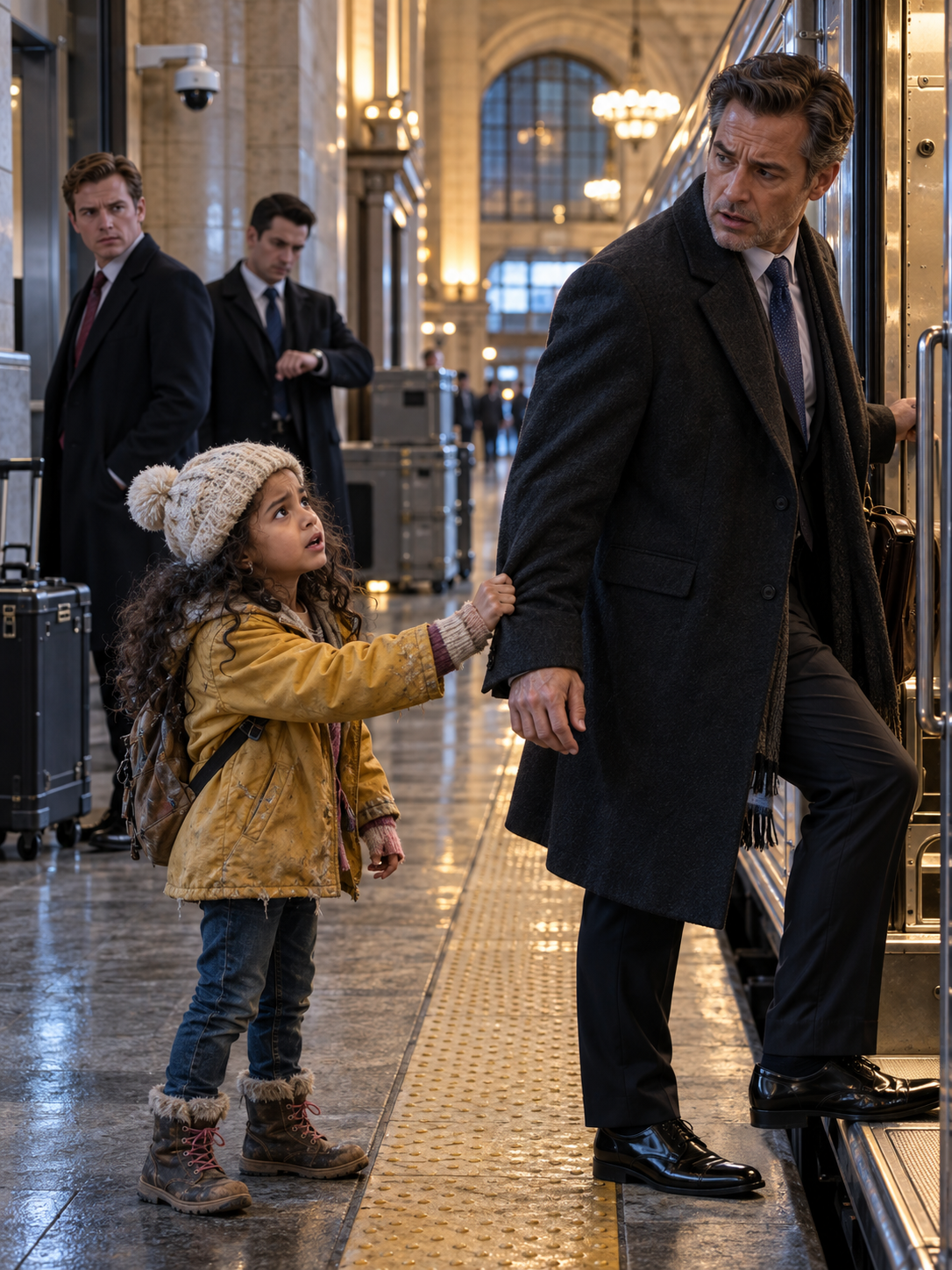
THE LITTLE GIRL WARNED A MILLIONAIRE NOT TO BOARD HIS TRAIN—THEN SECURITY FOOTAGE EXPOSED WHY HIS OWN BROTHER NEEDED HIM TO DISAPPEAR BEFORE WASHINGTON – Life Story
A six-year-old girl grabbed William Carter’s sleeve just as he lifted one foot toward the train and whispered, “Please don’t...

She Left Her Airport Counter to Help a Stranger in a Wheelchair—Months Later, He Wrote One Question Inside Her Purple Notebook – Life Story
Avery Brooks knew Jason Monroe was about to ask her something before she saw what he had written. He had...