I Let My Ex Call Me “His Girl” at Our Class Reunion… My Husband Asked for a Separate Check…
I Let My Ex Call Me “His Girl” at Our Class Reunion… My Husband Asked for a Separate Check
My high school sweetheart put his hand on my shoulder, called me “his girl,” and smiled at my husband across the table.
I laughed because, for one foolish moment, I thought everyone was watching me win.
Then my husband raised his hand for the waitress and said six words that would nearly end our marriage: “Separate check, please.
Just mine.”
Part 1: The Night My Husband Paid for Himself
The laughter around our reunion table stopped so suddenly that I could hear the ice settling in somebody’s glass.
Twenty years after graduation, twenty-three former classmates and their spouses had gathered at Gity’s Grill in Fair Haven, Connecticut, beneath strings of amber lights and framed photographs of local football teams.
My husband, Warren, was sitting across from me with half a burger on his plate.
Beside me, my high school boyfriend, Tate Rourke, had one hand resting comfortably on my shoulder, as though the intervening twenty years had never happened.
“Come on, Dee,” Tate said, giving my shoulder a playful squeeze. “Still my girl, though, right?”
I should have moved his hand.
I should have introduced a little distance between us, laughed politely, or simply told him that the girl he remembered had been married for fifteen years.
Instead, I tilted my head toward him and smiled while half the table watched.
It was a small performance, barely three seconds long, but I could feel the old thrill of being noticed rising in my chest.
Warren placed his napkin beside his plate.
He had spent most of dinner listening to stories about people he’d never met, asking questions when it seemed appropriate, and smiling at jokes that required explanations.
He was never the loudest person in a room, which was something I usually loved about him.
That night, though, his silence had begun to feel inconvenient.
“Excuse me,” he said when our waitress passed. “Could I get a separate check?
Just mine, please.”
The waitress, a young woman named Hannah, glanced at Tate’s hand before looking back at Warren. “Of course.
Just the burger and the beer?”
“That’s right.
Thank you.”
I gave a short, disbelieving laugh. “Warren, seriously?”
He didn’t answer immediately.
He took out his wallet, placed his credit card beside his plate, and waited while Hannah went to the register.
His expression wasn’t angry.
Somehow, that made the moment worse, because there was nothing dramatic enough in his face for me to accuse him of making a scene.
Tate leaned back in his chair. “Hey, buddy, don’t leave on my account.
We’re just messing around.”
Warren looked at him for one quiet second.
Then he looked at me.
“Take your time, Delia.
I’ll see you at home.”
He signed his receipt when Hannah returned, thanked her, and pushed his chair beneath the table.
There was no accusation, no slammed fist, no demand that I follow him.
He simply walked away, carrying his jacket over one arm, while everyone watched a man who had driven forty minutes to support his wife leave a dinner he hadn’t wanted to attend.
I stared after him, expecting him to turn around.
When he didn’t, humiliation rose so sharply that it almost felt like anger.
I told myself he was being possessive, that he had embarrassed me in front of people who had known me since childhood, and that I had every right to finish an evening I’d been looking forward to for months.
Hannah returned with the remaining check.
Before I could reach for my purse, Tate tapped the leather folder with two fingers.
“Put hers on mine.”
I could have refused.
I had enough money in my account, my wallet was sitting directly beside my elbow, and the waitress hadn’t even stepped away.
But Warren had just made a public distinction between himself and me, and some stubborn, childish part of me wanted to prove I still belonged at that table.
“Thanks,” I said.
Tate smiled. “Twenty years later, I finally get to buy you dinner.”
Dwight Bell, who had sat behind me in chemistry and still laughed like a car alarm, lifted his beer. “Well, that’s one way to handle a reunion!”
People laughed, a little too loudly.
My oldest friend, Beverly Lawson, didn’t.
Neither did Lacy, who kept studying the wine in her glass as though something important might be written at the bottom.
I noticed both reactions and dismissed them.
For the next two hours, I laughed harder than I wanted to, answered questions about people I’d barely thought of in a decade, and let Tate repeat stories about our teenage relationship.
Every few minutes, I glanced toward the front windows, where Warren’s silver pickup had been parked beneath a streetlight.
The space was empty, and my phone remained silent.
When Dwight mentioned the weekend trip our old group had planned for November, Tate raised his glass. “Make sure you bring my girl to Clearwater Lake.”
Another burst of laughter moved around the table.
“Apparently I don’t get a vote anymore,” I joked.
I thought the laughter meant they remembered how desperately Tate had once wanted me.
I thought they saw a successful, happily married woman being admired by the boy who had broken her heart.
And because I wanted that interpretation to be true, I stayed until nearly midnight.
By then, I was thirty-eight years old, an office manager at a dental practice, the owner of a comfortable home, and the wife of a man who had spent fifteen years loving me steadily.
None of those facts seemed as important as what a handful of former classmates might think about the girl I had been at seventeen.
My rideshare home cost thirty-one dollars.
I remember the amount because I stared at it while sitting in the back of a stranger’s Camry, watching Connecticut streets slide past the windows.
I had refused Tate’s offer to drive me, partly because I knew Warren would hate it and partly because accepting would have made the evening harder to explain.
Warren was at the kitchen table when I came inside.
A lamp illuminated his face, the untouched cup of decaf beside him, and the ordinary mail he’d sorted into neat piles.
He hadn’t turned on the television or opened his laptop.
He had simply made himself available for a conversation I was already preparing to win.
“You took the truck,” I said.
“You had your phone.
And you’d had a few drinks.”
“You could have told me you were leaving.”
“I did.”
“You embarrassed me.”
He studied me for a moment, and I recognized the expression he wore when a contractor gave him measurements that couldn’t possibly fit the building.
Warren estimated commercial heating and ventilation systems.
He was patient with complicated problems, but he didn’t pretend numbers meant something other than what they meant.
“Delia,” he said, “he left you at Lacy’s house after senior prom.
He walked out with Kristen Hale in front of everybody, and you sat outside in your dress until three in the morning.”
My throat tightened.
Sixteen years earlier, on our third date, I had told Warren that story over a basket of fries at a diner that had since been demolished.
I had cried so hard that I’d apologized for ruining our evening.
He had reached across the table, held my hand, and told me that being humiliated by someone you trusted wasn’t something you needed to apologize for.
I had never told our old classmates that version.
Not even Beverly knew every detail.
“You promised you wouldn’t bring that up,” I whispered.
“I didn’t bring it up to them.”
“But you’re bringing it up now.”
“Because tonight you sat beside the man who did it and let him tell the whole table you still belonged to him.”
“It was a joke.”
Warren turned his coffee mug a quarter turn. “Then why did you look so happy?”
I opened my mouth and found nothing convincing.
He turned his phone toward me.
At , he’d sent Beverly a message withdrawing from the November lake weekend.
He’d also told her the money we’d already contributed could remain with the group.
“You canceled our trip without asking me?”
“I canceled my place.
Yours is still yours.”
“So you’re punishing me because another man made a joke?”
“No.” His voice was almost painfully gentle. “I paid for myself, Delia.
That’s all I did tonight.”
He stood, rinsed the untouched cup, and set it in the dishwasher.
Then he turned off the kitchen light and walked toward our bedroom, leaving the small lamp burning for me.
I stayed at the table long after his footsteps disappeared.
From my purse, I pulled the receipt Tate had signed.
Grilled salmon.
Two glasses of house white.
His name in blue ink beneath the total.
I had kept it without knowing why.
The next morning, Warren left early for a walkthrough at a church in Milford.
The coffee pot was clean, the dishwasher had been unloaded, and my car keys were hanging in their usual place.
He hadn’t left a note, which wasn’t unusual, but I interpreted the absence as another act of disapproval.
By ten, our old classmates were discussing the trip in the group chat.
Beverly had updated the headcount, and Dwight responded with a laughing emoji.
“Guess she’s still Tate’s girl.”
Several people reacted.
Tate said nothing.
I typed an angry response, deleted it, wrote another, and deleted that too.
I wanted somebody to tell Warren he had misunderstood the entire evening, preferably somebody whose opinion he respected.
Then a private message appeared from Beverly.
Dee, before you ask me to take your side, there’s something you need to know about the ten-year reunion.
I stared at the screen.
Something Tate did when you weren’t there.
And for the first time since Warren walked out of Gity’s Grill, I wondered whether the laughter I’d enjoyed had been directed at me all along.
Part 2: The Joke Everyone Understood Except Me
Beverly was sorting old reunion name tags into a shoebox when I arrived at her house Saturday afternoon.
She had changed out of the silk blouse she’d worn the night before and was standing barefoot in her garage, surrounded by folding chairs and cardboard decorations.
A half-empty bottle of sparkling water sat beside a stack of photographs from our graduating class.
She didn’t hug me when I came in, which should have warned me that this wasn’t going to be a friendly conversation.
“I need you to talk to Warren,” I said before she’d even closed the garage door.
She kept sorting.
“About what?”
“About Tate.
About last night.
Warren respects you, Bev, and he might listen if you explain that Tate always acts like that.”
Beverly picked up a laminated name tag, stared at it, and dropped it into the box.
“He does always act like that,” she said. “That’s the problem.”
I crossed my arms. “I didn’t invite him to touch me.”
“No.
But you let him.”
“You’re making it sound like I cheated on my husband.”
“I’m telling you what I saw.”
I hated how calm she sounded.
Beverly and I had been friends since sixth grade, when she’d shared her lunch with me after somebody knocked my tray onto the cafeteria floor.
She knew which stories I exaggerated, how defensive I became when embarrassed, and exactly how long I could pretend not to understand something that frightened me.
“I just want you to explain that it was an old joke,” I said.
She finally looked at me. “Dee, what do you think the joke was?”
I told her.
I said Tate was newly divorced, still liked receiving attention, and wanted everyone to believe he’d never quite gotten over his high school girlfriend.
I said the whole evening had been silly and nostalgic.
I even said Warren ought to be secure enough in our marriage to recognize that being called somebody’s girl didn’t mean I wanted to become his girl.
Beverly waited until I finished.
“That’s not what he was doing.”
She reached for a photograph lying beneath the name tags.
It showed a group of people at the ten-year reunion in 2016, gathered at the Elks Lodge beneath blue-and-silver balloons.
I recognized Dwight, Lacy, Tate, and several others.
I wasn’t in the picture because I’d skipped that reunion, telling everyone we were too busy closing on our house.
“Do you remember why you didn’t come?” Beverly asked.
“We were moving.”
“We were moving furniture two weeks before that, Dee.
Your house was already painted.
You told me you didn’t want to be in a room where somebody might bring up prom.”
I remembered the conversation.
At twenty-eight, I had been engaged to the man who would become my husband, preparing to move into our first real house, and still terrified that former classmates might remember me standing outside Lacy’s basement, crying beneath a streetlight.
Beverly placed the photograph on a folding table.
“Late that night, after the slideshow, somebody asked Tate what happened between you two.
He’d been drinking, and everyone was telling old stories.
He stood up, put his hand on an empty chair like he was holding someone’s shoulder, and started imitating you.”
I felt the first cold movement of dread.
“He did this awful, trembling voice,” Beverly continued. “‘But Tate, you said I was your girl.’ Then he switched back to his own voice and said, ‘Still my girl, though, right?’”
My mouth went dry.
“Everybody laughed?”
“Not everybody.”
“Did you?”
“No.”
“Did you stop him?”
She lowered her eyes. “I told him to knock it off afterward.
I should have said something while he was doing it.”
I stared at the smiling faces in the photograph.
Dwight stood beside Tate, one arm raised, his mouth wide open in laughter.
“Dwight repeated that line for months,” Beverly said. “At cookouts.
At birthday parties.
Whenever someone mentioned you, he’d do Tate’s voice.”
I thought about Gity’s Grill.
Dwight’s explosive laugh.
The way Lacy wouldn’t meet my eyes.
The strange excitement around the table when Tate touched me.
For twenty-four hours, I had been picturing myself as the woman who got away.
The truth was that Tate had been reenacting the worst night of my adolescence, and I had smiled on cue.
Beverly reached for a chair, but I remained standing.
“Why didn’t you tell me?”
“I didn’t know how.
And I thought it was over.”
“You let me walk into that restaurant without knowing?”
Her face hardened. “I didn’t know he was going to do it again.
I should have warned you what he’d done before, and I’m sorry.
But don’t make me responsible for the way you treated Warren when it happened.”
Something in her tone reminded me of my mother.
Not because they were alike, but because both women had always been capable of cutting through a story I was telling to protect myself.
“It was embarrassing,” I said.
“Yes.
It was.”
“You don’t understand what it felt like.”
“Then tell me.”
I couldn’t.
Beverly pulled up another picture on her phone.
It was from Dwight’s wedding four years earlier.
Warren stood near the dance floor holding my silver heels while Tate, wearing a loose tie and a self-satisfied smile, spun me beneath the lights.
I remembered that wedding.
Tate had approached when the band started a slow song.
He’d insisted it was our song, although it hadn’t been.
I let him lead me onto the floor because Warren was talking to another guest, and when I caught sight of my husband waiting with my shoes, I waved as though I were doing something charming.
“Warren carried your shoes for almost fifteen minutes,” Beverly said. “I watched him stand there while you and Tate danced.”
“That wasn’t romantic.
Tate was being ridiculous.”
“Then why didn’t you stop?”
I looked away.
She scrolled to another photograph.
Lacy’s housewarming party, two summers before, where I’d spent nearly an hour entertaining Tate’s girlfriend with stories about how difficult he’d been as a teenager.
I had described his vanity, his jealousy, the way he’d once forgotten my birthday, and the absurd poems he wrote when he wanted forgiveness.
People laughed, and I kept going because each story made me feel as though I owned a piece of his history.
“Every time Tate enters a room,” Beverly said, “you need him to notice you.
You need him to remember he lost you.
And every time, Warren gets smaller in the story you’re trying to tell.”
I wanted to deny it.
Instead, I remembered how often I’d watched Tate’s face while talking about my marriage.
The way I’d casually mentioned our renovated kitchen, Warren’s successful business projects, our vacations, and the birthday bracelet my husband had given me.
I had told those stories to people who loved me.
But part of me had always wanted Tate to hear them.
“He was the one who hurt me,” I whispered.
“I know.”
“He made me feel worthless.”
“I know that, too.”
“Then why are you talking like I’m the bad person?”
Beverly stepped closer. “Because somebody hurting you at seventeen doesn’t give you permission to humiliate somebody else at thirty-eight.”
I sat down.
For a while, neither of us spoke.
Somewhere inside the house, her washing machine shifted into its spin cycle.
I watched a paper cup roll across the garage floor in the breeze and thought about Warren at the reunion, eating a burger while I laughed beneath Tate’s hand.
I’d been so focused on looking powerful that I hadn’t noticed my husband deciding he could no longer sit there.
“Do you think Warren knew about the joke?” I asked.
“I don’t know.”
“Did you tell him?”
“No.
I’ve never discussed it with him.”
When I got home, Warren was unloading supplies from his truck.
There was drywall dust on his sleeve and a small cut beside his thumb.
He looked tired, but he asked whether I’d eaten and offered to warm up some soup.
I followed him into the kitchen.
“Bev told me what Tate did at the ten-year reunion.”
Warren stopped beside the sink.
“She said he was making fun of prom night.”
“I know what he was making fun of.”
“Then you understand he was being cruel.”
“Yes.”
“So why are you angry at me?”
He turned around.
“I’m not angry because Tate made a cruel joke.
I’m hurt because you helped him make it.”
I stared at the floor, and he waited without filling the silence.
“I didn’t understand what everyone was laughing at,” I finally admitted.
“Maybe not.”
“That should matter.”
“It does.
But you understood that another man had his hand on you, calling you his girl, while your husband sat across the table.
You understood that part.”
I felt tears forming and fought them, furious at how easily I could still turn an uncomfortable conversation into a discussion about whether I was being treated fairly.
Warren took the soup from the refrigerator and placed it on the counter.
“You’re allowed to have a history, Delia.
You’re allowed to have regrets.
I don’t need you to pretend you didn’t love somebody before me.”
“Then what do you need?”
He looked directly at me.
“I need to know that when somebody asks you to make a fool of me, you won’t help them.”
He went upstairs to shower.
I remained in the kitchen, staring at the old receipt I’d placed beside the salt shaker.
By Monday morning, I’d convinced myself there was one obvious solution.
Tate needed to admit that he’d deliberately humiliated me, apologize to Warren, and tell the group to stop repeating the joke.
If everyone understood that Tate had been the cruel one, surely Warren would realize that my part in it was a mistake rather than a betrayal.
I drove to Rourke Marine on Route 9 during my lunch break.
Tate was standing beside a pontoon boat, wrapping it for winter storage, when he spotted me.
He switched off his heat gun and gave me the same lazy smile he’d worn at the reunion.
“Well, look at that,” he said. “My girl came back.”
“Don’t call me that.”
His smile widened.
“We need to talk about what you did Friday.”
“Sure,” he said. “But before you start telling me what a terrible guy I am, there’s something you should probably ask your husband.”
I folded my arms.
“What?”
Tate leaned against the boat and studied my face with open amusement.
“Ask Warren what he said to me at the bar before dinner.
Because, Dee, your husband knew exactly what I was planning.”
Part 3: The Warning My Husband Never Told Me About
A gust of October wind swept loose leaves across the boat dealership, but I barely noticed it.
Tate stood in front of me with the satisfied expression of someone who had been waiting for an opportunity to deliver a final punchline.
Behind him, dozens of boats sat elevated on trailers, their covers tightening and snapping in the breeze.
I had driven there expecting to confront the man who embarrassed me; instead, I felt the ground shifting beneath a story I was already struggling to understand.
“What did Warren say to you?” I demanded.
Tate shrugged. “Your husband came up while you were hugging everybody.
I was waiting for a drink.
He introduced himself, shook my hand, and asked for a word.”
I remembered arriving at the restaurant.
I’d walked ahead of Warren because I spotted Lacy near the entrance, and I’d spent the next fifteen minutes greeting old classmates, showing photographs of our kitchen remodel, and listening to stories about people I barely recognized.
Warren had stayed near the bar, holding my coat until I finally remembered to take it from him.
“He was polite,” Tate continued. “Almost annoyingly polite.
Said he understood we’d dated, understood high school could be complicated, and didn’t have a problem with any of that.”
“What else?”
“He said, ‘Whatever happened between you and Delia belongs to her.
If she wants to talk about it, that’s her business.
But don’t turn it into entertainment tonight.’”
I stared at him.
Warren hadn’t told me.
He hadn’t mentioned speaking to Tate when we sat down.
He hadn’t mentioned it after he walked out.
He hadn’t even used the conversation to defend himself while I accused him of being insecure and petty.
“You agreed?” I asked.
“Sure.”
“Then why did you do it?”
Tate looked genuinely surprised that I needed an explanation.
“Because I wanted to know what he’d heard.”
“What does that mean?”
“Your husband knew something about prom night.
He wouldn’t say exactly what.
I tried to get him talking, but he wouldn’t give me anything.”
The smile returned.
“So I got curious.
I figured if I did the old line, I’d find out which story you two were living with.
Yours, mine, or whatever version you told him.”
A mechanic emerged from the service building and called to Tate about a customer.
Tate waved him away, plainly enjoying the conversation too much to end it.
“When I put my hand on you, I figured you’d push it off,” he said. “Or your husband would get mad.
But you laughed.”
I felt sick.
“And then you let me pay for your dinner.”
“That’s disgusting.”
“Come on, Dee.
You were enjoying yourself.”
“You humiliated me on purpose.”
He looked at me for a moment without smiling.
“You’ve spent twenty years making sure everybody thinks you dumped me,” he said. “Every time we see each other, you work your husband into the conversation.
Every time somebody mentions prom, you suddenly need everyone to remember how much better your life turned out.”
He lifted one shoulder.
“Don’t act like I was the only person performing Friday night.”
His words hurt partly because I knew he was enjoying my reaction.
They hurt more because there was something true inside them.
“You’re going to apologize to Warren,” I said.
“For what?”
“For deliberately humiliating us.”
Tate picked up his heat gun.
“Your husband doesn’t need an apology from me.
He seems like a decent guy, actually.”
“Then act like it.”
He considered me for a moment.
“You know what I think?
I think he finally figured out why you keep inviting me into your marriage.”
I wanted to slap the smile off his face.
Instead, I walked to my car while he returned to work, because standing there another minute would have meant giving him exactly what he wanted.
I sat in the parking lot with both hands on the steering wheel.
Gradually, I reconstructed Friday evening.
Warren had watched me disappear into a crowd of old classmates.
He had identified the one man who knew how deeply I’d been hurt as a teenager, approached him privately, and asked him to leave that history alone.
He hadn’t told Tate the story I’d shared on our third date.
He hadn’t revealed that I’d waited outside a party until three in the morning, terrified and humiliated, or that I’d spent the following summer pretending I’d been the one who ended the relationship.
He had protected the version of me I was most ashamed of.
And an hour later, I’d laughed while Tate used that same wound to entertain a table full of people.
I thought back to the first time I’d told Warren about prom night.
We’d been dating for three weeks.
He was thirty, I was twenty-two, and we were sitting at a small diner after a movie.
I mentioned that our waitress resembled a girl from high school, and somehow the conversation turned to senior prom.
Warren listened while I told him how Tate had disappeared with Kristen Hale after we’d arrived at Lacy’s afterparty.
I’d worn a pale blue dress my mother had spent three months paying off.
I remembered the uncomfortable shoes, the smell of damp grass, and the way every passing pair of headlights made me stand because I thought Tate had returned.
I didn’t have enough money for a cab, and I was too proud to call my mother and explain why I needed to be rescued.
At three in the morning, Lacy’s father found me outside and drove me home.
As I told Warren, I began crying over a memory I’d believed I could discuss calmly.
I tried to apologize, but he moved his fries aside and reached for my hand.
“You were seventeen,” he said. “Someone should have come back for you.”
It was such an ordinary sentence.
For years, I’d expected people to ask why I hadn’t called someone, why I hadn’t gone inside, why I hadn’t known Tate was the kind of boy who would abandon me.
Warren hadn’t asked any of those things.
He had simply recognized that a frightened teenager deserved kindness.
Now, sixteen years later, I had allowed the boy who’d left me to make that kindness look foolish.
At work that afternoon, I made three scheduling mistakes and accidentally assigned two patients to the same hygienist.
Priya, our senior hygienist, quietly corrected the appointments before anyone noticed.
She asked whether I was feeling all right, and I told her I hadn’t slept.
I didn’t tell her that my marriage seemed to have changed shape over a joke I had willingly participated in.
Warren was on the couch when I arrived home, reviewing estimates on his laptop.
Eleven rooftop ventilation units were listed across a spreadsheet, along with labor costs and delivery dates.
He looked up when I entered, then finished typing a note before closing the file.
“I went to see Tate,” I said.
He didn’t look surprised.
“Did he apologize?”
“No.”
Warren waited.
“He told me you talked to him before dinner.”
“Yes.”
“Why didn’t you tell me?”
He rested his hands on the closed laptop.
“Because I didn’t want you to feel like you needed somebody standing guard over your past.
I thought if I spoke to him quietly, we could enjoy the evening, and you wouldn’t have to think about it.”
“But he did it anyway.”
“Yes.”
“And I didn’t know what it meant.”
Warren considered that carefully.
“I believe you didn’t know about the ten-year reunion joke,” he said. “I believe that.”
Relief flickered through me.
Then he continued.
“But I watched you smile when he called you his.
I watched you glance around the table to see who was noticing.
And when I asked for my own check, you looked embarrassed that I’d interrupted something you were enjoying.”
I lowered myself into the armchair.
“I wasn’t choosing Tate.”
“I know you weren’t planning to leave with him.”
“Then what are we fighting about?”
“You were choosing what those people thought about you over what I felt sitting across from you.”
The room became painfully still.
Warren leaned forward.
“I don’t need to be the most interesting man at your reunion.
I don’t need your old boyfriend to be jealous of me.
I don’t even need everyone to know we’re happy.
But I need to know that when I walk into a room with my wife, I’m not just part of the story she tells to impress somebody else.”
I looked down at my wedding ring.
For fifteen years, Warren had been the person who drove me to urgent care when I was sick, sat with my mother during her surgery, and quietly replaced the brakes on my car before a winter storm.
He remembered how I liked my coffee, which side of the bed made my shoulder ache, and the anniversary of my father’s death.
He had built our life through thousands of gestures that didn’t require witnesses.
And I had treated the gaze of one man from high school as something worth risking that life for.
“I’m sorry,” I whispered.
He nodded, but his expression didn’t change.
“I believe you’re sorry you’re hurting.
I don’t know yet whether you’re sorry for what you did.”
That sentence stayed with me long after we went to bed.
On Wednesday, I drafted a message to the reunion group chat exposing Tate’s deliberate cruelty.
I described the warning Warren had given him, the joke at the ten-year reunion, and the way he’d manipulated everyone at dinner.
By the third paragraph, I realized that the entire message was designed to make the group declare Tate the villain and me the victim.
Even in my apology, I was searching for a jury.
I deleted it.
Friday arrived, the evening Warren and I usually spent at Salathai on Bridge Street.
For twelve years, we’d taken the same booth near the fish tank whenever it was available, ordered pad see ew and green curry, and argued playfully over who got the last spring roll.
It was a small tradition, but the thought that he might cancel frightened me more than I’d expected.
He didn’t.
He came home from work, changed his shirt, and asked whether I was ready.
At the restaurant, he held the door for me.
He asked how Priya was doing and whether my sister’s knee had improved.
He even smiled when I told him about a patient who’d fallen asleep during a routine cleaning and started snoring so loudly that the dentist had to stop working.
For almost an hour, I allowed myself to believe we were returning to normal.
Then Mai, our usual waitress, brought the check.
Warren looked up.
“Could we do separate tonight, please?”
Mai hesitated.
For years, she’d seen him reach automatically for the bill, sometimes making a ridiculous show of sliding it away from me.
She knew our anniversary order and remembered that Warren liked extra lime with his curry.
Seeing her confused expression made something ache beneath my ribs.
“Of course,” she said.
I nodded as though it didn’t matter.
In the truck, I finally asked what I’d been afraid to ask all week.
“Is this how our marriage is going to be now?”
Warren kept his eyes on the road.
“I’m not doing this to keep score, Dee.”
“Then why?”
“Because I can’t keep putting my name on the same check and pretending nothing has changed.”
I turned toward the window.
“How long?”
“I don’t know.”
“And if you never feel differently?”
He was silent for several seconds.
Then he said, “I won’t lie to you just to make tonight easier.”
I stared at the passing storefronts, their lights trembling through the windshield.
For the first time, I understood that Warren wasn’t threatening me with divorce or demanding a performance of remorse.
He was telling me something far more frightening.
He no longer trusted what our ordinary life meant.
And nine days after the reunion, while I was still trying to figure out how to reach him, Tate posted a photograph that made our private fracture visible to everyone we knew.
Part 4: The Photograph That Exposed Everything
The photograph appeared on Sunday evening while Warren was in the garage replacing a damaged shelf.
I was folding laundry in our bedroom when my phone vibrated with a notification from Tate Rourke.
At first, I assumed he’d sent another private joke, and I nearly ignored it.
Then I opened the notification and felt my stomach drop.
There we were, sitting beneath the warm lights of Gity’s Grill.
Tate’s arm was draped across my shoulders.
My face was turned toward him, my mouth open in a wide, delighted laugh, and the wineglass in front of me caught the light like something from a carefully staged photograph.
Across the table, Warren’s chair was empty, his unfinished fries still visible beside a crumpled napkin.
The caption read: My girl.
Twenty years later.
Forty-three people had already liked it.
Dwight had commented with three laughing emojis.
Someone from our graduating class wrote, Some things never change.
Another woman asked whether we’d finally gotten back together, adding a heart that made the question seem harmless.
Tate had replied with a winking face.
I stared at the empty chair in the photograph.
Somehow, I’d been so absorbed in how attractive and carefree I looked that I hadn’t noticed the absence that made the picture possible.
My husband had been edited out of our reunion without anyone needing to crop him.
A message arrived from Joanne, Warren’s younger sister.
Is this why Warren came home early?
Mom saw the picture and she’s asking questions.
Joanne rarely contacted me directly.
She was a middle-school science teacher with two children, an exhausting schedule, and very little patience for manufactured drama.
At Thanksgiving, she’d sit beside me complaining about parents who argued over homework grades, and she’d usually send me home with leftover pie.
I typed, It’s not what it looks like.
Then I deleted it.
The problem was that the picture showed precisely what had happened.
There was no camera angle to blame, no innocent gesture being twisted by strangers, no misleading caption that had transformed an ordinary interaction into something scandalous.
Tate had put his hand on me, I had welcomed the attention, and Warren had left.
I finally replied, Yes.
It’s the same night.
I’m sorry Joanne had to see that.
Her answer came several minutes later.
I’m more concerned that Warren had to see it in person.
On Monday morning, the photograph followed me into work.
I was reviewing insurance claims when Priya stopped beside the reception desk and glanced at the image glowing on my phone.
She recognized me immediately, then noticed Tate’s arm.
“Is that Warren?” she asked.
“No.
Somebody I dated in high school.”
Priya looked uncomfortable. “Oh.
Sorry, I thought…”
She didn’t finish, and I didn’t ask her to.
The rest of the morning, I kept imagining the conversations that might take place once I stepped away from the front desk.
I knew how easily a small detail could become an office story; I’d spent fourteen years listening to patients reveal marriages, divorces, and betrayals while waiting for appointments.
At lunch, I removed the tag from Tate’s photograph.
It was a quiet gesture that made me feel briefly relieved, as if disconnecting my name from the image might also disconnect me from the evening.
Less than an hour later, Tate reposted the photograph to his story, tagging me again.
This time, he added two words.
She’s shy.
I put my phone facedown and felt an unfamiliar emotion settle over me.
It wasn’t jealousy or even the old shame of being rejected by him.
It was the realization that Tate would continue humiliating me for as long as humiliation gave him an audience.
For twenty years, I had believed our history was unfinished because he had once made me feel powerless.
Now I understood that keeping our history alive had been useful to both of us, though for very different reasons.
He enjoyed being the boy I couldn’t quite forget.
I enjoyed pretending I had become the woman he couldn’t have.
The cruelest part was that neither of us had been thinking very much about the man who had actually married me.
That evening, Warren came home carrying a grocery bag with bread, cheese, and tomato soup.
He washed his hands, made grilled cheese sandwiches, and placed one beside me at the kitchen counter.
The smell of buttered bread filled the room while I stared at the social media post I’d opened for perhaps the fiftieth time.
“Joanne sent it to you?” I asked.
“Yeah.”
“Are you angry?”
“I’m tired, Dee.”
He took a bite of his sandwich and opened an equipment catalog.
I almost wished he would shout, because shouting would have given me a familiar role.
I could have cried, defended myself, and perhaps convinced him that his reaction was making everything worse.
But Warren wasn’t asking me to defend myself.
He was simply unwilling to pretend the photograph didn’t hurt.
“Your mother wants to know if we’re coming Sunday,” I said.
“I’m going.”
“Do you want me there?”
“You’re welcome to come.”
“What am I supposed to tell her?”
He closed the catalog.
“Whatever you think is true.
But I’m not going to explain that photograph for you.”
That night, after Warren went upstairs, I opened the picture again.
For the first time, I looked closely at my own face rather than Tate’s hand.
I remembered exactly what I’d been thinking when somebody took it: that he looked older, that his divorce had been difficult, that I was wearing a beautiful dress and a wedding ring, and that everyone could see how comfortably I’d survived losing him.
I had wanted the room to believe the girl who cried on Lacy’s curb had grown into someone he regretted leaving.
The memory of that curb returned with a clarity I hadn’t permitted myself in years.
It was May 2006.
I was seventeen, wearing a blue satin dress that had looked elegant in the department store but felt too tight beneath the arms after six hours.
Tate had spent most of the afterparty ignoring me, laughing with Kristen Hale near the basement stairs while I stood beside the snack table pretending not to care.
When I finally asked what was wrong, he told me we’d been arguing for weeks and he was tired of it.
He said he didn’t want to spend the rest of senior year being interrogated whenever he spoke to another girl.
Then he took Kristen’s hand and walked upstairs while three people stood close enough to hear.
I remembered asking him to come back.
Not loudly.
Not dramatically.
Just once, in a voice I hadn’t recognized as my own.
He hadn’t turned around.
Outside, the night air smelled of wet grass and gasoline from somebody’s old Honda.
My shoes had rubbed blisters into both heels, and I’d removed them while sitting on the curb beside Lacy’s driveway.
At in the morning, I dialed my mother’s number, listened to it ring twice, and hung up before she answered.
I couldn’t bear the idea of explaining what had happened.
My mother had always been proud that I was independent.
When I’d cried over a school dance invitation Tate forgot to deliver, she’d told me not to let any boy see me begging for attention.
I had taken that advice so literally that even sitting outside a stranger’s house, frightened and alone, I couldn’t make myself ask for help.
When Lacy’s father eventually drove me home, I asked him not to tell anyone.
By July, I had developed a cleaner version of the story.
I told classmates I’d broken up with Tate before prom because we’d been drifting apart.
I said his leaving with Kristen had simply confirmed that I was right to end things.
The first time someone congratulated me for having standards, I felt almost lightheaded with relief.
After that, the lie became easier.
Twenty years later, my classmates still believed it.
At least, I believed they did until Beverly showed me what Tate had turned into a joke.
I looked at the photograph one final time.
A teenage girl had been abandoned, and instead of allowing that to be a painful thing someone else had done to her, I’d spent two decades turning it into a contest I needed to win.
Warren had known the unedited story, loved me anyway, and never asked me to rewrite it.
Now I had to decide whether I could stop rewriting it myself.
I found him in the garage checking the furnace filter.
He was standing beneath a fluorescent light, reading the replacement dimensions printed on the cardboard frame.
When he saw me, he set it down, recognizing from my expression that I hadn’t come to talk about the furnace.
“I want to tell everyone what really happened,” I said.
He waited.
“About prom.
About Tate.
About the reason he keeps making that joke.”
Warren picked up a rag and wiped his hands.
“You don’t have to explain your teenage years to a bunch of people just because Tate posted something ugly.”
“I know.
But I’ve been lying to them for twenty years.”
“Then it’s your decision.”
“Do you want me to?”
He looked at me carefully.
“Delia, I’ve never wanted you to confess anything for my sake.
I wanted you to be honest with me while we were sitting at that table.”
I felt tears rising.
“Would it help?”
“I can’t promise you that.”
“But you’re not telling me not to do it.”
“It’s your story,” he said. “It always was.”
At eleven that night, I opened Tate’s photograph and wrote a comment beneath it.
I didn’t call him a monster.
I didn’t explain why Warren had left, and I didn’t describe myself as a helpless victim.
I wrote that Tate had abandoned me at Lacy’s prom afterparty, that I’d waited outside until three in the morning, and that I’d spent twenty years pretending I’d been the one who ended our relationship.
I told them I had laughed at the reunion because I wanted them to believe Tate still wanted me.
I told them I had allowed him to pay for my dinner after my husband left.
And I ended with the sentence I’d been avoiding since that night.
This photograph isn’t proof that my high school boyfriend never got over me.
It’s proof that I was still willing to humiliate my husband to make people believe I got over him first.
I pressed Post before I could rewrite it into something more flattering.
Then I withdrew from the Clearwater Lake weekend and privately told Beverly she could keep our three-hundred-dollar contribution.
It was already part of the rental deposit, and I didn’t ask for any of it back.
By morning, Tate had deleted the photograph.
But twelve people had taken screenshots of my confession.
And when Warren sat down across from me at breakfast, placed his phone beside his coffee, and asked me one quiet question, I realized that even telling the truth might not have been enough.
“Delia,” he said, “who was that confession really for?”
Part 5: The Truth Wasn’t the Same as an Apology
I had been awake until three in the morning preparing an answer.
I’d imagined Warren reading my confession, recognizing how difficult it had been, and understanding that I’d finally taken responsibility.
I hadn’t expected him to question why I’d done it.
Sitting across from him in our kitchen, with the sunrise touching the edge of the curtains, I suddenly felt as though I’d worked all night repairing the wrong part of a broken house.
“I wanted everyone to know the truth,” I said.
“Why?”
“Because Tate’s been making a joke out of me for years.”
Warren nodded.
“And because I don’t want those people thinking you’re the kind of husband whose wife behaves like that.”
He looked down at his coffee. “But you did behave like that.”
The words weren’t cruel.
That was the part I could no longer escape.
“I know,” I said.
“Then who were you hoping would feel differently after reading it?”
I wanted to tell him I had done it for our marriage.
In a way, I had.
But when I examined the hours I’d spent drafting and revising the comment, I remembered imagining Dwight’s reaction, Lacy’s embarrassment, Beverly’s approval, and Tate’s fury.
I’d been thinking about the same people whose opinions had mattered too much at Gity’s Grill.
“I wanted them to stop laughing,” I admitted.
Warren sat back.
“That’s still about them, Dee.”
I looked at the window.
Outside, a school bus stopped at the corner, and two children hurried toward it with their backpacks bouncing.
The sight was so ordinary that it made our kitchen feel even quieter.
“I don’t know how to fix this,” I whispered.
For the first time that morning, Warren’s expression softened.
“I don’t know either.”
My phone vibrated again.
Dwight had sent a message saying only, Yikes, Dee.
Two former classmates had unfollowed me, and somebody in the reunion group had posted a joke about curbs that already had eleven likes.
Lacy called before breakfast was over.
“Why would you put my basement in the middle of this?” she demanded.
I went into the hallway so Warren wouldn’t have to hear another argument about prom night.
“Because that’s where it happened.”
“My parents still live in that neighborhood, Delia.
You made it sound like we all stood there watching you suffer.”
“You were there.”
“I was seventeen!”
“So was I!”
There was a silence at the other end.
Then Lacy said something I hadn’t expected.
“I know.
I remember how scared you looked when you asked where Tate went.”
My eyes burned.
“I thought you were going to go upstairs and call your mom,” she continued. “When I checked again, you’d already gone outside.
Dad told me he brought you home, but you didn’t speak to me for weeks afterward.”
“I couldn’t stand the idea of anybody knowing.”
“I know that now.”
Lacy’s voice broke slightly.
“I wasn’t trying to be cruel when I avoided looking at you at the reunion.
I knew what Tate was doing, and I didn’t know how to stop it without making it worse.”
I leaned against the hallway wall.
“I wish somebody had stopped him.”
“Me too,” she said. “But I also wish you’d looked at your husband when he stood up.”
After the call, I sat on the bottom stair for a long time.
Lacy hadn’t forgiven me for dragging her family into a public confession, and I hadn’t forgiven her for remaining silent while Tate performed.
But I finally understood that everyone at that table had been carrying a different version of the same night.
Mine had been the most carefully edited.
Later that morning, Beverly sent one message: I read what you wrote.
I’m sorry I didn’t protect you better back then.
I answered, You didn’t make me laugh Friday.
That part was mine.
She responded with a heart.
It was the first message I’d sent about the reunion without checking how it might make me look.
Warren found me that afternoon sitting on the back steps with a blanket around my shoulders.
The October air had turned cold enough that the grass remained damp long after sunrise.
He sat beside me, leaving a little space between us, and offered me the second cup of tea he’d made.
“I owe you an apology,” he said.
I looked at him.
“At the restaurant, I didn’t tell you I’d spoken to Tate.
I told myself I was protecting you, and partly I was.”
He paused.
“But after I warned him, I started wondering what would happen if he tried something anyway.”
I held the warm mug with both hands.
“You were testing me?”
“Not at first.
But when I saw him sitting beside you, I knew he was going to push it.
I could have told you about the conversation before we sat down.
Instead, I wanted to see whether you’d stop him without me asking.”
A strange mixture of relief and pain moved through me.
“So you set me up to fail.”
“No.” He shook his head. “Tate made his own decision.
You made yours.
But I should have told you what happened at the bar, and I should have been honest about what I was thinking.
That’s on me.”
“Were you hoping I’d fail?”
He looked genuinely hurt by the question.
“I was hoping I wouldn’t have to ask my wife to remember I was sitting there.”
Neither of us spoke for a while.
Then he told me something I’d never considered.
“When I was growing up, my parents fought in front of everybody.
Family dinners, church picnics, birthdays.
My dad used to make these little jokes about my mother, and everyone would laugh because they didn’t know what else to do.”
I turned toward him.
“He’d call her useless when she burned dinner, or pretend she spent his paycheck on shoes.
At home, they were just two people who didn’t know how to be kind to each other anymore.
In public, everybody had to watch.”
Warren looked down at his hands.
“I promised myself that if I ever got married, I wouldn’t use a room full of people to make my wife feel small.
That’s why I left quietly.”
For fifteen years, he’d rarely spoken about his parents’ marriage.
I knew they’d divorced when he was in college, and I knew he still called his mother every Sunday.
I hadn’t understood that his silence at the reunion came from something deeper than discomfort.
“You could have told me how much it hurt,” I said.
“I did, Dee.
I asked for my own check.”
The next Sunday, we went to his mother’s house for dinner.
Evelyn had made pot roast, mashed potatoes, and the soft dinner rolls Joanne’s children loved.
She greeted me kindly, but I could see the questions she was choosing not to ask.
Her house smelled of rosemary and furniture polish, exactly as it always had, and I wanted the familiar surroundings to reassure me.
Halfway through dinner, Joanne placed her fork beside her plate.
“I read what you wrote before Tate took it down.”
Warren looked at his sister, but he didn’t interrupt.
“It must have been hard to admit all that,” Joanne said.
“It was.”
She nodded.
“I’m still angry about what you put Warren through.”
My face warmed. “I know.”
Joanne passed me the basket of rolls.
“I’m not saying that to punish you.
I’m saying it because I love my brother, and I don’t want us all pretending everything’s fine just because you told the truth online.”
I accepted a roll, although I wasn’t hungry.
“I’m not asking anybody to pretend.”
For a moment, Joanne studied me.
Then her daughter asked whether she could have more gravy, and dinner continued.
On the drive home, Warren reached across the console to turn down the heat.
His sleeve brushed my hand, and I had the absurd impulse to catch his fingers and hold them.
I didn’t, because the gesture would have been less about affection than reassurance.
Instead, I told him I was grateful he’d gone with me.
He glanced over. “It’s my mother’s house, Dee.”
“I mean I’m grateful we can still do things together.”
“So am I.”
That was all he said, but it was enough to remind me that he wasn’t trying to erase our marriage.
He was trying to understand whether he could still trust it.
The separate checks continued.
At the diner near his office, I paid for my turkey sandwich while Warren covered his coffee and soup.
At a burger place after my nephew’s soccer game, we sat across from each other like any other married couple, laughing about how seriously eight-year-olds took winning, before asking the cashier to divide the bill.
There was no public announcement and no visible argument.
Nobody knew what those two receipts meant except us.
Sometimes I caught myself wanting to ask whether I’d been punished long enough.
Each time, I remembered that I’d spent twenty years measuring whether an old boyfriend regretted losing me, and I wondered if I was about to turn Warren’s forgiveness into another thing I wanted on my schedule.
One evening, I asked him whether he was still considering our future together.
He put down the instruction manual for a new thermostat and looked at me.
“Yes.”
The word frightened me.
“Are you considering leaving?”
“I haven’t made that decision.”
I swallowed.
“Do you still love me?”
“Yes,” he said without hesitation. “That’s part of what makes this so hard.”
I began to cry then, not because he had threatened to abandon me, but because I finally understood that loving someone and feeling safe with them were not always the same thing.
Warren moved beside me on the couch.
He didn’t offer a sweeping promise or tell me everything would be all right.
He rested his hand near mine, and after a while, I reached across the cushion and held it.
We sat that way until the living room grew dark.
A few days later, the first photographs from the Clearwater Lake weekend appeared in our old group chat.
And in the background of one of them, standing beside the fire pit with a drink in his hand, was Tate Rourke.
For the first time, I didn’t wonder whether he was thinking about me.
I wondered why I’d spent so many years needing him to.
Part 6: Learning to Live Without an Audience
The Clearwater Lake weekend began on the first Friday of November.
Beverly had rented a large house with a screened porch, a stone fireplace, and a dock that extended into water already darkening for winter.
We’d planned the trip for nearly a year, long before the reunion dinner became something everyone wanted to discuss.
I had imagined three days of card games, shared meals, old photographs, and the comfortable feeling of belonging to people who remembered my childhood.
Instead, I spent that Friday evening at home while Warren repaired a loose cabinet hinge.
My phone kept vibrating with pictures from the trip.
Dwight posed in a life jacket while holding a beer, Lacy photographed the lake at sunset, and Tate stood beside a grill with two classmates I hadn’t seen since graduation.
Someone posted a video of the group singing an old song on the porch.
I watched it twice.
Then I muted the conversation.
I didn’t announce that I was leaving the chat or demand that anyone stop talking about me.
I simply put the phone away and went into the kitchen, where Warren had spread the cabinet screws across a towel.
“Need help?” I asked.
He handed me a screwdriver.
For twenty minutes, we worked together without talking about Tate, the reunion, or the money we’d lost on the rental.
Warren held the cabinet door steady while I tightened the hinge.
When it finally lined up correctly, he smiled and said, “Nice work, boss.”
The words nearly undid me.
Before October, we’d spoken like that constantly.
We teased each other while cooking, argued over directions, and gave ridiculous titles to ordinary household tasks.
I hadn’t realized how much affection was hidden inside those little exchanges until they began returning one at a time.
The following Monday, I made a mistake at the dental office.
A patient named Mrs.
Keating had arranged for a complicated procedure to be completed before her daughter flew home for Thanksgiving.
I’d moved her appointment to accommodate an emergency and failed to tell her that the dentist she’d requested wasn’t available that afternoon.
When she arrived, she’d already arranged transportation and taken time off work.
My first instinct was to blame the new receptionist.
She was nineteen, anxious, and still learning our scheduling software.
If I said she’d forgotten to confirm the appointment, everyone would probably believe me.
I’d been managing the practice for years, and the dentist trusted my judgment.
I opened my mouth to explain.
Then I remembered Warren asking who my confession had been for.
“I made the mistake,” I said.
Priya glanced at me.
“I changed the appointment and didn’t confirm the provider.
I’m sorry, Mrs.
Keating.
Let me see what I can arrange without making you rearrange your whole day.”
It took three phone calls and the rest of my lunch break, but I found another opening and arranged the transportation change.
Mrs.
Keating remained irritated, and the dentist wasn’t pleased.
No one congratulated me for accepting responsibility.
I went home tired and strangely peaceful.
That was the first time I recognized how much energy I’d spent managing what people believed about me.
At work, at family gatherings, and especially around my old classmates, I had learned to protect my image before checking whether it matched my actions.
It wasn’t always dramatic.
Sometimes it was nothing more than a small excuse offered quickly enough that nobody could question it.
I began noticing those moments everywhere.
When my sister asked why I’d missed her call, I stopped claiming my phone had died when I’d simply been too distracted to answer.
When I forgot to buy something Warren needed for a job, I apologized instead of explaining how busy my day had been.
The changes were tiny and almost embarrassing in their simplicity.
Warren noticed some of them.
Others passed without comment.
I tried not to count.
In late November, Beverly came by to return a serving dish I’d lent her before the reunion.
We sat at the kitchen table with coffee while Warren worked in the garage.
For the first time in weeks, our conversation wasn’t entirely about who had laughed, who had apologized, or what Tate had done.
She told me her youngest son was struggling with reading.
I told her about a new dentist joining our practice.
We talked about the rising cost of groceries, the cold weather, and how impossible it seemed that our graduating class had already reached its twentieth reunion.
Then Beverly reached across the table.
“I didn’t mean to hurt you in the garage,” she said.
“You told me the truth.”
“I waited a long time to tell you.”
“You did.”
She looked down.
“I should have said something at the ten-year reunion.
I kept thinking that if I ignored Tate, everyone else would forget about his stupid joke.”
I considered her words.
“For a while, I was angry you didn’t warn me.”
“I know.”
“But I also spent years pretending I wanted nothing to do with him while finding excuses to stay connected to that group.
You couldn’t have fixed that for me.”
Beverly squeezed my hand.
“You know what I remember about prom?” she asked.
I shook my head.
“I remember finding you in the bathroom earlier that evening, fixing your lipstick because you’d been crying.
You told me you and Tate had fought, but you were going to make sure the night wasn’t ruined.”
I remembered.
Beverly had offered to leave with me.
I had refused because I couldn’t bear the thought of anyone seeing me without a date at the end of prom.
“You were so determined to prove you were having a good time,” Beverly said. “Even then.”
After she left, I went upstairs and opened the box containing our old high school photographs.
I found the familiar pictures of Tate and me at football games, birthday parties, and school dances.
In most of them, I looked happy.
In a few, I recognized the rigid smile I used when we’d been arguing but I didn’t want our friends to notice.
At the bottom was the prom photograph.
Tate stood behind me in a rented tuxedo, his arms wrapped around my waist.
My blue dress glittered beneath the camera flash, and I had my head tilted back toward his shoulder.
Anyone looking at the picture would have believed we were two teenagers having the best night of their lives.
I held the photograph for a long time.
Then I slid it into a separate envelope and placed it back in the box.
I didn’t tear it up or post it online.
I didn’t need to pretend that every happy memory was false because the relationship had ended badly.
I had loved Tate when I was seventeen.
He had hurt me.
Both things could be true without requiring the next twenty years to become a competition.
Thanksgiving came, followed by the rush of December.
Warren and I bought groceries, mailed cards, and attended my nephew’s Christmas concert.
He fixed the outside lights after a storm loosened the clips, and I wrapped presents on the living room floor while he read equipment specifications beside the tree.
Some evenings felt almost normal.
Other evenings didn’t.
Once, after a pleasant dinner with friends, I reached for his hand in the parking lot and felt him hesitate before taking it.
It lasted barely a second, but I carried that hesitation home.
Later, when I told him how much it hurt, he apologized for pulling away without thinking.
“I still get flashes of that night,” he admitted.
We were sitting on opposite sides of the bed, surrounded by clean laundry.
“Sometimes I’ll be doing something completely ordinary, and I’ll remember how you looked at him.
Then I start wondering how many other times I misunderstood what was happening.”
I put down the shirt I was folding.
“Do you think I’ve cheated on you?”
“No.
I’ve never thought that.”
“Then what are you afraid of?”
He took his time answering.
“That if someone makes you feel important enough, you’ll forget I’m there again.”
I wanted to tell him that would never happen.
The promise was right on my tongue, polished and reassuring, exactly the kind of answer I would once have given.
Instead, I said, “I understand why you’d be afraid of that.”
Warren looked at me, surprised.
“I don’t know how to prove I’ve changed,” I continued. “But I’m not going to ask you to believe a promise just because I want you to.”
He reached for the shirt in my lap and finished folding it.
“We can start there,” he said.
Christmas morning, he gave me a leather-bound notebook I’d admired in a shop window weeks earlier.
I gave him a new work jacket with reinforced pockets because his old one had worn through at the seams.
We drank coffee beside the tree while snow accumulated on the porch steps.
For a little while, neither of us was measuring anything.
But the separate checks continued.
In January, we split the bill after my mother’s birthday dinner.
In February, we ordered coffee at a diner after an early appointment and paid separately.
By then, Mai at Salathai no longer looked surprised when Warren requested two receipts.
I never asked him to stop.
There were nights when I resented the ritual, and I didn’t pretend otherwise.
It was difficult to know that I could make him laugh, share his bed, care for him when he was sick, and still be unable to repair the one small symbol he’d chosen to represent our broken trust.
But I had begun to understand that the issue wasn’t the money.
We still paid our mortgage from the same account.
We planned the household budget together, discussed repairs, and sent birthday gifts from both of us.
Warren wasn’t separating our finances or quietly preparing to disappear.
He was waiting to see whether our marriage could become a place where neither of us needed to pretend.
By March, I’d stopped searching the reunion group for my name.
I could hear Tate’s voice in my memory without wondering whether he missed me, and I no longer opened Beverly’s photographs hoping to find evidence that I’d been discussed.
There was a quiet kind of freedom in not needing to know.
Then, on a rainy Thursday evening, I walked out of the dental office and saw an unfamiliar number flashing across my phone.
I recognized the last four digits immediately.
Tate had changed his number years earlier, but he’d used the same final digits since high school.
I stood beside my car, watching the screen light up while rain collected on the windshield.
I could have ignored it.
I should have ignored it.
Instead, I answered.
And within minutes, Tate offered me the one thing I had wanted from him for twenty years—a chance to make everyone believe he had been the one who lost me.
Part 7: The Lie I Could Have Accepted Without Anyone Knowing
“Dee?”
Tate’s voice sounded unfamiliar without the laughter of our old classmates behind it.
There was traffic somewhere near him, the faint squeal of brakes, and the steady noise of rain against my car roof.
I stood in the dental office parking lot with my keys in one hand, wondering why a man I’d spent months trying to forget had suddenly decided we needed another conversation.
“What do you want, Tate?”
“I’m calling because I think I owe you an apology.”
I closed my eyes.
There had been a time when those words would have made my heart race.
At seventeen, I’d wanted him to apologize for leaving me.
At twenty-eight, I’d wanted him to admit he’d made a mistake.
At thirty-eight, I’d wanted him to apologize to Warren so our classmates would know who deserved the blame.
Now, standing alone in a rainy parking lot, I felt mostly tired.
“You had five months to apologize.”
“I know.
Things got complicated.”
“They got complicated because you kept making jokes about me.”
“That’s fair.”
His agreement surprised me enough that I remained on the call.
Tate cleared his throat. “I’ve been seeing someone.
Her name’s Amanda.
We’ve been going out for about six weeks.”
“I don’t need to know about your girlfriend.”
“Yeah, but she’s kind of the reason I’m calling.”
He explained that Amanda had grown up near Fair Haven and knew several people from our graduating class.
During their second date, she’d come across screenshots of my confession and asked what had happened between us.
Tate had apparently tried to dismiss everything as teenage drama, but Amanda had insisted on knowing why he was still mocking a woman he’d dated twenty years earlier.
“She didn’t think it was funny,” he admitted.
“It wasn’t.”
“I know that now.”
I leaned against my car.
“So apologize to her.”
“That’s what I’m trying to explain.
I thought maybe I could make things right for everybody.”
Something in his voice changed.
I recognized it from high school—the careful enthusiasm Tate used when introducing a plan that would benefit him while making the other person feel included.
“I could write something on the class page,” he said. “Clear the air.
Tell everybody the truth about our breakup.”
I frowned.
“I already told them the truth.”
“Yeah, but your version makes you look pretty bad, Dee.”
“My version was what happened.”
“Listen.
I could say you were the one who ended things before prom.
I could say I was jealous and bitter, and that’s why I’ve been making that joke all these years.”
I went still.
He continued, encouraged by my silence.
“Think about it.
You’d get your reputation back.
People would realize you were the one who walked away, and I’d take the blame for acting immature.
Amanda would see me owning my mistakes.
Everybody wins.”
For several seconds, I couldn’t speak.
He was offering to give me the exact story I’d spent twenty years trying to establish.
The girl on the curb would become the girl who knew her worth.
Tate would publicly admit that I’d rejected him, and the classmates whose laughter had haunted me would finally receive the correction I’d wanted for so long.
No one was sitting across from me.
No one was watching my expression.
Warren would never know if I agreed.
I could have accepted Tate’s offer, received the apology I’d always wanted, and told my husband that my ex had finally taken responsibility.
There would have been no reason for Warren to suspect that the entire confession was another carefully constructed lie.
For one terrible moment, I wanted to say yes.
I imagined the messages arriving.
Beverly congratulating me for getting closure.
Dwight making some stupid joke about how Tate had finally admitted defeat.
People from high school telling me they were glad the truth had come out.
And then I imagined my seventeen-year-old self sitting beside Lacy’s driveway.
I had hated that girl for twenty years.
Not because she’d done anything wrong, but because she’d been desperate enough to wait for somebody who had already left.
I’d spent half my adult life trying to erase her from the story of who I was.
Tate was offering to erase her for me.
“No,” I said.
He laughed softly.
“Come on, Dee.
Don’t be stubborn.”
“I’m not being stubborn.”
“You’re seriously going to turn down a chance to fix this?”
“It wouldn’t fix anything.”
“I’d be taking the blame.”
“For something that didn’t happen.”
There was a pause.
“So what?
Nobody cares about the details anymore.”
“I do.”
The words surprised me with their certainty.
I moved beneath the awning outside the office and watched rainwater spill from the gutter.
Cars passed on the road, headlights blurring against the pavement.
The whole world seemed to be carrying on without knowing that a woman in a parking lot was finally refusing the prize she’d chased for twenty years.
“You did leave me at that party,” I said. “I waited for you.
I was embarrassed, and I cried.
Then I lied because I couldn’t stand anybody knowing how much you hurt me.”
Tate said nothing.
“I don’t need you to make that night different.
I need to stop pretending it was.”
“You know you’re making this a bigger deal than it needs to be.”
“Maybe.
But it’s still true.”
His irritation began showing.
“I was trying to do something nice.”
“No, Tate.
You were trying to make Amanda think you’re a better person without having to tell her what you actually did.”
“That isn’t fair.”
“Then tell her the truth.”
He sighed.
“You always did know how to ruin a perfectly good solution.”
I almost smiled at the familiarity of it.
“Don’t post anything about me,” I said. “And don’t call me again.”
“Fine.”
I ended the call.
For several minutes, I remained beneath the awning with my phone in my hand.
The rain had eased, but I couldn’t bring myself to leave.
I’d spent years imagining that refusing Tate would feel victorious, that I’d experience some clean, unmistakable sense of triumph.
Instead, I felt sadness.
There was no celebration in accepting that I’d been abandoned at seventeen.
No satisfying reversal, no audience finally recognizing my strength.
There was only the knowledge that the girl on the curb had been hurt, and that I no longer needed to pretend otherwise.
I drove home without turning on the radio.
Warren was making chili when I arrived.
The kitchen smelled of onions, tomatoes, and cumin, and rain tapped gently against the window above the sink.
He wore his old gray sweatshirt, the one with paint on the cuff, and was stirring the pot with the wooden spoon he’d insisted was better than every expensive utensil I owned.
“You’re late,” he said.
“Something happened.”
He turned off the burner.
I told him everything.
I described Tate’s call, Amanda’s discovery, the proposed public confession, and the moment I’d considered accepting it.
I told Warren how badly I’d wanted that false version to become official, even after everything we’d been through.
He listened without interrupting.
When I finished, he stood quietly beside the stove.
“He offered to say you dumped him?” Warren asked.
“Yes.”
“And you said no?”
“Yes.”
“Why?”
I thought about it before answering.
“Because it wasn’t true.
And because I don’t want to spend another twenty years letting Tate decide what happened to me.”
Warren looked down at the spoon in his hand.
“You could have kept that call to yourself.”
“I know.”
“I wouldn’t have found out.”
“I know that, too.”
He nodded slowly.
“Did you tell me because you thought it would help us?”
I considered lying.
Part of me had wanted him to see that I’d changed.
I couldn’t deny that.
But I’d also felt an unfamiliar need to tell him what had happened simply because he was my husband and I didn’t want another private agreement with Tate living inside our marriage.
“Maybe a little,” I admitted. “But mostly because I didn’t want another secret between us.”
Warren set the spoon down.
For a long moment, neither of us moved.
Then he asked, “Do you want cornbread with the chili?”
I laughed through tears.
“Yes.”
He took the cornmeal from the pantry while I washed my hands and found the baking pan.
We moved around the kitchen together, occasionally bumping shoulders, exchanging small instructions about the oven and whether we’d used enough butter.
It was the first conversation we’d had in months that didn’t feel like a hearing.
After dinner, Warren cleared the dishes while I wiped the counter.
I wanted to tell him I loved him, but I was suddenly afraid that saying it would make the evening feel like another attempt to earn forgiveness.
He solved the problem by coming up behind me and resting his hand lightly against my back.
“I love you, Dee,” he said.
I turned toward him.
“I love you, too.”
He kissed my forehead.
It wasn’t the kind of embrace that erased five months of damage.
It was quieter than that, and somehow more important.
For the first time since the reunion, I wasn’t trying to make a moment mean more than it did.
I was simply grateful to be standing in my kitchen with my husband.
Two weeks later, on an ordinary Tuesday evening, Warren suggested Salathai.
He’d spent the day inspecting rooftop equipment in Danbury, and I had stayed late at the dental office finishing payroll.
Neither of us wanted to cook.
We drove through light rain, found our usual booth beside the fish tank, and talked about work while Mai brought menus we barely needed.
Warren ordered green curry.
I ordered pad see ew.
Then he looked up from the menu and smiled.
“Actually, do you want to split the curry?
They always give us too much.”
I hesitated for half a second.
“Sure.”
We shared the food, laughed about a patient who had attempted to pay an enormous dental bill in quarters, and argued good-naturedly about whether Warren needed another pair of work boots.
Nothing about the evening suggested that our marriage was approaching a turning point.
Then Mai came to the table carrying the check.
She looked between us with the familiar, practiced expression she’d developed over the past five months.
“Together or separate tonight?”
I opened my mouth to answer.
But Warren spoke first.
Part 8: The Check We Finally Shared
“Together, please.”
Two ordinary words.
Warren said them without looking at me, as though he’d simply decided what made sense for dinner.
Mai smiled, placed the leather folder beside his plate, and moved toward another table.
For several seconds, I stared at the check.
I had imagined this moment so many times that I almost didn’t recognize it when it arrived.
In my imagination, Warren would explain what had changed, perhaps take my hand and tell me he’d forgiven everything.
I would cry, he would comfort me, and the last five months would become a difficult chapter we could finally close.
Instead, he opened the folder, glanced at the amount, and reached for his wallet.
I looked across the table.
“Warren?”
He raised his eyes.
“Are you sure?”
He nodded.
“Yeah.”
I swallowed.
“Why tonight?”
He placed his card inside the folder and closed it.
“Because tonight it feels right.”
I waited, but he didn’t say more.
There had been a time when I would have demanded an explanation.
I would have wanted dates, milestones, and proof that my efforts had been noticed.
Five months earlier, I might have mistaken this small gesture for a declaration that I’d finally won.
But nothing about the last five months had resembled winning.
I’d lost the easy confidence with which I’d entered rooms, the comfortable assumptions I’d carried about being a good wife, and a version of my past that had protected me from remembering how frightened I’d once been.
I’d hurt someone who loved me, made our marriage a spectacle, and learned that admitting a mistake didn’t erase its consequences.
Warren hadn’t been keeping a list of punishments.
He’d been trying to find his way back to the woman he believed he’d married.
When Mai returned with his card, she handed him the receipt and thanked us for coming.
I watched him slip it into his wallet, the same ordinary habit I’d seen hundreds of times before.
Outside, the rain had stopped.
We walked to the truck together, our shoes making soft sounds against the damp pavement.
Warren unlocked the passenger door, and I climbed in while he walked around to the driver’s side.
The familiar smell of leather, coffee, and the pine air freshener I always complained about filled the cab.
For a while, we drove in silence.
Then I said, “I don’t want you to think I’m going to forget what happened just because you paid for dinner.”
He kept his eyes on the road.
“I don’t want you to keep punishing yourself for it either.”
I turned toward him.
“I don’t know how to do that yet.”
“Neither do I,” he said. “But I think we’ve spent enough time trying to make everything look right.
Maybe we can just work on making it right.”
His words settled somewhere deep inside me.
At a red light, he reached across the console and took my hand.
I held on.
Over the following weeks, life continued in the wonderfully inconvenient way it always had.
The upstairs bathroom developed a leak, my sister asked us to help move furniture, and Warren spent three evenings arguing with a supplier about damaged equipment.
We got irritated with each other, forgot things, and sometimes had conversations that ended badly.
But something had changed.
When I was upset, I no longer tried to make Warren the villain so I could feel justified.
When he needed space, he told me instead of disappearing into silence.
We learned to say when something hurt before resentment had time to organize itself into a story.
There were still moments when Warren remembered the reunion.
Sometimes he’d grow quiet when a certain song came on the radio or when someone mentioned an old boyfriend at a party.
On those evenings, I stopped asking whether he was still thinking about Gity’s Grill.
If he wanted to talk, I listened.
If he didn’t, I let him have the silence without interpreting it as a punishment.
I also began to understand that my shame over prom night had never been something I needed Warren to solve.
He had loved me when I told him the truth at twenty-two.
He had never asked for a stronger, more attractive, more successful version of the girl who cried in that diner.
The person demanding that transformation had always been me.
One Saturday in April, I found the receipt from Tate’s dinner while cleaning the drawer beside our kitchen telephone.
The paper had curled at the corners, and his signature was fading.
I remembered how carefully I’d kept it after the reunion, as though it proved that another man still wanted me.
For a moment, I could almost hear Dwight laughing and feel Tate’s hand resting on my shoulder.
Then I looked toward the backyard.
Warren was kneeling beside a flower bed, repairing a broken sprinkler head.
His old work jacket hung from the fence, and a small smear of dirt crossed his forehead.
He had been outside for nearly an hour, doing a chore we’d both been putting off.
There was no audience.
No one would praise him for fixing the sprinkler, and he wasn’t expecting anyone to.
He was simply taking care of the home we’d built together.
I folded the old receipt once and dropped it into the recycling.
Not because it had suddenly lost its history.
Not because throwing it away could undo what had happened.
I simply had no reason to keep it anymore.
Later that afternoon, Beverly called to ask whether I’d like to have coffee.
We met at a little bakery outside town, just the two of us, and spent most of the afternoon talking about our families.
Eventually, she mentioned that the reunion committee was discussing another gathering for our twenty-fifth anniversary.
“I figured I’d ask before anyone starts sending invitations,” she said.
I stirred my coffee.
“I’m not interested in going.”
“Because of Tate?”
I thought carefully.
“No.
I don’t think I need another reunion to prove anything.”
Beverly smiled.
“That’s probably the first time you’ve ever said that.”
“It’s probably the first time I’ve meant it.”
We sat together until the bakery began stacking chairs around the empty tables.
Before we left, Beverly hugged me and told me she was glad we were still friends.
I was glad, too, though I knew our friendship had changed in ways neither of us could reverse.
Some things were better because the old assumptions were gone.
That spring, Warren and I celebrated our wedding anniversary at home.
We’d originally discussed going to a nice restaurant, but his work schedule changed at the last minute, and I was tired after a long day at the office.
So I bought a small cake, Warren picked up takeout from our favorite place, and we ate dinner at the kitchen table beneath the same lamp that had illuminated his face on the night of the reunion.
At one point, I looked at him across the table.
“Do you remember our third date?”
He smiled.
“The diner?”
“Yeah.”
“You cried into the fries.”
I laughed softly.
“I did.”
“You also stole most of mine after you said you weren’t hungry.”
“That sounds like me.”
He leaned back in his chair.
“Why?”
I traced the edge of my plate with one finger.
“I’ve been thinking about what you said that night.
About how someone should have come back for me.”
Warren nodded.
“I remember.”
“For years, I thought the worst part of prom was that Tate didn’t come back.
I thought if I could make him regret leaving, I’d finally stop feeling like that girl.”
I looked up.
“But I think what hurt most was that I couldn’t admit I needed help.
I was so ashamed of being left that I kept choosing the appearance of being wanted over people who were actually there for me.”
Warren listened quietly.
“You were there,” I continued. “For sixteen years.
You were there for all the ordinary things that mattered, and I made you feel invisible because I wanted a room full of people to see me differently.”
He reached across the table and took my hand.
“I never needed them to see you the way I did.”
“I know.”
He squeezed my fingers.
“And you don’t have to spend the rest of your life apologizing for one night.”
“It wasn’t just one night,” I said. “It was years of letting that old story matter more than it should.”
“Then I’m glad we finally know what we were fighting.”
I smiled through tears.
“So am I.”
We finished our cake while the dishwasher hummed in the background.
Warren told me about a difficult customer, and I complained about a software update that had made scheduling twice as complicated.
We laughed, cleaned the table, and went upstairs together.
There was nothing remarkable about the evening.
That was what made it precious.
I never attended another class reunion, and Warren never asked me to.
Some people from Fair Haven still remember me as the girl Tate Rourke abandoned after senior prom.
A few probably still repeat the joke.
Others remember the photograph, the confession, or the argument that followed.
I don’t know exactly what any of them believe.
For twenty years, that uncertainty would have made me miserable.
Now, it doesn’t.
I know what happened on prom night.
I know what happened at Gity’s Grill.
I know the difference between being hurt by someone and using that hurt as an excuse to wound someone else.
And I know that my husband’s request for a separate check wasn’t the moment our marriage broke.
It was the moment he finally stopped pretending he wasn’t hurting.
For five months, we ate across from each other while the space between us slowly changed.
He never demanded that I erase my past, and I learned that forgiveness couldn’t be negotiated through public apologies or promises designed to sound convincing.
It had to grow in the ordinary places where we lived our lives.
I used to think love was proved by someone who couldn’t bear to lose you.
Warren taught me something different.
Sometimes love is the person who knows your most humiliating story and never uses it against you.
Sometimes it’s someone who tells you the truth even when doing so risks losing the marriage he’s spent years protecting.
And sometimes it’s a man sitting across from you in a quiet restaurant, reaching for a check after months of uncertainty.
The night Tate called me “his girl,” I let him pay for my dinner because I wanted everybody to believe he still wished I belonged to him.
I almost lost the man to whom I’d made a promise that actually mattered.
Five months later, there was no reunion crowd, no ex-boyfriend watching, and no applause when Warren finally said, “Together.”
There was only my husband, looking across the table at me.
And this time, I was looking back.
THE END
Recommended Stories

My Sister Had Her Best Friend Over for Dinner… She Smiled, “You Never Said Your Brother Was Single”
My Sister Had Her Best Friend Over for Dinner… She Smiled, “You Never Said Your Brother Was Single” She looked...
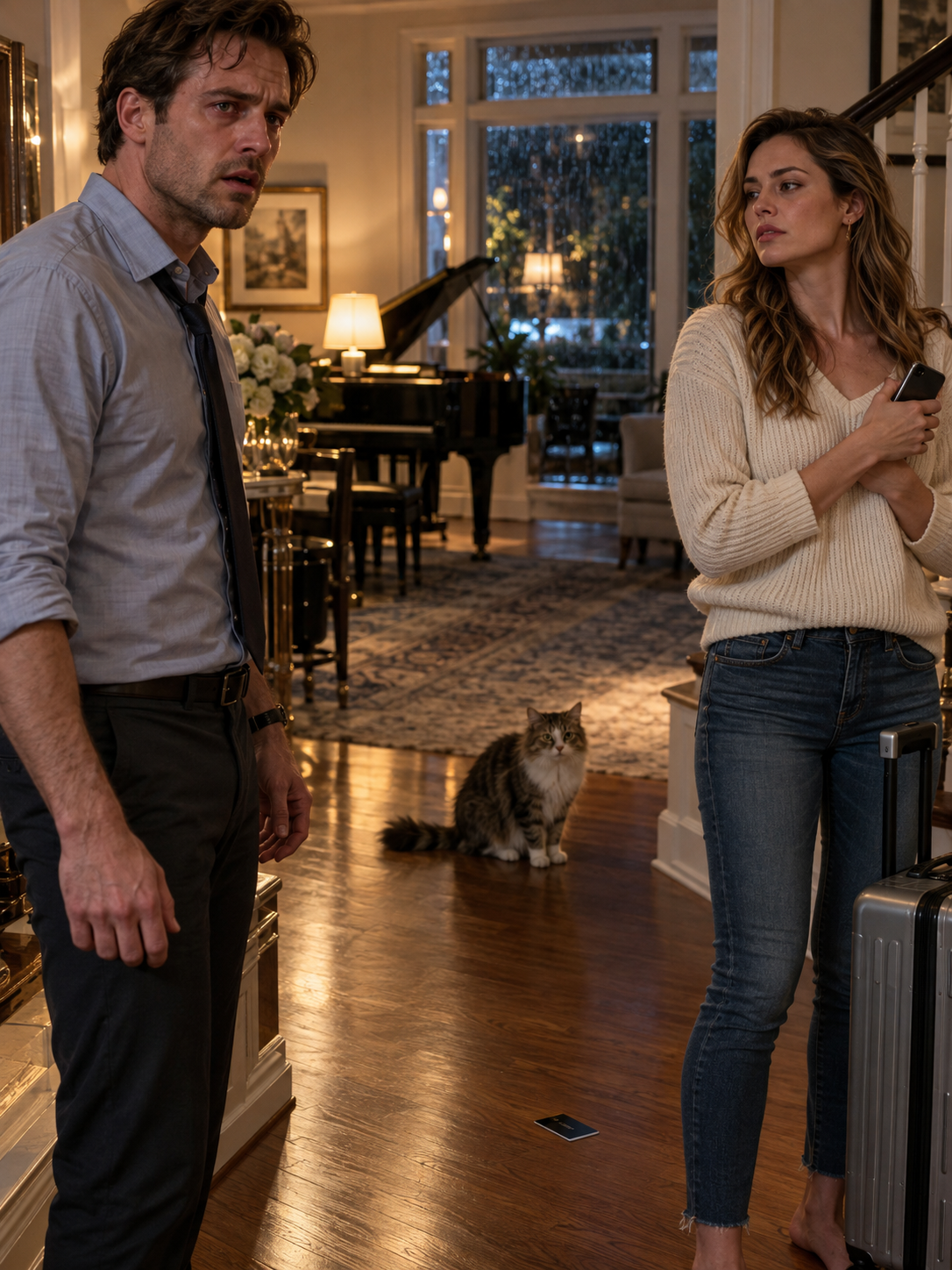
MY WIFE THREW ME OUT AFTER FIFTEEN YEARS, MADE ME GIVE UP MY CAT, AND SENT A LAWYER’S LETTER—BUT SHE COULDN’T CONTROL WHAT I DID NEXT – Life Story
She came home from visiting her parents and gave me less than two hours to disappear from the life we...
My Husband Left Me for the Woman He Always Wanted—Then a Man Who Had Quietly Believed in Me Walked Into the Coffee Shop After My Divorce – Life Story
Rain struck Adele Parker’s windshield so hard that the courthouse across the street looked like it was dissolving. Her divorce...