THE SIX-YEAR-OLD GIRL WHO SHOWED UP FOR HER SICK MOTHER’S DATE WITH A BILLIONAIRE — AND THE PROMISE THAT PUT HIS REPUTATION AND HER FAMILY’S PEACE AT RISK – Life Story
The little girl placed her purple backpack beside a billionaire’s dinner table and announced that she had come in her mother’s place.
Her mother was home with a dangerous fever, unaware that her six-year-old daughter had ridden through Chicago alone after dark.
And before the night was over, a stranger’s recording would turn one small promise into a public scandal that threatened everything her mother had worked to protect.
THE EMPTY CHAIR
Richard Cole had been waiting twenty-three minutes when the little girl approached his table at Romano’s.
“Mom is sick,” she said, gripping the straps of her purple backpack. “So I came instead.”
Richard looked at the child, then at the empty chair across from him.
For a moment, he wondered whether someone was playing an extraordinarily inappropriate joke.
The girl was tiny, with two neat braids tied in blue ribbons and a rain jacket that had clearly survived more than one Chicago spring.
Her sneakers were damp.
One shoelace had been tied into a double knot, while the other trailed dangerously close to the polished floor.
She looked as though she belonged at an elementary school spelling bee, not beside a candlelit table where dinner for two could cost more than a week’s groceries.
“I’m sorry,” Richard said, setting down his glass. “Who are you?”
“Annie Brooks.”
She said it carefully, like someone giving her name to a teacher on the first day of school.
“My mom is Danielle Brooks.
She’s supposed to have dinner with you tonight.”
Richard’s fingers tightened around the edge of the table.
Danielle Brooks.
The name was correct.
He had been introduced to Danielle through a mutual friend who insisted that two people with almost nothing in common sometimes needed exactly that.
Richard had agreed reluctantly.
At forty-one, he had grown accustomed to dates that felt more like interviews, where women wanted to know about his investment company before discovering whether he liked coffee.
Danielle had been different during their brief telephone conversations.
She had asked about his mother, laughed at his terrible attempt at describing a movie, and admitted she was nervous about dating again.
Now her daughter was standing in front of him.
“Where’s your mother, Annie?”
“At home.”
“Does she know you’re here?”
Annie glanced toward the window.
Outside, traffic moved through the wet streets, headlights smearing white and red across the glass.
The hesitation was brief.
But Richard noticed it.
“Not exactly,” she admitted.
Before he could respond, a restaurant manager appeared beside the table.
“Mr.
Cole, I apologize for the interruption.”
The manager, a narrow-faced man named Vincent, wore a charcoal suit and an expression suggesting that an unpleasant object had been discovered beneath the furniture.
He looked at Annie.
“Sweetheart, this is a private dining room.
You can’t wander around bothering guests.”
“I’m not bothering him,” Annie answered.
Vincent gave Richard an embarrassed smile.
“We’ll take care of this immediately.”
He reached for the girl’s backpack strap.
Richard stood.
“Don’t touch her.”
The words were quiet, but their effect was immediate.
Vincent withdrew his hand.
At the neighboring table, a woman stopped cutting her steak.
Someone farther away lifted a phone, pretending to photograph the chandelier.
Richard barely noticed.
He crouched so that he was looking directly into Annie’s anxious blue eyes.
“Tell me what happened.”
Annie swallowed.
“Mom worked late at the hospital.
Then it rained really hard.
When she got home, she was shaking.”
Richard waited.
“She tried to put on her pretty dress.
The green one.
But she got dizzy and had to lie down.”
“Is she alone?”
Annie nodded.
“She’s sleeping.
I put water next to her bed.”
A cold feeling settled beneath Richard’s ribs.
“How did you get here?”
Annie looked down at her wet sneakers.
“I rode my bicycle.”
“By yourself?”
“Yes, sir.”
“How far?”
“Six blocks.”
Richard turned toward the dark windows.
Six Chicago blocks.
Wet pavement.
Evening traffic.
Intersections where impatient drivers rolled through crosswalks.
And a six-year-old who had apparently decided that getting to a restaurant was more important than staying safe.
“Annie,” he said carefully, “that was dangerous.”
“I know.”
“Then why did you do it?”
Her lower lip trembled.
She tightened her grip on the backpack.
“Because Mom kept saying you would think she didn’t care.”
Richard said nothing.
“She was really excited,” Annie continued. “She practiced saying hello in the bathroom mirror.
She even asked me if her hair looked nice.”
A woman at the next table lowered her eyes.
Annie stepped closer.
“She’s not the kind of person who breaks promises.”
The little girl’s voice grew softer.
“She always tells me that when you can’t do something you promised, you have to tell the truth.”
Richard looked at the empty chair again.
He had come to dinner expecting to meet a stranger.
Instead, he was standing before a child who believed her mother’s good name was something she had to defend.
Annie took a shaky breath.
“If I tell you why she couldn’t come,” she whispered, “will you please not be angry with her?”
SIX BLOCKS THROUGH THE RAIN
Richard did not answer immediately.
He was looking at Annie’s face, at the mixture of fear and determination that no six-year-old should have needed to practice.
Then he pulled out the chair opposite his own.
“First, sit down for a minute.”
Annie hesitated. “Am I allowed?”
“Of course.”
Vincent shifted uncomfortably.
Richard looked at him. “Could we have a glass of water, please?”
The manager nodded and disappeared with the speed of a man who recognized that he had mishandled something important.
Annie climbed into the chair, her feet dangling above the floor.
She put her backpack on her knees and kept both hands around it, as though someone might still decide she did not belong.
Richard sat across from her.
“I’m not angry with your mother,” he said. “I’m worried about her.
And I’m worried about you.”
Annie’s shoulders relaxed slightly.
“She’s going to be really mad when she finds out.”
“She’ll probably be frightened first.”
“Because I rode my bike?”
“Because she loves you.”
Annie considered that.
Then she reached into her jacket and produced a folded paper napkin, damp around the edges.
“I wrote down what I wanted to say.”
Richard unfolded it carefully.
In uneven purple letters, the message read:
MY MOM IS SICK.
SHE DID NOT FORGET.
PLEASE DON’T BE SAD.
The final word had been written twice, the first attempt crossed out.
Richard stared at the paper longer than he intended.
He had signed contracts worth hundreds of millions of dollars.
He had negotiated acquisitions with people who measured loyalty in quarterly returns.
There were documents locked in his office that could change the future of entire companies.
Yet the most sincere promise he had encountered in years was written in purple crayon on a restaurant napkin.
“Did your mother ask you to write this?”
“No.
She doesn’t know.”
That was the part Richard could not ignore.
Annie had acted without permission.
Her reasons were sweet, but the risk was real.
He took out his phone.
“Do you know your mom’s number?”
Annie recited it immediately.
Richard called.
No answer.
He tried again while Annie watched anxiously.
Still nothing.
“Sometimes Mom puts her phone on silent when she sleeps,” Annie explained. “She has to sleep during the day when she works nights.”
Richard asked whether there was another grown-up she trusted.
Annie brightened.
“Mrs.
Alvarez lives next door.
She watches me when Mom has late shifts.”
“Does she have a phone?”
Annie nodded and recited that number too.
This time, someone answered.
A woman with a brisk voice sounded suspicious before Richard had finished introducing himself.
“Where is Annie?”
“At Romano’s restaurant.
She’s safe, but she came here alone.”
There was a sharp silence.
“Is Danielle with her?”
“No.
Annie says her mother’s sick.”
“Oh, good Lord.”
Richard heard keys jingling at the other end.
“I’m coming.
Don’t let that little girl out of your sight.”
Richard gave her the restaurant address.
When he ended the call, Annie was staring at him.
“Mrs.
Alvarez is going to tell Mom.”
“Yes.”
“I’m going to lose bicycle privileges forever.”
“Possibly.”
Annie sighed with the resigned expression of someone facing serious consequences.
Richard almost smiled.
Then Vincent returned with the water.
“Mr.
Cole, perhaps we could arrange for someone to escort the child outside while you finish your dinner.”
Richard turned.
For a second, he thought he had misheard.
“Finish my dinner?”
“The kitchen has already begun preparing your order.”
Richard looked at the table.
Two untouched menus.
One candle.
A white rose in a small glass vase.
The evening he had planned was still waiting for him, perfectly arranged.
But somewhere six blocks away, a woman was sick enough that her daughter had taken a bicycle through the rain to protect her feelings.
Richard folded the napkin and placed it in his inside pocket.
“Cancel the order.”
Vincent blinked.
“Sir?”
“I’m leaving.”
The manager glanced toward the surrounding guests.
“Of course.
We can bring your check.”
Richard took out his wallet.
“Charge me for the reservation and anything the kitchen has already prepared.”
As he spoke, he noticed a phone angled toward Annie from another table.
He looked directly at the person holding it.
“Please stop recording a child.”
The man lowered the phone, but Richard saw the screen go dark only after several seconds.
The video had probably already been saved.
Richard had been in enough public disputes to recognize when an ordinary moment was about to become someone else’s entertainment.
He turned back to Annie.
“Let’s get your backpack.”
She slid off the chair.
“Are we going to Mom?”
“As soon as Mrs.
Alvarez gets here.”
Annie looked disappointed.
“I know the way.”
“I believe you.”
“Then why do we need her?”
“Because knowing the way doesn’t make it safe to travel alone.”
Annie absorbed that in silence.
Outside, the rain had stopped, leaving the sidewalk shiny beneath the streetlights.
Richard waited with her near the restaurant entrance, away from the dining room and the curious glances.
Her bicycle was locked to a rack beside the curb.
It was small and red, with a crooked silver bell and a plastic basket decorated with faded stickers.
A pink helmet hung from the handlebars.
Richard bent to inspect it.
“You wore your helmet?”
Annie nodded.
“That’s good.”
“Mom says my brain is important.”
“Your mother is right.”
“She says I need it for math.”
Richard laughed despite himself.
“I suspect you’ll need it for a few other things, too.”
A cold breeze moved along the sidewalk.
Richard removed his coat and offered it to Annie.
She hesitated before allowing him to settle it around her shoulders.
The sleeves swallowed her hands.
“It’s too big,” she observed.
“It is.”
“You must be very tall.”
“I’ve been told.”
She looked up at the restaurant windows.
“Those people were staring at me.”
Richard followed her gaze.
“They were.”
“Did I do something embarrassing?”
“No.”
“Then why?”
He considered giving her an easy answer.
People are curious.
People don’t understand.
People sometimes make mistakes.
All of those things were true.
None were complete.
“Sometimes adults decide what someone is like before they know anything about them,” he said.
Annie frowned.
“That’s not very smart.”
“No,” Richard admitted. “It isn’t.”
Mrs.
Alvarez arrived twelve minutes later in an aging silver Honda.
She was a sturdy woman in her late fifties, wearing a raincoat over flowered pajamas, and she approached Annie with the swift, determined steps of someone who had spent years supervising children.
“Annabelle Grace Brooks.”
Annie lowered her head.
“Hi, Mrs.
Alvarez.”
“Do you know what kind of fright you’ve given me?”
“Yes, ma’am.”
“Your mother is going to turn my hair completely white.”
Richard stepped forward and explained everything before the older woman could imagine something worse.
Mrs.
Alvarez listened without interrupting.
Then she looked at Annie.
“You were trying to be helpful.”
Annie nodded.
“That doesn’t make leaving without telling a grown-up okay.”
“I know.”
“We’ll talk about consequences tomorrow.
Right now, your mom needs us.”
The directness of her words seemed to calm Annie more effectively than any reassurance.
Richard offered to walk with them.
Mrs.
Alvarez studied him carefully.
“You’re the man Danielle was supposed to meet?”
“Yes.”
She glanced at his expensive shoes.
“Well.
You’re going to ruin those.”
Richard looked down at the wet sidewalk.
“Probably.”
Mrs.
Alvarez snorted.
“Good.
Come on.”
They walked the six blocks together, with Mrs.
Alvarez holding Annie’s hand while Richard pushed the little bicycle.
The farther they traveled from Romano’s, the more the city seemed to change.
The polished storefronts gave way to a laundromat with bright fluorescent lights, a corner grocery with handwritten prices in the window, and narrow two-story houses squeezed together along quiet streets.
Annie narrated every turn.
“That bakery makes the best cookies.”
Mrs.
Alvarez corrected her.
“That bakery charges too much for cookies.”
“Both things can be true,” Richard said.
Annie giggled.
For the first time that evening, she sounded like a child again.
At the next corner, they stopped for a traffic signal.
Richard looked toward the line of headlights moving through the intersection.
“Were you frightened coming here?”
Annie shrugged.
“A little.”
“What frightened you?”
“The cars.”
Richard’s hand tightened around the bicycle handlebar.
“And I thought maybe you wouldn’t listen.”
He looked down at her.
“Why wouldn’t I listen?”
She considered the question.
“Sometimes people don’t listen when you’re little.”
Richard had no answer for that.
A moment later, Annie pointed toward a blue house with white trim and a porch light glowing above the front steps.
“That’s home.”
The house was modest but carefully maintained.
There were yellow flowers in a narrow window box and a wind chime hanging beside the porch.
Annie’s bicycle had left a clean rectangle on the small patch of concrete where it normally stood.
Richard set it there.
Mrs.
Alvarez unlocked the front door with the spare key Danielle had given her years earlier.
The house was warm and quiet.
From somewhere down the hallway came a harsh, exhausted cough.
Annie immediately forgot about her possible punishment.
“Mom?”
She ran toward the bedroom.
Mrs.
Alvarez followed.
Richard remained near the doorway, suddenly uncertain whether he should enter.
Then he heard Danielle’s voice.
“Annie? Baby, where were you?”
A moment later, her voice sharpened with panic.
“Who is that?”
Richard stepped into the hallway.
Danielle Brooks was sitting upright in bed, her hair falling loose around her face, one hand gripping the blanket.
Even in the dim light, her fever was obvious.
Her eyes moved from Annie to Mrs.
Alvarez.
Then they reached Richard.
And the expression on her face changed from confusion to absolute horror.
THE BLUE HOUSE
“Oh, my God.”
Danielle said it barely above a whisper.
Then she pressed both hands against her forehead.
“No.
No, please tell me this isn’t happening.”
Richard stopped just inside the doorway.
“Danielle?”
She looked as though she wanted the floor to open beneath her.
“Mr.
Cole.”
“Richard is fine.”
Danielle glanced at Annie.
“Where did you go?”
Annie’s courage vanished.
“To the restaurant.”
Danielle stared at her.
“Which restaurant?”
“Romano’s.”
For one terrible second, the room was completely silent.
Then Danielle pushed back the blankets.
“You went across the neighborhood? Alone?”
Annie nodded.
Danielle stood too quickly.
Her knees weakened, and she caught herself against the bedside table.
Richard moved forward, but Mrs.
Alvarez reached her first.
“Sit down, honey.”
Danielle resisted.
“My daughter went out in the dark, Rosa.”
“I know.
She’s here.
She’s safe.”
“She could have been hit by a car.”
“I know.”
“Someone could have taken her.”
“I know that too.”
The older woman’s voice remained steady.
Danielle sank back onto the bed, shaking.
Annie started crying.
“I didn’t want him to think you were mean.”
Danielle closed her eyes.
For a moment, Richard thought she might shout.
Instead, she reached for her daughter.
Annie climbed onto the edge of the bed and buried her face against Danielle’s shoulder.
“Oh, baby,” Danielle whispered. “You never, ever have to do something dangerous to protect my feelings.”
Annie sobbed.
“But you were sad.”
“I know.”
“And you were going to miss your date.”
“I know.”
“I thought he would leave.”
Danielle’s face crumpled.
Richard quietly turned away.
He had known Annie for less than an hour, yet he understood that this was not a moment he had any right to interrupt.
Mrs.
Alvarez brought a chair closer to the bed.
“Danielle, you’ve got a fever.
We need to figure out how high it is.”
Danielle nodded weakly.
“The thermometer’s in the kitchen.”
Richard offered to retrieve it.
Mrs.
Alvarez pointed him toward the correct cabinet with the efficiency of someone who had no time to be impressed by billionaires.
The kitchen was small, clean, and unmistakably lived in.
A hospital shift schedule was held to the refrigerator with a magnet shaped like a strawberry.
Beside it hung Annie’s spelling test, marked with a large red star.
A grocery list had been written on the back of an envelope.
Bread.
Eggs.
Apples.
Soap.
Someone had added COOKIES underneath in purple crayon.
Richard located the first-aid box and returned.
Danielle’s temperature was 102.7 degrees Fahrenheit.
Mrs.
Alvarez frowned.
“You need medical advice, honey.”
Danielle rubbed her temples.
“I work at a hospital, Rosa.”
“That doesn’t make you immune to getting sick.”
Richard almost smiled at the older woman’s bluntness.
Danielle did not.
She looked exhausted, embarrassed, and frightened.
“I left a message for the nurse advice line before I fell asleep,” she said. “I just wanted to rest for an hour.”
Her eyes filled again.
“And while I was sleeping, my daughter disappeared.”
Richard watched Annie’s expression collapse under the weight of those words.
Danielle noticed too.
She drew the little girl closer.
“I’m not saying this to hurt you, sweetheart.
I’m telling you why I was scared.”
Annie nodded miserably.
Mrs.
Alvarez offered to stay while Danielle contacted the clinic’s after-hours service.
The conversation was practical, reassuring, and far less dramatic than the situation felt.
Danielle described her symptoms, the duration of her fever, and the cough that had worsened during the afternoon.
She received guidance about hydration, fever management, warning signs that required urgent evaluation, and arranging an appointment if she did not improve.
Richard listened without interfering.
When the call ended, Danielle leaned back against the pillows.
Only then did she seem to remember that he was still there.
“I am so sorry.”
Richard pulled the chair closer.
“You don’t need to apologize.”
“Yes, I do.”
“You got sick.”
“And my daughter showed up at an expensive restaurant in the middle of your dinner.”
“Technically, I hadn’t ordered.”
Danielle stared at him.
Then, against all reasonable expectations, she laughed.
It was a brief, rough laugh that turned into a cough.
Richard handed her the water Mrs.
Alvarez had brought.
When she recovered, Danielle shook her head.
“This was supposed to be my first date in almost three years.”
Richard lifted his eyebrows.
“That’s a lot of pressure for a Tuesday.”
“Thursday.”
“Right.
Thursday.”
Danielle’s mouth twitched.
“I’m guessing you have an assistant who remembers these things.”
“I have an assistant who frequently reminds me that I should.”
For the first time, Danielle looked at him as a man rather than as an impossible complication in her bedroom.
Then her gaze dropped to the expensive watch on his wrist.
Reality returned.
“Richard, I appreciate you bringing Annie home.
Truly.
But you don’t need to stay.”
He nodded.
“I understand.”
“I don’t want you thinking we’re some kind of disaster.”
He glanced toward the refrigerator, where Annie’s spelling test was visible through the open bedroom door.
“I don’t.”
Danielle looked unconvinced.
Richard leaned forward.
“Annie came because she thought keeping your promise was her responsibility.
That’s what worries me.
Not the house.
Not the missed reservation.”
Danielle stared at the blanket.
“She hears too much.”
Mrs.
Alvarez touched her shoulder.
“Children do.”
Danielle swallowed.
“I try not to talk about money in front of her.
I try not to let her see when I’m exhausted.
But she notices everything.”
Richard waited.
“She knows when I pick up another shift.
She knows when I come home late.
She knows when I’m pretending not to worry.”
Her voice broke.
“And now she’s riding around Chicago because she thinks she needs to protect me from disappointing a man.”
Richard looked at Annie, who sat silently at the foot of the bed.
There was no easy reassurance.
The child had not created that fear out of nowhere.
Danielle had been carrying too much for too long, and Annie had seen enough to mistake love for responsibility.
Mrs.
Alvarez eventually took Annie into the kitchen to make toast.
Richard remained seated, but kept a respectful distance.
Danielle rested her head against the wall.
“My husband left when Annie was a baby,” she said.
Richard did not ask for details.
“He wasn’t a terrible man.
He just couldn’t stand being responsible for anyone but himself.”
She paused.
“That’s not an excuse.
It’s just the truth.”
Richard nodded.
“After that, I made everything about keeping things stable.
Rent paid.
Lunches packed.
Homework finished.
No surprises.”
She gestured weakly toward the doorway.
“Clearly, that strategy needs work.”
Richard smiled.
“Annie seems unusually resourceful.”
“Too resourceful.”
“Agreed.”
Danielle looked at him with mild surprise.
“You’re not going to tell me how amazing and brave she is?”
“She is brave.
But she shouldn’t have gone alone.”
Danielle studied him.
For the first time that evening, her expression softened with something deeper than gratitude.
“Thank you for saying that.”
Richard looked toward the hall.
“Does she have dinner?”
Danielle sighed.
“I was going to make soup.”
“Do you have ingredients?”
“Probably.”
“May I?”
She blinked.
“May you what?”
“Make soup.”
The question seemed to confuse her more than his arrival.
“Do you know how?”
Richard considered this.
“Not especially well.”
Danielle stared.
Then she smiled.
“There’s broth in the refrigerator.
Frozen vegetables in the freezer.
If you can find a pot, I think you can manage.”
Richard stood.
“I’ve negotiated a few difficult situations.”
“That doesn’t mean you know where I keep the salt.”
“Fair point.”
He found the salt eventually.
It took considerably longer to find the pepper.
Mrs.
Alvarez watched him work with the expression of someone observing an expensive appliance being used incorrectly.
“You’re cutting those carrots too thick,” she informed him.
“They’re already chopped.”
“Then you’re cutting the onions too thick.”
“Those were also chopped.”
She crossed her arms.
“Maybe you’re not cut out for kitchen work.”
Annie giggled from her chair.
Richard looked at the pot.
“I’m beginning to suspect that.”
When the soup was ready, Danielle managed half a bowl.
She thanked him quietly.
He did not make a speech about generosity.
He did not mention his companies or offer to buy her a better kitchen.
He simply washed the dishes afterward while Mrs.
Alvarez helped Annie prepare for bed.
Danielle watched from the doorway, wrapped in a blanket.
“You know you don’t have to do that.”
“I know.”
“You’ve said that several times tonight.”
“So have you.”
She smiled despite herself.
The silence that followed was unexpectedly comfortable.
When Richard finally prepared to leave, Annie appeared in her pajamas, holding a stuffed rabbit.
“Are you coming back?”
Danielle opened her mouth.
Richard answered first.
“If your mom would like me to.”
Annie turned toward her.
Danielle looked at Richard for a long moment.
“Maybe we could try dinner again when I can stand up without getting dizzy.”
“I’d like that.”
Annie smiled.
Richard crouched beside her.
“But before another dinner, we need a promise.”
Her expression grew serious.
“No more traveling anywhere alone without permission.”
Annie nodded.
“Even for important things.”
“Especially for important things.”
She offered her little finger.
Richard linked his with hers.
Then he stood and turned toward the door.
Danielle followed him onto the porch.
The rain had stopped completely.
A streetlight cast a pale circle across the pavement.
“I really am sorry,” she said.
Richard looked at her.
“Danielle, I wasn’t expecting tonight.”
“Neither was I.”
“But I’m glad I met you.”
She held his gaze.
Then she glanced down, almost embarrassed by how much the words affected her.
“Good night, Richard.”
“Good night.”
He walked toward his car with the damp purple napkin still in his pocket.
He was halfway home when his phone began ringing.
By the time he answered, his assistant was speaking unusually fast.
“Richard, there’s a video.”
He frowned.
“What video?”
“From the restaurant.
Someone posted it twenty minutes ago.”
Richard pulled into a parking space.
His assistant sent the link.
On the screen, Annie stood beside his table, surrounded by strangers.
The recording began just as Vincent reached for her backpack.
A caption appeared above her head.
BILLIONAIRE CAUGHT WITH LITTLE GIRL AT LUXURY RESTAURANT — WHAT HAPPENED NEXT?
Richard felt his stomach tighten.
The clip ended before anyone explained why Annie had been there.
Underneath it, strangers were already deciding what kind of mother Danielle Brooks must be.
THE OTHER SIDE OF THE GLASS
By midnight, the video had more than half a million views.
Richard sat at the kitchen island in his penthouse, watching the same twelve seconds repeat.
Annie standing beside the table.
Vincent reaching toward her backpack.
Richard stepping between them.
The scene was real.
The story attached to it was not.
Some viewers thought Annie had been begging.
Others suggested the incident was staged.
A few accused Danielle of using her child to attract a wealthy man.
The ugliest comments asked why a six-year-old had been alone in a restaurant.
That question, Richard knew, was legitimate.
But the people asking it seemed less interested in Annie’s safety than in finding someone to humiliate.
His assistant, Claire, called again.
“We can issue a statement tonight.”
“What would it say?”
“That you encountered a child in need and assisted her appropriately.”
Richard stared at the screen.
“That makes me sound like I rescued her from a burning building.”
“It’s standard language.”
“Then find different language.”
Claire paused.
“We also need to consider the family’s privacy.”
Richard closed his eyes.
That was the part he had nearly overlooked.
Annie had already attracted attention from strangers without understanding any of it.
Danielle had not even consented to being part of a public conversation.
“Don’t identify them,” he said.
“We won’t.”
“And don’t describe her mother as neglectful.”
“Of course.”
“Or as some helpless woman I saved.”
Claire hesitated.
“Richard, I’m trying to protect everyone.”
“I know.
I’m sorry.”
He rubbed his forehead.
“Let’s talk in the morning.”
When he ended the call, the apartment seemed unnaturally quiet.
His penthouse occupied the upper floors of a building overlooking the river.
The rooms were beautiful.
The furniture had been selected by an interior designer whose invoices had once made Richard wince.
From the windows, Chicago glittered beneath a clear black sky.
He owned valuable things.
He had accomplished things that once seemed impossible.
Yet the image he could not stop seeing was Danielle’s kitchen, where two mugs sat beside a drawing of a family.
His mother had grown up in a house not unlike that one.
She had worked two jobs after his father died, taking night shifts at a grocery warehouse while Richard finished high school.
He remembered how carefully she counted bills on Sundays.
He remembered her insisting that he study while she washed uniforms in the kitchen sink.
He had spent the next twenty years building enough wealth that she would never have to worry about money again.
Somewhere along the way, he had started believing that financial security and emotional security were practically the same thing.
Danielle’s house had unsettled that belief.
She was not asking him for financial rescue.
She was asking for a chance to be seen without embarrassment.
And now strangers were taking even that away.
Richard called her.
She answered after several rings, sounding sleepy and congested.
“Hello?”
“Danielle, it’s Richard.”
A pause.
“Is everything okay?”
“Annie’s safe.
I just wanted to warn you that someone filmed us at the restaurant.”
Her breathing changed.
“What?”
“The video is online.”
“How many people have seen it?”
He hesitated.
“Quite a few.”
Danielle was silent.
Then she asked the question he had expected.
“Are they saying things about Annie?”
“Yes.”
Her voice grew thin.
“What kind of things?”
“Some are asking why she was alone.”
Danielle swallowed.
“And others?”
Richard did not want to repeat the accusations.
He also did not want to lie.
“They’re making assumptions about your intentions.”
A long silence followed.
Then Danielle said, almost to herself, “I knew something like this would happen.”
Richard leaned forward.
“What do you mean?”
“People have always had opinions about how I raise my daughter.”
“Who?”
“Teachers who assume I’m not involved because I can’t attend every school event.
Parents who think I’m irresponsible because I work evenings.
People who hear I’m single and start looking for something I must have done wrong.”
She coughed.
“Now the entire internet gets a turn.”
Richard felt anger rise, sharp and useless.
“We can address it.”
“How?”
“I have a communications team.”
Danielle gave a tired laugh.
“Of course you do.”
He heard how absurd the suggestion sounded.
“I’m sorry.
That came out wrong.”
“Richard, I appreciate you wanting to help.
But please don’t do anything publicly without asking me.”
He paused.
“Of course.”
“I mean it.”
“I understand.”
After they hung up, Richard wrote the sentence on a piece of paper.
ASK DANIELLE FIRST.
He put it beside his phone.
He would later wish he had placed it somewhere more visible.
The following morning, Danielle woke to a message from Mrs.
Alvarez.
Someone had posted a screenshot from the restaurant video beside a photograph taken from Danielle’s public social media page.
Annie’s face had been matched to her name.
A local gossip account had identified Danielle’s employer.
By eight o’clock, strangers were leaving comments beneath an old photograph of Annie’s kindergarten graduation.
Danielle sat at her kitchen table staring at the screen.
Her fever had eased slightly, but the room seemed to tilt.
Mrs.
Alvarez brought her coffee.
“Put that phone down.”
“They found my workplace.”
“I know.”
“They’re calling me irresponsible.”
“People can be idiots from the comfort of their couches.”
Danielle looked up.
“What if the hospital sees it?”
“They’ll see a mother whose daughter made a mistake.”
“That isn’t how administrators always see things.”
Mrs.
Alvarez sat across from her.
“You’ve worked there seven years.”
“And I’ve spent seven years proving I’m dependable.”
Her voice rose.
“One video, Rosa.
One video where I wasn’t even present.”
Annie appeared in the doorway wearing her school pajamas.
“Are people mad at us?”
Danielle immediately turned the phone facedown.
“No, sweetheart.”
Mrs.
Alvarez gave her a look.
Danielle corrected herself.
“Some people are confused about what happened.”
Annie climbed into the chair beside her.
“Can we tell them?”
Danielle brushed a loose strand of hair behind her daughter’s ear.
“We’re going to figure out the best way.”
“Are they mad because I rode my bike?”
“Some people are worried about that.”
Annie’s shoulders sank.
“I’m sorry.”
Danielle pulled her close.
“Listen to me.
You did something unsafe, and we’re going to make sure it never happens again.
But that doesn’t mean strangers get to decide who you are.”
Annie nodded.
Then she asked, “Is Richard mad?”
Danielle looked toward the window.
“No.
He’s not mad.”
At almost that exact moment, Richard was standing inside Romano’s.
The restaurant looked less impressive in daylight.
The candles had been removed.
Staff were setting tables for lunch.
A delivery driver waited beside stacked boxes near the kitchen.
Vincent recognized Richard immediately.
“Mr.
Cole.”
Richard nodded.
“I’d like to speak with the general manager.”
Daniel Harris appeared within minutes.
He was a carefully dressed man in his fifties, with the cautious politeness of someone who understood the economic value of keeping wealthy customers happy.
“Richard, I’m terribly sorry about last night.”
Richard followed him into a small office.
Harris closed the door.
“We’ve had an extraordinary amount of attention.”
“So has a six-year-old girl.”
Harris sighed.
“We didn’t know the circumstances.”
“Did anyone ask?”
“Vincent attempted to determine why she was there.”
“He attempted to remove her.”
Harris leaned back.
“An unaccompanied child entering a restaurant after dark is a safety concern.”
Richard nodded.
“It should be.”
The manager looked relieved.
“But that concern should have made your staff ask whether she needed help.”
Harris’s relief vanished.
Richard continued.
“She was treated as though she had done something wrong simply by walking into the room.”
“We had guests complaining.”
“About what?”
Harris hesitated.
“Some assumed she was soliciting money.”
“Did she ask anyone for money?”
“No.”
“Did she threaten anyone?”
“Of course not.”
“Then the assumption was the problem.”
Harris rubbed his forehead.
Richard noticed a printed statement lying on the desk.
It described the restaurant’s commitment to maintaining an elegant guest experience.
“Who approved that?”
“Our public relations consultant.”
“When?”
“This morning.”
Richard looked at the company name at the bottom.
Avery Public Strategies.
The name was familiar.
Too familiar.
Thomas Avery was one of the largest institutional investors in Richard’s company.
His family also controlled a small collection of marketing agencies.
Richard pointed to the paper.
“Why are they advising your restaurant?”
Harris looked startled.
“They’ve handled our reputation work for years.”
Richard said nothing.
There was no evidence of wrongdoing in that fact alone.
Still, he filed it away.
Another piece of the same evening had now reached the company where he worked.
And the two worlds he had wanted to keep separate were beginning to overlap.
When Richard left the restaurant, reporters were waiting near the curb.
He should have driven away.
He knew that later.
But one reporter asked whether Annie had been abandoned, and the accusation struck the rawest part of his anger.
Richard stopped.
“The child was not abandoned,” he said firmly.
“Then why was she there?”
“Her mother was sick.
She came to explain that her mother couldn’t keep a dinner appointment.”
“Did you know the family?”
“Not before last night.”
“Where is the child now?”
“Home with her mother.”
“Have you been in contact with them?”
“Yes.”
“Will you see them again?”
Richard thought of Annie asking whether he would return.
“I’ve promised to check on them.”
A reporter leaned forward.
“At their home?”
Richard nodded before thinking.
“Yes.”
Cameras flashed.
Someone shouted another question.
Richard declined to answer, but the damage was already done.
The statement had confirmed that the wealthy businessman and the family from the video were still connected.
By lunchtime, the news was no longer about a strange meeting at a restaurant.
It was about Richard Cole, the mysterious single mother, and the child who had somehow brought them together.
THE PRICE OF A GOOD STORY
The first police cruiser arrived at Danielle’s house shortly after noon.
Its emergency lights were off, but a parked police car outside a modest neighborhood home attracted attention anyway.
Danielle watched through the kitchen window as two neighbors stopped walking.
Her stomach tightened.
Mrs.
Alvarez opened the door before the officer reached the porch.
“Can I help you?”
The officer introduced himself as Martinez.
“We’ve received several calls concerning the safety of a child seen in a video.”
Danielle stepped forward.
“That’s my daughter.”
Martinez was calm and professional.
He explained that he needed to check whether Annie was safe and understand how she had come to be alone.
Danielle invited him inside.
She did not pretend the situation had been harmless.
“She left without permission while I was asleep with a fever,” Danielle explained. “We have discussed it.
I understand how serious it was.”
Martinez asked reasonable questions.
Was Annie supervised regularly? Did Danielle have someone to contact in an emergency? Had this happened before?
Mrs.
Alvarez confirmed that she routinely helped with childcare.
Annie answered the officer’s questions from beside her mother.
She was visibly embarrassed when she admitted that she had gone out alone.
Martinez explained to her that good intentions did not make dangerous decisions safe.
Annie nodded.
“That’s what everybody keeps saying.”
He smiled gently.
“Then it’s probably worth remembering.”
After confirming that Annie was safe and that there was no immediate danger requiring further intervention, Martinez gave Danielle information about local family-support services.
He made no dramatic promises and issued no sweeping declarations about what would happen next.
When he left, Danielle felt both relieved and shaken.
Then a television van pulled up across the street.
A second followed.
Richard arrived minutes later.
He saw Danielle standing on the porch beside Mrs.
Alvarez, her face pale with exhaustion.
The reporters saw him too.
Cameras swung toward his car.
“Mr.
Cole!”
“Did you know authorities were investigating the mother?”
“Has the child been removed from the home?”
Richard felt a surge of anger.
But this time, he did not answer immediately.
He walked toward the porch.
Danielle met him halfway.
“Don’t,” she said.
He stopped.
“Danielle—”
“Please don’t make another statement.”
Her voice was quiet, but it carried unmistakable authority.
Richard glanced at the reporters.
“They’re saying things that aren’t true.”
“I know.”
“They’re suggesting Annie was taken away.”
“I heard them.”
“Then we should correct it.”
Danielle looked directly at him.
“Richard, every time you talk, more cameras show up.”
The accusation struck him because it was true.
She crossed her arms against the cold.
“I asked you last night not to speak for us without talking to me.”
He swallowed.
“I thought I was helping.”
“I know.”
That made it worse somehow.
Danielle looked toward the house.
“Annie hasn’t had breakfast without asking whether someone is angry with her.
She thinks she caused all this.
She thinks if she says the right thing, everybody will stop.”
Richard’s eyes moved toward the living room window.
Behind the curtain, he could see a small purple backpack.
Danielle lowered her voice.
“I don’t need another powerful man deciding what my family needs.”
He flinched.
She saw it, but did not withdraw the words.
“I don’t mean you’re a bad person,” she continued. “I mean you have choices I don’t.
You can walk away from those cameras.
They might follow you for a while, but eventually they’ll find another billionaire.”
She pointed toward the house.
“We live here.”
Richard looked at the street.
At the neighbors.
At the television vans.
At the strangers who had turned a frightened mother’s front yard into a place of entertainment.
“You’re right,” he said.
Danielle seemed surprised.
“I should have asked you before I said anything.”
He took out his phone.
“May I ask my communications team to request that the outlets stop identifying Annie and your home? No public statement from you.
No interview.”
Danielle considered it.
“Yes,” she said. “You can ask them to do that.”
“Nothing else without your permission.”
“Thank you.”
He stepped away to make the call.
For the first time since meeting Annie, helping meant doing less.
That afternoon, another visitor arrived.
Thomas Avery drove a black sedan and wore a navy suit that probably cost more than Danielle’s monthly rent.
Richard recognized him immediately.
“What are you doing here?”
Thomas removed his sunglasses.
“Trying to prevent a manageable situation from becoming an expensive one.”
Richard’s jaw tightened.
“Not here.”
Thomas looked past him toward the house.
“Your name is attached to a national controversy, Richard.
Our financing partners are nervous.
You haven’t answered the board’s calls.”
“I’ve been busy.”
“I noticed.”
Thomas lowered his voice.
“Listen.
There may be a way to turn this into something constructive.”
Richard knew that tone.
He had heard it in hundreds of meetings.
Thomas was about to offer a solution whose benefits had already been calculated.
Danielle came to the doorway.
“Richard?”
Thomas smiled.
“Ms.
Brooks.
Thomas Avery.
I’m a business associate of Richard’s.”
Danielle studied him.
“I see.”
“I understand you’ve had a difficult couple of days.”
“That’s one description.”
Thomas seemed momentarily unsettled by her directness.
Then he recovered.
“I’d like to discuss an opportunity that could benefit you and your daughter.”
Richard stepped forward.
“Thomas.”
Danielle raised a hand.
“It’s okay.
I’d like to hear what he has to say.”
Richard looked at her.
She held his gaze.
This was her house.
Her family.
Her decision.
He stepped aside.
Inside, Thomas opened a polished leather portfolio.
He explained that his firm had connections to foundations, public relations specialists, and corporate donors.
The public, he said, was responding strongly to the story of a wealthy businessman and a struggling single mother.
With the right approach, that attention could become a campaign supporting working parents.
Scholarships.
Emergency childcare assistance.
Public awareness events.
He described a professionally filmed interview, appearances at fundraising dinners, and a national initiative carrying Richard’s company’s name.
Then he mentioned compensation.
Danielle listened carefully.
“How much?”
Thomas named a figure that made Mrs.
Alvarez stop moving in the kitchen.
It was more than Danielle earned in two years.
Thomas continued.
“A housing stipend could also be arranged.
Educational support for Annie.
Access to excellent medical care.”
Danielle looked toward her daughter, who was drawing at the coffee table.
“Would Annie have to be interviewed?”
Thomas smiled.
“Her experience is central to the message.”
“That wasn’t my question.”
A small silence followed.
Thomas adjusted his cuffs.
“We would want her participation in a few carefully managed appearances.”
“How many?”
“That would depend on the campaign.”
“Would I approve what was filmed?”
“Of course, within reasonable production guidelines.”
“Would I be able to withdraw permission later?”
Thomas paused.
“That would need to be negotiated.”
Danielle folded her hands.
“Could you leave the proposal?”
“Certainly.”
She glanced at Richard.
He said nothing.
Thomas seemed surprised by his silence.
After a moment, Danielle asked another question.
“What happens if I say no?”
Thomas leaned forward.
“Nothing punitive, naturally.
But the attention isn’t going away simply because you don’t participate.”
He gestured toward the street.
“You’ve already lost control of the story.
This is an opportunity to regain it.”
The words were polished.
The implication was not.
Accept the offer, and someone powerful would help shape the narrative.
Refuse, and she would remain exposed.
Danielle looked at the portfolio.
Then she looked at Annie’s drawing.
“I need time to think.”
Thomas nodded.
“Of course.”
He left a business card on the table.
After he departed, Richard remained standing near the window.
Danielle broke the silence.
“You knew what he was offering.”
“I suspected.”
“You didn’t tell me not to accept.”
Richard turned.
“It wasn’t my decision.”
Danielle studied him.
Something shifted between them.
Not trust exactly.
But the possibility of it.
She picked up the portfolio.
“Rosa, could you help Annie with her bath?”
Mrs.
Alvarez understood immediately.
When they were alone, Danielle opened the proposal.
The first page was filled with reassuring language.
The second described emotional storytelling opportunities.
The third included a sample campaign title.
ONE PROMISE.
ONE FAMILY.
ONE SECOND CHANCE.
Danielle’s expression hardened.
She turned another page.
There was a photograph of her blue house.
Taken that morning.
She stared at it.
“Richard.”
He approached.
The photograph showed her front porch, flower boxes, and front steps.
It had been framed like a promotional image.
Beneath it was a proposed filming schedule.
Friday: exterior establishing shots.
Saturday: mother and daughter interview.
Monday: executive announcement.
Danielle looked up slowly.
“How did he know where to send a photographer?”
Richard took the portfolio.
His face changed.
He had thought Thomas was responding to the controversy.
Now he was no longer certain that was all Thomas had been doing.
A NAME ON THE DOOR
The first thing Danielle noticed was the date printed in the lower corner.
The proposal had been prepared before Thomas arrived at her house.
Not surprising on its own.
But the photographed exterior was labeled with a file reference from Avery Public Strategies.
The same agency Richard had seen on the restaurant’s printed statement.
Danielle turned the page back.
“Is this the company that advises Romano’s?”
Richard nodded.
“How do you know?”
“I saw their name at the restaurant this morning.”
She sat down slowly.
“Then Thomas isn’t just a businessman who happened to hear about us.”
Richard said nothing.
Danielle examined the proposal again.
“He knew there was a story before he knocked on the door.”
“That doesn’t prove anything improper.”
“I know.”
She looked up.
“That’s why I’m asking questions.”
Richard felt a flicker of admiration.
He had spent the last twenty-four hours reacting to events.
Danielle, despite being sick and exhausted, was beginning to do something more useful.
She was checking the sequence.
She pointed to the photograph.
“Was this taken from the public sidewalk?”
“Probably.”
“Is that legal?”
“It can be, depending on the circumstances.”
“Can they use it in an advertising campaign without asking me?”
“That is a different question.”
Danielle nodded.
“Then I want someone who knows the answer.”
Mrs.
Alvarez returned from the bathroom.
Annie was already in pajamas.
Danielle asked her neighbor to stay for another hour.
Then she called a legal-aid organization recommended by the hospital’s employee assistance program.
The intake coordinator listened, took notes, and referred her to an attorney experienced in privacy and media matters.
By the next morning, Danielle had a telephone consultation scheduled.
Richard offered to pay for private counsel.
She declined.
“I’d rather start with someone whose job isn’t connected to your company.”
He accepted the answer.
It was not a rejection of him.
It was a boundary.
And he was beginning to understand that the distinction mattered.
Meanwhile, Richard called Claire.
“I need every communication between Avery Public Strategies and our company concerning this story.”
Claire sounded cautious.
“That’s a sensitive request.”
“I know.”
“Thomas’s firm isn’t under your direct control.”
“I’m not asking for his private files.
I’m asking for our records.”
Claire paused.
“I can have compliance preserve the relevant company communications.”
“Please do.”
Richard then called David Pike, the chairman of his board.
David had known him for fifteen years.
He was not cruel or corrupt, but he possessed a talent for reducing emotional situations to manageable columns.
“Richard,” David said, “you’ve become extraordinarily difficult to reach.”
“I’ve had a difficult week.”
“So has the company.”
Richard looked out at the city.
“Has it?”
David sighed.
“Our partners are asking whether you’re capable of separating personal relationships from corporate decisions.”
“Thomas visited a private home and offered to turn a child into part of our brand.”
“That’s a dramatic interpretation.”
“It’s an accurate one.”
David paused.
“Thomas is trying to protect an investment.”
“Then he should focus on the investment.”
“Richard, you cannot run a company based entirely on feelings.”
“I don’t.”
“Lately, I’m not sure.”
Richard rubbed his forehead.
“I’m asking the board to review whether our partners used company resources to pursue a promotional campaign involving a child without consent.”
David was silent.
Finally, he said, “If you’re alleging misconduct, put it in writing.”
Richard nodded.
“I will.”
After the call, he sat at his desk and drafted a formal request for review.
It was less satisfying than confronting Thomas on a porch.
It was also more likely to produce a verifiable answer.
Across the city, Danielle spent the morning answering calls from her employer.
Her supervisor had seen the video.
Several patients had asked whether the woman in the news worked at the hospital.
Human resources wanted reassurance that no confidential patient information had been involved.
There was none.
Danielle had not discussed patients, identified anyone in her care, or used the hospital’s name publicly.
Still, the conversation left her shaking.
Afterward, she sat at the kitchen table with her head in her hands.
Mrs.
Alvarez placed a sandwich beside her.
“Eat.”
“I’m not hungry.”
“Eat anyway.”
Danielle lifted her head.
“I’m so tired, Rosa.”
“I know.”
“I worked seven years to build a stable life.
I have good reviews.
Annie has friends.
We have our routines.”
She gestured helplessly toward the window.
“And now people I don’t know are calling my workplace.”
Mrs.
Alvarez sat down.
“Then protect what you can.”
“How?”
“One thing at a time.”
The older woman pointed at the sandwich.
“Start with lunch.”
Danielle laughed weakly.
Then she ate.
That afternoon, attorney Eleanor Whitaker called.
She was a former judge who now directed a nonprofit legal center handling civil rights, privacy, and public-interest matters.
Her voice was calm, practical, and refreshingly uninterested in making speeches.
“I’ve reviewed what you sent,” Eleanor said.
“Can you help us?”
“Potentially.
But I want to be clear about what the law can and cannot do.”
Danielle gripped her pen.
“Okay.”
“People can discuss a public incident.
We can’t simply order the internet to stop talking.
But we can challenge false factual claims, request removal of identifying information in certain circumstances, and examine whether anyone used your daughter’s identity commercially without proper consent.”
Danielle wrote quickly.
Eleanor continued.
“I also want to know whether anyone has tried to pressure you into signing a publicity agreement.”
Danielle looked at the portfolio on the table.
“Yes.”
She explained Thomas’s offer.
Eleanor listened carefully.
“Don’t sign anything yet.”
“I wasn’t planning to.”
“Good.
Send me the entire proposal, including the photo and any correspondence.”
Danielle hesitated.
“Does this mean we’ll have to go to court?”
“Not necessarily.”
“Could it become expensive?”
“My organization has agreed to handle the initial representation without charging you.
We’ll discuss any further steps before taking them.”
Danielle closed her eyes.
Relief came so unexpectedly that she nearly cried.
“Thank you.”
Eleanor’s voice softened.
“Danielle, I need you to understand something.
You are allowed to say no.”
Danielle looked toward the hallway.
Annie was sitting on the floor, quietly arranging colored pencils.
“I know.”
“I mean no to interviews, no to filming, no to photographs, no to offers of money.
Even if someone insists those things would help you.”
Danielle swallowed.
“All right.”
“And you are also allowed to change your mind about what kind of help you want.”
After the call, Danielle sat silently for a long time.
Then she opened the proposal again.
She read every paragraph.
She circled several phrases.
Exclusive participation.
Publicity rights.
Approved family narrative.
She placed the papers back inside the folder.
That evening, Richard came by only after calling to ask permission.
He brought groceries Danielle had requested and nothing more.
No expensive gifts.
No cameras.
No grand announcement.
Mrs.
Alvarez let him in.
Annie was working on a school project at the kitchen table.
She looked up.
“Richard!”
He smiled.
“Hello, trouble.”
She frowned.
“Mom says I’m not allowed to be called trouble.”
“Then hello, Annie.”
“That’s better.”
Danielle appeared from the hallway.
Her fever had finally broken.
She was wearing jeans and a faded green sweatshirt, with her hair tied in a loose knot.
For the first time, Richard saw her looking almost like the woman he had expected to meet at dinner.
Except she was still tired.
And still guarded.
He set the groceries on the counter.
“You look better.”
“I feel human again.”
“Good.”
Annie held up her school project.
“I’m making a neighborhood map.”
Richard leaned down to inspect it.
There were houses, a bakery, a park, and a large red line crossing several streets.
He recognized the route immediately.
Annie noticed his expression.
“It’s where I rode.”
Danielle looked uncomfortable.
“I told her to draw the safe walking route to school instead.”
Annie pointed at the map.
“This is the unsafe route.”
Richard studied the intersections.
“That’s a useful thing to remember.”
Annie nodded solemnly.
Then she picked up a purple crayon and drew a large X across the restaurant.
“I’m not doing that again.”
“Good,” Richard said.
Danielle watched them.
Something in her expression softened.
Later, after Annie went to bed, Richard helped Danielle fix a loose kitchen cabinet handle.
He was not especially skilled with the screwdriver.
Danielle had to explain which direction to turn it.
He took the correction without irritation.
When the handle finally stopped wobbling, she leaned against the counter and smiled.
“You’re very proud of yourself.”
“I think I should be.”
“You tightened two screws.”
“Successfully.”
Danielle laughed.
It was the first unguarded laugh he had heard from her.
For several seconds, neither spoke.
Then Richard said quietly, “I’m sorry I brought more attention to your house.”
Danielle looked down.
“I know you meant well.”
“That’s not the same as doing well.”
“No.”
He nodded.
“I’ve learned that.”
She looked at him.
“Most people don’t like learning it.”
Richard gave a small smile.
“I haven’t particularly enjoyed it.”
The silence between them changed.
Not into romance.
Not yet.
But into something steadier.
Danielle set two mugs on the counter.
“Tea?”
“I’d like that.”
They sat at the kitchen table long after the water cooled.
They talked about the parts of their lives that had nothing to do with cameras.
Danielle told him about Annie’s obsession with collecting smooth stones, about the patients she remembered long after they left the hospital, and about the small rituals that made her home feel safe.
Richard told her about his mother, his first failed business, and the years when he had mistaken being constantly busy for being important.
He admitted that his marriage had ended five years earlier.
There had been no scandal, only two people who had stopped making room for each other.
“I was good at providing things,” he said. “Not especially good at being present.”
Danielle turned her mug slowly.
“Those are different skills.”
“Yes.”
“Can you learn the second one?”
Richard considered it.
“I think I’m trying.”
She met his gaze.
For a moment, he wanted to reach across the table.
He didn’t.
The next step belonged to both of them.
Then Danielle’s phone vibrated.
A message from Eleanor.
Danielle read it twice.
Her face lost its color.
“What is it?” Richard asked.
She turned the screen toward him.
Eleanor had obtained a copy of a media inquiry that had been forwarded through a reporter’s legal department.
Attached to it was an email from an account associated with Avery Public Strategies.
The email contained a suggested angle for the story.
It also contained the location of Danielle’s house.
The message had been sent before the first television van arrived.
Richard stared at the date.
Then at the sender.
Thomas’s firm had not merely responded to the publicity.
Someone working for it had helped bring the publicity to Danielle’s front door.
THE CHOICE NO ONE COULD BUY
Danielle read the email again the next morning.
It was not a dramatic confession.
There were no threats, no crude instructions, and no villain announcing a secret plan.
That made it more disturbing.
The language was professional.
Avery Public Strategies had described the situation as an opportunity for positive community engagement.
The email suggested that media outlets might obtain useful neighborhood footage near the Brooks residence.
It included the street address.
And it referred to Annie as a compelling young participant in an emerging human-interest narrative.
Danielle put down her phone.
For almost two days, she had believed strangers found her house because of the video.
Now she knew that someone connected to Richard’s business had actively helped direct attention there.
The discovery changed everything.
The cameras had not appeared by pure accident.
Someone had considered her family useful.
Someone had taken the most private part of her life and turned it into a location on a publicity schedule.
Eleanor called at nine.
“We have enough to ask serious questions,” she said. “But we need to be precise.”
Danielle sat at the kitchen table with a legal pad.
“Did Thomas send the email?”
“Not according to the copy we have.
It appears to have come from a senior employee at his agency.”
“Could he have known?”
“Possibly.
We shouldn’t assume it without evidence.”
Danielle pressed her fingers against her forehead.
“What can we do?”
“First, preserve the messages.
Second, ask the agency to stop distributing personal information and images connected to your daughter.
Third, pursue formal complaints or claims only where the facts support them.”
Danielle looked toward the front door.
A reporter had left a business card in the mailbox the previous evening.
“What about Romano’s?”
“We can send a separate complaint about how Annie was treated and ask for a written response.
That is a different issue.”
Danielle nodded.
She was grateful that Eleanor refused to turn everything into one enormous accusation.
The problems had different causes.
They required different responses.
After the call, Danielle opened the campaign proposal.
She read the financial offer again.
The money was astonishing.
Enough to clear her debts.
Enough to replace the car she had sold after her divorce.
Enough to put money aside for Annie’s education.
For a moment, Danielle imagined saying yes.
She pictured a different home with a fenced backyard, a reliable vehicle, and evenings when she did not have to calculate how many hours of overtime stood between the electric bill and the next paycheck.
Then she imagined Annie standing beneath studio lights.
Smiling because an adult told her to.
Answering questions about a night she already wished everyone would forget.
Danielle closed the folder.
She called Eleanor.
“I’ve decided.”
Eleanor waited.
“I don’t want the campaign.”
“Are you certain?”
“Yes.”
“Then we’ll decline it formally.”
Danielle swallowed.
“And I don’t want Annie doing television interviews.”
“That is your decision.”
“I want to make one statement, though.”
Eleanor’s tone sharpened with interest.
“What would you like it to say?”
Danielle looked toward the living room.
Annie was sitting on the rug, fitting pieces of a jigsaw puzzle together.
“I want people to know my daughter was trying to do something kind.
I also want them to know she made an unsafe choice, and we’ve addressed it as a family.”
She took a breath.
“I don’t want anyone to make her a hero or a villain.”
Eleanor was silent for a moment.
Then she said, “That’s a good place to begin.”
The statement took most of the afternoon to write.
Danielle rejected sentences that sounded too polished.
She removed a paragraph about struggling single mothers because she did not want to speak for every woman raising a child alone.
She cut a line thanking Richard for rescuing her family.
He had helped them.
But he had not rescued them.
There was a difference she intended to preserve.
At the end, the statement was simple.
Annie had acted out of love and concern for her mother.
She had traveled alone without permission, and that decision was dangerous.
Her family had addressed the issue.
Danielle appreciated the kindness shown by people who had offered support, but asked the public and media to respect her daughter’s privacy.
She would not be participating in interviews or advertising campaigns.
She wanted her daughter to return to her ordinary childhood.
Eleanor reviewed the statement for legal concerns.
Then Danielle read it aloud to Mrs.
Alvarez.
The older woman nodded.
“Sounds like you.”
Danielle felt her throat tighten.
“Good.”
When Richard arrived later that evening, she handed him a copy.
He read it carefully.
Then he looked up.
“It’s strong.”
Danielle smiled faintly.
“I don’t need it to be strong.
I need it to be mine.”
Richard nodded.
“It is.”
She studied his face.
“Have you spoken to Thomas?”
“Yes.”
“What did he say?”
“He says the agency employee acted without his approval.”
“Do you believe him?”
Richard took a breath.
“I don’t know.”
Danielle appreciated the answer.
It was the first time in days that someone had responded without trying to make uncertainty disappear.
Richard continued.
“Our compliance team is reviewing the communications.
The board has asked Thomas’s firm to preserve records.”
“What happens to your company?”
“That depends on what the review finds.”
She looked at him.
“You could lose business over this.”
“Yes.”
“Doesn’t that frighten you?”
Richard considered lying.
Then he shook his head.
“Of course it does.”
Danielle seemed surprised.
“I’ve spent twenty years building something.
There are people whose salaries depend on the decisions I make.”
He looked down at the paper in his hands.
“I can’t pretend there isn’t a cost.”
“Then why keep going?”
Richard met her gaze.
“Because I don’t want protecting a company’s reputation to mean pretending we don’t know what happened.”
Danielle held his eyes.
There was no grand declaration in the room.
No promise that money would solve everything.
Only two adults confronting the consequences of choices made by people who considered themselves practical.
That evening, Thomas called Richard.
His voice was cold.
“You’ve turned a minor marketing issue into a governance investigation.”
Richard sat alone in his office.
“Your agency distributed a child’s home address to journalists.”
“An employee sent background material.”
“Without the family’s permission.”
“You know perfectly well that journalists can find public addresses.”
“That doesn’t explain why your firm helped them.”
Thomas exhaled sharply.
“Richard, you’re letting this woman influence business decisions.”
Richard looked at the framed photograph on his desk.
It showed him with his mother on the day he opened his first office.
“Danielle hasn’t asked me to make any business decision,” he said.
“Then what’s driving this?”
“The records.”
Thomas was silent.
Richard continued.
“I don’t care whether you intended harm.
I care that your agency created risk for a family and tried to sell them a solution afterward.”
“You make it sound sinister.”
“It may not have been sinister.
It may have been ordinary business to you.”
Richard leaned back.
“That’s what concerns me.”
Thomas’s voice hardened.
“Our investment partnership may need to be reconsidered.”
“Then we’ll handle that through the board.”
“You’re willing to lose millions over this?”
Richard closed his eyes.
“No.
I’m willing to let an independent review determine what happened instead of covering it up because a partner is wealthy.”
Thomas ended the call.
Richard sat motionless for a long time.
He did not feel triumphant.
His company faced difficult negotiations, and he knew the board would scrutinize his decisions.
There would be lawyers.
There would be meetings.
There would be financial consequences.
Doing the right thing had not made any of those problems disappear.
Across town, Danielle had a different problem.
Annie’s school had called.
Another child had repeated something heard from an adult about Annie’s mother.
Annie had cried in the classroom.
Her teacher had comforted her, but Danielle could hear the strain in the woman’s voice.
“She’s been quieter than usual.”
Danielle thanked the teacher and arranged to speak with the school counselor.
Then she hung up and sat on the kitchen floor.
The statement had not yet been released.
The media had not gone away.
Her child was already suffering because adults could not resist turning a complicated situation into entertainment.
Richard called a few minutes later.
Danielle answered, but she could not keep her voice steady.
“Annie cried at school.”
He went quiet.
“She didn’t want to tell me why.”
“Danielle—”
“I know you’re trying.
Eleanor’s trying.
Rosa’s trying.
Everybody is trying.”
She wiped her eyes.
“But my little girl was afraid to go into her classroom.”
Richard closed his eyes.
He wanted to promise that tomorrow would be better.
He wanted to tell her he could fix it.
Instead, he asked, “What do you need right now?”
Danielle breathed shakily.
“I need to sit with my daughter.”
“Then do that.”
“I need everyone to stop asking her questions.”
“I understand.”
“And Richard?”
“Yes?”
“Please don’t come over tonight.”
The words hurt.
He answered anyway.
“Of course.”
After the call ended, he remained at his desk.
For the first time since Annie had approached his table, he understood that helping did not guarantee he would be welcomed.
Danielle had a right to protect her peace.
Even from him.
Especially from him, if necessary.
THE QUIET AFTER THE CAMERAS
Danielle released her statement the following morning.
Eleanor distributed it through appropriate media contacts and asked outlets to avoid repeating Annie’s identifying information.
Some complied immediately.
Others continued covering the controversy while removing the child’s name and recognizable images.
The original video remained online in some places, but the public discussion gradually began to change.
Instead of focusing entirely on the unusual dinner, journalists started asking how the family’s address had reached the press.
A reporter who had received the Avery agency email confirmed its authenticity.
Other journalists examined the relationship between Romano’s and the public relations firm.
Thomas issued a brief statement saying the agency was reviewing internal procedures and regretted any distress caused by its communications.
He did not admit personal involvement in the address disclosure.
Danielle did not claim that he had.
Eleanor advised her against making accusations that the documents did not support.
The restraint frustrated people who wanted a dramatic confrontation.
Danielle was not interested in satisfying them.
She wanted her daughter left alone.
Richard’s board convened a special meeting.
David Pike chaired it.
Thomas did not participate in the portion concerning his agency’s conduct.
The review found that Avery Public Strategies had circulated identifying information about the family without a documented request or consent from Danielle.
The agency had also begun developing promotional materials before receiving approval from the proposed participants.
The board suspended its planned communications work with the firm and required an independent review before any future engagement.
The financial partnership with Thomas’s investment group became strained.
A pending financing agreement was delayed.
Richard spent long evenings with advisers calculating what would happen if the company needed to replace that funding.
Employees asked questions.
Directors argued.
David warned that the delays would affect projects Richard cared about.
Richard listened.
He made adjustments.
He postponed one expansion and protected the company’s existing payroll obligations.
There was no miraculous victory.
No instant punishment that made the business whole again.
Instead, there were difficult choices and uncomfortable conversations.
And Richard accepted that his responsibilities extended to the employees who had nothing to do with the controversy.
When David eventually met him for coffee, the older man looked exhausted.
“You could have handled this more quietly,” he said.
Richard stirred his coffee.
“Yes.”
“Would you?”
“Some parts.”
David raised an eyebrow.
Richard continued.
“I should have protected the family’s privacy from the beginning.
I should have stayed away from the cameras.
And I should have recognized Thomas’s conflict sooner.”
David nodded.
“That’s more self-awareness than I expected.”
Richard almost smiled.
“But I wouldn’t ignore what the records showed.”
David looked out the window.
“Neither would I, now that we’ve seen them.”
The admission was quiet.
It mattered.
At Romano’s, management issued a more specific public apology.
The restaurant acknowledged that staff should have treated Annie’s arrival first as a child-safety concern rather than an inconvenience to guests.
The statement did not pretend that an unaccompanied six-year-old in a restaurant was ordinary or acceptable.
It recognized that staff could have responded with more care.
The restaurant revised its procedures for assisting lost or unaccompanied children and arranged training for employees.
Vincent remained employed, but received corrective coaching and supervision.
Richard had not demanded that he be fired.
Danielle had not asked for his livelihood to be destroyed.
She wanted the next child who needed help to encounter adults who asked questions before making judgments.
That was enough.
Meanwhile, Danielle returned to work.
Her first shift felt strange.
A few coworkers watched her with obvious curiosity.
One asked about the billionaire.
Another offered congratulations as though she had won a contest.
Danielle politely changed the subject.
When her supervisor asked whether she needed additional time away, Danielle explained that she wanted to return to her ordinary schedule.
She also requested a review of the department’s sick-leave procedures.
The past week had reminded her how vulnerable employees could become when they feared missing work.
Her supervisor listened.
Nothing changed overnight.
But the conversation had begun.
At home, Annie was slowly becoming herself again.
She returned to school, met with the counselor, and stopped asking whether strangers were angry with her every morning.
Danielle limited her exposure to news about the incident.
Mrs.
Alvarez resumed their familiar after-school routine.
Homework.
Snacks.
An argument about how many cookies counted as reasonable.
One evening, Annie opened her purple backpack and removed a drawing.
It showed a blue house beneath a yellow sun.
Two figures stood on the porch.
The small red bicycle was parked beside the steps.
Danielle studied it.
“Where’s Richard?”
Annie pointed to a tiny figure at the edge of the paper.
“He’s coming to visit.”
Danielle smiled.
“Maybe.”
Annie looked up.
“Do you like him?”
Danielle considered the question.
“Yes.”
“Like Mrs.
Alvarez?”
“In a different way.”
Annie thought about that.
“Like when you smile at your phone?”
Danielle laughed.
“Something like that.”
Annie nodded knowingly.
Then she went back to coloring.
A week later, Richard called Danielle.
Not to discuss lawyers.
Not to review statements.
Not to announce anything.
He simply asked how she was feeling.
“Better,” she said.
“And Annie?”
“Trying to negotiate for an extra half hour of television.”
“Sounds serious.”
“It is.
She’s brought charts.”
Richard laughed.
Danielle smiled at the sound.
They spoke for twenty minutes.
Then forty.
The conversation moved from the controversy to work, childhood memories, and the peculiar experience of raising a person who had recently learned to argue using complete sentences.
Before they hung up, Richard asked whether he could see her sometime.
Danielle leaned against the kitchen counter.
“Are you asking me on a date?”
“Yes.”
She was quiet for a moment.
“An actual date?”
“Preferably one where you attend in person.”
Danielle laughed.
“I’m going to need a few more days.”
“Take them.”
He did not push.
She appreciated that more than he knew.
Two weeks after the original evening, Richard stopped by on a Sunday afternoon.
This time, Danielle had invited him.
Annie was visiting Mrs.
Alvarez, and the house was unusually quiet.
Danielle had made coffee.
Richard brought pastries from the bakery Annie loved.
Mrs.
Alvarez would later complain about the price.
They sat on the back steps beneath a pale spring sky.
Richard wore a dark sweater and jeans.
Danielle wore a simple blue blouse.
There were no microphones.
No photographers.
No audience waiting for a memorable line.
For a while, they talked about ordinary things.
Richard admitted he had tried making the soup again.
“How was it?” Danielle asked.
“Not good.”
“What went wrong?”
“I may have confused two seasonings.”
Danielle covered her mouth.
“Which ones?”
“I’m not prepared to discuss it.”
She laughed so hard she had to put down her cup.
Richard watched her, smiling.
He had spent years attending expensive dinners with people who knew exactly how to behave.
He could not remember the last time he had enjoyed a conversation this much while sitting on concrete steps.
After the laughter faded, Danielle grew thoughtful.
“I’ve been scared,” she admitted.
Richard turned toward her.
“Of the publicity?”
“That.
And everything else.”
She looked at the yard.
“When my marriage ended, I promised myself I wouldn’t build my life around another person again.”
Richard listened.
“I kept Annie safe.
I worked.
I paid bills.
I made sure nobody could walk away and take our stability with them.”
She rubbed her thumb along the edge of her cup.
“Then you showed up.”
Richard smiled faintly.
“Technically, Annie showed up.”
Danielle laughed softly.
“Yes.
She did.”
The silence that followed was gentle.
Then Danielle looked at him.
“I don’t want you thinking gratitude is the same thing as love.”
Richard’s expression grew serious.
“I don’t.”
“And I don’t want Annie to think you’re here because you owe us something.”
“I understand.”
She studied him.
“What do you want?”
He could have answered with a charming line.
He could have described the future he imagined.
Instead, he took his time.
“I’d like to get to know you,” he said. “Without an audience.
Without anyone deciding what we’re supposed to be.”
Danielle looked down.
“That sounds nice.”
“And if all we ever become is two people who are glad they met, I’ll respect that.”
She turned toward him.
“Would you really?”
“Yes.”
Something softened in her face.
She reached across the space between them and took his hand.
It was a small gesture.
It required no announcement.
Richard held her hand gently.
Neither tried to turn it into a promise larger than it was.
Inside the house, the kitchen clock continued ticking.
A lawn mower started somewhere down the block.
Life was returning to ordinary sounds.
And for the first time, Danielle began to believe ordinary might be enough.
THE SECOND INVITATION
By early summer, the story had mostly disappeared from the news.
There were still occasional posts.
Old videos resurfaced.
Someone would sometimes recognize Danielle at the grocery store.
But the worst of the attention had passed.
Annie’s school year ended with a small celebration in her classroom.
Danielle attended in a yellow summer dress, smiling as her daughter received a certificate for reading.
Mrs.
Alvarez sat beside her.
Richard came only because Danielle invited him.
He stayed near the back of the room and did not attract attention.
When Annie spotted him, she waved so enthusiastically that her teacher had to remind her to face forward.
Afterward, Annie ran toward them.
“Did you see?”
Richard crouched to her level.
“I did.”
“I read all those books.”
“I heard.”
“Thirty-two.”
“That’s impressive.”
Annie grinned.
“Mom says I get to choose dinner.”
Richard looked at Danielle.
“What’s the verdict?”
“Pizza,” Annie announced.
Mrs.
Alvarez sighed.
“Of course it is.”
They went to a small neighborhood pizza place with paper placemats and windows facing the street.
Richard paid for his own dinner.
Danielle paid for hers and Annie’s.
He offered once to cover the table.
Danielle declined.
He did not turn the moment into an argument.
Annie spent most of the meal explaining a science project involving beans and sunlight.
At one point, she spilled her water.
Richard reached for napkins.
Danielle lifted the glass.
Mrs.
Alvarez informed everyone that this was why children should not gesture with both hands while telling stories.
It was an ordinary family evening.
That was what made it remarkable.
Later, as summer deepened, Danielle and Richard continued seeing each other.
They walked along the lakefront.
They explored a used bookstore.
Once, Richard helped Annie fix the loose bell on her bicycle.
He made her demonstrate that she knew the rules for riding safely with an adult.
Annie recited them dramatically.
“Helmet.
Stop signs.
Look both ways.
No going anywhere without telling Mom.”
“Excellent.”
“And don’t ride six blocks to meet billionaires.”
Richard laughed.
“An especially useful rule.”
Danielle watched from the porch.
She knew relationships were not built through a single grand gesture.
They were built through repetition.
Showing up when promised.
Listening when the answer was no.
Taking responsibility without demanding praise.
Richard was learning those things.
So was she.
There were awkward moments.
He sometimes suggested expensive restaurants without realizing how uncomfortable the attention might make her.
She sometimes refused help before understanding what he was offering.
They disagreed about schedules, privacy, and how much of their relationship Annie should know.
Neither always handled the conversations perfectly.
But they returned to them.
That mattered more than pretending there were no problems.
One evening, Richard asked whether Danielle would finally allow him to take her to dinner somewhere special.
She looked up from the dishes.
“How special?”
“Good food.
Quiet table.
No publicity.”
She narrowed her eyes playfully.
“Are you going to wear a blue suit?”
“If you insist.”
“Actually, I was hoping you’d wear something less intimidating.”
Richard smiled.
“Done.”
Danielle considered him for a moment.
Then she said yes.
The evening arrived on a warm Friday in July.
Mrs.
Alvarez came over to stay with Annie.
Danielle stood before her bedroom mirror wearing the green dress she had intended to wear months earlier.
It was simple and elegant, fitted at the waist, with sleeves that reached just above her elbows.
She had bought it on sale for a hospital fundraiser she never attended.
For a long time, it had hung in her closet as a reminder of things she kept postponing.
Now she adjusted the neckline and studied her reflection.
She looked nervous.
But she did not look small.
Annie appeared in the doorway.
“Mom?”
Danielle turned.
“Yes, sweetheart?”
“You look pretty.”
Danielle smiled.
“Thank you.”
Annie walked closer.
“Are you practicing what to say again?”
Danielle laughed.
“No.”
“Why not?”
“Because I already know him.”
Annie thought about that.
Then she reached up and straightened the necklace Danielle wore.
“Are you going to come home?”
Danielle’s smile faded slightly.
She crouched.
“Of course.”
“What if you get sick?”
Danielle held her daughter’s face gently.
“Then I’ll call.
And you’ll stay home with Mrs.
Alvarez.”
Annie nodded solemnly.
“Good plan.”
Danielle kissed her forehead.
“A much better plan than last time.”
At seven o’clock, Richard rang the doorbell.
Danielle opened the door herself.
He stood on the porch in a dark jacket and an open-collar white shirt.
No blue suit.
No tie.
He looked almost shy.
For a second, neither spoke.
Then Richard smiled.
“Hi.
I’m Richard.”
Danielle laughed.
“Hi.
I’m Danielle.”
They stood looking at each other.
Somewhere behind her, Annie giggled.
Richard glanced into the house.
“Hello, Annie.”
She waved.
“Don’t be late.”
Danielle closed her eyes.
“Annie.”
“What? That’s what you always tell me.”
Richard laughed.
“We’ll do our best.”
Danielle stepped outside.
Before leaving, she turned to Mrs.
Alvarez.
“Call if you need anything.”
“We’ll be fine,” the older woman replied. “Go enjoy yourself.”
The restaurant Richard had chosen was small and quiet.
It had no famous chef, no photographers waiting outside, and no special table reserved for important clients.
There were flowers in glass jars and soft jazz playing near the bar.
Richard had requested a table beside the window.
Danielle noticed.
“Another window table?”
He looked almost embarrassed.
“I thought perhaps we could have a better memory attached to one.”
She smiled.
“I’d like that.”
They ordered pasta and shared a dessert.
They talked about Annie’s reading certificate, Richard’s mother, Danielle’s work, and a trip to the lake they hoped to take before summer ended.
No one recognized them.
No one interrupted.
Halfway through dinner, Danielle reached across the table.
Richard took her hand.
“I was afraid of this,” she admitted.
“Dinner?”
“Trusting someone again.”
He held her gaze.
“I’m not going to tell you there’s nothing to be afraid of.”
“Good.”
“But I’d like the chance to keep showing you who I am.”
Danielle looked at their joined hands.
Then she smiled.
“I think I’d like that too.”
It was not a declaration of forever.
It did not erase her difficult years or guarantee that neither of them would ever disappoint the other.
It was simply a beginning they had chosen freely.
When Richard walked Danielle home later that evening, the neighborhood was quiet.
The porch light glowed above the blue door.
Mrs.
Alvarez had left a note saying Annie was asleep and the kitchen was clean.
Danielle read it and laughed softly.
“She always does that.”
Richard looked toward the window.
“Annie had a good evening?”
“She did.”
Danielle turned to him.
“Thank you for dinner.”
“Thank you for coming.”
She smiled.
“It’s nice not to send a substitute.”
Richard laughed.
They stood together for a moment.
Then Danielle stepped closer and kissed him.
It was brief, warm, and unhurried.
When she pulled away, Richard rested his forehead lightly against hers.
Neither spoke.
The porch light hummed above them.
A breeze stirred the flowers in the window box.
Inside, Annie slept peacefully, free from the need to defend anyone’s reputation.
Danielle opened the door.
Before stepping inside, she looked back at Richard.
“Good night.”
“Good night, Danielle.”
He waited until she closed the door.
Then he walked toward his car.
Inside the house, Danielle found Annie’s purple backpack resting on the kitchen chair.
Its zipper was half open.
A library book protruded from the top.
Danielle smiled and reached inside to straighten it.
Her fingers touched something folded.
A paper napkin.
Not the original one Richard had saved.
A new one.
Annie had written a message in purple crayon.
MOM WENT TO DINNER.
SHE CAME HOME.
PROMISE KEPT.
Danielle stood very still.
Then she placed the napkin beside the family photographs on the refrigerator.
The original night had begun with an empty chair, a frightened child, and a promise she thought she had broken.
Now the chair was waiting at home, exactly where it belonged.
And nobody had needed to take her place.
Recommended Stories
“My Cold Mother-in-Law Pushed Me Down the Flight of Stairs While I Was Five Months Pregnant with Twins, Killing Both of My Unborn Babies. Moments Later at the Hospital, My Husband Coldly Whispered That I Must Drop Every Single Criminal Complaint Against Her.”
I was five months pregnant with twins when my mother-in-law pushed me down the stairs. The fall wasn’t an accident....

TWO WEEKS BEFORE OUR WEDDING, I HEARD MY FIANCÉE LIE TO HER SISTER’S HUSBAND—AND WHAT I FOUND ON HER PHONE MADE ME QUESTION EVERY PROMISE WE HAD EVER MADE – Life Story
My fiancée lied to her brother-in-law while I stood ten feet away. He was searching for his wife, and Sarah...
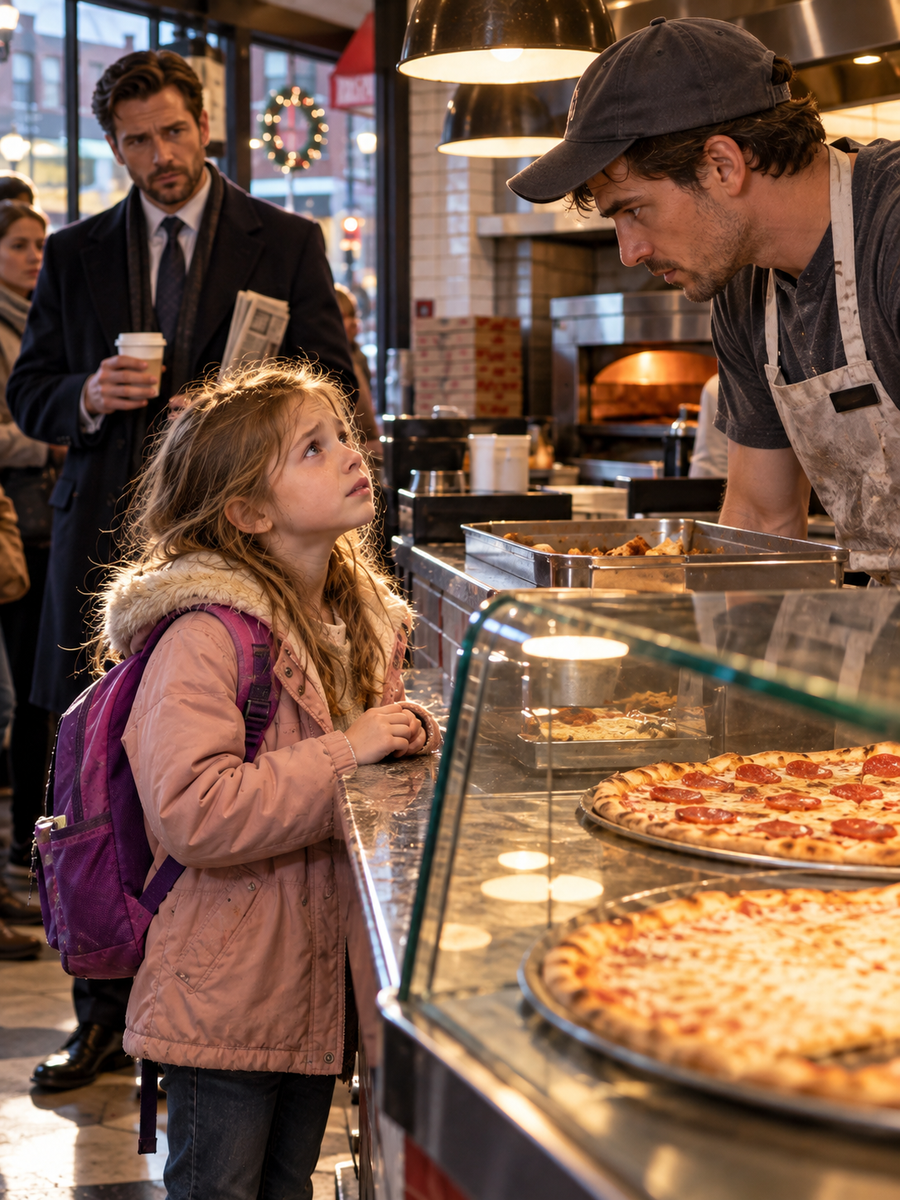
A SIX-YEAR-OLD GIRL ASKED FOR YESTERDAY’S PIZZA AT A BILLIONAIRE’S RESTAURANT—THEN HE FOLLOWED HER HOME AND DISCOVERED THE PROMISE HER MOTHER HAD KEPT FOR FIFTEEN YEARS – Life Story
The cashier scraped the last crusts into the trash while six-year-old Annie stood with her hands empty. Her mother was...