I FOLLOWED MY HOUND INTO A WYOMING BLIZZARD TO SAVE MY LITTLE BROTHER—AND FOUND MY DEAD FATHER’S PHOTOGRAPH IN A STRANGER’S CABIN WHILE THE COUNTY’S RICHEST RANCHER CLOSED IN – Life Story
A stranger opened his cabin door in the middle of a Wyoming blizzard, and my dead father’s face stared back at me from the wall.
My twelve-year-old brother was waiting in a house with almost no firewood, and the last light was disappearing behind the mountains.
Before I could ask why that photograph was there, the stranger heard something in the snow that made him reach for the lock.
I stood on the crooked porch with an axe in my right hand and a bundle of half-frozen branches on my back, staring past a man I had never seen before.
Above his fireplace hung a framed photograph of my father, Samuel Reed, smiling beside a timber wagon as if the winter that killed him had never happened.
The man blocking the doorway looked about fifty.
Snow had collected in his beard, though he had been inside, and one sleeve of his wool coat hung stiffly against his body.
He watched me notice the photograph.
Whatever he had intended to say when he opened the door vanished from his face.
“Where did you get that?” I asked.
His eyes moved from my face to the axe. “You’d better come in before you freeze.”
“My father’s picture,” I said. “Why is it in your house?”
Behind me, our hound, Rufus, whined and pressed his wet nose against my knee.
The wind pushed hard enough to bend the porch railing.
Somewhere below us, beyond the dark pines, my brother Ben was feeding our last scraps of kindling into a stove that would not stay warm until morning.
I had left him barely an hour earlier, promising I would be back before dusk.
We had argued about it at the door.
Ben wanted to come, and I had told him he was needed to keep the stove alive and the kettle filled.
That was a kinder way of saying his boots were split at the seams and I could not risk both of us in the storm.
“Please,” the stranger said, stepping aside.
He sounded less like a man offering hospitality than one afraid I might refuse it.
I crossed the threshold.
Heat from the hearth washed over my fingers so suddenly they hurt.
The cabin smelled of wet wool, boiled coffee, and the bitter herbs my father used to steep when his chest was tight.
A row of split logs stood beside the fireplace.
There were enough to last several nights.
I hated myself for noticing.
The stranger closed the door, set its iron latch, and leaned against the frame for an instant before straightening.
A ragged cough shook his shoulders.
As he lifted a hand to his mouth, his coat opened at the collar, exposing a bandage stained brown at the edge.
“You need help,” I said.
“So do you.” His voice was hoarse but steady. “You don’t come this far off the creek in weather like this for pleasure.”
“I came for wood.
My brother’s alone.”
That seemed to strike him harder than the cough had. “How old?”
“Twelve.
Now tell me how you knew Samuel Reed.”
He turned toward the photograph.
In it, my father stood between two younger men.
I had seen that smile a hundred times and never in a picture.
The father I remembered was usually tired, his hands split from rope and cold, smiling only when Ben pretended not to want another helping of supper.
“Sam saved my life once,” the stranger said. “And I gave him reason to wish he hadn’t.”
I slipped the axe from my hand and rested it against the wall, close enough to reach.
I wanted answers, but I wanted those stacked logs more.
Outside, the storm swallowed the path I had made getting here.
The stranger saw my glance toward the woodpile. “Take what you need,” he said.
Then his eyes shifted to the narrow window behind my shoulder.
He went completely still.
“Miss Reed,” he whispered, “don’t turn around.”
TRACKS BENEATH THE SNOW
Of course I turned around.
There are warnings a person can obey without thinking, and there are warnings that make the body move before the mind has caught up.
His belonged to the second kind.
Through the ice feathering the window, I saw a pale yellow light pass between two pine trunks.
It disappeared, returned farther to the left, and settled into a slow, unnatural rhythm.
A lantern.
Someone was moving through the trees.
The stranger pulled the curtain closed.
He did it carefully, without the hurried movements of a man startled by an unexpected visitor.
That frightened me more than anything.
“Who is out there?”
“I hoped they’d turn back at the ridge.”
“Who?”
He rested his good hand against the mantel and swallowed.
His breathing sounded tight, and his forehead glistened despite the cold draft seeping through the door.
“My name is Jonah Mercer,” he said. “Your father knew me before you were born.”
“That isn’t what I asked.”
“No, ma’am.
It isn’t.”
He crossed to the other window, moving with visible difficulty.
For the first time I noticed that his boots were beside the stove, still wet beneath a crust of snow.
A leather saddlebag lay on the table, its strap nearly torn through.
He hadn’t been in this cabin long.
Outside, Rufus raised his head.
The dog had stopped whining.
His ears stood forward, and a low sound gathered in his chest.
Then I heard horses.
Three, perhaps four, moving slowly enough that their hooves made muffled, deliberate impressions in the snow.
My stomach tightened.
I thought of Ben.
When Father was alive, he had taught us what to do if a storm trapped us without enough fuel.
Close the bedroom door.
Bring the blankets into the kitchen.
Keep the iron stove damped low instead of feeding it everything at once.
If the chimney smoked, open the draft.
If the fire failed, crawl beneath the quilts together and wait for daylight.
Ben remembered every instruction.
But he was twelve.
Twelve was old enough to pretend you weren’t frightened and young enough to believe your older sister would always come home because she had promised.
“I have to leave,” I said.
Jonah looked toward the trees.
“You couldn’t cross that ridge now.”
“I found this place.
I can find the way back.”
“You found it with daylight behind you.
There’s nothing behind you now.”
I went for my axe.
He didn’t try to stop me.
Instead, he reached beneath the table and brought out a smaller lantern, already filled with oil.
“Take this.
And take the dry wood.
You’ll get farther with both than with that wet bundle.”
His kindness was almost unbearable.
I had spent the past year learning that kindness often arrived with a price, particularly when it came from men who knew our circumstances.
I held out my hand for the lantern but kept my eyes on him.
“Why would men follow you into a storm?”
He didn’t answer.
“Mr.
Mercer.”
He looked up.
“Whatever you’ve done, my brother had no part in it.”
For a moment his expression changed.
I saw something like shame pass across his face, not quickly enough to hide.
“No,” he said. “He didn’t.”
A voice carried through the trees.
“Mercer! We know you’re in there!”
Jonah closed his eyes.
The voice came again, nearer.
“We tracked your horse from the south trail.
Don’t make us stand out here all night.”
The tone was rough but not yet threatening.
A man speaking to another man who had caused trouble and might be persuaded to end it.
Jonah moved to the door.
“Go back down the ridge,” he called. “There’s nothing here for you.”
One of the riders laughed.
“Then you won’t mind letting us look.”
I recognized that second voice.
Not its owner, not immediately, but the careful, confident way he spoke.
Men who worked under someone powerful often borrowed a little of that power for themselves.
I had heard the same tone in the general store when a ranch foreman informed a customer that his employer’s account came first.
The lantern moved closer.
Through a gap in the curtain, I made out three mounted figures.
Two wore heavy canvas coats.
The third had a fur collar and a broad-brimmed hat pulled low.
They stopped near the edge of the clearing.
One of the men swung down from his horse.
“Mr.
Whitcomb wants his property, Mercer.
That’s the whole of it.”
My hand tightened around the lantern.
Silas Whitcomb.
There wasn’t a household within fifty miles that didn’t know his name.
He owned the largest cattle operation in the county, supplied the church with coal during bad winters, and had paid for new windows in our schoolhouse after a windstorm broke the old ones.
When Father’s lungs failed the previous January, Whitcomb had sent a wagon to our place with flour, salt pork, and an offer to extend the account at the mercantile.
I remembered the wagon.
I remembered Ben waving from the porch.
And I remembered the note enclosed with the supplies, written in an elegant hand.
No family that has worked this country as faithfully as yours should go hungry.
I had thanked him.
The memory made something cold move through me.
“Mr.
Whitcomb sent them?” I whispered.
Jonah nodded.
“Why?”
He looked at the photograph.
“Because your father kept something he shouldn’t have had to keep.”
That sentence changed the shape of the room.
I stared at him.
Father had left behind very little when he died.
Two work shirts, his tools, a cracked pocket watch, and a Bible with our mother’s name written on the first page.
We had sold his extra harness to buy spring seed.
There had been no money hidden beneath the floorboards, no inheritance waiting for a kinder season.
Whatever Jonah meant, it had not saved us from poverty.
Outside, the man on foot climbed the porch steps.
“Open the door, Mercer.”
“I told you to leave.”
“You don’t get to give orders anymore.”
The man shook the handle.
Jonah’s face tightened, but he made no move toward it.
I stepped forward.
“Who are you?” I called.
Silence fell outside.
Then the answer came, suddenly less certain.
“Who is that?”
“Lydia Reed.”
I heard the creak of leather as someone shifted on a saddle.
“What are you doing up here, Miss Reed?”
“Trying not to freeze to death.
What are you doing?”
The man cleared his throat.
“This is private business.”
“Then conduct it without frightening half the mountain.”
Jonah’s mouth twitched, almost a smile.
The voice outside lowered.
“Miss Reed, I suggest you come out.
Mr.
Whitcomb won’t want you mixed up in this.”
That was when I understood they knew exactly who I was.
There were perhaps forty families in and around Miller’s Creek.
Most of us knew one another by sight.
But a hired rider finding a strange woman inside an abandoned mountain cabin shouldn’t have recognized her voice so readily.
Unless someone had already discussed her.
I stepped back from the door.
“Did they come here looking for my father?” I asked Jonah.
His silence lasted too long.
“Mr.
Mercer.”
“No,” he answered. “Not tonight.”
The porch boards creaked again.
A man shouted from the yard that the weather was turning.
Another complained about his horse.
The first rider answered sharply, ordering him to stay where he was.
Then a fourth voice rose from the darkness beyond the clearing.
“That’s enough, Clay.”
The voice was older, calm, and unmistakably familiar.
The men fell quiet.
A horse approached through the snow.
I moved to the window, ignoring Jonah’s warning, and wiped a small clear circle in the frost with my sleeve.
A tall man in an expensive black overcoat dismounted beneath the lantern light.
Even in the storm, his boots were polished.
Silas Whitcomb handed his reins to a rider and looked directly toward the cabin.
The man who had sent food when my father was dying had followed me into the mountains.
And he didn’t look surprised to find me there.
THE MAN AT THE DOOR
“Lydia,” Whitcomb called, his voice carrying through the weather. “You need to come home.”
He spoke the way he did at church suppers, when a child became too noisy or a hired hand forgot his place.
Not angry, exactly.
Certain that the matter would be settled because he had decided it should be.
I looked at Jonah.
“Why is he here?”
“Something that happened ten years ago.”
“Ten years ago, I was seventeen.”
“Your father wasn’t.”
Whitcomb stepped onto the porch.
“I’m going to assume you’ve stumbled into an unfortunate misunderstanding,” he called. “Mercer has been unwell.
He’s been telling stories, and he’s frightened people who have done nothing wrong.”
Jonah gave a dry, humorless laugh.
“I haven’t told her a story yet.”
“Then let’s keep it that way.”
A small silence followed.
I remembered how Whitcomb had stood beside Father’s grave the previous winter, hat over his heart, telling me Samuel was one of the finest men he had known.
He had asked after Ben.
He had told me to come to him if we needed anything.
I had believed him.
“Mr.
Whitcomb,” I said through the door, “I came to gather firewood.
My brother is alone, and I need to get home.”
“Then come out.
My men will see you safely down the mountain.”
It was a reasonable offer.
Almost.
“Will they take the firewood, too?”
A rider laughed before stopping himself.
Whitcomb’s expression didn’t change.
“Of course.”
“Then let Mr.
Mercer give me what I need, and I’ll be on my way.”
“Mercer has something of mine.”
Jonah moved beside me.
“No, Silas.
I have something you want.”
The familiarity of his tone was startling.
This wasn’t a poor drifter pleading with a wealthy landowner.
They sounded like two men who had known one another for years and wished they hadn’t.
Whitcomb drew a measured breath.
“Don’t mistake stubbornness for righteousness, Jonah.
You know better.”
“And you know better than to bring hired men to a sick man’s door.”
I looked down.
Jonah’s injured arm had begun trembling again.
He pressed it against his chest beneath the coat and tried to disguise the movement.
Whitcomb noticed.
“You need a doctor, old friend.
Come down peacefully.
I’ll pay for one.”
Jonah’s face tightened at the words old friend.
“You said the same thing to my brother,” he answered.
Something passed between them that I couldn’t understand.
Whitcomb turned toward me.
“Lydia, you’ve had a difficult year.
Nobody blames you for being unsettled.
But you should think about Benjamin.
He’s waiting for you, isn’t he?”
Every bit of warmth drained from my body.
Ben.
My little brother’s name, spoken by a man standing outside a hidden cabin in a blizzard.
It might have been ordinary concern.
Whitcomb had known our family for years.
But the way he used it made me feel as though our little house had been opened and examined without our permission.
“Leave my brother out of this,” I said.
Whitcomb’s voice hardened.
“Then don’t put yourself in the middle of business that doesn’t concern you.”
Behind him, one of the men shifted his weight.
The wind rose, whipping snow beneath the porch roof.
I had spent fourteen months measuring every word I spoke to men like Silas Whitcomb.
Men who owned the wagons that carried our grain, the stores that extended our credit, and the land surrounding the narrow strip of creek bottom Father had worked for nearly twenty years.
I knew what it cost to offend them.
I also knew what happened to women who were too grateful to ask questions.
“Business that doesn’t concern me,” I repeated. “With my dead father’s photograph hanging inside this cabin?”
Whitcomb’s expression changed.
Only for an instant.
But I saw it.
He hadn’t known about the photograph.
“What photograph?”
“The one above the fireplace.”
Jonah stepped forward.
“It’s just a picture, Silas.”
Whitcomb looked from him to me.
“Lydia, come outside.”
“No.”
The word surprised both of us.
My heart beat so fiercely I could feel it in my fingertips.
Whitcomb removed one glove, brushed snow from his coat, and glanced toward the men behind him.
“Clay, take the horses around to the sheltered side.
We may be here a while.”
The foreman hesitated.
“With respect, sir, the lower trail’s drifting shut.”
“Then you’d better hurry.”
Clay didn’t move immediately.
He was broad-shouldered, perhaps thirty-five, with a windburned face and the stiff posture of a man accustomed to doing what he was told.
I remembered seeing him unloading cattle at the stock pens.
He looked toward the cabin door.
“Sir, you said this was a matter of recovering a lost deposit.”
“It is.”
“You didn’t mention Miss Reed.”
“Because I didn’t know she was here.”
Clay accepted that answer reluctantly and led his horse away.
But another rider remained near the porch, looking from the windows to Whitcomb with growing discomfort.
I watched him through the frost.
He was beginning to understand that this wasn’t an ordinary dispute.
Jonah reached into his coat.
I moved instinctively, but he only drew out a small leather pouch.
Its mouth was tied with faded cord, and one side had been rubbed smooth by years of handling.
He opened it over the table.
Gold coins slid into his palm.
Not many.
Perhaps a dozen in that first handful, darkened by age but bright along their worn edges.
For a moment, I forgot the storm.
I had never seen so much gold together.
Our entire winter depended on a few dollars’ worth of supplies and whatever work I could find mending clothing for ranch families.
The coins in Jonah’s hand could have bought enough firewood to keep Ben warm for years.
“Where did you get those?” I whispered.
“From a man who had no right to them.”
“Whitcomb?”
Jonah closed his fingers.
“Not originally.”
He placed the gold back into the pouch.
Outside, Whitcomb called again.
“Jonah, we can still settle this privately.”
Jonah looked at me.
“That’s what he said ten years ago.”
The wind struck the cabin with such force that the roof timbers groaned.
A moment later, something hit the front window.
Glass cracked sharply.
Rufus jumped up barking, and I stumbled backward as cold air poured through the broken pane.
It was a stone, thrown from somewhere beyond the porch.
One of the riders shouted angrily.
“Who did that?”
“Not me,” another answered.
Clay came running back from the horses.
“Sir, I didn’t agree to this.”
Whitcomb spun toward him.
“Nobody asked you to break the window.”
“And nobody told us there’d be a woman inside.”
The men began arguing.
It was an ugly, frightened sound beneath the storm.
They had come expecting an old man, a disputed bag of gold, and a simple show of authority.
Instead, they had found a witness they knew, a blizzard that could strand them all, and an employer suddenly less interested in explaining himself.
Jonah leaned against the mantel.
“Lydia,” he said, “there’s a passage behind the hanging blanket.
An old drainage cutting from the mining days.
It’s narrow, but the roof is sound near this end.”
“You want me to crawl into a mine?”
“It opens above the south fork.
Your father’s place isn’t far from there.”
“How far?”
“Less than a mile from the outlet.
Half that, if you know the creek.”
I stared at him.
“You know where we live.”
“Sam told me.”
“Before he died?”
Jonah hesitated.
“Yes.”
The answer opened another question I had no time to ask.
Outside, Clay shouted that his horse had broken loose.
Hooves scattered across the clearing.
Two men ran after the animal, and another called for Whitcomb to turn back before the ridge became impassable.
Whitcomb refused.
Then he said something that changed everything.
“Bring me the pouch and the account book, Jonah.
Keep your old promises if you like, but those papers cannot leave this mountain.”
An account book.
Not merely gold.
I looked at Jonah.
He looked away.
Until that moment I had thought the coins were all Whitcomb wanted.
Now I knew the wealthiest man in the county had come through a blizzard for something that could be read.
And I was certain he did not want me reading it.
THE WEIGHT OF AN OLD PROMISE
For several seconds, nobody moved.
The word papers seemed to remain in the room after Whitcomb spoke it, heavier than the coins.
I looked at the leather saddlebag on Jonah’s table.
Its strap was nearly broken, and the buckle had been wrapped in a strip of cloth.
Something rectangular pressed against the worn leather.
Jonah noticed me looking.
“Not now,” he whispered.
Whitcomb came closer to the broken window.
“Listen to me, Lydia.
Mercer has spent years hiding from his own mistakes.
He’ll tell you anything to make himself seem honorable.”
“Then let him tell it,” I answered.
“You don’t understand what’s at stake.”
“That’s becoming obvious.”
He drew himself up.
“Your father understood that sometimes a community survives because good men agree to leave old troubles buried.”
The words struck me with peculiar force.
Father had said something very different.
He had always told Ben that burying a mistake didn’t make it disappear.
It simply gave somebody else the job of digging it up.
Yet Father had also been a quiet man.
When Whitcomb’s cattle crossed our lower pasture, Father never complained publicly.
When the feed merchant raised our prices, Father paid the difference or found another way to manage.
And when the sheriff questioned him about an argument at the old freight station, Father had returned home pale and refused to say what happened.
I had mistaken his silence for patience.
Now I wondered what it had cost him.
“Did my father know about that book?” I asked.
Jonah closed his eyes.
“Yes.”
“Did he write it?”
“No.
But he made certain I couldn’t forget what was written inside.”
Whitcomb’s voice cut through the wind.
“You see? He’s dragging Samuel’s name through this now.
That ought to tell you enough.”
A sudden gust pushed snow through the broken pane.
The fire bent in the hearth.
Jonah struggled to breathe, and I knew we had only minutes before the cold swallowed whatever warmth remained in the cabin.
I pulled a blanket from the narrow bed and pressed it against the damaged window.
The glass was sharp along the wooden frame, but the heavy wool caught against it and stayed.
Then I turned to Jonah.
“Tell me one thing.
If you have proof that Whitcomb stole from someone, why haven’t you taken it to the law?”
He stared at the floor.
“Because telling the truth would mean admitting what I did.”
The admission was so plain that I believed it.
Not because I knew him.
Because he looked like a man who had been saying the same words to himself for years.
Outside, Clay approached Whitcomb.
“Sir, the horses can’t stand much longer.
We’ve lost the track down the north slope.”
“Then find it.”
“We can’t see ten yards.”
“Clay.”
“No, sir.
We weren’t hired to frighten a woman and her dog half to death.”
Whitcomb stepped close enough that the lantern illuminated both their faces.
“I have paid your wages for eleven years.”
Clay removed his hat, letting snow collect in his dark hair.
“Yes, sir.
You have.”
“Then remember your responsibilities.”
Clay’s jaw worked.
“My responsibility tonight is getting these men home alive.”
I saw Whitcomb register the change in him.
A rancher could control a great deal, but he could not make exhausted horses cross a mountain after the trail disappeared.
Whitcomb had relied on the men coming with him.
Now they were thinking for themselves.
I opened the door a few inches.
Cold air pushed against my face.
“Mr.
Whitcomb, I am leaving with enough wood to keep my brother alive tonight.
Mr.
Mercer is staying here.
And whatever disagreement you have can wait until morning.”
Whitcomb looked at me as though I were a child who had interrupted an important conversation.
“You’ll stay out of it after that?”
I could have said yes.
It would have been the safest answer.
Instead, I heard myself say, “I won’t make a promise about something I don’t understand.”
His expression tightened.
“Your father would have wanted you to be sensible.”
“You don’t get to speak for him.”
The silence afterward seemed enormous.
For the first time that evening, Whitcomb looked genuinely angry.
He turned to Clay.
“Take Miss Reed home.
Then come back.”
Clay glanced toward the storm.
“I’m taking all three men back to the lower road.
There’s no returning tonight.”
“That’s an order.”
“Then I’m sorry, sir.”
Whitcomb stood motionless.
It was a small rebellion, almost polite.
But I watched it wound him more deeply than any accusation had.
His reputation depended upon men believing that his judgment could be trusted.
He had built a county-wide empire on the idea that Silas Whitcomb knew what was best.
Now even his own foreman was refusing him.
He looked back toward the cabin.
“This isn’t finished.”
“No,” Jonah said softly. “It isn’t.”
Whitcomb turned away.
His riders gathered the horses, struggling with frozen reins and wind-stiff blankets.
One man was still searching for the animal that had bolted, but Clay ordered the others to shelter near the lower trail while he followed its tracks.
Whitcomb climbed into his saddle with difficulty.
Before he rode away, he looked at me once more.
“Lydia, your family’s credit at Bennett’s store comes due next month.
I hope you’ll remember that generosity can be mistaken for weakness.”
Then he disappeared into the snow.
I remained in the doorway long after the last lantern was gone.
My cheeks burned.
Our credit.
The account that bought Ben’s winter boots, our flour, the medicine Father needed, and the seed I hoped to plant in spring.
Whitcomb knew exactly what we owed.
He had just reminded me that we were vulnerable.
Jonah stepped beside me.
“You shouldn’t have let him see you were afraid.”
“I wasn’t trying to impress him.”
“No.
I suppose you weren’t.”
His knees suddenly weakened.
I caught his good arm before he could fall, though his weight nearly pulled me down with him.
He was warmer than he should have been.
Fever.
“Sit,” I ordered.
He obeyed without argument.
I filled his tin cup with water, brought the kettle near the hearth, and stirred the fire until the logs caught properly.
Father had taught me enough about caring for sick people to recognize when a man needed more than a quiet night and a strong cup of coffee.
Jonah needed a doctor.
But Ben needed me now.
I brought the saddlebag to the table.
“What’s in the account book?”
Jonah looked at it.
“Names.
Amounts.
Deliveries.
Things a man thought would be forgotten once the people who remembered them were dead.”
“And my father?”
“He remembered.”
I reached for the buckle.
Jonah covered it with his hand.
“Please.
Let me tell you before you read it.”
“Why should I trust you?”
He considered that question without taking offense.
“You shouldn’t.
Not yet.”
It was the first honest answer I had received all evening.
I lowered myself into the chair opposite him.
The fire snapped, throwing sparks against the stones.
Jonah looked toward the photograph.
“In the winter of 1868, a mining company working the Sweetwater district sent a payroll shipment over the north freight road.
The wagon carried gold to pay men who had gone months without receiving their wages.”
I waited.
“Three days before Christmas, that shipment disappeared.”
“I’ve heard about the robbery.”
“Most people have.
What they’ve heard is wrong.”
He took a long breath.
“Two freight workers were blamed.
One died in prison.
The other came home a broken man.
Their wives and children spent years being treated like thieves.”
I thought of the widows who sometimes sold bread outside the church after Sunday services.
Women whose names I knew only through whispered conversations.
“Who took it?”
Jonah stared at his hands.
“Three men arranged for the shipment to be diverted.”
“And you?”
“I drove the replacement wagon.”
The room seemed to narrow around us.
“You helped them.”
“Yes.”
“Who were the others?”
He hesitated.
“Silas Whitcomb arranged it.
Another man handled the accounts.
I carried the money away from the road.”
I pushed back from the table.
Father’s photograph looked down at us, his younger face caught in a happiness I had never known.
“And you let innocent men take the blame?”
Jonah did not answer immediately.
When he did, his voice was scarcely audible.
“Yes.”
For a moment I wanted to strike him.
Instead, I stood and went toward the door.
“Where are you going?” he asked.
“Home.”
“The tunnel is behind the far blanket.
There’s a lantern hook near the second bend.
Keep to the right when the passage widens.”
I stopped.
“You’re just going to let me walk away?”
“It’s what I deserve.”
I faced him.
“Don’t make this about what you deserve.
My brother is waiting.”
His face fell.
There was no argument he could make against that.
I gathered the dry logs into two bundles, securing them with rope from the woodpile.
I tied one across my shoulders and held the other against my chest.
Jonah showed me the narrow opening behind a faded wool blanket.
The passage sloped downward into darkness, its entrance strengthened by old timber supports.
It smelled of damp earth and stone.
“Do you know where it ends?” I asked.
“Yes.
Your father helped repair the outlet years ago.”
I turned sharply.
“He knew about this place?”
“He knew every safe way off this mountain.”
I wanted to ask why Father had hidden so much of his life from me.
But Jonah was looking toward the photograph again.
“There was something he said the last time I saw him,” he murmured. “I thought I would remember it without writing it down.”
“What?”
Jonah’s voice trembled.
“He told me that the truth doesn’t become less important just because the people who need it have grown old.”
I looked at the pale, exhausted man beside the hearth.
“You should have listened.”
He nodded.
“Yes.”
I took the lantern and called Rufus.
The dog followed me into the old drainage passage, his nails clicking over the stone.
As the cabin disappeared behind us, I heard Jonah cough once, then again.
I wanted to turn back.
But somewhere below that mountain, Ben was waiting for the sound of my footsteps.
And I had already broken one promise to be home before dark.
THE ACCOUNT BOOK
The passage was narrower than Jonah had described.
At times I had to turn sideways to push the wood through between the stone walls.
Water had frozen in shallow pools along the floor, and every few yards the timber braces groaned beneath the weight of the mountain.
Rufus moved ahead of me with his nose low.
I kept one hand against the wall and the other around the lantern handle.
There was no room for panic.
At the second bend I found the iron hook Jonah had mentioned, its surface rusty but secure.
Beyond it, the tunnel widened into an old drainage channel where a narrow stream had frozen along one side.
I followed the higher ground.
The lantern flame wavered.
When I finally saw the pale opening ahead, relief weakened my knees.
The tunnel emerged beneath a rocky shelf overlooking the southern branch of Miller’s Creek.
The storm was still fierce, but the trees offered some shelter.
I knew this part of the valley.
Father had cut a narrow trail through the cottonwoods years earlier, using it to reach a hay meadow without crossing the main road.
I had walked that trail beside him as a child.
Now I followed it alone.
By the time our cabin appeared through the snow, my shoulders ached and my fingers had grown clumsy.
A weak orange light glowed behind the kitchen window.
I nearly cried.
Ben had kept the fire alive.
I pushed through the door, and Rufus hurried past me, shaking snow across the floorboards.
Ben rose from beside the stove.
For one terrible second he simply stared.
Then he rushed forward and wrapped his arms around my waist.
“I thought you got lost.”
“I found my way.”
“You were gone forever.”
“I know.”
His voice broke.
“I almost went after you.”
That frightened me more than the ride of Silas Whitcomb and his men.
I gripped his shoulders.
“Promise me you won’t ever do that in a storm.
If I’m late, you stay where there’s shelter.”
He looked down.
“You always tell me we’re supposed to help each other.”
“We are.
But sometimes helping means staying alive until the other person gets home.”
He studied my face.
“You’re scared.”
I tried to smile.
“I’m cold.”
“That’s not the same thing.”
I couldn’t argue.
We stacked the dry logs beside the stove, and I fed two into the fire.
Heat slowly returned to the room, filling the corners with a soft amber light.
Ben touched one of the pieces.
“Where did you find wood this dry?”
“A cabin up the ridge.”
“Somebody lives there?”
“Yes.”
He looked surprised.
“Who?”
“A man who knew Father.”
Ben sat down.
That answer had done what the fire couldn’t.
It had driven the cold from his face and replaced it with something that looked almost like hope.
“Did he tell you stories?”
“Some.”
“What kind?”
I stirred the pot of beans left over from supper.
“Complicated ones.”
Ben leaned back in his chair.
“Father always said complicated was just another word grown people used when they didn’t want to explain themselves.”
I laughed before I could help it.
“That sounds like him.”
We ate by the stove, passing the same chipped bowl between us.
Ben was hungry enough to scrape the last beans from the bottom, though he insisted I take the larger piece of bread.
When I finally lay down, sleep did not come.
I kept seeing gold coins in Jonah’s hand.
I kept hearing Whitcomb say that good men sometimes had to bury old troubles.
And I kept thinking about the photograph.
Father had never owned many things worth preserving.
Yet a man hiding in the mountains had kept an image of him beside his fire.
I wondered what kind of friendship survived so much shame.
By morning, the storm had weakened to a steady snowfall.
The creek was nearly hidden beneath ice, and the pasture fence had disappeared in places.
Sunlight struggled through the clouds, turning the distant hills a dull silver.
I found Ben chopping the thinnest branches into kindling.
“That’s enough,” I told him.
He looked up.
“Are you going back?”
I paused.
“Yes.”
“I want to come.”
“Not today.”
His face tightened.
“I’m not a baby.”
“I know.”
“Then stop treating me like one.”
I set down the water bucket.
“Ben, I found someone who is very sick, and there are men looking for him.
I don’t know what will happen.
Until I do, I need you safe here.”
He thought about that.
“Is it because of Father?”
I had not told him nearly enough for him to make that connection.
Yet children heard the things adults tried to hide.
“Yes,” I answered.
Ben’s eyes went to Father’s empty chair.
“Then I want to know, too.”
“You will.”
“When?”
“When I understand enough to tell you the truth without guessing.”
He accepted that, though reluctantly.
Before leaving, I checked the fire, set out bread and water, and told him to use the lower stack of logs first.
I also promised to send someone to stay with him if I couldn’t return before sundown.
Then I hitched our old mare, Juniper, to the small sled Father had built for hauling feed.
The mare was slow, but she knew the creek road, and the sled could carry more wood than my shoulders ever would.
I did not go directly into the hills.
I went first to Ada Bell.
Ada lived near the crossroads where Miller’s Creek widened into a town of a few dozen buildings.
She had taught school for nearly twenty years before taking over the weekly newspaper office after her husband’s death.
She was not a woman who made much noise.
She didn’t need to.
When someone told a foolish lie in front of Ada, she usually lowered her spectacles and waited until the silence became uncomfortable.
She opened her door before I knocked twice.
“Lydia Reed,” she said, looking at the snow on my coat. “Either you’ve brought me trouble or you’ve come to borrow my best shovel.”
“Trouble.”
“Then come inside.
The shovel’s broken.”
Her kitchen smelled of bread and printer’s ink.
I told her about the cabin, Jonah, the riders, Whitcomb, and the gold.
She listened without interrupting.
Only when I mentioned the account book did she set down her coffee.
“Did you see what’s written in it?”
“No.”
“Then you don’t know what it proves.”
“Jonah says it records a robbery.”
“Jonah may be telling the truth.
But if you accuse Silas Whitcomb publicly, the question won’t be whether you believe him.”
She folded her hands.
“The question will be what you can show.”
I stared at her.
“A wealthy man came to that cabin with hired riders in the middle of a blizzard.”
“That proves he wanted something.
Not that he stole it.”
“He threatened our credit.”
“That tells me what kind of pressure he’s willing to use.
It doesn’t tell a court who owned those coins ten years ago.”
I felt suddenly foolish.
Ada saw it.
“I’m not telling you to give up, Lydia.
I’m telling you not to hand Whitcomb a story he can easily turn against you.”
She stood, fetched a heavy shawl, and reached for her boots.
“What are you doing?”
“Coming with you.”
“To the cabin?”
“Somebody should see that injured man before the mountain finishes the work his enemies started.”
“Ada, you can’t—”
“I spent twelve years nursing my husband through illnesses worse than a cough.
I know enough to recognize when a doctor is needed, and I know which roads remain passable after snow.”
She looked me directly in the eye.
“But I won’t tell you what to believe about your father.
That’s your work.”
We collected clean bandages, hot broth, extra blankets, and a small tin of the salve Ada used for sore hands.
At my house, we left Ben with enough wood for the day and a clear promise that we would return before nightfall.
He was disappointed not to come.
But when Ada asked him to keep count of the remaining logs, he straightened with the seriousness of a boy entrusted with important business.
The old mining passage was easier to find in daylight.
We left Juniper sheltered beneath the cottonwoods and carried the supplies through the tunnel.
When we entered Jonah’s cabin, he was sitting where I had left him.
His skin was pale.
The fire had burned low.
He looked at Ada with an expression that suggested he recognized her before she spoke.
“Ada Bell.”
“Jonah Mercer.”
I stopped in the doorway.
“You know each other?”
Ada set the broth on the table.
“People who’ve lived in this county long enough tend to remember its ghosts.”
Jonah gave a faint smile.
“You still print the paper?”
“Every Thursday.”
“Then I suppose there’s no hiding anymore.”
Ada took his wrist to feel his pulse.
“That depends on whether you’re ready to tell the truth.”
He looked toward the photograph.
“I should’ve done it years ago.”
“Yes,” she said. “You should have.”
There was no cruelty in her voice.
Only exhaustion at a wrong that had lasted too long.
After making certain he was warm, Ada sent me to fetch more water while she examined the bandage at his shoulder.
She cleaned the abrasion where he had been thrown against a tree and told him the fever required attention from the town doctor.
He had fallen from his horse trying to outrun Whitcomb’s men.
He had ridden the rest of the trail in pain.
And he had been alone in the cabin for two days before I appeared.
When I returned with the water, Jonah was looking at the saddlebag.
“Lydia,” he said, “bring that here.”
I carried it to him.
He worked the damaged buckle loose with trembling fingers and withdrew a narrow account book wrapped in faded oilcloth.
The cover was cracked.
Its corners had softened from years of handling.
But the pages inside were dry.
He placed it in front of me.
“Your father asked me to keep that safe,” he said. “I kept it hidden instead.”
I opened the book.
The first pages contained ordinary freight records: dates, wagon numbers, weights of ore, amounts paid for timber, and the names of drivers.
Then I reached December 1868.
Seventeen payroll entries filled the page.
Beside them, in a hand I recognized immediately, were several small penciled marks.
Father’s handwriting.
At the bottom, a note had been added beneath the original figures.
Payment shipment received by authority of S.
Whitcomb.
I read it twice.
Then I turned the page.
There, beneath a list of names, was a second notation.
Delivery disputed.
Two men charged.
Wages remain unpaid.
The handwriting changed again near the bottom.
I had spent countless evenings watching Father make careful figures in the margins of our seed accounts.
His letters leaned slightly right, and he crossed his sevens to distinguish them from ones.
I knew his handwriting better than my own.
The last sentence was his.
Families are owed what was taken, whether the men responsible live to repay it or not.
I looked up.
Jonah was watching me quietly.
“My father knew,” I whispered.
“Yes.”
“He knew all these years.”
Jonah nodded.
“And he tried to make me do what I should have done without being asked.”
The book lay open between us.
Suddenly, the greatest mystery wasn’t why Silas Whitcomb wanted it.
It was why my father had died without telling me it existed.
THE PRICE OF SILENCE
I read the account book until the afternoon light began fading from the windows.
There were seventeen names.
Seventeen men who had worked through an early winter digging ore, cutting timber, hauling supplies, and building shelters on land that promised them wages before it promised them anything else.
The total was two thousand six hundred and forty dollars.
I checked it twice, using the pencil Ada handed me and a scrap of paper from her bag.
The entries had been made in different hands.
One belonged to the mining company’s clerk, recording the wages due.
Another was Jonah’s, noting the movement of the freight wagon.
Father’s writing appeared later, beneath several of the entries, documenting which families had never received payment.
Some had received small amounts years afterward.
Others had received nothing.
“What happened to the rest of the gold?” I asked Jonah.
He looked at the pouch.
“Spent.
Hidden.
Passed from one man to another.
Silas used part of it to keep his cattle operation alive after a bad season.”
“And this?”
“What I managed to recover before the men involved scattered.”
“Recover from whom?”
“From a place where Silas had hidden it.
Sam helped me find it.”
I counted the coins.
There were fifty-nine twenty-dollar pieces.
One thousand one hundred and eighty dollars.
It was more money than I had ever held, and not enough to repay even half of what had been stolen.
“Why didn’t Father take it to the bank?”
Jonah’s expression became guarded.
“He intended to.”
“When?”
“After I agreed to make a statement.”
“And you didn’t?”
“No.”
“Why?”
His answer came slowly.
“Because I gave evidence after the robbery that helped convict the wrong men.
If I admitted what happened, I would have to admit I’d lied.”
I stared at him.
“You let two innocent men suffer because you were afraid of being punished.”
“Yes.”
“Then my father kept your secret, too.”
Jonah looked away.
“I suppose he did.”
Something inside me gave way.
All my life I had believed Father incapable of doing wrong when he knew what was right.
I remembered him mending other people’s fences without asking for payment, leaving half our vegetables on a sick neighbor’s porch, and telling us that a person’s word was worth more than the money he carried.
Yet here was proof that he had known about stolen wages for years.
He had kept quiet.
Perhaps he had been afraid for us.
Perhaps Jonah had convinced him that exposing Whitcomb would only cause more suffering.
But seventeen families had waited while powerful men continued living comfortable lives.
I closed the book.
“I don’t understand him.”
Ada sat beside me.
“You don’t have to understand every choice your father made to decide what yours will be.”
I looked at the photograph.
“Did he know people were still going hungry?”
Jonah nodded.
“He helped several of them when he could.”
“With what money?”
“His own.”
I thought of the winters when Father refused to replace his worn coat, the spring he sold our second mule, and the autumn he told me there wasn’t enough saved for the school I had hoped to attend in Laramie.
He had never explained where some of our earnings went.
Now I wondered how often he had tried to repay a debt that wasn’t his.
I felt anger and grief together, so tightly mixed that neither could be separated from the other.
“He should have told me.”
“Yes,” Jonah said.
“He should have told someone.”
“Yes.”
His agreement infuriated me.
“You don’t get to sit there agreeing with everything.
You were part of this.”
Jonah lifted his eyes.
“I know.”
“Then stop talking about what you should have done and tell me what you’re willing to do now.”
The room fell silent.
For the first time since meeting him, I saw the possibility that Jonah might actually leave his hiding place.
Not because he had been forgiven.
Because he had finally been asked a question he could not answer with regret.
“I’ll give a sworn statement,” he said.
Ada looked at him sharply.
“You understand what that means?”
“I do.”
“You may be called to answer for your testimony ten years ago.”
“I know.”
“And you may not be able to avoid punishment.”
Jonah drew a ragged breath.
“I’ve avoided it long enough.”
I wanted to believe him.
But words came easily beside a warm fire, especially when nobody was yet demanding that they be honored.
I pushed the book toward him.
“Then we start with the names.”
We spent the remainder of the afternoon comparing the entries with what Ada remembered of the families.
She knew several through the school.
One widow had moved south after losing her husband’s wages.
A miner’s son had taken over his father’s small claim.
Two sisters lived with relatives near the crossing.
Other families had scattered when work at the old mine ended.
Ada wrote down what she knew without pretending to know more.
Each missing address became another problem we would have to solve.
At one point I traced a name with my finger.
Thomas Harlan.
I remembered an old man with a crooked shoulder who had brought potatoes to the church every autumn.
He had died when I was nineteen.
His widow had sold their cabin.
I looked at the amount beside his name.
One hundred and eighty dollars.
I tried to imagine what that money might have meant to them.
A repaired roof.
A doctor when he became ill.
Enough food to survive a season without depending upon charity.
Suddenly the gold on the table looked less like treasure and more like a room full of unanswered requests.
Ada wrapped the coins and counted them again in front of us.
“We’re going to need a proper inventory,” she said. “And the book must be kept somewhere it can be examined without being altered.”
“The bank?” I asked.
“Perhaps.
But not on Whitcomb’s word, and not simply because Jonah walks in carrying gold.”
I frowned.
“What else?”
“A sworn account of where it came from.
Witnesses to the count.
A written acknowledgment of who holds it.
And eventually a court order establishing whose property it is.”
She paused.
“Silas has influence here.
We must make certain the truth has a place to stand even when he isn’t willing to give it one.”
Jonah looked toward the door.
“If he hears you’ve got the book, he’ll come for it.”
“Then we won’t pretend it’s a secret,” I answered.
Ada raised an eyebrow.
I turned toward her.
“You print a newspaper every Thursday.”
“Yes.”
“Can you print the names?”
“Not yet.”
“Why not?”
“Because we haven’t established what the entries mean in a way that can survive a challenge.
I can print that a petition has been filed once you’ve filed it.
I can ask people who remember the old payroll case to come forward.
But I won’t accuse a man of theft in print merely because someone who admits he lied before now says he’s telling the truth.”
I leaned back, exhausted.
She was right.
That didn’t make waiting any easier.
We left Jonah with food, clean water, and enough wood for several days.
Ada promised to send the doctor by the southern trail if the weather allowed.
Before leaving, I stood beside Father’s photograph.
“Did he ever come here?” I asked.
Jonah looked at me.
“Several times.”
“Was he happy?”
The question surprised us both.
Jonah considered it.
“He was happiest when he spoke of you and Benjamin.”
I swallowed.
“And the last time?”
“He was worried.”
“About what?”
“That he’d leave you with more trouble than he could explain.”
I touched the frame.
“He did.”
Jonah lowered his gaze.
“Yes.”
I left the photograph where it was.
For the moment, I couldn’t bear to take it home.
Silas Whitcomb came to our house two mornings later.
By then the snow had stopped, and the sky had cleared to a hard, brilliant blue.
Smoke rose from chimneys along the valley, and teams of horses moved slowly over the packed road as neighbors began repairing the damage left by the storm.
I was splitting a log behind the cabin when Rufus barked.
Whitcomb arrived alone in a covered sleigh.
He wore a dark green scarf and a neatly brushed coat, looking precisely as he did when he visited families after church.
Ben watched him from the doorway.
“Go inside,” I told my brother.
He hesitated.
“Lydia—”
“Please.”
Ben obeyed.
Whitcomb stepped down.
“I see you made it home safely.”
“Yes.”
“And Benjamin?”
“He’s well.”
“Good.
I was concerned.”
I rested the axe beside the woodpile.
“Were you?”
He took the question without reacting.
“I’ve known your family a long time, Lydia.
You may be angry with me, but that doesn’t change the fact.”
I looked at the expensive sleigh, the well-fed horses, the fine gloves.
Our mare had been limping after hauling wood through the storm, and I had spent the previous evening rubbing her legs with warm cloths.
The difference between our lives stood plainly in the yard.
“Why are you here?”
Whitcomb took a folded paper from his coat.
“The account at Bennett’s store.”
He handed it to me.
The amount was forty-three dollars and sixty cents.
I knew the figure.
I had checked it every week since October.
“What about it?”
“I’ve purchased the note.”
I looked up.
The storekeeper had extended credit for winter supplies, secured by Juniper and our small wagon.
The note came due in early spring, and I had planned to pay it from sewing work and the first hauling jobs after the thaw.
Whitcomb had bought the debt.
“You bought it from Mr.
Bennett?”
“He had a business to run.
I offered him immediate payment.”
“You could have waited until spring.”
“I could have.”
His honesty chilled me.
He glanced toward the house.
“Your father struggled with accounts toward the end.
I was hoping to spare you the same difficulties.”
“By taking over what we owe?”
“By giving you a sensible opportunity.”
“What opportunity?”
He lowered his voice.
“Whatever Mercer has told you, leave it alone.
Return the book and the coins to me, and your family’s account will be settled.
I’ll see that Benjamin has new boots and that you have enough supplies to plant in spring.”
I watched his face.
He wasn’t smiling.
He truly seemed to believe he had made a generous offer.
“Those wages belonged to mining families,” I said.
“That was a long time ago.”
“Does that change who earned them?”
“It changes what can reasonably be done.”
He stepped closer.
“Do you imagine those people will all come back to claim their money? Some are dead.
Some have moved.
Others were never properly identified.
You’ll bring scandal upon the county and accomplish nothing but hurting yourself.”
“What about the men who went to prison?”
His expression tightened.
“They were convicted by a court.”
“On testimony Jonah Mercer says was false.”
“Mercer is a confessed liar.
Think carefully before you build your future on his word.”
He made a fair point.
That was what frightened me.
Jonah had lied before.
Whitcomb had spent years appearing honorable.
A stranger listening to both men might easily believe the rancher.
I took a breath.
“Then let the records be examined.”
Whitcomb shook his head.
“You think life is as simple as one honest account book.
It isn’t.”
“Then explain it to me.”
He looked out across our field.
For a moment he seemed older.
“In 1868, my ranch was close to failure.
Three hundred head lost in an early freeze.
Men who depended on me had wives and children waiting for wages.
I made decisions under circumstances you cannot imagine.”
I waited.
He turned toward me.
“I kept people employed.
I built something this county needed.”
“And the mining families?”
He did not answer.
I felt the awful temptation to accept his offer.
Forty-three dollars and sixty cents stood between us and the loss of Juniper, the only animal we owned that could pull a wagon.
Without her, we couldn’t haul winter wood from the lower forest or carry produce to town in spring.
Whitcomb could settle the debt with a few coins from his pocket.
He knew it.
He knew I knew it.
“Your father wasn’t a foolish man,” he said quietly. “He understood what it meant to protect a family.”
I looked past him toward our front window.
Ben stood behind the curtain.
The glass distorted his face.
I thought of every evening I’d told him to finish his supper even when I wasn’t hungry enough to eat mine.
Every morning I had sewn another patch onto his trousers and pretended not to notice that the cloth was thinner than before.
I wanted to protect him.
More than anything.
Whitcomb saw the hesitation.
“I’m not asking you to suffer,” he said. “I’m offering you a way not to.”
That might have persuaded me if he had offered to repay the families as well.
Instead, he wanted the account book.
He wanted the names buried.
I folded the paper and handed it back.
“The note comes due in spring,” I said. “Until then, I intend to pay what we owe.”
He didn’t take it immediately.
“You’re making a mistake.”
“Perhaps.”
“You have no idea how hard this will become.”
“I have some idea.”
His eyes moved toward the axe beside the chopping block.
Then he reached out and took the paper.
“I hope you don’t regret this.”
I watched him return to his sleigh.
I wanted to call after him, to ask whether there was any part of his concern for our family that had ever been genuine.
But he was already climbing into his seat.
The horses turned.
Snow crunched beneath the runners.
When he disappeared down the road, I went inside and found Ben standing beside the table.
He was holding Father’s old pocket watch.
“Did he offer to pay the bill?” Ben asked.
“Yes.”
“Why didn’t you let him?”
I sat down.
For a moment I had no answer that would make sense to a hungry twelve-year-old boy.
Then I said, “Because he wanted me to give him something that wasn’t mine.”
Ben studied the watch.
“Is it Father’s?”
“In a way.”
He looked toward the window.
“Then I guess we’ll have to find another way to pay.”
I reached for his hand.
He let me hold it.
And I knew that whatever happened next, he deserved more than a sister who taught him to be silent whenever powerful men offered comfort.
THE LONG ROAD TO TOWN
By the following Thursday, Miller’s Creek had begun talking.
Not everyone knew the truth, but everyone had heard a different version.
At the general store, a woman who had borrowed sugar from me the previous month turned away when I approached.
At the stable, two ranch hands stopped their conversation when they saw my face.
Someone claimed I had found treasure in the mountains and refused to share it.
Another said Jonah Mercer had tricked me into making accusations against a respectable man.
By Friday, a rumor reached Ben that I intended to sell our farm and disappear with stolen gold.
He came home from school red-faced and furious.
“Tommy Gates said Father was a thief.”
The words made me drop the shirt I was mending.
“What?”
“He said you found Father’s stolen money.”
I went still.
“Who told him that?”
“His father heard it at the mercantile.”
Ben pulled off his coat.
“He said that’s why Whitcomb came to see us.”
I closed my eyes.
A decade-old robbery had entered our little house through the mouths of schoolchildren.
It was exactly the kind of harm Whitcomb had warned me about.
Only he was helping it happen.
“What did you say?” I asked.
Ben looked at the floor.
“I told him he was lying.”
“Then?”
“He said if we were so honest, why couldn’t we pay for our own flour?”
My throat tightened.
Ben had never spoken about our poverty with shame before.
We lived carefully, but so did many families.
Some winters were harder than others, and most people understood that a bad harvest could reduce anyone to asking for credit.
Now someone had made our need into a public accusation.
I reached for him.
He stepped away.
“I hate him,” he said.
I didn’t know whether he meant Tommy Gates or Silas Whitcomb.
Perhaps both.
“You’re allowed to be angry,” I answered. “But we’re not going to let other people decide what kind of family we are.”
He looked at me, eyes bright.
“Then why are they allowed to say anything they want?”
“Because sometimes people repeat things before they know whether they’re true.”
“Like the men who blamed those miners?”
I stared at him.
He had heard enough to understand more than I realized.
“Yes,” I said quietly. “A little like that.”
Ben turned away.
For the first time since Father died, I understood that protecting him didn’t always mean keeping frightening things from him.
Sometimes it meant letting him see the truth before somebody else supplied a crueler version.
That evening, I opened the account book at our kitchen table.
I showed him the names.
I explained where the wages had come from, why the money had been taken, and why innocent men had been blamed.
I did not tell him every ugly detail of Jonah’s confession.
But I did not pretend Father had solved the problem.
“Did Father know?” Ben asked.
“Yes.”
“Why didn’t he tell us?”
“I don’t know everything he was thinking.”
“Was he scared?”
I considered that.
“I believe so.”
Ben stared at the pages.
“Father was scared?”
“Everybody gets scared.”
He seemed to find that harder to accept than the robbery.
Then he closed the book carefully.
“I wish he’d trusted us.”
“So do I.”
We sat together until the fire burned low.
The next morning I took the account book to Ada’s newspaper office.
Jonah had signed a written account of his involvement, describing how the shipment had been diverted from the main freight road, where the wagon had stopped, and which men had been present.
He had given his statement to a justice of the peace in town after the doctor cleared him to travel.
Ada and I had both witnessed him sign.
The justice had warned that admitting earlier false testimony might expose Jonah to prosecution.
Jonah had signed anyway.
Still, one confession from a man who had lied before was not enough.
We needed independent records.
Ada had spent the previous two days reviewing old notices preserved in her newspaper files.
The payroll robbery had been reported in the winter of 1868, and the names of the accused men had appeared in print.
The amounts recorded there matched several entries in Jonah’s book.
More importantly, the disputed wagon number matched the wagon described in the old hearing notices.
I examined the faded columns beneath Ada’s office lamp.
“This is the same wagon.”
“Yes.”
“But what proves Whitcomb authorized it?”
Ada tapped the account book.
“The notation identifies him.
The question is whether the signature can be verified.”
“Where?”
“Public records.
He signed enough contracts during those years.”
We crossed the street to the county clerk’s office.
The clerk, Mr.
Perkins, was a thin man who smelled faintly of tobacco and kept every paper arranged with almost religious care.
He didn’t like scandal.
He liked properly indexed documents.
That made him useful.
When Ada requested access to old freight and land-contract records, he frowned.
“What are you looking for?”
“A signature,” she answered.
“Whose?”
“Silas Whitcomb.”
The clerk’s expression changed.
He looked at me.
“Miss Reed, I hope you’re not planning to make trouble.”
“I hope I’m planning to correct some.”
He sighed.
“I can’t promise you anything.”
“We’re not asking you to,” Ada said. “We’re asking to examine public records.”
He disappeared into the rear room.
When he returned, he carried two bound volumes from the early territorial years.
We spent nearly an hour comparing entries.
Whitcomb’s signature appeared on cattle transactions, timber leases, and an agreement involving the transport of supplies to a mining camp.
His handwriting had a distinctive long descending stroke on the final letter of his surname.
The same stroke appeared beneath the payroll authorization in Jonah’s account book.
I felt my pulse quicken.
Ada leaned closer.
“Similar,” she said.
“It’s his.”
“Likely.
But we shouldn’t pretend we’re handwriting experts.”
I almost laughed.
Even now, with the ink before us, she refused to claim more than we could establish.
Mr.
Perkins adjusted his spectacles.
“The court can decide what weight to give it,” he said. “I can certify copies of the recorded signatures.”
I looked at him.
“You’d do that?”
“If proper fees are paid.
That’s my office.”
He paused.
“And I won’t have anyone telling the county clerk that he refused a lawful request because of the name written on it.”
I suddenly liked him enormously.
By late afternoon, we had arranged for a formal copy of the relevant records and prepared a petition asking that the recovered gold be preserved while the wage claims were examined.
The justice of the peace could receive the statements, but a district court would ultimately have to determine the competing claims to the money.
It wouldn’t happen in one afternoon.
There would be notice, witnesses, objections, and more work than I knew how to perform.
Ada advised me to speak to a lawyer when the circuit brought one through town.
For the moment, we could establish the record.
Jonah’s statement.
The original account book.
The names and amounts.
And an inventory of the gold witnessed by people who had no financial interest in it.
I had expected the truth to arrive like the sun breaking through clouds.
Instead, it arrived as paperwork.
Slow, stubborn, and terribly important.
On Thursday, Ada printed a restrained notice stating that a petition concerning the disputed Sweetwater payroll had been lodged and asking former workers or their surviving families to contact the newspaper office.
She did not accuse Whitcomb by name.
She did not write that the matter had been proved.
She simply gave the people named in the account book a reason to come forward.
That afternoon, an elderly woman arrived with her grandson.
Her husband had worked the mines.
She remembered waiting for wages that never came.
She remembered selling their cooking stove.
She remembered being told that the two men blamed for the robbery had hidden the money somewhere in the mountains.
When Ada showed her the name in the account book, the woman put one hand against the table.
“He earned every dollar of that,” she whispered.
I felt suddenly ashamed of how often I had thought of the gold as a way to rescue my own family.
It had belonged to people like her.
Families who had needed it when it mattered most.
The woman didn’t ask how much she might receive.
She asked whether anyone had finally cleared the names of the men accused.
Ada looked at me.
I couldn’t answer.
Not yet.
The worst blow came three days later.
I returned from town to find Ben sitting on the porch with a folded notice in his hand.
Juniper stood in the yard, her harness hanging loosely from the fence.
Two men had visited while I was away.
They had delivered a formal demand concerning the chattel mortgage secured by our mare and wagon.
Whitcomb, now the holder of the note, had begun the process of enforcing it.
The notice did not mean he could simply take Juniper that afternoon.
It did mean we would have to defend our interest or find the money before the debt was enforced.
I read the figures.
Principal.
Accrued charges.
Costs.
Forty-three dollars and sixty cents had become a threat large enough to swallow our ability to earn a living.
Ben looked at me.
“Will they take her?”
“Not today.”
“Will they take her next week?”
“I don’t know.”
He lowered his head.
“I thought if we just worked harder—”
“We’ve worked hard enough.”
The words escaped before I could stop them.
Ben looked startled.
I sat beside him.
“I’m sorry.
I didn’t mean to raise my voice.”
He rubbed his hands together.
“Maybe you should give Whitcomb the book.”
I stared out across the yard.
Juniper lowered her head to the frozen grass.
For a moment I could hear nothing except the soft creaking of the porch and my brother’s breathing.
He was not being cowardly.
He was twelve, and he wanted to keep the only horse he had ever loved.
I understood that better than he knew.
That evening, I rode to Jonah’s cabin.
He was stronger now, though the doctor had forbidden him from doing heavy work until the fever and pain had passed.
He had been helping Ada organize the records, writing down names and dates from memory where the account book was incomplete.
When he saw my face, he pushed back his chair.
“What happened?”
I handed him the notice.
He read it.
Then he set it down.
“I have the money.”
I shook my head.
“Not yours to give.”
“It’s a small part of the gold.”
“Which belongs to those families.”
“Lydia—”
“No.”
He studied me.
“I could work to repay it.”
“You can’t repay what you take from someone who’s already waited ten years.”
He turned away.
I knew he was trying to help.
But I also knew what accepting that money would mean.
For the rest of my life, I would wonder whether I had taken a little of what rightfully belonged to people who had already lost too much.
Jonah approached the fireplace.
“I can sell my horse.”
“You barely have a horse.
Whitcomb’s men ran it nearly to death.”
“I can find another way.”
“Mr.
Mercer, stop.”
He looked at me.
“I don’t need you to rescue me,” I said. “I need you to keep your promise.”
His expression softened.
“The statement?”
“Yes.”
“And the hearing?”
“Yes.”
He nodded.
“Then I’ll be there.”
I stood before Father’s photograph again.
For the first time, I noticed something about the image I had overlooked.
Father’s hand rested on Jonah’s shoulder.
Not casually.
Firmly, as though he were steadying a younger man who had just stumbled.
I thought about forgiveness.
How easily people used the word when they wanted someone else to forget what had happened.
But Father hadn’t forgotten.
He had kept names.
He had kept figures.
And even when he failed to expose the truth, he had refused to erase the people who suffered.
I touched the wooden frame.
Then I turned toward Jonah.
“There’s something I need you to understand.”
“What?”
“If you testify, I’m not going to ask the court to excuse what you did because you helped us.”
He looked at me for a long moment.
Then he nodded.
“I wouldn’t ask you to.”
For the first time, I believed he might be ready to stand before the people he had wronged.
Not as a hero.
As a man who had finally stopped hiding.
THE NAMES HE COULDN’T ERASE
The hearing began on a gray Monday morning in early February.
The district judge had arrived in town the previous evening, delayed two days by snow along the southern road.
By sunrise, people were gathering outside the small courthouse, stamping their boots and speaking in low voices.
I stood across the street beside Ada.
Ben held my hand.
He had insisted on coming.
“Are you frightened?” he asked.
“Yes.”
He nodded.
“Me too.”
Ada checked the papers inside her bag for the third time.
“Good,” she said. “Then neither of you is likely to mistake this for a game.”
I almost smiled.
Across the street, Silas Whitcomb arrived in a carriage.
He wore a dark coat and carried himself with the composed dignity I remembered from church.
A lawyer walked beside him, holding a leather case.
Whitcomb looked toward us.
His eyes rested on Ben.
Then on me.
He gave a small, almost disappointed shake of his head.
For one painful instant, I wanted to be the young woman he remembered.
Grateful.
Quiet.
Easy to help.
Instead, I took Ben’s hand and walked across the street.
Inside, the courthouse smelled of damp coats, paper, and coal smoke.
Jonah was already seated near the front.
He looked thinner than he had when I first entered his cabin, but the fever was gone, and his hands were steady.
When our eyes met, he stood.
“Morning, Lydia.”
“Morning.”
He looked down at Ben.
“You must be Benjamin.”
Ben studied him.
“You knew my father?”
“For a long time.”
“Did you like him?”
Jonah’s expression changed.
“Very much.”
Ben considered that.
“Then I hope you tell the truth about him.”
Jonah swallowed.
“So do I.”
The judge entered, and everyone rose.
The morning passed slowly.
Documents were identified.
Statements were read.
The petition concerning the recovered gold was placed before the court, along with the account book and the witnessed inventory.
Whitcomb’s lawyer argued that the records were unreliable.
He pointed out that Jonah had admitted involvement in the original robbery.
He reminded the court that witnesses had died, memories had faded, and the events had taken place a decade earlier.
He suggested that the account book might have been altered.
He questioned whether the remaining coins could be proved to belong to the unpaid miners.
These were not foolish arguments.
They were the arguments I had feared.
I sat with my hands folded in my lap, listening while a man in a clean collar tried to turn ten years of suffering into a matter of uncertain bookkeeping.
Then Jonah was called.
He walked to the front.
He swore to tell the truth.
And, for the first time in ten years, he told the whole story where other people could hear it.
He described the winter of 1868.
Whitcomb’s struggling cattle operation.
The agreement to divert the payroll wagon.
The third man’s handling of the accounts.
The false report that sent suspicion toward two innocent freight workers.
He described the gold that had remained hidden and how Samuel Reed had helped recover part of it.
He admitted giving false evidence.
He admitted letting innocent men carry the blame.
When Whitcomb’s lawyer asked why he was telling the truth now, Jonah looked toward the window.
“Because I thought I could live with it,” he said. “Turns out I couldn’t.”
The room was silent.
Then the lawyer asked the question I had been waiting for.
“Mr.
Mercer, if you lied under oath ten years ago, why should anyone believe you today?”
Jonah lowered his eyes.
“They shouldn’t take my word alone.”
He pointed toward the account book.
“That’s why I kept the records.”
The lawyer began another question.
But the judge asked to examine the entries again.
He compared the payroll figures with the preserved case notices and the certified signatures from county records.
He questioned Jonah about the route, the dates, and the names of the men involved.
Jonah answered without looking at me.
He didn’t ask for sympathy.
He didn’t try to make himself sound brave.
And when he couldn’t remember something, he said so.
That mattered.
More than I had expected.
Then Silas Whitcomb rose.
His lawyer had not yet called him, but Whitcomb asked permission to address the court.
The judge warned him that anything he said could be considered in the proceedings.
Whitcomb nodded.
He looked around the room.
“I have served this county for more than twenty years,” he began.
There it was.
The familiar voice.
The same measured authority he used when speaking at church, deciding wages, or settling disputes between ranch hands.
“I have employed men who otherwise would have gone hungry.
I have supported families when harvests failed.
I have helped build roads, schools, and places of worship.”
Several people nodded.
I could feel the room beginning to soften toward him.
Whitcomb continued.
“And now my reputation is being placed in the hands of a confessed criminal and a young woman who has been misled by him.”
My face burned.
Ben’s fingers tightened around mine.
Whitcomb turned toward me.
“Miss Reed’s father was a good man.
I respected him.
I helped his family when they needed it most.”
His voice grew quieter.
“I would ask her to remember that before she destroys something she cannot rebuild.”
I stared at him.
He had done this so many times.
Wrapped a threat inside a kindness.
Used a favor as proof that he must be right.
I rose.
Ada touched my arm.
I looked at the judge.
“May I say something?”
The judge nodded.
“You may answer questions relevant to your statement, Miss Reed.”
I stepped forward.
My legs felt unsteady, but my voice held.
“Mr.
Whitcomb helped my family,” I said. “That’s true.”
He looked relieved.
I continued.
“He sent flour when my father was sick.
He extended our credit.
He has done good things for people in this county.”
A murmur passed through the room.
“But I don’t believe those things give him ownership of what seventeen other families earned.”
Whitcomb’s face hardened.
I turned toward him.
“You came to Mr.
Mercer’s cabin in a blizzard.
You brought men to recover gold and an account book.”
“I came to recover property that I believed was mine.”
“Then why did you want the book?”
His lawyer rose.
The judge cautioned me not to turn my statement into an examination of Whitcomb, but allowed me to describe what I had witnessed.
I did.
I repeated the words Whitcomb had used at the cabin.
His demand for the account book.
His offer to settle our debt in exchange for the gold and records.
His warning about the consequences of refusing.
I did not embellish.
I did not say he had confessed to things he hadn’t.
I told the court precisely what I had heard.
Then a chair scraped behind us.
Clay, Whitcomb’s foreman, stood near the back of the room.
Everyone turned.
His coat was worn, and his hat looked as though it had been handled too many times.
He faced the judge.
“I was there that night.”
Whitcomb went still.
Clay had been on the witness list after confirming his presence to the justice of the peace, but until that morning he had not agreed to give a full account.
I had no idea what he would say.
The judge directed him to come forward.
After taking the oath, Clay described the journey into the mountains.
He explained that Whitcomb had told the riders they were recovering a disputed deposit from a former associate.
He confirmed that the party had not been told Lydia Reed would be inside the cabin.
Then he described what happened when Whitcomb demanded the book.
“He wasn’t asking for a debt payment,” Clay said. “He wanted those records.
I heard him say so.”
Whitcomb’s lawyer questioned him.
“Are you certain of the exact words?”
Clay hesitated.
“I remember what I heard.”
“Has Miss Reed offered you anything in exchange for your testimony?”
“No.”
“Have you recently argued with Mr.
Whitcomb about employment?”
Clay looked toward his former employer.
“Yes.”
The lawyer’s expression sharpened.
“So you have reason to resent him.”
Clay considered that.
“I worked for him eleven years,” he answered. “I was proud of the job.
But I didn’t know what he meant to do up there, and I won’t say I did.”
He looked at the judge.
“I’m not here because I hate Mr.
Whitcomb.
I’m here because the truth shouldn’t depend on who pays your wages.”
For the first time that morning, Whitcomb lowered his head.
The hearing did not end with a dramatic confession.
There was no sudden declaration that every question had been answered.
The judge ordered the gold placed in neutral custody under a documented inventory while the competing claims were examined.
The account book and certified records were preserved, and additional proceedings were scheduled.
The old convictions would require separate legal attention.
Jonah’s admitted false testimony was referred for appropriate review.
Whitcomb remained free to contest the allegations.
But the records would not disappear into his private possession.
And the families whose names appeared in the book finally had a legal path to seek what they had been denied.
When we stepped outside, the sky had begun clearing.
Ben looked up at me.
“Did we win?”
I watched the courthouse door close behind us.
“Not everything,” I said. “But we stopped them from hiding it again.”
He thought about that.
Then he slipped his hand into mine.
“I think Father would’ve liked that.”
I wanted to believe him.
But for the first time, I didn’t need to know what Father would have thought before deciding what was right.
The months that followed were not easy.
The remaining gold was distributed only after claims could be verified and the court approved the payments.
Some families received a portion of the wages they had lost.
Others had no surviving claimant the court could immediately identify, and their shares remained held pending further proceedings.
Ada printed the names and the outcome of the case.
She also printed a correction to the old account of the robbery, explaining the newly established evidence and the false testimony that had helped condemn innocent men.
For the families who had lived beneath the shame of those accusations, the public acknowledgment mattered as much as the money.
The civil proceedings continued into summer.
Whitcomb’s financial affairs came under closer scrutiny, and his creditors began losing confidence in him.
Agreements were renegotiated, disputed funds were traced where records allowed, and the judgment arising from the payroll claims forced him to dispose of substantial property.
By autumn, he had sold much of his ranch.
I saw him once more before he left the county.
He stood outside the mercantile, looking older than I remembered.
His coat was still fine.
His boots were still polished.
But nobody hurried across the street to greet him.
He noticed me.
For a moment, neither of us spoke.
Then he said, “I did keep men employed that winter.”
I looked at him.
“I believe you.”
“You’ll understand one day how difficult those decisions were.”
“Maybe.”
I glanced toward the store.
“But the families who lost their wages had difficult decisions, too.
Nobody asked them.”
He had no answer.
I walked past him.
I didn’t need an apology he wasn’t ready to give.
And I didn’t need to see him suffer to know that his power over me had ended.
We paid our own debt in installments.
I took sewing work, hauled vegetables after the thaw, and helped Ada set type at the newspaper office when she needed another pair of hands.
The money came slowly.
There were weeks when I worried about every penny.
But Juniper remained ours, and by late spring the note was paid.
I kept the receipt in our kitchen drawer.
Not because I expected anyone to praise me for it.
Because I never wanted Ben to forget that we had faced the debt without surrendering someone else’s rights.
Jonah faced consequences of his own.
His testimony was examined, and he remained accountable for his part in the old robbery and the false evidence he had given.
Cooperation did not erase what he’d done, though it mattered when his conduct was considered.
He accepted that without asking us to defend him.
He also helped identify surviving workers and relatives, using the knowledge he had spent years trying to escape.
When he eventually returned to the mountains, he did not disappear into the hidden cabin again.
He came to our place.
At first, I wasn’t certain I wanted him there.
Some mornings I could look at him and remember Father smiling in the photograph.
Other mornings I remembered the innocent men who had suffered because Jonah had been afraid.
Trust didn’t arrive all at once.
It came through small things.
He repaired the south fence without being asked.
He showed Ben how to split kindling without wasting good wood.
When I made decisions about the farm, he offered advice and accepted it when I chose differently.
He did not call himself part of our family.
But one evening, while we were eating supper, Ben set an extra plate at the table before Jonah came through the door.
I watched him do it.
Then I returned to stirring the beans.
Some changes didn’t need to be announced.
The following winter arrived early.
Snow drifted across the fields before Thanksgiving, and the creek froze hard enough for Ben to cross near the shallow bend.
Our cabin was still small.
The roof still leaked above the back window when the wind came from the west.
The kitchen floor tilted slightly toward the stove, and I had to patch my best coat again after catching it on the barn door.
We weren’t wealthy.
We weren’t free of worry.
But we had enough.
One evening, I stood outside with a lantern while Rufus nosed through the snow beside the woodpile.
The mountains had disappeared beneath a curtain of white.
A year earlier, that sight would have filled me with dread.
Now I knew the wood was stacked beneath a proper cover, the stove had been cleaned, and Ben had brought in enough kindling for the morning.
Through the kitchen window, I could see him sitting at the table, concentrating on a book Ada had lent him.
Above the fireplace hung Father’s photograph.
Jonah had given it to us in the spring.
I had carried it home carefully, wrapped in a blanket, and hung it where the light from the stove could reach the glass.
Sometimes I looked at it and remembered the father who had loved us.
Sometimes I remembered the man who had made mistakes, hidden secrets, and struggled to repair harm he had been afraid to confront.
Both men were real.
And loving him no longer required pretending otherwise.
I picked up the last piece of wood and opened the kitchen door.
Warmth met me at the threshold.
Ben looked up.
“Did you get enough?”
I glanced toward the stove, then at the photograph above it.
Outside, the wind moved through the pines.
Inside, the fire burned steadily.
“Yes,” I said. “We have enough.”
Recommended Stories
I Called Her Hotel. Vaughn Answered_ _She’s In The Shower._ I Smiled And…
I Called Her Hotel. Vaughn Answered: “She’s in the Shower.” I Smiled—and Made One Phone Call That Turned Our Fifth...

My mother-in-law said letting her son marry me was a mistake. I cut off the money, got him fired, and reclaimed my villa immediately.
“I made the biggest mistake of my life letting my son marry a woman like you,” Evelyn snapped, slamming her...
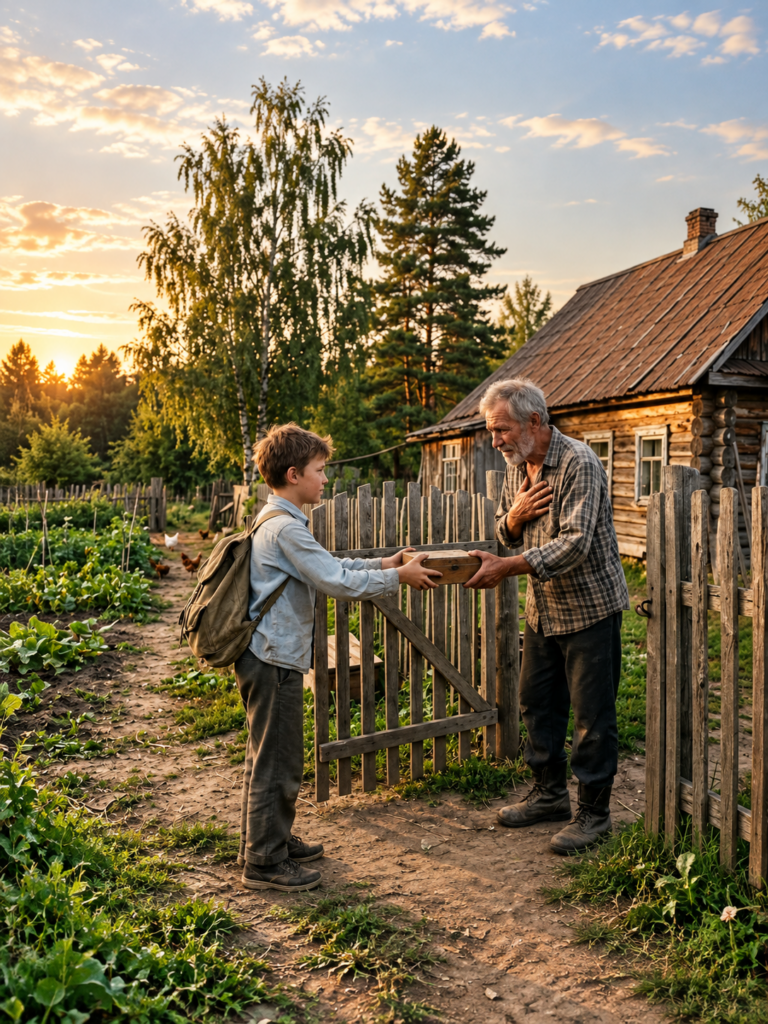
a 13-year-old orphan worked himself to exhaustion to repay his dead father’s debt—when he finally faced the old farmer, the man’s unexpected decision brought him to tears
a 13-year-old orphan worked himself to exhaustion to repay his dead father’s debt—when he finally faced the old farmer, the...