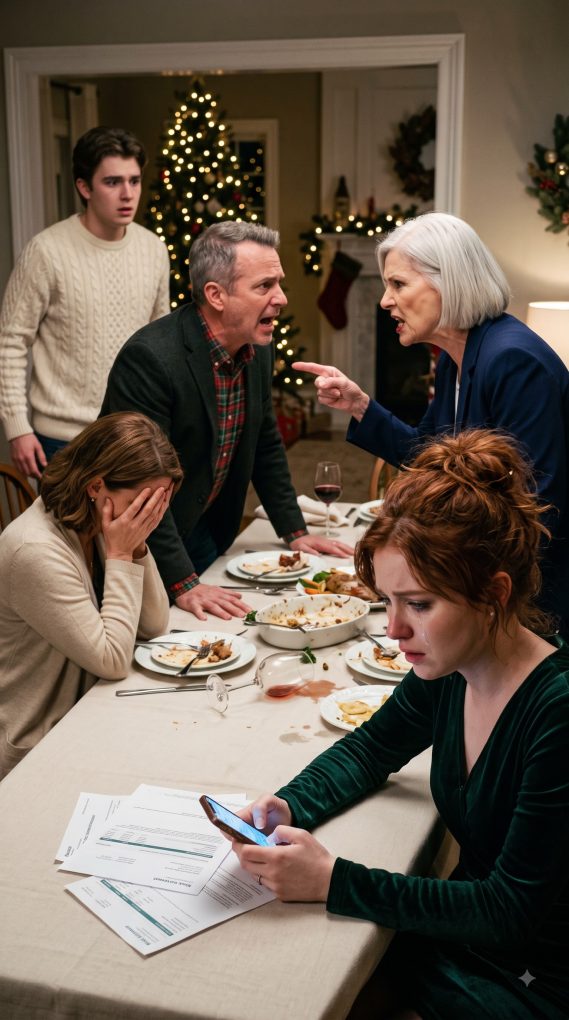
“Give your brother $50,000 or you’re dead to this family,” my mother declared at Thanksgiving dinner.
“Give your brother $50,000 or you’re dead to this family,” my mother declared at Thanksgiving dinner.
I folded my linen napkin, picked up my coat, and walked out without arguing.
Three years later, she stormed into my 32nd-floor corporate boardroom demanding money again, with my brother standing behind her.
She had no idea why I already had a legal document bearing the address of her Providence home…
My mother waited until Thanksgiving dinner to tell me exactly how much my place in the family was worth.
Fifty thousand dollars.
That was the amount she wanted me to transfer to my younger brother, Tristan, for another business venture.
When I refused, she set down her fork and delivered her ultimatum in front of the family.
Either I gave him the money, or I was no longer her daughter.
Tristan didn’t look surprised.
He sat there watching me, apparently confident that I would eventually reach for my phone and make the transfer.
Instead, I folded the linen napkin on my lap, placed it beside my plate, and stood up.
“Then I accept your decision.”
I collected my coat and walked out into the November cold.
For three years, I didn’t speak to either of them.
What my mother couldn’t have imagined that evening was that our next conversation would take place in a Boston corporate boardroom, with her house at the center of a financial proceeding she knew almost nothing about.
My name is Natalie Ward, and I grew up in Providence, Rhode Island.
My mother, Lorraine, owned an upscale floral boutique that catered to wealthy clients.
She understood expensive arrangements, elegant storefronts, and the importance of appearing successful.
Unfortunately, she cared more about looking financially secure than actually being financially secure.
Our family had operated that way for years.
When my father died, he left behind a life insurance payout that should have provided stability during an already difficult period.
Instead, my mother poured the entire payout into Tristan’s business ideas.
Tristan had dropped out of two colleges.
He was always excited about his next opportunity, usually because he believed it would make him wealthy without requiring the years of preparation other people considered necessary.
When one venture failed, he blamed the market, an unreliable partner, or somebody who hadn’t believed in him enough.
My mother believed every explanation.
She would tell anyone who listened that Tristan was a natural entrepreneur who simply hadn’t found the right opportunity.
Meanwhile, I worked long nights to earn my degree in corporate finance, graduating with honors.
I didn’t have the luxury of repeatedly starting over using somebody else’s money.
By the time I was thirty, I was managing distressed corporate debt and major urban redevelopment portfolios for a respected investment firm in downtown Boston.
I understood financial risk because evaluating it was part of my job.
But at home, my qualifications only seemed to make me more useful as a source of money.
My mother could spend an entire visit asking about my salary without asking whether I was happy.
Tristan would describe an investment opportunity, then casually suggest an amount I could contribute.
Neither of them seemed particularly interested in what I wanted to do with the money I earned.
.
Thanksgiving was supposed to be an ordinary family dinner.
Instead, Tristan announced that he needed funding for a cryptocurrency venture.
He had no credible financial model, no properly developed business plan, and no convincing explanation of how the investment would produce a return.
He simply wanted $50,000 immediately.
I asked questions I would have asked anyone seeking investment capital.
Tristan became irritated.
Mom told me I was making him feel incompetent.
I explained that I wasn’t going to invest my savings in something I couldn’t responsibly evaluate.
That was when Lorraine slammed her hands against the table.
She accused me of abandoning my brother when he needed support.
I reminded her how much of Dad’s insurance money had already disappeared into his failed businesses.
She didn’t dispute it.
She treated it as proof that Tristan deserved another chance.
Then she told me I could either transfer the money or consider myself permanently removed from the family.
I left.
.
The first Thanksgiving away from them was painful, but it was also the beginning of a quieter life.
I stopped expecting phone calls about new financial emergencies.
I stopped defending the fact that my savings belonged to me.
At work, I continued building the career I had spent years preparing for.
Eventually, I became a senior managing partner at Apex Horizon Capital, where our firm acquired nonperforming debt portfolios and restructured troubled financial institutions.
It was demanding work.
I spent long days examining liabilities, loan agreements, and businesses that had borrowed more than they could repay.
I was good at it.
And for the first time, my family wasn’t waiting at the end of every successful quarter with a new request.
Then, three years after that Thanksgiving dinner, my mother found me.
She had hired private investigators to locate me.
On a stormy Tuesday morning, I was conducting a quarterly review with our directors on the thirty-second floor of our Boston office.
We were seated around the mahogany conference table when the doors opened unexpectedly.
My mother entered, followed by Tristan.
She was dressed for an important occasion, but her expression suggested she had come for an argument.
“Natalie, this has gone on long enough.”
I remained seated.
Tristan stood behind her, looking around the boardroom with the same confidence he had displayed at Thanksgiving.
My mother announced that my three-year tantrum was over.
Then she demanded that I help save her house and provide money for Tristan’s latest business.
Tristan added that I owed them three years of financial support because I had ignored their calls.
Several directors looked toward me.
I signaled the approaching security officers to wait.
“Mother,” I said, “you told me I was no longer part of this family.”
She dismissed that as something said during an argument.
Then she threatened to damage my reputation if I refused to cooperate.
I glanced at the portfolio beside my chair.
Inside was a certified legal document I had already reviewed.
It concerned the same Providence property my mother was demanding that I save.
And unlike Lorraine, everyone involved in preparing that document understood exactly who held the debt against her house.
CHAPTER 2
My mother leaned over the conference table as though she were still standing in her own dining room.
“You’ve become very successful, Natalie.
The least you can do is help the people who raised you.”
I looked at Tristan.
He had crossed his arms and was studying the people around the table, apparently satisfied that our unexpected audience would make me more cooperative.
“Three years,” he said. “Three years you haven’t helped us with anything.”
I asked him one question.
“Do you have a business plan for this new venture?”
His expression hardened.
“Seriously?
You’re going to start that again?”
It was almost the same conversation we’d had at Thanksgiving.
Different building.
Different circumstances.
The same expectation.
My mother interrupted before he could answer.
“We didn’t come here to be interrogated.
We came because we’re about to lose our home.”
That was the first time she had spoken as though the situation might actually frighten her.
For a moment, I saw something beneath the expensive clothes and familiar indignation.
Lorraine was desperate.
But even desperation hadn’t persuaded her to begin with an apology or an honest explanation.
She had come demanding money.
I opened my portfolio.
“Which home are you referring to?”
She gave me the address of the house in Providence where I had grown up.
I withdrew a document bearing a certified blue seal and placed it on the table.
“Is this the property?”
She looked down.
“Yes.
What is that?”
“Read it.”
She pulled the document closer.
At first, her expression suggested ordinary confusion.
Then she reached the heading and stopped moving.
It was a judicial writ of possession and final eviction order.
For her home.
“Where did you get this?” she demanded.
“Our firm holds the relevant debt.”
She stared at me.
“That isn’t possible.”
I explained that Apex Horizon Capital had acquired a troubled regional lender as part of a larger institutional transaction.
Among that lender’s assets was the delinquent secondary mortgage secured against her property.
I hadn’t personally gone looking for her loan.
The acquisition involved a portfolio of distressed accounts.
Her mortgage had been included because it was one of the obligations the lender held.
During the acquisition audit, our investigators had examined the underlying loan files.
And they had discovered serious discrepancies.
My mother had substantially inflated the reported revenue of her floral boutique when applying for credit.
The figures she provided to obtain financing didn’t match the financial information uncovered during the review.
The inflated revenue had helped her qualify for borrowing she couldn’t afford.
The resulting debt had become severely delinquent.
I watched her eyes move across the document.
She had always believed that having a successful-looking business was nearly the same as having a financially sound one.
But lenders weren’t interested in the flowers displayed in her shop window or the wealthy customers whose events she supplied.
They were interested in actual revenue, expenses, liabilities, and repayment.
Those were numbers she could no longer avoid.
Tristan moved beside her.
“Mom, what does it say?”
She didn’t answer.
I explained that the property had reached the final stage of the legal process and that law enforcement was scheduled to clear it by the following afternoon.
Tristan looked directly at me.
“Tomorrow?”
“Yes.”
CHAPTER 3
He stepped away from the table.
For the first time since entering the room, he seemed genuinely concerned about something other than whether I would give him money.
My mother sank into an empty chair.
“No,” she whispered. “Natalie, you can’t do this.”
I looked at the document.
“The proceedings weren’t initiated because you’re my mother.
This is a delinquent loan that passed through the acquisition and legal process.”
She shook her head.
“But you could stop it.”
There it was again.
The assumption that because I had achieved something, everything I controlled should become available whenever the family needed rescuing.
I thought about the years after Dad died.
I remembered how carefully Lorraine maintained the boutique’s appearance while spending the insurance money meant to protect our family.
I remembered Tristan announcing one opportunity after another, always requiring another contribution before the previous failure had been properly understood.
I had once wanted my mother to recognize that I was working just as hard as my brother, although in a very different way.
Eventually, I stopped asking.
Now she was sitting in my office, asking me to use the career she had treated as a family resource to rescue them from the consequences of their own financial decisions.
“Where are we supposed to go?” she asked.
I didn’t have an answer that would make her circumstances comfortable.
And I wasn’t going to pretend I could erase a finalized legal proceeding simply by making an exception because she was related to me.
“Mother, you told me I was dead to this family when I wouldn’t give Tristan fifty thousand dollars.”
“That was three years ago.”
“I remember.”
“Families say things when they’re upset.”
“Yes,” I answered. “And sometimes those things have consequences.”
She looked down at the papers again.
Her voice softened.
“I’m your mother.”
I had spent enough years hearing that sentence to understand what usually came after it.
A request.
An obligation.
A reason that my own financial security should become less important than somebody else’s latest crisis.
“You are,” I told her. “But that doesn’t give you a claim on my savings or the authority to threaten me at work.”
Tristan suddenly found his voice.
“You could pay this off.
You know you could.”
I turned toward him.
“And what would happen after that?”
He didn’t understand the question.
“The house would be saved.”
“And the next business?
The next loan?”
He frowned.
“You always make everything about money.”
I looked at him for a moment.
He had entered my workplace to demand financial support and now seemed offended that I wanted to discuss finances.
It was the same contradiction that had defined our relationship for years.
My mother began crying.
She asked for mercy.
She talked about having nowhere to go and no money left.
FINAL
I believed that she was frightened.
But I also knew how we had reached that point.
After Tristan’s cryptocurrency venture collapsed, she had continued borrowing.
Her boutique accumulated unpaid merchant accounts, and she turned to increasingly expensive financing to keep the business and household operating.
She had taken out a high-risk secondary mortgage against the home.
Each financial decision postponed the immediate problem while making the eventual consequences worse.
My refusal to contribute $50,000 hadn’t created those debts.
Nor had three years of silence.
They were the result of decisions made while I was entirely absent from their lives.
One of the directors looked toward the papers, then back at me.
The quarterly meeting had been interrupted long enough.
My mother’s personal situation was not a reason to expose our employees or directors to further threats and disruption.
I turned toward security.
“Please escort them out.”
Lorraine stood abruptly.
“Natalie, please.”
I didn’t interrupt the officers.
Tristan protested as they guided him toward the doors.
My mother continued crying and asking whether I would reconsider.
I didn’t follow them into the corridor.
When the doors closed, the conference room remained quiet for several moments.
Then we returned to the agenda.
It felt strange to continue discussing financial projections after watching my mother leave.
But that had been my ordinary work before she arrived.
And it was still my work afterward.
The property proceedings continued.
Her house was ultimately lost and auctioned to satisfy creditors.
Lorraine moved into subsidized housing.
Tristan took warehouse shifts to support himself.
Those were not the futures either of them had imagined while asking me to fund another business idea.
I didn’t celebrate their circumstances.
I understood what losing the house meant to my mother.
It was the place she had worked hard to maintain, at least on the surface, and the home where our family had lived before everything became measured in terms of money and appearances.
There had been good memories there too.
My father had lived in that house.
I couldn’t forget him simply because my mother had handled his insurance money irresponsibly.
But missing parts of my childhood wasn’t a reason to surrender the life I had built.
I had spent years learning to separate financial obligation from emotional pressure.
My professional work required me to distinguish between what someone hoped would happen and what the actual numbers supported.
For a long time, I hadn’t been able to make that same distinction with my own family.
I wanted Lorraine to love me without expecting something in return.
I wanted Tristan to see me as his sister, rather than the person who could finance his next attempt at success.
Their visit to my office finally showed me how little those expectations had changed.
Even after three years apart, they had approached me as though the only unresolved question was how much money I owed them.
I was allowed to be sad about that.
I was also allowed to refuse.
When the next Thanksgiving season came around, I remembered the linen napkin I had folded before leaving my mother’s dining room.
At the time, I had wondered whether accepting her ultimatum would mean losing my family forever.
Three years later, I understood that the separation had already given me something I hadn’t been able to find while living according to their demands.
My earnings belonged to me.
My decisions belonged to me.
And my mother’s disappointment no longer determined whether I had fulfilled my responsibilities as a daughter.
I could care about what happened to Lorraine and Tristan without returning to the role they had assigned me.
That distinction had taken years to learn.
But after everything, I no longer needed another Thanksgiving argument to remind myself of it.
THE END.
I’ve shared the complete story, and I truly hope it touched your heart.
If this story moved you, please , like, and share the post.
Thank you for reading! ❤️
Recommended Stories

My family finished dinner before I came to my parents’ 32nd anniversary. Mom gave me a $2,000 bill. Sister laughed, “You’re our ATM!” I tore it up and left. Later, the bank called…
My family finished dinner before I came to my parents’ 32nd anniversary. Mom gave me a $2,000 bill. Sister laughed,...

love-At my former fiancé’s wedding, his bride took a dinner plate from my hand and said, “Employees eat downstairs. Not in the ballroom.” He stood near the bar and barely recognized me. I could have told her I owned the coastal hotel where they were celebrating, but I walked into the service corridor instead. Seven minutes later, the kitchen stopped serving dinner, the bar closed, and their expensive reception began falling apart…
At my former fiancé’s wedding, his bride took a dinner plate from my hand and said, “Employees eat downstairs. Not...
When I thanked my grandma for $500, she revealed she actually sent $200,000. That single realization instantly tore my family apart.
At our Christmas party, I raised my glass to Grandma. “Thank you for the $500 you gave me.” Her smile...