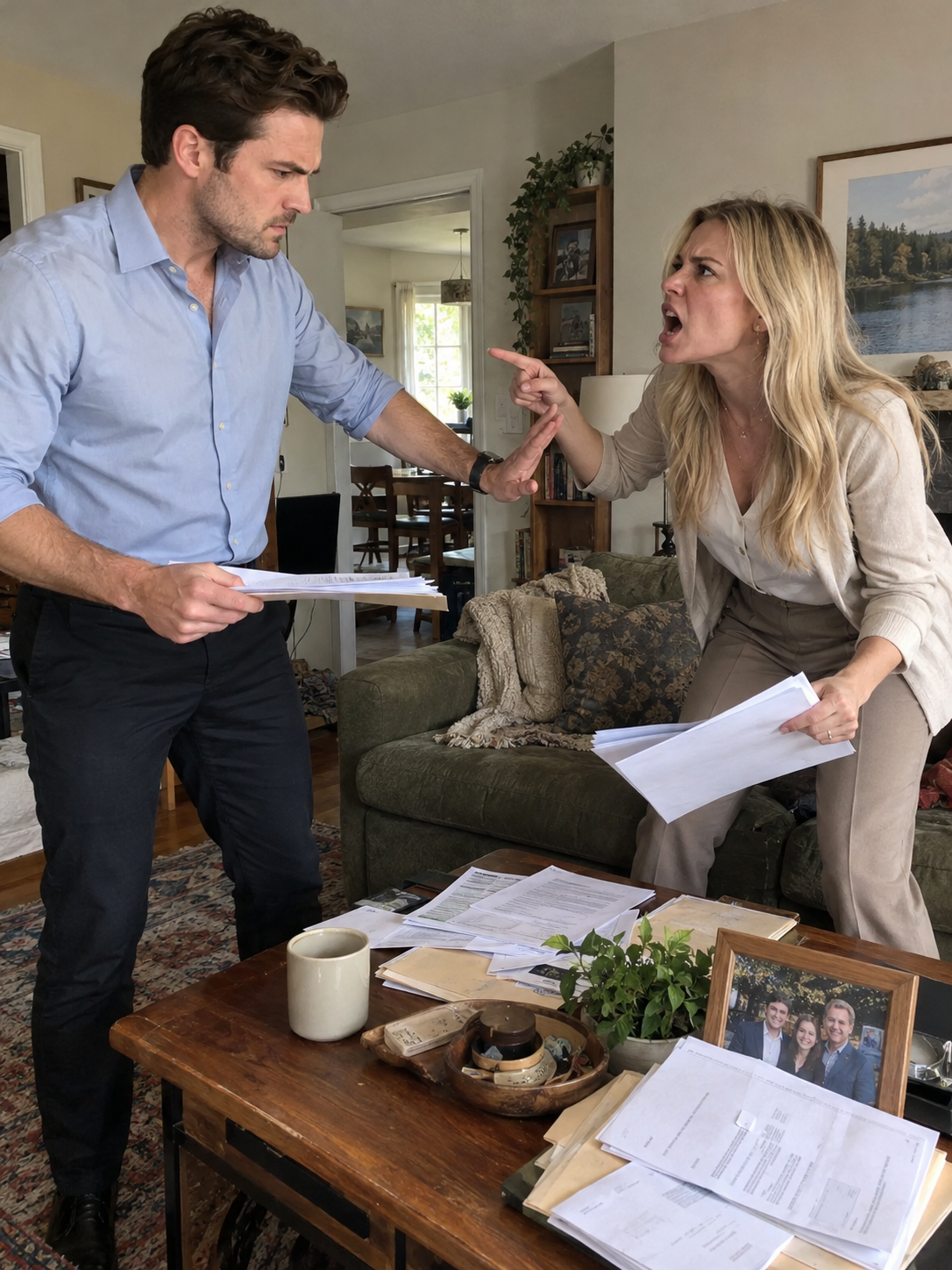
My husband admitted his assistant was pregnant and he wanted a divorce.
My husband admitted his assistant was pregnant and he wanted a divorce.
He sounded relieved.
I stood there thinking about the career he called volunteer work, the school bills my income helped pay, and all the years he’d never asked a second question.
He thought I needed him to survive what he’d just told me…
The hotel receipt came out of Gavin’s coat folded into a small, neat square.
I opened it expecting something I could put with the household paperwork, then stood beside the coat holding a bill for one room and two guests at a boutique hotel in River North.
I read it twice.
There are perfectly innocent reasons for an expense to look odd, and I had spent enough years examining documents to know that an odd detail was a reason to ask a question, not announce a verdict.
Still, I didn’t put it down.
Gavin hadn’t mentioned the hotel.
I tried to remember what he had said about that particular trip, sorting through the familiar assortment of meetings, dinners, and late arrivals.
His schedule had occupied so much space in our marriage that the individual explanations blurred together.
I could remember which shirts he wanted packed more easily than I could remember where he’d worn them.
I left the receipt where I could find it and went back to the evening.
Our nine-year-old son, Eli, still needed his mother to be his mother, and a suspicious piece of paper didn’t exempt me from ordinary life.
That was helpful at first.
There were things to finish, small questions to answer, bedtime to get through.
I could do those things while a separate part of my mind kept returning to the words “two guests.”
After Eli was asleep, I opened my laptop at the kitchen table.
The dishwasher was running beside me, making the same uneven washing sounds that had accompanied a surprising amount of my professional life.
On the screen was work for Regent Regulatory Partners.
Beside the laptop was the receipt.
I moved it away from my notes, then moved it back.
Apparently I needed it within reach, although touching it wasn’t improving the information.
Gavin believed I did occasional healthcare writing, mostly as a volunteer.
He’d been content with that explanation for years.
In reality, I was Regent’s lead regulatory strategist.
I reviewed submissions, examined compliance structures, and helped clients understand regulatory risk in acquisitions worth hundreds of millions of dollars.
At work, people waited for me to finish explaining.
At home, I sometimes finished a sentence after realizing my husband had already returned to his phone.
That difference hadn’t appeared all at once.
Before we married, I’d been a regulatory affairs specialist with a senior position becoming a real possibility.
My supervisor, Gordon Blackwell, had told me I was being considered.
I remember feeling pleased in a private, practical way.
I wanted the responsibility.
I liked finding the point in a complicated problem where careful preparation could prevent an expensive mistake later.
Then Gavin arrived with his confidence and his attention.
He could make a decision sound so settled that you mistook being included in it for being understood.
He was charming, decisive, and apparently certain about me.
When he proposed, I felt chosen in a way I hadn’t known I wanted.
I was capable at work and less sophisticated about love than I would have cared to admit.
Eight months after we met, he told me I could stop working. “You’ve been carrying so much,” he said. “I make enough.
Let me take care of you.” I didn’t hear a request to become smaller.
I heard relief being offered by somebody who loved me.
I gave notice in March, and we married in June.
At the time, the sequence felt romantic rather than hurried.
At the rehearsal dinner, his mother, Colette, pulled me aside and patted my hand. “I expect my son to be properly taken care of.” She said it sweetly, which made answering difficult.
A blunt demand would have given me something definite to object to.
This sounded like advice from a woman welcoming me into the family, and I smiled because I didn’t yet understand what she thought I’d agreed to.
Motherhood was the part I never regretted.
Eli arrived, and the world acquired a small person whose expressions interested me more than anything I’d previously considered important.
I could study his face for an unreasonable length of time.
Unfortunately, loving my baby didn’t make every other part of staying home satisfying.
I missed using my mind in the particular way my work required, and I felt guilty for missing it.
Gavin’s idea of our arrangement became clear through repetition.
He traveled, worked late, and came home expecting dinner and quiet.
I handled what needed handling.
If I tried to discuss something that mattered to me, his attention lasted until he established that it didn’t need action from him.
Disagreement didn’t produce a spectacular scene.
His eyes would tighten, his answers would shorten, and I would begin looking for a way to restore the evening.
I became very skilled at that.
I learned his mother’s recipes because mine were apparently too bland.
I ironed shirts before the rest of the house woke.
I remembered schedules and preferences and which subjects weren’t worth introducing after a difficult day.
There were no prizes for this expertise, although Colette occasionally praised Gavin for being such a stable provider while I stood in the kitchen holding something that needed washing.
When Eli was eight months old, Gordon called.
He had started Regent Regulatory Partners and wanted to know whether I’d consider flexible, remote work.
Part-time, on hours I could manage.
He knew I had a baby.
He also knew I still had expertise.
Hearing him ask what I wanted to do was so unfamiliar that I didn’t answer immediately.
“No one has to know,” he said.
I thought about the offer for three days.
Not because I lacked interest; I was interested almost painfully.
I was trying to imagine fitting it into a household where my availability had become part of everyone else’s planning.
Eventually, the thought of saying no felt worse than the complications of saying yes.
I worked during naps and after bedtime, sometimes with the dishwasher going, sometimes in the early quiet before anybody needed me.
I formed a small LLC under my maiden name, Ivy Caldwell, and billed through it.
The income went into a separate business account.
There was relief in seeing that name on work I understood and money I had earned.
I didn’t feel as if I were inventing a new person.
I recognized someone I’d been neglecting.
Gavin noticed the laptop.
Once, he asked what I was doing, and I told him I occasionally wrote for a healthcare nonprofit.
He asked whether they paid me. “Mostly volunteer,” I said.
He nodded and went back to his phone.
I had offered an incomplete and misleading explanation.
He had accepted it with an ease that hurt more than suspicion would have.
I knew that wasn’t an honest way to conduct a marriage.
Even sitting there with the hotel receipt, I couldn’t pretend I’d been perfectly open.
But I could remember the fear underneath that answer: that something I valued would become another matter to negotiate, defend, or give up.
I had protected it in a way that let the rest of my life continue looking unchanged.
The work grew.
I moved from part-time analysis to strategy, then to leading work I once would have assumed required a more visible office.
I handled careful reviews while Eli slept down the hall.
I learned to finish a memo, close the laptop, and begin preparing dinner without any sign that the two activities belonged to the same competent adult.
I wasn’t proud of how good I became at that transition.
Eventually, I earned more than Gavin.
Later, considerably more.
Some stayed in business and personal accounts; some went quietly into the joint account and helped pay for the life he believed his salary supported.
Eli’s private school.
The kitchen renovation Colette considered essential.
Trips and unexpected expenses.
I made transfers that looked ordinary, and Gavin didn’t ask enough questions to notice the pattern.
That hurt in ways I rarely examined.
I didn’t need him to be impressed by every assignment.
I wanted the kind of curiosity that makes someone look up and ask what you’ve been thinking about all evening.
Instead, I became useful in ways he understood and successful in ways he didn’t know existed.
Both parts of the arrangement required me to keep quiet, and I did.
Recently, Colette had touched my wrist during a visit and told me Gavin deserved someone who brought energy into a marriage. “You’ve always been so quiet, sweetheart.” I had looked at her hand and wondered what response she expected.
Agreement?
An apology?
I gave her neither, but I also didn’t ask her to explain herself.
Later, I regretted that silence.
At the time, I wanted her visit to end without a scene.
Now I wondered whether she’d known something I didn’t.
I couldn’t establish that from a hotel receipt, and I made myself stop.
It was easy to reinterpret every unpleasant remark once you had a reason to be afraid.
I dealt with evidence professionally.
I knew better than to turn a possibility into certainty because it fitted an unhappy story.
The laptop screen dimmed while I sat there.
I touched the trackpad, reread the paragraph in front of me, and realized I’d absorbed none of it.
That was unusual enough to irritate me.
A client’s work deserved more attention than I was giving it.
I saved my notes and closed the file rather than produce something careless simply to prove I could continue normally.
In the quiet afterward, I tried to decide what I wanted Gavin to say.
That he’d shared a room with a colleague because of some ridiculous booking problem?
That the receipt belonged to someone else?
Every possible explanation sounded rehearsed before I’d even asked him.
What I wanted, underneath those unlikely possibilities, was for him to care that I was standing there needing the truth.
I decided to ask in the morning.
There was no benefit in inventing his answer overnight.
I put the receipt away, checked on Eli, and stood for a moment watching him sleep.
One arm had escaped the blanket.
I tucked it back without waking him and felt an ordinary tenderness so strong that it briefly displaced everything else.
Whatever the receipt meant, I still had this child, this room, this small job to do.
The next morning, I brought the paper to Gavin.
I didn’t begin with a speech about our marriage.
I asked about the hotel and the second guest.
It was a straightforward question, and I expected at least some hesitation.
Instead, his expression changed in a way I couldn’t immediately place.
He didn’t look caught so much as tired of keeping something inconvenient arranged.
He admitted the relationship with Jade, his assistant.
She was twenty-six.
He told me she was pregnant.
Then he said he intended to pursue a divorce.
The information came with so little resistance that I had to ask enough to make certain I hadn’t misunderstood.
I hadn’t.
He’d been thinking about a future I wasn’t in, and now he was telling me where he’d decided I belonged.
I stood with the receipt between us.
He sounded relieved.
That was what I noticed most—not anger, not apology, but relief that I finally knew.
I thought about the laptop, the transfer records, the work waiting under my own name.
He had told me our marriage was ending as though he were also telling me my means of living were about to disappear.
I hadn’t yet said a word about either.
Continue below
.
Chapter 2/6
That afternoon, I called Gordon.
I told him about the affair, the pregnancy, and Gavin’s intention to divorce.
He listened without supplying a cheerful interpretation.
Then he said he’d been approached about opening a permanent Vancouver office.
He had intended to ask whether I would relocate as its lead strategist.
Full-time, with a senior role and relocation support.
I sat still while he explained, then said yes.
The next four months were practical.
I moved living expenses into my personal account, arranged independent credit cards, gathered documents, and planned for Eli’s schooling and our travel.
Our passports and birth certificates went into my laptop bag.
I kept doing the work Gavin didn’t understand while preparing to stop organizing my life around him.
None of it felt glamorous.
Most of it involved checking something twice.
By the day he pushed the divorce papers across the island, two suitcases were already in my car.
Jade stood in the living room with one hand on her stomach, looking around.
Gavin glanced at his phone. “Just sign it already.
I have dinner reservations at seven.” I asked whether he was completely sure.
He said yes with no hesitation, and I picked up the pen.
I signed, then told him I would collect Eli from school. “That’s fine,” he said, pulling the papers back.
He sounded finished.
I walked out with my bag, aware of the documents inside it and the flight scheduled for that evening.
The divorce itself still had a legal process ahead.
Leaving the kitchen required only that I keep walking.
Eli noticed the luggage as soon as he got into the car.
I told him we were going to the airport, then that we were going to Vancouver.
He asked whether Dad was coming.
I said no.
After a pause, he answered, “Okay.” I had prepared for questions I didn’t know how to answer, but that small acceptance nearly undid me.
At the airport, we ran into Gavin’s sister, Trisha.
She looked at the bags and asked whether her brother knew.
I said we’d signed divorce papers that morning.
When she warned that he would want to know where Eli was, I told her he had my number.
We went through security, and the calls began: Gavin, Colette, Gavin again.
I kept my attention on Eli and the instructions ahead of us.
At the gate, I answered Bernard, my father-in-law.
He wanted us to come back.
Gavin would pay for temporary housing while I looked for work.
I told him I already had work, had had it for years.
He went silent.
I ended the call before I began explaining a career he’d never asked about when we were sitting in the same room.
Eli had heard more than I wanted him to.
He said Dad had always been in a bad mood at home anyway.
I pulled him close, wishing I could know how much he’d carried without telling me.
Then he asked whether we could get a dog in Vancouver.
I laughed, unexpectedly and properly, and said we would discuss it.
He appeared willing to accept further negotiations.
We landed that night and went to a small hotel in Kitsilano.
I paid with my own card.
Only then did I read Gavin’s message saying he’d removed my access to the joint accounts and canceled the cards.
I wasn’t to expect him to fund whatever I’d planned.
Colette had left a message about my lack of skills and prospects.
.
I opened my banking app.
Personal account, business account, retirement savings—all intact.
I checked them slowly, not because I doubted the balances, but because my body hadn’t yet caught up with what I knew.
Across the room, Eli was settling into an unfamiliar bed.
I put down the phone and helped him.
We had somewhere to sleep.
Tomorrow, there were things I knew how to do.
Chapter 3/6
During those first weeks, I learned routes: the school, the office, the way back to where we were staying.
Rain made the city feel unfamiliar twice, first through the windshield and then again when it cleared.
Eli needed routine, and so did I.
I made one where I could, with ordinary meals and school mornings and answers that didn’t promise more certainty than I had.
There were nights I missed the old house.
That embarrassed me until I understood I wasn’t necessarily missing Gavin.
I missed knowing which cupboard held everything and how a room looked after dark.
I could believe leaving was right and still feel worn out by finding my way through another day.
After Eli slept, I sometimes sat at a table without opening my laptop, too tired even for familiar work.
At Regent, things were less uncertain.
People knew what I could do because I’d been doing it for years.
Being physically present changed the experience, though.
I could finish a conversation without listening for someone calling from another room.
I could leave notes where they were and return to them.
These were small conveniences that felt extravagant to me.
Three months after we moved, Regent sponsored the Pacific Biotech and Device Summit.
We were announcing our regulatory work on a $420 million acquisition, and Gordon wanted me to speak.
I prepared as I would for any serious audience: checked the material, stripped out what wasn’t useful, and practiced until the opening no longer sounded practiced.
My wedding ring was gone.
My name on the program was Ivy Caldwell.
Backstage, Gordon told me Gavin was there.
His company sold diagnostic equipment in the same industry.
Jade was with him.
Gordon asked whether I needed a minute.
I said no, then checked the pages in my hand despite knowing they were in order.
I wasn’t going to turn an assignment I’d earned into a response to my former husband.
The MC introduced the regulatory strategist behind the acquisition work.
I walked onto the stage in a charcoal blazer and adjusted the microphone.
During my second look across the room, I found Gavin.
He froze.
Jade sat beside him, visibly pregnant.
I registered his expression, gave a professional smile, and returned to the people who had come to hear the presentation.
I spoke about compliance architecture, regulatory exposure, and acquisition risk.
There were points that required careful explanation and others best left plain.
I knew the work.
Once I began, that steadied me more effectively than any private speech about confidence could have done.
I didn’t look at his table again.
When I finished, Gordon told me it had gone well, and I went into conversations with clients.
Nearly an hour passed before Gavin stopped me outside the ballroom.
He said I’d never told him I worked for Regent.
I confirmed that I’d worked during our marriage.
He accused me of lying, and I didn’t pretend I’d been candid.
I said I’d described healthcare writing and he’d never wanted to hear much beyond that.
“How much were you making?” he asked.
I looked at him for a moment before saying, “Enough.” Jade shifted behind him.
He asked whether Vancouver and the stage had been some kind of plan.
I told him I lived here and worked here.
Gordon called from farther down the corridor; a client was waiting.
As I turned away, Gavin asked what else he didn’t know. “A lot,” I said.
Soon afterward, our compliance group flagged a vendor file from the acquisition audit.
Gavin’s name appeared repeatedly.
I stopped before reviewing it and disclosed that he was my former husband.
The compliance director took the file, told me I was off it, and I handed it over.
Whatever was in those invoices, examining it was somebody else’s job.
Chapter 4/6
I kept that separation.
I didn’t search Gavin’s records or contact his employer.
Regent’s legal team and the acquiring company’s attorneys handled the discrepancies.
Any information I later received came through attorneys.
I had spent too long earning professional trust to confuse a painful personal history with permission to investigate someone.
The audit compared invoices against shipping records.
Equipment had been billed to clinical accounts without corresponding delivery documentation.
Over roughly two and a half fiscal years, the discrepancies exceeded $180,000.
The matter remained civil and employment-related, but the consequences were serious.
Gavin lost his job.
His company pursued repayment, clawed back bonuses, and sought damages.
Bernard emailed that he hoped I was satisfied.
I read it twice, recognizing the familiar invitation to accept responsibility for something Gavin had done.
I wasn’t satisfied.
I was concerned about what the consequences would mean for Eli, and I was angry that Bernard had decided my knowledge of the work made me the author of the problem.
I didn’t answer.
The divorce moved through its own process.
My attorney addressed the difference between Gavin’s documented income and our household expenses.
I had years of transfer records showing my contributions.
During mediation, someone remarked that I’d kept very organized files.
I said I’d needed to.
It was a plain answer to a question that contained a large portion of my marriage.
Those records helped establish the financial reality and informed the final division of assets.
They didn’t transform secrecy into an ideal arrangement, and I didn’t ask them to.
They showed where the money had come from and what it had supported.
I was relieved to discuss actual amounts with people who wanted accurate answers instead of a reassuring family story.
Support followed the ordinary guidelines.
When Gavin eventually found another job, seven months after losing the first one, payments were enforced through his wages.
By then, I had learned to separate financial administration from emotional weather.
An email about a payment needed an answer about a payment.
It didn’t require another argument about whether I had appreciated him.
Jade had her baby during that period, a healthy little girl.
Trisha told me subsequent testing had established Gavin wasn’t the father.
There had been someone else before Jade chose him as the more secure possibility.
I received the information without knowing what to do with it.
A child had arrived into enough adult confusion already.
I didn’t want to add my pleasure to it.
Colette had also co-signed a personal loan Gavin took while spending beyond his means.
When he defaulted, the obligation reached his parents.
Bernard’s retirement savings suffered, and their Naperville house went on the market.
I heard pieces, not the full private accounting.
Sometimes I remembered Colette praising her son’s stability in my kitchen.
Then I made myself return to what was happening in my own home.
By then, Eli had his dog: a rescue beagle mix with mismatched ears, whom he named Tuesday.
She chewed shoes and barked at deliveries with an authority she had not earned.
Eli began asking nightly whether she could sleep at the foot of his bed.
I said yes nightly, apparently participating in a legal process whose rules only he understood.
Our apartment overlooked part of the harbor.
On the drive to school, Eli explained that Tuesday hadn’t destroyed a sneaker because most of it remained.
I told him I admired his attention to quantity but questioned his definition of a usable shoe.
He considered that seriously.
Some mornings I laughed before we’d even reached school, and afterward I would notice it with surprise.
There were still difficult things to manage, but they no longer occupied every room.
Chapter 5/6
Seven months after the summit, Gordon promoted me to managing director.
When the office had emptied, I stood outside my door looking at the name on it.
Ivy Caldwell.
The title was gratifying, but it was the space that held me there: a room where my work could remain visible, a desk nobody expected cleared so somebody else could eat.
I considered whom to call.
Then I realized I wanted to tell Eli.
On the drive home, I explained that I’d been promoted.
He asked what managing director meant, and I said I was one of the people running the office.
He pronounced that cool, then asked whether Tuesday could still sleep in his room after that morning’s misconduct.
“She ate your sneaker,” I reminded him.
He said she’d been exploring.
We agreed she could sleep in his room provided no shoes were made available for further research.
I had imagined telling him my news with more ceremony.
Instead, we negotiated dog privileges while driving beside the water, and I found I preferred it.
Trisha texted occasionally.
Her messages were usually factual rather than apologetic: Gavin’s work, her parents’ situation, the things she thought I should know.
Once she said they’d all assumed I needed him more than he needed me.
I stared at that message before answering, “So did I.” It was uncomfortable to admit how thoroughly I’d accepted a story the bank statements had contradicted for years.
I’d participated in making my life smaller.
That didn’t excuse Gavin’s affair or his family’s contempt.
It did mean there were habits I could change without waiting for anyone’s agreement.
I had been so accustomed to avoiding an argument that I sometimes explained a reasonable preference as though requesting an exception.
At work, I caught myself doing it and began again more plainly.
I took credit when the work was mine.
Sometimes I spoke first in a meeting instead of waiting until everyone else had finished.
That wasn’t a wholesale change in temperament.
I still liked to think before talking, and I wasn’t going to become loud to prove I existed.
I was learning to distinguish being quiet from making sure nobody had to notice me.
I mentored younger analysts, particularly women returning after caregiving breaks.
When they apologized for time away, I told them their expertise hadn’t evaporated.
We talked about what needed updating and what they already knew.
I liked those practical conversations.
Confidence was easier to recover when it had a task attached, something a person could complete and recognize as her own.
At home, I discovered preferences I’d stopped considering.
I liked stronger coffee and music in the kitchen.
I liked having the window slightly open at night.
Some evenings dinner was late because I had work to finish, and Eli accepted this without interpreting it as a failure of love.
He could be noisy.
I could be tired.
Neither condition needed a family explanation.
The apartment was smaller and less polished than the house we’d left.
It could also accommodate an imperfect day without everyone becoming careful.
Tuesday could bark, Eli could forget something, and I could admit I didn’t feel like cooking.
We dealt with the particular problem in front of us.
I began to understand how much energy I’d spent preventing the old household from noticing ordinary life.
Parenting arrangements with Gavin became more practical.
There were calls, visits, schedules, and school updates.
I kept the communication clear and didn’t ask Eli to carry messages.
His father’s failures as my husband didn’t give me ownership of their relationship.
That boundary required attention, especially when I was angry.
I wanted Eli to be free to love his dad without checking whether it hurt me.
By the time we approached a year in Vancouver, I was less surprised by a good day.
I still noticed them, but I no longer waited for someone to explain why I hadn’t earned one.
I came home, put down my bag, and let myself belong in the life that was actually there.
Final chapter 6/6
One afternoon, I was reviewing a submission when Eli came home and dropped his backpack in its usual place.
Tuesday rushed to greet him, nails clicking across the floor.
He scratched behind her ears, then appeared in my doorway.
I looked up expecting a question about homework or the dog.
Instead, he asked, “Mom, are you happy?”
My coffee had gone cold beside a stack of reports.
Beyond the window, rain had turned the harbor gray.
I looked at him and realized I didn’t need to examine the answer before giving it. “Yeah,” I said. “I really am.” He thought about that, nodded, and said, “Good.” Then, after a small pause, “Me too.”
He went down the hallway after Tuesday.
I stayed at the desk with my hand resting beside the report.
I had worried about so much on his behalf: the move, his school, his father, the unfamiliar rooms.
I’d tried not to demand reassurance from him.
Now he’d offered two ordinary words and gone back to being nine, leaving me with more than I knew how to hold.
He’d noticed the old house’s tension.
I’d known that since the airport, but hearing he was happy here made it harder to preserve my old idea that keeping everything smooth had protected him.
He hadn’t needed perfectly timed dinners as much as he’d needed a home where people could have feelings without rearranging the whole evening around them.
Later, during a practical call, Gavin asked whether I’d ever loved him.
I almost defended myself automatically.
Then I said yes.
He was quiet before asking what had happened.
I told him I’d stopped confusing being needed with being loved.
He asked what that meant about him.
I answered as carefully as I could: I thought he’d confused being served with being loved.
He didn’t argue.
We finished the call without resolving our history, which was appropriate.
I didn’t need him to agree with every part of my understanding before I could live by it.
Once, I would have replayed the conversation, editing my tone and wondering whether I’d been unfair.
That evening, I put the phone down and returned to Eli.
I thought occasionally about Gavin’s face at the summit.
It had been a startling moment, but I didn’t want it to become the most important one.
The work existed before he saw it.
So did the account balances, the judgment my clients trusted, and the mother who had stayed up finishing assignments after bedtime.
Public recognition hadn’t created any of those things.
Gordon had offered opportunities, and I had worked for them.
There were thousands of hours behind what looked like a sudden appearance on a stage.
Remembering that made me kinder toward the woman I’d been.
She had made compromises I wouldn’t make now, but she had also kept something alive until I was ready to use it differently.
After I finished the submission that afternoon, I went into the kitchen and took one sip of my abandoned coffee.
It was cold enough to deserve an honest decision.
I poured it away and made a fresh cup.
From Eli’s room came a thump, then his voice assuring Tuesday that she was innocent of whatever had happened.
I called down the hallway to ask whether anything required a towel.
Eli considered the question before saying no.
I waited another moment, heard him laughing, and leaned against the counter with my warm cup.
Outside, the rain kept moving across the harbor.
For now, nobody needed me to do anything.
I stood there and drank my coffee while it was hot.
THE END.
I’ve shared the complete story, and I truly hope it touched your heart.
If this story moved you, please , like, and share the post.
Thank you for reading! ❤️
Recommended Stories
GHUB. At 32, I found out from my cousin that my parents had quietly written me out of their will and left everything to my younger sister, including the house I had helped save
FULL STORY CONTINUATION IF FACEBOOK BROUGHT YOU HERE, HERE’S THE CONTINUATION YOU’VE BEEN WAITING FOR. ENJOY! 👇 CHAPTER 2 Blocking...

MY WIFE SAID SHE SPENT THE NIGHT WITH HER BEST FRIEND—THEN I FOUND HER IN A GUEST ROOM, AND A DNA TEST EXPOSED THE SECRET SHE’D HIDDEN FOR SIX YEARS THE GUEST-ROOM DOOR WAS HALF OPEN, AND MY WIFE WASN’T ALONE. BY SUNRISE, WE WERE BOTH IN A HOSPITAL AND OUR MARRIAGE WAS OVER. THEN MY LAWYER ASKED ME TO SWAB MY CHILDREN’S CHEEKS—AND ONE RESULT MADE THE BETRAYAL LOOK SMALL. – Life Story
THE DOOR UPSTAIRS At on a snow-heavy Saturday morning, I pushed open Rebecca Lane’s guest-room door and saw my wife...

At my sister’s wedding, Mom handed me an $86,000 bill and said, “You can afford it.” I smiled, stood up, and asked the groom one question that stopped the entire wedding.
At my sister’s wedding, Mom handed me an $86,000 bill and said, “You can afford it.” I smiled, stood up,...