My husband took over the mail while I was pregnant
My husband took over the mail while I was pregnant, saying he’d made our bills paperless.
I wanted to believe he was helping.
Then I searched our address at work and found a $23,000 judgment he’d never mentioned—beside an old agreement about the house he’d been treating as his for nine years…
By the third Friday without a water bill, I was standing in our kitchen holding a seed catalog addressed to the previous owner and wondering why that woman could still receive mail at my house when I apparently couldn’t.
Daniel was at the counter with his laptop open.
I asked whether anything else had come.
He glanced at the catalog, then back at the screen, and said he’d moved everything to paperless.
“Everything?” I asked.
It sounded fussier aloud than it had in my head.
I was fourteen weeks pregnant, wearing pants with a waistband I had begun to regard as a personal enemy, and I didn’t want to become the woman who complained because her husband had taken a chore off her hands.
Daniel had been saying he wanted to lighten my load.
That was a lovely offer.
I was trying to receive it gracefully.
“The bills, Hannah.
I’ve got it handled.” He said it with the mild patience of somebody explaining a television remote.
I put the catalog on the counter and asked where I could find the statements if I needed them.
He waved toward the laptop.
Online, obviously.
Then his phone lit up, and the conversation seemed to be over, although I was still standing there with the same question.
I work at a title company in Columbus.
For eleven years, I’d spent my days checking who owned what, who owed whom, and whether the person selling a property had neglected to mention an inconvenient spouse.
I was accustomed to asking follow-up questions.
At home, though, I disliked sounding as if I were examining my own husband.
Daniel knew that about me.
He could hear the point where I became embarrassed by my own persistence.
So I let it rest.
I put the catalog in the recycling and went back to whatever I’d been doing before I noticed the mail.
That’s the part I remember most clearly: there was no thunderous warning, no strange woman’s perfume, no unfamiliar car outside.
There was a man in our kitchen doing something that looked helpful, and a small practical question he hadn’t quite answered.
I wanted the question to stay small.
Our mail usually arrived between one and three.
Daniel worked from home on Wednesdays and Fridays, and by March he had become remarkably dependable about collecting it.
Before that, envelopes might sit until one of us came home and remembered.
Now he seemed to notice the delivery immediately.
I told myself pregnancy had made him attentive.
I was grateful, then irritated that gratitude required me to ignore what I was noticing.
This was our first baby.
I wanted to enjoy being excited without turning every ordinary decision into a test of what kind of parents we would be.
Daniel had cried when I told him I was pregnant.
He’d pulled me close, and I’d felt the surprising warmth of his tears against my neck.
Later, he became quieter.
I took that for nerves.
I had plenty of my own, and it seemed unfair to insist his arrive in the same packaging.
When he offered to handle the bills, I remembered those tears.
I remembered the way he’d put his hand on my stomach before there was anything to feel.
There are reasons we believe people we love, and they aren’t always foolish reasons.
Sometimes they’re the best moments we’ve had with them.
I carried those moments into conversations where they didn’t necessarily belong.
The house made me especially careful about money conversations.
I’d bought it at twenty-four, before Daniel, with the money my grandmother Eleanor left me.
Two hundred and twelve thousand dollars, paid outright, for a brick colonial on Marigold Court in Grove City.
Three bedrooms, a maple tree, and enough space that I initially had to walk into a room to remember why I owned it.
I hadn’t grown up expecting to have a house like that by myself.
I framed the closing statement.
My coworkers found this hilarious, and I understood their position.
Other people my age displayed concert posters or photographs of themselves on beaches.
I displayed a document showing funds disbursed.
But I’d stood at that closing table with my grandmother gone and a set of keys in front of me, and I wanted something to mark the fact that her care for me had become a place I could live.
The deed read Hannah M.
Brennan, an unmarried woman.
I liked the plainness of it.
No explanation of how frightened I’d been about maintaining a house, no mention of the fact that I’d called my father before choosing a furnace filter.
Just my name and the fact of ownership.
At work, I could follow somebody’s property through generations.
At home, I occasionally opened a closet and felt pleased that I could put whatever I wanted in it.
Then I met Daniel.
He was twenty-five, worked in medical supply sales, and remembered how I took my coffee after hearing it once.
He could tell a story without making you feel he was waiting for applause, which was a considerable talent in a man who made his living talking.
I liked watching him make a quiet person laugh.
I liked being beside him when a room grew friendlier because he’d entered it.
His mother, Linda, noticed other things.
At our first dinner, she asked about my father’s dealership and remembered how many cars he sold.
I didn’t object.
Dad talked about the dealership himself, often at lengths nobody had requested.
Walter Brennan could make a conversation about the weather arrive at hail damage within three turns.
He wore his navy dealership jacket everywhere and treated reading a contract as a basic household skill.
Eight weeks before the wedding, he asked me to sign a premarital agreement.
I was mortified.
We sat discussing it while I tried not to sound like an offended teenager, which is difficult when your father is looking at you as if you’ve forgotten something obvious.
I told him it felt like preparing for the marriage to fail.
I was in love, and I wanted him to recognize that as a substantial piece of information.
“I carry hail insurance on four hundred cars,” he said. “That doesn’t mean I want it to hail.” He wasn’t smiling, although he knew perfectly well what he sounded like.
I looked away because I could feel myself being persuaded and resented how efficiently he’d managed it.
Dad had a rule: never sign what you haven’t read.
He considered affection a poor reason to suspend it.
When I raised the agreement with Daniel, he shrugged. “Whatever makes your dad comfortable.” His ease embarrassed me further.
I’d prepared for him to feel wounded, and instead he seemed willing to accommodate a nervous father.
That became part of how I remembered it: Daniel being generous, Dad being Dad, and me making an issue of something that didn’t need to become one.
Ruth Albrecht drafted the agreement.
She’d been my father’s attorney for decades, and she had a quiet way of waiting until people finished explaining why the ordinary precautions shouldn’t apply to them.
I knew her through Dad.
I knew she read closely and kept things.
At the time, I was much more interested in getting married than in appreciating those qualities.
I signed the morning before the wedding.
Daniel signed that afternoon.
I read my copy because I’d been raised by Walter Brennan and because refusing to read it would have required more rebellion than I possessed.
Then the wedding happened, and the agreement went into the category of completed things.
I didn’t spend the next nine years remembering its language.
There were anniversaries, workdays, groceries, and all the small arrangements by which two people fill a house.
Our marriage had been ordinary in ways I valued.
Daniel took out the trash.
He cried at friends’ weddings.
We could spend an evening together without entertaining each other every minute, and I liked that ease.
If you’d asked me whether I trusted him, I would have answered before you finished.
It wouldn’t have occurred to me that remembering to put out the bins and telling the truth about money were separate qualifications.
That spring, I kept trying to fit the disappearing envelopes into the marriage I thought I had.
Paperless billing was sensible.
Sharing household work was sensible.
My husband taking something off my list ought to have been sensible.
I was capable of building a reasonable explanation around almost anything, provided I didn’t look too closely at the part where he’d avoided giving me access.
At work, avoidance made me pay attention.
A seller who answered a straightforward question with a long story usually gave me a reason to open another file.
A missing page bothered me more than a messy one.
I wasn’t suspicious of everyone; I simply knew that documents didn’t improve through hopeful interpretation.
I would tell a coworker to check the record before she spent another hour wondering.
With my own life, I kept postponing the obvious step.
For a while, I even felt disloyal considering it.
Searching our address seemed different from looking for a bill.
There was something deliberate about sitting down at a computer and checking what my husband might not have told me.
I could hear how it would sound if I explained it afterward: I didn’t believe you, so I looked.
What I had trouble admitting was that I already didn’t believe him completely.
The search would only make me acknowledge it.
On the Friday I finally did it, I ate lunch at my desk.
It was a slow afternoon, and I’d finished the file in front of me.
There was no customer waiting, no phone conversation I could use to postpone the thought.
My coffee sat beside the keyboard.
I moved my lunch things out of the way and opened the recorder’s index, telling myself I would look, find nothing surprising, and go back to work feeling slightly ridiculous.
Typing my own street address felt oddly formal.
I entered it the way I would for any other property, checked the spelling, and waited for the results.
I knew the house’s history.
I’d examined it before I bought it.
I knew there was no mortgage.
That certainty was part of what had allowed me to be so casual at home.
I had been thinking of the house as the one piece of our life that didn’t require watching.
The first document wasn’t new.
It was a memorandum of our premarital residence agreement, recorded with the Franklin County Recorder shortly after the wedding.
Ruth had put notice of the agreement into the public record.
I stared at the date and felt a faint embarrassment that I’d forgotten.
A title examiner ought to remember what had been recorded against her own home.
Then again, I’d been a bride that week, not an examiner.
I opened it and read more carefully.
There was my name.
There was the property description.
There was the notice that anyone searching the residence could have found all along.
I remembered Ruth’s office, my father’s insistence, Daniel’s shrug.
What had seemed like an awkward family precaution had been sitting quietly in the county records for nine years.
I moved the cursor and kept going.
The other record was from January.
Northgate Recovery Partners had obtained a judgment against Daniel J.
Puit for more than twenty-three thousand dollars.
I checked his name again, although I knew it.
I checked the date.
Then I read the amount a third time, with my hand resting beside the mouse and my coffee cooling close enough to touch.
We had been planning for a baby while my husband had a collection judgment he hadn’t mentioned.
I tried to remember a conversation about debt, a warning, anything I might have misunderstood.
Nothing came.
He’d been collecting the mail and telling me everything was handled.
Meanwhile, a matter serious enough to reach the court docket had existed since January.
The examiner in me understood another piece almost immediately.
A judgment could attach to real estate a debtor owned in the county.
Daniel didn’t own our house.
He held no recorded ownership interest in it, and the old memorandum was there to notify anyone who went looking.
I had married him, lived with him, and let him take over the bills.
None of those things had put his name on my deed.
.
I looked from the judgment to the agreement.
Eleven minutes earlier, I’d wanted to prove I was being silly about the mail.
Now I had a debt my husband had hidden and a record showing that the house he treated as ours was still legally mine.
I sat with both documents open, unable to decide which fact he understood—and which one he was counting on me not to check.
Continue below
Chapter 2/6
I ordered a certified copy of the memorandum and sent it to Ruth with a sticky note: Please hold.
Do not tell my father.
She called that night and asked whether I’d remembered it.
When I said no, she answered, “That is what the recorder is for.” Then she asked if I was in danger.
I told her I wasn’t.
She agreed to represent me, charging a dollar to make the arrangement formal.
That weekend, while we were doing dishes, I asked Daniel whether there was anything about money he wanted to tell me.
He looked up from his phone as though I’d interrupted an important task. “You’re hormonal, babe.
I’ve got it handled.” When I persisted, he put the phone down and gave me his old, warm smile. “Let me carry something for once.” I dried my hands and later started a notebook in my purse.
By late June, I had eleven pages of dates and conversations.
Then I checked our baby-and-home savings account from my car at work.
In March it had held $52,500, much of it remaining inheritance money.
Now it held about $11,200.
Fourteen transfers had gone to an account in Kayla’s name.
My sister-in-law had received $41,300 while I’d been thinking about crib sheets and leave from work.
Daniel laughed when I asked.
Kayla was moving it into a higher-yield account, he said, until he fixed his credit.
He heard that last part after he said it. “Forget I said that.” He kissed my forehead.
I let him finish explaining, then called Ruth from the car.
She told me to preserve everything and warned me that the residence provision depended on Daniel filing first.
I didn’t have to wait, but filing myself would change what we could invoke.
Josie arrived in September, seven pounds and one ounce, with dark hair and a stern little face.
For a few hours, holding her, I forgot to calculate anything.
Linda arrived at the hospital and asked whether Daniel should be the primary contact because I was tired.
The nurse looked at me and said Mom was first, Dad second.
I loved her briefly and intensely for making an ordinary arrangement sound ordinary.
Linda stayed ten days to help.
On the sixth night, I woke to an empty bassinet and found her downstairs feeding Josie.
I asked her not to take the baby without waking me.
She said I was exhausted and should let people help.
Daniel stood nearby looking at his phone.
He also began photographing me asleep with Josie, explaining that the pictures were for the baby book.
I wanted that to be true.
At four weeks postpartum, I found a painless lump above my collarbone.
There were night sweats and itching, too.
An ultrasound led to a biopsy.
At six weeks, Dr.
Anita Raman told me I had Hodgkin lymphoma.
She explained that it was highly treatable and outlined roughly six months of chemotherapy.
I stared at a diagram while she spoke.
Daniel asked how long I’d be out of commission.
In the parking garage, he asked what chemotherapy would cost.
Nothing before that.
I held my purse in both hands and understood that whatever he’d been preparing, illness wasn’t going to make him reconsider.
That night I called Dad from the bathroom and told him everything.
He listened until I stopped.
Then he told me not to sign anything and to text when Daniel made his move.
.
The next evening, Daniel announced a family dinner for Thursday.
Linda would bring dessert and Pat from next door, who was supposedly worried about me.
I barely knew Pat.
I said it sounded nice, then looked at the man I’d married and tried to recognize the kindness in his expression.
I put Josie to bed that night knowing I needed my phone charged.
Chapter 3/6
At dinner, Linda took the head of my table.
Kayla sat beside her with her phone ready, and Pat picked at the pot roast while I held Josie against my chest.
Daniel slid a folder toward me. “Sign it,” he said. “The lawyer already wrote it up.” The first page bore a filing stamp from that morning.
He had already begun the divorce.
Then he told me the baby would stay with him and Linda.
Josie was six weeks old, he said, and I was sick.
I needed to be realistic.
Linda laughed and said, “Nobody wants a sick wife with a screaming baby.” Kayla giggled without lowering her phone.
I read the pages, feeling Josie’s small weight against me, and put my thumb under the table to send Dad one word: Now.
“I need a minute,” I said.
Linda gave me thirty, as though she owned both the house and the clock.
She put my medication in a grocery bag by the door and told me to leave the baby’s things.
Kayla tilted the phone toward me. “Say goodbye to the house, babe.” Pat asked whether this was necessary.
Linda told her to eat.
I stayed seated.
Daniel paced between the window and the china cabinet while I rocked Josie.
When he told me to hand her over, I said no.
He threatened to tell the judge I’d run off with her. “Tell him whatever you want,” I answered.
I wasn’t feeling brave.
I was concentrating on keeping my daughter comfortable and not letting them turn my fear into agreement.
Near the end of the half hour, headlights crossed the dining-room wall.
Three black Chevrolet Tahoes pulled into the driveway, demonstrators from Dad’s lot.
Dad got out of one, Mom from another, and Ruth and a second attorney from the third.
My father came straight to me and asked whether I’d signed anything.
Then he asked whether Josie had eaten.
That nearly undid me.
Mom took her upstairs while Ruth laid a folder over Daniel’s papers.
Linda called it a private family matter.
Dad looked at Pat, then Kayla’s phone, and asked why there was a neighbor and a camera.
Kayla fumbled the phone onto the carpet.
Ruth, meanwhile, asked Daniel whether he’d ever read the county records.
He said he didn’t need to.
His name was on everything.
His name was on bills.
It wasn’t on the deed.
Ruth read the agreement aloud, including his acknowledgment that he held no ownership claim and the provision requiring him to leave within forty-eight hours if he filed for divorce.
Daniel turned to Linda. “Mom, you told me this was just a form.” Linda said he’d been a child.
Ruth reminded her he’d been twenty-six, employed, and offered independent counsel.
The other attorney introduced himself as Marcus Odum.
He placed the stamped complaint beside the agreement and explained when Daniel’s filing had started the contractual clock.
Daniel said he’d fight.
Ruth told him he could.
When Kayla reached for her phone, Marcus instructed her to preserve the recording; he would send a formal preservation notice.
She stood again without touching the screen.
Pat put down her fork and apologized to me.
Dad asked whether she would write down what she’d heard, and she agreed.
Linda announced they were leaving, but Daniel refused.
He went upstairs to the guest room.
His mother and sister went out, leaving their plates behind.
I heard the guest-room door close and knew this wasn’t finished.
Dad put his dealership jacket around my shoulders.
It smelled of cold air and the inside of cars, and suddenly I could cry.
I leaned against him while Ruth gathered her papers.
Nobody asked me to be sensible or lower my voice.
Upstairs, Mom had my baby.
For the moment, I didn’t have to hold everything myself.
Chapter 4/6
Josie woke before dawn, and I fed her in the quiet while Daniel remained down the hall.
When I reached for my phone, a new video appeared in the shared family album Kayla had created years earlier.
Her recording had uploaded automatically.
Forty-four minutes of our dinner were sitting among birthdays and holiday pictures.
I watched enough to understand what it contained, then saved the original file that morning.
The thumbnail disappeared from the album shortly afterward.
By then, Marcus had the recording.
He asked exactly when I’d saved it and where it had been, and told me not to edit or circulate it.
I answered each question carefully.
At work, I appreciated an orderly record.
With my own family’s voices coming out of my phone, the same orderly questions felt like something solid to stand on.
At Ruth’s office, Marcus prepared my response, a counterclaim, and requests for temporary orders and exclusive possession.
I asked about the forty-eight hours.
Ruth said the clause was a promise, not a locksmith.
I wasn’t to change locks, remove clothes, or touch Daniel’s belongings.
They would ask the court to enforce it.
A hearing was set for Monday morning.
Until then, he remained in the house.
Janet Whitman, the fraud examiner working with them, had traced the transferred savings.
Of the $41,300, nearly fourteen thousand had gone toward the collection debt, ninety-six hundred toward credit cards, thirteen thousand five hundred to sports-betting accounts, and the remaining forty-three hundred out in cash.
She explained it without flourish.
I watched her close the binder and thought about Daniel telling me our daughter would have a cushion.
Dr.
Raman called with the staging results and confirmed the treatment plan.
She wanted me in Monday afternoon.
Court at nine, chemotherapy at one-thirty.
I wrote both appointments down because they were appointments, and writing things down was what I knew how to do.
The doctor waited before saying that whatever else was happening, the cancer was something she had a plan for.
Late that afternoon, Daniel’s attorney filed an emergency motion.
Preston Hale wanted to delay enforcement of the residence provision and make Daniel the temporary residential parent.
Linda’s affidavit said Daniel had thought the agreement was a tax document.
It also said I couldn’t safely care for Josie and had threatened to take her out of state.
I stood at the kitchen counter reading words I had never said.
Attached were photographs of me asleep with my daughter.
The captions described an unresponsive mother.
I recognized the couch, the glider, my own clothes.
The baby book.
I sat down on the kitchen floor, remembering how pleased I’d been that Daniel wanted pictures of us.
Above me, a floorboard creaked.
He was still upstairs.
That evening, Teresa Morales from Children Services came to the door.
Mom stopped on the stairs holding Josie, and Daniel appeared above her sounding relieved that someone had come to help.
Teresa inspected the nursery, asked about the pediatrician and weight checks, and listened.
She asked Daniel when he’d learned about the cancer and when he’d filed.
Tuesday, then Thursday.
Her pen moved.
Alone with me in the kitchen, she explained the allegations: medical inability to care for my child and an intention to flee.
I said I hadn’t left Josie overnight since her birth.
Teresa told me the report had arrived Thursday afternoon, hours before dinner and before I’d refused anything.
I looked toward the dining room.
They had prepared for my refusal before I’d known what they intended to ask.
Chapter 5/6
Late that night, Ruth called with an offer from Preston.
Dad and Marcus were on the line; Mom sat beside me on the nursery floor.
Daniel would stay in the house until the final hearing.
I would withdraw my request for exclusive possession.
Parenting would be divided equally starting Monday.
He would pay household bills and contribute toward my medical expenses.
In return, the family would cooperate in getting the Children Services report closed as unfounded.
“They’ll take the lie back if you drop the claim,” Ruth said.
She advised against accepting, but the decision was mine.
Marcus asked me not to decide at midnight.
Dad said he would support whatever I chose.
I held the phone against my ear, staring at the edge of Josie’s crib, and wished someone could tell me there was a choice that wouldn’t cost anything.
Equal parenting would begin the day I started chemotherapy.
I thought about treatment, recovery, an infant, and Daniel in the next bedroom.
I wanted one week in which nothing unexpected happened.
I wanted to lie down without wondering who might photograph it.
The offer seemed to hold out quiet, and I was tired enough to feel the pull even while I understood the conditions.
After two, I stood over Josie’s crib.
She slept with her hands beside her ears, making the small noises I now recognized without fully waking.
Agreeing wouldn’t make Daniel truthful.
It would give him what he’d asked for after his family had made our house unbearable.
I opened a message to Marcus and typed No.
Then I put the phone away and checked that her blanket was clear of her face.
Monday morning, I wore a gray blazer and walked into court holding Dad’s arm.
Preston described my illness and his client’s supposed misunderstanding.
He spoke about a baby belonging with her father in a house the father had lived in for nine years.
I kept my hands together and listened.
I couldn’t spend the morning objecting every time he made something familiar sound different.
Marcus introduced the certified memorandum, Daniel’s signed acknowledgment that independent counsel had been offered and declined, and Ruth’s notes from the signing.
There was the transfer schedule, too, and Pat’s handwritten account of dinner.
Seeing her statement moved me unexpectedly.
She had sat at my table and failed to stop it, then gone home and done the uncomfortable work of writing down exactly what she’d allowed herself to watch.
Magistrate Elaine Brandt asked to hear part of the video.
Linda’s voice filled the room, followed by Daniel threatening to tell a judge I’d run off with Josie.
My own answer sounded flatter than I remembered.
The magistrate removed her glasses and asked Linda where I had threatened to leave the state.
Linda said it had happened earlier.
Then came the question about her report to Children Services before dinner.
Linda said she’d been concerned about her granddaughter.
The magistrate looked at the recording and the documents, then back at her.
I couldn’t tell everything she was thinking, and I didn’t try.
For months I’d interpreted every pause in my own home.
Here, somebody else was responsible for asking the next question.
When Daniel testified, Marcus asked whether he’d read the agreement.
No.
Had he believed it was a tax document?
After a long pause, he admitted he hadn’t believed anything in particular.
He simply hadn’t read it.
Asked about the betting payments, he said he’d intended to put the money back.
Then Marcus asked what he’d said to me after the cancer appointment.
Preston objected, but the question was allowed.
Daniel looked at me. “I asked what chemo would cost,” he said.
Had he asked anything first?
No.
I looked down at my sleeve while the magistrate wrote.
There was nothing I needed to add.
Final chapter 6/6
The magistrate found that Daniel had signed the agreement voluntarily and had declined counsel in writing.
She found Linda’s account contradicted by the documents and recording.
I would have exclusive possession of the house, and Daniel had to leave by Wednesday evening.
I would be Josie’s temporary residential parent and legal custodian.
His parenting time would begin with two-hour visits three afternoons a week and increase as she grew.
She said she wasn’t punishing a father for his mother’s affidavit.
The distinction mattered, even when I was too tired to examine all my feelings about it.
Daniel was ordered to return the $41,300 through an attorney’s trust account within fourteen days and pay $18,740 toward the legal costs generated by the emergency dispute.
Preston was allowed to withdraw.
Linda received a pointed reminder that she had signed her statement under oath.
Daniel caught up with me at the elevators. “Hannah, I didn’t know,” he said.
I told him I had chemotherapy at one-thirty.
He repeated that he hadn’t known, and I answered, “You didn’t read it.” The doors opened before I had to find anything else to say.
Dad came in beside me, and we went downstairs.
That afternoon, a nurse named Ben hung the first bag.
Dad waited in the lobby with a Chevrolet brochure he’d brought from home.
Mom was outside with Josie, who had finally fallen asleep.
I sat in the treatment chair and let people explain what would happen next.
There were things to watch for, people to call, another appointment to make.
I could be frightened without having to persuade anybody that I needed care.
Treatment lasted into April.
Some days were worse than I’d expected, and others were ordinary enough that I felt almost suspicious of them.
Mom helped with Josie.
Dad remained dependable in the practical ways he understood.
When my scan came back clear, I rang the infusion-room bell, and Ben cried harder than I did.
I was grateful he’d known me long enough to feel entitled.
Children Services closed the case as unsubstantiated.
Teresa’s letter was brief.
I read it several times anyway.
I asked Ruth not to pursue Linda’s affidavit further.
That wasn’t forgiveness; I had appointments, a daughter, and only so much of myself available.
Linda sent a card in June.
I didn’t open it.
Pat had left a casserole on my porch a week after the hearing.
The note said she should have left her plate and walked out.
I kept it.
I didn’t need her to turn into somebody who’d been brave at dinner.
It helped that she had stopped explaining and told the truth afterward.
The final decree came eleven months after Daniel filed.
The house stayed mine, and the missing money had been restored to the account.
His collection judgment remained in the docket, with no interest in my home for it to attach to.
I knew where the mail was now.
I opened it at my kitchen table, sometimes with Josie trying to take the envelopes.
Daniel moved to a one-bedroom apartment in Hilliard.
He arrived early for every handoff.
Josie squealed when she saw his Accord, and I learned to let her happiness be hers.
He was becoming a better father with a schedule than he’d been a husband without one.
I didn’t have to call that enough for me to recognize that it mattered to her.
One afternoon, after they came home, Josie tried walking across the living room.
She took two determined steps and sat down hard, looking at me in outrage.
I lowered myself onto the floor and held out my hands.
The maple’s shadow moved across the boards behind her.
She leaned forward, caught my fingers, and pulled herself up to try again.
THE END.
I’ve shared the complete story, and I truly hope it touched your heart.
If this story moved you, please , like, and share the post.
Thank you for reading! ❤️
Recommended Stories
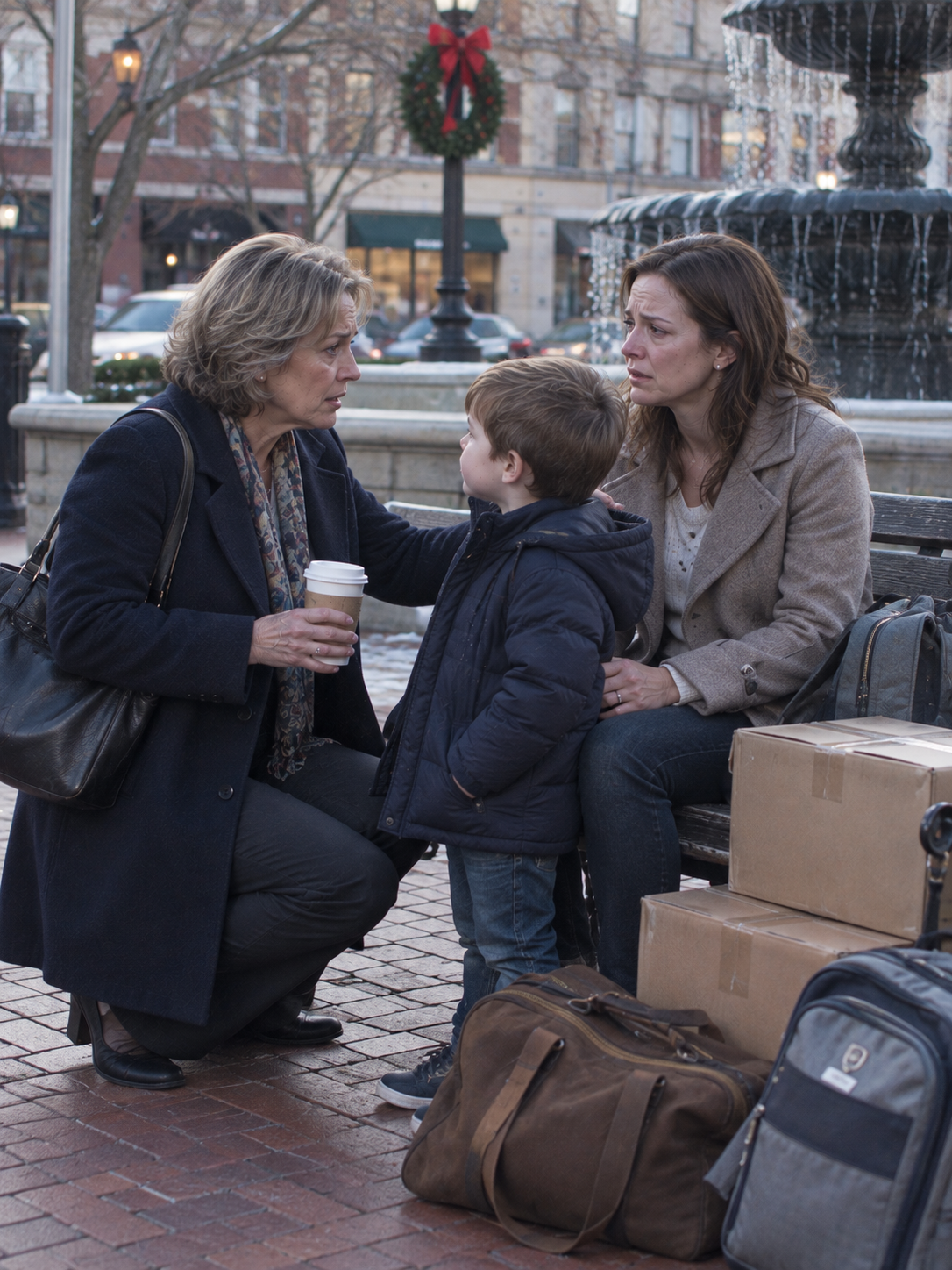
“I found my daughter sitting in the town square with my five-year-old grandson,
“I found my daughter sitting in the town square with my five-year-old grandson, three moving boxes, and one worn duffel...

My Ex-Husband Invited His Pregnant Ex-Wife to Mock Her at His Company Gala—He Had No Idea She Owned the Company – Life Story
The invitation arrived on a Tuesday afternoon in an expensive cream envelope with Natalie Robinson’s ex-husband’s handwriting across the front....

THE SIX-YEAR-OLD GIRL BEGGED A BILLIONAIRE TO OPEN HIS GATE DURING A BLIZZARD—BY MORNING, HER MOTHER’S MISSING COAT HAD PUT HIS ENTIRE EMPIRE UNDER QUESTION – Life Story
The little girl was freezing outside a mansion with twenty empty rooms. The billionaire nearly sent her back into the...