A RUINED MILLIONAIRE FLED HIS WIFE’S BETRAYAL AND HID IN A HOMELESS GIRL’S ALLEY SHELTER—THEN SHE REVEALED THE WARNING HE HAD IGNORED BEFORE LOSING EVERYTHING – Life Story
A seven-year-old girl pulled a ruined millionaire beneath a plastic tarp while two men searched the alley for him.
By midnight, the people he had trusted with his marriage and his company were preparing to take whatever he had left.
Then the little girl looked into his face and whispered, “I tried to warn you before.”
The first thing Stellan Reed Vale heard was his own name being shouted through the rain.
The second was the scrape of expensive shoes against wet pavement, coming closer.
He stumbled into the narrow alley behind a row of shuttered restaurants, struck his shoulder against a brick wall, and nearly fell.
His dark wool coat was soaked through.
One shoe had lost its sole at the heel.
In his right hand, he gripped a dead phone that had been ringing with threats and demands until the battery finally surrendered.
“Mr.
Vale!” a man called from the street. “We know you came this way.”
Stellan pressed himself against a dumpster, trying to control his breathing.
Six hours earlier, he had been the chairman and chief executive of Vale Meridian Holdings, a real estate and infrastructure company worth hundreds of millions of dollars.
Now the board had removed him, his access to company accounts had been revoked, and a financial dispute threatened his remaining assets.
His wife had stood in front of reporters that afternoon and described him as a man whose judgment could no longer be trusted.
The worst part was that she had said it with tears in her eyes.
A faint sound came from behind him.
“Hey.”
Stellan turned.
Between two brick walls, beneath an awning made from discarded advertising banners, sat a little girl wearing an oversized gray sweatshirt.
Her dark hair was braided unevenly, and she held a folded piece of bread inside a paper napkin.
She couldn’t have been older than seven.
“Come here,” she whispered.
Stellan stared at her.
“Quick,” she added. “They’re coming.”
He looked toward the street, where a flashlight swept across the rain.
Then he ducked beneath her tarp.
The space was hardly large enough for both of them.
Plastic sheeting covered the ground.
Two milk crates supported a piece of plywood that served as a table.
A battery candle glowed beside a small tin box, and a pair of worn sneakers had been placed neatly near the entrance.
The girl pulled the tarp shut and reached past his arm to cover the candle.
“Don’t move,” she whispered.
Outside, footsteps entered the alley.
Stellan could see their shadows shifting through the translucent plastic.
One man stopped near the dumpster.
“Check the other side,” someone said.
The girl’s fingers tightened around the edge of the tarp.
Stellan wondered whether he had just brought danger to a child who already had almost nothing.
He moved to stand, but she caught his sleeve and shook her head.
The footsteps continued.
For several seconds, neither of them breathed normally.
Then a car door slammed somewhere beyond the alley, and the voices grew distant.
Stellan remained on the ground, listening.
The girl uncovered the candle.
Its small amber light returned, illuminating a face that seemed strangely familiar.
“You’re Stellan,” she said.
He looked at her carefully.
“Yes.”
“I know.”
“Have we met?”
She nodded.
He searched his memory and found nothing.
The girl unfolded the napkin around her bread, then folded it again without taking a bite.
“You were outside the restaurant,” she said.
“Which restaurant?”
“The one with the gold windows.
And the man who opens the car doors.”
Something shifted in his expression.
The Bellwether.
It was the restaurant where his wife had insisted they celebrate their anniversary three weeks earlier.
It was also where she had begun asking him to sign documents she claimed would protect the company.
“How do you know about that place?” he asked.
The girl glanced toward the tarp, making sure the footsteps had not returned.
“I was behind it one night,” she said. “I heard your wife talking to somebody.”
Stellan felt his stomach tighten.
“What did she say?”
The girl looked down at her hands.
“I didn’t understand all of it.”
“Tell me what you remember.”
She hesitated.
Then she raised her eyes.
“She said you would sign because you trusted her.”
For a moment, the alley was silent except for the rain.
Stellan leaned forward.
“Who was she talking to?”
The girl’s expression changed.
Not because she was afraid of him.
Because she had recognized something in his face.
Then she reached toward the small tin box beside her sleeping mat.
“I kept something,” she whispered. “Because I thought you might come back.”
THE NIGHT HE RAN
Stellan watched the little girl draw the tin box into her lap.
Its lid had once displayed a picture of holiday cookies.
Most of the paint had worn away, leaving patches of blue metal and rust around the edges.
She opened it with both thumbs.
Inside were four buttons, a yellow ribbon, two smooth stones, a library card with a broken corner, and a folded white handkerchief.
She lifted the handkerchief carefully.
“I think this is yours.”
Stellan stared.
The embroidered initials in one corner were small but unmistakable.
S.R.V.
His mother had given him six of those handkerchiefs when he graduated from business school.
She believed a man should always carry something clean enough to offer another person.
He had kept one in the inside pocket of his coat for years.
He remembered losing it outside the Bellwether.
He remembered almost nothing about the child who had been standing nearby.
“You found this?”
The girl nodded.
“You dropped it when you were getting into your car.
I picked it up, but you were talking on your phone.”
Stellan took the fabric from her.
It smelled faintly of soap and cardboard.
“You tried to give it back?”
“Yeah.”
He remembered a voice.
A small voice calling, “Mister?”
He remembered looking down and seeing a little girl in a gray sweatshirt, her hand raised toward him.
He had assumed she wanted money.
“I said I was sorry,” he murmured.
“You did.”
“And I walked away.”
She did not answer.
The admission sounded worse spoken aloud.
“What were you trying to tell me?”
The girl considered him with the solemn concentration of a child deciding how much an adult could be trusted with.
“Your wife was in the back room with a man.
He had a shiny silver pen.
He kept making a clicking sound with it.”
She demonstrated by tapping one finger against the tin lid.
“Your wife said something about papers.
The man said, ‘Once he signs, we won’t need him anymore.’”
Stellan’s hand closed around the handkerchief.
“What did the man look like?”
“Tall.
Brown hair.
Blue coat.
He had a little cut right here.”
She touched the left side of her chin.
Blaze Garrick.
Stellan’s chief financial officer.
The man who had stood beside Corrine during the afternoon press conference, explaining how the board had been forced to intervene before Stellan’s mistakes destroyed the company.
Blaze had a narrow scar on his chin from a cycling accident years earlier.
Stellan knew because he had been the one who drove him to the hospital.
“Did you see the man’s face?” he asked.
The girl nodded.
“Are you sure?”
“Yeah.
He came outside to talk on his phone.”
She looked at the ground.
“He told somebody to make sure the papers were ready by Monday.”
Stellan tried to remember the calendar.
Three weeks earlier.
Monday.
The Monday Corrine had brought a leather folder into their bedroom shortly before midnight.
He had been exhausted from negotiations over a financing agreement, and she had placed a glass of water on his nightstand.
“Just administrative signatures,” she had said. “Blaze needs them before the banks open.”
He had signed without reading every page.
Not because he was foolish.
Because he had become accustomed to trusting the people closest to him with the details he considered beneath his attention.
He had built a company large enough that his signature could move millions of dollars.
And somehow he had convinced himself that being busy excused him from knowing what he was signing.
He looked at the girl again.
“What’s your name?”
“Elowen.”
“Elowen what?”
“Skyheart.”
“That’s a beautiful name.”
“My mom picked it.”
There was something final in the way she said it.
He did not ask where her mother was.
Not yet.
Instead, he asked, “How long have you been staying here?”
She shrugged.
“A little while.”
“How long is a little while?”
She bent one corner of the napkin.
“Since last Tuesday.
Before that, we were somewhere else.”
“Who’s we?”
Elowen pressed her lips together.
Her face had changed from open to guarded.
Stellan understood the boundary.
He looked around the shelter.
There were signs of careful effort everywhere.
The plywood table had been wiped clean.
Her shoes were positioned where rain would not reach them.
A plastic bottle held water.
She had even made a hook from a bent wire hanger to keep her sweatshirt off the ground.
He had spent much of his life approving buildings with marble lobbies and imported fixtures.
This child had built a home from things other people threw away.
“Are you hungry?” he asked.
She looked at the bread in her hands.
“No.”
Her stomach made a small, unmistakable sound.
Stellan almost smiled.
Almost.
“Neither am I,” he lied.
Elowen studied him for a second.
“That’s not true.”
“No,” he admitted. “It isn’t.”
She broke the bread into two pieces and offered him the larger half.
He refused.
She pushed it closer.
“You can have it.
I know where to get more tomorrow.”
“Where?”
“There’s a diner.
Marlowe gives me food sometimes.”
“Does Marlowe know you’re here?”
Her shoulders rose.
“Sort of.”
Stellan took the bread because he could see she would not eat until he accepted it.
He broke his piece in half again and handed some back.
“Then we’ll both eat.”
She considered the smaller portion, apparently decided it was fair, and took a bite.
Outside, rainwater dripped from the roof of the building beside them.
Stellan listened to the sound and realized something he had not expected.
For the first time that day, nobody was asking him to explain himself.
Nobody wanted a statement, a signature, or an admission.
A seven-year-old girl had given him the largest piece of her dinner.
And she had no idea how much he had once been worth.
He unfolded the handkerchief and rubbed his thumb over the embroidered letters.
“Elowen?”
“Yeah?”
“When you tried to tell me about my wife, what did you say?”
“I said I heard something bad.”
“And what did I say?”
She looked at the tarp.
“You said you couldn’t help me.”
Stellan closed his eyes.
He remembered now.
He had been rushing into a car while his assistant waited with a laptop and a list of urgent calls.
The child had spoken.
He had answered without listening.
He opened his eyes again.
“I’m sorry.”
Elowen glanced at him.
“It’s okay.”
“No,” he said gently. “It wasn’t.”
She seemed unsure what to do with that answer.
Then she moved the battery candle closer to the center of the table.
“There’s another blanket,” she said. “But it’s kind of scratchy.”
He accepted it.
They sat beneath the thin plastic roof while traffic hissed beyond the alley.
Eventually his exhaustion overcame his anxiety.
He fell asleep sitting against the wall, still holding the handkerchief.
When he woke, the rain had stopped.
Morning light filtered through the blue tarp, making everything inside appear underwater.
Elowen was sitting at the entrance, watching the street.
A piece of bread lay beside him, neatly wrapped.
“You saved that for me?” he asked.
She nodded.
“You were asleep.”
“Did you eat?”
She shook her head.
Stellan sat up.
“Then neither of us eats until we find you some breakfast.”
She seemed offended by the suggestion.
“I know where breakfast is.”
“Good,” he said. “You can show me.”
A few minutes later, they emerged into a city that looked almost insultingly normal.
Delivery trucks blocked loading zones.
Buses exhaled at intersections.
A woman in a navy business suit hurried past with two coffees and a conference badge swinging from her neck.
Stellan stopped beneath a storefront window.
His face was on a television mounted inside.
The headline beneath it read:
VALE MERIDIAN BOARD REMOVES FOUNDER AMID FINANCIAL CRISIS.
Elowen looked from the television to him.
“That’s you.”
“Yes.”
“Did you do something bad?”
Stellan watched Corrine appear onscreen.
She wore a cream-colored coat and stood with Blaze beside her.
“I wish I knew exactly what happened,” he said.
Elowen thought about that.
“Maybe you should ask the lady who was talking about you.”
He looked down.
Somehow, that was the simplest advice anyone had given him in weeks.
The problem was that Corrine had spent years making sure he believed her answers.
THE WOMAN IN WHITE
Marlowe Dane’s diner occupied the corner of Mercer and Ninth, between a locksmith’s shop and a laundromat with three perpetually broken machines.
The sign above the entrance had lost two letters, so MARLOWE’S DINER looked like MARLO E’S DINER whenever the lights came on.
Inside, the coffee smelled stronger than anything Stellan had ever ordered from a hotel breakfast menu.
A bell chimed when Elowen pushed open the door.
The man behind the counter looked up.
He was broad-shouldered, gray-haired, and wore an apron stained with coffee and pancake batter.
“Elowen.”
His expression softened before shifting to concern.
“Where have you been, kiddo?”
“Around.”
“That wasn’t the question.”
She glanced toward Stellan.
Marlowe’s eyes followed.
For a moment he appeared not to recognize the tall, exhausted man standing in the doorway.
Then he did.
“Well,” he said quietly. “That’s a surprise.”
Stellan felt the familiar urge to explain.
Marlowe raised a hand.
“Sit down first.
You both look terrible.”
He brought them eggs, toast, and two mugs of hot chocolate before Stellan could argue about payment.
Then he sat across from them.
“Elowen,” he said, “I need to know where you’ve been sleeping.”
She looked at her plate.
“You said you knew.”
“I knew where you went sometimes.
I didn’t know you were staying out there overnight.”
Her fork stopped.
Marlowe leaned forward.
“You remember Ms.
Ortiz? The outreach worker we met?”
Elowen nodded without looking up.
“I called her again yesterday,” he said. “She’s been trying to find you.”
Stellan listened carefully.
Marlowe explained that Elowen had started appearing at the diner several weeks earlier with her mother, who had been moving between temporary housing programs.
Her mother, Hannah Skyheart, had worked nights cleaning offices until a respiratory infection became severe enough to require hospitalization.
Marlowe had helped them with meals.
Then Hannah had been transferred to another hospital for specialized treatment.
Elowen had been staying temporarily with an acquaintance of her mother’s.
When that arrangement failed, the child disappeared.
The outreach workers had been looking for her.
“Why didn’t you go back to them?” Marlowe asked.
Elowen stared at her eggs.
“They said I might have to go somewhere far away.”
“Who said?”
“The lady at the other place.”
Marlowe sighed.
“Honey, you can’t stay outside waiting for your mom to come back.”
“I know.”
Her voice was so small Stellan almost missed it.
Marlowe turned toward him.
“And how did you end up with her?”
“She helped me last night.”
“Helped you how?”
Stellan paused.
He could see Elowen watching him closely.
He chose his words.
“I got into a bad situation.
She showed me somewhere safe.”
Marlowe looked from the man to the child.
“That’s a seven-year-old girl,” he said. “She shouldn’t be responsible for keeping a grown man safe.”
The words landed cleanly.
Stellan had spent years around people who softened criticism before delivering it.
Marlowe had no such habit.
“You’re right,” Stellan said.
Elowen looked surprised.
Marlowe leaned back.
“Good.
Then we’re going to start by making sure she’s somewhere safe today.”
He reached for the phone behind the counter.
Elowen became visibly tense.
“Do I have to leave?”
Marlowe lowered the receiver.
“Not this second.
But we need someone whose job is to help children to come talk with you.”
She turned toward Stellan.
It was not a request.
It was the beginning of an old fear.
He felt an impulse to promise that nobody would take her anywhere.
But he had no right to make that promise.
Instead, he said, “I’ll stay while we figure out what happens next, if they’ll let me.”
Marlowe studied him.
Then nodded once.
“That’s a better answer.”
While Marlowe contacted the outreach worker, Stellan borrowed the diner’s landline.
He dialed a number he had avoided for almost a year.
Naomi Wren Ellis answered on the third ring.
“Ellis.”
“Naomi.
It’s Stellan.”
There was a pause.
Then the unmistakable sound of a chair moving.
“Where are you?”
“Somewhere in the city.”
“That wasn’t the question.”
He almost laughed.
Apparently everyone who cared about facts had decided to speak plainly today.
“At Marlowe’s Diner, on Mercer.”
“I saw the news.”
“Then you know why I’m calling.”
“I know what people are saying,” Naomi replied. “I don’t know what actually happened.”
Stellan looked toward Elowen.
She was cutting her toast into tiny squares.
“I think Corrine and Blaze planned it.”
Naomi said nothing.
He continued.
“I may have a witness.
Someone who heard them discussing papers before I signed.”
“What kind of witness?”
He hesitated.
“A child.”
Another pause.
“Stellan, listen carefully.
Do not question that child again.
Do not promise her anything connected to your case.
And don’t put her name in a text message.”
He looked at Elowen.
“Okay.”
“Has anyone contacted child protective services?”
“Marlowe’s doing that now.”
“Good.”
Naomi’s voice changed, becoming sharper.
“Now tell me exactly what documents you signed.”
Stellan explained the late-night folder.
The signatures.
The board meeting.
The sudden financial crisis.
The claims that he had approved a series of unauthorized loans secured by company assets.
Naomi waited until he finished.
“Did you keep copies?”
“No.”
“Did you read every page?”
Stellan swallowed.
“No.”
“Then we have a problem.”
“I know.”
“Do you have proof they altered anything?”
“Not yet.”
“Then we investigate.
We don’t accuse.”
He heard her typing.
“I’m coming to the diner.
Don’t call Corrine.
Don’t call Blaze.
And don’t use any company systems you no longer have authority to access.”
He agreed.
Before hanging up, Naomi added, “Stellan?”
“Yes?”
“You remember why I stopped representing Vale Meridian?”
He looked across the restaurant.
Marlowe was refilling a customer’s coffee.
“Because I ignored your advice.”
“More specifically?”
“Because you warned me our approval procedures were too dependent on a few trusted people.”
“And?”
“Because I told you trust was one of our competitive advantages.”
Naomi let the silence do its work.
“I’ll see you in forty minutes.”
When she arrived, she wore a charcoal suit, flat black shoes, and a coat still dotted with rain.
She had been Stellan’s outside counsel during the company’s most aggressive expansion.
She was also the only attorney who had ever ended a meeting with him by saying, “Your signature isn’t an internal control.”
He had been offended for three days.
Then he had promoted Blaze.
Naomi sat with Stellan in the corner booth while Marlowe took Elowen to wash her hands.
“Start at the beginning,” she said.
Stellan began with the financing arrangement.
Vale Meridian had borrowed heavily to acquire a series of aging commercial buildings, intending to convert them into mixed-income housing and medical facilities.
The projects were sound, but expensive.
Interest rates had risen, construction delays had accumulated, and the company needed a refinancing agreement to avoid selling assets below value.
Blaze had handled the financing.
Corrine, who oversaw investor relations and the company’s charitable foundation, had managed messaging to lenders and board members.
Stellan had spent most of that period negotiating with municipal authorities and major partners.
Then, three weeks earlier, Corrine presented a packet of routine approvals for his signature.
Two days later, a lender reported a substantial pledge of company-controlled assets that had not been properly disclosed to the board.
The pledge secured a debt associated with an investment entity Stellan barely recognized.
Within days, the bank demanded additional collateral.
The company’s credit rating came under review.
Vendors began asking for assurances.
The board removed Stellan while an internal investigation proceeded.
And Corrine told reporters she had warned him repeatedly about his deteriorating judgment.
Naomi took notes without interruption.
“Was the pledge approved by the board?” she asked.
“According to Blaze, yes.”
“Did you see the approval?”
“No.”
“Did anyone independent verify the signatures?”
“Not that I know of.”
Naomi leaned back.
“So we’re not talking about a random market collapse.
We’re talking about a transaction that may have created the crisis.”
Stellan nodded.
Naomi looked at him for a long moment.
“You know what bothers me?”
“My wife?”
“Not yet.
The speed.”
She turned her notebook around.
A line of dates marched across the page.
“Lender notice on Tuesday.
Emergency board call Wednesday.
Executive removal Thursday.
Public statement before lunch.”
“They said they were protecting investors.”
“Maybe they believed they were.
But someone had their materials ready before anyone had finished checking the underlying transaction.”
Stellan remembered Corrine’s press conference.
The cream coat.
The tears.
The careful words about necessary leadership changes.
“She’s always been good in front of cameras.”
Naomi capped her pen.
“Being good in front of cameras isn’t fraud.
Signing or knowingly using false documents is.”
She folded her notebook.
“That’s what we have to prove.”
At the front counter, Elowen was laughing at something Marlowe had drawn on a paper napkin.
It was a terrible picture of a dog.
For a brief second, Stellan forgot the financial crisis.
Then his eyes moved to the child-sized coat hanging beside the door.
The sleeves were too short.
One elbow had been patched with a different shade of gray.
He realized that even if he recovered everything he had lost, the most important decision he made that day might have nothing to do with his company.
A phone rang behind the counter.
Marlowe answered.
He listened, glanced at Elowen, and looked toward Stellan.
“The outreach worker’s coming,” he said.
Then he covered the receiver.
“And she says there’s news about Elowen’s mother.”
A SIGNATURE IN THE WRONG ROOM
The woman who arrived forty minutes later introduced herself as Lucia Ortiz.
She wore a waterproof navy jacket and carried a canvas tote bag filled with forms, children’s books, and packets of crackers.
She did not look like someone who had come to take charge of a dramatic situation.
She looked tired.
Competent.
And unwilling to waste anyone’s time.
“Elowen,” she said gently, crouching beside the booth, “I’ve been hoping I’d find you.”
Elowen stared at her shoes.
“Am I in trouble?”
“No.
But I’m worried about you.”
“Where’s my mom?”
Lucia’s face changed.
She sat on the bench beside the little girl.
“Your mom is still in the hospital.
She’s getting care.
She’s asked about you, and the hospital social worker has been helping us find you.”
Elowen’s eyes filled.
“Can I go there?”
“Not today.
She’s too sick for visitors right now.
But we’re working on a way for you to talk to her.”
The girl nodded once.
It was the nod of a child trying to behave well enough to earn an answer she already feared.
Stellan looked away.
Lucia explained that Hannah’s condition was serious but stable.
She might require prolonged rehabilitation, and the agency was arranging temporary care while determining what family support was available.
There was an approved emergency foster home with space for Elowen.
Marlowe immediately asked about visitation and contact.
Lucia answered his questions.
Stellan listened.
Then Elowen reached across the table and touched his sleeve.
“Will you be here when I come back?”
He looked toward Lucia.
She studied him with the measured caution of a professional who had seen adults make promises under emotional pressure and disappear when those promises became inconvenient.
“I’d like to stay in contact,” Stellan said. “If that’s appropriate.”
Lucia gave him her business card.
“We can discuss that after we make sure she’s settled.”
Elowen looked at his face.
He could see the question she wasn’t asking.
He took his handkerchief from his pocket.
“Remember this?”
She nodded.
“You kept it safe for me.
I want to return the favor.”
Lucia gently interrupted.
“Mr.
Vale, let’s not make her responsible for an agreement she doesn’t understand.”
Stellan stopped.
Then nodded.
“You’re right.”
He turned back to Elowen.
“I’ll talk to Ms.
Ortiz about visiting.
That’s something I can do.”
Elowen seemed to accept the correction.
She took her tin box when it was time to leave.
Before going, she looked at Stellan again.
“You’re going to find out what happened?”
“I’m going to try.”
She nodded.
“Okay.”
No grand speech.
No dramatic goodbye.
She simply took Lucia’s hand and walked outside.
Stellan watched until the car turned the corner.
Naomi was already gathering her papers.
“You have a problem to solve,” she said.
He looked at her.
“Which one?”
“The one that belongs to you.”
She meant the company.
But Stellan was beginning to understand that he had more than one responsibility.
They spent the afternoon in Naomi’s modest law office, a two-room suite above a pharmacy.
Her desk held a printer, a glass paperweight, and a photograph of her parents standing beside a fishing boat.
Nothing in the room was designed to impress clients.
That was one reason Stellan trusted it.
Naomi brought in a forensic accountant named Daniel Brooks, a quiet man with reading glasses and an unfortunate habit of speaking while still looking at his screen.
Daniel had previously audited the company for an outside lender.
He understood the financing structure.
He also knew which information could legally be obtained from public filings, independent lenders, or formal discovery.
They began with documents Stellan was entitled to possess as a former executive, shareholder, and guarantor.
The lender’s notice included a schedule of pledged assets.
Daniel placed it beside an earlier financing proposal.
“These two schedules shouldn’t be identical,” he said.
Stellan leaned forward.
“Why?”
“Because the earlier proposal was abandoned before the final asset review.
This version includes three properties that were supposed to be excluded.”
He pointed to the addresses.
One was a medical office building in Cleveland.
Another was a mixed-income housing project in Columbus.
The third was a logistics facility in Indianapolis.
Stellan recognized all three.
Each had been discussed as collateral during preliminary refinancing negotiations.
But he had rejected that arrangement.
The buildings were critical to long-term cash flow, and pledging them together would create dangerous exposure.
“Blaze knew I rejected that.”
Daniel glanced at him.
“Knowing you rejected it doesn’t mean he didn’t submit a revised proposal.”
“Then where’s the revised authorization?”
Naomi answered.
“That’s the question.”
They requested the complete transaction file through the lender’s legal department and prepared a formal demand for preservation of relevant records.
Naomi also sent letters asking the company and its officers to preserve emails, board materials, approval logs, original signed documents, and devices used in the transaction.
Stellan wanted to telephone the bank’s president.
Naomi stopped him.
“You can make yourself feel better for ten minutes or build a case that survives scrutiny.”
He put down the phone.
“I hate it when you say things like that.”
“That’s why I charge by the hour.”
For the first time in two days, he laughed.
It sounded strange in the small office.
Then Daniel opened a file and stopped smiling.
“There’s another issue.”
“What?”
“The entity that received the financing proceeds.”
He enlarged a corporate registration.
The borrower was called Alder Peak Capital Partners.
Stellan recognized the name.
Corrine had mentioned it months earlier as a potential investor in a private development fund.
She had described it as a well-capitalized group interested in affordable housing.
“Who owns it?” he asked.
Daniel shook his head.
“The registration uses a management company.
We need more records.”
Naomi leaned toward the screen.
“Who signed the management company’s annual report?”
Daniel scrolled.
A name appeared.
Blaze Garrick.
Stellan felt the room become very still.
Blaze had been involved in hundreds of entities over the years.
He had legitimate reasons to sign documents on behalf of subsidiaries.
But Alder Peak was supposed to be an independent counterparty.
If he controlled it, the financing arrangement might have been a concealed related-party transaction.
“If he was on both sides,” Stellan said, “he couldn’t have approved this without disclosing it.”
Naomi nodded.
“That’s the first serious question we’ve found.”
Stellan looked at the company name again.
Alder Peak.
He remembered Corrine standing beside him at a charity gala, introducing a quiet investor in a blue suit.
The man had spoken about community development.
Corrine had been unusually attentive to the conversation.
Stellan had thought she was helping.
Now he wondered what else she had been arranging.
Naomi cautioned him not to jump ahead.
“Blaze might be acting as an administrator.
It could be disclosed somewhere we haven’t seen.”
“Do you believe that?”
“I believe we need the complete records.”
She folded the document.
“Assumptions are what got you here.”
That evening, Corrine called Naomi’s office.
Stellan saw her name on the screen.
He asked Naomi to put the call on speaker.
Naomi shook her head.
“She’s your spouse.
She’s also potentially adverse to you.
Let me handle it.”
She answered.
Corrine’s voice came through smooth and controlled.
“Naomi.
I heard Stellan contacted you.”
“He has retained me for certain matters.”
“I’m concerned about him.”
“Then I’m sure you’ll cooperate with requests for the relevant documents.”
A small silence followed.
“Of course,” Corrine said. “But I hope you understand he’s under considerable stress.”
“I understand that documents exist.”
Corrine exhaled softly.
“He’s always been proud.
I don’t want this to become something that hurts him more.”
Naomi glanced at Stellan.
“Then transparency would help.”
Another pause.
“Tell him I want him to come home.”
Stellan felt a familiar pull.
For twelve years, Corrine’s voice had meant certainty.
He could hear the kitchen of their home in it.
The clink of plates.
The late-night conversations.
The sound of her saying his name when the rest of the world wanted something from him.
Naomi answered, “I’ll pass that along.”
After the call, she looked at him.
“You don’t owe her an immediate answer.”
Stellan sat back.
“I want to ask her why.”
“That’s reasonable.”
“I want her to tell me the truth.”
“That may not happen.”
He stared at the phone.
The hardest part of betrayal was not always discovering someone had lied.
Sometimes it was realizing how much of your life depended on believing they hadn’t.
THE PRICE OF BEING SEEN
Three days later, Stellan was allowed to visit Elowen at her temporary foster home.
Lucia Ortiz arranged the visit.
The foster parent, a retired elementary school teacher named June Howard, lived in a narrow brick house with a yellow front door and wind chimes on the porch.
Elowen was sitting at the dining table when Stellan arrived.
She had colored pencils arranged in a line and a piece of paper covered with carefully drawn rectangles.
She looked up.
Then looked at Lucia.
“You said he might come.”
“He asked to,” Lucia replied.
Elowen turned back toward Stellan.
“You actually came.”
The words were not dramatic.
That made them worse.
Stellan sat in the chair Lucia indicated.
“I said I wanted to visit.”
“People say that.”
He did not attempt to argue.
Instead, he placed a small paper bag on the table.
Inside was a set of new colored pencils.
Elowen studied them.
“I already have some.”
“I see that.”
“These ones are okay.”
He glanced at Lucia.
She gave him a slight smile, as if to say that children were rarely impressed by the speeches adults rehearsed for them.
Stellan pushed the bag aside.
“Then tell me what you’re drawing.”
Elowen turned the paper around.
It was a floor plan.
A square room.
A small bed.
A window.
A door.
And a row of shelves along one wall.
“It’s my room,” she said.
He smiled.
“Looks bigger than mine.”
She frowned.
“That’s because you’re drawing in your head.”
He laughed.
“Fair enough.”
She pointed to the shelves.
“June says I can put my things there.”
“That’s good.”
“But I don’t want the tin box on the shelf.”
“Where do you want it?”
“Under the bed.”
“Why?”
She looked at him as though the answer should have been obvious.
“Because that’s where I can get it.”
He understood.
Not everything a child kept close was valuable to anyone else.
Sometimes a tin box mattered because it could be carried quickly.
They spent the next half hour drawing buildings.
Stellan showed her how architects used simple shapes to make floor plans.
Elowen showed him how to draw a door that opened inward.
He had never noticed how much pride could fit into a child’s explanation of a hinge.
When the visit ended, she asked whether he had fixed his company.
“Not yet,” he said.
“Why not?”
“Some people aren’t answering questions.”
“Can you make them?”
“Sometimes.
But it takes a while.”
She looked disappointed.
Stellan had the same feeling.
That night, he returned to Naomi’s office and found her standing beside the printer.
The lender had produced a copy of the disputed pledge agreement after receiving a formal request from its counsel.
Naomi handed him the first page.
“Look at the signature block.”
He did.
His name appeared at the bottom.
Stellan Reed Vale.
The handwriting was close.
Very close.
But the final stroke of the V was wrong.
His mother had taught him to write his name with a sharp upward finish.
This signature curved downward.
He had seen that difference before on documents prepared by assistants using old scanned images of his signature.
“It’s not mine,” he said.
Naomi looked at him.
“Don’t answer because you want it to be false.”
“It isn’t mine.”
She pointed to a certification below.
“There’s a witness signature.”
Blaze Garrick.
Stellan stared.
The agreement represented that Stellan had signed the document in person at Vale Meridian’s downtown office on a specific Monday afternoon.
But Stellan remembered that afternoon.
He had been at a board retreat in Philadelphia.
He remembered because one director had suffered a medical emergency during the meeting, delaying the return flight.
Naomi had already obtained the retreat’s attendance records.
They confirmed he had been present throughout the relevant period.
“But I could have signed remotely,” Stellan said.
“Not this agreement.
It specifically required an original ink signature witnessed at the stated location, with a separate certification from the finance officer.”
She tapped the paper.
“Blaze certified that he personally witnessed you sign.”
Stellan read the language again.
A slow, unpleasant clarity came over him.
Someone had not merely misrepresented his judgment.
Someone had manufactured an event.
Naomi was careful.
“This doesn’t prove Corrine directed it.
It doesn’t prove every financial consequence came from this document.
But it’s strong enough to challenge the transaction and demand the original.”
Stellan nodded.
“Then let’s demand it.”
The forensic examination took time.
So did the subpoenas.
So did the effort to obtain the bank’s internal approval records without making reckless accusations.
During those weeks, Vale Meridian’s stock continued to fall.
Several projects stalled.
A major construction subcontractor threatened litigation over unpaid invoices.
Stellan watched employees he had known for years carrying their belongings out of company offices.
He could not enter the building.
He could not authorize a payment.
He could not promise their jobs were safe.
One afternoon, he stood outside a coffee shop across from company headquarters and watched his former assistant, Renee Walker, emerge carrying a cardboard box.
She saw him through the window.
He raised his hand.
She came inside.
Renee was forty-three, direct, and had managed his calendar for almost eleven years.
She set the box beside her chair.
“I wasn’t sure you wanted anyone from the company speaking to you.”
“I always wanted you speaking to me.”
She gave him a tired look.
“That’s not entirely true.”
He accepted the correction.
“Fair.”
She stirred her coffee.
“Blaze told us not to discuss the investigation with you.
Said it could create legal problems.”
“It might.”
“I know.
That’s why I’m not bringing you records.”
He looked at the cardboard box.
“Then why stop?”
“Because I wanted to see your face when I said this.”
Her eyes met his.
“You used to listen to people.
Then everything got big, and you started treating questions like interruptions.”
Stellan said nothing.
Renee continued.
“Last year, I tried to get fifteen minutes on your calendar because the finance team was bypassing dual approvals.
You sent me to Blaze.”
He remembered.
Vaguely.
“I thought he was handling it.”
“He was the person I was worried about.”
The coffee shop suddenly felt too small.
Renee took a breath.
“I’m not telling you that because I think you deserved what happened.
Nobody deserves to have documents forged under their name.”
She looked away.
“I’m telling you because if you get your company back and do everything the same way, you’ll hurt more people.”
Stellan stared at his untouched coffee.
“What happened to your job?”
“Administrative leave.
They said restructuring.”
“Are you all right?”
“I’m angry,” she said. “I can manage angry.”
He nearly smiled.
Before leaving, she added, “Naomi Ellis called me.
I told her I’d answer questions through the proper process.”
“Thank you.”
“Don’t thank me yet.
I’m going to tell her the things you don’t want to hear, too.”
After she left, Stellan sat alone for nearly an hour.
He had spent days imagining the moment he might prove Corrine and Blaze had betrayed him.
He had not spent enough time considering the people he had failed while trusting them.
That evening, he visited Elowen again.
She was on the porch with June, sorting fallen leaves into piles by color.
Stellan helped.
He ruined the first pile by accidentally stepping into it.
Elowen laughed so hard she bent forward and had to hold the railing.
It was the first time he had heard her laugh without restraint.
For twenty minutes, they worked with leaves while the autumn light faded.
Then Elowen grew quiet.
“Did your wife say sorry?”
Stellan shook his head.
“Not yet.”
“Are you going to?”
“For what?”
“For not listening.”
He looked at the small piles scattered around the porch.
“Yes,” he said. “I think I have to.”
Elowen picked up a yellow leaf.
“You already said sorry to me.”
“That doesn’t mean I fixed it.”
She thought about that.
Then placed the leaf on top of the largest pile.
“No,” she agreed. “But you came back.”
He carried those words with him all the way to Naomi’s office.
Because he was beginning to understand that being forgiven and becoming trustworthy were not the same thing.
THE QUIET WITNESS
The original pledge agreement arrived from the lender’s document custodian eleven days after Naomi requested its preservation.
It was delivered in a sealed evidence envelope, accompanied by a chain-of-custody record.
Naomi met Stellan and Daniel in a conference room at the forensic document examiner’s office.
The examiner, Dr.
Evelyn Hart, had spent twenty-seven years analyzing questioned signatures and writing instruments.
She spoke without ornament.
“I can’t tell you who signed this document merely by looking at it.”
Stellan nodded.
“But can you tell me whether I signed it?”
“I can compare it with known exemplars and evaluate significant similarities and differences.”
She placed enlarged photographs on the table.
The questioned signature contained several unnatural pauses.
Certain strokes appeared to have been copied from an older signature specimen.
The ink flow was inconsistent with Stellan’s usual writing habits.
Most importantly, the document’s signature displayed a curved final stroke not present in numerous verified signatures spanning more than a decade.
Dr.
Hart did not declare the matter solved.
She explained that the differences supported a conclusion of probable simulation, subject to the limitations of handwriting comparison.
Then she placed another photograph beside the first.
A close-up of the blue-black ink.
“The instrument used was a fountain pen or similar liquid-ink writing instrument,” she said.
Stellan thought of Elowen.
The tapping sound.
The shiny silver pen.
“Can you identify the pen?”
“Not from ink alone.
Many instruments can use similar formulations.”
Naomi nodded approvingly.
“That’s what I expected.”
But Daniel had another record.
A company expense report obtained during discovery showed that Blaze had purchased a limited-edition silver fountain pen shortly before the restaurant meeting.
The purchase proved ownership of a pen.
It did not prove use.
The distinction mattered.
Still, the connection was too precise to ignore.
Elowen had described a distinctive silver pen before anyone showed her the expense report.
The restaurant’s reservation records confirmed Corrine and Blaze had occupied a private dining room that evening.
A staff schedule placed an employee at the service entrance where Elowen said she had been standing.
Security footage, preserved after Naomi’s request, showed the pair leaving together.
None of that alone established fraud.
Together with the questioned document, the suspicious financial transaction, and Blaze’s false witnessing certification, it created a pattern that required explanation.
Stellan studied the photographs.
For years, he had believed that the most powerful evidence was the kind that appeared in an enormous spreadsheet.
Now one of the central questions in his case had begun with a child noticing the sound of a pen.
Across town, Corrine was preparing another statement.
She had retained a crisis communications firm, and a draft press release described Stellan’s allegations as a desperate attempt to discredit a responsible board.
Blaze insisted the challenged transaction had been approved under established procedures.
Then he made a mistake.
In a written declaration, he repeated that he had personally witnessed Stellan sign the pledge agreement at the downtown office.
The statement was not merely inaccurate.
It tied Blaze’s credibility to a location and time that independent records could test.
Naomi read the declaration twice.
Then she placed it beside the attendance documentation from Philadelphia.
“This is going to matter,” she said.
Stellan wanted to know whether it meant they could win.
Naomi looked at him.
“It means we’re closer to proving a material fact.
Don’t confuse that with the end of the case.”
Meanwhile, Elowen had begun asking questions about her mother.
Lucia arranged a supervised telephone call from the hospital.
Stellan was not present.
He learned about it during his next visit, when Elowen showed him a drawing of a woman with long dark hair standing beneath a yellow umbrella.
“That’s my mom,” she said.
“She’s pretty.”
“She sounds tired.”
Stellan sat beside her.
“What did she say?”
“That she loves me.”
“Good.”
“And that she’s trying to get better.”
Elowen moved her pencil back and forth.
“June says doctors can’t promise when people get better.”
“June’s right.”
“Then why did my mom say she was trying?”
“Because trying is something she can do, even when she can’t control the result.”
Elowen considered that.
“Like your company?”
He smiled sadly.
“A little.”
She moved the drawing closer to him.
“Do you think she’ll come home?”
Stellan wanted to tell her yes.
He wanted to make the world behave like a story in which adults could guarantee happy endings if they spoke with enough conviction.
But he had learned what careless promises cost.
“I hope so,” he said. “I know a lot of people are helping her.”
Elowen nodded.
Then she asked if he wanted to draw a dog.
They spent the rest of the visit trying to draw Marlowe’s diner dog from memory.
Stellan’s looked like a cow.
Elowen insisted it needed a tail.
He gave it three.
She laughed again.
And for a little while, neither of them had to solve anything.
The next afternoon, Corrine finally agreed to meet Stellan.
Naomi had advised against a private confrontation.
Stellan agreed to a supervised meeting in the offices of a neutral family-law mediator, with their respective attorneys available nearby.
He arrived early.
Corrine entered six minutes late.
She wore a navy dress, a plain wedding band, and the same perfume she had worn on their honeymoon.
The familiarity unsettled him more than he expected.
She sat across from him.
“You look exhausted.”
“I am.”
“Have you been sleeping?”
“Some.”
Her eyes moved over his face.
“I wish you’d come home.”
He studied her.
“Why?”
She appeared surprised.
“Because you’re my husband.”
“Is that still what you want?”
Corrine’s expression tightened.
“Stellan, please.
Not everything has to become an interrogation.”
He placed a copy of the pledge agreement between them.
She glanced at it.
“Naomi told me you were challenging the paperwork.”
“Did you know Blaze was connected to Alder Peak?”
Corrine looked away.
“Blaze works with dozens of investment entities.”
“Did you know he signed on both sides of the transaction?”
She folded her hands.
“I wasn’t involved in the technical financing.”
“You introduced Alder Peak to the company.”
“As a potential investor.”
“You told me it was independent.”
“I believed it was.”
Stellan waited.
Corrine’s face remained composed.
He recognized the expression.
For years, he had considered it evidence of calm intelligence.
Now he wondered how many conversations she had survived by refusing to show the truth.
He reached for the handkerchief in his pocket.
“Do you remember our anniversary dinner?”
She frowned.
“Of course.”
“You said we should go to the Bellwether.”
“Yes.”
“Did you meet Blaze there a few nights earlier?”
She hesitated for the first time.
“We had a work dinner.”
“About what?”
“Company matters.”
“About getting me to sign the pledge?”
Corrine looked toward the door.
“I’m not discussing a legal accusation without my attorney.”
“Fair enough.”
He began to gather his papers.
Then she spoke.
“You weren’t listening to anyone, Stellan.”
He stopped.
Corrine’s voice had lost some of its polish.
“You were making decisions without consulting the people who had to keep everything standing.
You rejected refinancing options, delayed necessary sales, and treated every concern like an insult.”
“Some of that is true.”
She blinked.
He continued.
“I should have listened.
I should have demanded stronger controls.
I should have read every document before signing.”
Her expression softened slightly.
“Then you understand.”
“No.”
The word was quiet.
“I understand my mistakes.
I don’t understand why you thought those mistakes gave you the right to deceive me.”
Corrine stared at him.
“I was trying to protect what we built.”
“By lying?”
“By making sure it survived.”
He looked at the woman he had married.
“And where was I supposed to be when it survived?”
She did not answer.
For the first time, Stellan saw not merely ambition in her face, but fear.
Fear that the company would fail.
Fear that her social standing would collapse.
Fear that the life she had built around their success might disappear if she allowed anyone else to decide what happened next.
That fear explained something.
It excused nothing.
He stood.
“I need the original records, Corrine.”
She looked up.
“You’ll destroy us both.”
He folded the agreement.
“No.
I’m trying to find out who already did.”
As he walked out, his phone vibrated.
It was a message from Lucia Ortiz.
Elowen had disappeared from an approved outing with her foster parent.
And nobody knew where she had gone.
THE DOOR LEFT OPEN
Stellan reached June Howard’s house twenty minutes later.
Lucia was already there.
June stood in the kitchen, visibly shaken.
Elowen had gone with her to a neighborhood bookstore for a supervised children’s activity.
During a crowded moment near the front counter, she had slipped out.
Store employees had checked the restrooms and neighboring shops.
Lucia had notified the proper authorities.
Stellan felt panic rise.
“Did she say anything before she left?”
June pressed her hands together.
“She’d been quiet all morning.”
“About what?”
“Her mother.
And the hearing.”
Stellan looked toward Lucia.
“What hearing?”
Naomi had filed a motion seeking emergency relief concerning the challenged financial transaction.
The opposing side had learned that a child might have information relevant to a restaurant meeting.
Although Naomi had requested protective measures, gossip had begun circulating after a court filing referenced a potential witness without identifying her.
Elowen had overheard part of an adult telephone conversation.
She believed Stellan’s legal problems were growing because he had involved her.
Stellan felt sick.
Lucia handed him a copy of a small note June had found beneath Elowen’s pillow.
The handwriting was uneven but careful.
THANK YOU FOR LETTING ME STAY.
MR.
STELLAN HAS IMPORTANT THINGS TO FIX.
I DON’T WANT TO MAKE IT HARDER.
Stellan stared at the page.
He had spent weeks thinking about how much Elowen had helped him.
He had not understood that she might believe her usefulness was the only reason adults wanted her nearby.
“Where would she go?” Lucia asked.
Stellan looked up.
“The alley.”
They contacted the officers coordinating the search and shared the possible location.
Stellan asked whether he could accompany them.
Lucia agreed that he could assist nearby, but the professionals would take the lead in approaching Elowen.
They found her beneath the same blue tarp.
She had carried her tin box back.
The battery candle sat beside her.
A folded blanket lay across the plywood floor.
She looked up when Lucia called her name.
Her eyes moved past the caseworker.
And settled on Stellan.
“You came,” she whispered.
He knelt just outside the shelter.
“Of course.”
“I didn’t want to bother you.”
He struggled to answer.
Elowen glanced toward Lucia.
“Did I do something wrong?”
Lucia crouched beside her.
“You scared us because we didn’t know where you were.
But you aren’t in trouble for being afraid.”
Elowen swallowed.
Stellan remained silent until she looked at him again.
“You have the court thing,” she said.
“Yes.”
“And you’re still in trouble.”
“I’m working on it.”
She picked at the corner of her blanket.
“Maybe if I don’t talk about your wife, they’ll stop being mad.”
Stellan felt the truth of it strike him.
Adults had turned a child’s memory into something heavy enough to frighten her away from safety.
He looked at Lucia.
Then back at Elowen.
“You don’t have to talk about my wife.”
She frowned.
“But Naomi needs me.”
“Naomi needs facts.
That’s her job.
Your job is to be seven.”
Elowen stared at him.
He continued.
“You don’t have to fix my company.
You don’t have to help me win anything.
And you don’t have to earn a place to sleep.”
Her eyes filled.
“Then why did you come?”
Stellan took a breath.
“Because I was worried about you.”
“Even if I don’t help?”
“Especially then.”
The girl looked down.
For several seconds, she said nothing.
Then she crawled toward the entrance and allowed Lucia to take her hand.
Stellan helped carry the tin box.
He did not touch the shelter until Elowen pointed to the folded blanket.
“Can we take that too?”
“Of course.”
She watched him place it carefully inside a bag.
It was a small task.
He did it as though nothing mattered more.
Back at June’s house, Elowen ate soup while Lucia spoke privately with Stellan.
The caseworker was direct.
“She’s experienced instability, separation, and fear about whether adults will stay.
She needs consistency, not a dramatic promise.”
Stellan nodded.
“I understand.”
“Do you?”
He looked toward the dining room.
“I think I’m beginning to.”
Lucia studied him.
“Then keep doing what you’ve done well.
Show up when you say you will.
Respect boundaries.
Don’t make her responsible for your emotions or your legal case.”
He agreed.
Then he asked a question he had been avoiding.
“If her mother can’t care for her for a long time, what happens?”
Lucia explained that the agency would first work with Hannah and evaluate safe family options.
Temporary foster care could continue as necessary.
Long-term decisions would require assessments, hearings, and careful consideration of Elowen’s needs.
Stellan listened.
“I want to be considered as a caregiver if that becomes appropriate.”
Lucia did not smile.
She did not thank him.
She gave him a list of requirements.
Background checks.
Training.
Home assessment.
Financial and personal references.
Evaluation of his ability to provide a stable environment independent of the outcome of his lawsuit.
Stellan took the list.
“I’ll do it.”
She looked at him.
“That’s a serious commitment.”
“I know.”
“It’s not something you can solve with a donation.”
He thought about the alley.
“I know that, too.”
Later that evening, Naomi called.
Her voice was tight.
“The court denied our request for immediate restoration of your executive authority.”
Stellan stood beside the kitchen window in his rented apartment.
Outside, cars moved through wet streets.
“Why?”
“The judge found enough unresolved questions to order preservation of records and set an expedited evidentiary hearing.
But she won’t reverse the board’s decision on this preliminary record.”
He closed his eyes.
“So I’m still out.”
“For now.”
“And the company?”
“Still under the board’s control.”
“And Blaze?”
“Still there, although subject to restrictions concerning the disputed transaction.”
Stellan leaned against the wall.
For the first time, he understood that proving the truth might not restore the life he had lost.
Investors could leave.
Projects could fail.
His marriage might be beyond repair.
Even if the court eventually ruled in his favor, time would not reverse itself.
Then Naomi spoke again.
“There’s something else.”
“What?”
“Blaze’s attorneys have produced another declaration.
Corrine signed it.”
Stellan opened his eyes.
“What does it say?”
“That she personally observed you review the disputed financing package before the date of the pledge.”
He stared at the street.
Corrine was no longer merely suggesting that he had made poor decisions.
She was placing herself inside the disputed transaction.
Naomi continued.
“If that’s false, she’s assuming significant legal exposure.”
Stellan rubbed his forehead.
“Why would she do that?”
“Because she thinks you’re going to lose.”
He said nothing.
Naomi lowered her voice.
“She also thinks you’ll protect her.”
He looked at the handkerchief lying on his kitchen counter.
For twelve years, he had protected Corrine from embarrassment, disappointment, criticism, and doubt.
Maybe she had mistaken that loyalty for permission.
“Naomi,” he said.
“Yes?”
“I want the hearing to go forward.”
“Even if it means your marriage is finished?”
He looked toward the dark window.
“My marriage was supposed to be where I didn’t have to pretend.”
He paused.
“I can’t keep pretending now.”
THE DAY THE STORY CHANGED
The evidentiary hearing began on a cold Monday morning in a downtown courtroom with pale wooden benches and fluorescent lights.
Stellan arrived with Naomi and Daniel Brooks.
He wore a navy suit he had purchased years earlier, before Vale Meridian’s valuation made expensive clothing feel ordinary.
The sleeves were slightly too long.
He had lost weight.
His wedding ring was no longer on his hand.
Across the room, Corrine sat with her attorneys.
Blaze occupied the chair beside her.
They did not look like villains.
Corrine looked exhausted but carefully composed.
Blaze looked like a senior executive preparing for a difficult quarterly review.
That was what frightened Stellan most.
People could cause enormous damage without ever looking monstrous.
The courtroom clerk called the matter.
The judge outlined the limited purpose of the hearing: to determine whether interim relief was warranted concerning the disputed financial instruments and related company actions.
She was not deciding every claim.
She was not conducting a criminal trial.
She was examining whether evidence justified preventing further reliance on transactions that might have been improperly authorized.
Naomi began with the original pledge agreement.
She questioned the lender’s records custodian about how it had been received, who had certified the signatures, and what procedural requirements governed acceptance.
The custodian confirmed that the agreement required an original signature and a witness certification.
Blaze had supplied the certification.
Naomi then introduced the Philadelphia attendance records.
A hotel employee testified about registration logs and meeting-room access.
An independent board director confirmed that Stellan had attended the retreat throughout the afternoon.
A photograph from the event had been taken during the same period in which Blaze claimed he watched Stellan sign the agreement in another city.
The defense suggested that the signature time might have been recorded incorrectly.
Naomi did not argue.
She showed the witness certification.
The document listed a specific time and place.
Blaze had repeated both details in his sworn declaration.
Then Dr.
Evelyn Hart explained her examination.
She described the differences between the questioned signature and Stellan’s verified handwriting.
She spoke carefully about probability, limitations, and the danger of overstating conclusions.
The judge listened.
So did Corrine.
Blaze’s attorney objected to an attempt to characterize the findings as definitive.
The judge sustained the objection.
Naomi corrected her phrasing.
Then continued.
She introduced records demonstrating Blaze’s relationship with Alder Peak.
Corporate filings.
Compensation arrangements.
Disclosures that had not appeared in the board materials.
An independent accountant explained how the challenged pledge had created substantial risk for Vale Meridian while benefiting the financing entity associated with Blaze.
The judge asked several questions.
Naomi answered each with a document rather than an accusation.
When Blaze took the stand, he maintained that Stellan had approved the arrangement.
He said the company had been under severe financial pressure.
He said the disputed documents reflected decisions made in a period of unusual urgency.
Then Naomi asked whether he had personally watched Stellan sign the pledge agreement.
Blaze hesitated.
“Yes.”
“At the downtown office?”
“Yes.”
“On the date listed?”
“Yes.”
Naomi showed him the attendance record.
“Then how was he in Philadelphia?”
Blaze adjusted his glasses.
“I may have been mistaken about the exact time.”
Naomi looked at the certification.
“You signed a statement under penalty of perjury affirming that time.”
“It was a busy period.”
“You reviewed this declaration with your attorney?”
“Yes.”
“And repeated that you personally witnessed the signature?”
“Yes.”
Naomi paused.
“So which statement should the court believe?”
Blaze looked toward Corrine.
It was a small movement.
Almost nothing.
But Stellan saw it.
He had seen that glance hundreds of times before, usually in boardrooms when Blaze wanted Corrine to rescue a difficult conversation.
This time, she kept her eyes on the table.
The judge instructed Blaze to answer.
He swallowed.
“I don’t recall the exact circumstances of the signature.”
A quiet sound moved through the room.
Not shock.
Recognition.
The confident man who had certified an event under oath could no longer describe it reliably.
Naomi turned to another document.
The lender’s transaction logs showed that a required approval had been submitted through a finance workstation assigned to Blaze’s office.
The system record did not identify the person who physically clicked the approval.
But it contradicted the company’s claim that Stellan himself had completed the process through his authorized executive account.
Naomi linked that record to the signature certification.
She did not claim it proved everything.
She showed that multiple parts of the company’s account could not simultaneously be true.
When Corrine testified, she initially maintained that she had simply assisted with routine paperwork.
Naomi asked whether she had read the pledge documents before presenting them to Stellan.
Corrine said she had.
Naomi asked whether she understood the transaction benefited Alder Peak.
Corrine said she relied on Blaze’s explanation.
Naomi introduced an email obtained through discovery.
It was from Corrine to Blaze, sent several days before Stellan was shown the signature packet.
The message was brief.
Make sure the revised collateral schedule is not included in the board summary until the refinancing is complete.
Stellan stared at the screen.
Naomi asked Corrine what she meant.
Corrine’s voice became thin.
“The board summary was preliminary.”
“Were you aware that three additional properties had been added to the collateral schedule?”
“I knew there had been revisions.”
“Did you tell your husband?”
“He was unavailable.”
“Did you tell the board?”
Corrine looked toward her attorney.
The judge waited.
Finally, Corrine answered.
“No.”
Naomi let the word settle.
“Why not?”
Corrine’s eyes filled.
Not theatrically.
This time, the tears came without control.
“Because he was going to stop it.”
The room became silent.
Stellan felt no satisfaction.
He had imagined anger, relief, perhaps a rush of vindication.
Instead, he felt the terrible quiet of hearing the person he loved admit that she had treated his judgment as an obstacle to be defeated.
Naomi asked one final question.
“Did you know the company would rely on documents representing that Mr.
Vale had approved the transaction?”
Corrine looked at Blaze.
Then back at the judge.
“Yes.”
The admission did not establish every element of fraud.
Her attorney immediately clarified that she disputed any intention to deceive lenders and had not personally forged a signature.
But the foundation of her public account had changed.
She knew material information had been withheld.
She knew Stellan opposed the transaction.
And she had allowed documents to circulate representing approval she could not honestly confirm.
Stellan lowered his eyes.
The hearing recessed for lunch.
In the hallway, Corrine approached him before either attorney could intervene.
“Stellan.”
He stopped.
Her face was pale.
“I didn’t think it would go this far.”
He looked at her.
“How far did you think it would go?”
“I thought we’d refinance, stabilize the company, and put everything behind us.”
“You let them tell the world I was unstable.”
“I was scared.”
He believed her.
That was the tragedy.
He believed she had been scared.
He believed she had convinced herself that controlling the company justified removing anyone who might challenge her.
He also believed that she had chosen the lie again and again when opportunities to stop appeared.
“I was scared, too,” he said.
Corrine began to cry.
He wanted, out of twelve years of habit, to reach for her.
He kept his hands at his sides.
“I loved you,” he said. “But I’m not going to protect this anymore.”
She looked down.
He walked past her.
For once, he did not turn around to see whether she was following.
The afternoon session concerned evidence connecting Corrine and Blaze before the disputed transaction.
The restaurant’s records confirmed the private meeting.
A preserved security recording established their presence.
But the recording had no useful audio.
The words spoken inside the room remained a question.
Naomi informed the court that Elowen had provided a description of the meeting before the records were obtained.
A guardian ad litem appointed for the child had reviewed the circumstances.
The judge had also considered the importance of the testimony, the child’s age, and the risk of emotional harm.
Elowen was not required to participate merely because Stellan wanted to win.
After consultation with her guardian, foster parent, and caseworker, she had agreed to answer a limited number of questions.
The judge permitted a brief protected examination with Lucia nearby.
Stellan had not asked her to testify.
In fact, when Naomi first explained the possibility, he said he would rather lose the motion than make Elowen believe her safety depended on her answers.
Naomi had agreed.
And Elowen had made her own decision within the protections established for her.
When she entered, she wore a pale blue sweater and clean sneakers.
Her hair had been braided by June.
She carried no evidence.
No dramatic envelope.
Only a small stuffed rabbit Lucia had allowed her to bring for comfort.
Stellan watched her settle into the chair.
He remembered the blue tarp.
The dry bread.
The tin box.
The little girl telling him not to move while strangers searched the alley.
Naomi approached her slowly.
“Do you remember where you were on the night you heard the conversation?”
Elowen nodded.
“Behind the restaurant.”
“Why were you there?”
“Because it was raining.
I was waiting where the kitchen people sometimes gave away food.”
“Did you hear people talking?”
“Yes.”
“Tell us what you remember.
Only what you remember.”
Elowen described the woman wearing white.
The man with the scar.
The silver pen tapping against the table.
The glass with an orange slice.
She described the words she remembered.
“Once he signs, we won’t need him anymore.”
Naomi did not ask her to interpret them.
She asked whether she understood what the adults were discussing at the time.
Elowen shook her head.
“No.”
“Did anyone tell you what to say here today?”
“No.”
“Did Mr.
Vale ask you to help him win?”
“No.”
“What did he tell you?”
Elowen looked toward Stellan.
“He said I didn’t have to fix his company.”
Naomi smiled faintly.
“Thank you.”
The opposing attorney was permitted a short examination.
He kept his voice gentle.
“Could you have misunderstood something you heard?”
Elowen considered the question.
“Maybe some words.”
“Which words?”
“I don’t remember everything.”
“Then how can you be sure about the ones you told us?”
“Because I tried to tell him the next day.”
The attorney paused.
“Why did you try to warn him?”
Elowen looked down at her rabbit.
“He looked nice.”
“Just because he looked nice?”
She shook her head.
“No.
The lady and the man were talking about him, and he didn’t know.”
She glanced toward Stellan.
“I thought somebody should tell him.”
The attorney waited.
Then asked, “But he didn’t listen to you.
Why did you help him later?”
Elowen looked puzzled.
“Because he needed help.”
The attorney said nothing.
She continued in the quiet voice Stellan remembered from the alley.
“He was scared when he came to my place.”
“Were you scared?”
“A little.”
“Then why did you let him in?”
Elowen held the rabbit against her chest.
“Because I knew how it felt when nobody stopped.”
No one spoke for several seconds.
Stellan lowered his head.
The words did not prove a signature had been forged.
They did not establish who controlled Alder Peak.
They did not make a child an expert in corporate finance.
But they explained why she had tried to warn a stranger, and why she had helped him even after he ignored her.
Her memory, supported by independent restaurant records, placed Corrine and Blaze together discussing a planned signature.
The more decisive financial evidence came from the documents, the records, and the adults’ own testimony.
Naomi knew that.
So did the judge.
The child was excused.
As Elowen passed Stellan, she stopped.
“Did I do okay?”
He crouched to her level.
“You told the truth.”
She nodded.
“Okay.”
Then she left with Lucia.
There was no applause.
No triumphant music.
Only a small pair of sneakers moving quietly across the courthouse floor.
And Stellan understood something he would remember long after the hearing ended.
The most important person in the room had never asked to be important.
ESPECIALLY WHEN IT RAINS
The judge issued her interim ruling several days later.
The disputed pledge agreement could not be relied upon for additional transfers while the litigation continued.
The parties were ordered to preserve relevant records.
The court found substantial questions concerning the validity of the authorization process, the accuracy of Blaze’s witness certification, and the failure to disclose material conflicts of interest.
The ruling did not immediately restore Stellan as CEO.
It did not reverse the company’s financial losses.
It did not declare anyone guilty of a crime.
But it stopped the challenged transaction from causing further damage while the parties addressed the underlying claims.
The financial investigation expanded.
Blaze resigned after an independent board committee reviewed the evidence and his conflicting statements.
Regulators received referrals concerning the disputed documents and related transactions.
Corrine stepped down from her positions at the company and foundation.
She and Stellan began divorce proceedings.
Months later, a negotiated civil resolution unwound portions of the financing arrangement and returned certain assets to Vale Meridian.
The settlement did not compensate every vendor or restore every job.
It did, however, establish a path for creditors to recover substantial sums and allow stalled projects to be reassessed without the disputed debt structure.
Stellan cooperated with investigators.
He answered difficult questions about his own failures.
He admitted that he had signed documents without adequate review and tolerated weak internal controls.
He did not excuse those failures because other people had committed more serious ones.
When the independent board asked him to consider returning as chief executive, he declined.
He offered to assist with an orderly transition and governance reforms.
Then he recommended Renee Walker for a senior operations role.
Renee called him after the announcement.
“You know I can’t promise I’ll agree with you about everything,” she said.
“I’m counting on it.”
She laughed.
It felt like another small piece of his life had been returned.
But the life he was building no longer looked like the one he had lost.
He rented a modest house in a quiet neighborhood near a public elementary school.
The kitchen had chipped white cabinets and a window overlooking a narrow backyard.
It was not impressive.
It was stable.
That mattered more.
He attended caregiver training.
He completed background checks.
He submitted references and financial documents.
He met with social workers who asked questions no board member had ever dared ask him.
How did he respond when someone was angry?
What would he do if a child refused to speak?
Could he accept that Elowen might love her mother and still need care from someone else?
Did he understand that providing a home would not entitle him to gratitude?
He answered.
Sometimes badly.
Sometimes after thinking for a long time.
He learned to say, “I don’t know, but I’ll find out,” without feeling diminished.
During that period, he continued visiting Elowen.
They went to the public library with June.
They made pancakes at Marlowe’s diner after closing time.
They learned that Stellan could not braid hair, that Elowen hated canned peas, and that both of them liked sitting in silence while rain hit the windows.
One afternoon, she asked him about his marriage.
“Is your wife still mad at you?”
He considered the question.
“I don’t know.”
“Are you mad at her?”
“Sometimes.”
“Do you miss her?”
He looked at the sidewalk.
“Yes.”
Elowen kicked a pebble.
“Then why don’t you go back?”
“Because missing somebody doesn’t always mean being together is good for you.”
She thought about that.
Then took his hand.
They walked another block without speaking.
Later, a hospital social worker arranged for Elowen to speak with Hannah again.
Her mother had survived the worst of the illness, but recovery was slower and more complicated than anyone had hoped.
She was receiving treatment and assistance while working toward a stable living arrangement.
Stellan respected that process.
He understood that loving Elowen did not give him the right to replace Hannah.
He attended meetings when invited.
He listened when Hannah spoke.
Their first conversation was awkward.
Hannah was thin, exhausted, and wary of the wealthy stranger who had become important to her daughter.
“She’s not a project,” Hannah said.
Stellan nodded.
“I know.”
“She’s not something you get to fix so you can feel better about your life.”
“I know.”
Hannah studied him.
“Do you?”
He looked at the little drawing Elowen had given him.
A room.
A window.
A bed.
A shelf.
“I didn’t at first,” he admitted.
Hannah’s expression softened.
Just slightly.
She had little interest in his company, his public reputation, or the court case.
She wanted to know whether he could help Elowen feel safe without making her feel disloyal to her mother.
Stellan promised only what he could control.
He would be consistent.
He would tell the truth.
He would support contact with Hannah as directed by the professionals working with the family.
And he would never ask Elowen to choose between them.
Hannah looked at him for a long moment.
“Then maybe we can figure something out.”
Over time, as Hannah’s treatment continued and professionals assessed what support she needed, the agency considered Stellan as a possible approved caregiver.
The process was careful.
Nobody treated one dramatic night in an alley as a substitute for preparation.
The court reviewed the proposed placement.
Elowen’s guardian expressed her views.
Hannah participated in the planning.
After the necessary evaluations, Stellan was approved to provide supervised foster care, subject to continuing agency oversight and a plan supporting Elowen’s relationship with her mother.
When Lucia told him, he sat at his kitchen table for several minutes without speaking.
Then he asked what he needed to buy.
Lucia smiled.
“A bed is a good beginning.”
He bought one.
Then spent an entire Saturday assembling it incorrectly.
The instructions were upside down when Marlowe came over.
Marlowe took one look at the unfinished frame and said, “You used to run a company?”
“Apparently.”
“That’s concerning.”
They spent the afternoon putting the bed together.
Renee stopped by with a small bookshelf.
Naomi brought a lamp.
June sent over a patchwork quilt Elowen had chosen herself.
No one held a ribbon-cutting ceremony.
No one posted photographs.
The room simply became ready.
On the afternoon Elowen arrived, she carried the tin box in one hand and the gray sweatshirt in the other.
Stellan met her at the front door.
She looked around the living room.
“Is this your house?”
“It’s where I live.”
“Is it big?”
“Not especially.”
“Good.”
He smiled.
“Good?”
“Big places make funny noises.”
He thought about the enormous home he had shared with Corrine, where rooms stayed empty for months and every footstep seemed to echo.
“I think you’ll like this one.”
Elowen walked slowly down the hallway.
At the bedroom door, she stopped.
The walls were pale yellow.
Sunlight lay across the quilt.
The bookshelf stood beside the window.
Her drawing had been placed in a small frame above the desk.
She stared at it.
“You kept that?”
“Of course.”
She stepped inside.
Touched the quilt.
Opened the closet.
Then looked beneath the bed.
Stellan said nothing.
She set the tin box on the floor.
Carefully.
Within reach.
After a moment, she turned toward him.
“Can I keep my old sweatshirt?”
“Yes.”
“Even though it’s dirty?”
“We can wash it.”
“But then it won’t smell the same.”
Stellan looked at the worn fabric.
He remembered the blue tarp.
The rain.
The little shelter built from scraps.
The child who had made order out of whatever the city had forgotten.
“Then we can put it somewhere safe until you’re ready,” he said.
She nodded.
He did not tell her she had a new life now.
He did not ask her to forget the old one.
He understood that the things people survived did not disappear simply because their circumstances improved.
That evening, Marlowe came over with containers of pasta.
Naomi arrived carrying a grocery bag filled with ordinary necessities Stellan had forgotten to buy.
Milk.
Paper towels.
Dish soap.
A box of cereal.
Elowen helped set the table.
She insisted everyone needed a napkin.
Stellan watched her fold them carefully into squares.
Something tightened in his chest.
The handkerchief his mother had given him lay in his pocket.
He had stopped carrying it because it reminded him of his former life.
Now he carried it because it reminded him of the night his life had changed.
After dinner, Elowen sat on the couch between Marlowe and Naomi.
She fell asleep before the movie ended.
Stellan carried her to bed.
She woke briefly when he placed her beneath the quilt.
“Stellan?”
“Yes?”
“Are you going somewhere?”
“Just to the kitchen.”
“Will you come back?”
He sat beside the bed.
“Yes.”
She closed her eyes.
A minute later, she opened them again.
“Even when it rains?”
He looked toward the window.
Clouds had gathered above the neighborhood.
The first drops were beginning to tap against the glass.
He thought of Corrine beneath the cameras.
Blaze’s silver pen.
The courtroom.
The sound of his own name being shouted through the alley.
Then he thought of a small girl reaching through the darkness and saying, “Come here.”
He pulled the quilt gently over her shoulders.
“Especially when it rains.”
Elowen smiled without opening her eyes.
Stellan sat beside her until her breathing settled.
Then he went to the kitchen.
He washed the dinner plates.
Put the leftovers in the refrigerator.
Checked that the back door was locked.
Ordinary things.
Small things.
The kind of things he had once paid other people to remember.
When he returned to the hallway, he saw the tin box beneath Elowen’s bed.
Its scratched blue lid caught a thin line of lamplight.
He thought about how carefully she had protected everything inside it.
A ribbon.
A button.
A few stones.
A handkerchief that had belonged to a stranger.
He had once believed security meant having enough money that nothing important could be taken away.
Now he knew better.
Security meant knowing who would still be there when the money was gone.
Months later, Stellan returned to the alley one final time.
The city had cleared the abandoned materials from the space.
The blue tarp was gone.
The milk crates had disappeared.
Nothing marked the place where a frightened man had spent the night beneath a child’s makeshift roof.
He stood for a moment between the brick walls.
Then he reached into his coat and unfolded the white handkerchief.
The initials were still visible.
He remembered the little girl who had tried to warn him.
The one he had ignored.
The one who had helped him anyway.
He folded the fabric again and placed it in his pocket.
That evening, he returned home carrying a loaf of fresh bread from Marlowe’s diner.
Elowen was at the kitchen table working on a drawing.
She looked up when the door opened.
“You’re back.”
Stellan smiled.
“I said I would be.”
Outside, rain began falling against the windows.
Inside, the light stayed on.
And this time, nobody had to hide.
Recommended Stories

A STRANDED NURSE WAS LEFT FREEZING AT A TRAIN STATION UNTIL A WEALTHY COWBOY OFFERED HIS GLOVES—THEN A RIDER ARRIVED WITH A TERRIFYING WARNING – Life Story
The stationmaster locked the waiting room while the young nurse was still sitting outside, her hands trembling so badly she...
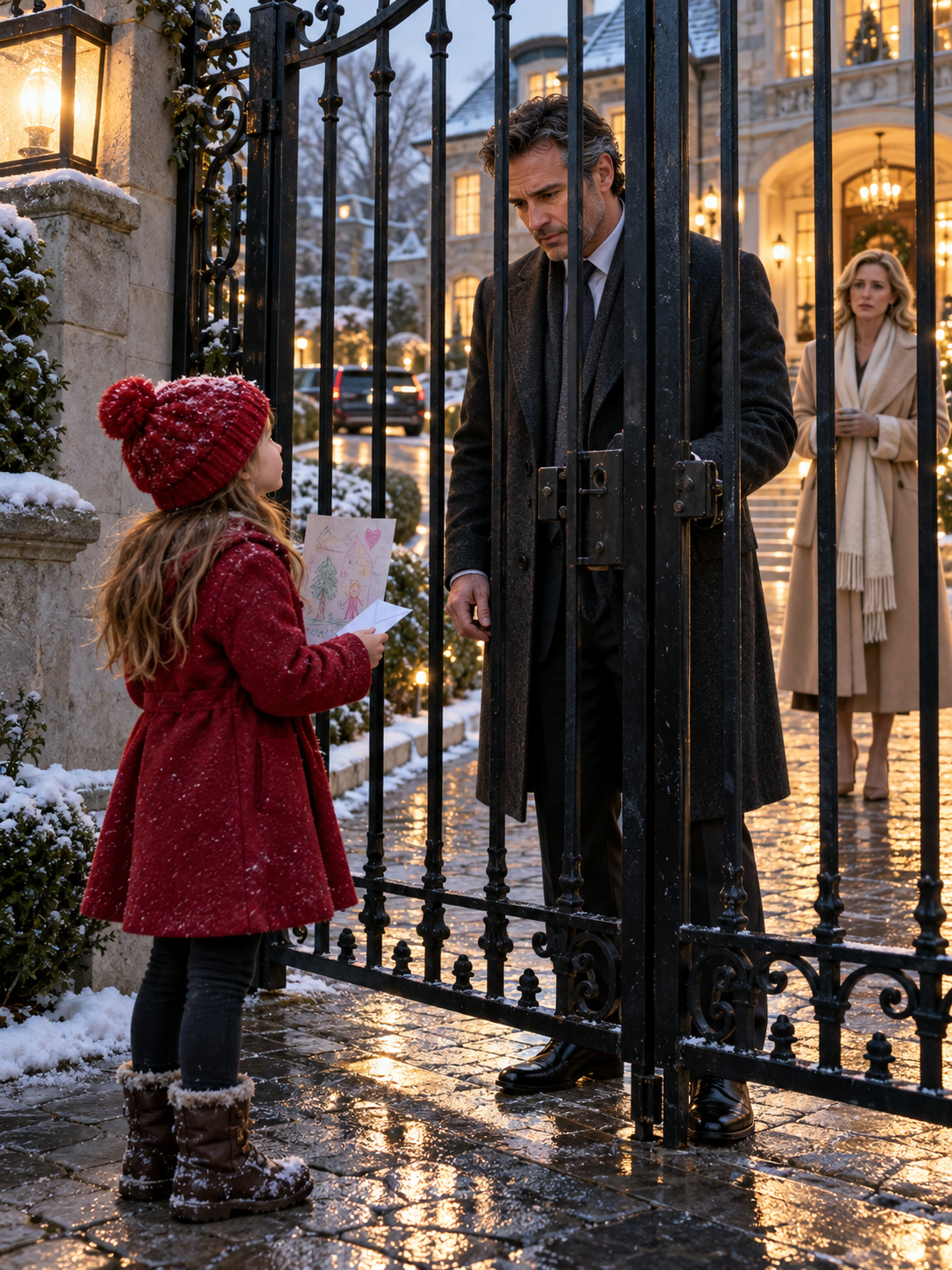
THE BILLIONAIRE REFUSED TO GIVE A SIX-YEAR-OLD GIRL A JOB AT HIS IRON GATE—THEN SHE NAMED THE WOMAN WHO HAD TRIED TO SAVE HIS FAILED COMPANY – Life Story
The little girl pushed a handwritten sign against the iron gate, as though the paper might persuade the man on...

The CEO Said I Could Never Build a Supercar—Then Her $20 Million Apex Failed in Front of 200 Guests – Life Story
Alexandra Holt stood in the middle of my garage, looked at the grease on my sleeves, and told me in...