“Let her sit with the other computer kids,” my father laughed when we arrived at the Silicon Valley Innovation Awards.
“Let her sit with the other computer kids,” my father laughed when we arrived at the Silicon Valley Innovation Awards.
At 34, I had spent years listening to my parents and brother dismiss my career as a little IT job.
They tried to move me to table 89 with the interns.
I didn’t argue.
I walked to my assigned seat at table one, knowing my name was already printed in the evening’s program…
The first thing my mother complained about was the seating.
“Table 47, Sarah.
Can you believe that?
Your father and I are practically in the back of the ballroom.”
We were standing inside the Fairmont Hotel, where nearly 2,000 people had gathered for the Silicon Valley Innovation Awards.
Executives, investors, founders, and engineers filled the room in formal clothes.
My mother had barely said hello before she started explaining what she considered a terrible mistake.
“They told us there’s a place for you at table 89,” she said. “With the other young professionals.”
I looked at her.
“Why would I sit there?”
My younger brother Derek gave me the familiar expression he used whenever he thought I was being difficult.
“Because those front tables are for people who actually run companies.”
My father laughed and adjusted his jacket.
“Let her sit with the other computer kids.
She’ll be more comfortable.”
I remember looking at my father for a moment longer than usual.
He wasn’t trying to be cruel.
That was part of what made it hurt.
He genuinely believed he understood my professional standing better than I did.
My mother touched my arm.
“Don’t be embarrassed, sweetheart.
Everyone starts somewhere.
You’ll work your way up.”
I was 34 years old.
I had a PhD in computer science from MIT.
I had founded three companies.
And my parents still spoke about my career as though I repaired printers in somebody’s basement.
I could have corrected them right there.
Instead, I looked down at the badge hanging from my neck.
Dr.
Sarah Mitchell.
Table One.
My family had been assigned table 47 because they were attending as my guests.
I had been seated at table one for the previous three years.
I watched them head toward their seats.
Then I walked in the opposite direction.
My place card was waiting near the front of the ballroom, between Janet Reeves, the CEO of Oracle, and Marcus Chin, the founder of a successful artificial intelligence startup.
Janet stood when she saw me.
.
“Sarah!
Congratulations on tonight.”
“Thank you,” I said, smiling. “Although I still think 34 is a strange age to receive a lifetime achievement award.”
She laughed.
“You’ve spent eighteen years working on cybersecurity.
I think you’ve earned the title.”
I sat down, but my eyes drifted toward table 47.
My mother was studying the program.
Derek was looking around at the guests.
Dad seemed disappointed that his seat wasn’t closer to the stage.
None of them looked toward table one.
That was familiar.
Growing up, Derek was always the one whose accomplishments received detailed attention.
His promotions were dinner-table news.
His supervisors’ compliments were repeated to relatives.
When I tried explaining an encryption project, my father would listen for a few seconds before asking whether it meant I could fix his computer.
At Thanksgiving, I mentioned a major funding round for Secure Cloud Systems.
Dad told me venture capital was probably some kind of pyramid scheme.
At Christmas, I started explaining one of my patents.
Mom interrupted to ask Derek about his promotion.
After enough conversations like that, I learned to stop giving explanations nobody wanted.
.
The evening’s ceremony began.
Awards were presented for startups, mobile technology, and engineering achievements.
Whenever someone returned from the stage, my father leaned forward to watch.
He respected successful people in technology.
He simply didn’t believe his daughter was one of them.
During dinner, Janet asked about the quantum-resistant encryption project my company was developing.
“We’re in beta testing,” I told her. “We’re preparing for commercial deployment.”
Marcus asked how it felt to have sold my previous company for $340 million at 28.
I laughed.
“It was surreal.
Mostly because I still had to figure out what I wanted to do next.”
He knew what came next.
At 25, I had founded Secure Cloud Systems.
At our most recent funding round, the company was valued at $2.8 billion.
Our security technologies protected financial transactions across institutions around the world.
I wasn’t thinking about any of those figures when I first saw Derek walking past our table toward the bar.
He slowed down.
Just slightly.
He looked at Marcus, then Janet, then me.
He didn’t stop to speak.
But I could tell he had heard something.
A little later, the host, technology journalist Amanda Park, returned to the stage for the evening’s final presentation.
“The Lifetime Achievement Award recognizes an individual whose contributions have fundamentally transformed our industry.”
I put down my water glass.
Amanda began describing the recipient’s career.
A teenager developing university network security protocols.
A first company founded at 20.
A second company sold for $340 million at 28.
I glanced toward my family.
Mom had finally stopped looking around the ballroom.
Amanda continued.
“Seventeen patents in encryption technology.
A PhD from MIT.
Founder and CEO of Secure Cloud Systems.”
My father’s expression changed.
Derek stopped moving.
And then Amanda smiled into the microphone.
“Ladies and gentlemen, this year’s Lifetime Achievement Award goes to Dr.
Sarah Mitchell.”
The audience rose.
I stood from table one, adjusted my dress, and walked toward the stage as applause filled the ballroom.
For the first time that evening, all three members of my family were staring directly at me.
But the moment that stayed with me wasn’t their surprise.
It was what I saw when I stepped away from the microphone and returned to my seat.
Derek was already coming toward me.
His face looked nothing like it had when he told me the front tables were for people who actually ran companies.
“Sarah,” he said quietly, “can we talk?”
He glanced back at our parents.
Then he asked a question that explained more about the last ten years of our family than he probably realized.
“Why didn’t you tell us who you really were?”
THE NEXT PART IS BELOW 👇 Don’t forget to switch from “Most Relevant” to “All Comments” to continue reading more 👇
IF FACEBOOK BROUGHT YOU HERE, HERE’S THE CONTINUATION YOU’VE BEEN WAITING FOR.
ENJOY!
I followed Derek toward a quieter corner near the ballroom windows.
Behind us, people were still talking about the awards.
Servers collected dinner plates, and guests moved between tables to congratulate the winners.
Derek stopped beside the window.
“I didn’t know,” he said.
“Know what?”
“Any of it.
The companies.
The patents.
The money.” He rubbed his forehead. “Two point eight billion dollars, Sarah?”
“That’s the company’s valuation, Derek.
Not the balance in my checking account.”
He nodded, embarrassed.
Then came the question again.
“Why didn’t you tell us?”
I looked at my brother, trying to decide whether he genuinely wanted an answer.
“Do you remember Thanksgiving?”
He frowned.
“Which Thanksgiving?”
“Last year.
I mentioned Secure Cloud’s latest funding round at dinner.”
He thought for a moment.
“Dad said something about investors.”
“He said venture capital was a pyramid scheme.
You laughed, and Mom asked about your promotion.”
Derek looked away.
“At Christmas,” I continued, “I explained that we had patented another encryption system.
Mom said computer talk was boring and asked whether you were getting a raise.”
“We didn’t understand what you meant.”
“You didn’t ask.”
He didn’t answer.
I reminded him that I had invited our parents to hear me speak at a cybersecurity conference the previous year.
They had declined because they were busy.
He knew about the invitation.
I could see him remembering it.
“We thought you were exaggerating,” he finally admitted.
That hurt more than the seating arrangement.
Not because I needed my family to understand every technical detail of my work.
Most people don’t understand advanced encryption, and I don’t expect them to.
But there is a difference between not understanding someone’s work and deciding that person must be exaggerating about it.
“You thought I was pretending to be more successful than I was?”
Derek’s silence answered for him.
When I returned to table one, several colleagues congratulated me again.
Marcus introduced me to investors interested in our next project, and Janet mentioned a possible partnership.
These were conversations about work I loved.
For a little while, I let myself enjoy them.
Then my mother approached.
Her eyes were red, and her mascara had smudged slightly.
“Sarah, sweetheart, I don’t know what to say.”
I stood.
“You don’t have to say anything tonight, Mom.”
“But we didn’t know.”
I looked at her.
“You didn’t want to know.”
She shook her head.
“That’s not fair.”
So I reminded her about the time I’d told her I founded Secure Cloud Systems.
She had asked whether that meant I had finally stopped playing with computers.
I reminded her about my PhD research and the keynote invitation she had declined.
“I thought you were making everything sound more important than it was,” she admitted.
I had expected something like that from Derek.
Hearing it from my mother was harder.
“Why would I need to exaggerate my career to you?”
She started to answer and stopped.
My father came over before she found the words.
He stood beside her, looking uncomfortable in a room where he had spent the evening admiring other people’s accomplishments.
“Sarah, I was wrong.”
I waited.
“I shouldn’t have made that joke about the computer kids.
And I shouldn’t have assumed you belonged at the back.”
“It wasn’t just tonight, Dad.”
“I know.”
“Do you?”
He looked at me, and for once he didn’t interrupt.
“You’ve spent years telling me what kind of career I have without ever asking what I actually do.”
He lowered his eyes.
“I was wrong about that too.”
Mom asked whether we could fix things.
I wanted to say yes.
I also wanted to ask why it had taken a ballroom full of strangers applauding me before my own family became curious.
Instead, I told them I would be back the following week.
“If you want to talk then, we can.
But I don’t want another conversation where everybody apologizes and then goes right back to the way things were.”
Derek nodded.
“That’s fair.”
We left the ballroom separately.
At my hotel, I placed the crystal award on the desk near the window.
My phone was full of congratulatory messages from colleagues and friends.
I answered a few.
Then I sat looking at the award.
It was beautiful.
I was proud of it.
But the strange thing about that night was how little the applause had changed my feelings about my work.
I had loved cybersecurity before anyone gave me a trophy.
I loved solving complicated problems.
I loved watching our engineers develop something that made people safer.
My parents’ disbelief had not stopped me from doing that work.
It had only kept them from knowing an important part of my life.
Three weeks later, Mom called.
“Your father and I have been talking,” she said.
I waited.
“We’d like to visit your office.
Not just stop by for lunch.
We’d like you to show us what your company actually does.”
That was different.
I agreed.
They arrived on a Thursday morning with Derek.
I took them through our security operations center, where employees monitored threats, and into the development areas where engineers worked on new encryption systems.
Derek asked questions about the technology.
Some were basic.
A few revealed that he still misunderstood what we did.
But this time he listened to the answers.
Mom asked what happened when a company experienced a security breach.
Dad wanted to know how our team protected information traveling between systems.
Nobody laughed when I explained something complicated.
When we reached my office, Dad stopped in front of the framed patents on the wall.
Beside them hung my MIT diploma and photographs from professional conferences.
He studied a picture of me speaking to a large audience.
“What was this one?”
“A cybersecurity summit.”
He nodded slowly.
“Is this the one you invited us to?”
“Yes.”
He looked at the photograph for another moment.
Then he said something I hadn’t expected.
“I missed all of this.”
I stood beside him.
“You did.”
He turned toward me.
“I was so busy telling you what I thought you should be doing that I never asked what you were actually doing.”
His voice was quiet.
“I should have been proud of you years ago.
Not just after seeing you accept an award.”
I didn’t immediately forgive him.
I didn’t need to.
For the first time, he had acknowledged what had actually been missing.
It wasn’t recognition from the technology industry.
It was ordinary interest from my family.
The kind of interest parents show when they ask how your day went and stay long enough to hear the answer.
Over the following weeks, things changed in small ways.
Mom stopped referring to my work as “computer stuff.” She began asking about our encryption research.
Derek sent me an article about a cybersecurity development and asked whether the reporting was accurate.
Dad called after reading about a data breach and wanted to understand how systems like ours could help prevent similar incidents.
Sometimes their questions were awkward.
Sometimes I had to explain the same thing twice.
And sometimes I still caught myself expecting someone to change the subject.
Ten years of being dismissed doesn’t disappear because somebody starts asking questions.
But I noticed the effort.
The crystal award now sits in my office at Secure Cloud headquarters.
When visitors ask about it, I talk about the engineers and researchers whose work made our achievements possible.
I don’t tell them about table 47.
That’s a different kind of story.
Not long ago, I spoke at a conference for women in technology.
Afterward, a young software developer approached me.
She told me her family didn’t understand her career.
They thought she spent her days playing games on a computer.
She wanted to know how to make them take her seriously.
I remembered myself trying to explain patents over Christmas dinner while my mother asked Derek about his next promotion.
“Keep doing work that matters to you,” I told her. “Share what you’re proud of.
But don’t spend your whole career waiting for someone else to decide it’s important.”
She thanked me.
I thought about that conversation on my way home.
For years, I had hoped that one more explanation, one more achievement, or one more invitation would finally make my parents interested.
Eventually, I stopped trying.
The award ceremony hadn’t made my work more valuable.
It had simply made it impossible for my family to keep ignoring it.
Our next family dinner is scheduled for Sunday.
Mom called yesterday to ask whether I wanted to bring anything.
Then she asked about our latest project.
I told her we were working on encryption designed to withstand future quantum computing attacks.
She paused.
“Sarah, I don’t understand what quantum-resistant means.
Could you explain it to me when you come over?”
“Of course, Mom.”
“Good,” she said. “I’d like to understand.”
It was such a small conversation.
No applause.
No stage.
No crystal award.
Just my mother asking a question and being interested in the answer.
I hung up and went back to work.
The woman who had tried to send me to table 89 with the interns was finally willing to learn what I did.
It didn’t erase all the dinners, the jokes, or the years when I felt invisible.
Our relationship still needed work.
But for the first time in a long while, I was looking forward to sitting around my parents’ table.
Not because they knew I was successful.
Because they were finally getting to know me.
THE END.
I’ve shared the complete story, and I truly hope it touched your heart.
If this story moved you, please , like, and share the post.
Thank you for reading! ❤️
Recommended Stories

She Ran Into an Elevator to Escape Her Cruel Ex—But the Ruthless Mafia Boss Inside Made One Promise That Changed Her Life Forever
Part 1 “GET BACK HERE, MADELEINE!” Derek Lawson’s furious voice thundered down the marble hallway of Chicago’s Langham Hotel. Madeleine...

“My wife vanished on our 45th anniversary and was returned two days later in a wheelchair, gripping my sleeve in total silence. My daughter-in-law warned me she was losing her mind, but late that night, a hidden note fell from her clothes: ‘Don’t let them know you’ve read this.’ What followed made my blood run cold.”
Part 3 (FULL ENDING) The air in the room was suffocating. Chloe stood by the dresser, scrutinizing the floor with...
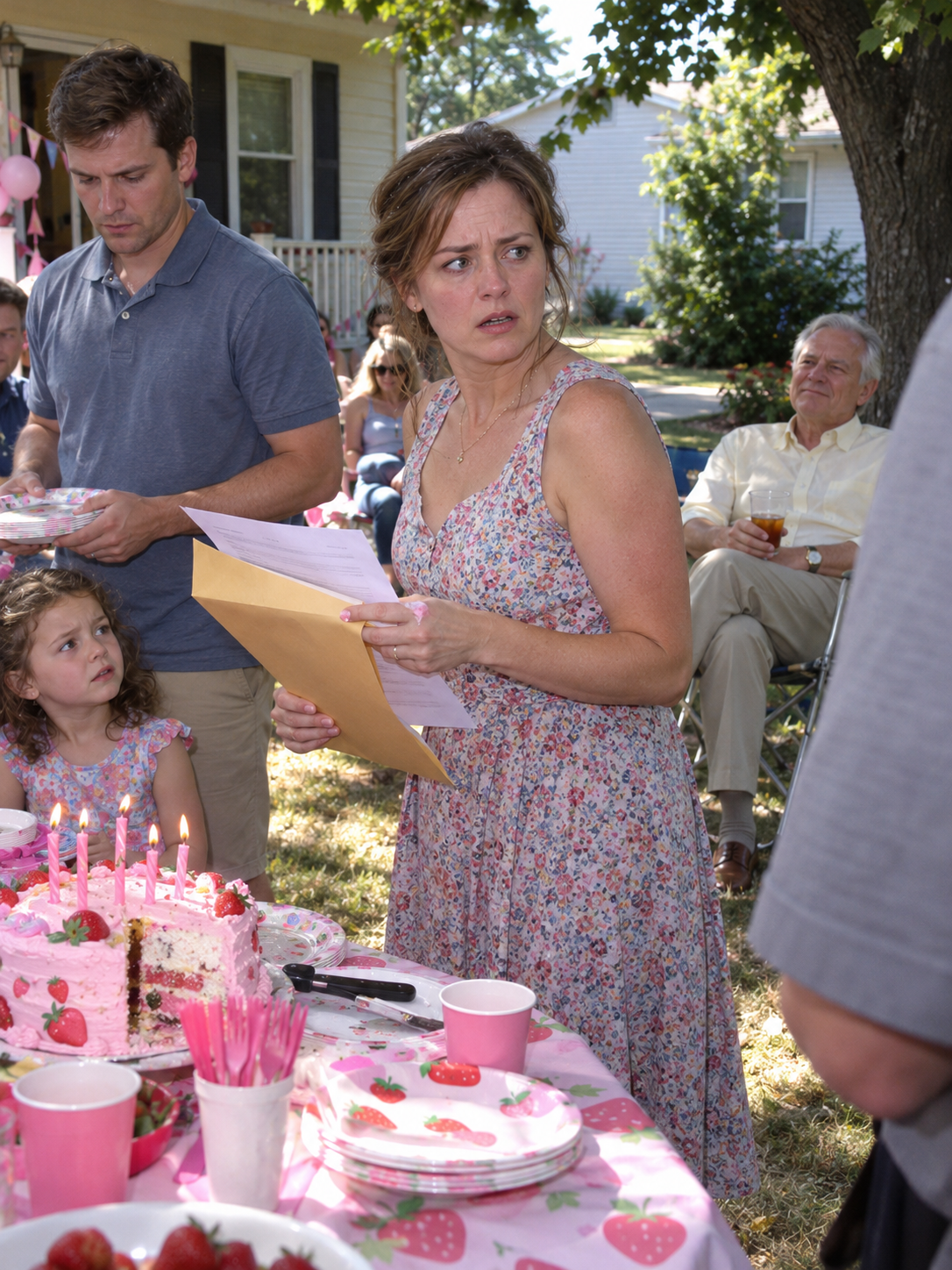
My father-in-law had me served with a lawsuit while my daughter stood over her fifth birthday cake.
My father-in-law had me served with a lawsuit while my daughter stood over her fifth birthday cake. “You’re just a...