On the morning my divorce was finalized, I went back for the boxes my late mother had left in the attic.
On the morning my divorce was finalized, I went back for the boxes my late mother had left in the attic.
My former mother-in-law blocked the porch and screamed, “Get out of my house!” For six years, my husband had let her treat me like a nobody.
This time I smiled and told her the house was already sold.
Then I mentioned what the company board had decided…
My divorce became official at 11:14 on a Tuesday morning.
I remember the exact minute because I had spent most of the hearing watching the courtroom clock, afraid to believe that six years of marriage could end with a few sentences from a judge.
When the ruling came, I felt relief before I felt anything else.
Not happiness.
Not triumph.
Just the unfamiliar sensation of having a decision about my own life finally settled.
My name is Athena Marsh.
I’m thirty-two, and until that morning I was married to Julian, a man who could speak confidently to a room full of executives but somehow lost his voice whenever his mother insulted me.
We were sitting at separate tables in the courtroom.
Julian wouldn’t look at me.
His mother, Loretta, sat behind him, straight-backed and watchful, as though even a divorce hearing was something she intended to supervise.
The judge finalized the divorce and awarded me my fair share of our marital assets.
I listened carefully, because for years I’d been told I was asking for too much whenever I asked for basic respect.
I had come to expect an argument over even the smallest thing.
This time the decision didn’t depend on whether Julian found it easier to agree with his mother.
When we got up to leave, I resisted the habit of looking toward him to see how he wanted me to behave.
That habit had become so ordinary I scarcely noticed it anymore.
At his family’s dinners, if Loretta made a remark about my clothes or manners, I’d glance at Julian.
He’d study his plate, change the subject, or pretend he hadn’t heard.
Afterward, he would tell me I knew how his mother was.
Yes, I knew.
That had always been the problem.
Loretta’s family had lived in the same house for two generations.
It was a substantial home with a front porch she treated almost like a receiving line, a place where people were expected to greet her properly and leave with a pleasant opinion of the family.
For six years I walked through that front door trying to get something right.
If I spoke confidently, I was showing off.
If I stayed quiet, I had nothing interesting to contribute.
If I disagreed, I was disrespectful.
If I agreed, I apparently lacked a mind of my own.
Her favorite observation was that I wasn’t sophisticated enough for Julian.
Sometimes she said it directly.
Other times she wrapped it in advice, explaining how a woman married into their family ought to dress, speak, or carry herself.
She could turn an ordinary holiday meal into a small examination I had not known I was taking.
Julian would hear it, give me a warning glance not to react, and move everyone along to dessert.
I tried, especially early in our marriage, to believe he was keeping the peace.
I told myself that challenging his mother would only cause a larger fight and that we could build our own life away from those remarks.
But peace that always requires one person to absorb the insult isn’t peace.
It’s an arrangement, and I was the person paying for it.
The strangest thing was that Loretta’s picture of me had never matched the work I actually did.
She thought of me as a wife who had married into a successful family and should be grateful for it.
Julian rarely corrected her.
It was easier for him if she believed I was somebody he had to provide for, somebody whose opinions about the business were sentimental rather than informed.
But years before our marriage collapsed, I’d put my own money and my own reputation into helping the company Julian’s father had built.
The business was in trouble then.
It had reached a point where past family success wasn’t enough to cover what the numbers were saying.
I worked through financial information, drew on professional relationships I’d built independently, and spent more sleepless nights than I care to count helping with a restructuring that gave the company a fighting chance.
It wasn’t glamorous work.
The conversations were difficult, and not every problem had an answer anybody liked.
Sometimes what I contributed was a useful contact; sometimes it was a question people around the table preferred not to hear.
But the work mattered.
The company survived a period when its future had genuinely been uncertain, and I was proud to have helped.
That involvement did not disappear when Julian and I started having problems.
I held shares.
I sat on the board.
I had responsibilities that existed whether or not my husband wanted to discuss them over dinner.
Loretta either didn’t understand those facts or chose not to.
To her, the important person was the son who carried the family name and occupied the chief executive’s office.
At first I assumed Julian would eventually tell her how much I’d contributed.
Then I learned that he liked the story she told.
In that story, he was the leader and I was a fortunate bystander.
If I pointed out a concern about the business, he could dismiss it as interference from his wife.
If I quietly helped solve a problem, the result became another example of the family’s talent for taking care of itself.
Over the final two years of the marriage, my concerns about his leadership grew beyond our personal differences.
I reviewed performance, sent written memos, and raised questions at board meetings.
I could see targets being missed and decisions postponed.
The company was not an abstraction to me.
Hundreds of people depended on it for paychecks, health coverage, and stability.
Their livelihoods mattered more than whether Julian enjoyed being challenged.
Julian treated my warnings much as he’d treated complaints about his mother.
I was making too much of things.
I should stop worrying about matters that weren’t my concern.
He seemed to believe that if he could convince me to be quiet, the underlying problems would become quiet as well.
Business numbers, unlike dinner guests, are not particularly interested in keeping a family comfortable.
Eventually our marriage reached the point where continuing it meant pretending that both of us were people we were not.
I filed for divorce.
I had no desire to drag every ugly dinner-table conversation into public view.
I wanted a fair outcome, some room to breathe, and a chance to live without waiting for permission to disagree.
I also remained responsible for the company decisions in front of the board.
The financial and operational concerns had been under review for months, independently of the divorce.
I knew Julian would eventually interpret any professional consequence as a personal attack.
That didn’t change the figures or the warnings he’d been given.
On the morning the court ended our marriage, another important decision was reaching its conclusion.
The board had reviewed the evidence concerning Julian’s performance.
The meeting that followed my hearing would settle whether he could continue as CEO.
I was not acting on a sudden temper, and I wasn’t entitled to remove him by simply announcing that I wanted him gone.
A board has to make that decision; its members have obligations beyond one family’s feelings.
After court, I still had one personal errand.
Several boxes belonging to my late mother were stored in the attic of the family house.
I’d left them there during the marriage, always expecting I’d have time to bring them to a place of my own.
They weren’t particularly impressive from the outside.
They mattered because they were hers, and I wanted them away from a house where I no longer intended to spend another holiday pretending everything was fine.
I drove to the house and pulled into the familiar driveway.
My old key was still in my pocket.
That morning I’d had the legal right to use it, and I knew the house’s status was no longer what Loretta imagined.
Still, the sight of the porch brought back the old instinct to check my clothes and prepare a polite greeting.
Six years of practice doesn’t disappear because a judge signs a decree.
Loretta was already outside when I got out of the car.
Her arms were crossed, her feet planted squarely in front of the door.
She didn’t ask whether I was there to collect anything.
She didn’t ask how the hearing had gone.
From the expression on her face, she seemed to believe her son’s divorce meant she could finally say aloud what she’d spent years implying.
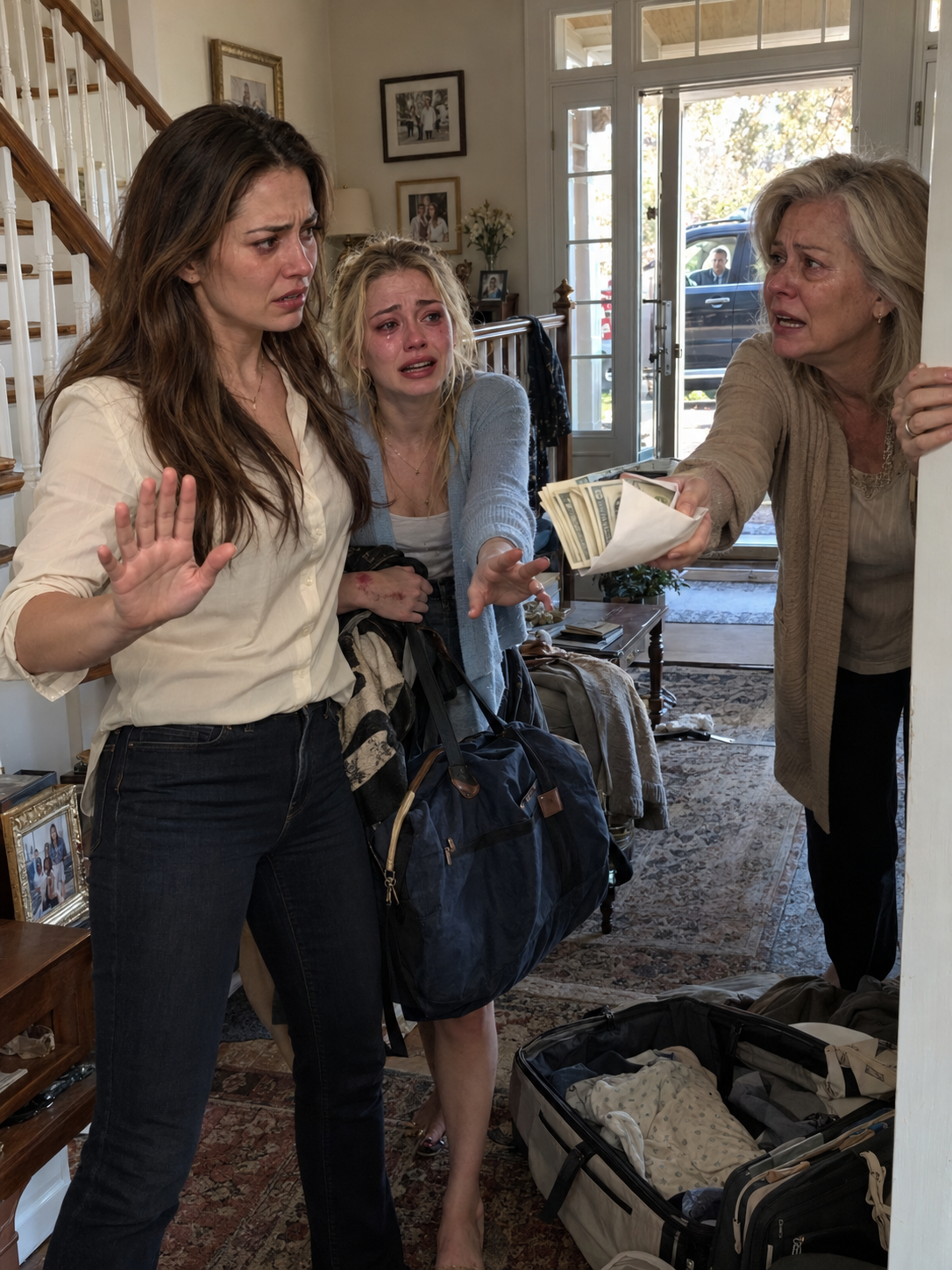
“Get out of my house!” she shouted as I reached the steps.
Her voice carried across the quiet street.
I saw a curtain move in a neighbor’s window. “Don’t ever set foot in my house again.
Get out!”
For a second, the woman I’d been throughout that marriage almost answered.
She would have apologized for arriving unexpectedly.
She would have explained the attic boxes, promised to be quick, and tried to convince Loretta she wasn’t causing trouble.
I could feel that old response forming before I remembered that I was no longer required to make this easier for either of them.
Instead, I stood still and looked at her.
She was waiting for tears, an argument, anything that would let her end the scene as the injured owner defending her home.
I had something much simpler than an argument.
I knew what had happened to the house, and I knew the decision the company board had just made.
So I smiled, not because her words were funny, but because I was finally able to answer without asking myself whether Julian would approve. “Actually,” I said quietly, “I already sold this house.”
Her arms fell to her sides.
She stared as though I’d used a word she didn’t recognize.
Before she could recover, I added, “And I just fired your son as CEO.”
Her face changed.
First disbelief, then confusion, then the beginning of fear.
She caught the porch railing with one hand. “That’s impossible,” she whispered. “You don’t have that kind of power.
You never did anything for this family except take.”
.
I shook my head.
I told her I’d invested my own savings, connections, and years of work in the company, and that the board had reviewed Julian’s leadership for months.
Its decision was final.
None of that required Loretta to believe in my abilities.
It only required the people entrusted with the business to examine what had actually happened.
“You wanted me out of this house,” I told her as I stepped back toward the driveway. “Consider it done.
I won’t be coming back.
But you may want to sit down before you call Julian.”
Then I turned toward my car.
Behind me, Loretta said nothing.
I left her on the porch, looking at the home she had been so certain she could command, and drove away without looking back.
For once, she didn’t get to decide when our conversation was over.
CHAPTER 2
Three hours after I left the porch, Julian called.
I was sitting in my car outside a coffee shop, watching steam curl out of the cup in the holder beside me.
I’d been telling myself I needed to think about what came next, but mostly I was enjoying the ordinary quiet.
Then his name lit up my phone, and I knew exactly what his mother had told him.
“What did you do?” he demanded.
No hello, no question about the divorce hearing. “My mother says you sold the house and I’m not CEO anymore.
Tell me this is a joke.”
“It’s not a joke,” I said. “The board voted this morning.”
He went silent for a moment, as though he expected me to add that I’d only been trying to upset Loretta.
I didn’t.
Reynolds had presented the quarterly numbers to the board.
Julian had missed three consecutive earnings targets, two major contracts had gone to competitors, and employee culture surveys from the last two quarters were worse than any the company had seen in ten years.
“I didn’t write those numbers, Julian,” I told him. “You did.”
He started breathing harder.
Usually he’d say I was taking things personally, or promise we’d discuss them when he had more time.
Sometimes he’d change the subject to my tone, as though a softer voice could improve a financial statement.
This time he said, “You could have warned me.”
For one foolish second, I felt the familiar urge to protect him.
I wanted to explain things gently enough that he wouldn’t feel embarrassed.
That reflex surprised me, because the hearing had been over for hours.
Apparently six years of taking responsibility for another person’s comfort doesn’t vanish when a judge announces a divorce.
“I’ve been warning you for two years,” I said. “I sent memos.
I raised concerns in board meetings.
I spoke to you privately.
You told me to stop worrying about things that weren’t my concern.”
I remembered sitting with difficult figures in front of me, wanting him to look at them instead of treating every question as an insult.
I’d never expected him to enjoy criticism.
I’d only wanted him to recognize that running a company required listening to people who brought unwelcome facts.
His father had built something that mattered.
The employees had kept it alive through hard periods.
Julian seemed to hear only the challenge to his authority.
He took a breath, then asked if this was punishment for the divorce.
That was easier for him to believe: an angry former wife seeking revenge.
It was harder to face the possibility that his own decisions had been examined and found wanting by people other than me.
.
“No,” I said. “Four hundred and twelve people work there.
They deserve leadership that takes their livelihoods seriously.
This isn’t about what happened between us.
It’s about accountability.”
He began to argue, but I ended the call.
Not to win a point or make him suffer.
I knew how our conversations went when he decided my explanation couldn’t possibly be the whole truth.
We would travel in circles until I was defending my right to speak at all.
I had nothing new to tell him, and the board’s decision didn’t become less real because he refused to hear it.
I sat with the quiet afterward.
I didn’t feel as pleased as I’d expected.
I knew losing the position would frighten him.
I’d once loved him, and I remembered the man I’d hoped he could become.
But feeling sorry for him wasn’t a reason to ignore what he’d done, either to our marriage or to the company.
I put down my phone and finished the coffee.
For the first time that day, I wasn’t waiting for another member of his family to tell me who I was.
CHAPTER 3
That evening, I met Priyanka Osei at a small restaurant downtown.
She was the board’s newest independent director, and she’d become someone I could speak to without worrying that every observation would be recast as an attack on Julian.
She didn’t pretend the situation was simple because a vote had been taken.
A company still had to function the next morning.
Employees still needed direction, and customers needed confidence that somebody was paying attention.
Months earlier, Priyanka had approached me quietly with spreadsheets.
She’d examined information that confirmed what I feared: missed targets, lost contracts, and evidence that the workplace itself was suffering.
We weren’t looking at abstract lines in a report.
Behind each disappointing quarter were decisions that affected workers who had no seat at our family dinner and no power to change what was happening.
She hadn’t come to me because I was Julian’s wife.
She’d come because I sat on the board, knew the business, and had participated in the restructuring that helped it survive a previous crisis.
That distinction mattered.
During my marriage, I had repeatedly been invited to accept credit only when it was harmless, in the vague language of being supportive.
The actual work involved difficult figures, difficult conversations, and judgment calls.
Priyanka understood that.
She didn’t ask me to be humble about my contribution, and she didn’t ask me to exaggerate it, either.
We could discuss what I knew without spending half the conversation defending why I knew it.
Over dinner she slid a folder across the table. “The board is unanimous,” she told me. “They want you to step in as interim CEO while we conduct a proper search.”
I looked at her, then down at the folder.
I’d spent the afternoon repeating that this wasn’t personal revenge.
I meant it.
Still, an offer like that, arriving on the same day my divorce became final, was difficult to take in.
Six years of being treated as though I wasn’t capable of understanding the family business had left marks I couldn’t erase simply by proving somebody wrong.
Priyanka reminded me that my earlier restructuring work was part of why the company had survived its worst period.
People remembered it, even if Julian and Loretta preferred their version of events.
I wanted to be careful with that praise.
It didn’t make me the only person who had saved the business, and it certainly didn’t mean one person’s intelligence could replace sound governance.
In fact, that kind of thinking was part of what had brought us here.
I asked about the transition.
The board would need stable interim leadership and a genuine search, not another family appointment dressed up as a business decision.
The company could not afford to keep treating a familiar surname as a substitute for performance.
And no employee should have to wonder whether speaking honestly would put a target on their back.
As Priyanka described the board’s expectations, I thought about Julian’s phone call.
He had asked why I hadn’t warned him.
Priyanka had brought me evidence months before the vote; I had brought him warnings for two years.
Those conversations existed.
They simply hadn’t produced the answer he wanted, so in his mind they hardly counted.
I realized I was still thinking about how he would react to my decisions.
I set that concern aside and looked again at the folder.
The question in front of me wasn’t whether Julian would call it betrayal.
It was whether I could accept a demanding role for the right reasons, with enough oversight to protect the people depending on the company.
I knew what my answer needed to include.
I just wasn’t going to say yes on the assumption that the title alone would fix anything.
CHAPTER 4
“I’ll do it,” I told Priyanka, “but only if we put real oversight in place.
Not family favoritism dressed up as leadership.
Real accountability.”
She smiled and raised her glass slightly. “That’s exactly why the board chose you.”
Priyanka wasn’t asking me to be impressive at a dinner table or to prove I deserved to stand beside Julian.
She was asking whether I would do a job and accept the scrutiny that came with it.
I could answer that question on the strength of my work, not my marriage.
I wasn’t naïve about what I’d agreed to.
Interim CEO wasn’t a trophy to carry home after an ugly divorce.
There would be responsibilities, decisions people disagreed with, and questions I couldn’t solve by having been right about Julian.
A proper search meant I might not remain in the role.
Oversight meant my own judgment would have to stand up to challenge.
Those conditions were reasons to take the position seriously, not reasons to refuse it.
I thought of the 412 employees whose lives had barely appeared in Julian’s description of what had happened.
They hadn’t attended our divorce hearing.
They hadn’t heard Loretta shouting on the porch.
They had jobs and families and ordinary worries.
Some had spent years helping keep the company going.
If I wanted a meaningful break with the past, it would show in how the business was led, not in how satisfying my last conversation with Loretta had been.
That was a lesson I wished Julian had learned.
I could picture him earlier in our marriage, proud of the company his father had built and eager to be seen as its natural leader.
I hadn’t begun by wanting him removed.
I had wanted him to listen.
A warning was not an insult; an uncomfortable number was not disloyalty.
Somewhere along the way, he’d confused being supported with never being questioned.
I had made my own mistakes, too.
I’d stayed quiet too often at family dinners, telling myself I was being patient.
I’d allowed his mother’s opinion to follow me home and shape what I chose to say next time.
I’d expected marriage to mean that if I explained my hurt clearly enough, Julian would eventually stand beside me.
By the end, I understood that love couldn’t be maintained by one person doing all the listening.
I still had my late mother’s boxes to think about.
I hadn’t brought them down from the attic that afternoon.
Those belongings mattered, and I could address them separately.
I didn’t need to step back onto Loretta’s porch that day to prove I’d left her power behind.
When I drove home after dinner, I passed the house again.
For six years, it had stood for all the things I was expected to accept to remain part of that family.
Now I could see it without imagining the next holiday, the next comment, or the next moment Julian would avert his eyes.
I had no reason to stop.
At thirty-two, I was divorced, facing a demanding new responsibility, and more uncertain about the future than any triumphant speech would suggest.
But I was finally free to make decisions without shrinking myself to protect someone else’s pride.
Loretta had wanted me out of her house.
Julian had wanted me out of his business conversations.
Neither had imagined that I could leave the first behind and help lead the second.
I wasn’t proud because they were frightened.
I was proud because I’d stopped treating their approval as the measure of my worth.
The divorce gave me a legal ending.
The board’s decision gave the company an opportunity to change.
And I gave myself something I’d postponed for six years: permission to begin again without apologizing for being capable.
THE END.
I’ve shared the complete story, and I truly hope it touched your heart.
If this story moved you, please , like, and share the post.
Thank you for reading! ❤️
Recommended Stories

SHE MISSED HER NURSING FINAL TO KEEP A STRANGER ALIVE, BUT HER DEAN ERASED FOUR YEARS OF WORK—UNTIL THE WOMAN FROM THE SIDEWALK CAME LOOKING FOR ANSWERS – Life Story
Emma Bradley knelt beside a bleeding stranger while the bus to her nursing final opened its doors. If she stayed,...
LLT. My sixteen-year-old sister let me take the blame for her pregnancy, then laughed while our parents and church drove me from home
FULL STORY CONTINUATION IF FACEBOOK BROUGHT YOU HERE, HERE’S THE CONTINUATION YOU’VE BEEN WAITING FOR. ENJOY! 👇 CHAPTER 2 Before...

MY WIFE SAID HE WAS JUST AN OLD FRIEND—THEN I READ THEIR MESSAGES MOCKING OUR MARRIAGE AND PREPARED FOR THE CONFRONTATION SHE NEVER SAW COMING – Life Story
The message on my wife’s phone said my apology had been “adorably pathetic,” and the man she’d been sleeping with...