My daughter called me a useless old man. Thirteen days later, I learned she had already paid for the room where she planned to put me.
Part 1:
My wife died in October, and four weeks later my daughter inherited a $4 million beat house in La Hoya, California, while I inherited a rotting fishing lodge in the Wisconsin woods that I believed had been sold 30 years ago.
The day the will was read, my own daughter looked me in the eye, called me a useless old man, and told me I had 19 days to get out of her house.
I was 67 years old with a modest pension, one duffel bag, and a brass key tied to a cork bobber on a piece of fishing line.
So, I flew halfway across the country to a lake I had never seen, climbed a sagging porch, and pushed open a door that, as far as I knew, hadn’t been opened in decades.
What I saw inside stopped me where I stood.
Hello, my dear friends, and welcome.
Before we begin, if you [clears throat] enjoy stories like this one, take a second to like the video and subscribe, and tell me in the comments where in the world you’re listening from.
I love seeing how far these stories travel.
A quick note: parts of this story are fictional, but the message behind it is what truly matters.
Now, pull up a chair and let me take you back to the day it all started.
The 14th floor of the Estes and Witcom building has a view of San Diego Bay that costs more per square foot than anything I built in 40 years of running road cruise.
I sat there in my one good sport coat, hands on my knees, listening to an attorney named Marian Est shuffle paper.
Part 2:
Helen had been gone 28 days.
I was still setting out two coffee cups every morning before I remembered.
Across the long walnut table sat my daughter Camille, 38 years old, in a cream colored suit that probably cost what my first pickup did.
Next to her sat her husband, Trent, who spent the whole meeting checking his watch.
Camille sells luxury real estate.
She leaned toward Marion the way people lean toward a slot machine.
“This is the last will and testament of Helen Hollis Kesler,” Marian began, together with the Hollis Kesler family trust.
She read in a calm, even voice.
“To our daughter, Camille.”
Helen left the house at 6120 Bird Rock Terrace, appraised at $4.2 million.
The investment accounts, $2.9 million.
Her shares in the family engineering firm, 2.1, $9.2 million in all.
Camille’s hand found Trent under the table and squeezed.
Marian turned a page.
“To my husband, Walter Kesler, I leave the property known as Pine Hollow Lodge on Lon Hollow Lelk in Vias County, Wisconsin. 212 acres, a main lodge, a boat house, and outbuildings.
County assessed value, $164,000.”
I thought I had misheard.
Pinehollow was the fishing camp Helen’s grandfather built in 1938, where she learned to swim and to tell time by the call of the loons.
But her father lost it to debts before she finished college.
She told me so the week we got engaged, with her eyes on her coffee.
The way she talked about things that still hurt, and I never raised it again.
For 41 years, I believed that lodge belonged to strangers.
“Wait,” Camille said. “That falling down fishing shack?
Mom’s family sold that ages ago.”
“It was never sold,” Marian said evenly.
Helen kept it.
Camille laughed, and it wasn’t a happy sound.
“So, Dad gets a rotting cabin in the middle of nowhere and I get—”
She stopped, but she had already done the math across her face.
I asked about the house where I had lived for 16 years.
Marianne explained kindly that it had come to Helen from her aunt Beatatrice before we married, which made it Helen’s separate property to leave as she saw fit.
My pension, my savings, and our old truck were mine.
There is no gentle way to learn that the place you called home was never legally yours.
But she found one.
“He can’t manage a property like that,” Camille said to Marion.
Not to me. “Be honest.
He’s a useless old man.
He’ll freeze to death out there or burn the place down.”
“Camille,” Trent murmured, with all the force of a man reading a menu.
I had run a crew of 40 men and plowed county roads through blizzards that closed the interstate, and I sat there and said nothing because a man who buried his wife four weeks earlier doesn’t have much fight in him.
That is an ugly thing to learn about yourself.
Marian slid a cream colored envelope across the table.
Helen’s handwriting.
“Walt, open this at the lodge, not before.”
Beside it, she set the key.
“She was very specific,” Marian said. “She asked that you read it there and nowhere else.”
That evening, a legal-sized envelope sat on the kitchen counter with my name on it.
Notice to vacate.
Camille leaned against the island with her arms folded.
“19 days,” she said. “That’s the Tuesday before Thanksgiving.
It’s generous, Dad.
I’m listing the house in January, and buyers don’t want an old man’s recliner in the photographs.”
She tapped the counter.
“And don’t take anything that isn’t yours.
Mom’s jewelry, the art, the silver.
Trent made an inventory.
Those were your mother’s things, and now they’re mine.”
That night in the guest room, I thought about the last night of my wife’s life.
We had put a hospice bed in the sun room so she could see the Pacific.
Camille had come twice in 14 months of illness, 20 minutes each time, mostly on her phone.
Around 3 that morning, Helen woke.
Her hand found mine, light as paper.
“Trust the lake, Walt,” she whispered. “Everything you need is on the water.”
I thought she was drifting back to girlhood.
“Okay, Helen.”
“And don’t sign anything for anybody.
Promise me.”
“I promise.”
She died as the light came up over the ocean.
Now, 19 days from being a man with no address, I turned that brass key over in my fingers and wondered what my wife had been doing for 40 years that she couldn’t tell me.
On the fourth day, I flew to Minneapolis, rented a pickup, and drove nearly 5 hours east and north into country that got quieter with every mile.
Snow was just starting, small dry flakes that don’t stick yet.
In a little town called Maro Creek, I stopped for gas beside dots bait and tackle, and a woman in the window watched me for a lot longer than anyone should watch a stranger buying coffee.
The road to the lodge was a gravel track that wound six miles through the pines.
Alongside it, every h 100red feet or so stood a wooden survey stake with a ribbon of bright orange tied to the top.
40 years of reading road plans told me what that meant.
Somebody had recently measured this land for something, and nobody had asked the owner.
Then the trees opened, and there was the lake, black and enormous, without one other roof on the whole shoreline.
And at the water’s edge stood Pine Hollow Lodge: gray log walls, a porch that sagged like a swaybacked horse, moss on the roof, shutters hanging by one hinge, a faded sign in the window that said closed.
From the outside, it was exactly what Camille said.
The brass key turned like it had been oiled yesterday.
I pushed the door, and I stopped on the threshold with my mouth open.
It was warm.
That was the first thing.
The air smelled of cedar and wood smoke.
The floor had been swept.
A fire was laid in the stone hearth, and every wall of that great room, floor to rafters, was covered with maps, hundreds of them.
Handdrawn lake surveys with depth soundings in Helen’s small square handwriting.
Plat maps with parcel after parcel shaded green, each stamped with a date, the earliest from 18 years ago.
Jars of water samples lined up on shelves like little soldiers.
And above the fireplace in a frame was a photograph of me at 39 holding a musky as long as my arm.
Beneath it, on a white card:
“Walt, this is where I went on those conference weekends.
I never once lied about the science.”
I sat down on the nearest chair because my legs wouldn’t hold me.
Then I saw the mantle.
In the center was a rectangle clean of dust, shaped like the base of something small and round.
I knew it at once.
Helen’s father carved a cedar lon for her when she was nine, and it had sat on her desk through every house we ever lived in.
My hands shook as I opened the envelope.
“Walt, if you’re reading this, you’re standing in the one place I never had to pretend.
I’m sorry for the secrets.
Please don’t be angry yet because there is more to say, and I can’t say it until the time is right.
Go home, let Camille show you who she’s become.
Don’t sign a single thing, and bring the loon back to the mantle.
It belongs here, and it will do the rest.
Call Marion before you do anything else.
I love you.”
Behind me, the door creaked.
The woman from the bait shop stood on the porch with a covered casserole dish and a flashlight.
She was in her 70s with a gray braid and a canvas coat.
And she didn’t look surprised at all.
“Dot Limfist,” she said.
“Helen said you’d come the minute the wheel was red and that you’d stand right there looking like you got hit by a snowplow.”
She set the casserole on the table.
“I’ve kept the heat on and this place swept for her for 18 years.
That’s all I’m allowed to say.
She made me swear on my husband’s grave.”
“Dot.
What is all this?”
“Hers,” Dot said simply. “Eat something.
And Walt, those orange steaks aren’t Helens.
Somebody’s been poking around the county offices.
You go home and do what she told you, then you come back.”
I ate Dot’s casserole by that fire, and in the morning I flew home with a map of the lake folded in my coat and a question I couldn’t answer.
A good road foreman writes down what he can’t explain.
I started a log book that day.
By day nine, strangers were walking through my house with clipboards.
Coastal estate liquidators, said their polo shirts.
Women with price guns stuck orange stickers on Helen’s teapotss.
In the sun room where she had died, a young man was unbolting the hospice rail like garage sale furniture.
Helen’s study was stripped bare.
The desk dragged to the curb.
The contents of the drawers dumped into a rented dumpster in the driveway.
I walked out there in my slippers.
On top of a heap on its side lay a cedar lon with one glass eye staring at the sky.
I climbed into that dumpster.
I’m 67, and the sides were taller than my belt, and I did it anyway.
When I stood up with that carved bird against my chest, shaking banana peels off my sleeves, Camille was on the front steps with her phone in her hand.
“Dad, it’s a duck.”
“It’s a loon.”
“It’s trash.”
She sighed.
“Fine, take your wooden duck.
It’s the last thing you take.”
I wrapped it in a bath towel and put it at the bottom of my duffel bag, and I felt for the first time in a month like a man who had done something.
On day 10, Camille arrived with two guests.
One was a man in a gray suit named Douglas Marsh, an elder law attorney.
The other was a cheerful woman named Brenda from Cypress Point, senior living in Escandido.
At the dining table where Helen and I had eaten a thousand dinners, Marsh laid out a thick stack of papers.
“A general durable power of attorney,” he said in the smooth voice of a man selling extended warranties. “It lets Camille manage your finances and medical decisions while you transition into supportive living.
Brenda can tell you about the garden suite.”
“Transition?” I said.
“Mr.
Kesler, you’re 67, recently widowed with no income but a small pension and a property you’ve never visited.”
He smiled.
“If you decline, Camille would have grounds to petition this in the San Diego Superior Court for a conservatorship.
Aud Judge would be sympathetic.”
Camille didn’t meet my eyes.
I thought of Helen’s hand on mine.
Don’t sign anything.
Promise me.
“I’d like my own attorney to read it.”
“Of course,” Marsh said. “We’ll need an answer by Friday.”
The second they left, I called Mary Estes.
I didn’t wait a day.
She listened and said in a voice like a closing vault, “Walt, do not sign anything and do not speak to Mr.
Marsh without me in the room.
Helen put the lodge and the land around it into an irrevocable trust in your name.
No power of attorney can touch it.
No conservator can reach it.
I can’t tell you more until you’re at the lodge, but you are not as alone as Camille thinks.”
“What land around it?”
Marianne said, “Trust the lake.”
On day 13, the house phone rang while I was alone.
A pleasant young voice said, “Hi, this is Brenda at Cypress Point, just confirming M Kesler’s tour on the 24th.
We have the garden suite reserved and the deposit was paid in August, so we’re all set.”
I gripped the counter.
“What day in August?”
I could hear her typing.
“August 29th, paid by Camille Kesler Ror.”
Helen died October 9th.
On August 29th, my wife was alive in a hospice bed in the sun room, fighting for every breath, and my daughter was putting a deposit on my room.
I wrote the date in my log book, and my handwriting looked like a stranger’s.
That night, after midnight, I came down for a glass of water and heard Camille’s voice in the kitchen, low and bright on speakerphone.
I stopped in the dark hallway.
I did what any foreman does when a worker says something that matters.
I pulled out my phone and pressed record.
A man’s voice, smooth as a salesman’s.
“So the hearing set, and Marsh says it’s a formality, a rubber stamp.”
Camille said, “Once I’m conservator, I sign the lodge over to you, plus everything Mom bought up there, the whole shoreline.”
“Garrett, all 8 miles,” the man said. “I’ll pay 2.1 million and you’ll be a hero.
Your father gets a nice room in Escandido with a view of the parking lot.”
Camille laughed.
“He doesn’t suspect a thing.
He thinks it’s a rotting cabin.
He has no idea what Mom built.”
“And if he figures it out before he signs?”
“He won’t.
We file Monday.”
I held my breath until the call ended.
Then I went back to the guest room, wrote the name Garrett Holloway in my log book, and backed the recording up to the cloud.
Whatever my wife had been building, my daughter knew its price, and I understood that I was being hunted by my own child.
The next morning, she met me at the front door with a check made out to me for $75,000.
“A fair offer for the lodge,” she said. “Take it.
Find a nice place to retire and we can all move on.”
Two weeks earlier, she had called it worthless.
I looked at her beautiful, tired, calculating face, and I searched for the little girl who used to carry the end of a canoe down to the water with me, laughing.
I couldn’t find her.
I tore the check in half and in half again and handed her the pieces.
“I’ll take my chances,” I said.
I left on the 19th day, the Tuesday before Thanksgiving, with a duffel bag, a carved loon in a bath towel, and a log book.
At the San Diego airport, the security agent pulled the bundle out of my carry-on and asked what it was.
“My wife’s bird,” I said, and she let me through without another word.
By late afternoon, I was on that gravel road again, past the orange stakes, through a wet snow that was finally sticking.
Dot had left the porch light on and a fire going.
She stood in the doorway with her arms crossed against the cold.
“Well, I brought the loon.”
I took it out of the towel and set it on the mantle in the clean rectangle of dust.
Something inside the base clicked.
A small deliberate sound like a pocket watch opening.
I tipped the bird over, and a hidden drawer slid out an inch.
Taped flat inside lay a small steel key with a paper tag.
In Helen’s tiny square handwriting, it said, “Boat house loft.
Go alone.
The rest is waiting.”
I stood holding it with the snow ticking against the windows and my pulse going like a jackhammer.
And before I tell you what that key opened, my friends, I want to ask you: leave one word in the comments.
Lack.
I’d like to know how many of you have stayed with me this far.
And a reminder that parts of this story are fictional.
So, if that isn’t what you came for, you’re welcome to step away.
But if you want to know what my wife hid above that boat house, stay right here because the truth is about to come out.
The boat house stood 60 yards down the shore.
A squat gray building with a tin roof.
Inside, the smell of old rope and lake water.
A narrow ladder led to the loft, and my knees complained all the way up.
Under a canvas tarp in the far corner sat a steel foot locker.
The little key slid into the padlock, and the padlock opened with a heavy click.
Inside were three thick binders with colored tabs and one envelope with my name on it.
The tabs read Camille Holloway and the Northshore.
I sat on a coil of rope, held the envelope up to my flashlight, and read:
“Walt, if you found this, then I am gone, and Camille has already tried to take the lodge.
I’m so sorry.
There are three things you need to know.
“First, Camille has stolen from us.”
She took out a home equity line against the house for $410,000 in two draws with my forged signature and a notary who has never met me.
I found out 2 months after my diagnosis when the bank statement came to my office.
I never confronted her.
I couldn’t bear to.
I documented everything instead.
“Second, she has been working with a developer named Garrett Holloway since the month I got sick.
Together, they plan to put you in a care facility, take control of the lodge through a conservatorship, and sell the land.
“Third, Walt, please sit down.
The lodge is the front door to the biggest piece of unbroken shoreline left in northern Wisconsin.
Over 18 years, through a company I formed called Lon Hollow Holdings, I quietly bought 11 neighboring parcels, 1740 acres, 8 and 1/2 m of untouched shore.
“The only road in Crosses the Lodge land a developer would pay nearly any price, but it was never meant for a developer.
The Northwoods Land Conservancy has agreed to buy a perpetual conservation easement and the parcels together for $18,600,000, with a state grant helping.
“The money goes to you.
I put it all in an irrevocable trust in your name.
Nobody can touch it.
Marian is the trustee.
Dot is my eyes.
And an investigator named Lena Ortiz with the sheriff’s financial crimes unit has copies of every page.
“You’ll wonder why I left Camille $9 million knowing what she is.
I couldn’t cut off my own child, so I made her inheritance a door held open instead of a gift.
“If she petitions for control over you, contests the will, or does business with Holloway, she forfeits everything, and the evidence goes straight to Lena.
If she walks through as the girl I raised, she keeps it all.
I prayed she would.
“Don’t forgive her because it’s easy.
If you ever forgive her, do it because she earned it.
“I love you more than I ever managed to say out loud.
“Trust the lake,
Helen.”
I read it three times with my hands shaking so hard the paper rattled.
In the first binder, on two withdrawal slips, a signature I would have known anywhere except the H looped too tight like a coat hanger.
Helen’s H was open and generous.
Whoever wrote this one was in a hurry.
There were bank photographs of my daughter at a teller’s window in a cream colored suit.
In the second binder were Garrett Holloway’s emails with subject lines like off the books, and a draft offer of 2.1 million for the lodge and every parcel around it.
Beneath it, in Helen’s hand: worth $18 million at least.
And a screenshot of a text from Camille sent in August:
“Mom won’t last the winter.
Get the paperwork ready for Dad.
Pay the deposit now before the weight list closes.”
I sat in that cold boat house until the light went gray over the water.
Helen hadn’t spent those 14 months only sick and silent and dying.
She had been fighting a war.
I had held her hand and read mystery novels aloud to her.
And all the while she was building a legal wall around my life brick by brick.
I thought of my daughter on the front steps graciously letting me keep a wooden duck, and something in my chest cracked down the middle quietly the way ice does.
Dot found me there.
She climbed the ladder with a thermos and a bowl of chili and sat on an overturned bucket without asking.
“Three things I’m supposed to tell you,” she said. “One, Holloway and your girl were in town 3 days ago asking the register of deeds about road easements.
Two, Ruth Ellingsson from the conservancy will be here tomorrow at 9 with Marian.
Helen set it up.
Three, eat that chili because you look like death.”
I ate every bite.
I slept that night in Helen’s childhood bunk with the loon watching me from the mantle.
And for the first time since October, I slept.
At 10 9 the next morning, the day before Thanksgiving, a black rental suburban rolled up the drive.
Camille climbed out in a camel coat and sunglasses.
The man who got out of the driver’s side was in his 50s, tan in November, with a perfect silver haircut and a quarter zip that probably cost $400.
I knew his voice before he said a word.
I walked out onto the sagging porch with my phone in my pocket.
“Dad,” Camille called. “We need to talk.”
“No, we don’t.”
Holloway stepped forward with his hand out.
“Mr.
Kesler, Garrett Holloway.
I believe I can offer you a real solution.”
I looked at the hand and left it where it was.
“$6 million cash today.
You sign the deed and you walk away free.”
“6 million,” I said. “For a rotting fishing shack.”
“Dad, take the money,” Camille said. “You can have a nice, comfortable place like Cypress Point.”
She flinched.
Holloway’s smile cooled 10°.
I took out my phone.
“There’s something I want you both to hear.”
My daughter’s voice filled the cold morning, bright and low.
“Once I’m conservator, I sign the lodge over to you, plus everything Mom bought up there.”
Then his voice.
“Your father gets a nice room with a view of the parking lot.”
Then her laugh.
“He has no idea what Mom built.”
The recording ended.
Camille had gone the color of oatmeal.
“That was last week,” I said. “You didn’t know I was in the hall.”
Hol recovered first.
“I don’t know what you think you overheard, but that land is worthless without capital and expertise.”
“Then why are you here?”
“Dad, stop being stubborn,” Camille burst out. “It’s worth $20 million.”
It was so quiet I could hear the lake lapping at the dock.
She froze with her hand over her mouth.
Holloway closed his eyes like a man whose partner has just walked off a cliff in front of him.
“20 million,” I said. “I thought it was a shack.”
A silver Subaru came up the drive.
Mary and Estus stepped out in a long wool coat with her briefcase.
Beside her came a woman in her 50s in a green fleece and hiking boots.
Behind them, Dot Linfist pulled her plow truck sideways across the end of the driveway, cut the engine, and leaned against the hood with her arms folded, with the calm face of a woman at a fish fry.
“Good morning, Walt,” Marian said pleasantly. “I see we have visitors.”
“This is a private conversation,” Holloway began.
“Not anymore.”
Maryanne handed him a set of papers.
“A cease and desist letter, Mr.
Holloway.
The Hollis Kesler Trust names you and Holloway shoreline partners.
Specifically, any dealing between this family and your company triggers the forfeite clause.”
She turned to Camille.
“And this is yours.
If you pursue a conservatorship, a power of attorney, or any business with Mr.
Holloway, you lose the house, the accounts, and the shares.
Everything reverts to your father, and a complete file goes to the financial crimes unit, which I’m told has been expecting it.”
Camille’s hands shook.
“Mom did this.”
“Your mother did everything,” Marian said, not unkindly.
The woman in the fleece shook my hand.
“Ruth Ellingsson, Northwoods Land Conservancy.
Your wife and I spent 6 years on this, Mr.
Kesler.
The option agreement is signed.
The state grant is approved. $18,600,000 and 8 and a half miles of shoreline protected forever.”
She looked at Holloway.
“Your competing inquiries were denied in October.”
Holloway said nothing.
“You told me you had it handled,” he said to Camille, and she didn’t answer.
He climbed behind the wheel of the Suburban and sat there, engine running.
Camille stayed.
She stood in the snow with the papers in her hands, looking at me the way she did at 5 years old when she’d broken something she couldn’t fix.
For a moment, I thought she might say she was sorry.
I thought she might say anything at all.
She folded the papers, walked to the Suburban, and got in beside him.
Dot, with great dignity, moved her truck 8 ft and let them pass.
I sat down on the top step.
Marian put a hand on my shoulder.
“You all right?”
“No,” I said. “But I’m standing.”
That’s the first thing Helen asked me to make sure of.
2 days after Thanksgiving, which I spent eating Dot’s turkey and her pickled beets, an email from Camille arrived.
Marian read it to me by the fire.
Camille announced she would file a probate challenge alleging undue influence and a conservatorship petition as well, since I was living alone in a dilapidated building.
A vulnerable adult, she called me.
“I’m sending her a 48 hour warning,” Marian said. “Notorizzed, copied to Miz Ortiz and the court.
If she files, she forfeits within 72 hours and the criminal referral goes out the same day.”
“She’s proud,” I said.
“Proud people make stupid decisions.”
But she didn’t.
On the second afternoon, Camille’s attorney withdrew every threat in writing.
Not long after, I got Camille’s email.
“Dad, my lawyer has advised me to drop everything.
I accept the terms of Mom’s will.
I keep the house.
You keep the lodge.
We’re done.
Please don’t contact me.”
There wasn’t one word of apology in it.
Not a word about the forged signature or the deposit paid while Helen lay dying.
It read like a woman closing a real estate deal.
I wrote back three sentences.
“You forged your mother’s name while she was dying.
You tried to lock me in a room so you could sell the land.
I am not afraid of you anymore.”
I closed the laptop and sat by the window a long time, watching the lake.
Dot came by that evening with a six-pack of root beer and sat beside me on the porch steps in the cold.
“Helen told me something once,” she said. “She sat at my counter an hour and never touched her coffee.
She said, ‘I keep waiting for Camille to ask what I want to tell her.
All she ever asks is what I’m leaving.’”
My throat closed.
“I told her what my mother told me,” Dot said. “Some people hear enough and think it means not enough.
That’s not your failure.
That’s their choice.”
She finished her root beer.
“Good men don’t go looking for knives in their kids, Walt.
Helen was proud of you.
She said you’d come through.”
In the middle of December, investigator Lena Ortiz drove up to the lodge herself.
She was in her 40s with a nononsense ponytail and a badge on her belt.
“Your wife came to us 12 months before she passed.
She said she sent us everything every month, even from the hospital.
Most organized complainant I’ve had in 20 years.”
She closed her folder.
“We arrested Garrett Holloway on Monday.
Wire fraud, conspiracy, financial exploitation of an elder.”
I thought of that tan hand held out on my porch.
“And Camille, we offered her a deal.
She’ll plead guilty to felony forgery, pay full restitution, and testify against Holloway.
Her dealings with him trigger the trust forfeite clause, so the house and the accounts revert to you.”
Lena paused.
“I’m told she asked whether you’d forgive her.”
“What did you say?”
“That it wasn’t my question to answer.”
The closing happened on the second Friday of January at that same old table with Ruth, Marian, two lawyers from the state, and Dot, who insisted on baking.
It was 18 below at dawn, and the lake had frozen so solid you could hear it grown like something alive.
I signed my name where I was told.
The conservancy would hold those 8 and 1/2 miles forever.
No condos, no marina, no gated road.
The loons would have the lake, and so would any kid who wanted to learn to fish.
I kept the lodge, the boat house, and 40 acres.
Helen would have wanted that.
A week later, the escrow officer called.
“Mr.
Kesler, I wanted you to hear this from a person and not a bank notification.
The funds have been wired. 17,940,000.
After closing costs.”
I said, “Thank you,” hung up, and sat down on the hearth in front of Helen’s carved loon.
I had spent 40 years watching other people’s money get poured into asphalt.
I had never held a number like that.
Helen had done this while I was reading her mystery novels, and she had not once let me see her afraid.
“What do I do with it?” I asked the empty room.
The fire popped.
It sounded, I swear, like her laugh.
In February, I sat in Marian’s office with a yellow legal pad across from a foundation lawyer named Priya Ramen.
“Walter,” she said, “$2 million is a serious opening commitment.
What do you want to do?”
I flipped to the first page.
“Three things.
First, scholarships. $5,000 each for kids in Vis County and San Diego who want its water and conservation theen loved.
“Second, free legal help for older people.
Lawyers will read every paper before it’s signed so nobody’s own child can scare them out of their home.
“And third—”
I had to stop.
“Respit,” I said when I could, “for caregivers.
The nurses carried Helen’s body, but I carried her through the days, and nobody carried me.
I want families like that to have a week at the lodge free, a warm bed, a hot meal, and somebody else doing the dishes.”
Priya wrote it all down.
“And the name?”
“The Helen Hollis Kesler Foundation,” I said, and I didn’t have to think about it.
I sold the house on Bird Rock Terrace that spring for $4,400,000, and every dime went into the foundation.
I walked through it one last time.
Nothing was left of our life, a small hole in the sunroom wall where the hospice rail had been bolted.
I touched it with two fingers, locked the door, and drove north.
In June, on the shore of Lon Hollow Lake, we held the first scholarship ceremony.
140 people filled folding chairs in the grass beside the boat house.
22 students sat in the front rows, scrubbed and nervous.
Dot sat in the front in a dress, which nobody in Maro Creek had seen in 30 years.
I stood at a little podium.
“My name is Walt Kesler,” I said. “My wife Helen spent her life studying water.
She believed a thing worth having is worth protecting and worth even more when you give it away.”
I didn’t tell them about the forgery or the conspiracy.
I told them about a woman who made a promise to a lake and kept it.
The last student, a girl named Elena Brandt, 18, hands trembling, came up for her envelope.
“Mr.
Kesler, I want to study hydrarology,” she said. “I want to be like Mrs.
Kesler.”
“Be the kind of scientist who tells the truth when it costs you something,” I said. “That’s what Helen was.”
She cried.
And so did Dot.
And so, I’ll admit, did I.
In the spring of the second year, an envelope came with a Phoenix return address.
It was from Camille.
It sat in my kitchen drawer for 11 weeks before I could open it.
She wrote that she was working in the leasing office of an apartment complex, that Garrett Holloway had been convicted, that every month she sent a payment to the court, and that she was seeing a counselor.
She wrote in her careful, looping hand that she hadn’t been able to say the words in person, so she was trying to write:
“I’m sorry, Dad.
I was ashamed of how so much I wanted what I couldn’t buy.
I’m sorry I made you feel like you were in the way.”
I read it standing at the stove.
I don’t know whether it was true, my friends, and I’m honest enough to say so.
Part of me wanted it to be true with an ache I can’t describe.
Another part remembered a notary’s stamp and a deposit paid in August.
I wrote back two lines.
“I read your letter.
I’m not ready, but I’m not slamming the door.
If you want to know me, start by telling the truth in every room you walk into.”
I signed it, Dad, and mailed it the next morning.
Helen had written, “Don’t forgive her because it’s easy.”
Maybe forgiveness isn’t a day.
Maybe it’s a road like the ones I used to build.
You grade it a little at a time, and you check every culvert, and you don’t open it until it will hold.
These days, I wake at 6 and walk the shoreline with a thermos of coffee.
Dot stops by on Thursdays, 73, and sharp as attack.
In summer, the lodge fills with families who haven’t slept in months.
And on their last morning, they leave notes on the kitchen table that I read and keep in a drawer.
The loon on the mantle watches all of it.
Not long ago, I was 67 with a duffel bag and a brass key and a daughter who called me useless.
I thought I had lost everything.
Helen had left me three gifts.
First, a place and the lesson that the thing nobody wants to look at is sometimes the thing most worth saving.
Second, safety, the quiet kind of love that does its work while you’re looking the other way.
And third, a purpose.
Because a legacy isn’t something you leave when you die.
It’s something you build with whatever time you have.
Some people might call this a story of revenge.
It wasn’t.
It was protection.
A woman who knew she was dying spent her last strength building a fence around the man she loved, and it held.
If I have one lesson to pass on, my friends, it’s this.
Don’t wait for a crisis to learn what matters.
Read what you sign.
Ask questions, and if the people who share your name show you who they are, believe them.
Then choose who you’ll be in response us.
You can choose bitterness, or you can build something with the rest of your days.
Dot says the Lord works in ways we don’t understand until later.
Helen would have called it planning.
I think it was both.
This story may end here, but yours is still being written.
Protect the things that matter.
Build something that outlasts you, and trust the people who’ve earned it.
Before you go, I’d really like to hear from you.
What would you have done in my place, standing in that lodge with a carved loon in your hands, discovering that your own child had come for your home?
Tell me in the comments.
And if this story touched you, please subscribe so you won’t miss the next one.
And one last reminder: this story draws on real themes like inheritance, family conflict, and the love that lasts, but parts of it are fictional.
Thank you for being here, my friends.
Now go out and make something that matters.
Recommended Stories
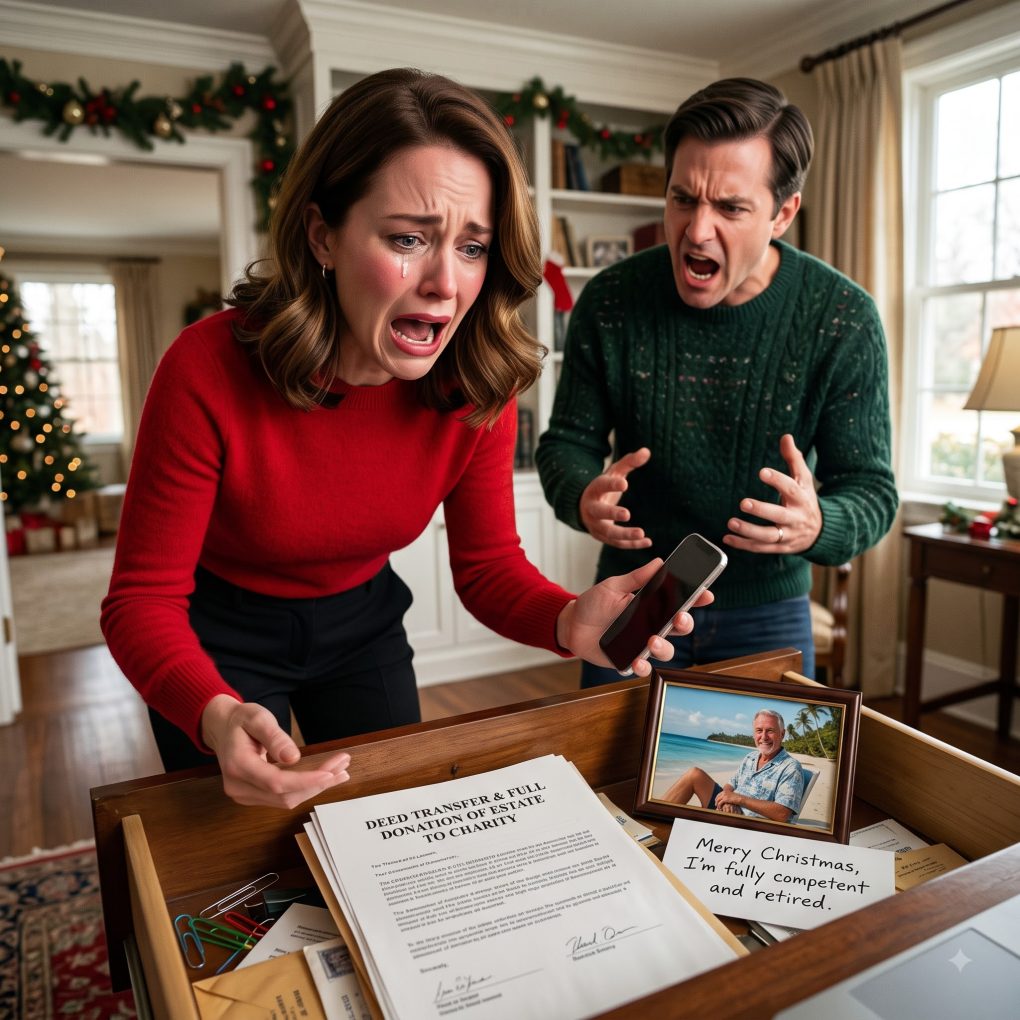
Nine days before Christmas, I caught my daughter plotting to commit me to an asylum and seize my house. On Christmas morning, she called asking where I was—I told her to open my top desk drawer, and what she found inside made her scream in horror.
Nine days before Christmas, I caught my daughter plotting to commit me to an asylum and seize my house. On...

The first time my mother-in-law told me to get out of my own home, she was smiling over coffee in a penthouse I paid $12,000 a month to live in. The second shock was realizing my husband was in on her plan—unaware that her greed was about to land them both in federal handcuffs.
The first time my mother-in-law told me to get out of my own home, she was smiling over coffee in...

MY HUSBAND IGNORED MY EMERGENCY CALL WHILE HE WAS WITH HIS MISTRESS—THEN A HIDDEN ACCOUNT IN MY NAME REVEALED WHAT HE PLANNED TO LEAVE BEHIND – Life Story
My husband ignored my desperate message while I lay on our kitchen floor, twenty-nine weeks pregnant and struggling to breathe....