LOVE-My sister hugged me over breakfast and thanked me for buying her a $585,000 house, even though I’d never agreed to give her a dime. Dad had already signed the purchase agreement and placed a gift letter beside my grandfather’s blue mug, expecting me to sign away part of the inheritance he’d controlled since I was fourteen. Then I mentioned a phone call I made at 11:58 the night before, and his smile disappeared…
My sister hugged me over breakfast and thanked me for buying her a $585,000 house, even though I’d never agreed to give her a dime.
Dad had already signed the purchase agreement and placed a gift letter beside my grandfather’s blue mug, expecting me to sign away part of the inheritance he’d controlled since I was fourteen.
Then I mentioned a phone call I made at 11:58 the night before, and his smile disappeared…
“Thank you for buying me a house!”
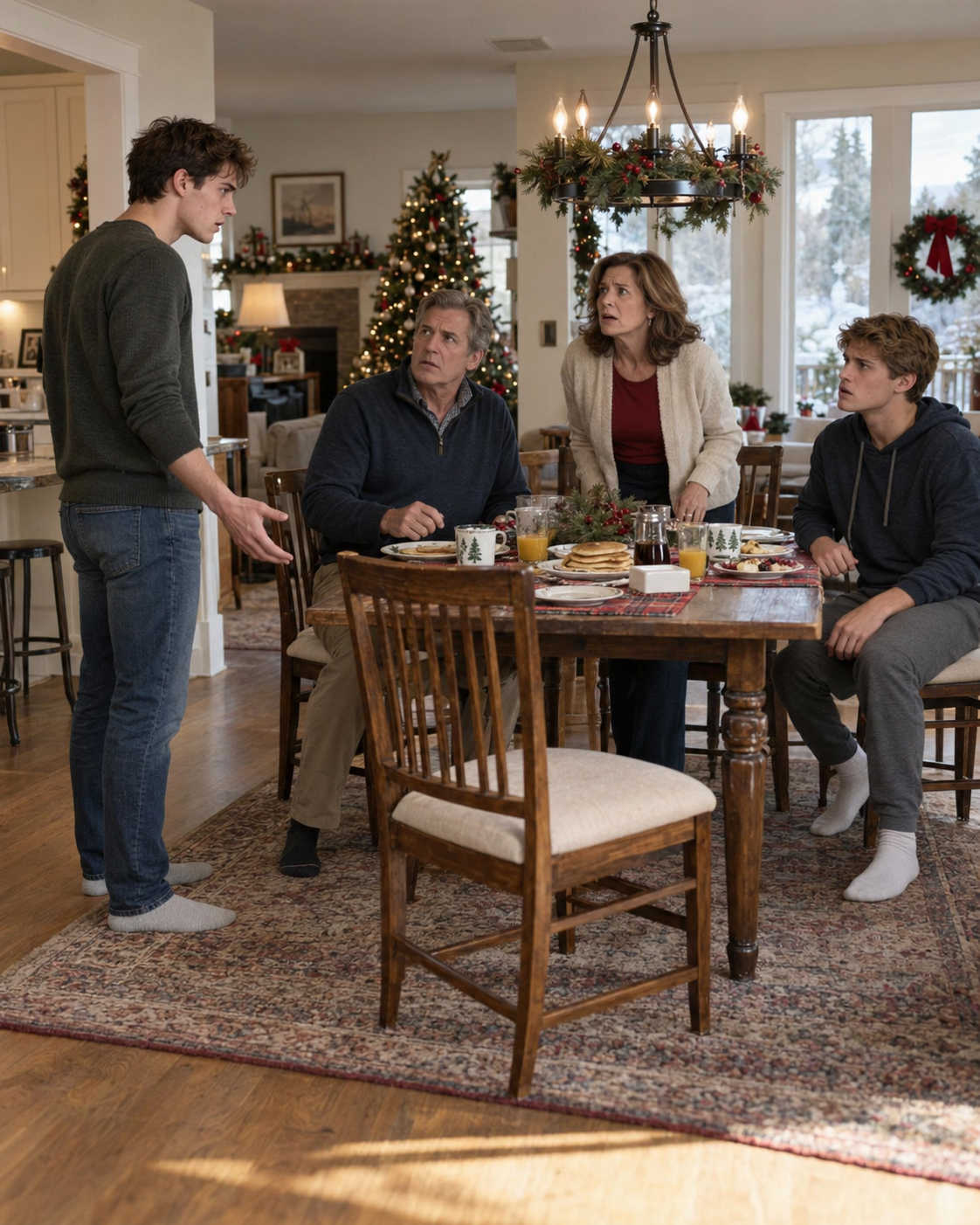
My older sister, Belle, practically screamed those words into my ear as she threw her arms around my shoulders.
She hugged me so hard that coffee spilled over the rim of the old blue mug I was holding.
A few drops landed on the kitchen table, inches from a stack of documents my father had arranged beside my breakfast plate.
I didn’t hug her back.
I just sat there, looking at the papers, trying to understand how my family could be celebrating something I had never agreed to do.
Across the table, my father, Douglas Mercer, smiled like a man who had just arranged the perfect surprise.
“There we go,” he said, pushing the documents toward me. “Just take care of the paperwork, Poppy.”
A black pen was clipped to the top page.
Mom stood behind his chair, smiling nervously.
She had already set out the good plates and folded the napkins, even though it was only breakfast.
“It was supposed to be a surprise,” she said.
I looked down at the first page.
It was a purchase agreement for a three-bedroom house on Larksburg Court in Elizabethtown, Kentucky.
The price was $585,000.
I recognized the neighborhood.
Belle had talked about wanting a house there for months, describing the large kitchens, spacious bedrooms, and beautiful yards as though moving there was something already decided.
I had always assumed she and Dad were discussing a mortgage.
Apparently, I was the mortgage.
Dad’s signature was already on the agreement.
Underneath the purchase paperwork was another document, a gift letter, with a space for my signature.
The letter stated that I was voluntarily giving Belle $585,000 and expected nothing in return.
I hadn’t offered Belle $585,000.
I hadn’t even offered her $585.
Yet here she was, standing beside me in her nicest sweater, practically bouncing with excitement.
“Poppy, can you believe it?” she said. “Three bedrooms!
And the kitchen has that huge island I showed you!”
I stared at my father.
“Have you called the realtor?”
His smile weakened.
“Why would I need to call the realtor?”
I set my grandfather’s blue mug down carefully.
.
“Because there’s something you need to know about that money.”
The room went quiet.
Belle’s smile lingered for another second before she looked from me to Dad.
Mom stopped moving behind his chair.
Dad folded his hands on the table.
“What exactly are you talking about?”
I glanced at the clock above the kitchen doorway.
It was just after eight in the morning.
Less than nine hours earlier, at 11:58 the night before, I’d made a phone call nobody in that room knew about.
And that call was the reason I could sit there without reaching for the pen.
But to understand why my father was so certain I’d sign away more than half a million dollars, you have to understand what had been happening to my inheritance for the previous four years.
And it started with the only person in my family who never made me feel like I had to earn my place.
My grandfather, Walt Mercer.
Grandpa lived outside Bardstown, Kentucky, in an old farmhouse surrounded by fields that looked golden in late summer.
The house had a narrow front porch, a kitchen with worn wooden cabinets, and an aluminum storm door that never closed properly unless you gave it a firm shove.
.
Grandpa refused to replace it.
“Still works, Pop,” he’d say whenever I complained. “Just needs somebody who knows how to handle it.”
Pop was his nickname for me.
My actual name is Poppy, but hearing him say Pop always made me feel special.
Everyone else in my family had another name for me.
The easy one.
Belle was the pretty one, the exciting one, the one who needed things.
I was the easy one because I rarely complained.
If Belle needed a new dress for a party, Mom bought it.
If I needed something, Mom checked whether Belle had an old one that would fit.
If Belle wanted a big birthday celebration at the country club, Dad arranged it.
My birthdays usually involved dinner at home and a cake from the grocery store.
I don’t want to pretend I had a terrible childhood.
We had a comfortable house.
There was food on the table, and I attended a good school.
But comfort and fairness aren’t always the same thing.
I learned early that keeping everyone happy meant asking for as little as possible.
Belle didn’t have to learn that lesson.
She was the older daughter, confident and beautiful, with the kind of personality that made people turn toward her when she entered a room.
I loved her when I was little.
I followed her around the house and wanted to borrow her makeup, her shoes, and whatever perfume she happened to be wearing.
Sometimes she was kind to me.
Other times, she treated me like an annoying shadow.
Mom usually told me to give her space.
Dad said Belle had expensive tastes because she was ambitious.
When I asked why ambition required a new handbag, he told me I’d understand when I got older.
Grandpa never talked like that.
He noticed things.
If I was unusually quiet during Sunday dinner, he would ask whether something was bothering me.
If I told him I didn’t need anything for my birthday, he’d find out what book I wanted and bring it himself.
He never made a production of those moments.
He simply remembered.
Every summer, I spent time at his farmhouse.
We’d get up before seven and sit on the porch while the fields disappeared beneath a layer of morning mist.
Grandpa drank his coffee black.
When I was younger, he filled my blue mug mostly with milk, added a little coffee, and called it our special arrangement.
As I got older, the coffee got stronger.
He liked to sit quietly for a while before starting his day.
I liked that about him.
At home, silence usually meant somebody was angry.
With Grandpa, silence meant we were comfortable.
Sometimes he told stories about the farm.
Sometimes he explained how he’d saved money, purchased land, and made decisions that other people thought were foolish at the time.
He wasn’t the sort of man who bought expensive things just because he could.
His truck was old, and he wore the same work jackets for years.
But he knew what everything cost.
One morning, he asked me what I wanted to do when I grew up.
I told him I wasn’t sure.
“Good,” he said.
I laughed.
“Good?”
“Means you’re still thinking.
Don’t let anybody rush you into becoming somebody else’s idea of successful.”
I remembered that conversation for years.
When I was thirteen, everything in our family changed.
A bourbon distillery wanted to expand its operations and approached Grandpa about buying part of his land.
After months of discussions, he agreed to sell thirty-eight acres.
The purchase price was a little over $3 million.
To me, that number was almost impossible to imagine.
I was thirteen.
Three million dollars might as well have been all the money in the world.
Dad understood it very differently.
The moment he heard about the sale, he began talking about how the money should be handled.
He said Grandpa needed professional help.
He talked about investment accounts, estate planning, and the importance of keeping the money within the family.
Some of his concerns might have been reasonable.
Grandpa was getting older, and a sale of that size involved complicated decisions.
But Dad didn’t sound worried about Grandpa.
He sounded frustrated that Grandpa wasn’t handing him control.
I remember one Sunday afternoon when Dad drove us to the farmhouse.
He and Grandpa went into the kitchen while Mom, Belle, and I stayed outside.
Through the screen door, I heard Dad say, “You don’t need all that sitting in an account.
I could put it to work.”
Grandpa answered, “I’ve already got plans for it.”
“I’m your son.”
“I know who you are, Doug.”
Dad came outside twenty minutes later, red-faced and silent.
We drove home without stopping for the ice cream Belle had been promised.
That was how angry he was.
The following spring, Grandpa suffered a stroke.
Nine days later, he was gone.
I was fourteen years old.
I remember the funeral only in pieces.
The smell of flowers.
Mom squeezing my shoulder.
Belle complaining that her shoes hurt.
And the awful realization that I’d never again sit on that porch and hear Grandpa call me Pop.
For weeks afterward, I kept expecting someone to suggest we visit him.
Then I’d remember there was nobody waiting at the farmhouse.
A little while later, we went to the reading of his will.
Dad wore a dark suit and sat beside Mom.
Belle looked bored.
I was too sad to care about money.
Grandpa left the farmhouse and five surrounding acres to my father.
The proceeds from the land sale went to me.
Because I was a minor, the money was held in a custodial account that Dad would control until I turned eighteen.
I didn’t fully understand what that meant.
I only knew that Grandpa had left me something enormous, and Dad was responsible for looking after it.
I thought that meant the money would be safe.
On the drive home, I leaned my head against the car window and closed my eyes.
I wasn’t actually asleep.
I just didn’t want to talk.
Dad thought I couldn’t hear him.
“Three million dollars,” he said bitterly. “And he gave it to the one who still sleeps with the hall light on.”
Mom replied quietly.
“She’s fourteen, Doug.
You’re the one holding it.”
There was a pause.
Then Dad said something about my grandfather always having to make a point.
I kept my eyes closed.
Until that moment, I hadn’t understood how deeply Dad resented what Grandpa had done.
He didn’t talk about the inheritance as something Grandpa had wanted me to have.
He talked about it like money that had been taken away from him.
And Mom’s response frightened me almost as much.
She seemed to believe that because Dad controlled the account, Grandpa’s decision didn’t really matter yet.
I wanted to ask them what would happen when I turned eighteen.
But I didn’t.
I was fourteen, grieving, and already very good at staying quiet.
For the first few months, nothing seemed different.
Dad went to work at his insurance office.
Mom took care of the house.
Belle continued getting whatever she needed.
Whenever Grandpa’s money came up, Dad told me not to worry.
He was handling it.
I assumed that was what responsible adults did.
Then, six months after the will was read, I found a bank statement.
It was sitting among some papers on Dad’s desk.
I wasn’t looking for trouble.
I’d gone into his office for something school-related and noticed my name printed near the top of the page.
Underneath it was an account number and a balance larger than anything I’d ever seen.
I stood there reading the transactions.
One withdrawal caught my attention.
March 14.
$38,000.
I stared at the number.
Thirty-eight thousand dollars seemed like an extraordinary amount of money to disappear from an account that was supposed to belong to me.
Then I remembered something.
That same week, Belle had arrived home from Louisville driving a brand-new white Jeep.
There had been a red bow on the hood.
Dad stood in the driveway taking photographs while Belle squealed and hugged him.
Mom said he’d been planning the surprise for weeks.
I remembered watching from the porch, feeling happy for my sister and a little embarrassed by how badly I wished someone would surprise me with something.
Now I stood in Dad’s office wondering whether the money for that car had come from Grandpa’s inheritance.
I didn’t know enough about financial accounts to be certain.
So I asked Mom.
She was folding towels in the laundry room when I approached her.
“Mom, can I ask you something?”
“Of course.”
“Did Dad use money from Grandpa’s account to buy Belle’s Jeep?”
Her hands stopped for only a second.
Then she folded another towel.
“Your father is the custodian, sweetheart.”
“I know, but—”
“That means he decides what’s best.”
I looked at her.
“Isn’t the money supposed to be for me?”
She sighed.
“Poppy, please don’t start making accusations.”
“I’m not accusing anybody.
I’m asking.”
She finally turned toward me.
“Don’t make this ugly.
Your grandfather would hate that.”
I remember how much those words hurt.
Grandpa had been gone less than a year, and she was already using his name to make me feel ashamed of asking about something he’d left me.
I walked away without another question.
The next morning, Dad’s desk drawer had a new lock.
He never explained why.
And I never brought up the Jeep again.
But I stopped believing that the money was simply being protected.
I began paying attention.
At first, I didn’t know what I was doing.
Whenever a bank statement arrived and I had an opportunity to see it, I photographed the pages with my phone.
I didn’t take the originals.
I didn’t move anything.
I simply saved a copy of what I could find.
Then I uploaded the photographs to a private cloud folder.
I called it Chemnotes.
Dad never took much interest in my schoolwork, but he knew I liked science.
A folder with that name wasn’t likely to attract attention.
I kept it separate from the family computer and protected the account with a password nobody else knew.
Every few weeks, I’d check what I’d saved.
At first, I thought I was misunderstanding the transactions.
Maybe Dad was moving money between accounts.
Maybe the withdrawals were investments.
Maybe there was an explanation I hadn’t been given.
I wanted there to be an explanation.
I didn’t enjoy suspecting my own father.
So I began writing down dates and amounts, leaving room for information I didn’t yet have.
Over time, patterns appeared.
There were payments connected to Belle’s college expenses.
There were large withdrawals around the time our kitchen was remodeled.
I remembered Mom spending weeks choosing countertops and cabinet hardware while Dad complained about how expensive everything had become.
There were credit card payments too.
I couldn’t always tell what those charges had purchased, so I noted what I knew and didn’t guess at the rest.
Then there was the wedding venue deposit.
Belle had been planning to marry a man she’d met in Louisville.
For months, Mom talked about flowers, catering, and the beautiful venue Belle wanted.
The engagement eventually ended.
The wedding never happened.
But the money had still left the account.
And then came Dad’s pickup truck.
It cost $64,000.
He told everyone he’d earned it after a particularly good year at the insurance office.
He drove it proudly, parking it where visitors could admire it.
I remember standing beside the driveway one afternoon while he explained its features to a neighbor.
He never looked at me.
I wondered whether he had any idea that I knew where the money had come from.
By the time I was seventeen, I’d documented $418,600 in withdrawals.
Four hundred eighteen thousand, six hundred dollars.
I wrote the amount on a sheet of notebook paper and stared at it.
There were individual withdrawals I still couldn’t confidently explain, but the total was real.
The photographs showed the money leaving.
And so many of the dates lined up with purchases that had nothing to do with me.
The strangest part was how little my daily life had changed.
I still rode the school bus.
I still wore Belle’s hand-me-down jeans.
When I asked Mom about buying something new, she usually told me to make do with what I had.
I didn’t mind being careful with money.
Grandpa had taught me that being able to afford something wasn’t the same as needing it.
What bothered me was the double standard.
Dad treated the inheritance like family money whenever Belle wanted something.
But when I needed something, it suddenly became a lesson in responsibility.
Once, I mentioned that my laptop was struggling with a school project.
Dad told me to stop expecting expensive solutions to ordinary problems.
Two weeks later, Belle came home with new luggage for a trip.
I didn’t ask what it cost.
I was tired of knowing.
By then, I had started counting the months until my eighteenth birthday.
Dad occasionally mentioned that I’d need to be sensible when the account became mine.
He warned me about people who might try to take advantage of me.
I used to wonder whether he understood how those warnings sounded.
The person I was most afraid of losing my money to was sitting across from me at dinner.
I still loved him.
That’s something people sometimes have trouble understanding.
You can know somebody is treating you unfairly and still love them.
I remembered him teaching me to ride a bicycle, helping with school projects, and bringing home soup when I was sick.
I also remembered the bank statements.
Both versions of my father existed.
For a while, I hoped he would correct things before I turned eighteen.
Maybe he would quietly replace the missing money.
Maybe he’d explain what had happened.
Maybe he’d admit he’d made mistakes.
But as my birthday approached, he became more controlling whenever money was mentioned.
Then, while I was seventeen, Grandpa’s lawyer called.
His name was Wendell Ostrander.
He’d known Grandpa for years and worked from an office with dark wooden furniture, crowded bookshelves, and a brass nameplate beside the door.
I’d met him at the reading of the will.
This time, he asked to speak with me privately.
I was nervous walking into his office.
He greeted me kindly, offered me water, and reached into a drawer.
“I’ve been holding something for you, Poppy.”
He placed an envelope on his desk.
My name was written across the front in Grandpa’s unmistakable handwriting.
For a moment, I couldn’t touch it.
Seeing those letters made me miss him so badly that my throat tightened.
Mr.
Ostrander waited.
When I finally opened the envelope, I found a letter.
Grandpa wrote that he’d created a special trust with an old friend named Margarite Fen, a trust officer in Louisville.
He’d put only ten dollars into it.
At first, I thought I’d misunderstood.
Ten dollars?
After leaving me millions?
Then I continued reading.
The trust had been set up as a place where I could protect and manage my money once I was old enough to take responsibility for it.
Grandpa hadn’t put the land-sale proceeds directly into it.
Instead, he’d left me the means to move the money there when I turned eighteen.
Near the bottom, he’d written a sentence I still remember word for word.
“I built the vault, Pop.
But you have to carry the money in yourself.”
I pressed the letter against the desk.
Grandpa had known I would eventually have to make decisions without him.
He’d given me something valuable, but he’d also left me a way to protect it.
Mr.
Ostrander explained the arrangement slowly.
There would be formal paperwork, identification requirements, and decisions I needed to understand before moving any funds.
He also told me something important.
Once I had legal authority over the inheritance, I didn’t have to leave it under my father’s influence.
Then I showed him my photographs.
I hadn’t planned to.
I’d brought them because I didn’t know whom else to trust.
I handed him my phone and opened the Chemnotes folder.
He went through the statements carefully.
He asked questions.
Sometimes he enlarged a photograph to read a date.
Sometimes he made notes.
The longer he looked, the quieter he became.
Finally, he removed his glasses.
“Poppy, that money was never your father’s to spend.”
I stared at him.
Even after everything I’d documented, hearing an adult say those words frightened me.
“Does that mean he’s stolen it?”
Mr.
Ostrander chose his answer carefully.
“It means these transactions need a proper accounting.
Your father was responsible for protecting your interests.
Being custodian did not make the money his personal property.”
I looked down at my hands.
“What should I do?”
“First, keep these records safe.
Don’t confront him with something you’re not prepared to handle.”
He explained that once I turned eighteen, he could help me take control of the account and work with Margarite to protect what remained.
He didn’t promise that every dollar would be recovered.
He didn’t tell me the situation would be easy.
He just told me that I had rights, and that I didn’t have to surrender them to keep my family happy.
Before I left, he made sure I understood the most important point.
“When your birthday comes, Poppy, don’t sign anything your father puts in front of you without having it reviewed.”
I promised him I wouldn’t.
For months afterward, that promise was the only thing that kept me calm.
I continued saving records whenever I could.
I kept the letter from Grandpa hidden with my important things.
And I waited.
Then, two weeks before my eighteenth birthday, I overheard Dad arguing with someone on the phone.
He was in the garage.
I’d come downstairs to get something from the kitchen and heard his voice through the door.
“It’s a custodial account,” he snapped. “I’m the custodian!”
I stopped walking.
There was a long silence.
Then he said, “I understand what you’re telling me.”
Another pause.
“Fine.
After the sixteenth.
Just send me whatever she has to sign.”
My heart began pounding.
October sixteenth.
My birthday.
I stood there for several seconds, trying not to make a sound.
Then I went upstairs and called Mr.
Ostrander.
He listened while I repeated the conversation.
“Don’t panic,” he said. “We anticipated that your father might try to get you to sign something.”
I asked whether Dad could keep controlling the account after I turned eighteen.
He explained that under the arrangement governing my inheritance, my father would no longer have the same authority once I reached that age.
But that didn’t mean I should casually sign paperwork I didn’t understand.
We agreed to speak with Margarite and prepare the documents needed to establish my control and arrange the transfer to Grandpa’s trust.
I didn’t tell Mom.
I didn’t tell Belle.
And I certainly didn’t tell Dad.
The days leading up to my birthday felt strange.
Mom suddenly became interested in whether I’d be home on the sixteenth and the following morning.
Dad asked whether my school schedule would interfere with some paperwork.
Belle unexpectedly announced she was coming home.
She had been talking for months about wanting a house in Elizabethtown, closer to the places she liked and with enough room for the life she imagined having.
She’d shown me pictures of kitchens and dining rooms, always pointing out the expensive features.
I listened politely.
I’d never assumed her plans had anything to do with me.
Then October sixteenth arrived.
My eighteenth birthday.
I woke up expecting at least a birthday greeting.
There wasn’t one.
Mom was downstairs arranging tablecloths.
Dad had already left a note about something he wanted handled the following day.
Belle was home, unusually cheerful, and kept disappearing into the living room to talk quietly with Mom.
When I walked into the kitchen, Mom barely looked up.
“Morning, sweetheart.
Make sure you’re here for breakfast tomorrow.”
I waited.
Maybe she was planning a surprise birthday dinner.
Maybe everyone was pretending to forget.
But nobody mentioned that I’d turned eighteen.
Dad came home later and asked whether I had any plans the next morning.
When I said no, he nodded.
“Good.
We’ll take care of everything then.”
I wanted to ask what everything meant.
Instead, I said okay.
I spent part of that birthday dealing with the very paperwork Grandpa’s lawyer had helped me prepare.
I confirmed my identity, reviewed the account arrangements, and made sure I understood the steps required to move my inheritance into the trust.
Margarite was calm and precise.
She didn’t talk to me like a little girl who had suddenly inherited a fortune.
She explained what each document meant and what the bank would need before it could complete the transfer.
She also reminded me that a large account shouldn’t be moved carelessly just because I was frightened.
We needed to do it correctly.
By that evening, I felt a little more confident.
Then I discovered why my family had been behaving so strangely.
Dad’s printer was in his home office.
I went there looking for a document I’d been told to collect, and noticed several freshly printed pages resting in the output tray.
The first page was a purchase agreement.
A house on Larksburg Court.
Three bedrooms.
Elizabethtown, Kentucky.
Purchase price: $585,000.
My father’s signature was already on it.
I flipped to the next page.
There was a bank statement showing sufficient funds to support the purchase.
I recognized the account immediately.
It was mine.
Then I found the gift letter.
The document said that I, Poppy Mercer, was voluntarily giving $585,000 to my sister Belle.
There would be no repayment.
No loan.
No obligation.
Just a gift.
At the bottom was a blank line for my signature.
The date beside it was October seventeenth.
Tomorrow.
I sat down in Dad’s desk chair.
For a moment, I could barely think.
All the little things from the previous weeks came rushing back.
Belle suddenly coming home.
Mom arranging the breakfast table.
Dad insisting I be available the morning after my birthday.
The conversation I’d overheard in the garage.
“After the sixteenth.
Just send me whatever she has to sign.”
They had been planning this.
Not a birthday celebration.
Not a family meeting about the money Grandpa left me.
They had planned to put a $585,000 gift letter in front of me, surround me with excitement and gratitude, and expect me to sign it because I was the easy one.
I looked at the amount again.
Five hundred eighty-five thousand dollars.
It was more money than I had ever spent in my entire life.
And my family had decided to give it to Belle as though my consent was a minor inconvenience.
I thought about Grandpa’s old blue mug.
I thought about how carefully he had lived.
I remembered him saving things that still worked and telling me that having money didn’t mean I had to give it away.
Then I looked at the gift letter again.
I could almost hear Mom telling me not to make things ugly.
I could picture Belle crying if I refused.
And Dad telling me I was selfish.
For a few minutes, I seriously considered whether signing might be easier than fighting.
That’s how deeply my family had trained me to keep the peace.
Then I opened the Chemnotes folder.
I looked at the statements.
The Jeep.
The renovation.
The truck.
The wedding venue.
Four years of withdrawals I had never authorized.
They had already spent hundreds of thousands of dollars.
Now they wanted another $585,000.
And this time, they wanted my signature to make it look like I had happily agreed.
I photographed the documents and returned them to the printer exactly where I’d found them.
Then I went to my room.
I checked the paperwork Mr.
Ostrander had prepared.
I read Grandpa’s letter again.
I sat there for a long time, looking at the clock, trying to decide whether I really had the courage to stop my father.
At 11:58 p.m., I picked up my phone.
I called the financial institution’s twenty-four-hour account security line, using the contact information Margarite had helped me verify.
When the representative answered, I explained that I had just reached the age when control of my custodial inheritance passed to me.
I told her someone had prepared a large transfer using my account as proof of funds, and I was concerned about an unauthorized withdrawal.
She asked me to verify my identity.
Then she asked whether I’d signed the gift letter.
“No,” I said.
“Have you authorized the proposed payment?”
“No.”
“Do you want us to place a restriction on outbound transactions while the ownership and authorization records are reviewed?”
I closed my eyes.
“Yes.”
She explained what the restriction would mean.
I listened carefully.
Then I confirmed my request.
Before ending the call, I asked her to make a note that I did not authorize any gift or purchase connected to the property on Larksburg Court.
She gave me a reference number.
I wrote it down beside the date.
October sixteenth.
11:58 p.m.
I didn’t sleep much after that.
I kept imagining Dad discovering what I’d done.
He had controlled the money for years.
He was accustomed to signing papers and making decisions without asking me.
I was frightened of what would happen when he realized that had changed.
But I was more frightened of what would happen if I kept letting him do it.
The next morning, I went downstairs carrying Grandpa’s blue mug.
Mom was in the kitchen.
Dad sat at the breakfast table wearing the pleased expression he always had when one of his plans was going exactly the way he’d arranged.
Belle came rushing toward me.
And before I had even sat down, she threw her arms around me.
“Thank you for buying me a house!”
Coffee spilled over my fingers.
She started telling me about the bedrooms, the yard, and how she’d finally have the home she’d been dreaming about.
Mom smiled.
Dad pushed the papers toward me.
“Just sign here, Poppy.”
I looked at the gift letter.
Then I looked at my sister.
“Belle, did somebody tell you I’d agreed to this?”
Her smile faltered.
“Dad said you were helping me.”
“Did he say I’d offered you $585,000?”
She glanced at Dad.
“He said Grandpa left you enough money that you wanted to share some of it.”
I felt a sick twist in my stomach.
I’d suspected Dad was planning to pressure me.
I hadn’t realized he’d already told Belle the decision had been made.
Mom spoke quickly.
“Poppy, honey, this is a wonderful opportunity to do something generous for your sister.”
I looked at her.
“Did you know about the gift letter?”
She hesitated.
“We all discussed the arrangement.”
“Without me?”
Dad sighed.
“Don’t start making this difficult.”
I looked at the papers again.
“This isn’t a birthday gift from you, Dad.
You’re asking me to give Belle more than half a million dollars.”
“You’ve got plenty,” he said.
“That’s not the point.”
“Then what is the point?”
I lifted Grandpa’s mug.
“The point is that Grandpa left that money to me.”
Dad’s face hardened.
“And I have spent four years managing it.”
“I know.”
“Then I don’t need a lecture from an eighteen-year-old about financial responsibility.”
Belle stood beside me, no longer smiling.
“Poppy, are you saying you don’t want me to have the house?”
I turned toward her.
“I’m saying I never agreed to buy it.”
Her face flushed.
“But Dad already signed everything.”
“That doesn’t mean I agreed.”
Mom pressed a hand to her chest.
“Please don’t ruin this for Belle.”
Something inside me went still.
There it was again.
Not whether I’d been asked.
Not whether the money was mine.
Only whether my refusal would disappoint someone else.
Dad picked up the pen and placed it directly in front of me.
“Sign it, Poppy.”
I didn’t touch it.
Instead, I asked him whether he’d called the realtor.
He frowned.
“Why would I need to?”
“Because you’re going to have to explain something.”
“What exactly did you do?”
I glanced at the clock.
Then I told him.
“11:58 last night.”
He stared at me.
“What?”
“At 11:58 last night, I called the bank.”
Dad slammed his coffee mug onto the table.
Belle stepped away from my chair.
Mom went pale.
I continued.
“I told them I hadn’t authorized this purchase.
I asked them to restrict withdrawals until my account ownership and instructions were confirmed.”
Dad pushed back his chair so suddenly it scraped against the floor.
“You had no right to do that!”
I looked at him.
“I turned eighteen yesterday.”
For several seconds, nobody spoke.
Then Dad strode toward the kitchen counter, where his laptop sat charging.
He opened it, typed in his password, and brought up the banking website.
I watched him enter the account information.
He clicked once.
Then again.
The page loaded.
A red notification appeared across the screen.
“Account access restricted.
Contact the account owner or financial institution for further assistance.”
Dad stared at it.
Then he looked at me.
For the first time in my life, my father seemed to understand that the money Grandpa left me might no longer be under his control.
And he was furious.
✨THE NEXT PART IS BELOW 👇Don’t forget to switch from “Most Relevant” to “All Comments” to continue reading more 👇
3.
Full story continuation
IF FACEBOOK BROUGHT YOU HERE, HERE’S THE CONTINUATION YOU’VE BEEN WAITING FOR.
ENJOY! 👇
Dad clicked the banking page again.
When the same red notification appeared, he leaned closer to the laptop, as though the problem might disappear if he looked hard enough.
“This is a mistake,” he muttered.
He tried another page.
Nothing changed.
Then he picked up his phone.
“I’m calling the bank.
Somebody there has clearly misunderstood what’s going on.”
I stayed seated.
“Dad, they haven’t misunderstood.”
He turned toward me.
“Don’t tell me what they understand.
I’ve managed that account for four years.”
“And yesterday I turned eighteen.”
His expression darkened.
“Which means you are legally an adult.
It doesn’t mean you suddenly know how to manage three million dollars.”
I looked at the documents on the table.
“Apparently, I’m old enough to give Belle $585,000, but not old enough to decide whether I want to.”
Mom made a small sound.
“Poppy, please.”
“No, Mom.
I want him to answer.”
Dad lowered his phone.
“You’re twisting everything.”
“Then explain it to me.”
I picked up the gift letter.
“Why does this say I’m voluntarily giving Belle money when nobody asked me?”
Dad stared at me.
“Because that’s what families do.
They help each other.”
“Then why didn’t you ask?”
He didn’t answer immediately.
Belle stepped forward.
“Dad?”
He looked at her.
“Not now, Belle.”
“No.
You told me Poppy wanted to do this.”
I watched my sister’s expression change.
All morning, she’d been excited about the house.
Now she looked confused and embarrassed.
“You said Grandpa left her more money than she’d ever need,” she continued. “You said she was happy to help me get settled.”
Dad waved a hand.
“That was the understanding.”
“Whose understanding?” I asked.
He glared at me.
“Poppy, stop being difficult.”
I almost laughed.
Difficult.
That was what happened when I stopped agreeing.
For four years, I’d been easy because I’d stayed quiet while money disappeared from my account.
Now that I was asking questions, I was difficult.
Belle looked at the paperwork again.
“Wait.
You actually never talked to her about it?”
Mom stepped toward her.
“Your father and I thought it would be a lovely thing for the family.”
Belle stared at her.
“That’s not what I asked.”
The kitchen went silent.
Dad finally put his phone down.
“I’ve provided for both of you your entire lives.
I don’t think it’s unreasonable to expect some cooperation.”
I felt my hands trembling.
“Grandpa provided that money, Dad.”
His face reddened.
“Your grandfather was my father.”
“I know.”
“And he left me managing a fortune while giving me a farmhouse.”
“He left you the farmhouse and five acres.”
Dad shook his head.
“You have no idea what went on between your grandfather and me.”
I studied him.
“Maybe I don’t.
But whatever happened between you and Grandpa doesn’t mean you get to spend my inheritance.”
That was when he made his biggest mistake.
He leaned across the table and said, “Do you honestly think I haven’t already used some of that money to take care of this family?”
Mom closed her eyes.
Belle looked at him.
I felt something settle inside me.
He had finally said it.
Not in a bank statement.
Not as a transaction number.
Out loud.
“You mean the $38,000 withdrawal for Belle’s Jeep?” I asked.
Dad froze.
Belle turned toward me.
“What?”
I continued.
“Or the kitchen renovation?
The wedding venue deposit?
The credit card payments?”
Dad’s expression changed from anger to alarm.
I looked toward the window.
“And the $64,000 pickup truck.”
He said nothing.
Belle stepped back.
“Dad, what is she talking about?”
He tried to recover.
“Those were household expenses.
Your sister doesn’t understand how family finances work.”
I looked directly at him.
“I have copies of the statements.”
Mom gripped the back of a chair.
Dad’s eyes narrowed.
“What statements?”
“The statements from my inheritance account.”
“How did you get those?”
“I’ve been keeping records for years.”
His face went pale beneath the anger.
I didn’t tell him about the Chemnotes folder.
I didn’t tell him where the copies were stored.
I simply said, “By the time I was seventeen, I’d documented $418,600 in withdrawals.
And I gave the records to Grandpa’s lawyer.”
Mom sat down.
Belle looked at Dad as though she’d never seen him before.
“You bought my Jeep with Poppy’s money?”
Dad rubbed his forehead.
“Belle, sweetheart, it’s more complicated than that.”
“Was it her money?”
He didn’t answer.
Belle’s eyes filled with tears.
“I thanked you for that car.”
Dad looked away.
I could see the embarrassment spreading across her face.
For years, she’d believed Dad was giving her expensive gifts because he wanted to.
Now she was discovering that some of those gifts had come from money Grandpa left me.
I didn’t feel happy watching her realize it.
Belle hadn’t seen the account statements.
She had believed what our parents told her.
But she’d also spent years accepting things without asking many questions, while I was expected to make do.
Both things were true.
Dad suddenly straightened.
“Enough.
I’m not going to sit here and be interrogated by my own daughters.”
I stood.
“Then call the realtor.”
He stared at me.
I placed the gift letter in front of him.
“Tell them the money isn’t available for this purchase.”
“You’ll ruin the deal.”
“I never agreed to the deal.”
“They’re expecting the funds.”
“Then you need to correct that.”
Mom looked at me with tears in her eyes.
“Poppy, think about what this will do to Belle.”
I turned toward her.
“Mom, did you ever think about what all of this was doing to me?”
She opened her mouth.
Then closed it.
I continued.
“You told me Grandpa would hate it if I asked questions.
You watched Dad use the money, and you told me not to make things ugly.”
Her eyes dropped to the table.
“I was trying to keep the family together.”
“By making me pay for everybody?”
She began crying.
I wished I could say I felt nothing.
But hearing my mother cry still hurt.
I wanted to comfort her.
I wanted to tell everyone it was fine, that we could forget the entire morning and start over.
That old instinct was still there.
But I looked at the $585,000 gift letter and knew what comforting everyone would cost me.
So I picked up Grandpa’s blue mug.
“I have an appointment with Mr.
Ostrander,” I said. “I’m leaving.”
Dad pointed toward the hallway.
“If you walk out of here and turn this into some legal battle, don’t expect this family to welcome you back.”
I stopped.
My chest hurt.
For eighteen years, I’d tried to be the daughter who didn’t cause trouble.
The easy one.
Now my father was threatening to take away my place in the family because I wouldn’t give my sister a house.
I looked at him.
“Grandpa loved me without making me pay for it.”
Dad flinched.
I wasn’t trying to hurt him.
I was finally saying something I’d needed to say for years.
Then I walked out.
I didn’t slam the door.
I just pulled it closed behind me and left.
At Mr.
Ostrander’s office, I told him everything.
The gift letter.
The purchase agreement.
The bank security call.
My father’s reaction.
He listened without interrupting.
When I finished, he looked at the reference number I’d written down.
“You did the right thing by not signing.”
I felt my shoulders loosen.
For a moment, I was afraid I’d start crying.
“What happens now?”
“First, we make sure the financial institution has the necessary documentation and that the remaining funds are protected.
Then we request a complete accounting of your father’s transactions.”
I swallowed.
“And the house?”
“That purchase is your father’s problem unless you have separately agreed to an obligation.”
“I haven’t.”
“Then don’t sign anything related to it.”
He called Margarite while I sat across from him.
She confirmed that the bank had placed a temporary restriction on outbound transactions pending its review.
My father’s old custodial access could not simply be used to authorize the gift.
The bank still needed to complete its ownership verification and processing requirements before the funds could move into Grandpa’s trust.
It wasn’t finished.
But for the first time, I knew nobody could simply put a piece of paper in front of me and make half a million dollars disappear without my consent.
Over the next several business days, I worked with Margarite and the bank to complete the transfer arrangements.
Every document was explained to me.
Every authorization required my approval.
When the remaining inheritance was finally placed under the trust arrangement Grandpa had established, Margarite showed me the completed records.
I stared at the paperwork.
Grandpa had started that trust with ten dollars.
Now it was holding the money he’d meant for me to protect.
I remembered his letter.
“I built the vault, Pop.
But you have to carry the money in yourself.”
For the first time since his funeral, I felt like I’d done something he would have understood.
Not because I’d won an argument.
Because I’d taken responsibility for what he’d entrusted to me.
Meanwhile, the house purchase fell apart.
Dad initially tried to reassure the realtor that the funds were coming.
They weren’t.
Without my signed gift letter or an authorized transfer, he couldn’t produce the money the transaction depended on.
Eventually, he had to explain that the promised gift wasn’t available.
Belle was devastated.
She called me two days later.
I almost didn’t answer.
When I did, her voice was tight.
“The house is gone.”
I sat on the edge of my bed.
“I’m sorry you’re disappointed.”
She laughed bitterly.
“Disappointed?
I’ve been planning my entire life around that place.”
I closed my eyes.
“Belle, nobody asked me if I wanted to pay for it.”
“I know that now.”
“Then why are you angry with me?”
She was quiet.
Finally, she said, “Because I thought something wonderful was happening.
And now I feel like an idiot.”
I understood that.
She’d been told she was getting a house.
She’d imagined living in it.
She’d pictured where the furniture would go.
Now she knew the whole thing had been built on a promise I never made.
But understanding her disappointment didn’t mean I had to solve it.
“You’re not an idiot for believing Dad,” I said. “But I can’t buy you a $585,000 house just because he told you I would.”
She started crying.
“I know.”
I let her cry.
Then she asked a question I hadn’t expected.
“Why didn’t you tell me about the Jeep?”
I looked down at the floor.
“Because I was fourteen when I found the statement.
And Mom told me not to cause trouble.”
Belle was silent.
“I didn’t know,” she whispered.
“I believe you.”
That didn’t erase the years of favoritism.
But it mattered that she was asking.
We ended the call quietly.
For several weeks, Belle barely spoke to me.
I let her have the distance.
I had enough to handle.
Mr.
Ostrander requested a detailed accounting of the custodial funds.
The process was uncomfortable.
There were statements to review, withdrawals to classify, and explanations to request from Dad.
Some transactions required more investigation than others.
The account had been large, and not every withdrawal was automatically improper just because I didn’t recognize it.
Mr.
Ostrander insisted that we separate legitimate expenses, account activity, and investment matters from money that had been used for purposes unrelated to my benefit.
But the purchases for Belle, the household renovation, and Dad’s truck raised serious questions.
Dad was angry about the review.
He left me several messages accusing me of letting a lawyer turn a private family matter into a financial investigation.
At one point, he told me I was embarrassing him.
That hurt, especially because I knew how much his reputation mattered to him.
He’d worked in insurance for years.
He was accustomed to being trusted with important financial decisions.
Now he was being asked to explain decisions he’d made while controlling his daughter’s inheritance.
But I reminded myself that I hadn’t created the transactions.
I had simply kept the records.
Eventually, Dad agreed to meet with Mr.
Ostrander.
I attended the meeting.
Mom came with him.
Dad looked older than he had on the morning of my birthday.
He sat at the conference table with a folder in front of him and avoided my eyes.
Mr.
Ostrander went through the concerns calmly.
Dad offered explanations for some expenses.
Others were difficult to defend.
When the discussion reached the truck, Dad looked at me.
“I needed a reliable vehicle for work.”
I nodded.
“I understand needing a vehicle.”
He seemed relieved.
Then I continued.
“But Grandpa left me that money.
If you needed to borrow it, you should have asked.
You didn’t even tell me.”
Dad looked away.
For the first time, I saw something beyond anger in his expression.
Shame.
The financial review took time, and I learned that protecting money wasn’t nearly as simple as watching the balance in an account.
There were records to reconcile and legal questions to resolve.
Mr.
Ostrander discussed the possibility of going to court.
He also explained that a negotiated repayment agreement might be less expensive and less destructive, provided it adequately protected my rights.
I didn’t make a decision immediately.
I was eighteen.
I had just learned that my father had been using my inheritance for years.
I wasn’t going to rush into another financial arrangement simply because someone told me it was best for the family.
Eventually, after the records had been reviewed, Dad agreed in writing to repay the amount identified as improperly used.
The agreement was prepared through the lawyers.
It included a repayment schedule and security against property he owned.
Dad decided to sell his expensive pickup truck to help make the first payment.
He hated doing it.
I knew that.
But I didn’t ask him to sell it out of revenge.
He’d purchased it using money he hadn’t been entitled to treat as his own.
Returning part of that money was a practical consequence of that decision.
The remaining balance would take time to repay.
There were no miracles.
Nobody handed me a check for every missing dollar the following morning.
But there was a written obligation, a plan, and a way to enforce it if he failed to comply.
That was more protection than I’d had at fourteen.
Mom asked whether I could forgive Dad now that he’d agreed to repay the money.
I told her forgiveness and repayment weren’t the same thing.
She didn’t like that answer.
But she didn’t argue.
A few months after my birthday, Belle invited me to lunch.
I almost said no.
Then I decided to go.
She was already sitting at a small table when I arrived.
There was no dramatic hug.
No expensive gift.
Just my older sister looking nervous.
We ordered sandwiches and talked awkwardly about ordinary things for a while.
Then she set down her glass.
“I’m sorry about breakfast.”
I looked at her.
She continued.
“I was so excited about the house that I didn’t think about how strange it was that nobody had asked you first.”
I didn’t interrupt.
“I believed Dad because I wanted to believe him.
And when you said no, I acted like you were taking something away from me.”
She rubbed her eyes.
“But it wasn’t mine.”
Hearing her say that mattered more than I expected.
I told her I appreciated the apology.
She asked whether we could start over.
I said I wanted to try.
But I also told her that things couldn’t go back to the way they’d been.
I didn’t want to spend the rest of my life being the easy sister who never needed anything.
Belle nodded.
“I think I got used to that.”
I smiled sadly.
“So did I.”
We didn’t become best friends over lunch.
There were years of habits between us.
But it was the first conversation we’d had in a long time where neither of us was trying to play the role our parents had assigned.
Belle eventually began looking at houses she could afford through her own finances.
They weren’t as large as the place on Larksburg Court.
There were compromises.
A smaller kitchen.
Less space.
A neighborhood that wasn’t quite as expensive.
Sometimes she complained.
But she no longer assumed that wanting something meant somebody else had to buy it.
As for Dad, our relationship remained difficult.
He called occasionally.
At first, most conversations were about paperwork or repayment arrangements.
Eventually, he began asking about my life.
I was cautious.
I didn’t want every conversation to become another argument about money.
And I didn’t want to pretend that a few polite questions erased what had happened.
One afternoon, he asked whether I’d visit Grandpa’s farmhouse.
I hesitated.
I hadn’t been there much since the funeral.
The thought of returning made me nervous.
But I agreed.
When I arrived, the farmhouse looked almost exactly as I remembered.
The fields stretched beyond the porch.
The old aluminum storm door still required an extra push to close.
Dad noticed me looking at it.
“Your grandfather never would replace that thing,” he said.
I smiled.
“He said it still worked.”
Dad gave a small laugh.
“Sounds like him.”
We sat on the porch for a while.
The afternoon was quiet.
Eventually, Dad spoke.
“I was angry with him.”
I looked at him.
“Grandpa?”
He nodded.
“When he sold the land, I thought he’d finally let me help manage everything.
I had plans.
Investments.
Things I thought would benefit the family.”
I listened.
“When he left you the proceeds, I felt like he didn’t trust me.”
I thought about that.
“Maybe he wanted you to have something different.”
Dad looked out over the fields.
“Maybe.”
Then he took a breath.
“I told myself I was using the money for the family.
That I was making decisions he’d have approved of if he’d understood them.”
He rubbed his hands together.
“But I never asked you.
And I knew the money wasn’t mine.”
I stared at him.
Those were words I’d needed to hear.
Not an excuse about how much the family had benefited.
Not another argument about his role as custodian.
An acknowledgment.
“Why didn’t you just tell me?” I asked.
He looked at me.
“Because I knew you’d say no.”
The answer hurt.
But it was honest.
Dad shook his head.
“And because I didn’t want to admit I was doing something wrong.”
We sat quietly.
Then he said, “I’m sorry, Poppy.”
I didn’t know what to say.
Part of me wanted to hug him.
Another part remembered Mom telling me Grandpa would hate it if I made things ugly.
I remembered the lock on Dad’s desk drawer.
The bank statements.
The gift letter.
And how frightened I’d been when I made that call at 11:58.
“Thank you for saying that,” I told him.
He nodded.
I didn’t tell him everything was fine.
Because it wasn’t.
But for the first time, he seemed willing to acknowledge that rebuilding trust would require more than one conversation.
When I left that afternoon, I stood beside the old storm door for a moment.
I could almost picture Grandpa coming through it with two mugs of coffee.
I wished I could tell him everything.
About the statements.
The trust.
The house I hadn’t bought.
The argument that nearly destroyed my relationship with my parents.
And the strange relief of finally knowing that I could make my own decisions.
I still had his blue mug.
I kept it in my kitchen, not packed away somewhere safe.
I used it.
Sometimes I drank coffee from it while reviewing school plans or working through the financial information Margarite wanted me to understand.
Other mornings, I simply sat quietly and watched the day begin.
I had no intention of spending my inheritance recklessly.
Grandpa had worked too hard for that.
I wanted to continue my education, make sensible decisions, and eventually build a life where I could support myself without depending on anyone’s approval.
Having money didn’t mean I knew everything.
In fact, turning eighteen taught me how much I still needed to learn.
So I asked questions.
I worked with people who explained things instead of demanding blind trust.
And I stopped being embarrassed when I didn’t understand something.
That was a bigger change than I expected.
For most of my childhood, asking questions had been treated like challenging authority.
Now I was learning that asking questions was part of taking responsibility.
My mother and I also had difficult conversations.
She admitted that she’d known Dad was using some of the inheritance for family expenses.
She said she’d convinced herself that because he was managing the money, he understood what he was permitted to do.
I asked why she’d told me Grandpa would hate it if I complained.
She cried.
“I knew that would make you stop asking.”
That answer hurt more than almost anything else.
Because it meant she’d understood exactly what she was doing.
But at least she was finally telling the truth.
I told her I loved her.
I also told her that if we were going to have a better relationship, she couldn’t keep using guilt whenever I made a decision she disliked.
She agreed to try.
And over time, I watched whether her actions matched her words.
Some days were better than others.
There were still uncomfortable family gatherings.
Dad occasionally slipped into telling me what I should do with my money.
Belle sometimes forgot that my plans didn’t have to revolve around hers.
Mom still had a habit of asking me to keep the peace.
But I had changed.
I no longer automatically apologized whenever somebody was disappointed.
I could say no without giving a twenty-minute explanation.
And I could leave a conversation when it stopped being respectful.
The strange thing is that I didn’t feel powerful.
I felt older.
Not because I had millions of dollars.
Because I had finally learned that being loved shouldn’t require giving people everything they ask for.
Sometimes I think about the morning Belle hugged me and thanked me for buying her a $585,000 house.
I remember the coffee spilling from Grandpa’s blue mug.
The black pen waiting on top of the papers.
Dad smiling because he believed the decision had already been made.
Mom standing behind him, expecting me to keep everybody happy.
And myself, sitting there, frightened but determined.
If I’d signed that gift letter, I doubt it would have been the last time somebody decided how my inheritance should be spent.
There would always have been another reason.
Another family emergency.
Another opportunity.
Another way to make me feel selfish for wanting a say in my own future.
The hardest lesson Grandpa left me wasn’t about how to save money.
It was about protecting the things that matter, even when somebody you love is disappointed.
He gave Dad the farmhouse.
He gave me the proceeds from the land.
And he gave me a ten-dollar trust with a letter explaining how to take responsibility when the time came.
I don’t know whether he expected everything that happened.
I hope he didn’t.
But I’m grateful he gave me a way to protect myself.
That call at 11:58 didn’t solve everything.
It didn’t recover four years of withdrawals overnight.
It didn’t magically turn my father into someone who understood my feelings.
And it didn’t give Belle the house she’d been promised.
What it did was give me time to make my own decisions.
For the first time, the family couldn’t simply assume my answer would be yes.
And that changed more than the account balance.
I was still Poppy.
Still the younger sister.
Still the daughter who wanted her parents to be proud of her.
But I wasn’t going to be the easy one at the expense of my own future anymore.
And if Grandpa could have seen me sitting at my kitchen table one quiet morning, holding his old blue mug and reading through the records of the trust he’d started with ten dollars, I think he would have smiled.
Then he’d probably have told me not to make too much fuss about it.
And he’d have reminded me to shut the storm door properly on my way out.
THE END.
I’ve shared the complete story, and I truly hope it touched your heart.
If this story moved you, please , like, and share the post.
Thank you for reading! ❤️
Recommended Stories

“Don’t Move!” A Single Dad Caught a Falling Billionaire—Then His Navy SEAL Past Stunned Everyone
The Billionaire Was Falling Seventy-Two Floors—Then The Maintenance Man Said Two Words Nobody Forgot Her hand was slipping, and the...
My parents refused $800 to keep me in college—then I overheard what they secretly gave my brother.
Part 1: I survived on ramen while my parents bought my brother a $35,000 car. When I found out they...

The Single Dad Was Fired on Christmas Eve — Then the CEO Saw What He Carried Out the Door…
The Single Dad Was Fired on Christmas Eve — Then the CEO Saw What He Carried Out the Door… The...