Single Dad Gave Blood to Save a CEO’s Daughter—Then She Realized He Was the Man She Mocked…
Single Dad Gave Blood to Save a CEO’s Daughter—Then She Realized He Was the Man She Mocked
“Get him out of here,” the CEO ordered, while his nine-year-old daughter watched her father being humiliated.
Six hours later, the CEO’s own little girl was fighting for her life, and the hospital had found only one possible local blood donor.
When Clare Whitmore reached the donation room, she recognized the man’s worn work boots before she saw his face.
Part 1 — The Man She Told to Remember His Place
At on a rainy Thursday evening, Ethan Cole was kneeling beside an open equipment cabinet on the third floor of Whitmore Memorial Hospital, trying to repair a portable cardiac monitor that had stopped working during a routine patient transfer.
Beyond the double doors, a string quartet played softly while wealthy donors gathered beneath crystal chandeliers for the hospital’s annual fundraising reception.
Ethan could hear champagne glasses touching and conversations drifting through the corridor, but his attention remained on the loose connection beneath his screwdriver.
A nurse had told him the monitor was needed before the night shift, and he intended to make certain it worked.
“Daddy, are we almost finished?” his nine-year-old daughter asked from the chair beside the wall.
Lucy Cole wore a yellow raincoat, her brown hair gathered into a crooked ponytail, and her school backpack rested between her sneakers.
Her after-school program had closed unexpectedly because of a plumbing problem, leaving Ethan with no choice but to bring her to the engineering department until his shift ended.
His supervisor had given permission, provided she remained in the staff area, but the equipment repair had taken longer than anyone expected.
“Five more minutes, sweetheart,” Ethan answered, reaching for a smaller screwdriver.
Lucy tilted her head and gave him the suspicious look she had perfected over nine years. “You said five minutes fifteen minutes ago.” Ethan smiled without looking up. “Then I’ve already made excellent progress.”
Lucy giggled and returned to drawing tiny planets in the notebook balanced on her knees.
Ethan loved that sound more than anything in the world, partly because there had been a time when he feared he might never hear it again.
Five years earlier, after his wife Rachel died, Lucy had spent nearly three months speaking only when necessary.
The house had become so quiet that Ethan sometimes left the kitchen radio playing simply to make the evenings feel less empty.
They had survived those months together, one small routine at a time.
Pancakes on Sundays, library visits every other Saturday, and a two-finger signal Rachel had invented when Lucy was little that meant I’m right here.
Ethan used it whenever Lucy became nervous at school performances or doctor’s appointments.
There were still nights when his daughter asked questions about her mother that he could not answer, but he had learned that staying beside her mattered more than having the perfect words.
“Dad,” Lucy whispered suddenly, “there’s a lady looking at us.”
Ethan tightened the final screw and glanced over his shoulder.
A tall blonde woman in a perfectly tailored cream-colored suit stood near the reception entrance, surrounded by three executives and a security officer.
Clare Whitmore, the hospital’s chief executive officer, had inherited her father’s controlling interest in the healthcare network and spent the past twelve years transforming it into one of the state’s most influential medical organizations.
Her photograph appeared in business magazines, her name was engraved above the entrance to the new children’s wing, and tonight almost everyone in the building seemed determined to impress her.
Except Ethan, who was concentrating on whether the monitor would pass its final diagnostic test.
“Excuse me,” Clare said sharply.
Ethan rose to his feet, wiping his hands on a clean cloth. “Yes, ma’am?” She glanced at the toolbox, the exposed cabinet, and finally the faded navy work shirt he had washed so many times that the hospital logo had begun to peel. “Why is maintenance equipment being displayed outside a reception attended by our largest donors?”
Ethan followed her gaze toward the open cabinet. “The pediatric transfer team reported a faulty monitor, and the charge nurse asked me to finish the repair before changing shifts.” Clare’s mouth tightened. “Then perhaps the charge nurse should have considered our schedule.
This corridor was supposed to be cleared forty minutes ago.” Ethan kept his tone respectful. “I understand, but the monitor was marked urgent.”
One of the executives, Adrian Vale, leaned toward Clare.
As chief operating officer, Adrian had spent years presenting himself as the person who could make difficult problems disappear before they reached her desk.
He wore a dark suit with a silver tie, and the smile on his face suggested he was enjoying the interruption. “We’ve had a few issues with the engineering team’s timing,” he said lightly. “Nothing serious, of course.”
Ethan looked at him.
He had personally reported three delayed equipment replacements to Adrian’s office during the past month, and none had received a response.
The repaired monitor was one of several units still being used because a purchase request had been postponed until after the fundraiser.
Ethan could have explained all of that, but there were donors gathering behind Clare and Lucy was listening.
He decided to keep the conversation focused on the patient equipment.
“The monitor is working now,” he said. “I’ll run the final check and take it downstairs.” Clare crossed her arms. “I wasn’t asking for a progress report, Mr.…” She glanced at his badge. “Cole.
I was telling you that you should not be here.”
Lucy stopped drawing.
Ethan noticed the movement before he noticed the silence spreading around them.
A few guests had come out of the reception room, curious about the disturbance, and someone near the doorway raised a phone as though preparing to record.
Ethan lowered his voice. “Ms.
Whitmore, I’m not trying to interrupt your event.
I’m finishing work that the nursing team requested.”
Clare had spent the afternoon managing an unexpectedly difficult meeting with hospital trustees, an angry call from a major donor, and a disagreement with Adrian over the cost of upgrading aging equipment.
She was exhausted, impatient, and aware that several influential guests were now watching her handle an employee who seemed unwilling to follow instructions.
None of those things justified what she said next.
But instead of stepping away, she allowed the frustration to harden into contempt.
“Do you know who I am?”
Ethan held her gaze. “Yes, ma’am.”
“Then you understand that when I give an instruction in this building, I expect it to be followed.”
“And when a nurse tells me equipment is needed for patient care,” Ethan answered quietly, “I need to make sure it’s safe before I leave.”
Adrian let out a short, uncomfortable laugh.
Another executive looked toward the floor.
Clare’s expression changed, and Ethan could almost see the moment she stopped hearing his words as a professional explanation and began treating them as a challenge to her authority.
She stepped closer, her expensive heels clicking against the polished floor.
“This is a reception for the people who keep this hospital running,” she said. “You don’t belong in the middle of it.”
Ethan’s fingers tightened around the shop cloth.
“Perhaps,” Clare continued, looking at his boots, “you should remember where you belong.”
Lucy stood so quickly that her backpack fell sideways.
“My daddy fixes things here,” she said.
Her voice was small, but it carried through the quiet corridor.
Ethan turned toward her, surprised, while Clare looked down at the little girl in the yellow raincoat.
For one brief second, something uncertain crossed Clare’s face.
Then Adrian moved closer, and the moment passed.
“Lucy,” Ethan said gently, “it’s okay.”
“No, Daddy.
You fixed the thing because somebody needed it.”
A woman near the reception doors lowered her eyes.
Ethan could feel the attention settling over his daughter, and he hated that she had been pulled into an adult humiliation she had done nothing to deserve.
He moved toward her, but Clare spoke again before he reached the chair.
“Security, please escort Mr.
Cole and his daughter downstairs.
We’ll deal with the maintenance issue tomorrow.”
The officer hesitated.
He recognized Ethan from years of overnight shifts and had watched him help hospital employees carry equipment during emergencies.
Ethan spared him the embarrassment of having to choose between his instincts and the CEO’s instruction.
He closed the cabinet, finished the diagnostic check, and quietly placed the temporary third-floor access badge on the reception table.
“The monitor passed,” he said. “The transfer team can use it tonight.”
Clare did not answer.
Ethan packed his tools, picked up Lucy’s backpack, and offered her his hand.
As they walked toward the elevator, Lucy kept her chin raised, but Ethan could feel her fingers trembling.
Behind them, the quartet resumed playing, and someone laughed a little too loudly at a joke that had not been particularly funny.
The world seemed determined to pretend nothing important had happened.
Inside the elevator, Lucy stared at her father’s boots.
“Are we in trouble?”
“No, sweetheart.”
“Then why did she make you leave?”
Ethan watched the floor numbers descend.
He wanted to tell Lucy that some people were cruel because they could be, but Rachel would have challenged him to give their daughter something better than bitterness.
He crouched until they were eye level. “Sometimes people decide what you’re worth before they know anything about you.”
“But you’re the best person I know.”
Ethan swallowed. “You might be a little biased.”
Lucy did not smile. “You should have told her she was wrong.”
“I probably should have said a few things differently,” he admitted. “But I didn’t want you to see me become someone I wouldn’t be proud of just because I was angry.” He brushed a loose strand of hair from her forehead. “We can stand up for ourselves without treating someone else the way they treated us.”
Lucy considered that explanation. “I still don’t like her.”
“You don’t have to.”
The elevator opened onto the main lobby, where rain streaked the tall windows and the automatic doors admitted bursts of cold October air.
Ethan checked his phone and saw two missed calls from Frank Bennett, his engineering supervisor.
He intended to return them from the parking garage, then take Lucy home for the grilled cheese sandwiches she had requested that morning.
Tomorrow he would document what happened and let Frank help him decide what to do next.
They were twenty feet from the exit when the emergency entrance burst open.
A team of paramedics rushed a stretcher across the lobby, followed by a physician calling for immediate imaging and trauma surgery.
A little girl lay beneath a thermal blanket, her blonde hair tangled against a neck brace.
Her face was frighteningly pale, and a paramedic held pressure against a dressing near her side.
One pink sneaker had fallen off, leaving her sock exposed.
“Emily,” someone cried behind them. “Emily, Mommy’s here.”
Clare Whitmore hurried through the emergency doors.
Her cream-colored suit was still immaculate, but her face no longer resembled the composed woman Ethan had seen upstairs.
She was following the stretcher so closely that a nurse had to guide her away from the equipment.
Her hands reached toward the little girl as though she could somehow hold her in the world through sheer determination.
“I’m right here, sweetheart,” Clare whispered. “I’m right here.”
Ethan recognized Emily from the framed family photograph in the hospital’s main entrance.
She was ten years old, and only a few months earlier Clare had proudly introduced her at the opening of a new pediatric rehabilitation center.
Now Emily’s eyes were closed, and the wheels of the stretcher rattled over the floor as the team disappeared through the trauma doors.
Lucy gripped Ethan’s hand.
“Daddy,” she whispered, “that’s the lady’s little girl.”
Ethan nodded.
A minute later, an emergency announcement sounded over the hospital communication system.
The regional transfusion service was being contacted for urgently needed compatible blood, and registered donors with uncommon blood profiles were being asked to respond to the blood bank’s emergency request.
Ethan recognized the kind of call immediately.
He had been a volunteer donor for years, and the blood center kept additional information about his unusually rare red-cell antigen profile.
He looked toward the emergency department.
Lucy noticed the expression on his face.
“Dad,” she said carefully, “are you thinking about helping?”
Ethan was silent for a moment.
He had spent ten hours on his feet.
His back hurt, his dinner was waiting at home, and the woman who had just embarrassed him was disappearing behind a set of doors where nobody would care about her money or her reputation.
Walking away would have been understandable.
Nobody standing in that lobby could have reasonably expected him to do anything else.
Then he looked at Lucy.
“If there’s something I can do,” he said, “I think I should.”
Twenty minutes later, Clare sat in a private consultation room while Dr.
Naomi Morgan explained that Emily had suffered a serious abdominal injury in a collision on the rain-soaked highway.
Surgeons were preparing to control internal bleeding, but a complication from transfusions Emily had received during an earlier childhood illness made finding suitable blood unusually difficult.
The hospital had enough resources to begin emergency treatment, but the team was concerned that additional blood loss would exhaust the compatible supply before more units could arrive.
Clare gripped the edge of the table.
“Then get it from somewhere else.”
“We’re working with the regional blood center.”
“Use a helicopter.
Use a private plane.
I’ll pay for whatever you need.”
Dr.
Morgan met her eyes. “We’re already arranging transport, Ms.
Whitmore.
But some things cannot be moved faster simply because someone can afford the aircraft.”
Clare stared at her.
For the first time in years, she could not think of a useful instruction to give.
Near midnight, the blood bank notified Dr.
Morgan that a registered donor with a rare compatible profile had been located inside the hospital.
The laboratory was completing its testing, and the donor had agreed to an urgent collection if the final checks were satisfactory.
Clare stood so quickly that her chair struck the wall.
“Who is he?”
Dr.
Morgan hesitated. “He has agreed that you may know his identity, but I think it would be better if you spoke with him yourself.”
Clare followed her into the corridor.
At 12:17 a.m., they reached the donation room.
Through the glass, Clare saw a man sitting in a reclining chair, one arm resting on a padded support while a nurse checked the collection equipment.
His work boots were scuffed.
His navy shirt hung over the back of the chair, and a little girl in a yellow raincoat watched him from the other side of the window.
Clare stopped breathing.
“No,” she whispered.
Dr.
Morgan turned. “What’s wrong?”
Clare did not answer.
Inside the room, Ethan Cole slowly lifted his eyes.
And the man she had told to remember his place was the one person who had chosen to stay when her daughter needed him.
But before Clare could reach for the door, Dr.
Morgan caught her arm.
“There’s something else you need to understand,” the doctor said.
Clare looked at her, terrified.
“Mr.
Cole already knew Emily was your daughter when he agreed to donate.”
Part 2 — The Blood Money Could Not Buy
For several seconds, Clare stood motionless outside the donation room.
She had expected a stranger, perhaps someone whose name she could write in a thank-you letter or whose family she could reward through the hospital foundation.
Instead, the person inside was the technician she had humiliated in front of fifty guests.
Worse, she could still hear herself telling him that he did not belong in the very building where he was now helping to save her child.
“Did he know who needed the blood?” Clare asked.
Dr.
Morgan nodded. “He recognized Emily when the trauma team brought her in.
Nobody had to tell him.” Clare pressed a hand against the glass, then quickly withdrew it when she realized Ethan could see her. “After what I said to him?”
“Yes,” the doctor answered. “After that.”
Three hours earlier, Ethan had approached the blood bank’s registration desk with Lucy still holding his hand.
The coordinator, Olivia Reyes, recognized his name from the donor registry and asked him to wait while the team reviewed his records.
His blood group alone was not what made him potentially useful.
Years of previous testing had identified a rare combination of red-cell antigens, and the regional transfusion service maintained a list of donors whose blood might be suitable for patients with difficult antibody profiles.
Emily’s earlier medical treatment had left her with antibodies that could react dangerously to many otherwise acceptable donor units.
A compatible unit was being transported from another facility, but the weather and distance meant it could not arrive immediately.
Ethan understood that being a possible match did not mean he could simply give blood and watch someone carry it straight upstairs.
There would be screening, laboratory testing, processing, and a final compatibility check before any collected blood could be released.
“How long will everything take?” he asked Olivia.
“We’ll work as quickly as safety allows,” she said. “The doctors are doing everything possible to stabilize Emily while we prepare additional blood.”
Ethan looked toward Lucy, who was sitting with her legs dangling from a waiting-room chair.
She had taken out her science notebook again, but the pages remained blank.
Every few seconds, her eyes moved toward the trauma department.
Ethan recognized that look; it was the expression she used when trying not to ask a question because she already feared the answer.
Frank Bennett arrived twenty minutes later after receiving Ethan’s message.
He was sixty-two, broad-shouldered, with silver hair and the permanently skeptical expression of a man who had spent three decades repairing machines that administrators insisted were perfectly functional.
He brought Lucy a cup of hot chocolate and Ethan a sandwich from the cafeteria.
Then he sat beside them without asking why Ethan had volunteered.
“You could’ve gone home,” Frank said eventually.
“I know.”
“You probably should’ve gone home.”
Ethan glanced at Lucy. “I know that, too.”
Frank watched him for a moment, then pushed the sandwich closer. “Eat something before they decide you’re fit to donate.
Your daughter has already had enough excitement for one night.” He lowered his voice. “And for the record, I heard about the third floor.
We’ll handle that tomorrow.”
Ethan opened the sandwich, but his appetite was gone. “Did the monitor get back to the pediatric team?” Frank nodded. “Passed every check, just like you said.” Ethan relaxed slightly.
That detail mattered to him more than whatever the hospital’s executives might say about his behavior.
Lucy waited until Frank stepped away to answer a call. “Daddy, can I ask something?” Ethan turned toward her. “Of course.” She hesitated, then looked at the faded silver wedding ring he still wore on his left hand. “Is this like when the people at the hospital helped Mommy?”
The question caught him off guard.
Rachel had spent the final months of her life fighting leukemia, and during that time she had needed repeated transfusions.
Ethan remembered sitting beside her bed while a bag of donated platelets hung from a metal pole, watching color return slowly to her lips.
Those transfusions had not cured her, but one had given her enough strength to go home for a weekend.
Lucy had been four, and Rachel had spent that Saturday teaching her daughter how to make paper butterflies at the kitchen table.
“Something like that,” Ethan said.
“Those people didn’t know Mommy.”
“No, they didn’t.”
Lucy pressed her lips together. “But they helped her anyway.”
Ethan nodded.
“Then I think Mommy would want us to help Emily.”
Ethan reached across the space between their chairs and took his daughter’s hand.
He wanted to tell her that Rachel would have been proud of her, but the words gathered painfully in his throat.
Instead, he squeezed her fingers and smiled.
Lucy seemed to understand.
When the laboratory finally confirmed that Ethan could proceed, Olivia brought the consent forms and explained the remaining steps.
Ethan listened carefully, asked two questions, and signed.
She also asked whether he was comfortable having his identity disclosed to Emily’s family.
He considered the question for a moment before answering.
“You can tell her mother,” he said. “But I don’t want the hospital making an announcement about it.”
Olivia studied him. “Are you worried about publicity?”
“I’m worried about my daughter having to see strangers decide what this means,” Ethan answered. “She’s already seen enough tonight.”
Back in the corridor outside the donation room, Clare watched Lucy rise from her chair.
The little girl looked directly at her, without smiling or moving closer.
Clare had faced hostile investors and angry government officials without losing her composure, but something about that child’s disappointed eyes made her suddenly wish she were anywhere else.
“Lucy,” Clare began.
Lucy looked through the glass at Ethan.
Clare stopped.
Inside, the nurse adjusted the collection equipment and asked Ethan how he was feeling.
He answered with a quiet smile, then lifted two fingers toward Lucy.
The little girl returned the gesture, and Clare noticed the enormous trust contained in that tiny movement.
Dr.
Morgan spoke gently. “You should let him finish without interruption.”
“I want to thank him.”
“You will have the opportunity.”
Clare swallowed. “I also need to apologize.”
“Then make sure you understand what you’re apologizing for.”
The words were not spoken cruelly, but Clare felt them.
She remembered looking at Ethan’s clothes and deciding he was an obstacle to the evening, rather than a professional doing the work her hospital depended upon.
She remembered Lucy defending him and the uneasy laughter from the people who had allowed Clare’s authority to become their entertainment.
At the time, she had told herself she was enforcing standards.
Standing outside the glass, she could no longer make herself believe that explanation.
Then a nurse hurried down the corridor toward Dr.
Morgan.
The doctor’s expression changed as she listened.
Clare recognized the change instantly.
“What’s happening?” she demanded.
Dr.
Morgan turned to her. “Emily’s bleeding has become more difficult to control.
The surgical team is taking her back into the operating room.”
Clare’s knees weakened.
“But you found a donor,” she whispered.
“We did.
And that’s important.
But the blood still has to complete the necessary tests before it can be used.”
“How long?”
“We’re doing everything we safely can.”
Clare shook her head. “Please don’t give me another answer about procedures.
That’s my little girl.”
Dr.
Morgan held her gaze. “And every procedure we’re following is meant to keep her alive.”
Clare stared through the glass at Ethan.
The collection bag was filling slowly, with a steadiness that seemed almost unbearable against the urgency upstairs.
He had already given her something she could neither demand nor purchase, yet there was still no guarantee that it would be ready in time.
A surgical nurse appeared at the far end of the corridor.
“Dr.
Morgan,” she called, “we need you now.”
Clare turned toward her.
The nurse hesitated before speaking.
“Emily’s blood pressure is falling again.”
Part 3 — The Longest Night of Clare Whitmore’s Life
At a.m., Clare sat alone in the surgical waiting room holding a pink sweater that still smelled faintly of her daughter’s strawberry shampoo.
She had taken it from a bag of Emily’s belongings and folded it three times, although there was nothing wrong with the way it had been folded before.
The television above the reception desk displayed silent s for vacation resorts.
Clare stared at the bright blue water on the screen and wondered how the world could continue showing such ordinary things while her daughter was fighting for her life.
Her phone vibrated with a message from Emily’s father, who was traveling back from a business trip.
Clare had already told him about the accident, and now he was asking for another update she did not have.
She typed three different replies before sending the shortest one: She’s in surgery.
I’ll call as soon as I know anything.
Then Clare opened her messages from earlier that afternoon.
At p.m., Emily had sent a picture of a paper sunflower she had made at school.
At , she had written, Aunt Nora says you’re busy tonight.
Can you call before my rehearsal?
Clare had read the notification while preparing her remarks for the fundraiser and told herself she would answer afterward.
At , Emily had sent one final message.
It’s okay, Mom.
I know your work is important.
Love you.
Clare pressed her thumb against the screen.
The message had remained unanswered while she spent nearly ten minutes publicly humiliating a man for being in the wrong hallway.
She wanted to call Emily now, not because a telephone could reach the operating room, but because she could not bear the thought that her daughter’s last words to her had been an apology for wanting attention.
Across town, Ethan’s kitchen clock would have been approaching one-thirty.
On an ordinary Thursday, he would already have washed the dinner dishes, checked Lucy’s homework, and reminded her not to stay awake reading under the blankets.
Instead, he remained in the donation room while a nurse finished the collection and prepared him to rest.
His face was pale from exhaustion, but his first question was whether the laboratory had everything it needed.
“They’re processing the donation now,” Olivia explained. “We’ll let you know when it’s been cleared.”
Ethan nodded, then glanced toward the corridor.
Lucy had fallen asleep with her head against Frank’s shoulder.
The old supervisor sat rigidly, one arm carefully positioned so she would not slip sideways.
His phone lay face down in his lap, and when Ethan emerged, Frank raised an eyebrow. “If anybody from management complains about overtime tonight, I’m sending them the bill.”
Ethan gave a tired laugh.
Frank’s expression softened. “You did a good thing, son.”
“We don’t know if it’ll help yet.”
“Doesn’t change why you did it.”
Ethan looked at Lucy.
He remembered Rachel telling him, during one of her final hospital stays, that she did not want their daughter growing up believing the world owed her fairness.
She wanted Lucy to believe that unfairness was real, that people sometimes failed each other, and that kindness still mattered because of those things, not in spite of them.
At the time, Ethan had been too frightened of losing Rachel to appreciate what she was asking.
Now he understood how difficult the lesson could be.
Upstairs, the operating room filled with carefully coordinated movement.
Dr.
Morgan and the surgical team worked to control the bleeding while the anesthesiologist monitored Emily’s circulation and the transfusion service searched continuously for compatible support.
A regional courier was traveling through the storm with another matched unit, but deteriorating highway conditions had slowed the journey.
The team had managed with available resources longer than anyone had initially expected, yet there was very little room left for another setback.
At a.m., Clare was told that the donated unit had passed the critical compatibility checks and the remaining clearance process was nearing completion.
She stood in the hallway with a cup of coffee that had gone cold long ago.
When a blood bank specialist explained the final steps, she listened without interrupting, aware that every part of the process involved people she would ordinarily have passed without noticing.
She had spent years treating the hospital as a complicated system of budgets, schedules, policies, and strategic objectives.
Tonight, each of those categories had acquired a human face.
There was the laboratory scientist who had stayed beyond her shift, the respiratory therapist whose husband was waiting at home with dinner, and the courier driving through freezing rain.
There was Ethan Cole, who had been treated as disposable because his work did not come with a corporate title.
At a.m., the laboratory released his donated red-cell unit for clinical use.
Clare watched the transport container disappear through the secured doors.
Its arrival in the operating room did not produce a miracle or erase the dangers Emily faced.
It gave the surgical team a desperately needed option at the moment their choices were narrowing.
For the next two hours, Clare waited while physicians used that option to support her daughter’s recovery from the bleeding.
At a.m., Dr.
Morgan entered the waiting room.
Clare stood before the doctor could speak.
“Emily survived the operation,” Dr.
Morgan said.
For a moment, Clare simply stared at her.
“The bleeding is controlled, and we’re encouraged by her response.
She’s going to intensive care, where we’ll watch her closely.
I can’t promise there won’t be complications, but this is a much better place than we were several hours ago.”
Clare covered her mouth.
She had imagined hearing those words so many times during the night that when they finally came, her body seemed unable to understand them.
She tried to speak, but a broken sound escaped her throat instead.
Dr.
Morgan guided her into a chair and waited while she cried with the helplessness of someone who had spent too long believing she could control everything.
“The donation mattered,” the doctor said quietly. “It gave us additional compatible blood when we urgently needed it.
And the regional unit has arrived, so we have more support available now.”
Clare nodded repeatedly.
“Can I see him?
The donor?”
“He went home with his daughter after completing the observation period.”
Clare closed her eyes.
Of course he had gone home.
Ethan had a child waiting for breakfast, schoolwork, and the ordinary security of knowing her father would be there when she opened her eyes.
Clare had been thinking of him as the answer to her emergency.
She had barely considered what helping her daughter had cost him.
An hour later, Ethan stood in his kitchen preparing oatmeal while Lucy sat at the table in her pajamas.
He had slept for less than three hours, and the smell of coffee was doing almost nothing to improve his concentration.
His phone lay beside a plate of toast, waiting for a message from the hospital.
“Are you worried about the girl?” Lucy asked.
“Of course.”
“Do you think she’s going to be okay?”
“I hope so.”
Lucy stirred her oatmeal without eating it.
After a moment, she looked up. “Even if she gets better, that lady still shouldn’t have talked to you like that.”
Ethan pulled out the chair across from her. “You’re right.”
Lucy looked surprised. “I am?”
“Absolutely.
Helping someone doesn’t mean pretending they never hurt you.” Ethan folded his hands on the table. “And forgiving somebody, if you ever decide to, doesn’t mean they shouldn’t have to make things right.”
Lucy seemed relieved by the distinction.
“So you can be nice and still be mad?”
Ethan smiled tiredly. “I’ve been practicing that since yesterday.”
His phone vibrated.
Frank had sent a brief message explaining that Emily was stable after surgery and the doctors were cautiously optimistic.
Ethan read it twice, then showed Lucy.
Her face brightened immediately, and for a moment the kitchen felt lighter than it had since the previous evening.
A second message arrived.
This one came from the hospital’s human resources department.
Ethan opened it expecting a routine administrative question about his donor leave or the hours he had missed.
Instead, he found a formal notice stating that he had been placed on administrative suspension pending an investigation into an alleged violation of executive-floor access procedures and refusal to comply with management instructions.
His hospital credentials would be temporarily deactivated, and he was not to report for his next scheduled shift.
Lucy noticed the change in his expression.
“Daddy?”
Ethan locked the screen.
“Nothing for you to worry about, sweetheart.”
But when Lucy went upstairs to brush her teeth, Ethan opened the email again.
The complaint had been submitted by the office of Adrian Vale, using Clare Whitmore’s instruction to remove him as the basis for the report.
The notice also warned that the investigation could result in termination.
Ethan stared at the words.
The hospital had accepted his blood in the middle of the night.
By morning, it had decided he was no longer welcome inside.
Part 4 — The Letter That Arrived After the Miracle
By late morning, Emily Whitmore was lying in a pediatric intensive care bed with a breathing tube recently removed and a soft blanket covering the equipment attached to her.
Her skin had regained some color, and when Clare took her hand, the little girl’s fingers moved weakly around hers.
The room was filled with quiet mechanical sounds, but Clare heard only her daughter’s breathing.
She sat there for nearly an hour before Emily opened her eyes.
“Mom?”
Clare leaned forward immediately. “I’m here, baby.”
Emily looked confused. “Did we miss the rehearsal?”
A painful smile crossed Clare’s face. “You can miss every rehearsal for the rest of your life if you want to.”
Emily’s eyes closed again, but her fingers tightened around her mother’s hand.
Clare stayed beside the bed until the nurse reminded her to eat something.
As she rose, her phone displayed several messages from Adrian Vale requesting an urgent executive meeting.
She almost ignored them, then noticed one mentioning an employee disciplinary matter connected to the previous evening.
Twenty minutes later, Clare entered her office and found Adrian waiting with a folder.
He offered his usual reassuring smile, though it disappeared when she did not return it. “First, I’m relieved Emily is improving,” he said. “Everyone here has been hoping for good news.”
“Thank you.
What’s this disciplinary matter?”
Adrian opened the folder. “The technician from the reception.
Ethan Cole.
Security documented his refusal to clear a restricted event area after being directed to do so.” He tapped the page. “I asked human resources to review the incident so we could demonstrate consistent enforcement.”
Clare looked up slowly.
“You suspended him?”
“Pending investigation.
It’s standard procedure.”
“Did you know he donated blood for Emily last night?”
Adrian’s expression changed. “I heard something about that this morning.”
Clare waited.
“It’s a remarkable gesture,” he continued carefully. “But we can’t let a personal act of generosity interfere with operational discipline.”
For a moment, Clare found herself looking at the man who had stood beside her in the corridor while she humiliated Ethan.
Adrian had not challenged her behavior, had not mentioned the urgent repair request, and had shown no concern for the little girl watching her father endure public embarrassment.
He had simply recognized which direction power was moving and stepped in front of it.
“Who asked him to work on that monitor?” Clare said.
Adrian glanced at the folder. “I believe the nursing department submitted a request.”
“Was it urgent?”
“The designation is being reviewed.”
“Then review it before you suspend the person who completed it.”
Adrian closed the folder. “Clare, with respect, this situation is attracting attention.
A few guests filmed the exchange.
If we don’t establish that workplace procedures were followed, we could appear to be tolerating insubordination.”
Clare heard the familiar language of reputation management.
Twenty-four hours earlier, she might have accepted it without questioning who would suffer to protect the hospital’s image.
Now she imagined Ethan explaining to Lucy that he might lose his job because he had insisted on finishing a repair for patients.
“You have until this afternoon to provide the full service record,” Clare said. “And the suspension stays paid while an independent review takes place.
No one is to retaliate against him or any employee who witnessed the incident.”
Adrian’s jaw tightened.
“Clare, the trustees will want—”
“Then the trustees can hear what actually happened.”
Across town, Ethan was explaining a different version of the same conflict to his daughter.
Lucy had come downstairs after brushing her teeth and found the kitchen table covered with paperwork.
His phone was open beside a notebook containing dates, names, and the repair ticket number from the previous evening.
She could read enough to recognize the hospital’s logo.
“Are they mad because you helped Emily?” she asked.
“No.
I don’t think that’s why.”
“Then why can’t you go to work?”
Ethan closed the notebook.
“Something happened last night, and the hospital says it needs to investigate.”
Lucy stared at him. “But you didn’t do anything wrong.”
“I don’t believe I did.”
“Then tell them.”
“I will.”
She looked away, blinking rapidly, and Ethan understood that the email had taken something from her beyond the security of his paycheck.
She had watched him choose generosity when he had every reason not to, and now she was afraid the lesson had been a mistake.
When she finally spoke, her voice was barely audible.
“If being good gets you in trouble, why should people be good?”
Ethan felt a sudden flare of anger, not at Lucy, but at the people who had put that question in her mind.
He wanted to promise that doing the right thing would always bring a reward, yet Rachel had taught them both that promises built on comforting lies eventually became another kind of betrayal.
He moved his chair closer and waited until Lucy looked at him.
“Because doing what’s right and being treated fairly aren’t always the same thing,” he said. “But you should never have to accept being treated unfairly just because you tried to help somebody.” He took her hand. “That’s why I’m going to stand up for myself now.”
That afternoon, Clare went to the clinical engineering department without telling Adrian or asking anyone to prepare for her visit.
The basement corridor was lined with repair carts, storage cabinets, and equipment awaiting inspection.
A radio played quietly from a shelf, and someone had taped a handwritten sign above the coffee machine asking employees not to put empty pots back on the burner.
It was a part of the hospital Clare had rarely visited during her years as CEO.
Frank Bennett looked up when she entered.
“Ms.
Whitmore.”
“Mr.
Bennett.
I want to talk about Ethan Cole.”
Frank removed his glasses. “Is he still suspended?”
“For now, yes.
I’m having the circumstances reviewed.”
“Then we can start there,” Frank replied.
Clare pulled out a chair.
Frank studied her for a moment before speaking. “Ethan’s worked here six years.
He takes the late calls, trains the new technicians, and knows which nurses will tell you something’s broken before the computer system catches up.” He gestured toward Ethan’s empty workbench. “He’s not perfect.
Sometimes he stays on a repair longer than the schedule allows.
But when a piece of equipment has a patient connected to the other end of it, he doesn’t treat that like a negotiable deadline.”
Clare looked at a framed photograph on the workbench.
Ethan stood in a park with Lucy on his shoulders and a dark-haired woman smiling beside them.
The photograph had been taken in autumn, with yellow leaves scattered across the grass.
Clare recognized the woman from something Ethan had said in the corridor after the donation.
“His wife?”
Frank nodded. “Rachel.
She died five years ago.”
Clare studied the picture.
“He could have left after that,” Frank continued. “A medical device company offered him almost twice what we pay.
He turned it down because the job involved traveling three weeks a month.” Frank’s voice softened. “He said Lucy had already lost one parent.
He wasn’t going to make her feel like she’d lost the other one every time the phone rang.”
Clare looked away from the photograph.
For years, she had measured employee value through performance reports, salary bands, and organizational charts.
Now she was hearing about a man whose most important decisions had been made outside the categories she used to judge him.
She remembered offering lavish bonuses to executives for staying through difficult negotiations.
Ethan had remained in an ordinary job because his daughter’s mornings mattered more than a larger paycheck.
Frank opened a file drawer and removed a thick folder.
“There’s something else you need to see.”
Inside were copies of repair requests, equipment replacement recommendations, and emails sent over the previous six months.
Several involved patient monitoring systems whose replacements had been approved clinically but delayed administratively.
Others showed that work orders had been downgraded or moved to later dates because of budget reviews and donor events.
Ethan’s request from the previous evening appeared near the top, clearly marked urgent by the nursing supervisor.
Clare turned page after page.
“Why wasn’t this brought to my attention?”
“It was,” Frank said.
She looked up.
Frank slid a printed email across the desk. “My team sent a summary to the executive office in August.
Adrian’s department replied that the projects would be reconsidered after the fall fundraising campaign.”
Clare scanned the message.
At the bottom was a short approval from her own account.
Proceed with the proposed deferral schedule.
Maintain event readiness and review capital requests next quarter.
Clare Whitmore, CEO.
For the second time in less than twenty-four hours, Clare realized that the damage she had caused was far greater than the words she had spoken in a hallway.
And this time, Ethan Cole had the paperwork to prove it.
Part 5 — An Apology Without a Price Tag
Three days later, Emily was sitting upright in her hospital bed, complaining about orange gelatin and trying to convince a nurse that chocolate ice cream qualified as a medically necessary breakfast.
Clare sat beside her, grateful for every small argument.
The doctors expected Emily to recover, though her healing would require time, follow-up appointments, and more patience than the little girl possessed.
For the first time since the accident, Clare allowed herself to imagine taking her daughter home.
“Mom,” Emily said suddenly, setting down her spoon, “who was the man who gave blood for me?”
Clare’s fingers tightened around her coffee cup.
“His name is Ethan Cole.”
“Do you know him?”
“Yes.”
“Is he your friend?”
Clare looked toward the window.
Outside, sunlight reflected off the ambulance bay and nurses were walking between buildings with paper cups in their hands.
She could have told Emily that the donor was a hospital employee and left the conversation there, but her daughter was old enough to recognize when adults were hiding the uncomfortable part of a story.
Clare set down her cup.
“No, sweetheart.
I treated him badly before your accident.”
Emily frowned.
“What did he do?”
“He was trying to fix something the hospital needed, and I was worried about making a good impression on our guests.
I spoke to him in a way that made him feel unimportant.” Clare paused. “His little girl was there, too.”
Emily’s expression changed. “You were mean to his daughter?”
“I was unkind to her father, right in front of her.”
“Why?”
Clare had answered complex questions from investors and journalists without hesitation.
Her daughter’s simple question left her searching for words. “Because I was proud and impatient,” she admitted. “And because I forgot that being in charge doesn’t mean I’m better than the people who work for me.”
Emily was quiet for a long moment.
“Did he help me even after that?”
“Yes.”
Emily looked down at the blanket covering her legs. “Then I think he’s nicer than you were.”
Clare laughed once, though her eyes filled with tears. “I think you’re right.”
When Clare left Emily’s room that afternoon, she carried two things in her handbag: an apology she had been rehearsing for days and an envelope containing a personal check.
She had written the amount herself, trying to imagine what would meaningfully help a man raising a daughter on one salary.
Every figure she considered felt either inadequate or insulting, but she had settled on one anyway.
It was difficult to unlearn the habit of solving problems by offering money.
Ethan was stirring tomato soup when the doorbell rang.
Lucy sat at the kitchen table working on a science project about the solar system, with bits of colored paper scattered around her elbows.
Their small house smelled of toasted bread and laundry detergent, and the old refrigerator hummed loudly whenever the kitchen fell quiet.
Ethan wiped his hands on a towel and opened the door.
Clare stood on the porch wearing a navy sweater and dark trousers.
No assistant waited beside her, and no company car occupied the driveway.
She had parked at the curb, where wet autumn leaves clung to the windshield.
For several seconds, neither of them spoke.
“Mr.
Cole,” she said finally. “May I have a few minutes?”
Ethan stepped outside, pulling the door almost closed behind him.
“You can call me Ethan.”
Clare nodded. “Then please call me Clare.”
He waited.
“I came to apologize,” she began. “Not because you gave blood for Emily.
I should have apologized even if you had never come back to the hospital.”
Ethan leaned against the porch railing.
“I judged you by your clothes and your job.
I embarrassed you in front of people who should have known better, including me.” Clare swallowed. “And I made your daughter watch while I used my position to make you feel small.”
Ethan’s expression remained unreadable.
“I was wrong,” Clare said.
“Yes,” he answered.
The simplicity of the word surprised her.
There was no dramatic accusation behind it, no anger she could argue against.
Ethan had simply refused to make the truth easier for her to hear.
Clare nodded, accepting that an apology did not entitle her to immediate forgiveness.
“I’ve thought about that evening every day,” she continued. “I keep remembering what Lucy said about you fixing the monitor because someone needed it.”
Ethan glanced toward the door.
“She was scared afterward,” he said quietly. “Not because you were angry.
She was scared because she couldn’t understand why someone with so much power would use it against a person doing his job.”
Clare lowered her eyes.
“I know.”
“No,” Ethan said, without raising his voice. “You know now.
She knew that night.”
Clare felt the difference.
She reached into her handbag and removed the envelope, holding it carefully between both hands. “I wanted to do something for your family,” she explained. “For what you did for Emily.
This is from me personally, not the hospital.”
Ethan looked at the envelope.
“Is that a check?”
“Yes.”
He shook his head.
“Please don’t.”
“Ethan, it’s not charity.”
“Then what is it?”
“Gratitude.”
He studied her for a moment. “I didn’t donate because I expected anyone to owe me something.”
“I understand that.”
“Then don’t turn it into a debt you can settle.”
Clare lowered the envelope.
She had expected hesitation, perhaps pride, perhaps a negotiation about what would be appropriate.
She had not expected him to reject the entire premise.
For years, she had believed that financial generosity could repair almost anything, and she was only beginning to understand how insulting it could become when offered in place of meaningful change.
“There is also a position opening in medical systems management,” she said carefully. “It would mean better pay, more responsibility, and—”
“Would you have offered it to me last Thursday morning?”
Clare stopped.
Ethan waited.
“No,” she admitted.
“Then I don’t want it.”
“You’re qualified.
Frank showed me your work.”
“Then let the normal hiring process determine that.
Don’t hand me a promotion because I happened to be the person who could help your daughter.”
Clare slipped the envelope back into her handbag. “I’m trying to make this right.”
“I believe you,” Ethan said. “But making something right isn’t always the same as making the person you hurt feel grateful.”
Clare looked toward the kitchen window.
Lucy was carefully arranging paper planets along a piece of string, her tongue caught between her teeth in concentration.
Clare wondered how many evenings Ethan had spent beside that table, helping with homework after ten-hour shifts, and how little she had needed to know about him before deciding his dignity was expendable.
“What should I do?” she asked.
Ethan considered the question.
“Start with the people who don’t have the luxury of turning down your money,” he said. “The housekeepers who need every shift.
The nursing assistants afraid to complain about staffing.
The technicians who get blamed when equipment breaks because nobody approved replacing it.”
Clare listened.
“Don’t make people prove they’re extraordinary before you treat them like they matter.”
The words settled between them.
“I found the equipment reports,” Clare said.
Ethan looked up.
“Frank showed me the requests.
And I found my approval on the deferral schedule.”
His expression changed slightly. “Then you know why I was upstairs.”
“I do.”
“And you know I wasn’t refusing to work.”
“Yes.”
Ethan turned toward the rain-darkened street. “Then that’s where you start.”
Clare nodded.
Before leaving, she told him that the independent disciplinary review was still underway and that she intended to make sure the records were examined fairly.
Ethan thanked her for coming but did not invite her inside.
She accepted the boundary and walked back toward her car without asking him to reassure her.
The next morning, Ethan received another message from human resources.
The hospital was prepared to withdraw his suspension, the email explained, provided he signed an agreement resolving the incident without further dispute.
Attached was a confidentiality and non-disparagement clause that would prevent him from discussing how management had treated him or the equipment concerns connected with the event.
Ethan read it twice.
Then he forwarded the document to Frank with a single question.
Did Clare approve this?
Frank called twenty minutes later.
“I don’t know,” he said, sounding angrier than Ethan had ever heard him. “But Adrian’s office is also preparing a story for the hospital’s public relations department.”
“What kind of story?”
“One about an ordinary employee whose extraordinary act of kindness saved the CEO’s daughter.”
Ethan closed his eyes.
Frank hesitated before continuing.
“They want a photograph of you and Lucy beside Clare and Emily.”
Ethan looked through the kitchen doorway at his daughter, who was packing her schoolbag.
“And the disciplinary complaint?” he asked.
“Still in the official record.”
Ethan sat down slowly.
The hospital wanted the world to celebrate him as a hero.
But it was still demanding that he remain silent about why it had treated him like he was nothing.
Part 6 — The Room Where No One Could Buy the Truth
Clare learned about the proposed confidentiality agreement at the following morning.
Frank had forwarded the document to the independent employee-relations investigator, who then brought it directly to her attention.
By nine o’clock, Clare had ordered the agreement withdrawn and the planned publicity campaign stopped.
By ten, Adrian Vale was sitting across from her desk, insisting that both measures had been intended to protect the hospital.
“You can’t offer to erase an employee’s disciplinary record in exchange for silence,” Clare said.
Adrian leaned forward. “We’re offering him a resolution.
These agreements are common.”
“After suspending him for completing an urgent repair?”
“That’s your interpretation of what happened.”
Clare stared at him.
“My interpretation?”
“Clare, you were there.
You gave the instruction to remove him.
I’m the one who had to document it afterward.”
For a moment, neither spoke.
Adrian was not wrong about the central fact, and Clare recognized that his defense had been built around a truth she desperately wanted to avoid.
He had used her authority, but she had given him the opportunity.
The humiliation began with her, and every attempt to blame Adrian alone would become another way of escaping responsibility.
“I did give that instruction,” she said. “And I was wrong.”
Adrian looked genuinely surprised.
Clare continued. “You were wrong to turn my behavior into a disciplinary complaint against the employee I mistreated.
And we were both wrong to allow urgent equipment concerns to be buried beneath scheduling and budget decisions.”
“We’re a healthcare organization facing serious financial pressures,” Adrian replied. “We can’t replace everything simply because engineering submits a request.”
“I’m not suggesting that we can.”
“Then what exactly are you proposing?”
“That we stop pretending the financial decisions have no consequences for the people doing the work.”
Adrian’s expression hardened. “The trustees won’t appreciate being told they’ve put patients at risk.”
Clare looked at the folder lying between them.
“Then I’ll tell them what I approved,” she said. “And they can decide what accountability looks like.”
Two days later, the hospital’s board convened an extraordinary meeting.
The conference room overlooked the city, with polished walnut tables, leather chairs, and a wall displaying photographs of Whitmore Memorial’s expansion projects.
Clare had spent years in that room defending acquisitions, negotiating budgets, and presenting impressive performance figures.
This time, the people seated across from her included a nursing supervisor, a clinical engineering manager, an independent employee-relations investigator, and Ethan Cole.
Ethan wore a clean blue shirt and the same brown work boots Clare remembered from the fundraiser.
His collar was slightly crooked, and he had spent the morning worrying about whether Lucy would finish her school project without his help.
He had nearly declined the invitation, knowing that public recognition could become another kind of performance.
Frank had persuaded him to attend because the repair process and the disciplinary action deserved a factual record.
The board chair, Victor Sloane, opened the meeting with an expression of professional concern.
Victor was a former banking executive who had helped stabilize the hospital network through two difficult financial years.
He was accustomed to uncomfortable numbers, but he seemed considerably less comfortable with the employees seated at the opposite end of the table.
“We all agree that Mr.
Cole’s donation was generous,” Victor began. “But this meeting concerns governance, employment decisions, and the proper handling of urgent maintenance requests.
We need to separate public sentiment from the underlying facts.”
Ethan nodded.
For once, someone in management had said something he could agree with.
He did not want his blood donation used as evidence that every judgment he made at work was correct.
He wanted the service record examined, the nurses heard, and the disciplinary complaint evaluated on its merits.
The nursing supervisor, Judith Ramos, spoke first.
She had requested the repair because the transport team was already short one functioning monitor, and the remaining spare had failed a routine check.
She explained that Ethan had remained after his scheduled shift because delaying the repair would have placed additional strain on the night team.
When Victor asked why the work had not been postponed until after the fundraising reception, Judith looked directly at Clare.
“Because our patients don’t know when the hospital is holding a fundraiser,” she said.
No one laughed.
Frank then presented the maintenance records.
He explained which devices had been repaired, which replacements remained delayed, and how urgent requests had sometimes been grouped with discretionary upgrades during budget review.
He was careful not to claim that any patient had been harmed without evidence.
His concern was that an administrative process had repeatedly treated warnings from clinical staff as inconveniences rather than information requiring timely decisions.
Adrian argued that the purchasing delays were unavoidable because of financial constraints.
Some of what he said was true, and Clare knew the trustees would recognize it.
The hospital had struggled with reimbursement changes, rising labor costs, and the expense of expanding pediatric services.
Yet the evidence also showed that senior management had failed to distinguish clearly between requests that could reasonably wait and those affecting clinical operations.
When Ethan was invited to speak, he stood without notes.
“I’ve worked here six years,” he began. “I’ve made mistakes.
I’ve forgotten to submit paperwork on time, and I’ve probably annoyed every supervisor I’ve ever had by arguing about equipment that I thought needed attention.”
Frank almost smiled.
“But last Thursday, I was doing the work I had been asked to do.
The monitor needed repair, the nursing team needed it available, and the completed checks showed it was safe for use.” Ethan paused. “I wasn’t trying to embarrass anybody.
I was trying to finish my job and take my daughter home.”
He looked down at his hands.
“What happened afterward matters because of what Lucy saw.
She saw somebody with authority treat my work like it was something to be ashamed of.” His voice remained steady, though Clare noticed his fingers tighten against the edge of the table. “And then she saw me receive an email saying I might lose that job because I didn’t stop doing what the nurses needed.”
Victor shifted in his chair.
“Mr.
Cole, we’re grateful for what you did for Emily.”
Ethan looked up.
“I appreciate that.
But my employment record should be corrected because the complaint is unsupported, not because I donated blood.” He let the words settle. “And the equipment system should be fixed because patients and nurses depend on it, not because I happen to be sitting in this room.”
Clare felt her throat tighten.
Ethan sat down.
The room remained silent until Victor turned toward her.
“Clare, do you have anything to add?”
She stood.
“I signed the deferral approval,” she said. “I did not ask enough questions about how urgent repairs would be handled.
And when I encountered Ethan working outside the reception, I assumed he was creating a problem rather than responding to one.”
She glanced toward Ethan.
“I spoke to him disrespectfully.
I ordered him removed.
He did not deserve that treatment, and neither did his daughter.”
Adrian lowered his eyes.
Clare continued. “The disciplinary process that followed was wrong.
But I don’t intend to solve this by making one employee the villain and pretending our leadership culture played no part in what happened.”
Victor watched her carefully.
“What are you recommending?”
“An independent review of our equipment prioritization and management practices, with staff protected against retaliation for reporting concerns.
Immediate correction of Ethan’s employment record, with his paid suspension formally withdrawn.
A reviewed capital plan that distinguishes urgent patient-care needs from discretionary projects, and monthly meetings where support staff can raise issues directly with leadership.”
She paused.
“And because my own judgment is involved, I will relinquish direct oversight of this investigation to the board’s independent governance committee.”
The debate lasted another two hours.
Some trustees supported the recommendations immediately, while others worried about costs, legal exposure, and the consequences of admitting management failures.
Victor insisted that the hospital could not commit to purchasing every requested device, and Clare agreed.
What she refused to accept was a system in which urgent clinical concerns could be downgraded without documented review by the people responsible for patient care.
By the end of the meeting, the board had approved an independent audit, reinstated Ethan without disciplinary findings, and authorized a revised equipment-prioritization process.
Adrian was placed on administrative leave pending review of his handling of the employee complaint and the maintenance documentation.
Clare remained CEO, but her oversight of the investigation would be restricted, and the board would evaluate her leadership against the corrective measures she had proposed.
It was not a dramatic victory.
No one applauded, and the hospital’s financial problems remained unsolved.
But for the first time, employees who had spent years documenting concerns could see a process that required leadership to answer them.
As Ethan gathered his papers, Clare approached him.
“I’m sorry you had to come here to prove what should have been obvious,” she said.
He looked at her.
“I didn’t come for an apology.”
“I know.”
“I came because there are people in that building who can’t afford to lose their jobs for speaking up.”
Clare nodded.
Then Ethan added something she had not expected.
“Lucy asked me yesterday whether people can actually change.”
Clare became still.
“What did you tell her?”
Ethan slipped the corrected employment notice into his folder.
“I told her I didn’t know yet.”
He gave Clare a quiet, almost regretful smile.
“That’s something only time can answer.”
Part 7 — Seven Words That Changed Everything
The first sign that Clare Whitmore was changing came on a Monday morning when she canceled a presentation about employee engagement and attended an actual staff meeting instead.
She sat at a folding table in a basement conference room with eight employees whose names she had previously known only from payroll reports.
When a nursing assistant explained that broken transport equipment was regularly left in hallways because the department lacked adequate storage space, Clare did not interrupt with a promise or an excuse.
She wrote down the problem, asked who was responsible for solving it, and arranged a follow-up that included the people who used the equipment every day.
Over the following weeks, the hospital began implementing the board’s corrective measures.
The independent review confirmed serious weaknesses in how maintenance requests had been classified and documented, along with improper handling of Ethan’s disciplinary complaint.
Adrian Vale eventually left his position after the review findings were presented, and the board approved phased replacement of the most urgent monitoring equipment.
Clare had to postpone part of the expansion project she had spent two years championing, a decision that disappointed several major donors.
She made it anyway.
Ethan returned to work without a promotion, a special title, or a ceremony.
On his first morning back, he found a handwritten note from Frank on his workbench: Try not to rescue any more executives’ children before lunch.
Ethan laughed for the first time in days and folded the note into his toolbox.
Then he checked the repair schedule and went upstairs to replace a worn cable in the pediatric department.
The building looked almost exactly as it always had.
The same elevators chimed, the same coffee machines failed at inconvenient moments, and the same nurses hurried through the corridors balancing more responsibilities than anyone could reasonably fit into one shift.
Yet certain things were different.
When an urgent repair request was submitted, Ethan could now see who reviewed its priority and why, and staff had a way to challenge a delay without risking their jobs.
One afternoon, as he returned from a repair, he saw Clare standing beside a hospital custodian named Thomas Harris.
She was listening while the man explained a problem with the automatic doors near the loading area.
Rather than promising vaguely to look into it, Clare asked him to show her exactly what was happening and called the facilities supervisor to join them.
Ethan continued walking.
He did not need her to see him noticing.
Two weeks after the board meeting, Emily Whitmore was finally well enough to leave the hospital.
Before her discharge, she asked her mother whether she could meet the man who had helped her.
Clare hesitated, knowing Ethan had already given more than anyone could reasonably request of him.
Instead of arranging a surprise visit or inviting photographers, she sent him a brief message asking whether he would be comfortable with a private meeting.
Ethan discussed it with Lucy first.
“Emily wants to say thank you,” he explained.
Lucy considered the idea while braiding the loose strings on her backpack. “Is her mom coming?”
“Probably.”
Lucy frowned.
“Do I have to forgive her?”
Ethan put down the dish towel in his hand.
“No, sweetheart.
Nobody gets to demand that from you.”
“Even if Emily almost died?”
“Emily didn’t do anything wrong,” he said gently. “And you’re allowed to be friends with her without pretending you’re ready to trust her mom.”
Lucy thought for a moment.
“Then I want to meet Emily.”
They arranged to meet at a small public park on Saturday afternoon.
Emily arrived wearing a blue cardigan and carrying a sketchbook, moving carefully because she was still recovering.
Clare walked beside her with the nervous attention of a mother who had recently learned how fragile ordinary afternoons could be.
Ethan and Lucy were waiting near a picnic table beneath a maple tree.
Emily approached Ethan first.
“Mr.
Cole?”
“Hey, Emily.”
She looked up at him with serious blue eyes.
“Thank you for helping me.”
Ethan crouched slightly so they were closer to eye level.
“I’m glad you’re feeling better.”
Emily held her sketchbook against her chest. “Mom said you didn’t even know me.”
“That’s true.”
“Then why did you help?”
Ethan glanced toward Lucy, who stood a few feet away, listening.
“Because you needed someone to,” he answered.
Emily nodded as though that explanation made perfect sense.
Then she turned toward Lucy and noticed the small planet keychain attached to her backpack.
Within minutes, the two girls were discussing science projects, favorite books, and whether Saturn’s rings would look different from the surface of one of its moons.
Clare watched them from beside the picnic table.
“I wish I could give you back that evening,” she said quietly.
Ethan followed her gaze toward the girls.
“You can’t.”
“I know.”
“But you can make sure the next person wearing work boots doesn’t have to go through it.”
Clare nodded. “I’m trying.”
Ethan considered her for a moment.
“I can see that.”
It was not forgiveness wrapped in an elegant speech.
It was something smaller, and perhaps more valuable: acknowledgment that she had begun doing the difficult work of becoming different.
Over the next three months, Lucy and Emily became friends.
Their mothers and fathers arranged occasional afternoon visits, and the girls discovered that they shared an intense dislike of long division and an equally intense enthusiasm for drawing animals that did not look remotely like the animals they were supposed to represent.
Ethan and Clare remained careful around each other, sometimes talking about the girls’ homework or Emily’s recovery, sometimes standing in companionable silence while their daughters played.
There were still moments when Clare spoke too quickly or instinctively tried to solve a problem by giving instructions.
Now she sometimes caught herself, stopped, and asked a question instead.
Ethan noticed those moments more than the grand changes announced at board meetings.
He knew from raising Lucy that character was formed less by the promises people made in emotional moments than by the choices they repeated when nobody was rewarding them.
On a cool December evening, Ethan sat in the second row of Lincoln Elementary School’s auditorium with a folded program in his hands.
Red and silver paper stars hung above the stage, and the room smelled of floor polish, winter coats, and cookies from the refreshment table.
Lucy stood with her classmates beneath the warm lights, wearing a blue dress Rachel had once bought in a larger size because she knew her daughter would grow into it someday.
Ethan felt the familiar ache in his chest as Lucy searched the audience for him.
When she found him, she smiled and raised two fingers.
I’m right here.
He returned the signal.
A moment later, someone quietly took the empty seats behind him.
“Is this okay?” Clare whispered.
Ethan turned to find her standing with Emily, who wore a simple red sweater and carried a small handmade card.
There was no assistant, no camera, and no elaborate arrangement.
Just a mother and daughter hoping to watch a friend perform.
Ethan glanced toward the stage, where Lucy had already spotted them.
“I think you’ve been approved,” he said.
Emily grinned and sat down.
For the next forty minutes, the auditorium filled with the imperfect, enthusiastic music of fourth graders trying desperately to remember their cues.
Ethan laughed when Lucy entered a verse too early and covered the mistake with an exaggerated smile.
Clare laughed, too, though she kept a hand over her mouth when Emily whispered that Lucy was definitely going to complain about it afterward.
There were no executives, no hospital titles, and no speeches about extraordinary generosity.
Ethan was simply a father watching his daughter sing.
Clare was simply a mother grateful that her own daughter was healthy enough to sit beside her and whisper jokes.
When the performance ended, Lucy hurried down the aisle.
“Emily!”
The girls embraced, talking so quickly that neither could finish a sentence.
Emily then approached Ethan and held out the card she had been protecting all evening.
Across the front, she had drawn four people standing beneath a bright yellow sun, surrounded by flowers, crooked clouds, and two dogs that looked suspiciously like horses.
“I made this for you,” she said.
Ethan opened it carefully.
Inside, written in blue pencil, were seven words.
Thank you for giving me another tomorrow.
He stared at the sentence.
Around him, chairs scraped against the floor and families gathered their belongings.
Someone called for a missing mitten, and children crowded around the refreshment table.
But Ethan barely heard any of it.
He thought of Rachel lying in a hospital bed five years earlier, smiling weakly because donated blood products had given her enough strength to spend one more weekend at home.
He remembered her sitting with Lucy at the kitchen table, folding paper butterflies with hands that shook from exhaustion.
There had never been enough tomorrows for Rachel, and that knowledge had changed the way Ethan understood the time people were given.
Now another little girl stood before him holding a card.
And she had been given another tomorrow.
Ethan knelt and looked at Emily.
“This,” he said softly, “is one of the best gifts anyone has ever given me.”
Emily smiled.
“Mom said you wouldn’t take money.”
Ethan glanced at Clare.
“Your mom’s learning.”
Clare raised an eyebrow.
“Slowly,” she admitted.
Lucy laughed, and Emily joined her.
When the girls ran toward the cookie table, Clare remained beside Ethan.
For a moment, neither spoke.
Evening sunlight poured through the auditorium windows, illuminating the dust floating above the emptying chairs.
“I wanted to tell you something,” Clare said.
Ethan folded Emily’s card carefully.
“Go ahead.”
“The staff meetings are becoming permanent.
The revised maintenance process is working better, though we still have problems to solve.” She hesitated. “I also asked the board to include employee feedback in my annual leadership review.”
Ethan looked at her.
“Why?”
“Because people shouldn’t have to wait until a crisis to tell me I’m wrong.”
He smiled faintly.
“That sounds like progress.”
Clare looked toward the two girls, who were arguing over whether one of the cookies had more chocolate chips than the other.
“I still think about what I said to you,” she admitted. “Sometimes I wish you had shouted at me.
It would have been easier to tell myself we were both wrong.”
Ethan considered her words.
“I was angry,” he said.
“I know.”
“No, I mean really angry.
When Lucy asked why you treated me that way, I wanted to tell her every ugly thing I could think of.” He glanced at his daughter. “But I knew she’d remember whatever I said next.”
Clare’s expression softened.
“So you chose to help Emily because of Lucy?”
“Partly.”
“And the rest?”
Ethan looked down at the card.
“Rachel needed blood when she was sick.
People we’d never met gave her days we wouldn’t otherwise have had.” He paused. “I couldn’t save my wife.
But somebody gave her another weekend with our daughter.
I never forgot what that meant.”
Clare’s eyes filled.
“Ethan, I didn’t know.”
“You didn’t have to.”
He folded the card once more, taking care not to crease the drawing.
“That’s the point,” he said quietly. “People shouldn’t have to tell you everything they’ve survived before you decide they deserve kindness.”
Clare lowered her eyes, then nodded.
For several seconds, they stood in silence while the last families moved toward the auditorium doors.
There was no grand declaration of forgiveness, no sudden transformation of their relationship into something it had never been.
Ethan had learned to respect the changes Clare was making, and Clare had learned that respect could not be demanded, purchased, or received merely because someone was sorry.
It had to be practiced.
Lucy returned with Emily, both girls carrying cookies wrapped in napkins.
“Dad,” Lucy said, “Emily wants to come over next Saturday.
Can she?”
Ethan glanced at Clare, who gave a small nod.
“If her parents are okay with it, I don’t see why not.”
Emily beamed.
Lucy reached for her father’s hand, and Emily took Clare’s.
Together, they walked toward the exit, where the winter evening had painted the sky pale gold above the school parking lot.
At the doorway, Lucy stopped.
“Dad?”
“Yeah, sweetheart?”
She looked up at him, her expression suddenly serious.
“Do you remember when I asked why that lady was mean to you?”
Ethan glanced at Clare.
“I remember.”
Lucy thought for a moment.
“I think I understand something now.”
“What’s that?”
She looked toward Emily, who was waiting patiently beside her mother.
“People can do something really wrong,” Lucy said, “and still decide to do better afterward.”
Ethan’s throat tightened.
“Yeah, Loose,” he answered. “They can.”
Lucy gave Clare a shy smile, then hurried outside with Emily.
Clare stood still for a moment, watching the two girls disappear into the cool evening air.
Ethan could see that she wanted to say something, perhaps another apology or another expression of gratitude.
But instead, she simply held the door while an elderly woman carrying several folded chairs passed through.
“Thank you, Ms.
Whitmore,” the woman said.
“Of course,” Clare replied, stepping aside to make room.
Ethan watched the exchange, then followed his daughter outside.
Three months earlier, Clare Whitmore had looked at his worn boots and told him to remember where he belonged.
She had believed a man’s value could be measured by his position, his clothes, and the people willing to make room for him.
That night, Ethan had walked away carrying a toolbox and holding the hand of a little girl who had seen everything.
Now he walked into the evening holding that same little girl’s hand, with Emily laughing beside them and Clare following a few steps behind.
His boots were still worn, his paycheck was still modest, and his life was still filled with ordinary worries about bills, school lunches, and the next day’s work.
He had not become wealthy.
He had not been transformed into a celebrity.
He had simply remained the kind of father he had always tried to be.
Lucy suddenly let go of his hand and ran ahead to catch Emily, who had reached the bottom of the steps.
The two girls stopped beneath a streetlamp and turned back toward their parents.
Lucy raised two fingers, her familiar signal, and Emily copied the gesture without hesitation.
Clare looked at Ethan.
“What does that mean?”
He watched the girls smiling beneath the light.
“Rachel taught it to Lucy when she was little,” he said. “It means I’m right here.”
Clare looked back toward Emily.
Then, very slowly, she raised two fingers in return.
And for the first time since the night she nearly lost her daughter, Clare Whitmore understood that the most important people in her life were not the ones who could give her something she wanted.
They were the ones who showed up when someone needed them.
Ethan slipped Emily’s handmade card into his jacket pocket, beside the photograph of Rachel he carried everywhere.
He watched Lucy and Emily walk toward the car, their voices rising together into the cold evening air.
He had spent years wishing Rachel could see the daughter they were raising.
Now, as Lucy reached back to help Emily over a patch of icy pavement without being asked, Ethan smiled through the sudden sting of tears.
Rachel would have understood.
And somewhere between the night he was told he did not belong and the evening two little girls walked hand in hand beneath the winter lights, Ethan realized something he had never needed Clare Whitmore to tell him.
He had known where he belonged all along.
Recommended Stories

My Wife Said I Had Stolen Her Future—Then a Bar Video Showed What She Was Doing on the Nights She Took Our Baby to Her Sister’s – Life Story
The first video I saw of my wife with another man was eleven seconds long. She had told me she...

My Mother-in-Law Is Furious I Finally Stood Up to Her, And My Wife Is Taking Her Side
My Mother-in-Law Kept Breaking One Rule With Our Baby—Then I Took Her Phone, and Our Whole Marriage Went on Trial...
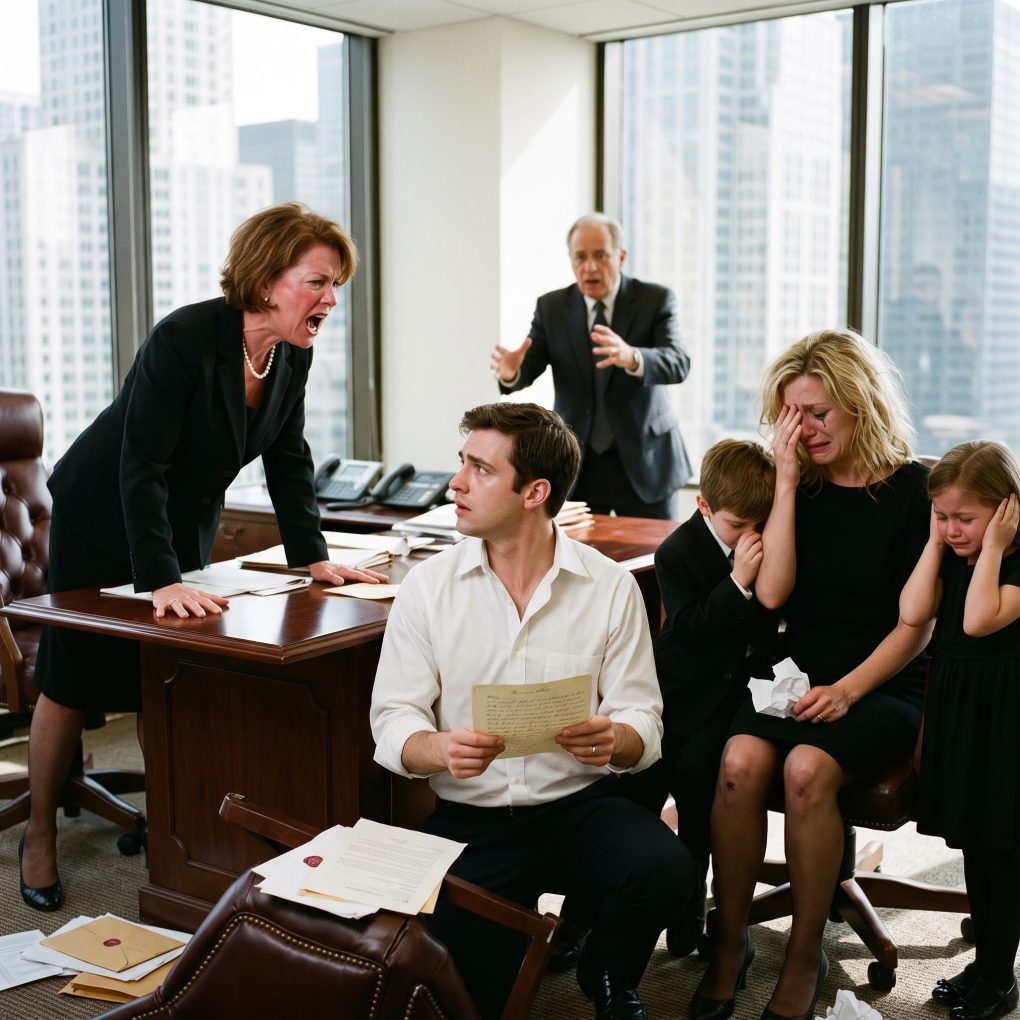
A strange woman and three children cried “daddy” at my father’s funeral—louder than my own mother. She clutched my hand until her nails drew blood. Then the lawyer read the will, and my father’s final secret shattered our family…
My father’s oak casket hadn’t even touched the bottom of the vault when the wails shattered the silence. In the...