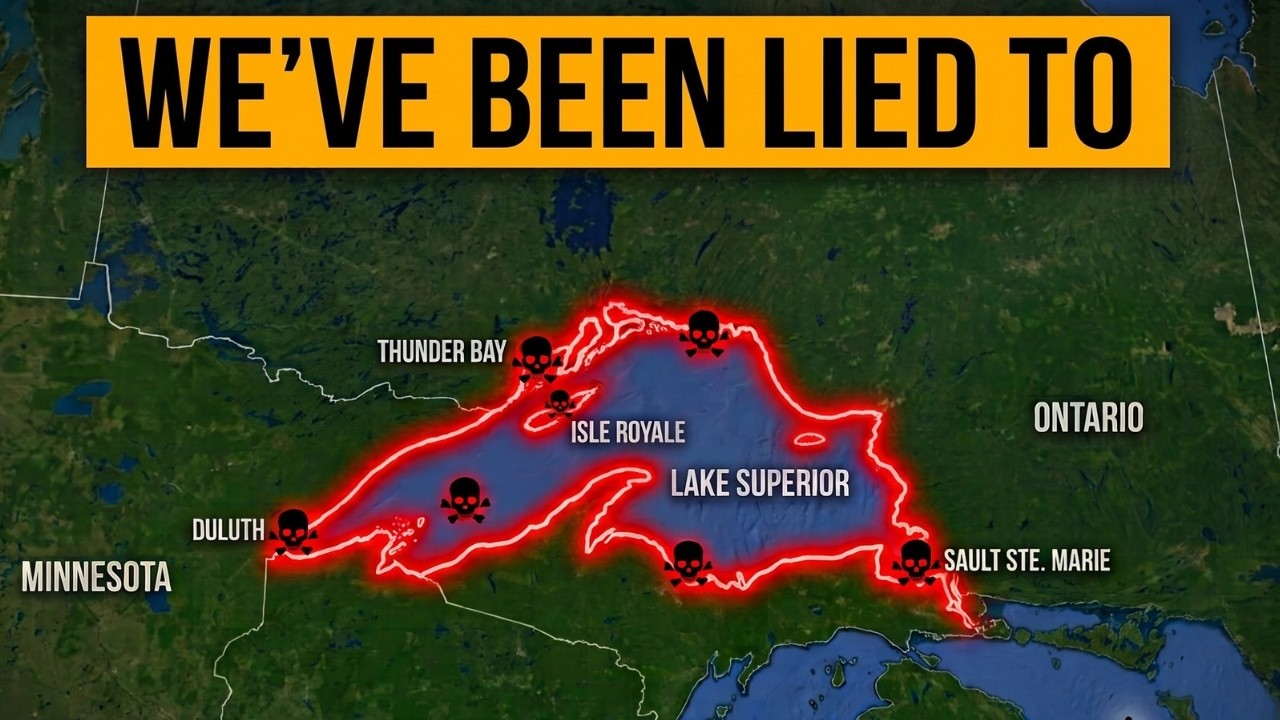
Lake Superior hides countless wrecks, but one discovery has divers and scientists refusing to speak openly. A sonar sweep recently revealed something massive resting far deeper than the lake’s most
Deep in the heart of North America sits a body of water so vast and so strange that it behaves less like a lake and more like a cold, patient ocean. Lake Superior holds 3 quadrillion gallons of water, so much that if you drained it, the entire landmass of North and South America would sit under a foot of water. It contains half of all the water in the entire Great Lakes system, dwarfing Erie, Onta…

The world’s most mysterious underwater object just gave up a secret it kept for 140,000 years—and the truth is terrifying. Divers probing the Baltic Sea Anomaly, the massive disc-shaped structure that sparked endless alien theories, claimed it was just a glacial deposit.
In June 2011, marine surveyors Peter Lindberg and Dennis Asberg were mapping the northern Baltic Sea floor when sonar detected a large, circular object roughly 60 meters across. The shape had unusually sharp edges, and a straight, 300-meter trench extended from one side of it across the seabed. The discovery puzzled the team, which had years of experience locating shipwrecks and recovering cargo f…

Back in 2011, sonar picked up a massive, perfectly circular object 90 meters beneath the Baltic Sea, complete with straight edges and a strange drag mark trailing behind it. The Swedish exploration team behind the find had no history with UFOs, but headlines instantly screamed alien spacecraft.
In June 2011, a Swedish exploration team called Ocean X was scanning the floor of the northern Baltic Sea with side-scan sonar, searching for shipwrecks. The team, led by Peter Lindberg and Dennis Asberg, had been at sea for nine days and was preparing to head home when they decided to run the sonar one last time. That final pass picked up an unusual shape on the seafloor at a depth of roughly 90…

Explorers mapping Lake Michigan’s floor found dozens of massive, near-perfect circular holes at 500 feet deep, some over 600 feet wide. Sonar scans in 2022 revealed roughly 40 depressions arranged in eerie, footprint-like patterns no one has documented in the Great Lakes.
Explorers mapping the bottom of Lake Michigan have identified dozens of large circular depressions in the lakebed. The discovery was made using sonar equipment, and researchers are still determining what created the formations.In 2022, a team of researchers was using sonar to map the lake floor and search for shipwrecks. They expected to see standard rock formations and sand deposits. Instead, the…