The Sumerian “Handbag of the Gods” has just revealed another ancient secret, and it is not what researchers expected. Carved into temple walls thousands of years ago, the mysterious object appears in Mesopotamia, Egypt, and even South America, sparking wild theories about lost civilizations or visitors from beyond.
Artifacts resembling modern handbags appear in ancient carvings across cultures separated by thousands of years and thousands of miles. The same object, a small rectangular container with a curved handle, appears in Sumerian seals, Assyrian palace reliefs, a 12,000-year-old stone pillar in Turkey, and Olmec carvings in Mexico. Researchers refer to it informally as the “bag of the gods,” though mai…
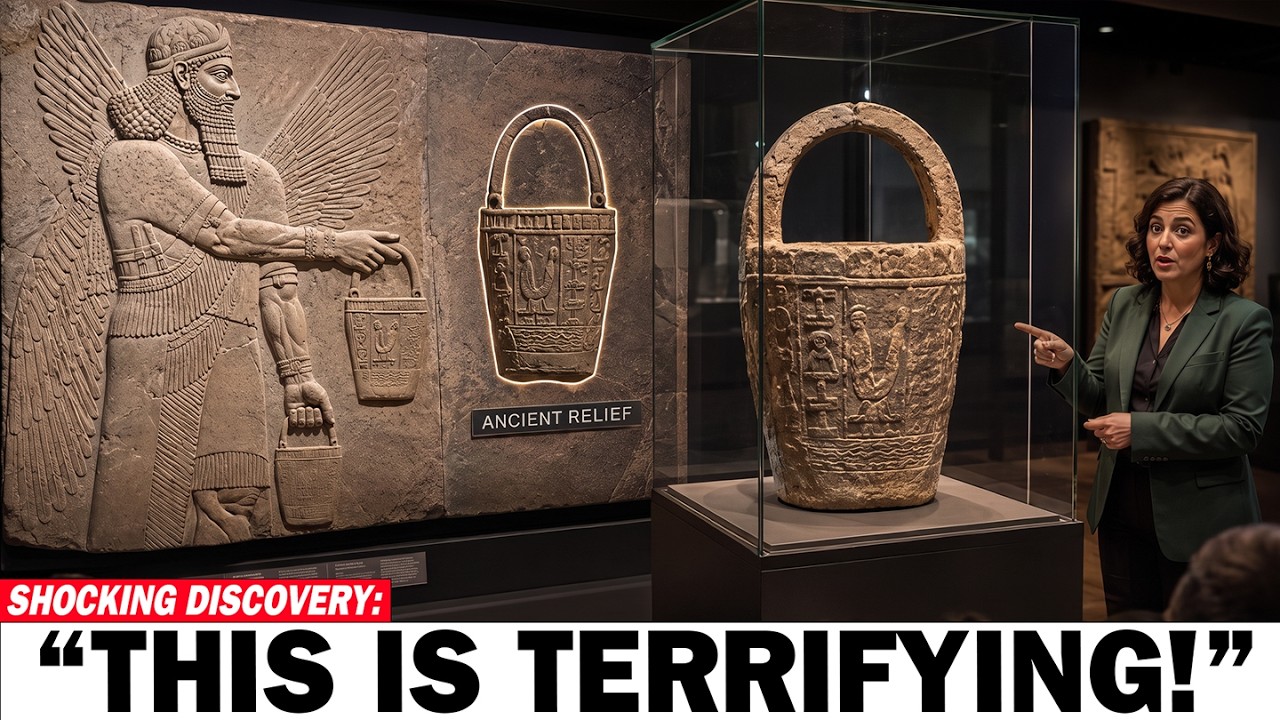
For decades, researchers dismissed the mysterious “handbag of the gods” carved across ancient Sumerian temples as mere mythology. Now, a team of scientists has finally examined the enigmatic symbols under advanced imaging, and the results have stunned the archaeological world.
For roughly 12,000 years, a recurring symbol has appeared in ancient art across three continents: a solid container with a curved handle, resembling a modern handbag. Carved by the Sumerians, the builders of Göbekli Tepe, and the Olmec of Mesoamerica, the object appears in sacred contexts but its contents are never depicted.The symbol first appears in Mesopotamian art, where figures known as the A…

Scientists used AI to analyze an ancient Sumerian star map, and what it revealed contradicts everything we thought we knew. The clay tablet, known as the Planisphere, was discovered in the 19th century but remained a mystery for over 150 years.
In 1850, a British archaeologist named Henry Layard recovered a small clay tablet from the ruins of the royal library of Ashurbanipal in Nineveh. The artifact, cataloged as K.8538, is about 14 centimeters wide and covered on one side with cuneiform markings arranged in eight wedge-shaped sections. It is known as the Planisphere of Nineveh. For more than 150 years, the object sat in the British Mus…