What if the legends of Hollywood’s Golden Age weren’t just charming or talented—but also hilariously, tragically human? Behind the dazzling smiles and Oscar statues, some of the biggest names in cinema were, by all accounts, utterly clueless. Their stories aren’t just about fame and fortune; they’re about the absurd, the naive, and the downright dumb decisions that defined their lives off-screen.
Take Johnny Weissmuller, the Olympic swimmer who became Tarzan. He could swing from vines with ease, but reading a script? That was a different jungle. “He was better with the rope than the script,” one crew member quipped. Weissmuller’s lack of awareness extended to his finances, leaving him broke and wandering hotel halls in his robe, still calling himself Tarzan.
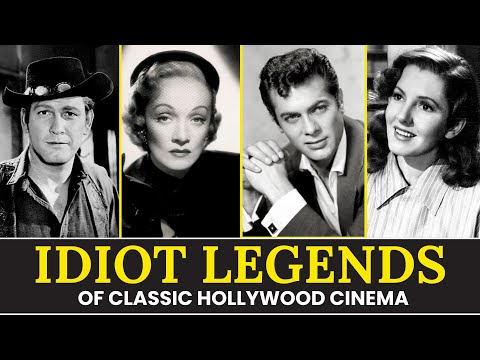
Then there’s Ed Wood, the filmmaker who believed every line he wrote was pure Shakespeare. His masterpiece, Plan 9 from Outer Space, is famously labeled the worst movie ever made—complete with paper plate flying saucers. Wood’s delusion was so profound that he never recognized his own shortcomings, blaming critics for not “getting it.”
And who could forget Jayne Mansfield? With an IQ of 163, she spoke five languages and played classical violin. Yet she built her career on playing the dumb blonde, a role she leaned into so heavily that even studio heads believed it was real. “She weaponized stupidity,” one biographer noted, but it ultimately trapped her in a persona she couldn’t escape.
Wallace Beery, a bankable star of the 1930s, was known for his gruff charm—and his violent temper. Directors simplified scripts for him because he couldn’t follow nuanced direction. Joan Crawford allegedly called him “cruel, stupid, and arrogant.” Off-screen, he invested in ostrich farms and novelty candy shops, convinced they’d be the next gold rush.
George Raft had the looks and swagger of a gangster icon, but his career choices were comically bad. He turned down The Maltese Falcon, Casablanca, and Double Indemnity—roles that made Humphrey Bogart a star. “I go with what I know,” Raft shrugged, as his career faded into oblivion.
Buster Crabbe, another Olympic gold medalist turned action hero, never read full scripts. He focused on stunts, not character arcs. When offered a TV reboot of Flash Gordon, he demanded creative control, then lost interest midway, leaving producers scrambling. His downfall wasn’t scandal—it was a quiet refusal to grow.
These stars weren’t just flawed; they were blind to their own limitations. Their stories remind us that fame doesn’t guarantee wisdom, and sometimes, the brightest lights cast the darkest shadows.
Esther Williams, Hollywood’s Million-Dollar Mermaid, was equally indifferent to anything beyond the water tank. She admitted to rarely reading her scripts, once joking, “If it doesn’t involve a pool, I’m not interested.” When her film roles dried up, she passed on television believing the medium was beneath her—and watched her swimwear line collapse under poor management.
Milton Berle, the first Mr. Television, refused to modernize his act even as ratings slid. “This is what made me famous,” he insisted, recycling vaudeville gags two decades out of date. He turned down an MGM film contract to protect his nightclub appearances, then invested in a chain of comedy clubs he never once visited. They collapsed within two years.
Frank Fay, once hailed as the greatest stage comedian in America, mistook applause for infallibility. He openly voiced antisemitic and racist views, mocked crew members, and turned down sound films believing talkies were beneath him. George Burns called him “the funniest man who ever lived and the most detestable human being I ever met.” By the 1950s, he was sleeping in rented rooms.
William Frawley, beloved as Fred Mertz, was nearly uncastable before I Love Lucy saved him. He slurred his lines from chronic drinking, had a scene cut from Miracle on 34th Street because he couldn’t stay sober, and scoffed at rehearsals. “If you need to practice, you shouldn’t be in this business,” he told a younger co-star.
Jean Arthur possessed one of the most distinctive voices of the 1930s, yet she spent her career running from fame. She refused press interviews, vanished between projects for months, and had breakdowns over lighting and costumes. She turned down His Girl Friday and It’s a Wonderful Life—roles written with her in mind—then retreated to her apartment with no plan at all.
Rod Steiger’s immersion in method acting became a cage of his own making. He rejected Patton and The Godfather, calling the latter too commercial, then admitted to regretting both. Director Sidney Lumet said it plainly: “Rod was brilliant, but he made things harder than they had to be on everyone.” He spent his final years in low-budget foreign films, just to make ends meet.
Earl Holliman built a career on predictability. He turned down Judgment at Nuremberg as “too political,” refused dialect training, and avoided the stage entirely. Director Richard Fleischer remarked that “he wasn’t difficult, he just didn’t stretch.” He sank his earnings into a Burbank restaurant that failed within three years.
Peter Lorre had the mind of a philosopher but the heart of a ghost. Terrified of unemployment after fleeing Nazi Germany, he accepted whatever came his way and rejected mainstream roles, fearing audiences wouldn’t accept him outside the shadows. Addicted to morphine, he rarely negotiated his contracts—at one point borrowing money from Boris Karloff to avoid eviction.
Marlene Dietrich cloaked herself in strategic ignorance, feigning simplicity to maneuver through an industry that wanted her seductive but silent. She pretended not to understand English during contract disputes, though she was fluent. “Men are frightened of smart women,” she once said. “They prefer a whisper to a sentence.” But when the studio system weakened, she had no fallback—no producing, no directing, only sequins and old standards.
Tony Curtis admitted he never read scripts all the way through, once referring to Laurence Olivier as “that English guy who yells a lot.” Billy Wilder said he had to pull performances out of him frame by frame. And Guy Madison, discovered as a telephone lineman, was described by director William Castle as having “the personality of a bookshelf”—yet he kept asking which way to face the camera well into his fourth film.
By the 1960s, Madison was reduced to dubbed European films and low-budget westerns, still handsome, still blank, still wondering why the phone stopped ringing. He had every opportunity and no idea what to do with any of it.
But if Madison was the blank slate, Clara Bow was the wildfire. The original “It Girl” of the silent era, Bow could light up a screen like nobody else—but off-camera, she was a hurricane of bad decisions, worse marriages, and an almost pathological distrust of anyone who tried to help her. Studio executives called her “the girl who couldn’t say no”—not to parties, not to gamblers, not to the wrong men.
According to biographer David Stenn, Bow gambled away enormous sums at the racetrack and card tables, once losing her entire weekly salary in a single night. “She had no off switch,” her secretary recalled. “Money came in and went out like a tide.” She married cowboy actor Rex Bell and retreated to a Nevada ranch, but the isolation only deepened her paranoia. She kept a loaded gun in her nightstand and accused visitors of being spies.
When sound arrived, Bow’s Brooklyn accent and nervous energy made her a target for mockery. Instead of training her voice or fighting for better material, she simply quit. She walked away from a contract worth millions, burned her bridges with Paramount, and spent her final decades as a recluse, dying alone in a small Los Angeles apartment at sixty.
Then there was John Barrymore—the greatest Hamlet of his generation, a man so gifted that his profile alone could sell tickets. But Barrymore treated his talent like a party trick he’d grown bored of. He drank through rehearsals, forgot his lines on live stages, and once reportedly hired a stand-in to read his part while he napped backstage during a Broadway run.
His brother Lionel, no saint himself, once said of him: “John could memorize the Bible in an afternoon and forget his own name by dinner.” Barrymore blew through fortunes on yachts, divorces, and champagne, then spent his final years in agony, unable to remember the lines that once made him immortal. He died broke, his career a punchline about wasted genius.
And finally, there’s the strange case of Thelma Todd—the “Ice Cream Blonde” who could hold her own against the Marx Brothers but couldn’t seem to hold her own life together. She opened a restaurant near the beach, got tangled up with mobsters who wanted a piece of it, and was found dead in her car at twenty-nine under circumstances that have never been fully explained. Her friends said she was sweet, funny, and hopelessly naive about the men she trusted.
Each of these legends shared a peculiar blindness—a refusal to see the cliff’s edge until they’d already stepped off it. They were warned, advised, even mocked by friends and colleagues. Yet they kept swinging, kept signing contracts without reading them, kept turning down the roles that could have saved them.
Maybe that’s the real Hollywood ending: not the fade to black, but the slow, stubborn walk away from every open door. Fame gave them immortality, but it also masked a staggering lack of awareness.
Their stories aren’t meant to make us feel superior. They’re a mirror—because we all have that one thing we refuse to learn, that one warning we ignore, that one role we keep playing long after the curtain should have dropped.
So here’s the question that lingers like cigarette smoke in a backlot alley: If the brightest stars of their era couldn’t see their own blind spots, what makes you so sure you’ve spotted yours?
Report this article
Select a reason for reporting: