THE CEO MADE A BLACK JANITOR CLEAN UP HIS SHATTERED TOWER MODEL IN FRONT OF EVERYONE—THEN THE BILLIONAIRE CLIENT ASKED A QUESTION NO EXECUTIVE COULD ANSWER – Life Story
Wesley Harrington slammed the Dubai tower model onto the marble floor hard enough to silence the entire lobby.
Fourteen days stood between his architecture firm and the loss of an eighty-million-dollar contract, yet he ordered the Black maintenance worker to kneel and clean up his anger.
But the man gathering the broken pieces had noticed something in the tower’s foundation that nobody in the expensive suits seemed able to explain.
THE MARBLE FLOOR
The central spire snapped.
Pale resin columns scattered beneath the reception desk, and a piece of the foundation rolled against Darien Taylor’s work boot.
Harrington, chief executive of Vertex Architecture, pointed at the wreckage as though Darien had broken it.
“Clean it up.
Every piece.
Our client will be here in five minutes.”
Darien held a gray mop in one hand and the supply-cart handle in the other.
Twenty people stood within earshot, many of them architects whose names appeared in industry magazines.
Nobody bent down.
Someone stepped over the broken tower to reach the elevators.
“Sir, the fragments are sharp,” Darien said. “I’ll get a dustpan.”
Harrington’s mouth tightened. “I wasn’t asking for a safety briefing.”
Darien crouched anyway.
He had learned to move carefully around broken things.
A jagged edge nicked his finger through the thin glove, and he withdrew his hand before the injury grew worse.
His eyes followed the fragment lying near his knee: part of the northern foundation raft, its delicate model piles splayed at the wrong angle.
It was not the first time he’d studied this building.
For three weeks he’d emptied wastebaskets outside the design room while its engineers argued over foundation revisions.
He recognized the geometry.
He also recognized what the newest sketches had failed to correct.
Behind the reception desk, Amara Wilson shifted forward as if to help.
She was Vertex’s youngest project architect and the only Black woman on the lead team.
Before she could reach Darien, a senior associate caught her attention with an urgent question about the client’s arrival.
A chime sounded from the entrance.
Four engineers entered behind Sheikh Abdullah Al-Fayed, the developer whose firm had awarded Vertex an eighty-million-dollar early-works design and delivery package for a tower in Dubai.
Al-Fayed wore a dark coat dampened by rain.
His eyes moved from the broken model to the man gathering it off the floor.
“Is there a reason your presentation is in pieces?” he asked.
Harrington’s voice changed completely. “A display mishap.
We’ll have a replacement brought upstairs.”
“I am not here to see a replacement display.” Al-Fayed kept his hands at his sides. “I am here to find out whether your proposed foundation can be built safely.”
No one answered immediately.
The client’s chief structural engineer, Dr.
Nabil Farouk, held a rolled drawing tube under one arm.
He had already rejected two revised load-path studies.
Vertex’s deadline to produce a defensible solution was fourteen days away.
Darien put another fragment into the pan.
A small resin beam carried the joint detail he’d stared at in last week’s drawings.
The junction between the foundation’s northern pile group and the transfer structure was still modeled as rigid.
A rigid assumption was exactly what concerned him.
Xavier Chambers strode through the crowd with a paper coffee cup and a leather portfolio.
The associate architect cut across Darien’s workspace, striking the dustpan with his shoe.
Two pieces slid out.
“Watch where you’re working,” Xavier snapped.
Darien steadied the pan. “I’m trying to keep the path clear.”
Xavier looked down at him. “Then try harder.”
A few executives laughed, quickly and nervously.
Darien felt heat rise beneath his collar.
His electricity had been shut off on Thursday, and his landlord had given him until Friday to resolve two months of overdue rent.
Losing this job would take away the last paycheck standing between him and a locked apartment door.
Al-Fayed’s engineer unrolled a drawing on the reception counter. “Mr.
Harrington, your northern pile-cap junction still assumes restraint the soil report doesn’t support.
Who signed off on this revision?”
Darien recognized the line before the sheet lay flat.
Amara looked at the paper, then at the fragments in his hands.
And for the first time that morning, Darien wondered whether keeping his head down might cost more than speaking.
The engineer tapped the drawing with one finger.
“Your latest submission increases the stiffness of the northern support group without addressing the resulting redistribution of forces.
If the soil behaves according to the field testing, you’re shifting the problem into the transfer structure.”
Harrington glanced toward Xavier.
“That’s being addressed.”
“By whom?” Farouk asked.
“Our engineering consultants.”
“Then I suggest they attend the next meeting.”
Sheikh Al-Fayed looked at the scattered model pieces.
“I have already given your company two extensions.
Fourteen days, Mr.
Harrington.
My engineers must be satisfied before any construction approval proceeds.
If they are not, we will appoint another design team.”
The lobby remained silent as the delegation moved toward the private elevators.
Harrington waited until they disappeared.
Then his expression changed.
“Who approved that model for display?” he demanded.
Xavier pointed toward an assistant.
The assistant looked toward Amara.
Amara opened her mouth, but Harrington was already walking away.
“Find me something that works,” he snapped. “I don’t care how.”
Darien finished collecting the pieces.
One small section of the northern foundation lay beneath the reception bench.
As he reached for it, he noticed a detail molded into the resin: a connection plate intended to hold two structural components in perfect alignment.
In an actual building, those components would not remain perfectly still.
The soil would settle.
The structure would move under changing loads.
The junction would respond to forces that a presentation model could never demonstrate.
Darien held the fragment for an extra second.
“Are you finished?”
Xavier stood over him.
“Yes, sir.”
“Then take that mess downstairs.
And get someone to polish this floor before the clients come back.”
Darien rose.
Xavier’s gaze traveled over his maintenance uniform.
“Honestly, I don’t know why they let you people wander around the executive floors.”
Darien looked at him.
The phrase was familiar.
You people.
It could mean maintenance workers when anyone challenged the speaker.
It could mean something uglier when nobody did.
Darien had learned that asking which meaning was intended rarely produced an honest answer.
“I have a work order for this floor,” he said.
Xavier smiled thinly.
“Then follow it.”
Darien pushed his cart toward the service corridor.
Amara caught up with him near the freight elevator.
“Wait.”
He stopped.
She looked at the small bandage he had wrapped around his finger.
“Are you okay?”
“It’s a scratch.”
“That wasn’t what I meant.”
Darien gave her a tired smile.
“Then the answer’s still the same.”
Amara looked toward the lobby.
“Harrington shouldn’t have done that.”
“No.”
“Xavier either.”
“No.”
She hesitated.
“I heard you say something about the foundation.”
Darien’s eyes sharpened.
“When?”
“Just before the delegation arrived.
You looked at the drawing and said the connection wasn’t right.”
He remembered speaking almost under his breath.
“Maybe you misheard me.”
“Maybe.”
The elevator arrived.
Darien pushed his cart inside.
Amara held the doors with one hand.
“I’m working on that connection,” she said. “The revised load path.
If you noticed something, I’d rather hear it than keep guessing.”
Darien stared at her.
She was sincere.
He could see that.
But sincerity did not protect anyone from a powerful man’s anger.
“Be careful who you ask for answers around here,” he said.
The elevator doors closed between them.
As it descended, Darien looked at his reflection in the brushed steel.
Thirty-two years old.
A maintenance uniform.
A cheap bandage.
A cleaning cart containing the remains of a tower that an entire team of professionals could not make safe enough to build.
He had once expected his life to look very different.
And the worst part was that he still knew exactly how to begin solving the problem.
DRAWINGS BY CANDLELIGHT
The key stuck halfway into Darien’s apartment lock.
He jiggled it twice before the door opened.
Inside, the room was dark.
His electricity had been disconnected four days earlier, after he fell behind on payments.
He had arranged a payment plan, but the initial amount was more than he could put together before the deadline.
He flicked the light switch anyway.
Nothing happened.
The apartment was small enough that he could cross it in six steps.
His bed stood beside a narrow window overlooking an alley.
Across from it, a folding table served as his desk, dining table, and drawing board.
Architectural sketches covered the walls.
Some were projects from school.
Others were designs he had imagined during night shifts at Vertex: affordable housing, neighborhood libraries, a community center with a courtyard large enough for children to run without crossing a street.
On the desk sat a brass drafting compass.
His grandfather had given it to him when he was thirteen.
The tool was old, heavier than modern drawing instruments, with a worn wooden case and a hinge that clicked softly when opened.
His grandfather had worked as a construction foreman for thirty-eight years.
He had never become an architect.
But he knew how to read drawings, measure foundations, and recognize when someone was trying to hide poor workmanship beneath polished finishes.
“A building has to tell the truth,” he used to say. “The walls can be beautiful, but the foundation doesn’t care about appearances.”
Darien removed his uniform and washed his hands.
The scratch on his finger had stopped bleeding.
He cleaned it, applied a fresh bandage, and opened the refrigerator.
Half a carton of milk.
Two eggs.
A plastic container of rice.
He stood looking at the shelves, calculating how long the food would last.
His phone showed a bank balance of ninety-four dollars and seventeen cents.
His monthly blood pressure medication had recently required a larger copayment after a change in his insurance coverage.
He had picked up the prescription that morning.
Now his remaining money wouldn’t cover rent.
He set the medication beside a glass of water and took it according to his doctor’s instructions.
Then he ate the rice cold.
There had been a time when he spent evenings drawing because it made him happy.
Now he drew because it reminded him that the mind inside the maintenance uniform was still his.
Five years earlier, Darien had been studying architecture at Howard University, concentrating on building structures and design technology.
He had completed demanding coursework in mathematics, building systems, and structural analysis.
His professors had considered him unusually gifted at understanding how structural behavior could shape architectural design.
He still needed to finish his degree.
He had been approaching his final year when his mother received a cancer diagnosis.
The medical bills accumulated.
Darien took a semester off to help her.
Then another.
He worked evenings, drove her to appointments, argued with insurers, and watched the savings he had intended for tuition disappear.
His mother died the following year.
By then, returning to school required money he no longer had.
He applied for scholarships, academic reinstatement, and entry-level drafting positions.
Some employers wanted a completed degree.
Others wanted experience he had never had the chance to earn.
Vertex hired him through a maintenance contractor.
He told himself it was temporary.
Six months became a year.
Then two.
By his third year, he knew the architecture floor better than some of its new employees.
He knew which project rooms stayed lit past midnight.
Which associates left revisions on whiteboards.
Which engineers argued over calculations.
And which executives walked through a freshly cleaned hallway without noticing the person holding the mop.
He did not have access to confidential design systems.
He did not pretend otherwise.
But the plans displayed during open project meetings, the revisions discussed within earshot, and his own technical training were enough to make him curious.
Darien took out a sketchbook.
On a clean sheet, he drew the tower’s foundation concept from the details he remembered.
The northern side carried a group of deep piles supporting the transfer structure above.
The revised scheme increased resistance to lateral loading from wind.
That part made sense.
The problem was what happened next.
The new arrangement created a sharp stiffness difference between neighboring foundation elements.
Under changing loads, the connected sections would not deform in the same way.
If the analysis assumed a perfectly rigid relationship, important stresses could be underestimated.
Darien drew a circle around the connection.
Then another.
He did not have the complete geotechnical report, all design load cases, or the project team’s verified numerical model.
He knew that meant he could not certify a solution.
But he could identify a question the design team needed to answer.
He began sketching an alternative load path.
Additional reinforcement.
Modified connection geometry.
A more deliberate distribution of movement and force between the pile groups and the transfer structure.
The idea was not a finished engineering design.
It was a way to approach the problem differently.
By ten o’clock, the room had grown cold.
A knock sounded at his door.
Mrs.
Chen stood outside holding a flashlight.
She was seventy-one, with silver hair cut neatly around her face and a wool cardigan buttoned to the neck.
“Your lights still aren’t working?”
Darien tried to smile.
“They’ll be back soon.”
“You said that Friday.”
“I know.”
She stepped past him and looked around.
“Have you eaten?”
“Yes.”
“What?”
“Rice.”
She shook her head.
“Rice isn’t dinner by itself.”
“It’s a beginning.”
Mrs.
Chen opened a grocery bag.
Inside were two containers of homemade food.
Darien sighed.
“You don’t have to keep doing this.”
“I know.”
She placed them in his refrigerator.
“That’s why it’s a gift.”
She noticed the drawings on the desk.
“Still studying?”
“Trying to.”
Mrs.
Chen picked up the sketchbook.
Her eyes settled on the foundation diagram.
“My father was a civil engineer in Shanghai,” she said. “He worked on bridges.”
Darien looked up.
“You never told me that.”
“You never asked.”
She studied the page.
“Is this from the building on the news?”
“Something like it.”
“The one your company is having trouble with?”
Darien nodded.
She looked from the drawing to the brass compass.
“Can you help them?”
“I might know where they’re looking in the wrong place.”
“Then tell them.”
Darien laughed quietly.
“Mrs.
Chen, I clean their offices.”
“So?”
“They don’t ask me what I think.”
She set the sketchbook down.
“Then perhaps you should ask why they don’t.”
He shook his head.
“It’s not that simple.”
“No,” she agreed. “Nothing important ever is.”
At the door, she paused.
“Tomorrow my nephew is bringing me a portable battery for emergencies.
I’ll ask him to bring you one too.”
“Please don’t.”
“Darien.”
He looked at her.
“When my husband lost his job, you carried groceries upstairs for us every week.
You fixed the lock on my door.
You helped me fill out those insurance forms.”
“That was different.”
“Only because you were the one giving.”
She left before he could argue.
Darien returned to his desk.
He opened his grandfather’s compass, set its point against the page, and began marking the relationship between the foundation elements.
For the first time that evening, his work felt less like an escape and more like a possibility.
But possibility did not pay the landlord.
At eleven forty-three, his phone vibrated.
A message from the building management company.
FINAL NOTICE: PAYMENT OR VACATE BY FRIDAY.
He read it twice.
The notice was written as though the landlord could simply remove him when the deadline passed.
Darien knew it wasn’t that simple.
But knowing the law and having the time, money, and energy to assert your rights were different things.
Another message arrived.
This one came from Vertex’s scheduling system.
Mandatory overtime.
Executive floor preparation.
Report at a.m.
Darien looked at the drawings.
Then at the overdue bills.
Then at the medication beside the sink.
He closed his sketchbook.
Tomorrow, he would put on the gray uniform again.
But he did not put the compass away.
He left it on the desk, open to the page where the northern foundation had finally begun to make sense.
At six the next morning, Vertex felt more like an emergency room than an architecture firm.
Employees hurried between conference rooms carrying rolled drawings and half-finished coffee.
The executive floor smelled of printer toner and expensive cologne.
Darien was replacing trash bags outside the primary design studio when he heard Harrington’s voice.
“We are not losing this contract.”
Through the open glass doors, the project team gathered around a long table.
Xavier stood beside a screen showing the Dubai tower.
Amara sat near the end, her tablet open to a foundation diagram.
Harrington pointed at the screen.
“The client’s engineer says our revised solution still has a stiffness problem.
I need a defensible answer, not another week of internal arguments.”
Xavier stepped forward.
“We can increase reinforcement in the transfer region.”
Amara looked up.
“That won’t necessarily solve the deformation mismatch.
We need to revisit how the junction is modeled.”
Xavier gave an impatient sigh.
“We’ve discussed this.”
“We’ve discussed adding material,” she replied. “That’s not the same as changing the load path.”
Harrington rubbed his forehead.
“Can someone give me a solution that doesn’t require redesigning half the foundation?”
Darien stopped beside the doorway.
He had heard the same disagreement repeated in different words for three weeks.
Xavier wanted to strengthen what already existed.
Amara wanted to examine how the whole system behaved.
Darien knew which approach was closer to the answer.
Harrington noticed him.
“Why is maintenance standing in my conference room?”
Darien lifted the trash bag.
“Scheduled cleaning, sir.”
“Then finish and leave.”
Xavier glanced at the gray uniform.
“Some of us are trying to do work that matters.”
Darien lowered his eyes.
He could feel Amara watching him.
As he turned toward the door, she spoke.
“Mr.
Harrington, what if we commissioned a separate peer review of the northern connection rather than adding another reinforcement layer?”
Harrington looked irritated.
“That would take time.”
“So will submitting another design that gets rejected.”
Xavier shook his head.
“We don’t need outside help.
We need to finish what we’ve started.”
Darien stopped in the hallway.
He had never heard Amara push back so directly.
And he wondered how much longer she would be allowed to do it.
At noon, he encountered Xavier near the executive elevators.
The architect was walking with two clients.
Darien moved his cleaning cart aside.
Xavier barely looked at him.
“Watch the walls with that thing.
We don’t need another repair bill.”
One of the clients glanced at Darien.
“Long day?”
Darien smiled politely.
“Getting there.”
Xavier laughed.
“He’s always here.
Sometimes I think maintenance has the easiest job in the building.”
Darien thought of his six o’clock start.
His aching feet.
The medication he had taken with water in the breakroom.
The apartment that would be dark when he returned.
He kept his expression neutral.
Xavier continued walking.
His words remained behind him.
“Some people just don’t understand real professional pressure.”
Darien pushed the cart toward the service hall.
There was a difference between being unseen and being treated as if seeing him would be inconvenient.
He was beginning to understand how much that difference had cost him.
THE NORTHERN LINE
On Wednesday, Darien found Amara alone in the model room.
A new foundation mockup stood beneath a white task lamp.
She had removed one side of the structure to expose the connections.
The table was covered with tracing paper, rulers, and several marked-up drawings.
Darien entered to empty the wastebasket.
Amara looked up.
“Can I ask you something?”
He hesitated.
“Sure.”
“Do you have any design training?”
His hand tightened around the trash bag.
“Why?”
“Because you keep looking at these drawings like you understand them.”
Darien glanced toward the hallway.
“People look at drawings.”
“Not the way you do.”
He took a slow breath.
“I studied architecture.”
“Where?”
“Howard.”
Her expression changed.
“You went to Howard?”
“For a while.”
“What happened?”
“Life.”
Amara waited.
She did not press him.
That made it easier to continue.
“My mother got sick.
I left before finishing.”
She nodded.
“I understand.”
He looked at the model.
“Your northern junction still assumes more restraint than the foundation may actually provide.”
Amara became completely still.
“Say that again.”
Darien stepped closer.
He pointed to the connection without touching the model.
“The piles on this side are being treated as if they respond almost identically to the adjacent support group.
But if the geotechnical model shows different stiffness and settlement behavior, a rigid connection could concentrate demands right here.”
Amara followed his finger.
“That is what I’ve been worried about.”
“Then why is everyone adding more reinforcement to the same detail?”
“Because it’s the fastest change they can explain to the client.”
“Fast isn’t the same as right.”
Amara looked at him.
For a moment, Darien regretted speaking.
Then she asked, “What would you do?”
He looked at the available drawings.
“I’d test a different transfer arrangement.
Give the forces another path.
Then study the displacement compatibility, not just peak strength.”
She reached for a pencil.
“Show me.”
Darien hesitated.
His name was not on the project.
He had no employment agreement giving him design authority.
He didn’t even have permission to use the firm’s professional resources.
“I shouldn’t be drawing on your documents,” he said.
“Then use this.”
She slid a blank sheet toward him.
He took the pencil.
His first line was uncertain only because his hand was trembling.
The second came naturally.
Within minutes, he had outlined a conceptual modification: reinforced connections arranged to distribute load more evenly, with a revised transition between elements of differing stiffness.
He labeled assumptions that would require verification.
Actual soil parameters.
Wind and seismic loading cases.
Construction sequencing.
Material strength.
Allowable movement.
Amara watched his pencil move.
“You’re not just guessing.”
“No.”
“How long have you been thinking about this?”
“Since the first revision.”
“That was three weeks ago.”
“I know.”
She stared at the sketch.
“Why didn’t you say anything?”
Darien looked toward the hallway.
“You saw what happened in the lobby.”
Amara lowered her eyes.
Then she looked at him again.
“I did.”
He put down the pencil.
“This is only a concept.
It needs proper analysis by the structural team.”
“I know.”
“And the drawings we’re discussing belong to the project.
I don’t want you putting my name on something I haven’t been formally asked to do.”
Amara studied him.
“You’re worried they’ll steal it.”
Darien gave a humorless smile.
“I’m worried they’ll decide I shouldn’t have been thinking about it in the first place.”
She folded the sketch carefully.
“I’ll ask for an authorized review.”
Before Darien could answer, the door opened.
Xavier entered.
“What is this?”
Amara turned.
“We’re discussing a possible alternative approach.”
Xavier looked at Darien.
“With maintenance?”
Darien stepped back.
Amara held the drawing.
“He identified a concern with the northern connection.”
Xavier stared at her.
“Are you serious?”
“Yes.”
“Amara, we have qualified engineers working on this.”
“And we have a problem they haven’t resolved.”
Xavier’s jaw tightened.
He looked directly at Darien.
“Did you go through our project files?”
“No.”
“Then where did you get this idea?”
“From the drawings discussed in the project room.”
Xavier laughed.
“That’s incredible.”
Amara’s expression hardened.
“What’s incredible?”
“That you’re entertaining technical advice from someone who empties trash.”
Darien felt his shoulders tighten.
He could defend himself.
He could explain his coursework.
He could name the professors who had praised his work.
But he knew the result.
Xavier would become more aggressive.
Amara would be accused of poor judgment.
And Darien’s job could disappear before Friday.
He stepped toward the cart.
“I’m finished here.”
Xavier pointed at the door.
“Good.”
Darien left.
Behind him, he heard Amara speak.
“You don’t have to agree with him, Xavier.
But you could at least listen before deciding he has nothing to contribute.”
The door closed.
Darien stood in the hallway for several seconds.
Then he pushed the cart toward the elevator.
He had spoken.
Nothing had changed.
Or so he believed.
That afternoon, Harrington called an emergency meeting about the Dubai project.
Darien was cleaning the corridor outside the conference room when he heard Xavier presenting a new conceptual approach.
The description sounded familiar.
A different load path.
Modified transition geometry.
Reduced concentration of forces at the northern junction.
Darien stopped.
Through the glass, he saw Xavier drawing a triangular reinforcement arrangement on the whiteboard.
It resembled Darien’s sketch.
Not perfectly.
Some details were missing.
But the underlying approach was his.
Amara sat at the table, watching with a face so still it frightened him.
Harrington nodded.
“That’s the first reasonable thing I’ve heard all week.”
Xavier smiled.
“I’ve been reconsidering the problem from a broader systems perspective.”
Darien felt the cart handle press into his palm.
The room erupted into questions.
No one asked where the idea came from.
No one looked toward the maintenance worker outside the glass.
Darien kept moving.
At the end of the corridor, he stopped beside the service elevator and leaned his forehead against the cold wall.
He had spent years imagining that talent would reveal itself if given the slightest opening.
Now he had watched someone take that opening and step through ahead of him.
His phone vibrated.
A message from Amara.
I saw.
I’m sorry.
Please don’t give up on the design.
Darien stared at the words.
Then another message arrived.
Xavier can’t explain the assumptions.
He took the idea, not the understanding.
Darien read it twice.
That evening, he returned home with a new purpose.
He was no longer trying only to solve the tower problem.
He needed to establish what he had created, when he had created it, and how his ideas differed from the incomplete version Xavier was presenting.
He opened his sketchbooks.
The earliest diagrams were dated three weeks before the meeting.
His calculations were written in several colors of ink.
Some pages contained corrections.
Others showed rejected ideas.
Together, they formed a design history that could not easily be invented after the fact.
He photographed the pages.
Then he recorded a short video explaining the evolution of his conceptual design.
He was careful not to include confidential company documents.
He used his own drawings and stated which assumptions would need validation.
His voice sounded strange in the recording.
Calm.
Professional.
Certain.
When he finished, he watched it once.
Then he saved copies to two secure locations.
Mrs.
Chen knocked at the door.
She carried a portable power bank and a small thermos of tea.
“My nephew brought this,” she said.
Darien accepted it.
“Thank you.”
She glanced at the phone on his desk.
“Working again?”
“Yes.”
“Good.”
He hesitated.
“Mrs.
Chen, what would you do if somebody took credit for something you made?”
She thought for a moment.
“I would keep proof.”
He smiled faintly.
“Already done.”
“Then I’d make sure the right people saw it.”
Darien looked at the sketches.
“The right people don’t always want to look.”
Mrs.
Chen touched the brass compass.
“Then perhaps you haven’t found the right people yet.”
The following morning, Darien made a decision.
He would develop a small physical demonstration of the concept using reclaimed modeling materials.
He asked the model-shop technician whether he could take certain offcuts and discarded components home.
The technician gave permission, noting that they were waste material unrelated to current project deliverables.
That distinction mattered to Darien.
He had already been made to feel dishonest for knowing things outside his job description.
He would not give anyone a legitimate reason to accuse him of stealing company property.
For three nights, he worked after his maintenance shifts.
The model was small.
It did not attempt to reproduce the entire tower.
Instead, it illustrated the foundation transition and the way alternative reinforcement might change the distribution of load.
He used flexible connectors to make relative movement visible.
He marked each component.
He filmed the assembly process.
In one corner, he placed a small label.
Concept Study — Darien Taylor.
It was the first time he had put his full name on professional design work in five years.
When Amara saw the model on Friday morning, she stood silently for almost a minute.
“This is yours?”
“Yes.”
“And you made it yourself?”
“Yes.”
She touched the edge of the base.
“You’ve thought about the construction sequence.”
“Some of it.
Not enough to call it finished.”
She looked up.
“Darien, this is good work.”
He stared at her.
The words were ordinary.
He had not realized how long it had been since he’d heard them.
Amara opened her tablet.
“I want to ask the project director for a formal technical review.”
Darien shook his head.
“Not yet.”
“Why?”
“Because if it goes through Xavier, it disappears.”
She couldn’t deny that.
“What do you want?”
Darien looked at the model.
“I want an opportunity to explain it myself.
And I want somebody qualified to test it before anyone calls it safe.”
Amara nodded.
“Then we need a better way.”
At that moment, Xavier appeared at the studio door.
His eyes went straight to the model.
“What is that?”
Darien turned.
“A concept study.”
“For what?”
“The foundation transition.”
Xavier walked closer.
He examined the structure with sudden interest.
“Where did you get those components?”
“Discarded shop materials.
I asked permission.”
Xavier looked at Amara.
“Why wasn’t I told about this?”
“Because it isn’t your model,” she answered.
His expression changed.
“Everything related to this project needs to go through the team.”
Darien picked up the model.
“Then the team can invite me to present it.”
Xavier stared at him.
“Are you trying to make demands?”
Darien’s heart pounded.
“No.
I’m telling you whose work it is.”
For several seconds, the room was silent.
Then Xavier smiled.
“Interesting.”
He stepped aside.
“Let’s see how far that gets you.”
ANOTHER MAN’S SIGNATURE
By Monday, the foundation concept had become the center of Vertex’s revised presentation.
Darien discovered that not because anyone informed him, but because Xavier’s voice carried through the design studio doors.
“The key innovation,” Xavier told the assembled executives, “is a modified transition system that reduces the mismatch between adjacent foundation elements.”
On the screen appeared a diagram.
It was not identical to Darien’s model.
But the arrangement was unmistakably derived from it.
Xavier had changed the labels.
He had adjusted the proportions.
He had removed the notes identifying assumptions that still needed verification.
The result looked cleaner.
It also looked more complete than the analysis justified.
Harrington leaned forward.
“Can we submit this?”
Xavier nodded.
“We’re preparing the supporting calculations.”
Amara raised a hand.
“Who is preparing them?”
“Our engineering team.”
“Has anyone reviewed the foundation displacement assumptions?”
“We’re working through those.”
“Then the drawings should be marked preliminary.”
Xavier gave her a cold look.
“They are preliminary.”
“The presentation doesn’t say that.”
Harrington slapped his hand against the table.
“Enough.
We need confidence in front of the client.”
Amara looked at him.
“Confidence isn’t verification.”
The room became painfully quiet.
Harrington stared at her.
“Are you telling me your own team can’t deliver?”
“I’m telling you we need to be accurate about what we’ve proved.”
Xavier leaned back.
“We’ve got the concept.
We can finalize the calculations.”
Darien watched from the hallway.
He knew the danger.
Xavier had copied the visible shape of the idea without preserving the reasoning that made it useful.
The new design still depended on unverified soil assumptions and an incomplete treatment of the connection between the northern foundation and eastern transfer structure.
The very weakness Darien had warned about could survive beneath the new presentation.
He stepped away before anyone noticed him.
His phone vibrated.
A message from the building management company.
FINAL VACANCY NOTICE.
REDEVELOPMENT SCHEDULE ACCELERATED.
He opened the attachment.
The notice claimed that residents were required to leave because major demolition work would soon begin.
It offered a small payment to anyone who surrendered their apartment keys within forty-eight hours.
There was no court order.
No formal eviction judgment.
Just a demand written in bold letters.
Darien called Mrs.
Chen.
“Did you get this?”
“Yes.”
“Have you signed anything?”
“No.”
“Don’t.”
She sighed.
“Darien, they’ve already shut off water twice this week for repairs.
The elevator keeps breaking down.
Yesterday they told the third floor that the building might not be safe.”
He closed his eyes.
“I’m going to find out who owns the redevelopment company.”
“You have enough problems.”
“This is one of them.”
He checked public property records during his lunch break.
The building was owned by a real estate company with several layers of corporate ownership.
He followed the filings.
One holding company led to another.
Then a familiar name appeared.
Harrington Urban Development Partners.
Wesley Harrington was listed as a controlling investor.
Darien stared at the screen.
The same executive who had humiliated him in the lobby was connected to the effort to clear his apartment building.
For a moment, the coincidence felt almost unbelievable.
Then he remembered the redevelopment signs that had appeared outside the building months earlier.
Harrington frequently spoke at company events about expanding Vertex into development advisory services.
The connection had been public.
Darien simply hadn’t known where to look.
He printed the ownership records at the public library after work.
He also printed the notices sent to tenants.
Then he called the city’s tenant protection hotline.
The person who answered explained that a landlord could not legally remove occupied tenants simply by posting a forty-eight-hour demand.
Utility interruptions and unsafe conditions could be reported for inspection.
Darien wrote down every instruction.
He filed a complaint.
Mrs.
Chen agreed to provide a statement.
Two other tenants did as well.
The next morning, a city inspector visited the building.
He documented the lack of reliable hot water, maintenance failures, and the posted notices.
The inspector did not promise that everyone could remain indefinitely.
Redevelopment could proceed through lawful processes.
But the building owner had obligations while tenants remained in possession.
Darien took photographs of the inspection notice.
Then he went to work.
His phone battery was low.
His apartment was still dark.
His rent remained overdue.
But for the first time, he understood that the landlord’s demand was not the same thing as lawful authority.
At Vertex, Xavier was waiting near the freight elevator.
“Mr.
Harrington wants to see you.”
Darien’s stomach tightened.
“About what?”
“Come along.”
The CEO’s office occupied the northeast corner of the executive floor.
The windows looked across Manhattan toward the river.
A large architectural photograph hung behind Harrington’s desk.
Xavier stood beside the doorway.
Harrington did not offer Darien a seat.
“I understand you’ve been involving yourself in the Dubai project.”
Darien kept his hands at his sides.
“I discussed a technical concept with Ms.
Wilson.”
“Are you employed here as an architect?”
“No.”
“Do you have a completed degree?”
“No.”
“Are you a licensed professional?”
“No.”
Harrington leaned forward.
“Then what makes you think you have the authority to participate in an eighty-million-dollar project?”
Darien chose his words carefully.
“I don’t claim authority to approve a design.
I identified a concern and developed a concept that could be evaluated.”
Harrington looked toward Xavier.
The architect gave a slight shrug.
“We’ve had some confusion over where the idea originated.”
Darien turned.
“There’s no confusion.”
Xavier’s expression hardened.
“Be careful.”
Darien faced Harrington again.
“I have dated sketches and recordings of the design process.
I can show how I developed it.”
Harrington stared at him.
“You’re saying Xavier stole your work?”
“I’m saying he presented a concept I developed without identifying me.”
Xavier laughed sharply.
“This is absurd.”
Darien kept his voice steady.
“The original includes assumptions and secondary reinforcements missing from the version you’re using.”
Harrington looked irritated.
“Mr.
Taylor, you seem to be forgetting your position.”
Darien felt something inside him settle.
For years, he’d heard variations of that sentence.
At job interviews.
In conference rooms.
From men who assumed a maintenance uniform defined the limits of his mind.
“My position is why I’m standing here,” he said. “It doesn’t change the work.”
Harrington’s face darkened.
“You’re suspended from your maintenance assignment pending a review of your conduct.”
Darien stared.
“For identifying a design concern?”
“For disrupting the workplace and making accusations against senior staff.”
Xavier looked away.
Darien felt the old panic rise.
No paycheck.
No rent.
No medication next month.
He could apologize.
He could withdraw the claim.
He could agree that Xavier had independently developed the concept.
He knew that was what Harrington expected.
Instead, he asked, “Will you put the reason for my suspension in writing?”
Harrington blinked.
“What?”
“I’d like the reason documented.”
“Human Resources will contact your contractor.”
“Thank you.”
Darien turned to leave.
At the door, Harrington spoke again.
“People like you should be grateful for the opportunities you’re given.”
Darien stopped.
He did not turn around.
“I was grateful for the job,” he said. “I wasn’t asking you to give me somebody else’s profession.”
Then he walked out.
In the service corridor, his hands began to shake.
He leaned against the wall until the feeling passed.
The doors of the freight elevator opened.
Amara stood inside.
She looked at his face.
“What happened?”
“They suspended me.”
Her expression changed.
“Darien—”
“Don’t say you’re sorry.”
She stepped out.
“I was going to ask what you need.”
He looked at her.
That was different.
He took a breath.
“I need you to remember what happened in the model room.
The sketch.
The conversation.
What Xavier said.”
“I remember.”
“And I need you to tell the truth if anyone asks.”
She nodded.
“I will.”
He looked toward the executive floor.
“They’re going to present an incomplete design.”
“I know.”
“Then make them test it.”
Amara’s voice was quiet.
“I’ve been trying.”
“Try harder.”
The words came out sharper than he intended.
She flinched.
Darien regretted them immediately.
“I’m sorry.”
Amara shook her head.
“No.
You’re right.”
He looked at her.
She continued.
“I’ve been careful because I don’t want to lose the position I’ve worked for.
But every time I stay quiet, Xavier gets to decide what happened.”
Darien understood that fear too well.
He placed one hand on the cart he’d pushed for three years.
“Then maybe both of us need to stop letting him.”
Amara met his eyes.
“Yes.”
THE BUILDING THAT WENT DARK
The next two days took almost everything Darien had left.
His maintenance contractor placed him on unpaid leave while reviewing the complaint from Vertex.
His landlord continued demanding payment.
The city inspector’s report did not immediately restore reliable utilities.
Mrs.
Chen moved temporarily to her nephew’s apartment in Queens after the building’s heating system failed again.
Darien helped carry her bags downstairs.
She stood beside the waiting car, her expression stern.
“You can come with me.”
“I have nowhere to put my things.”
“My nephew has storage.”
“I still have work to finish.”
She glanced at the worn sketchbook beneath his arm.
“Work doesn’t keep you warm.”
“I know.”
“Then promise me you won’t stay in that apartment if it becomes unsafe.”
He nodded.
“I promise.”
She looked at him for a long moment.
Then she pressed a small envelope into his hand.
Inside was a transit card and the address of a legal aid office.
“I already spoke to them,” she said. “They know about the building.”
Darien tried to hand it back.
She closed his fingers around it.
“You helped me when my husband was sick.
Let someone help you now.”
After she left, Darien stood on the sidewalk beneath a cold gray sky.
Construction fencing surrounded part of the neighboring lot.
The redevelopment company had begun clearing an unoccupied structure beside his building.
Dust drifted across the street.
His home suddenly looked temporary.
He returned upstairs and packed his most important belongings.
The textbooks from Howard.
His mother’s photographs.
The original sketchbooks.
The brass compass.
He placed them in two boxes.
Then he called Samuel Ortiz, the housing attorney whose number Mrs.
Chen had provided.
Samuel listened carefully.
He asked about the notices, the utility interruptions, the inspection, and the ownership records.
When Darien explained Harrington’s connection to the redevelopment company, the attorney became interested.
“Do you have documentation?”
“Yes.”
“Good.
Don’t confront anyone about that yet.
Send me copies, and we’ll determine the appropriate next steps.”
Darien looked at the boxes on the floor.
“Can they make us leave this week?”
“Not through the notice you’ve described.
But unsafe conditions may require temporary relocation, and the landlord has obligations.
We need to address the immediate housing problem separately from the broader dispute.”
“Can you help?”
“Yes.
But I need you to understand this won’t be settled by one phone call.”
Darien almost laughed.
Nothing in his life had been settled by one phone call.
“I understand.”
The attorney arranged to meet him the following morning.
Darien ended the call.
For the first time that week, he had a plan that did not depend on Harrington changing his mind.
That evening, Amara called.
Her voice sounded strained.
“The client moved the final presentation forward.”
“How far?”
“Tomorrow.
Three o’clock.”
Darien sat on the edge of his bed.
“What?”
“Dr.
Farouk reviewed Xavier’s latest package.
He says the junction analysis is still incomplete.
Al-Fayed wants a final technical meeting before deciding whether to move the work.”
Darien closed his eyes.
“Xavier doesn’t have the secondary connection design.”
“I know.”
“Has anyone asked him to explain the assumptions?”
“Yes.”
“And?”
“He gave the same presentation again.”
Darien looked at the sketchbook beside him.
“Then the answer hasn’t changed.”
Amara hesitated.
“Darien, I told the project director about your work.”
He sat straighter.
“What happened?”
“He asked why I hadn’t brought it forward earlier.”
“What did you say?”
“That I did, and Xavier dismissed it.”
Silence.
“He wasn’t happy,” she continued. “He said we can’t bring an uncredentialed contributor into the formal design process without review.”
“He’s right about the review.”
“I told him that.
I also said the person who developed the idea should be present to explain it.”
“What did he say?”
“He said Harrington would never approve it.”
Darien looked at the dark window.
“Then you know the answer.”
“No,” Amara said firmly. “I know Harrington’s answer.”
He frowned.
“What’s the difference?”
“Dr.
Farouk is the client engineer.
He’s the one who has to evaluate the technical merit.
If he asks for the person who developed the concept, Harrington doesn’t get to pretend you don’t exist.”
Darien felt his pulse quicken.
“Are you willing to tell him?”
“Yes.”
“Even if Xavier finds out?”
“He already knows I’m questioning him.”
Darien stood.
“Then send Dr.
Farouk the original concept description, with my permission, through an appropriate channel.
Make clear it’s a preliminary study and needs independent verification.”
“Can you send a dated copy?”
“I have one.”
“Good.”
He paused.
“Amara?”
“Yes?”
“Don’t claim more than we can prove.”
She answered without hesitation.
“I won’t.”
After the call, Darien opened his laptop.
He prepared a concise technical explanation.
He included the conceptual diagrams he’d developed independently, his dated design history, and the assumptions requiring validation.
He did not promise that the tower would be safe.
He explained why the current submission was incomplete and what additional analysis should be performed.
At the bottom, he signed his name.
Darien Taylor — Independent Design Concept Contributor.
He read the document three times.
Then sent it to Amara.
She confirmed receipt.
An hour later, another message arrived.
Dr.
Farouk wants to speak with you tomorrow before the meeting.
He has questions.
Darien stared at the screen.
He had spent five years waiting for somebody to ask.
Now the question had finally come.
At nine the following morning, Darien sat in the housing attorney’s office with a folder on his lap.
Samuel Ortiz reviewed the redevelopment notices.
“These are troubling,” he said.
Darien waited.
“The property owner has obligations concerning utilities and habitability.
The city inspection establishes some of the conditions.
We can request enforcement and pursue available remedies.”
“What about the other tenants?”
“They have rights too.
We’ll contact those who’ve agreed to participate and determine whether collective representation makes sense.”
Darien opened the ownership records.
“And Harrington?”
Samuel examined the documents.
“If his investment company controls the redevelopment entity, that may be relevant.
But we need to establish who made which decisions.”
Darien nodded.
He was learning that an accusation, even a justified one, became more powerful when supported by careful evidence.
Samuel looked up.
“Can you stay somewhere safe tonight?”
“Mrs.
Chen’s nephew offered a room.”
“Take it.”
Darien stared at the table.
“I hate asking.”
Samuel closed the folder.
“Accepting a place to sleep isn’t surrender.”
Darien looked at him.
“Then why does it feel like it?”
“Because you’ve been carrying too much alone.”
The answer stayed with him.
When he left the office, he went directly to his apartment.
He packed the remaining essentials.
A friend from the building helped carry the boxes.
By noon, Darien had moved his most important belongings to temporary storage arranged through Mrs.
Chen’s nephew.
The apartment stood almost empty.
A rectangle of dust marked the place where his desk had been.
The window rattled in the wind.
For five years, he’d imagined leaving that room after earning a professional position.
He’d pictured carrying his drawings into a larger apartment, perhaps one with a separate workspace and enough light to work without a lamp.
Instead, he was leaving because the building had become too difficult to live in safely.
He stood at the door.
The brass compass rested in his coat pocket.
His phone vibrated.
A message from Amara.
Meeting confirmed.
Dr.
Farouk will see you at .
Visitor access arranged through the client team.
Bring your original notes.
Darien looked once more around the empty apartment.
He had no job.
No permanent home.
Less than forty dollars available in his bank account.
And an invitation to explain an engineering concept to one of the most demanding clients Vertex had ever served.
He locked the door.
Then he went downstairs.
For the first time, he wasn’t going to Vertex to clean.
THE QUESTION THEY COULDN’T ANSWER
At one thirty, Darien entered Whitmore Plaza—home to Vertex Architecture—through the main doors.
He wore a clean white shirt, charcoal trousers, and a dark jacket he’d owned since his last semester at Howard.
The clothes were not expensive.
The cuffs were slightly worn.
But they fit.
He carried a drawing tube beneath one arm and his sketchbook in a canvas bag.
The security officer checked his visitor authorization.
“Mr.
Taylor?”
“Yes.”
“Thirty-eighth floor.
Conference room B.”
Darien accepted the temporary badge.
For three years, his maintenance identification had opened the service elevators and storage rooms.
Now a different badge allowed him to ride upstairs as a visitor invited by the client.
He stood among executives and consultants in the elevator.
Nobody asked him to move aside.
Nobody told him to be invisible.
The doors opened onto the familiar marble corridor.
Darien walked past the place where Harrington had shattered the model.
The floor had been polished.
No evidence remained.
He stopped for a moment.
Then continued.
Amara waited outside Conference Room B.
When she saw him, relief crossed her face.
“You made it.”
“Wasn’t sure I would.”
She glanced at his bag.
“Everything there?”
“Yes.”
“Good.”
She lowered her voice.
“Harrington knows you’re meeting Farouk.”
Darien felt his stomach tighten.
“What did he say?”
“That this is highly irregular.”
Darien gave a small smile.
“He’s not wrong.”
Amara shook her head.
“You know what I mean.”
“I do.”
She opened the door.
Dr.
Nabil Farouk stood beside a large screen displaying the tower’s foundation model.
He was a reserved man in his fifties, with silver at his temples and a manner that made unnecessary conversation feel wasteful.
“Mr.
Taylor.”
“Doctor.”
“Ms.
Wilson sent me your preliminary study.”
Darien nodded.
“I want to be clear,” Farouk said. “The idea is interesting.
That does not mean it is an approved design.”
“I understand.”
“Good.”
Farouk pointed toward the screen.
“Your concept changes the stiffness distribution between the northern pile group and the transfer structure.
Why?”
Darien set down his bag.
“Because the current proposal appears to assume displacement compatibility that the available soil behavior may not support.”
Farouk watched him.
“What information are you using?”
“Only what I was able to observe in the project discussions and the publicly displayed design materials.
I don’t have the complete geotechnical dataset.”
“Then you cannot calculate the final response.”
“No.”
Farouk raised an eyebrow.
Darien continued.
“But I can identify why the current approach needs a different model.
Adding strength to a connection doesn’t eliminate a deformation mismatch.
It may transfer the demand somewhere else.”
Farouk turned to Amara.
“That’s the concern you raised.”
“Yes.”
He looked back at Darien.
“Show me.”
Darien opened his sketchbook.
He laid out the development of the concept, beginning with the first rough diagram.
Then the intermediate versions.
Then the revised arrangement.
He explained how the altered transition could provide a more deliberate route for loads while limiting abrupt differences in deformation.
Farouk asked about settlement.
Darien answered.
He asked about wind loading.
Darien answered what he could and identified what required verification.
He asked about construction sequence.
Darien referred to the notes he’d written beside the model.
At one point, Farouk interrupted.
“You’ve neglected a possible torsional response under asymmetric loading.”
Darien looked at the diagram.
Then he nodded.
“Yes.
That needs to be included in the detailed analysis.”
Farouk studied him.
“You’re comfortable admitting that?”
“I’d rather be corrected on paper than after concrete is poured.”
For the first time, Farouk smiled.
A small smile.
But real.
He closed the sketchbook.
“Where did you train?”
“Howard University.
Architecture program.
I left before completing the degree.”
“Why?”
“My mother became seriously ill.”
Farouk nodded without asking for details.
“You understand that an architectural education does not make you a licensed structural engineer.”
“Yes.”
“And that these calculations require qualified engineering review.”
“Yes.”
“Then what are you asking for?”
Darien looked at the drawings.
“An honest evaluation of the idea.
Credit for the work I actually did.
And the chance to contribute under people qualified to approve the final design.”
Farouk regarded him thoughtfully.
“That is a reasonable request.”
He checked his watch.
“We have ninety minutes before the formal meeting.”
Darien closed the sketchbook.
“Is that enough?”
“Enough to determine whether your concept deserves further investigation.”
Farouk paused.
“Not enough to certify a tower.”
Darien nodded.
“I wouldn’t trust anyone who claimed otherwise.”
At three o’clock, the primary boardroom filled with executives.
Sheikh Abdullah Al-Fayed entered with four engineers and two financial advisers.
Harrington stood near the head of the table.
Xavier waited beside the presentation screen.
Amara sat near the client engineers.
Darien took a seat at the far end, where Farouk had instructed him to wait.
Harrington noticed him immediately.
His face tightened.
“Mr.
Taylor?”
Darien rose slightly.
“Good afternoon.”
Harrington looked toward Farouk.
“Doctor, I understood this was a technical review with our project team.”
“It is,” Farouk said.
“Mr.
Taylor is not part of our project team.”
“He has been invited to explain a concept relevant to the review.”
Xavier laughed under his breath.
“This is ridiculous.”
Sheikh Al-Fayed looked toward him.
“Then let us see whether the work is ridiculous.”
The room fell silent.
Harrington forced a smile.
“Of course.”
The presentation began.
Xavier spoke confidently at first.
He described the revised foundation transition as the result of weeks of internal analysis.
He displayed diagrams that looked remarkably similar to Darien’s earliest concept.
Harrington nodded approvingly.
The client engineers listened.
Then Farouk raised a hand.
“Mr.
Chambers, you’ve altered the connection geometry.
Show us the displacement compatibility analysis.”
Xavier changed slides.
A table appeared.
Farouk studied it.
“These are strength checks.”
“Yes.”
“I asked about relative movement between the support groups.”
Xavier cleared his throat.
“We’ve considered those effects.”
“Where?”
“We’re finalizing the detailed model.”
Farouk leaned back.
“Then the design is not ready.”
Harrington intervened.
“Doctor, our team has made substantial progress.”
“I can see the progress.”
Farouk pointed toward the screen.
“But progress is not the same as demonstrating that the junction performs acceptably.”
Xavier clicked to another slide.
It contained generic seismic loading information.
Farouk’s expression did not change.
“These values do not answer my question.”
Xavier looked toward Amara.
She remained silent.
“Perhaps,” Xavier began, “we could focus on the cost efficiencies—”
“No,” Sheikh Al-Fayed said.
His voice was quiet.
That made it more commanding.
“My engineers will not approve an unsafe or inadequately demonstrated design because it is cheaper.
We discussed this at our first meeting.”
Harrington’s face lost color.
“Of course.”
Farouk folded his hands.
“Mr.
Chambers, who developed the modified transition concept?”
Xavier hesitated.
“Our team.”
“Who specifically?”
“I led the development.”
Farouk looked toward Darien.
Then back at Xavier.
“Can you explain why the initial concept included three alternative reinforcement arrangements, but your presentation shows only one?”
Xavier stared.
“I don’t know what you mean.”
Darien felt his pulse quicken.
He knew exactly what Farouk meant.
The three arrangements appeared in his dated sketches.
Only one had been copied into Xavier’s revision.
Farouk continued.
“The original study considered alternative stiffness distributions.
The version before us eliminates two without explaining why.”
Xavier’s expression hardened.
“Original study?”
Farouk opened Darien’s sketchbook.
“This study.”
The room went still.
Harrington stared at the pages.
Xavier’s mouth tightened.
“That material was developed internally.”
Darien stood.
“No,” he said.
Every face turned toward him.
He had imagined this moment for days.
He had rehearsed what he would say.
But standing in the room, looking at the people who had ignored him, he realized that anger would not help him explain the work.
He needed to be accurate.
“My name is Darien Taylor,” he said. “I worked on the maintenance staff here.
I developed the original concept independently after observing the foundation problem discussed during project meetings.”
Harrington’s voice cut across the room.
“This is completely inappropriate.”
Darien looked at him.
“I brought dated notes, design sketches, and recordings of my work.
I can explain the technical reasoning.”
Xavier stepped forward.
“He’s been listening to our meetings and copying information he doesn’t understand.”
Darien turned toward him.
“Then ask me a question.”
Xavier blinked.
“What?”
“About the design.
Something you think I don’t understand.”
Farouk raised a hand.
“I’ll ask the questions.”
He motioned Darien toward the screen.
“Mr.
Taylor, explain the concern with the current connection.”
Darien walked forward.
He felt every eye on him.
His shoes sounded unusually loud against the polished floor.
He stopped beside the drawing.
For a second, he saw his reflection in the black screen.
The same man who had knelt in the lobby gathering broken resin pieces.
He opened his grandfather’s compass and used its closed point to indicate the relevant locations without marking the original drawing.
“The issue isn’t simply whether the northern foundation is strong enough,” he began. “It’s how the northern group and the adjacent structure respond differently under load.”
He pointed to the transition.
“If we make one region much stiffer but treat the connection as perfectly rigid, we can force demand into neighboring elements that weren’t designed for it.”
Farouk nodded slightly.
Darien continued.
“The concept I developed changes the transition geometry and gives us several reinforcement options.
The goal is to distribute forces more consistently while accounting for differential movement.”
He moved to the next diagram.
“These are alternatives, not approved construction details.
They need to be checked using the verified geotechnical parameters, wind response, seismic requirements, material properties, and construction sequence.”
A member of the client engineering team leaned forward.
“What makes you think the alternatives improve performance?”
Darien opened his notebook.
“Because the preliminary calculations show that the load path can be redistributed without relying on the same unrealistic restraint assumption.
But the improvement has to be confirmed through detailed analysis.”
He wrote a simplified relationship on the whiteboard.
Then another.
He explained how varying stiffness changed the distribution of force.
The numbers were not an attempt to impress the room.
They were a way to make the reasoning visible.
The engineer asked about settlement.
Darien answered.
Another asked about connection detailing.
Darien described two possibilities and explained what additional data was needed to choose between them.
Farouk challenged one assumption.
Darien corrected it.
The exchange continued for nearly twenty minutes.
Gradually, the room changed.
Executives who had been checking their phones leaned forward.
The financial advisers stopped whispering.
Amara watched with her hands folded, a small expression of relief softening her face.
Xavier stood beside the screen, silent.
Finally, Farouk closed his tablet.
“The concept is technically plausible,” he said. “It warrants full analysis by the responsible engineering team.”
Sheikh Al-Fayed looked at Darien.
“And you developed this while working in maintenance?”
“Yes.”
“Why?”
Darien looked toward the windows.
The city stretched beyond them.
Thousands of buildings.
Thousands of people.
So many lives held inside structures designed by strangers.
“Because the problem mattered,” he said. “And because I still love architecture.”
Al-Fayed studied him.
“Why didn’t you come forward earlier?”
Darien looked at Harrington.
Then Xavier.
Then the place near the doorway where the maintenance cart would ordinarily stand.
“Would anyone here have listened?”
No one answered.
Amara spoke.
“I would.”
Darien turned toward her.
She continued.
“He showed me the concept before Xavier presented it.
I saw his original sketch.
I asked for a review, and I was told it wasn’t necessary.”
Farouk nodded.
“Her account is consistent with the design history we’ve examined.”
Xavier’s face flushed.
“This doesn’t prove I stole anything.”
Darien looked at him.
“I’m not asking you to confess.
I’m asking the company to review the evidence.”
Harrington stood abruptly.
“We can address internal personnel matters after the client meeting.”
Sheikh Al-Fayed turned toward him.
“No, Mr.
Harrington.
This is relevant to the integrity of the work you’re asking me to approve.”
Harrington froze.
The client continued.
“I require accurate documentation of who developed the concept, who reviewed it, and who will be responsible for the final calculations.”
Farouk added, “We also need a formal technical peer review.
No approval will be issued on the basis of this meeting alone.”
Darien nodded.
That was exactly what he wanted.
Not an impossible declaration that he’d solved a skyscraper in twenty minutes.
A genuine professional review.
An opportunity to complete the work responsibly.
Al-Fayed looked at Harrington.
“My firm is prepared to maintain the contract provisionally if Vertex agrees to a verified review process, transparent authorship records, and the participation of Mr.
Taylor as a compensated design contributor under appropriate professional supervision.”
Harrington’s mouth tightened.
“Mr.
Taylor lacks the required credentials for a licensed design position.”
“I understand that,” Al-Fayed said. “He is not being asked to certify construction documents.”
Farouk leaned forward.
“He is being asked to explain and develop his concept as part of a qualified team.”
Harrington looked trapped.
Xavier stared at the floor.
Then Al-Fayed spoke again.
“One more thing.”
Harrington looked up.
“I have seen how your employees behave when they think someone has no power.
I am concerned about what that says regarding your internal judgment.”
Silence filled the room.
Darien felt the words settle somewhere deep.
The client had seen more than a technical problem.
He had seen the hierarchy that allowed the problem to remain unsolved.
Harrington finally nodded.
“We’ll cooperate with the review.”
Al-Fayed closed his folder.
“Good.”
Then he turned to Darien.
“Mr.
Taylor, your contribution will be documented.
My engineers will work with Vertex’s qualified team to evaluate the proposal.
If the analysis supports it, we can discuss the next stage.”
Darien felt a tightness in his throat.
“Thank you.”
Al-Fayed shook his head.
“Thank you for speaking.”
The meeting ended without applause.
There was no celebration.
No miraculous construction approval.
Only a set of conditions, a review schedule, and a room full of people forced to acknowledge the man who had entered through the service elevators for years.
As the delegation gathered its materials, Xavier approached Darien.
His voice was low.
“You enjoyed that.”
Darien looked at him.
“No.”
Xavier frowned.
“Then why embarrass me?”
“I didn’t.”
“You made me look like a fraud.”
Darien held his gaze.
“You presented work you couldn’t explain.”
Xavier’s face tightened.
Darien continued.
“I didn’t ask for your position.
I asked for my name.”
He stepped around him.
Amara waited by the door.
“You okay?”
Darien let out a breath.
“I think so.”
She smiled.
“You did it.”
He looked back at the whiteboard, where his calculations remained visible.
“No,” he said. “Now we have to see if it works.”
For the first time, she laughed.
And Darien realized that was the difference between being admired for a moment and being trusted with real work.
One was a feeling.
The other was a responsibility.
WHAT A FOUNDATION HOLDS
The next morning, Darien woke in Mrs.
Chen’s nephew’s spare room.
Sunlight came through clean curtains.
There was heat.
A working shower.
A glass of water on the nightstand.
For several seconds, he forgot where he was.
Then he remembered the boardroom.
The questions.
The whiteboard.
The sound of his own voice explaining a concept he’d once been afraid to discuss.
His phone contained twenty-seven unread messages.
Some were from journalists.
Some from strangers who had heard about the meeting through employees.
One was from the maintenance contractor.
His suspension had been lifted pending further review, and he would be paid for the shifts improperly withheld.
Another came from Vertex’s human resources department.
The company requested a meeting to discuss his role and compensation.
Darien stared at the message.
Then he called Amara.
“Did someone tell the press?”
She sighed.
“An assistant recorded part of the meeting.
A clip is circulating.”
Darien closed his eyes.
“Of course.”
“It’s already on industry websites.”
“What does it show?”
“You explaining the foundation concept.
Xavier arguing.
Harrington looking like he wants the floor to swallow him.”
Darien rubbed his forehead.
“I didn’t agree to be filmed.”
“I know.”
Amara paused.
“Do you want me to help you request its removal?”
“Yes.
At least until we understand what was recorded and whether anything confidential is visible.”
“Okay.”
He was surprised by how quickly she agreed.
Many people would have seen the attention as an opportunity.
Darien saw the risks.
The design was still under review.
His name was attached to an unfinished concept.
He didn’t want public enthusiasm to replace professional verification.
That afternoon, he met with Vertex’s human resources director and outside counsel.
Harrington was not present.
The meeting was careful.
The company acknowledged that concerns had been raised about how Darien’s contribution was handled and about his maintenance suspension.
An independent investigation would review the authorship dispute and workplace conduct.
Darien provided copies of his dated sketches and recordings through his own adviser.
He did not surrender the originals.
He requested written acknowledgment of his role in developing the preliminary concept, appropriate compensation for any future work, and assurance that he would not be required to present himself as a licensed professional.
The company agreed to negotiate a consulting arrangement consistent with those limitations.
A qualified structural engineering team would remain responsible for design verification and professional sign-off.
Darien also asked for one condition that surprised the room.
“I want Amara included in the technical review.”
The human resources director looked up.
“Why?”
“Because she raised the concern before anyone else took it seriously.
She understands the project.
And she was willing to tell the truth when it wasn’t convenient.”
The attorney made a note.
“We can discuss that with the project director.”
Darien nodded.
He did not ask for Xavier’s job.
He did not ask for Harrington to be publicly humiliated.
He asked for work to be evaluated honestly.
That was enough.
Or rather, it was where the work began.
Two days later, the independent technical review started.
Darien sat beside Amara in a conference room filled with structural engineers, geotechnical specialists, and project managers.
For the first time in years, he was not responsible for emptying the wastebaskets after the meeting.
He was responsible for explaining his design assumptions.
The review was demanding.
Some of his early calculations needed revision.
One connection detail required a different arrangement after the engineers examined the actual soil parameters.
A proposed reinforcement element was rejected because it complicated construction sequencing.
Darien accepted the corrections.
He asked questions.
He took notes.
He worked late, not because someone threatened to cut his hours, but because he wanted to understand the full problem.
Amara challenged him when his sketches became too ambitious.
He challenged her when she settled too quickly for a familiar solution.
They argued over drawings.
Then they went downstairs for coffee and returned to the conference room with better ideas.
Professional respect grew through the work itself.
After eight days, the review team had developed a revised concept supported by more complete analysis.
It was not simply Darien’s original sketch reproduced at full scale.
It was the result of collaboration, testing, correction, and professional judgment.
But the insight that had started the process remained central.
The northern connection needed a different approach to how movement and forces were distributed.
The client accepted the revised design direction for continued development, subject to final detailed engineering and approvals.
Vertex retained the contract.
The company had not been saved by a miraculous calculation.
It had been saved because somebody who understood the problem had finally been allowed to contribute, and qualified professionals had taken the contribution seriously.
Harrington’s board launched a review of the company’s project management and workplace practices.
Xavier was removed from leadership of the Dubai project while the authorship investigation continued.
The review established that he had presented Darien’s conceptual work without appropriate attribution.
He was disciplined and reassigned.
His family connections did not disappear.
Neither did his professional relationships.
But his reputation suffered, and the promotion he’d expected was withdrawn.
Harrington faced scrutiny of his own.
Several employees described similar incidents of intimidation and credit-taking.
The firm’s leadership had to confront the fact that its internal culture discouraged people from raising technical concerns.
That problem could not be repaired by putting Darien’s face on a brochure.
Darien made that clear when a public relations representative suggested an advertising campaign celebrating Vertex’s discovery of hidden talent.
“You didn’t discover me,” he said.
The representative looked uncomfortable.
Darien continued.
“I was here.
Every day.
You just didn’t ask.”
The campaign never ran.
Meanwhile, the housing dispute became impossible for Harrington to ignore.
The tenants’ attorney had collected inspection records, utility complaints, redevelopment notices, and documentation of the ownership structure.
Several residents joined the action.
The city required corrective steps concerning unsafe conditions and improper utility interruptions.
The redevelopment company entered negotiations over lawful relocation arrangements and compensation for eligible tenants.
Darien attended the meetings when his schedule allowed.
He was no longer the only resident speaking.
Mrs.
Chen participated by video from Queens.
At one meeting, a representative from Harrington Urban Development offered a standard relocation package.
Darien read it carefully.
Then he looked up.
“This doesn’t address the residents who already paid for temporary housing because the utilities failed.”
The representative hesitated.
“We’re prepared to review documented expenses.”
“Then put that process in writing.”
Samuel Ortiz nodded beside him.
The negotiation continued.
There were no raised voices.
No dramatic threats.
No billion-dollar executive suddenly surrendering everything.
Just tenants asking for enforceable terms and refusing to be hurried into signing away their rights.
Eventually, a revised agreement provided additional relocation support and a process for documented expenses.
It did not save the old building from redevelopment.
But it helped prevent residents from being forced out without the protections available to them.
Mrs.
Chen chose an apartment closer to her nephew.
Darien helped her move.
She stood in the doorway of the new place, examining the clean walls and working kitchen.
“Too quiet,” she said.
“You’ll get used to it.”
“I don’t want to get used to everything.”
He smiled.
“Fair enough.”
She turned toward him.
“So.
You’re an architect now?”
“Not yet.”
Her expression softened.
“But you’re working on it.”
“Yes.”
“Good.”
She pointed toward the brass compass case in his hands.
“Your grandfather would be proud.”
Darien looked down.
For years, he’d carried that tool as a reminder of the future he’d lost.
Now it felt like something else.
A connection between what he’d been taught and what he was finally allowed to practice.
Three months after the confrontation, Darien moved into a modest apartment in Queens.
It wasn’t luxurious.
The kitchen was small.
The floors creaked.
The view faced a row of brick buildings rather than the Manhattan skyline.
But the electricity worked.
The water was hot.
The rent was manageable on his consulting income.
And the second bedroom was large enough to become a workspace.
On the desk stood his grandfather’s compass.
Beside it lay a letter from Howard University.
The university had reviewed his academic record and outlined a pathway to complete his remaining degree requirements while working.
He read the letter several times.
The opportunity wasn’t a gift from Sheikh Al-Fayed.
It was an academic process he’d pursued using his existing credits, updated financial aid options, and a plan compatible with his employment.
Darien had made the calls.
Completed the paperwork.
Contacted former professors.
And accepted that finishing would require more hard work.
He was ready.
One evening, Amara visited to review a separate project.
Darien had begun collaborating on the preliminary design for a neighborhood community center.
It would include classrooms, a small library, and a flexible hall for after-school programs.
The work paid less than the Dubai consulting assignment.
He cared about it more than he expected.
Amara spread the drawings across his desk.
“You moved the entrance.”
“Yes.”
“Why?”
“The first scheme put the main doors too close to the drop-off lane.
I want a wider pedestrian approach.”
She examined the plan.
“And the courtyard?”
“Still there.”
She smiled.
“You’re stubborn.”
“Only when I’m right.”
“Then you must be wrong a lot.”
He laughed.
For a moment, the room felt wonderfully ordinary.
Two colleagues.
A set of drawings.
Coffee cooling in mismatched mugs.
No one fighting to be heard.
No one pretending that a title was the same thing as knowledge.
Amara looked toward the framed maintenance badge on the shelf.
“You kept it.”
Darien followed her gaze.
The gray badge carried his photograph and the words Facilities Services.
“Yes.”
“Why?”
He thought for a moment.
“Because that job paid my bills when I had no other option.”
She nodded.
“And because I don’t want to forget how people treated me while I wore it.”
“That too.”
Amara looked back at the drawings.
“What’s next?”
Darien opened his compass.
“Let’s fix the entrance.”
They worked until the streetlights came on.
Six months after the lobby incident, Darien returned to Vertex for a scheduled technical meeting.
The receptionist greeted him by name.
His visitor badge identified him as an architectural design consultant.
The elevator carried him to the thirty-eighth floor.
He walked past the main lobby.
Near the reception desk, a new employee had accidentally knocked a small display model from a low table.
Several pieces lay on the marble.
The young man looked terrified.
He crouched quickly, reaching toward the broken fragments.
Darien stopped.
For a moment, he saw himself.
The gray uniform.
The twenty executives.
The sound of Harrington’s anger echoing across the stone.
Then he knelt beside the young employee.
“Careful,” he said. “Some of those edges are sharp.”
The man looked up.
“I’m sorry, sir.
I was just trying to—”
“It’s all right.”
Darien picked up a dustpan from the nearby maintenance cart.
“Let’s clear the walkway first.”
The employee stared.
“You don’t have to help.”
“I know.”
They gathered the pieces together.
Around them, people continued walking toward meetings.
One executive paused and asked whether anyone needed assistance.
The young employee shook his head.
“We’ve got it.”
Darien smiled.
When the floor was clear, he stood and handed the dustpan back.
“What’s your name?”
“Caleb.”
“Nice to meet you, Caleb.
I’m Darien.”
Caleb looked at the visitor badge.
“Are you one of the architects?”
Darien considered the question.
He wasn’t licensed.
His degree was still in progress.
He worked as a design consultant under qualified professional supervision.
The distinction mattered.
“I’m working toward it,” he said.
Caleb nodded.
“That sounds good.”
Darien looked at the repaired display table.
“It is.”
Upstairs, the Dubai team waited for him.
Amara had sent a message asking him to review the latest design development package.
The foundation concept had survived months of scrutiny.
It had changed along the way.
So had he.
He no longer needed to imagine a dramatic moment when everyone who’d overlooked him would regret it.
He had work to do.
People who trusted him.
Neighbors who had stood together when their homes were threatened.
A degree to finish.
And buildings he hoped would last longer than the arguments surrounding their creation.
As he walked toward the elevator, the young maintenance worker called after him.
“Mr.
Taylor?”
Darien turned.
“Thanks for stopping.”
Darien looked at the clean marble floor.
Then at the man holding the dustpan.
“You’re welcome.”
The elevator doors opened.
Darien stepped inside, carrying his drawings.
His grandfather’s compass rested in his jacket pocket.
And this time, he left no one invisible.
Recommended Stories
MY 13-YEAR-OLD SON WHISPERED, “DAD, I THINK MOM IS CHEATING”—THEN HER FIRST QUESTION TOLD ME EXACTLY WHO SHE PLANNED TO BLAME – Life Story
My thirteen-year-old son looked at me and said, “Dad, I think Mom is cheating on you.” He was shaking harder...
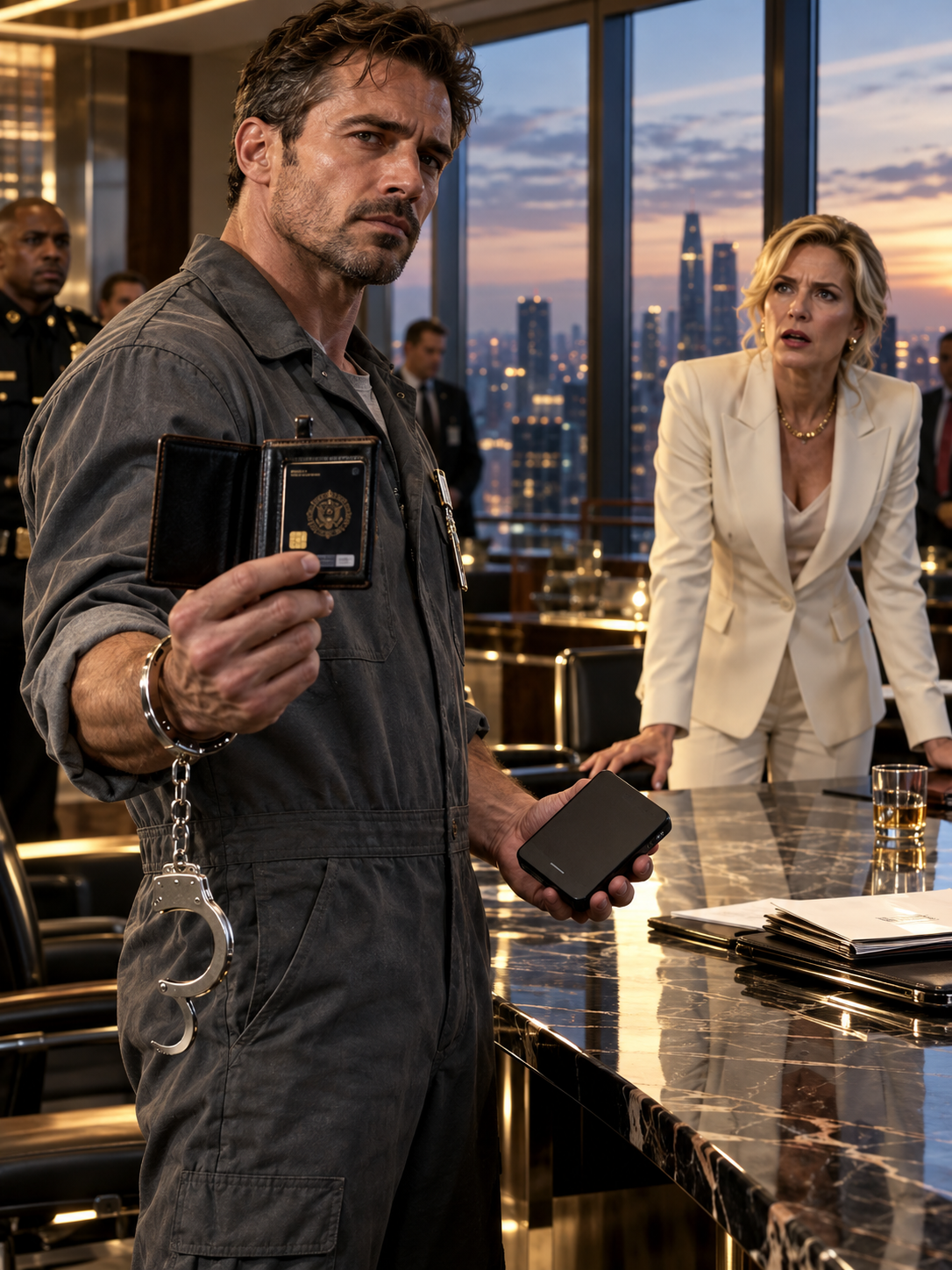
The CEO Had the Maintenance Man Handcuffed for Stealing a Classified Drive—Then the Police Chief Opened His Wallet – Life Story
Vivien Lockwood ordered the man in gray maintenance coveralls handcuffed before anyone asked why he was standing outside her classified...

My Brother Ordered Me to Pay His Mortgage or “Stop Calling Yourself Family”—Then a Bank Letter Showed What My Parents Had Put Up for Him – Life Story
My brother did not ask me to help with his mortgage. He called me three days after I got the...