My daughter-in-law announced that her father was moving into my guest room
My daughter-in-law announced that her father was moving into my guest room, then told me, “We already told Dad he could count on this.” My son sat beside her eating pie while I learned what they had promised without asking me—and why her father believed he no longer needed his own apartment…
“What a stunning kitchen.” Breanna ran her fingertips along my granite countertop, pausing near the sink as though she had found something worth showing somebody.
I was holding my teacup and wondering whether to offer her the last piece of pie.
Then my daughter-in-law looked toward the backyard and said, “My dad is going to love waking up to this view every morning.”
I kept the cup halfway to my mouth.
Beyond the window stood the sycamore Frank and I had planted when Marcus started kindergarten, its roots now lifting one corner of the garden edging.
It was a pleasant view, even allowing for the crooked edging, but I couldn’t see what it had to do with Gary’s mornings.
He had come for dinner.
As far as I knew, dinner was the entire arrangement.
“What do you mean?” I asked, setting the cup down before I spilled anything.
Breanna was smiling, perfectly at ease in my kitchen.
Across the table, my son pressed the side of his fork into a bit of pie crust that had already been reduced to crumbs.
Marcus had never needed quite so much concentration to finish dessert.
Gary gave a small, uncomfortable chuckle. “I told her I don’t want to be a burden.” He was sitting with both feet tucked beneath his chair, a courtesy I had noticed before in people who worried about taking up too much space.
We had been having family dinners together for four years, and he still asked before reaching for the salt.
I looked from him to his daughter, waiting for somebody to explain what had apparently been explained to everybody else.
“You wouldn’t be a burden, Dad,” Breanna said.
She said it quickly, with the brisk affection she used when she believed he was worrying over nothing.
Then she turned toward Marcus. “Would he?”
“No.
Of course not.” Marcus looked up just long enough to say it, then folded his napkin beside his plate.
He had done that as a boy when a teacher’s note was waiting in his backpack: made one small corner of his surroundings unusually tidy.
I had taught school for too many years to mistake a carefully folded napkin for an answer.
Until that moment, it had been an ordinary dinner, which was precisely why the remark took me so long to understand.
I had cooked, they had eaten, and there were serving dishes waiting near the sink.
Gary had thanked me twice.
Marcus had settled into the chair he always chose, comfortable enough to stretch out his legs, and I had enjoyed having him there.
I was sixty-three, four years widowed, and still susceptible to the simple pleasure of feeding my son.
I didn’t want company every evening.
I had come to like reading without somebody asking whether I was nearly finished with the light.
But when Marcus sat at my table, I could still see the boy who used to bring his schoolwork into the kitchen because he claimed he thought better near the refrigerator.
He was a grown man with children of his own now.
That didn’t prevent me from noticing whether he had eaten enough.
Breanna put down her fork. “So here’s what I was thinking.” She glanced toward the hallway. “Dad can take the guest room down the hall.
His lease ends next month anyway, so that gives us time to clear the walk-in closet and repaint before he settles in.”
The last words brought the whole thing into focus.
Not a visit.
Not a few nights while an apartment was being repaired.
She was discussing a man moving into my house, along with the preparations she expected to make before he arrived.
I looked toward the hallway, following her glance, and for a moment saw my own guest room as she apparently saw it: available.
There was nothing wrong with that room’s paint.
I had chosen it myself, holding little cards against the wall at different hours because a color that looked restful at noon could look like old oatmeal by supper.
The closet contained spare bedding and things I wanted to keep.
None of that was important beside the question of Gary living there, but the casual mention of repainting bothered me.
She had already moved past whether I agreed and arrived at what needed improving.
“No,” I said.
Breanna blinked, then gave a little laugh. “I’m sorry?”
“I said no.” My voice sounded much more ordinary than I felt.
I turned toward Gary because he deserved to hear it from me, without being discussed over the top of his head. “You’re welcome for dinner whenever you like.
But you’re not moving into my home.”
His eyes dropped to his water glass.
I hated that part immediately.
Gary hadn’t marched into the kitchen with a suitcase; he was sitting at a table where he had been invited, discovering that the invitation meant something different to each of us.
I wanted to spare him the embarrassment.
I also knew that softening my answer into something uncertain would leave all four of us in a worse position.
“I think there’s been a misunderstanding,” Breanna said.
She still had her pleasant voice, though the smile had become work.
One hand rested beside her plate, the other flat against the countertop. “We’ve discussed this for weeks.”
“You have,” I said. “Nobody has discussed it with me.”
“My dad needs somewhere to live, and you have four bedrooms sitting empty.” She said it as a practical observation, like pointing out that I had put a serving spoon in the wrong dish.
I could see how tidy the arrangement must have looked when she described it to herself.
Her father needed a room.
I had rooms.
In between those facts, apparently, there was nothing worth troubling over.
Frank and I had bought the house on Larkspur Lane thirty-one years earlier, when parts of the street were still dirt and our bank balance was a subject best approached after a good night’s sleep.
I taught school; he worked as a plumber.
We had taken on a mortgage that frightened us and then spent years learning the difference between a repair we could afford and one we could do ourselves.
Often those turned out to be the same repair, once Frank had thought about it long enough.
He built shelves, repaired fence boards, and worked on the porch until it became a place we could sit without mentally adding up what still needed doing.
I painted, held things level, and developed strong opinions about which jobs required more than one drop cloth.
The house was comfortable now.
It hadn’t become comfortable because space was something we had too much of.
Near Breanna’s hand was the small chip beside the sink where Frank had dropped a cast-iron skillet the week before he died.
It caught a dishcloth if I wiped too quickly.
I noticed it every morning and had never had it repaired.
That didn’t mean I expected the whole family to stand around admiring damaged granite, but it was difficult to hear the place described as unused when so much of my life was still actively happening in it.
“It makes sense,” Breanna said.
“It makes sense to you.”
“It makes sense objectively.” She leaned back a little, as though we had reached the point where somebody needed to be reasonable.
I had heard that tone often enough in parent conferences: a firm belief that disagreement proved the other person had failed to understand.
She wasn’t asking what I wanted.
She was explaining why wanting it was unnecessary.
“You don’t decide what happens in my house,” I said.
“Mom,” Marcus began quietly.
That one word hurt more than Breanna’s explanation.
He didn’t sound surprised by the plan.
He sounded concerned about my reaction to it, which was a very different thing.
“I’m speaking, Marcus.” I raised my hand just enough to stop him, a schoolteacher’s habit I generally tried to leave out of family conversations.
He closed his mouth.
Part of me wanted him to open it again and say the obvious—that they should have asked me.
Instead, he sat beside his wife while I did the uncomfortable work alone.
Frank used to say our son had a good heart and a soft spine.
I had defended Marcus whenever he said it, partly because mothers are entitled to object to the anatomical assessments of fathers.
Marcus was kind.
He hated seeing anyone upset and would go to considerable trouble to make an unpleasant moment disappear.
What I had been slower to admit was that sometimes the trouble fell to somebody else.
Breanna drew her chair closer to the table. “We already told Dad he could count on this.”
.
I looked at her.
Until then, I had thought I was hearing an astonishingly presumptuous proposal.
Now I understood that Gary had been brought to dinner expecting to discuss an arrangement he believed existed.
The embarrassment on his face had become something else, and I felt an immediate, sick concern about how far this had gone.
“You told him what?”
“His lease is ending,” she said.
“That isn’t what I asked.” I turned toward Gary, but Breanna spoke before he could answer.
Her father rubbed his thumb along the base of his glass.
The room had gone quiet enough for me to hear the refrigerator running behind me, an ordinary sound that suddenly seemed much too loud.
“I didn’t know there was any disagreement,” Gary said.
“It isn’t a disagreement,” Breanna told him. “Diane just needs time to adjust.” She gave him a reassuring look, and I felt my face grow hot.
There I was, sitting at my own table, listening to my refusal being explained away as a temporary difficulty.
She was comforting him with the expectation that I would eventually become easier.
“Did Gary already give notice?” I asked.
Breanna didn’t answer immediately.
Marcus looked at her, then down at the table.
I waited.
There were times in a classroom when silence did more useful work than another question, and for once I was grateful for the practice.
I didn’t reach for a plate or offer more tea.
Nobody was going to mistake this pause for permission to change the subject.
“Yes,” she said.
I looked at Gary again.
His shoulders had drawn inward.
He had given up an apartment believing there was a place waiting for him, and I was only now being informed that the place was mine.
Concern for him pressed against a second feeling I was less proud of: the temptation to agree simply so everybody could stop looking so miserable.
I knew what agreeing would mean, though.
Someone else’s waking hours, meals, visitors, belongings.
The little accommodations that are perfectly reasonable when two people have chosen to share a home.
I didn’t want to negotiate my evenings or feel inhospitable for wanting to be alone.
Gary could be a decent man—and he was—without being someone I wanted to live with.
“You arranged for your father to leave his apartment before asking whether he could live in my house?” I asked.
Breanna shifted in her chair. “Well, by us.”
“Who is us?”
She glanced at Marcus.
He didn’t help her. “Mostly me.”
.
For a moment I couldn’t think of anything to say that wouldn’t make the evening worse.
I was angry with her, disappointed in my son, and sorry for a man who had trusted his daughter.
Those feelings did not sort themselves into separate, manageable piles.
They sat together while the tea cooled and a dab of pie filling dried on the edge of Marcus’s plate.
“So you made the decision,” I said at last. “You committed Gary to it, and now you’re telling me because you expect me to agree.”
“That’s not how it is.”
I held her eyes. “It is from where I’m sitting.”
Gary cleared his throat. “Diane, honestly, I don’t want to cause trouble.” I believed him.
In all our dinners together, he had never behaved as though anything in my house was owed to him, not even another helping.
He looked so uncomfortable that I wanted to find him something useful to do, some harmless reason to leave the table, but that would only have spared the rest of us from acknowledging what had happened.
“You aren’t causing it,” I told him. “I mean that.” I gathered the dessert plates because my hands needed a task. “There’s a senior community on Ashford Road.
My friend Grace lives there and likes it.
That might be an option to look at.”
“He is not going into some facility,” Breanna said, getting up after me.
“Then you’ll need another plan.” I carried the plates to the sink, careful not to stack them too high.
I was still the hostess, absurdly concerned that Gary shouldn’t hear crockery clattering and think I was angry with him. “But it won’t involve him moving into my house.”
Breanna followed me close enough that I had to turn to face her. “You have all this space.
You’d rather let it sit empty than help family?” Behind her, Marcus remained at the table.
I wanted him beside me, not to fight with his wife, just to acknowledge that I had a say in my own life.
“You’d choose an empty house over your own family,” she said.
I set the plates down. “This house is not empty.” She looked around the kitchen as though the evidence ought to be obvious, and I waited until she looked back at me. “I live here.”
Continue below
Chapter 2/6
Breanna pressed her lips together, and that was the end of dinner.
Gary thanked me at the door with painful formality.
Marcus helped him with his jacket, giving himself something useful to do while avoiding my eyes, and Breanna went out ahead of them.
I watched her talking sharply beside the truck, her hands moving in the porch light.
After they drove away, I closed the curtains and went back to the dishes.
For the next week, I kept expecting Marcus to call and say they understood.
I didn’t need a ceremony.
A simple admission that they should have asked would have done.
Instead, the conversation stayed with me in pieces, usually while I was doing something that required very little thought.
I would be folding a towel and suddenly hear him saying, “Mom,” as though I were the person who had brought an unreasonable proposal to dinner.
At nine-fifteen one morning, the doorbell rang.
Breanna stood on the porch with two large storage bins, her purse caught awkwardly against one elbow.
I opened the door, and she stepped past me before I had asked what she wanted. “Morning, Diane.
These are just some of Dad’s things.
We’re tight on space, so they can stay here until he gets settled.”
She set them beside the staircase.
Through the plastic I could see dishes, photo albums, and a quilt folded against one side.
They were ordinary belongings, which made the whole thing worse.
Gary’s life was being packed up in the belief that mine would make room for it. “Settled where?” I asked, but she was already turning toward the door.
“Oh, come around, Diane.
You always do.” She smiled as she said it.
Then she left me standing beside two bins I hadn’t agreed to receive, listening to the car start outside.
I stood there longer than I care to admit.
The quilt looked soft and well used, and for an instant I wondered whether putting it outside would be cruel.
Then I caught myself considering how to make the first accommodation.
I went to the garage for Frank’s furniture dolly, checked the straps, and took my time moving the bins onto the covered porch, where they would stay dry.
Afterward, I texted Marcus to collect them before dark.
He called within the hour. “Mom, you didn’t have to put them outside.”
“They’re under cover.”
“They’re just boxes.” He sounded tired, and the old impulse rose in me to make his day easier.
I leaned against the kitchen counter instead. “You’re making this harder than it needs to be.”
“No, Marcus.
I said Gary wasn’t moving in.
His belongings can’t start arriving anyway.” I looked through the window at the bins. “Please collect them.” He sighed, but he said he would come after work.
When he arrived, he loaded them into his truck alone.
I almost invited him inside.
Instead, I told him to drive safely and watched him leave.
Two mornings later, I heard my front door unlock while I was still in my robe.
Breanna came in carrying grocery bags and headed toward the hallway. “Morning.
I’m going to get a head start clearing the hall closet.
We’ll need room for Dad’s coats.”
I stepped into her path. “Stop.
Where did you get a key?” She looked surprised by the question.
Marcus had given her one years earlier, she explained, in case something happened.
I held out my hand. “Give it back.”
“Seriously?
You’re being ridiculous.
I’m family.” She shifted the bags, waiting for me to move.
I stayed where I was.
My slippers were old, my robe was belted crookedly, and I had never felt less prepared to defend anything.
Nevertheless, I told her that family did not unlock another person’s house after being told no.
She dug the key out of her purse and slapped it onto the hallway table. “You’re going to regret shutting everyone out.” I picked it up and told her I was refusing to be pushed out.
She left with the bags, slamming the door hard enough to disturb the photographs.
I straightened one frame, still holding the key.
Chapter 3/6
Once I was dressed, I drove to the hardware store.
By afternoon, a locksmith was working on the exterior doors while I stood nearby trying to be helpful without hovering.
He tested each lock, then handed me three new keys.
I tried one myself.
The bolt moved smoothly, and the door opened exactly as it always had, which seemed almost disappointing after everything the old key had come to mean.
One new key stayed with me.
I put another in the fireproof box in my bedroom and the third in a locked drawer of Frank’s desk.
Then I stood beside the desk with my hand on the drawer.
Marcus had always had a way into the house.
Taking that for granted had once felt like trust; now I needed him to knock.
I didn’t enjoy the distinction, but I left the drawer locked.
The next errand was harder.
For six years, I had sent money each month to help with Sophie and Ben—school clothes, camps, the expenses that arrived even when sensible people thought they had budgeted carefully.
I loved being able to help.
I also knew how easily a gift could become something people planned around, especially when the giver never mentioned it.
At the bank, I arranged for the money to go into custodial accounts for the children’s futures instead.
Their names on the paperwork steadied me.
I wasn’t willing to keep the old arrangement merely because changing it would provoke another argument.
Still, when I signed, I thought of camp and growing feet and how much easier it had been to send money than to discuss what anybody expected.
That evening, I sat beneath the sycamore with the new keys in my pocket.
My garden needed attention.
So did the porch edging, though Frank had lived quite happily with it crooked, and I saw no reason to become ambitious on his behalf now.
I stayed outside until the light began to fade.
For the first time since dinner, I managed several minutes without rehearsing a conversation.
Breanna called the following month. “Where is the money?” There was no greeting, which at least saved us both the strain of pretending this was a social call.
I told her it was going into accounts for Sophie and Ben.
She said they needed it and had already put down a camp deposit.
“I understand you were expecting it,” I said. “But you’ll have to manage that expense yourselves.”
“So this is punishment.”
“No.
I’m still putting money aside for the children.” I could hear how unsatisfactory that answer was to her.
Money saved for years ahead wouldn’t settle a bill in front of her now, and I didn’t pretend otherwise.
But I wasn’t going to restore the transfer to prove I loved my grandchildren.
Days later, Marcus came alone.
He sat at the kitchen table and rubbed both hands over his face before telling me Breanna thought I was tearing the family apart.
I waited.
He looked exhausted, but exhaustion couldn’t keep doing the work of an explanation.
Finally he said, “She says if you don’t change your mind, she’ll stop bringing the children around.”
The room seemed to narrow around that sentence.
I thought of Sophie coming through the door with something she wanted to tell me, and Ben forgetting his jacket because departures always surprised him. “And what do you say about that?” I asked.
“I don’t want to lose either of you.” His voice had gone small.
I wanted to reach across the table, but I kept my hands around my cup.
“Marcus, I’m your mother.
I’m asking to live in my own home without someone moving another person into it.” He looked away. “You can’t keep asking me to give in so you won’t have to object.”
He sat with that for a while.
Before leaving, he said, “I’m sorry.” I accepted the words because I wanted them to be a beginning.
When the door closed, I remained at the table, frightened about the children and unwilling to buy their visits with a room.
Chapter 4/6
Two quiet weeks passed before I found Gary near my mailbox.
He looked as though he had walked up the drive several times in his head and still wasn’t certain how to finish.
I invited him inside for tea.
He sat carefully, thanked me, and spent a few minutes discussing harmless things before finally setting his cup down.
“Breanna told me you had invited me to stay here.”
“No,” I said.
His shoulders dropped. “I was afraid of that.” He had surrendered his lease because he believed everything was settled.
At dinner he had understood there was trouble, but he hadn’t understood how completely the invitation had been invented.
I felt terrible for him.
That feeling was real, even though it didn’t change my answer.
We talked about Ashford Road again.
I offered to introduce him to Grace, who could tell him what living there was actually like, rather than either of us guessing. “You’d still help me?” he asked.
I reached across and touched his hand.
I wasn’t going to give up my house, I told him, but I had no quarrel with him.
Three days later, Breanna and Marcus arrived with a manila folder.
Gary was with them, and Sophie and Ben waited near the truck.
Breanna said we needed to settle things and tried to come through the doorway while she was speaking.
I stayed where I was until she stopped.
“If you came to visit, come in,” I said. “If you came to pressure me about the house, we’ve finished that conversation.” She lowered the folder.
I should have trusted my hesitation, but the children were there, and I let everyone inside.
They settled in the living room while Breanna spread papers across my coffee table.
She said she had spoken to an attorney.
Transferring the house into Marcus’s name now would offer tax advantages, she explained, and I would retain lifetime occupancy.
I left the papers where they were. “Where would I live?”
“The basement.” She saw my expression and added, “The finished basement.
There are three bedrooms upstairs.
We’d need those for us and the kids.”
I turned to Marcus. “Did you agree to this?”
“I thought it might simplify things.” He was looking at the floor again, and I had a sudden, weary memory of the pie plate.
“For whom?” He didn’t answer.
I looked around the room: Frank’s chair by the window, the clock on the mantel, the photographs I dusted badly because moving every frame seemed excessive.
They were discussing how I would occupy a portion of the home where I was presently sitting.
Breanna said I was being emotional about property. “Yes,” I told her. “I am.” I didn’t apologize for it.
I spoke about Marcus learning to walk in that hallway and Frank reading to him near the window.
Then I told them I already had an estate plan.
Marcus looked up at once.
The house was to go to him after my death.
Breanna’s expression brightened before I had finished explaining, then changed when I made the timing clear.
I told them that if the effort to push me out continued, I would change the documents and leave the property to a foundation helping widows rebuild their lives.
I meant it, though saying it to my son hurt.
“You’d punish your own family?” Breanna demanded.
“I want to live here without being asked to surrender it.” My voice was tired now.
I didn’t have a better way to say it.
Gary stood. “That’s enough, Breanna.” She turned toward him, startled.
He told her she had said I invited him, had let him surrender his apartment on that understanding.
When she tried to explain that she was solving a problem, he interrupted. “You lied to me.”
Nobody answered him.
He apologized to me, although I told him again that he didn’t need to, then said they were leaving.
The children hugged me.
Marcus followed Gary toward the door, and Breanna gathered her papers.
I waited until the last page was inside the folder before showing her out.
Chapter 5/6
Afterward, I found a small indentation in the sofa cushion where Ben had been sitting.
I smoothed it with my palm, then wished I hadn’t.
The children had been quiet through too much adult conversation, and I couldn’t undo that by making the room tidy.
I put the cups in the kitchen and left the rest until morning.
Over the next months, I gardened, volunteered at the library, and read in Frank’s chair.
At the library, books arrived in reassuringly manageable trouble: a torn jacket, a misplaced volume, something shelved where nobody would think to look.
I liked being useful without having to argue about whether I was allowed a preference.
At home, the custodial accounts continued to grow.
Marcus called occasionally.
Our conversations were shorter, but he was less likely to fill an awkward pause with something pleasant and irrelevant.
Sometimes we talked about the children.
Sometimes we stopped before either of us had found a comfortable ending.
Breanna didn’t call, and I didn’t seek her out.
I missed an easier family life without knowing whether we had ever truly had the version I missed.
One November evening, Marcus came to the door alone.
He looked thinner, and there was something tentative about the way he asked to come in.
I stepped aside.
We went to the kitchen, and I made coffee while he sat at the table, keeping his jacket on until I reminded him he could take it off.
“Breanna and I are separating,” he said.
I put the pot down carefully. “When?”
“Three weeks ago.” He stared at his mug.
I waited for him to continue instead of supplying questions he could answer without saying much.
Eventually he told me the house had become one argument among many.
There were disagreements about money, control, and an unhappiness he could never seem to satisfy.
I didn’t feel pleased to have been proved right.
This was my son’s marriage, and there were children inside it.
Whatever relief I felt that he was finally speaking plainly came alongside grief for what he had hoped his life would be.
He rubbed a mark on the table with one fingertip, an old habit, and I let him take his time.
“She wanted me to contest your will,” he said. “She spoke to another lawyer without me.”
My hand tightened around my cup.
I didn’t ask him to explain how she imagined doing that; I wanted to know what he had done.
When I asked, he finally looked at me. “I told her I would never take my mother’s house away from her.”
“I’m proud of you,” I said.
The words came before I had considered whether they might sound too much like a mother congratulating a child.
“I should have said it months earlier.”
“Yes.” I reached across the table then. “But I’m glad you said it.”
He told me Gary had moved into the community on Ashford Road.
Grace had introduced him around, and he was joining activities and making friends.
I was grateful for that news.
Gary had needed a place to live, and beneath all the arguing it had been easy for his actual needs to disappear.
Marcus had signed a lease across town.
They were painting the apartment that week, he explained, then paused.
I recognized the embarrassment before the request arrived. “Could I stay here a couple nights?”
“Of course,” I said. “As my guest.”
He laughed, briefly and with relief. “I won’t forget.” We sat a while longer, letting the conversation become ordinary by degrees.
He asked about the library.
I told him about the garden.
Neither subject was important enough to require a side, and I was surprised by how much I enjoyed that.
When he got up to leave and collect what he needed, he carried both cups to the sink.
I watched him rinse them, then move them aside so I could reach the faucet.
It was a very small courtesy.
That evening, I noticed.
Final chapter 6/6
Having Marcus in the house felt familiar in ways I welcomed and ways that made me cautious.
I liked hearing someone moving around in the morning.
I also found myself listening for the point when a visit might quietly become an arrangement.
He kept his things in the guest room, asked before changing plans, and talked about his apartment as a place he expected to inhabit.
Each ordinary act helped.
He repaired the back gate, a job Frank had kept meaning to finish.
I stood nearby with a small container for the screws because I had learned long ago that a man looking for a dropped screw could turn ten minutes into an afternoon.
Marcus accepted my assistance without remark.
When the gate finally closed properly, he opened and shut it twice, pleased with himself in a way I recognized.
We raked leaves, cooked dinner, and sometimes kept talking after the dishes were done.
There wasn’t one conversation that repaired us.
He would admit something difficult, and I would have to resist either softening it too quickly or making him admit it again.
Other evenings we discussed nothing more consequential than whether there were enough leftovers for lunch.
One Saturday, Sophie and Ben came over and devoted themselves to making leaf piles that undid a respectable amount of work.
Marcus watched from the kitchen window while they threw themselves into the yard. “I almost lost this,” he said.
I rested my hand on his shoulder.
He told me he had thought giving in was how a person kept peace.
“I know,” I said.
Outside, Ben emerged from a pile with leaves stuck to his back, and Sophie brushed them off with more enthusiasm than care.
Marcus smiled at them, then looked at me.
We didn’t need to turn the moment into another long conversation.
He knew what I had been asking of him, and he was finally trying to do it.
After he moved into his apartment, the visits continued.
Gary came for tea occasionally, looking healthier and more at ease.
He talked about his walking club, card nights, and a woodworking course with enough enthusiasm that I had to ask when he found time to stay home.
He laughed.
I was happy to hear a complaint about being busy from a man who had arrived at my mailbox afraid he had nowhere to go.
Winter passed, and by spring our lives had acquired a workable rhythm.
Breanna remained part of the children’s lives, but she never returned to mine.
I didn’t celebrate that absence.
There were things I would have preferred to turn out differently, and wishing so didn’t require me to reopen the door to the same treatment.
One afternoon, Sophie touched the lock while I was letting them in and asked why I always locked the door now.
I told her I liked knowing people would knock and wait for me to welcome them.
She considered this, then hugged me and said she liked coming to my house.
I held her a little longer than necessary before making room for Ben.
Later, Marcus asked whether I regretted any of it.
We were at the kitchen table, and I could tell he meant the whole unhappy stretch, not merely the locks.
I said I regretted that the fight had become necessary.
He admitted he should have backed me that first night.
“Yes,” I said.
“You’re not going to make that easier?”
“I’ve forgiven you, Marcus.
I haven’t forgotten what happened.” He nodded, then gave me a small smile.
This time he stayed with the discomfort instead of asking me to remove it.
After everyone left that evening, I carried my cup to the sink.
The little chip caught the edge of my dishcloth, as it always did.
I freed the cloth, wiped the counter, and checked the back door.
Then I turned off the kitchen light and went to Frank’s chair, where my book was waiting open at the place I had chosen to stop.
THE END.
I’ve shared the complete story, and I truly hope it touched your heart.
If this story moved you, please , like, and share the post.
Thank you for reading! ❤️
Recommended Stories

She Came to Sign the Divorce—The Mafia Boss Lost Control Seeing Her 8 Months Pregnant…
She Came to Sign the Divorce—The Mafia Boss Lost Control Seeing Her 8 Months Pregnant Part 1: The Signature That...

ON CHRISTMAS EVE, A BILLIONAIRE LEFT HIS FAMILY’S PARTY AFTER A HOSPITAL CALLED ABOUT HIS PREGNANT EX—BUT THE WOMAN HE ABANDONED REFUSED TO FORGIVE HIM – Life Story
The champagne slipped from Dorian Harlo’s hand when a hospital nurse said the name he had spent six months trying...
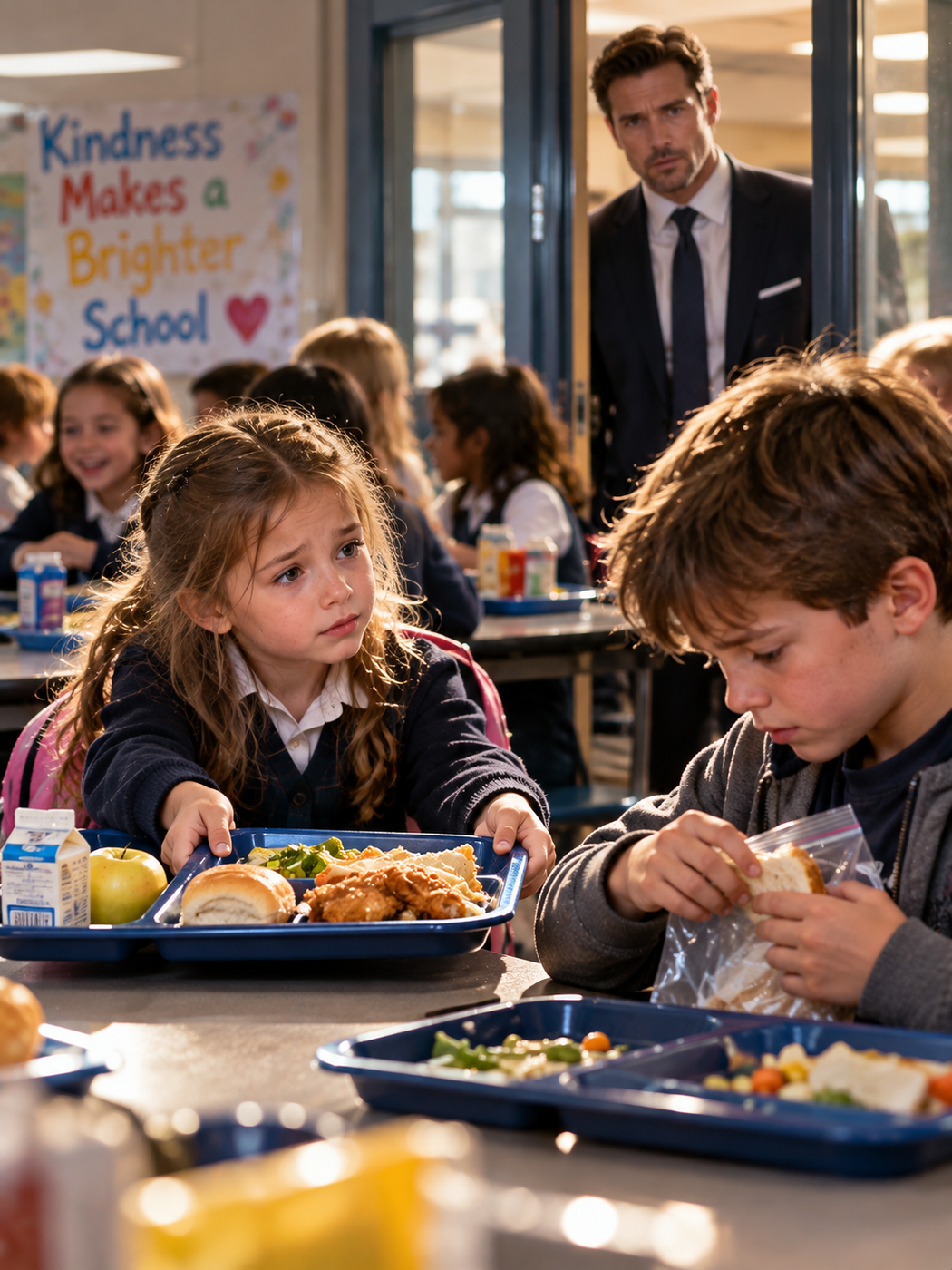
A BILLIONAIRE FATHER CAUGHT HIS SIX-YEAR-OLD DAUGHTER HIDING BREAD IN HER BACKPACK—THEN HE WALKED INTO HER SCHOOL CAFETERIA AND SAW WHY SHE WAS GOING HUNGRY – Life Story
The boy was folding half a school lunch into a plastic bag when Annie pushed her full tray across the...