ON CHRISTMAS EVE, A BILLIONAIRE LEFT HIS FAMILY’S PARTY AFTER A HOSPITAL CALLED ABOUT HIS PREGNANT EX—BUT THE WOMAN HE ABANDONED REFUSED TO FORGIVE HIM – Life Story
The champagne slipped from Dorian Harlo’s hand when a hospital nurse said the name he had spent six months trying to forget.
His former girlfriend was giving birth on Christmas Eve, and the child he had walked away from was about to enter the world without him.
But before he could reach the delivery room, Sienna had one message that made him question whether he deserved to walk through the door.
The Number on the Screen
A crystal champagne flute struck the marble floor and broke at Dorian Harlo’s feet.
The sound cut through the Christmas music in his parents’ drawing room.
Forty guests turned toward him, but Dorian barely noticed.
His phone was pressed to his ear, and a nurse at Hartford General had just told him that Sienna Marlo was in labor.
“Mr.
Harlo? Are you still there?”
“Is she safe?”
“She’s being monitored by her obstetric team.
She gave us permission to call you.” The nurse paused. “She asked whether you could come.”
Six months.
That was how long Dorian had gone without hearing Sienna’s voice.
Six months since he had stood in the kitchen of her Brooklyn apartment and said he was giving her freedom, when what he had really been doing was escaping the life they had made together.
Their child was due after Christmas.
He knew the date because he had written it on a yellow square of paper, then hidden the paper beneath a stack of contracts in his office.
He had never managed to throw it away.
“Tell her I’m coming,” he said.
“I’ll let her know.
Please drive carefully.
The roads are getting bad.”
The call ended.
Across the room, the string quartet kept playing, uncertain whether to acknowledge the broken glass.
His mother’s holiday party had always been engineered to appear effortless.
The fireplaces burned with identical oak logs.
The white roses had arrived from a florist in Manhattan that morning.
A dozen brass bells hung from the staircase, each tied with dark green velvet.
Dorian had once loved that precision.
Tonight it made the room feel like a photograph in which no one was allowed to move.
His sister Catherine crossed the rug first.
She wore a burgundy dress and held a linen napkin, which she handed to a waiter before crouching to move a shard of glass away from Dorian’s shoe.
“What happened?” she asked.
“Sienna’s having the baby.”
Catherine stood.
For one second her face showed nothing.
Then she looked at his coat hanging beside the front doors.
“Why are you still here?”
The question carried farther than she intended.
His father, William, stopped speaking to two directors from Harlo Communications.
His mother, Eleanor, came toward them with the careful expression she used whenever anything threatened to become public.
“Dorian,” Eleanor said softly, “perhaps we should discuss this somewhere private.”
“There isn’t anything to discuss.”
“You’re upsetting the guests.”
Catherine gave a short, astonished laugh. “A woman is having his child, Mom.”
Eleanor’s face changed.
Dorian had never told his parents how far along Sienna had been when he left.
He had called the breakup difficult and asked everyone to respect his privacy.
In his family, privacy was often another word for a subject money could make disappear.
William stepped closer. “Are you certain the hospital needs you? Perhaps there’s someone else with her.”
“I don’t know.”
It was the first honest answer Dorian had given his father about Sienna in months.
He didn’t know who had accompanied her to prenatal appointments or who had helped her buy a crib.
He didn’t know whether she was frightened, whether she hated him, or whether she had only kept his name on a form because there had been no one else to list.
He knew she had once believed he would be there.
A waiter approached with a broom.
Dorian stepped aside, bent to pick up his car keys from the console, and found that his hand would not stop shaking.
His mother touched his sleeve. “Think about what showing up tonight might mean.”
He looked at her, at the glittering room behind her, and at his own reflection in the black window.
“I should have thought about that six months ago.”
Catherine opened the front door.
Snow blew over the threshold, scattering across the polished floor.
Dorian reached for his coat.
Then his phone lit up with another message from the hospital.
Sienna had asked the nurse to tell him something before he arrived.
The message was brief.
She wants you to know that coming tonight does not mean you are coming back into her life.
She is asking you to come for the baby.
Dorian read it twice.
Then he walked out into the snow.
His father followed him beneath the stone portico, where two black SUVs waited beside the driveway.
The older man had always moved with a confidence Dorian had tried to imitate, even as a boy.
Tonight William looked uncomfortable in his dinner jacket, the cold already reddening his ears.
“Son, I’m not telling you not to go.”
“That’s exactly what you were doing inside.”
“I’m telling you to think.
You and Sienna made a decision about your relationship.
Having a child doesn’t automatically undo that decision.”
“I made a decision,” Dorian said. “She lived with it.”
William opened his mouth and then closed it.
Dorian had never corrected his father so openly.
Not when he was sixteen and William missed his school play to close an acquisition.
Not when he was twenty-eight and his first independent business venture succeeded, only for William to introduce it at dinner as another Harlo family achievement.
He clicked his key fob.
His car lights flashed against the falling snow.
“Do you need a driver?” William asked.
“I need to go.”
He slid behind the wheel, shut the door, and sat with his hands on the steering wheel for three full breaths before starting the engine.
Sienna’s message had taken away the one story that might have made the evening easier to bear.
She had not called to say she missed him.
She had not called to ask him to repair their relationship.
She had called because a child was arriving, and the child deserved to have his father asked.
His navigation screen estimated forty-six minutes to Hartford General.
Dorian called Catherine through the car speakers.
“Do you have Sienna’s friend Lena’s number?”
“Why?”
“Because I don’t know if anyone’s with her.”
There was a pause, followed by the faint noise of Catherine moving away from the party.
“I have it.
And Dorian?”
“Yes?”
“Don’t go into that hospital expecting Sienna to be grateful.”
“I don’t.”
“I’m serious.
You can be frightened tonight.
You can regret what happened.
But she doesn’t have to take care of either feeling.”
Dorian looked at the dark road ahead.
“I know.”
“Then listen to her.
For once, just listen.”
She sent him Lena Ortiz’s number a minute later.
He hesitated before calling.
Lena had been Sienna’s closest friend since graduate school, a woman who worked in child and family services and had never been particularly impressed by his expensive watches or successful company.
The last time he had seen her, she had stood silently beside Sienna as he carried the final box of his belongings out of the apartment.
She answered on the fourth ring.
“Dorian?”
“I’m on my way to Hartford.
Is Sienna alone?”
“No.
Her mother was with her earlier.
I’m with her now.”
Relief moved through him, followed immediately by shame.
“Thank you.”
“Don’t thank me for doing what a friend does.”
“I wasn’t trying to—”
“Good.
Then we’re clear.”
Traffic slowed near a highway exit.
Dorian watched snow gather along the guardrail.
“How is she?”
“She’s tired.
She’s scared.
The doctors are watching her blood pressure.
That’s all I’m telling you over the phone.”
“Her blood pressure?”
“She’s being taken care of.”
“Lena, please.”
“Dorian, I spent months watching her convince herself she could handle everything without asking you for anything.
Tonight, she finally asked for one thing.
Don’t turn it into a conversation about how terrible you feel.”
He swallowed.
“I’m coming.”
“I know.
The question is what happens after you arrive.”
Lena hung up.
Dorian drove the rest of the way with the radio off.
He passed gas stations glowing blue against the snow, a highway diner closing early for Christmas, and a couple pushing a stalled car toward the shoulder while their hazard lights blinked.
Ordinary people doing ordinary things on a night that had become the dividing line of his life.
At the hospital entrance, he surrendered his keys to the parking attendant and walked into a lobby bright with fluorescent light.
A security officer directed him toward maternity.
By the time he reached the nurses’ station, the cuffs of his trousers were wet and his expensive shoes squeaked against the floor.
A nurse in navy scrubs looked up.
“Dorian Harlo?”
“Yes.”
“I’m Patricia.
We spoke earlier.”
He leaned toward the desk. “How is she?”
“She’s progressing.
Dr.
Martinez is with her now.
I need you to understand that Sienna decides who comes into her room and who stays.”
“Of course.”
Patricia studied him for a moment.
“She asked us to call you because she wants you to have the opportunity to be here.
That is not the same as giving you permission to make decisions for her.”
Dorian nodded.
The nurse pointed toward a row of chairs against the wall.
“Have a seat.
I’ll ask whether she’s ready.”
Dorian sat in his charcoal suit, under a television playing a muted Christmas movie, and waited for the woman he had abandoned to decide whether he could meet his son.
For the first time in his adult life, his money could not shorten the wait.
Permission to Stay
The door to the maternity corridor opened twelve minutes later.
Lena Ortiz came through first, wearing jeans, a gray cardigan, and the exhausted expression of someone who had spent most of the night being useful.
Her dark hair was twisted into a loose bun.
One sleeve was stained with coffee.
“You look like a magazine for regret,” she said.
“I probably deserve that.”
“Probably.”
He stood. “Is she all right?”
Lena folded her arms. “She’s doing well.
The doctor is keeping an eye on her blood pressure, but there’s no emergency right now.
Her mother’s getting some rest in the family waiting room.”
He closed his eyes briefly.
“Did she say I could come in?”
“She did.
With conditions.”
“Tell me.”
“No grand speeches.
No promises about moving in.
No calling your parents to announce they’ve become grandparents.
No photographs without her permission.”
“I understand.”
“And if she wants you to leave, you leave.”
“Yes.”
Lena watched him for a long moment, as if she were looking for the familiar man who could agree to anything and then reorganize the agreement until it suited him.
Finally, she stepped aside.
“Then come on.”
Sienna’s room was warm, almost uncomfortably so.
A monitor displayed green numbers beside the bed.
The air smelled of disinfectant, clean cotton, and the faint citrus scent of the hand lotion Sienna had always kept in her purse.
She lay propped against white pillows, her brown hair pulled into a messy knot.
A pale hospital gown covered her shoulders.
Her cheeks were flushed, and beneath her eyes lay shadows that no amount of sleep would have completely erased.
Dorian stopped at the doorway.
For three years, he had known exactly how to approach her.
He would kiss her forehead when she worked too late, touch the small of her back in a crowded room, or sit beside her on the floor when she came home exhausted from a difficult case.
Now he did not know whether he was allowed to cross the room.
Sienna looked at him.
“You came.”
“Yes.”
She looked toward the chair beside her bed.
“You can sit.”
Dorian took the chair.
A contraction tightened across her face before either of them could speak.
Her fingers gripped the blanket, and she breathed through her teeth.
Lena moved closer, checking the position of the water cup.
“Slow breath, Si.
You’ve got it.”
Dorian sat helplessly until Sienna reached out and caught his wrist.
“Don’t just stare at me.”
He took her hand.
Her grip was so strong that the tendons in his fingers ached.
“I’m here,” he said.
“I noticed.”
Despite everything, he almost smiled.
The contraction passed.
Sienna released his hand and tipped her head against the pillow.
“You look ridiculous in that suit.”
“I came from my parents’ Christmas party.”
“Of course you did.”
There was no accusation in her voice.
Somehow that made it worse.
He loosened his tie.
“I’m sorry.”
Sienna shut her eyes.
“Dorian, I can’t do that conversation right now.”
“I know.”
“No.
You don’t.” She opened her eyes again. “You don’t know how many versions of that conversation I’ve already had without you.”
He had no answer.
Dr.
Elena Martinez entered a moment later, checking the monitor and speaking to Sienna in a calm, direct voice.
The baby’s heart rate looked reassuring.
Labor was moving steadily.
They would reassess soon.
She glanced at Dorian.
“Are you the baby’s father?”
“Yes.”
“Is he staying?” she asked Sienna.
Sienna looked at him for a few seconds.
“For now.”
Dr.
Martinez nodded, accepting the answer without comment.
Lena slipped into the hallway to update Sienna’s mother and get another cup of water.
Once the door closed, Dorian and Sienna were alone with the machines and the uncertain rhythm of labor.
He looked at the hospital bag on the chair.
A lavender sweater lay folded on top.
A soft blue blanket peeked from one corner, still bearing the price tag from a neighborhood store.
“You packed everything,” he said.
“I had nine months to think about it.”
The words were simple.
He felt their weight anyway.
“I should have been there.”
“Yes,” Sienna said.
He looked at her.
She was not crying.
She was not trying to make him understand with some beautifully constructed argument.
She was stating a fact.
“I thought I was protecting you,” he said.
“From what?”
“From the attention.
From my family.
From everything that comes with my life.”
“You thought I couldn’t handle your life, so you decided I shouldn’t be part of it?”
He stared at his hands.
“That wasn’t what I wanted.”
“Then why did you keep talking about me quitting my job? Why did you want me to move into your apartment without any say over what our home looked like?”
He remembered the arguments.
Sienna had wanted to keep working with vulnerable families.
He had wanted her to leave the stress behind.
He had offered a driver, a private obstetrician, a new apartment, and a full-time assistant before he had ever asked what kind of help she actually wanted.
Every offer had sounded generous to him.
Every offer had come with an invisible instruction.
“I was afraid I’d fail you,” he said quietly.
Sienna’s eyes filled, but her voice remained steady.
“So you failed us first.”
Another contraction rose before he could answer.
This time he held her hand without being asked.
He listened when she told him not to talk.
He wiped the damp hair from her forehead only after she nodded.
The next hour arrived in pieces.
A blood pressure cuff tightening around her arm.
Dr.
Martinez adjusting the bed.
Lena returning with ice chips.
Sienna leaning forward, exhausted and determined, while Dorian counted breaths under his breath because saying anything more seemed wrong.
At one point she looked at him and whispered, “I don’t think I can.”
“You can,” he started.
She shook her head sharply.
“Don’t tell me what I can do.”
He stopped.
Then he leaned closer.
“What do you need?”
Sienna caught her breath.
“Just hold my hand.”
He did.
Later, when Dr.
Martinez told her it was time to push, Dorian stayed close enough for Sienna to squeeze his fingers and far enough away to let the medical team work.
He had negotiated contracts worth hundreds of millions of dollars without feeling a tremor in his voice.
Now he could barely say her name.
And then, shortly after midnight on Christmas morning, the room filled with a baby’s cry.
It was not a delicate sound.
It was fierce, indignant, and astonishingly loud.
Dorian looked toward Dr.
Martinez.
“A boy,” she said, smiling. “He’s here.”
Sienna began to cry before she saw him.
When the nurse placed the baby against her chest, Sienna bent over him and whispered something Dorian could not hear.
The tiny boy quieted beneath her voice.
He had dark, damp hair and one hand curled against his cheek.
His face was flushed and wrinkled.
He looked nothing like the perfect newborns in the family photographs that hung in Dorian’s parents’ hallway.
He was more beautiful than anything Dorian had ever seen.
Sienna looked up.
“Come closer.”
Dorian leaned over the bed.
Their son opened his mouth in a sleepy protest.
“Hello,” Dorian whispered.
He tried to say more, but nothing came.
Sienna watched him carefully.
For one strange moment, the anger between them seemed to step aside, allowing something older and more fragile to exist.
“He has your eyebrows,” she murmured.
“He has your mouth.”
“He definitely has your talent for making an entrance.”
Dorian laughed once, shakily.
The sound surprised them both.
The medical team completed their checks.
When Sienna was ready, the nurse helped Dorian hold the baby.
He had never held anything so carefully.
The boy weighed just over seven pounds, yet Dorian felt as though his arms contained the whole future.
He adjusted the blanket with clumsy fingers, terrified of doing something wrong.
The baby’s hand opened against his shirt.
Dorian stared at it.
That hand had been forming while he attended shareholder meetings.
Those fingers had grown while he sat alone in his penthouse, telling himself Sienna was better off without him.
The boy had existed every day of those six months.
He had simply refused to be there.
“Have you chosen a name?” the nurse asked.
Sienna glanced at Dorian.
“I have some ideas.”
He looked up immediately.
“You should choose.”
“I didn’t say I needed your permission.”
“I know.
I just—”
“Dorian.” Her tone softened. “I’m asking what you think.”
He swallowed.
“What names?”
“Gabriel,” she said. “I’ve liked Gabriel for a while.”
He looked down at the baby.
“Gabriel.”
The boy stretched one hand, then settled against his father’s chest.
“It suits him,” Dorian said.
“Gabriel Marlo-Harlo,” Sienna added.
Dorian nodded without hesitation.
“Gabriel Marlo-Harlo.”
A small part of him recognized what the hyphen meant.
Their son belonged to both families, but Sienna was not disappearing into his surname or his fortune.
It was a distinction he might once have tried to negotiate.
Now he understood that accepting it was the first reasonable thing he had done all night.
Later, after the room grew quiet and Gabriel slept in the bassinet, Sienna lay back against her pillows.
Dorian sat beside her, holding a paper cup of coffee that had gone cold.
“Can I ask you something?” he said.
She looked at him wearily.
“One thing.”
“Why did you ask them to call me?”
Sienna turned toward the bassinet.
“Because he deserved the chance to have his father here.”
“Not because—”
“Not because I want to pretend the last six months didn’t happen.”
He nodded.
Outside the window, the snow had stopped.
The hospital parking lot shone beneath orange streetlights.
“Do you hate me?” he asked.
She considered the question.
“I did.
Some days I still do.”
He looked down.
“But I never wanted him to inherit that feeling,” she continued. “I never wanted to stand in front of our son and explain why I didn’t even give his father the chance to meet him.”
Dorian studied Gabriel’s sleeping face.
“I want to be in his life.”
Sienna pulled the blanket higher over her legs.
“Then be in his life.”
He looked at her.
“That’s it?”
“No,” she said quietly. “That’s where it starts.”
The baby shifted in his bassinet, making a small, searching sound.
Sienna watched Dorian rise automatically to check on him.
She said nothing.
But when he sat down again, she moved the bassinet a little closer to his chair.
A Home with Two Addresses
On the third morning after Gabriel’s birth, Dorian stood in the doorway of Sienna’s Brooklyn apartment holding a diaper bag in one hand and a paper sack of groceries in the other.
The apartment looked almost exactly as he remembered it.
A blue ceramic bowl sat beside the entrance.
There were books stacked beneath the living room window and a framed photograph of Sienna with her mother on the narrow shelf above the radiator.
But the far corner had changed.
A white bassinet stood beside the couch.
Burp cloths hung over the arm of a rocking chair.
A small collection of folded baby clothes occupied the space where Dorian’s records had once been kept.
He set the groceries on the kitchen counter.
“I bought eggs, bread, oatmeal, some vegetables, and that ginger tea you like.”
Sienna, sitting on the couch with Gabriel against her shoulder, looked inside the bag.
“You remembered the tea.”
“I remember a lot of things.”
She didn’t answer.
Dorian glanced around the apartment again.
“Where’s the crib?”
“In the bedroom.”
“Did someone assemble it for you?”
“I did.”
He looked at her.
“You assembled a crib by yourself?”
“Lena helped with the instructions.
I handled the parts.”
There was something almost unbearable about imagining her on the bedroom floor, pregnant and tired, reading a manual while he attended another late dinner with executives.
He wanted to apologize.
Instead, he asked, “Would you like me to make breakfast?”
Sienna looked surprised.
“You cook now?”
“I’ve always cooked.”
“You used to call the restaurant downstairs whenever I said I was hungry.”
“I said I could cook.
I didn’t say I made good decisions about it.”
For the first time that morning, she smiled.
It disappeared quickly, but Dorian carried it with him into the kitchen.
Gabriel began fussing while he cracked the eggs.
Sienna shifted him against her chest, then winced as she tried to stand.
Dorian turned immediately.
“Are you okay?”
“Just sore.”
“Sit down.
What do you need?”
“Water.
And the pillow behind you.”
He brought both.
She accepted them without the tense hesitation that had accompanied his offers of help at the hospital.
It was a small thing, but he understood its importance.
For three years, Dorian had treated problems as opportunities to demonstrate competence.
If Sienna was tired, he offered a vacation.
If her apartment needed repairs, he suggested moving.
If her workload became overwhelming, he proposed paying her expenses so she could resign.
He had rarely considered that the most useful thing might be a glass of water and a pillow.
After breakfast, Gabriel fell asleep against Sienna’s shoulder.
Dorian washed the dishes.
When he finished, she was still watching him.
“What?” he asked.
“I’m trying to decide whether you’re genuinely different or just terrified.”
“Both, probably.”
She studied him.
“That might be the first answer you’ve given me without trying to make yourself sound better.”
He dried his hands.
“Can we talk about what happens next?”
Sienna glanced down at Gabriel.
“We need to.”
Dorian sat across from her.
“I want to help financially.
Not by handing you a credit card.
I mean real support.
Something consistent.”
Her face tightened.
“I won’t have you paying my bills and then deciding where I live.”
“I don’t want that either.”
“You said that when we were together.”
“I know.”
He reached into his coat pocket, then stopped himself.
“I’ve been thinking about how to do this properly.
We can each have our own attorneys.
We can establish paternity, formalize child support, and write a parenting agreement that doesn’t depend on whether we’re getting along.”
Sienna looked genuinely surprised.
“You want an agreement?”
“Yes.”
“Even if I never get back together with you?”
Dorian met her eyes.
“Especially then.”
Gabriel stirred between them.
Sienna lowered her gaze to him.
For a long time, neither spoke.
Finally, she said, “I need time to believe that.”
“I have time.”
She looked up sharply.
“No, Dorian.
You have a company and a hundred people who call you when they want something.
You have a life that moves very fast.
What I need to know is whether you’ll make time.”
The distinction settled between them.
“I’ll make time,” he said.
She looked unconvinced.
But when Gabriel woke an hour later, she handed him to Dorian and went to take a shower.
It was the first time she had left him alone with their son.
Dorian sat in the rocking chair, listening to the water running beyond the hallway.
Gabriel stared up at him with unfocused blue-gray eyes.
“Apparently, your mother is testing me,” Dorian whispered.
The baby yawned.
“Fair enough.”
Then Gabriel began to cry.
Dorian checked his diaper.
He rocked him.
He walked around the room, whispering nonsense and trying to remember what the nurse had demonstrated about supporting his head.
Nothing worked.
By the time Sienna emerged, Dorian was sweating through his shirt.
“He’s hungry,” she said.
“I gathered that.”
“You look like you negotiated a hostage release.”
“I think he won.”
Sienna laughed.
It was the first unguarded laugh he’d heard from her in six months.
And it hurt more than he expected, because he remembered how often he had taken that sound for granted.
Two weeks later, they met with separate family-law attorneys in a quiet office overlooking Union Square.
Dorian’s lawyer had prepared several options for financial support.
Sienna’s attorney, a practical woman named Ruth Keller, asked detailed questions about housing, health insurance, childcare, and what would happen if either parent moved.
Dorian answered without interrupting.
When the discussion turned to custody, Ruth explained that a newborn’s feeding needs and existing routines mattered, and that any schedule should develop gradually around Gabriel’s best interests.
Dorian agreed.
Sienna watched him sign an agreement for regular support payments and a temporary parenting schedule.
“You don’t want to negotiate the amount?” she asked afterward.
“I want Gabriel provided for.
The calculation is for the lawyers to work through.”
“That’s not what I meant.”
“I know.”
They stood outside the building as pedestrians rushed along the sidewalk.
A delivery truck idled near the corner, sending white exhaust into the cold afternoon air.
Sienna adjusted Gabriel’s blanket inside his stroller.
“You could have made this difficult.”
“I already made enough things difficult.”
She glanced at him.
“Don’t say things like that because you think I want to hear them.”
“Okay.”
“Just keep doing what you said you’d do.”
Dorian nodded.
“Okay.”
By late February, they had found a two-family brownstone in Park Slope.
The upstairs apartment had three bedrooms, a small kitchen, and a living room with windows overlooking a quiet street.
The downstairs unit had two bedrooms and a separate entrance.
The building was expensive, but they agreed on an arrangement that preserved Sienna’s independence.
Dorian would own neither her living space nor her choices.
Their attorneys documented his housing contribution separately from child support, including terms protecting her ability to stay if their personal relationship deteriorated.
Sienna insisted on reviewing every page.
Dorian didn’t complain.
The afternoon they received the keys, she stood in the upstairs living room with Gabriel asleep in his carrier.
“It’s beautiful,” she said.
“Too big?”
“No.
That’s the problem.”
He frowned.
She looked at the sunlight crossing the wooden floor.
“I could get used to this.”
“Would that be bad?”
“If I get used to it, and then you leave again, I have to explain to Gabriel why everything changed.”
Dorian stepped closer but didn’t touch her.
“I can’t make you certain about me.”
“No,” she said. “You can’t.”
“But I can give you something to judge.”
“What?”
“Tomorrow.
And the day after that.”
She watched him for a long moment.
Then she handed him a spare key.
“Downstairs is yours.”
He accepted it.
“And upstairs?”
Sienna smiled faintly.
“Upstairs, you knock.”
That evening, Dorian stood in his new kitchen surrounded by unpacked boxes and listened to Gabriel crying through the ceiling.
His first instinct was to run upstairs.
Instead, he sent Sienna a message.
Do you need help?
A moment later, her reply appeared.
Yes.
Could you bring the clean bottles?
He took the stairs two at a time.
For once, he was going upstairs because she had asked.
The Things Money Could Not Fix
The first real test came on a Thursday night when Gabriel was seven weeks old.
Dorian was downstairs reviewing a merger proposal while Sienna tried to settle their son upstairs.
At 10:15, she sent a message.
He’s fighting sleep.
Can you take him for twenty minutes?
Dorian looked at the numbers on his screen.
His chief operating officer was waiting for approval on a revised forecast.
The document represented several weeks of work and millions of dollars in projected revenue.
He closed the laptop.
Upstairs, Sienna stood in the hallway with Gabriel against her shoulder.
Her hair was tied back, and the front of her sweater was damp from spilled milk.
“You can say no if you’re busy,” she said.
“I’m here.”
“I know.
I’m just saying—”
“Sienna.
Give me the baby.”
She transferred Gabriel into his arms.
Then she leaned against the wall and shut her eyes.
“When did you last sleep?” Dorian asked.
“I don’t know.
Tuesday?”
He frowned.
“It’s Thursday.”
“That’s what the calendar says.”
He nearly suggested hiring a night nurse.
Instead, he asked, “Would you like to sleep for an hour while I take him downstairs?”
Sienna looked at Gabriel.
“He’s probably going to need another feeding.”
“Then I’ll bring him back.”
She hesitated.
Dorian waited.
Finally, she nodded.
“An hour.”
He carried Gabriel downstairs and settled into the living room.
The baby protested immediately.
Dorian walked between the couch and the window.
He tried humming an old song his mother had sung when he was little.
Gabriel seemed unimpressed.
He shifted the baby’s weight carefully and checked the time.
Three minutes had passed.
He had faced hostile investors with more confidence than he felt with a crying infant.
At last, Gabriel settled against his chest.
Dorian lowered himself onto the couch and watched the small rise and fall of his son’s breathing.
His phone buzzed.
James Mercer, his uncle and longtime business partner, wanted to know why he had left the evening call.
Dorian typed a reply.
I was needed at home.
I’ll review the revised numbers tomorrow morning.
Three dots appeared.
Then James wrote:
We cannot run this company around a baby’s sleep schedule.
Dorian stared at the screen.
He could almost hear James saying it, his voice polished and impatient, as though family were an unpredictable market condition.
Dorian replied:
We aren’t.
We’re running it around clear priorities.
You’ll have my comments by eight.
He turned the phone facedown.
Upstairs, for the first time in days, Sienna was sleeping.
The following week, she received an invitation to interview for a senior caseworker position at Community Family Support Services.
Dorian had mentioned her experience to a professional contact who worked with several nonprofit organizations.
He had asked whether they were hiring, not whether they would hire her.
Sienna had sent her résumé herself.
Now she sat across the kitchen table from him, holding the email.
“They want to interview me.”
“That’s great.”
“It’s a flexible position.
Two remote days each week, assuming the caseload allows it.”
“Sounds promising.”
She watched him.
“You didn’t tell them to offer me the job, did you?”
“No.”
“Dorian.”
“I asked whether there were openings.
They told me to send you the public posting.
Everything after that is yours.”
She exhaled.
“Good.”
“You don’t believe me?”
“I want to.”
He nodded slowly.
“Then I’ll make it easy to verify.
You can ask the person who sent me the posting.”
Sienna looked at him again.
Six months earlier, he would have been offended by the question.
He might have reminded her how many executives owed him favors, how carefully he protected his reputation, how fortunate she was to have someone willing to help.
Now he simply understood why she needed to ask.
The morning of her interview, Gabriel had his two-month pediatric appointment.
Dorian offered to take him alone.
Sienna looked doubtful.
“You know where his insurance card is?”
“In the front pocket of the diaper bag.”
“And his feeding times?”
“Ten-thirty, usually.
I packed a bottle.”
“And the questions for Dr.
Chen?”
He lifted his phone.
“Written down.”
She raised an eyebrow.
“Show me.”
Dorian handed it over.
The list included questions about sleep, feeding, skin irritation, and whether Gabriel’s slight preference for turning his head to the right needed attention.
Sienna read it twice.
Then she gave the phone back.
“Okay.”
“Okay?”
“You take him.”
He tried not to look too pleased.
That afternoon, Dr.
Sarah Chen examined Gabriel in a room decorated with cheerful animal paintings.
She checked his growth, reflexes, feeding history, and developmental progress.
She also explained the recommended immunizations for his age.
Dorian asked questions.
He wrote down the answers.
When Gabriel began crying during the appointment, Dorian soothed him with the same quiet humming that had finally worked during their first night in the downstairs apartment.
Dr.
Chen smiled.
“You’ve been practicing.”
“Every night.”
“It shows.”
Dorian looked down at his son.
For years, he had associated competence with authority.
He knew how to lead people because he could make decisions faster than they could.
Fatherhood was teaching him something less flattering and more useful.
He was becoming capable by admitting how much he didn’t know.
When they returned home, Sienna was in the kitchen wearing a navy dress and mismatched socks.
“How did it go?” she asked.
“Thirteen pounds, two ounces.
Growing well.
Dr.
Chen answered everything on the list.”
“And you?”
“I survived.”
She smiled.
“Congratulations.”
“How was the interview?”
She looked down at the coffee cup in her hands.
“I think I did well.”
“Just well?”
“They asked about the hardest family I’d ever worked with.”
“What did you say?”
“I told them the hardest cases aren’t always the ones where people don’t care.
Sometimes everyone cares, but nobody knows how to stop making things worse.”
Dorian stood very still.
“Sounds familiar.”
“I wasn’t talking about us.”
“I know.”
She met his eyes.
“Not entirely, anyway.”
The job offer arrived three days later.
Sienna read it aloud while Gabriel slept in the next room.
The salary was reasonable.
The health insurance was good.
The schedule gave her room to continue working while remaining present for her son.
When she finished, Dorian lifted his glass of water.
“To your new job.”
She touched her glass to his.
“To earning it.”
That Saturday, Eleanor invited them to lunch at the Harlo estate.
Dorian had warned his mother beforehand that the visit would be short and that Gabriel’s routine came first.
Eleanor greeted Sienna warmly, but the afternoon became uncomfortable when she mentioned a photographer.
“Just a few family pictures,” she said. “Nothing elaborate.”
Sienna looked toward the staircase, where enormous portraits of the Harlo family lined the walls.
“Private pictures?”
“Of course, darling.”
Catherine, seated beside the fireplace, raised an eyebrow.
“Mom.”
Eleanor looked offended.
“What?”
“You told the holiday committee you hoped to have a new family photograph for the foundation newsletter.”
The room fell silent.
Eleanor pressed her lips together.
“It would be a lovely way to introduce Gabriel.”
Sienna adjusted her son’s blanket.
“I’m not comfortable with that.”
Eleanor’s expression tightened.
“I understand your concern, but the Harlo family has always—”
“Mom,” Dorian interrupted.
She turned toward him.
“Gabriel isn’t a public relations announcement.”
“That’s not what I meant.”
“Then it should be easy not to do it.”
William set down his coffee cup.
“There’s no need to make this unpleasant.”
Dorian looked at his father.
“She’s his mother.
She said no.”
Catherine hid a smile behind her napkin.
Sienna said nothing until they were back in the car.
Then she looked at him.
“You didn’t have to argue with your mother.”
“I didn’t argue.”
“You did, a little.”
“She pushed.”
“She’s used to getting her way.”
“So was I.”
Sienna looked out the window.
Outside, the estate’s iron gates opened slowly.
“That’s what scares me,” she said.
Dorian glanced at her.
“What?”
“That one day you’ll remember you can usually get your way.”
He thought about her words long after they returned to Brooklyn.
That night, while Sienna bathed Gabriel, Dorian stood downstairs looking at the spare key she had given him.
It was ordinary brass, without a monogram or an expensive leather tag.
He had never owned anything that reminded him so clearly that permission and ownership were not the same thing.
And he knew that, sooner or later, life would test whether he truly understood the difference.
The Missing Months
In early April, Gabriel woke from his afternoon nap screaming.
Dorian heard him through the ceiling while he was reviewing a presentation for the company’s board.
At first, he assumed it was the usual complaint about a wet diaper or an interrupted nap.
Then the crying changed.
It became sharp, desperate, and unfamiliar.
He muted his microphone.
A moment later, Sienna called.
“Dorian, can you come up?”
There was something in her voice he had never heard before.
He left the conference without waiting for a response and ran upstairs.
Sienna stood in the nursery holding Gabriel against her chest.
The baby’s face was flushed, and his body was tense with discomfort.
“He won’t eat,” she said. “He won’t settle.
I don’t know what’s wrong.”
Dorian reached for the thermometer.
They checked his temperature and called Dr.
Chen’s office.
After hearing about Gabriel’s symptoms, the nurse advised them to have him evaluated promptly.
Dorian grabbed the diaper bag.
“We’re going.”
Sienna looked at him.
“To the hospital?”
“Dr.
Chen’s nurse says he needs to be seen.
Let’s not guess.”
The drive to the emergency department felt much longer than it was.
Dorian concentrated on the traffic while Sienna sat beside Gabriel in the back seat, speaking to him softly.
The baby eventually stopped crying, but he remained unusually quiet.
That frightened Dorian more.
At the hospital, they gave the triage nurse a complete account of the symptoms.
A physician examined Gabriel carefully, checking his breathing, temperature, ears, and responsiveness.
After ruling out more urgent concerns, the physician identified inflammation in both ears consistent with an acute ear infection.
She explained the treatment plan, discussed pain relief appropriate to Gabriel’s age and weight, and gave them instructions about symptoms that would require immediate reassessment.
Sienna listened with both hands clasped together.
When the doctor left, she covered her face.
Dorian sat beside her.
“Hey.”
“I know he’s okay.”
“He’s going to be watched and treated.
We know what to do.”
“I know.”
But she was crying.
He did not tell her to stop.
Instead, he placed his hand beside hers on the chair.
After a moment, she took it.
They stayed that way while Gabriel slept.
On the drive home, Sienna stared through the window at the gray Brooklyn streets.
“I thought something terrible was happening,” she said.
“So did I.”
“I kept thinking about the pregnancy.”
Dorian glanced at the rearview mirror.
“What about it?”
She didn’t answer immediately.
At home, they settled Gabriel upstairs.
Sienna changed into an old sweatshirt and made tea, then left both mugs untouched on the counter.
Dorian sat across from her.
“You said something about the pregnancy.”
She wrapped her hands around the mug.
“There were complications.”
He remembered her mentioning a few scares at the hospital after Gabriel’s birth.
He had wanted to ask more then, but she was exhausted, and the subject had slipped away amid feedings, appointments, and their attempts to establish a routine.
“What kind?”
“At twenty-seven weeks, I had bleeding.
They evaluated me at the hospital.
Everything turned out okay, but I was terrified.”
Dorian felt his stomach tighten.
“You went alone?”
“Lena drove me.”
He lowered his eyes.
“Why didn’t you tell me?”
Sienna looked at him across the table.
“What would I have said?”
“That you needed help.”
“I did need help.”
The refrigerator hummed behind them.
She reached for a tissue and wiped her eyes.
“Do you remember our last argument?”
He nodded.
“You stood in my kitchen and told me that you couldn’t give me the kind of life I deserved.
You said you were afraid your family would interfere, that your schedule would make everything harder.”
“I remember.”
“And then you told me I would be better off making decisions without you.”
He closed his eyes.
“At the time, I thought I was being honest.”
“You were being frightened.
There’s a difference.”
Dorian looked at the floor.
Sienna continued.
“I spent weeks trying to decide whether I should call you.
Every time something happened, I picked up my phone.
Then I remembered that you had already told me what you wanted.”
“That’s not what I wanted.”
“Dorian, you walked out.”
He looked up.
She wasn’t raising her voice.
That made the words impossible to escape.
“You didn’t say you needed a week to think.
You didn’t ask to talk to a counselor.
You didn’t ask how we could make parenting work if our relationship didn’t.
You packed your things, handed me the key, and left.”
He remembered the key.
He had placed it beside her coffee mug because he couldn’t bring himself to put it directly into her hand.
At the time, he had believed the gesture respectful.
Now he saw a pregnant woman standing alone in a kitchen while the father of her child explained why leaving was supposedly an act of love.
Sienna looked toward the staircase.
“I had a birth plan before you came back.
Lena was supposed to be there, and my mother.
If anything happened to me, I wanted the hospital to contact you because Gabriel would still need his father.”
Dorian’s throat tightened.
“That’s why you kept my name.”
“Yes.”
He had spent months treating that phone call as evidence that some part of Sienna still wanted him.
The truth was more painful.
She had called because she was thinking about Gabriel.
Even after everything, she had been prepared to separate her feelings about Dorian from her son’s future.
“Were you ever going to tell him about me?” he asked.
“Of course.”
“What would you have said?”
Sienna studied his face.
“I would have told him the truth in a way he could understand.
That his father loved him, but was scared and made a terrible decision.
I wasn’t going to turn you into a monster.”
Dorian swallowed.
“Even though you hated me.”
“Even then.”
He sat very still.
For years, he had believed that generosity meant having enough money to solve someone else’s problems.
Sienna had given him something he could never have purchased.
She had protected his relationship with their son when she had every emotional reason to turn away.
Dorian looked at the untouched tea.
“I don’t know how to make up for that.”
“You can’t.”
He nodded slowly.
“I know.”
“You can be here now,” she said. “That’s different.”
Gabriel began fussing upstairs.
Both of them stood.
Dorian paused beside the table.
“Let me get him.”
Sienna nodded.
He climbed the stairs and found his son awake in the crib, his cheeks still pink but his expression calmer.
“Hey, buddy.”
Gabriel looked toward his voice.
Dorian lifted him gently and settled into the rocking chair.
For several minutes, he did nothing but hold him.
Outside, an ambulance passed in the street, its siren rising and falling between the buildings.
He thought about the night Sienna had sat in a hospital without him.
He could never go back to that night.
But he could make sure that when Gabriel needed him next, he would not have to wonder whether his father would come.
Later, Sienna entered the nursery.
She stopped in the doorway when she saw them.
Dorian was asleep in the chair, one hand resting protectively across Gabriel’s back.
She watched him for a moment, then stepped closer and gently woke him so they could put Gabriel safely in his crib.
Dorian opened his eyes.
“Sorry.”
“It’s okay.”
He looked at her.
She hesitated, then brushed a strand of hair away from his forehead.
“Thank you for being here today.”
He wanted to tell her he loved her.
The words rose so suddenly that he almost said them.
But he remembered her voice in the kitchen.
You can’t.
He did not try to turn one good day into forgiveness.
Instead, he stood and helped her settle Gabriel.
The next morning, he called his assistant and arranged to move two recurring late-afternoon meetings.
He did not announce the change to Sienna.
He simply made room for the life he had said he wanted.
When the Lights Went Out
Three weeks later, Sienna called Dorian from her office at 11:47 p.m.
He was asleep downstairs.
Her name on the screen brought him upright before he even answered.
“Si?”
“I’m okay.”
He was already reaching for the lamp.
“What happened?”
“Someone broke into the building.
I’m with the police.”
Dorian stood.
“Where are you?”
“At work.
I’m fine, Dorian.
I called 911 when I heard somebody in the hallway.”
“Are you hurt?”
“No.”
“I’m coming.”
There was a pause.
“Gabriel’s asleep.”
“I’ll call Catherine.”
“Don’t wake him unless you have to.”
“I won’t.”
He heard Sienna take a shaky breath.
“Dorian?”
“Yes?”
“Please come.”
His sister arrived twenty minutes later wearing a coat over her pajamas.
She took the baby monitor from him and waved him toward the door.
“Go.”
“Thank you.”
“Just drive carefully.”
At Sienna’s office, police officers had secured the building and were documenting the break-in.
A rear service entrance had been forced open.
Several computers were missing.
Sienna had been finishing paperwork when she heard noises and locked herself in an interior room before calling emergency services.
She was physically unharmed.
But when Dorian entered the lobby, she looked smaller than he had ever seen her.
A gray blanket hung around her shoulders.
Her hands were trembling.
He approached slowly.
“Can I hug you?”
She nodded.
He wrapped his arms around her.
For a moment, she held herself rigid.
Then she leaned against him and began to cry.
Dorian said nothing.
He stayed there while the officer finished writing down her account.
When she was ready to leave, she thanked the police, collected her bag, and walked outside beside him.
The city was almost empty.
A garbage truck moved slowly along the opposite curb, its orange lights reflecting in rainwater left from an earlier shower.
Sienna looked at the dark office windows.
“I thought I was being ridiculous when I heard the noise.”
“You called the police.”
“I kept thinking maybe it was the cleaning crew.”
“But you called.”
She nodded.
He opened the passenger door.
At home, Catherine was sitting on the couch reading a novel.
“Gabriel didn’t wake up once,” she reported.
Sienna crossed the room and hugged her.
Catherine looked startled, then held her tightly.
“I’m glad you’re all right,” she whispered.
After Catherine left, Dorian made tea.
Sienna sat at the kitchen table, looking toward the hallway.
“I don’t want to go upstairs yet.”
“Okay.”
“I know that’s stupid.”
“It isn’t.”
“I just don’t want to be alone.”
Dorian pulled out the chair across from her.
“Then you won’t be.”
They talked until nearly three in the morning.
Not about their relationship.
Not about what the frightening evening might mean for their future.
They talked about security procedures, late shifts, whether her employer would change the building’s access arrangements, and who could watch Gabriel if Sienna needed a day off.
At one point she asked whether Dorian could help her review the building’s safety recommendations.
He said yes.
When she finally became too tired to speak, he brought blankets from the closet.
She lay on the couch.
He settled into the armchair.
“Dorian?”
“Hmm?”
“Are you comfortable?”
“Not particularly.”
She laughed softly.
“You could go downstairs.”
“I know.”
“Then why are you staying?”
He looked at her across the dim room.
“Because you asked me to.”
She was quiet.
Then she turned onto her side and pulled the blanket over her shoulder.
“Good night.”
“Good night, Si.”
In the early hours of morning, Gabriel began fussing upstairs.
Dorian checked the monitor and went to settle him.
When he returned, Sienna was awake.
She watched him move through the living room, exhausted and rumpled, with a clean burp cloth hanging over his shoulder.
“You didn’t wake me.”
“He settled.”
She looked at his face.
There were no expensive clothes to impress her now.
No carefully rehearsed apology.
No grand declarations.
Just a man who had stayed when he was asked and gotten up again when his child needed him.
“Come sit down,” she said.
Dorian sat on the opposite end of the couch.
Sienna moved closer until her shoulder touched his.
Neither spoke for a long time.
The window gradually changed from black to gray.
At last, she rested her head against him.
He did not move.
He knew better than to mistake the gesture for a promise.
But he also knew that something between them had changed.
Not because he had saved her.
She had saved herself by calling the police and following her instincts.
He had simply come when she needed someone she trusted.
And for Sienna, that distinction meant more than he understood.
The next day, her employer confirmed additional security measures and reviewed procedures for employees working after hours.
She took two days away from the office.
Dorian adjusted his schedule so she could rest.
By the weekend, Gabriel was laughing again, Sienna had begun sleeping normally, and the duplex was filled with the familiar sounds of ordinary life.
Dorian allowed himself to believe they were finding their way.
Then James Mercer called.
And the part of Dorian’s life he had been carefully reorganizing demanded to know how much he was willing to give up.
The Price of Being Present
The call came on a Tuesday morning in May.
Dorian was sitting downstairs with quarterly reports spread across his desk.
Upstairs, Gabriel was enjoying tummy time while Sienna answered work emails.
James did not bother with greetings.
“The Meridian agreement is in trouble.”
Dorian leaned back.
“What happened?”
“Their board wants another round of negotiations.
They have concerns about our expansion plan.”
“We addressed the infrastructure requirements last month.”
“Not the operational commitments.”
Dorian opened the latest proposal.
“What exactly are they asking?”
“They want senior leadership in Singapore.
In person.
This week.”
He looked toward the ceiling.
“How long?”
“Ten days, possibly longer.”
Dorian felt the familiar pull of his old life.
Meridian represented a major opportunity for Harlo Communications.
The partnership would support expansion into Southeast Asian markets and strengthen the company’s position against larger competitors.
It also carried real financial risk.
Thousands of employees depended, in one way or another, on decisions made in the executive offices.
He could not dismiss the stakes simply because he had become a father.
“Can the team handle the first round without me?”
“Dorian, they specifically want you.”
“Why?”
James hesitated.
“Some of their directors have heard you’re stepping back.”
“I’m not stepping back.”
“That’s not how it looks.”
Dorian looked at the reports on his screen.
He had delegated more operational work during the past five months, but the financial performance was sound.
The company’s growth projections remained strong.
He knew the difference between responsible delegation and neglect.
James continued.
“People notice when the CEO stops appearing at every dinner.
They notice when you leave calls early.”
“I leave calls when the work is finished.”
“You used to stay until everyone else left.”
“That didn’t make the meetings better.”
“This isn’t about your parenting philosophy.”
“No,” Dorian said. “It’s about whether our team can demonstrate the strength of the company without turning my personal schedule into a performance.”
James sighed.
“Just get on the plane.”
Dorian stared at the wall.
“I’ll call you back.”
“Dorian—”
“I said I’ll call you back.”
He ended the call.
For several minutes, he sat without moving.
Upstairs, Gabriel made a delighted squealing sound.
Sienna laughed.
Dorian stood.
He climbed the stairs and found them on the nursery floor.
Gabriel was reaching for a soft yellow ball just beyond his fingertips.
He kicked his legs in frustration, then managed to push himself forward a fraction of an inch.
“Look at him,” Sienna said.
Dorian knelt beside them.
“Impressive.”
“He’s determined.”
“Wonder where he gets that.”
“Unfortunately, from both of us.”
He smiled.
Then Sienna noticed his expression.
“What happened?”
He explained the call.
She listened carefully, occasionally moving Gabriel’s toy closer to encourage him.
When Dorian finished, she asked, “What do you want to do?”
“I want to stay.”
“That’s not quite what I asked.”
He frowned.
“I don’t want to miss ten days with Gabriel.”
“And what happens if you don’t go?”
“We might lose the deal.”
“How much does that affect the company?”
“Potentially a lot.”
Sienna nodded.
“And the people who work for you?”
“Some departments would feel it.”
She looked down at their son.
“Then it’s not just about what you want.”
He studied her.
“You think I should go?”
“I think you should make a real decision instead of acting as though one choice automatically proves you love us and the other proves you don’t.”
Dorian sat back.
The answer irritated him.
He had expected her to appreciate that he wanted to remain at home.
Instead, she was asking him to consider obligations he would once have used as an excuse to leave without discussion.
“I don’t know how to make everyone happy,” he admitted.
“You can’t.”
“I’m trying.”
“I know.”
She settled Gabriel onto his back.
“That’s why we have to talk about it.”
For the next hour, they discussed schedules, childcare, her work commitments, and whether Dorian could shorten the trip.
Sienna did not immediately offer to accompany him.
Gabriel was still very young, and international travel would require careful planning.
She also had responsibilities to families relying on her work.
“I can’t just leave for two weeks,” she said.
“I know.”
“And you can’t expect me to reorganize everything because James is impatient.”
“I know.”
“Then let’s find out what’s actually necessary.”
Dorian agreed.
But an hour later, his assistant sent him several proposed itineraries.
He looked at the earliest flight.
Then, without discussing it further with Sienna, he placed a reservation on hold.
He told himself he was simply protecting his options.
It was the kind of small, efficient decision he had made thousands of times in business.
That evening, Sienna came downstairs carrying Gabriel’s clean laundry.
Dorian’s laptop was open on the kitchen counter.
An airline notification appeared on the screen.
She saw the itinerary.
Singapore.
Friday evening.
One passenger.
Sienna stopped.
“Did you book a flight?”
Dorian turned.
“It’s only a hold.”
“You told me we were discussing it.”
“We are.”
“Then why is your name on a ticket?”
“Because seats are limited, and I need to keep the option open.”
She set the laundry basket down.
“And when were you planning to tell me?”
“Tonight.”
“Before or after you decided everything else?”
He felt irritation rise.
“Sienna, this is a major business decision.”
“I know.”
“I can’t run every scheduling detail past you.”
She became very still.
“No,” she said. “You can’t.”
Her calmness frightened him more than anger would have.
“That’s not what I meant.”
“I know what you meant.”
He stepped toward her.
“Si, please.”
She moved away.
“Do you know what I heard when you said that?”
He said nothing.
“I heard the same man who told me he would decide where we lived because he knew what was safest.
The same man who thought he could solve every problem if I just let him handle it.”
Dorian glanced at the itinerary.
It looked suddenly foolish.
“This isn’t the same.”
“Then why does it feel the same?”
Gabriel began fussing upstairs through the monitor.
Sienna picked it up.
“I need to get him.”
“Can we finish talking?”
“Not right now.”
She walked toward the stairs.
Dorian followed her to the doorway.
“I wasn’t planning to leave without telling you.”
She turned.
“You weren’t planning to abandon us on the night you left my apartment either.
You told yourself you were doing the right thing.”
He froze.
Sienna’s eyes were bright with tears.
“I am not asking you to give up your company.
I’m asking you to stop making decisions about our family as though the rest of us are details you’ll handle afterward.”
Then she went upstairs.
Dorian stood alone beneath the kitchen light.
His phone buzzed.
James wanted a final answer by morning.
For the first time since Gabriel’s birth, Dorian felt the old temptation to make the problem disappear by acting quickly and explaining later.
He could leave for Singapore.
He could save the deal.
He could return with apologies and expensive presents and tell himself that providing for his family was another form of love.
It would be so easy.
And it would cost him everything he had spent five months trying to rebuild.
He looked at the staircase.
Then at his phone.
He called James.
“I’m not taking the Friday flight.”
James went silent.
“Excuse me?”
“I need another option.”
“There isn’t one.”
“Then we negotiate one.”
“Dorian, the client has asked for you personally.”
“I heard you the first time.”
“You’re risking the deal.”
“I understand that.”
“And for what?”
Dorian looked toward the ceiling.
“For a decision I can defend to everyone affected by it.”
James exhaled sharply.
“You’re making a mistake.”
“Maybe.”
“Your father won’t be pleased.”
“Then he can call me.”
Dorian ended the conversation and canceled the reservation.
He did not go upstairs immediately.
Instead, he spent the next two hours preparing an alternative.
He examined which executives were already available in Singapore, which technical questions required his presence, and which portions of the proposed contract could be handled remotely.
By midnight, he had developed a plan for a shorter visit supported by a local negotiating team and a clear schedule for further discussions.
He sent it to James.
Then he climbed the stairs.
Sienna was asleep on the couch, Gabriel resting safely in his crib.
Dorian covered her with a blanket.
She stirred.
“What time is it?”
“Late.”
“Are you leaving Friday?”
“No.”
Her eyes opened.
“Why?”
“Because I hadn’t actually made a decision yet.
I just acted like I had.”
She sat up slowly.
“Dorian—”
“I shouldn’t have put the reservation on hold without telling you.
I know why it scared you.”
She watched him.
“Did you cancel because I got upset?”
“I canceled because the plan was wrong.”
“And what happens to the company?”
“I’m trying another plan.”
She looked away.
“You can’t keep rearranging everything forever.”
“No.”
He sat on the other end of the couch.
“But I can stop pretending that every crisis requires me to be the person who sacrifices the least.”
Sienna studied him in the dim room.
For a long moment, he thought she might reach for his hand.
She didn’t.
“I need to sleep,” she said.
“Okay.”
“And I need you to stop promising things you haven’t figured out how to do.”
He nodded.
“Okay.”
She went to her bedroom and closed the door.
Dorian remained on the couch.
He had made the right choice about the flight, but it had not repaired what happened.
For the first time, he understood that changing his behavior did not entitle him to immediate trust.
Trust had its own schedule.
And he was not the one who controlled it.
The Flight That Changed Everything
Two days later, Sienna found Dorian in the downstairs kitchen at six in the morning.
He was standing over a frying pan, attempting to make pancakes.
One was burned around the edges.
Another had folded in half.
She looked at the stove.
“Is this breakfast or a warning?”
He glanced at the pan.
“Still deciding.”
She stepped closer.
“Move.”
He handed her the spatula.
For several minutes, they cooked without speaking.
Gabriel was asleep upstairs, and the house was quiet except for the sound of batter sizzling in butter.
Finally, Sienna said, “Lena thinks I’m being too careful.”
Dorian looked at her.
“About what?”
“You.”
He turned down the heat.
“What did you tell her?”
“That it’s easy to trust someone when nothing difficult is happening.”
He nodded.
“And now something difficult is happening.”
“Yes.”
Sienna flipped the pancake.
“She’s right about one thing.
I keep waiting for you to turn back into the person who left.”
Dorian leaned against the counter.
“I can’t promise I’ll never make another mistake.”
“I know.”
“But I can promise I won’t make one and then tell you it was for your own good.”
She glanced at him.
“That would be a start.”
They ate breakfast while Gabriel slept.
Then Dorian showed her the revised plan.
He had proposed a five-day trip, with preparatory meetings handled remotely and authority delegated to the local team.
He also had a clear contingency plan if negotiations extended beyond the available window.
Sienna read the schedule carefully.
“You did all this after we argued?”
“Yes.”
“Why didn’t you tell me?”
“Because I wanted to make sure it was a workable plan before asking you to trust it.”
She studied the pages.
“And James?”
“He isn’t happy.”
“Your father?”
“Less happy.”
Sienna almost smiled.
“Sounds like a successful morning.”
Dorian shook his head.
“Not yet.”
Later that afternoon, Sienna called her supervisor.
She explained that Gabriel’s father might need to travel for several days and asked about the possibility of rearranging her responsibilities or taking approved leave.
Her supervisor was willing to discuss options.
Sienna’s caseload could be covered in advance, and some administrative work could be completed remotely if she remained available during agreed hours.
That evening, she brought Dorian the conversation.
“I might be able to come with you.”
He looked up sharply.
“To Singapore?”
“Yes.”
“Si, you don’t have to do that.”
“I know.”
“It would be a long flight with Gabriel.”
“I know.”
“And your job—”
“Dorian.”
He stopped.
She sat across from him.
“I’m not offering because you need me to.
I’m offering because I think it could work, if we plan it properly.”
He watched her.
“I don’t want you sacrificing your independence.”
“Then don’t make it a sacrifice.”
She smiled faintly.
“I can decide whether I want to go.”
They talked for another hour.
Gabriel already had a passport; they had arranged it together weeks earlier when Catherine invited them to a family gathering in Canada.
Sienna had confirmed the required documentation and consent with her own attorney, and both parents had agreed to his travel plans.
They checked his pediatrician’s advice, reviewed the flight schedule, and arranged appropriate supplies.
Sienna insisted that Gabriel’s needs would determine the practical limits of the trip.
Dorian agreed.
She also insisted that she would have her own room if she wanted one.
“Of course.”
“And I’m not going to spend five days entertaining your business associates.”
“I wouldn’t ask you to.”
“And if Gabriel is miserable, I get to complain.”
Dorian smiled.
“I expect both of you to complain.”
She threw a dish towel at him.
For the first time in days, they laughed.
They left for Singapore the following week.
The flight was exhausting.
Gabriel slept in short stretches, woke hungry at inconvenient times, and developed a passionate dislike for the changing table in the airplane lavatory.
Dorian spent nearly an hour walking the aisle with him while Sienna rested.
A flight attendant offered water.
A tired mother across the aisle gave him a sympathetic smile.
When he returned to his seat, Sienna looked at his rumpled shirt.
“Still think this was a good idea?”
“Ask me after I sleep.”
She took Gabriel from him.
“Your turn.”
He closed his eyes.
For the first time since boarding, he allowed himself to rest because someone else was sharing the work.
Singapore was bright, humid, and busy.
The hotel was comfortable, but Sienna was clear that they would keep Gabriel’s routine as stable as possible.
She planned quiet mornings, short outings, and enough time for the baby to rest.
Dorian attended his meetings.
He called at agreed times.
When a negotiation ran late, he sent a message rather than allowing Sienna to sit wondering where he was.
On the third evening, he returned to the hotel to find Sienna sitting by the window with Gabriel asleep nearby.
She was wearing a loose cotton dress, and her hair fell around her shoulders.
The city lights reflected across the glass behind her.
“How did it go?” she asked.
“Complicated.”
“Bad complicated?”
“Expensive complicated.”
She smiled.
“That’s your specialty.”
He sat beside her.
For several minutes, they watched the traffic moving far below.
Dorian told her about the negotiations.
Meridian wanted stronger guarantees on infrastructure delivery and operational support.
Some of its directors were concerned about future execution risks.
Sienna listened.
Then she asked, “Do you think they’re being unreasonable?”
“Not entirely.”
“Then why are you fighting them?”
“Because their proposal puts too much risk on us.”
She nodded.
“So you’re not fighting over whether they’re right.
You’re fighting over who carries the consequences if something goes wrong.”
Dorian looked at her.
She shrugged.
“That’s usually what people are fighting about.”
He laughed softly.
“You should come to my board meetings.”
“No, thank you.
I prefer people who admit they’re upset.”
He leaned back against the couch.
“I missed talking to you like this.”
Sienna’s smile faded.
“So did I.”
The words hung between them.
Dorian looked at her.
“I never stopped loving you.”
She turned toward the window.
“I know.”
“You do?”
“Yes.”
He waited.
She folded her hands in her lap.
“That’s what made everything so confusing.
I believed you loved me.
Then you left anyway.”
Dorian looked down.
“I’m sorry.”
“I know that too.”
He nodded.
For a while, they sat in silence.
Then she moved her hand across the couch until her fingers rested beside his.
Dorian looked at them.
He did not reach immediately.
Sienna moved closer.
Their hands met.
It was a small gesture.
But it had taken months of difficult conversations, sleepless nights, and ordinary acts of care to make it possible.
The following morning, Dorian entered the Meridian conference room knowing that the meeting could determine whether the agreement survived.
James was seated beside the company’s legal adviser.
Across the table sat Meridian’s senior representatives.
The discussion began with technical requirements and financial terms.
For nearly two hours, Dorian answered questions, clarified responsibilities, and proposed adjustments to the implementation schedule.
The room remained tense.
Finally, Meridian’s lead negotiator, Adrian Tan, closed the document in front of him.
“Mr.
Harlo, our concern isn’t simply the contract.”
Dorian waited.
“We need assurance that your company has the leadership capacity to deliver.”
“We do.”
“Some of our directors believe you have reduced your involvement.”
James shifted in his chair.
Dorian kept his voice even.
“I have delegated more operational responsibility to people who are qualified to exercise it.”
“Your personal availability has changed.”
“Yes.”
Adrian studied him.
“Should we interpret that as a change in commitment?”
Dorian looked at the contract.
For years, he had built his reputation on being the man who never left first.
He stayed at dinners longer than anyone else.
He answered calls in the middle of family celebrations.
He treated exhaustion as proof of dedication.
And whenever someone asked him to choose between professional recognition and a relationship that required patience, he had found a way to describe the professional choice as unavoidable.
He looked up.
“You should interpret it as a change in how I lead.”
James turned toward him.
Dorian continued.
“I built this company around my availability.
That made us fast, but it also made us dependent on one person.
We’re changing that structure.
The technical team has clearer authority, our regional leadership has expanded, and we’re documenting responsibilities so that delivery doesn’t depend on where I’m sitting.”
Adrian listened without interrupting.
Dorian opened the revised implementation plan.
“This is what we’re offering.
Named executives with defined responsibilities, measurable milestones, independent reporting, and a schedule we can actually deliver.”
One of Meridian’s directors leaned forward.
“And if you’re unavailable?”
“Then the person responsible for that decision makes it.
That’s why they’re responsible.”
James shifted again.
Dorian looked directly at Adrian.
“If your confidence depends on my being willing to abandon every other obligation whenever somebody asks, then I’m not offering you the kind of leadership you want.”
The room fell silent.
Dorian heard his own breathing.
He understood the risk.
The agreement could collapse.
His father might call the speech reckless.
James might spend months reminding him what he had cost the company.
But for once, he had not confused control with commitment.
Adrian looked down at the revised plan.
Then he turned to his colleagues.
“Let’s review the execution terms.”
The negotiation continued for another three hours.
Dorian did not win every point.
Harlo Communications accepted additional reporting requirements and a phased implementation structure.
Meridian agreed to reduce some of the more aggressive risk-transfer provisions.
The final agreement was smaller than the original projection.
It was also more realistic.
When the meeting ended, Adrian shook Dorian’s hand.
“You were right about one thing,” he said.
“Which thing?”
“We shouldn’t be investing in one man’s willingness to work himself into the ground.”
Dorian smiled.
“I’m learning that myself.”
James waited until they were alone.
“You could have lost everything with that speech.”
“No,” Dorian replied. “I could have lost the deal.”
James looked at him.
“There’s a difference?”
“A very large one.”
Dorian packed his papers.
For the first time, he believed it.
That evening, he returned to the hotel before Gabriel’s bedtime.
Sienna was sitting on the floor, laughing as their son tried to grab a bright yellow toy.
Dorian stopped in the doorway.
Gabriel turned toward him.
His face lit up.
Dorian lowered his briefcase and knelt.
“Hey, buddy.”
Gabriel reached for him.
Dorian picked him up and held him close.
Sienna watched them.
“How did it go?”
“We have an agreement.”
Her face brightened.
“You saved it?”
“We negotiated something everyone can live with.”
“That’s better than saving something that shouldn’t have been signed.”
He smiled.
She stood and stepped closer.
“I’m proud of you.”
Dorian looked at her.
“You don’t have to say that.”
“I know.”
She touched his arm.
“That’s why I’m saying it.”
He stood with Gabriel in his arms, looking at the woman who had once believed he would always choose the life that was easiest for him.
For the first time, he knew she had seen him choose differently when it was difficult.
He did not ask whether she loved him again.
He simply handed her the baby’s pajamas and helped prepare Gabriel for bed.
Later, when the city was quiet, Sienna knocked on the door between their adjoining hotel rooms.
Dorian opened it.
She stood in the hallway wearing her old gray cardigan.
“I can’t sleep,” she said.
“Me neither.”
She hesitated.
“Can we talk?”
He stepped aside.
They sat by the window for a long time.
They spoke about the months she had spent alone, the fears that still returned unexpectedly, and the things he had learned about himself that he did not particularly like.
There were no perfect answers.
At one point, Sienna began crying.
Dorian reached for her hand.
She allowed it.
Then she leaned against his shoulder.
“I don’t know if we can become what we were,” she whispered.
“I don’t want us to become what we were.”
She lifted her head.
“What do you want?”
He thought carefully.
“I want us to build something where neither of us has to become smaller to make the other person comfortable.”
Sienna studied his face.
Then she kissed him.
It was brief and uncertain.
When she pulled away, he did not try to turn it into anything more.
She rested her forehead against his.
“We have a lot to figure out,” she said.
“I know.”
“And one good business trip doesn’t fix everything.”
“I know.”
She smiled faintly.
“Good.”
They stayed beside the window until the city lights began to fade.
For the first time, their future did not feel like a promise Dorian was making on behalf of both of them.
It felt like a question they were finally allowed to answer together.
A Different Christmas Morning
By the following December, the Park Slope duplex had become a place that no one would have mistaken for a billionaire’s carefully designed home.
There were fingerprints on the glass doors.
A wooden toy truck sat beneath the dining table.
One corner of the living room belonged entirely to Gabriel, whose growing collection of books and stuffed animals had gradually taken over the shelves.
Dorian had learned to step around them without complaint.
His office downstairs still held financial reports and contracts, but it also contained a changing station, a basket of toys, and a framed photograph of Gabriel asleep against Sienna’s shoulder.
The photograph was slightly crooked.
Dorian had never corrected it.
Their relationship had changed gradually after Singapore.
There was no dramatic announcement.
No sudden decision to erase the separate apartments.
Sienna continued working.
Dorian continued leading the company, although he no longer treated every late meeting as an unavoidable emergency.
They had disagreements.
Sometimes Sienna felt overwhelmed and forgot to ask for help until she was exhausted.
Sometimes Dorian became impatient and slipped into the habit of offering solutions before listening.
They had learned to recognize those moments.
And they had learned that an argument did not have to end with someone leaving.
One evening in October, Gabriel developed a mild fever after a routine illness.
Dorian stayed up with him while Sienna rested.
At two in the morning, she found him sitting beside the crib, checking the instructions the pediatrician had given them.
“You can sleep,” she whispered.
“So can you.”
She smiled.
“You first.”
He looked up.
“Are we doing that thing where neither of us admits we’re tired?”
“Apparently.”
She sat beside him.
Their shoulders touched.
After a moment, Dorian said, “I used to think being a good father meant never being afraid.”
Sienna looked toward Gabriel.
“I think it means being afraid and doing the job anyway.”
He nodded.
She rested her head against him.
They stayed there until the baby settled.
It was not a romantic evening by any conventional measure.
There were no candles, no expensive gifts, no carefully prepared dinner.
But as Sienna sat beside him in an old sweatshirt, watching their son sleep, Dorian felt a kind of closeness that he had never found in the grander moments of his former life.
It was built from shared responsibility.
From the knowledge that neither had to face the difficult hours alone.
Gabriel’s first birthday arrived just before Christmas.
Catherine organized a small gathering at the duplex.
Lena brought a homemade cake.
Eleanor arrived carrying far too many gifts and, to everyone’s amusement, asked Sienna where she would like them placed.
William spent nearly half an hour on the floor helping Gabriel stack wooden blocks.
Dorian watched his father with a mixture of surprise and sadness.
There had been a time when he would have given anything to have William sit on the floor and play with him.
Now he understood that his father was trying, in his own awkward way, to become the grandfather he had not always known how to be as a parent.
Later, William joined him in the kitchen.
“He’s a happy little boy.”
“He is.”
William watched Gabriel laughing at something Catherine had done.
“You’ve made some changes.”
Dorian rinsed a plate.
“Yes.”
“I wasn’t sure they would last.”
“Neither was Sienna.”
William looked at him.
“And you?”
Dorian considered the question.
“I think I was afraid they wouldn’t.”
His father nodded slowly.
After a moment, he said, “I missed more than I should have when you were young.”
Dorian stopped rinsing the plate.
William kept his eyes on the living room.
“I told myself you would understand someday.
That everything I was doing was for the family.”
Dorian said nothing.
“I suppose sometimes you need to be there for the family, not just work for them.”
The admission was quiet.
It did not repair the missed birthdays or the lonely school performances.
But Dorian heard it.
He placed the plate in the drying rack.
“Gabriel likes it when you read to him.”
William looked toward his grandson.
“I can do that.”
Dorian smiled faintly.
“Then start there.”
On Christmas Eve, they gathered at the Harlo estate again.
The same fireplaces burned.
The same chandeliers glowed above the long dining table.
But this year, Dorian arrived with a diaper bag over one shoulder and Gabriel balanced against his hip.
Sienna walked beside him, carrying a tin of cookies she and Lena had made that morning.
Eleanor met them at the door.
“My favorite grandson.”
Gabriel reached for her necklace.
Catherine laughed.
“Careful.
He has expensive taste.”
Dorian looked around the drawing room.
A year earlier, he had stood near the fireplace pretending that his life was complete.
Now his son was trying to steal his grandmother’s jewelry, Sienna was arguing playfully with Catherine about the correct amount of cinnamon in the cookies, and his father was searching for a toy truck he had promised Gabriel.
Nothing was as orderly as before.
Everything felt more real.
At dinner, Dorian’s phone vibrated.
He glanced at the screen.
James.
A year ago, he would have answered immediately.
This time, he checked the message.
It was a routine question about a meeting scheduled for the following week.
He sent a brief reply that it could wait until Monday.
Then he put the phone away.
Sienna noticed.
“Everything okay?”
“Everything’s fine.”
She smiled.
“Good.”
After dinner, Gabriel grew tired and restless.
Dorian took him upstairs to a quiet guest room and settled him for a short nap, following the routine that had become second nature.
When he returned, Sienna was standing by the tall windows overlooking the snowy garden.
She wore a dark green dress and a simple gold necklace.
He approached quietly.
“Missing the party?”
“Enjoying the silence.”
He stood beside her.
Outside, snow drifted across the garden paths.
Sienna watched the lights reflecting in the window.
“Do you remember last Christmas?”
“Every minute.”
She turned toward him.
“I was so angry with you.”
“I know.”
“I didn’t know if letting you into that hospital room was the right thing.”
Dorian looked at her.
“Why did you?”
“Because I knew Gabriel deserved the chance to have his father there.”
He nodded.
She paused.
“And because part of me hoped you might finally understand what you were walking away from.”
Dorian felt something tighten in his chest.
“I do now.”
“I know.”
She took his hand.
For a moment, they stood together without speaking.
Then Sienna said, “I think I’m ready to stop being afraid of what happens next.”
He looked at her.
“Really?”
“Not completely.”
He smiled.
“That’s fair.”
“But I’m ready to try.”
Dorian lifted her hand and kissed her fingers.
“I love you.”
Sienna’s eyes filled with tears.
“I love you too.”
He had imagined hearing those words again more times than he could count.
In his imagination, they had always arrived during something dramatic.
A desperate apology.
A perfect evening.
A moment when he finally found the right speech.
Instead, they came quietly, beside a window, after a year of diapers, difficult conversations, shared meals, and mistakes neither of them had run away from.
Sienna smiled through her tears.
“What?”
“Nothing.”
“Dorian.”
He laughed softly.
“I just realized that I don’t need to convince you of anything tonight.”
“No,” she said. “You don’t.”
The following morning, Christmas sunlight filled the upstairs living room of their duplex.
Gabriel was awake early, sitting among wrapping paper and wooden blocks while Sienna tried to persuade him to eat breakfast.
Dorian stood in the kitchen making pancakes.
They were better now.
Not perfect.
But edible.
Sienna appeared in the doorway with Gabriel on her hip.
“Your son is refusing oatmeal.”
“Our son,” Dorian corrected.
She rolled her eyes.
“Our son is refusing oatmeal.”
“He has excellent judgment.”
“He has your judgment.”
“Then we’re in trouble.”
Gabriel laughed as though he understood the joke.
Sienna set him in his high chair and reached for the coffee Dorian had prepared.
There was a small wrapped package beside her mug.
She looked at it.
“What’s this?”
“A Christmas present.”
“We said nothing extravagant.”
“It isn’t.”
She opened it carefully.
Inside was a simple gold compass pendant.
Three small letters were engraved on the back.
S.
D.
G.
Sienna turned it over in her palm.
“It’s beautiful.”
Dorian leaned against the counter.
“I wanted you to have something that belongs to all three of us.”
She looked up.
“A compass?”
He nodded.
“For finding our way when things get complicated.”
Sienna smiled.
“Dorian, things are always going to be complicated.”
“I know.”
“Gabriel is going to grow up.
Our jobs will change.
We’ll argue about things we haven’t even imagined yet.”
“I know.”
She looked at the pendant again.
“Then why a compass?”
Dorian glanced toward the living room, where their son was banging a wooden spoon against his high-chair tray.
“Because getting lost isn’t the worst thing that can happen.”
Sienna looked at him.
“What is?”
“Refusing to find your way back.”
For a moment, she said nothing.
Then she stepped closer and kissed him.
“Help me put it on?”
He fastened the necklace around her neck.
Gabriel demanded attention with an indignant squeal.
They both laughed.
Sienna returned to the high chair and lifted their son into her arms.
Dorian watched them from the kitchen doorway.
A year earlier, the sound of breaking glass had stopped a Christmas party and sent him racing toward a life he had been too frightened to accept.
Now the kitchen was filled with the clatter of dishes, the smell of pancakes, and Gabriel’s delighted laughter.
Dorian’s phone lay facedown on the counter.
No urgent call was needed.
No dramatic promise remained to be made.
Sienna glanced at him.
“Are you coming?”
He took the plates from the counter and walked toward them.
And this time, he was already home.
Recommended Stories

MY HUSBAND SPENT THE NIGHT WITH HIS MISTRESS, THEN FOUND MY WEDDING RING ON THE FLOOR—HE NEVER ASKED WHY I HAD TAKEN THE ONE FILE HE FEARED – Life Story
His pregnant wife left her wedding ring on the bedroom floor while he was sleeping with another woman. By sunrise,...
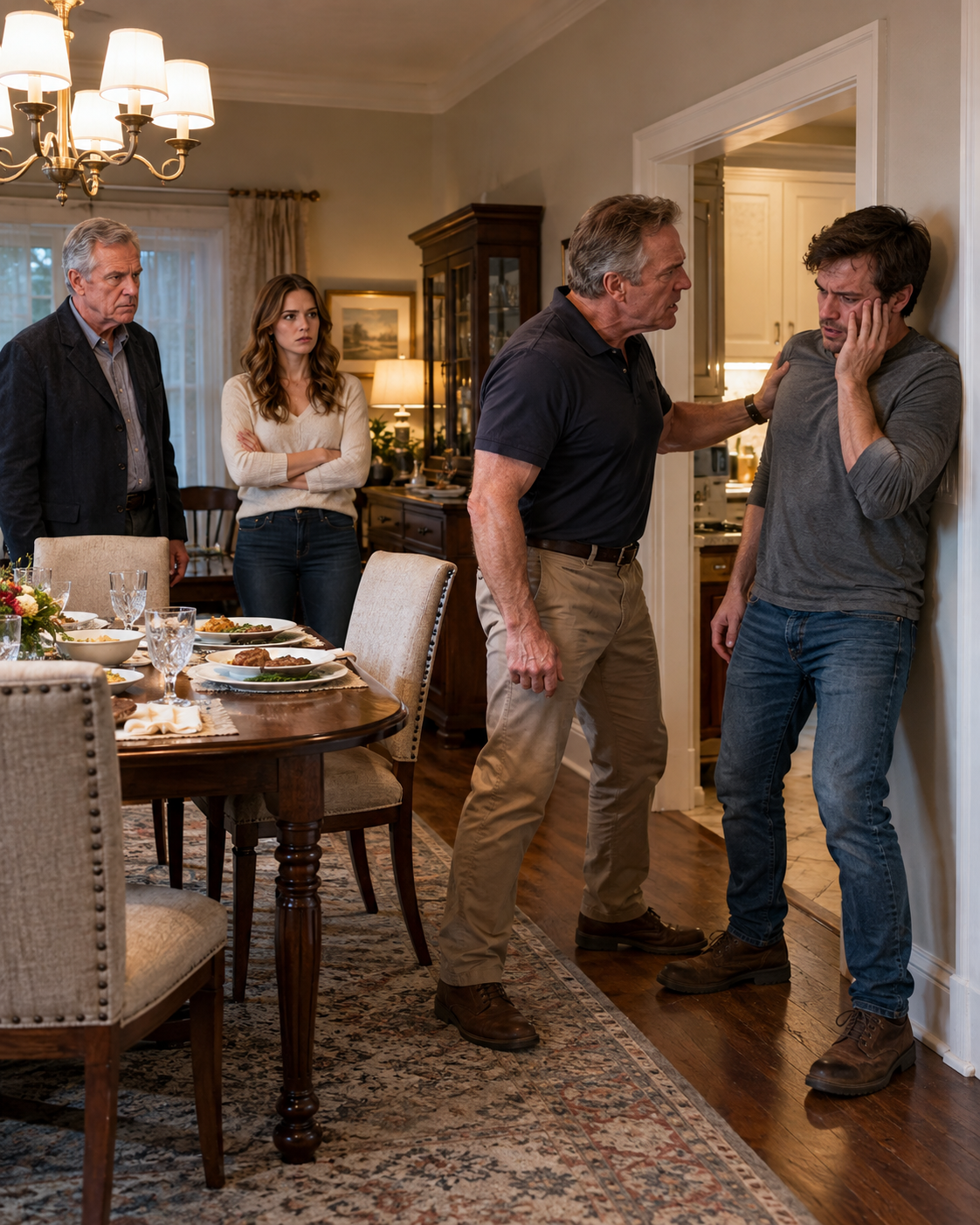
My daughter-in-law watched her father put his hands on my son—and thanked him for it.
Part 1: Scene 1: The dinner invitation My daughter-in-law’s father put his hands on my son at Sunday dinner, shoved...

A Hundred Engineers Gave Up on the Prototype—Then the Night Janitor Asked to Open the Hood – Life Story
A hundred engineers had touched the Helix prototype before dawn, and not one of them could make it wake up....