“‘Our daughter is finally doing something useful,’ my mother announced into a microphone while 23 relatives applauded in the hospital chapel.
“‘Our daughter is finally doing something useful,’ my mother announced into a microphone while 23 relatives applauded in the hospital chapel.
They had gathered to pressure me into donating a kidney to my older brother, Leo.
I was 29, terrified, and had never agreed to the surgery.
Then my own doctor entered carrying a sealed white envelope, looked directly at my father, and asked, ‘Did you tell them yet?’…”
“Our daughter is finally doing something useful.”
My mother said those words into a wireless microphone in the second-floor chapel of St.
Mercy General Hospital.
Twenty-three relatives were watching.
Some nodded.
A few clapped.
My cousin Renee wiped a tear from her cheek.
I stood near the back doors in a gray hoodie and worn sneakers, holding my purse so tightly that my fingers hurt.
They weren’t celebrating a decision I’d made.
They were celebrating a decision they expected me to make.
They wanted me to give my older brother one of my kidneys.
And nobody had bothered to ask whether I was willing.
My name is Mia Preston.
I’m twenty-nine years old, and that Tuesday morning I was supposed to attend what my family called a Family Blessing.
My aunt Sandra had printed prayer cards.
Renee had organized the group chat.
My father had spoken to the hospital chaplain.
Someone had brought a fruit basket.
Twenty-three relatives had driven, flown, and carpooled to the hospital.
Not one of them had asked whether I was comfortable with what was happening.
Three weeks earlier, my brother Leo had learned that his kidneys were failing.
Leo was thirty-four.
He was funny, brilliant, and the kind of person who could make a room feel brighter simply by walking into it.
I loved him.
When I learned how serious his condition was, I was frightened.
I wanted him to get treatment.
I wanted him to live.
But when the doctors explained that he needed a living donor, my mother called with what sounded less like a request than an announcement.
“Mia, the family has decided you’ll be the donor.”
I remember standing in my kitchen, holding the phone.
.
“What do you mean, decided?”
“You’re his sister.
We need you to step up.”
“I need to talk to the doctors first.”
“There’s no time for you to overthink this.”
I told her I was scared.
She said fear was selfish.
I asked whether I could speak with a doctor privately, without relatives listening.
She called that ungrateful.
By the following week, people were texting me about sacrifice, loyalty, and what good sisters were supposed to do.
Aunt Sandra reminded me how many people were praying for Leo.
Renee kept sending messages about the blessing.
Nobody asked what I had learned during my preliminary screening.
Nobody seemed interested in whether I could safely donate.
They were interested in getting me to agree.
I’d spent most of my life being the accommodating daughter.
.
When family plans changed, I rearranged my schedule.
When someone needed help, I showed up.
When my parents disagreed with me, I usually stopped arguing.
I wasn’t always happy about it.
But keeping the peace had become such an ordinary part of my life that I barely noticed how much I was giving up.
I believed that if I was patient and helpful enough, my family would respect me when something truly mattered.
Then Leo became ill.
And suddenly the one decision that belonged entirely to me was being discussed as though I’d already surrendered it.
That Tuesday, I arrived at the hospital hoping there might be a quiet conversation.
Instead, I found my relatives gathering in the hallway.
Aunt Sandra held her petition.
Renee was checking messages on her phone.
Mom was wearing her good blue dress, the one she saved for funerals and court appearances.
Dad stood beside her.
His name is Reed Preston.
He’s a tall, broad-shouldered man who rarely seems uncertain about anything.
When I tried to tell him I needed time, he looked toward the chapel.
“Just come inside, Mia.”
Inside, the pews were already filling.
I stayed near the doorway.
Mom walked to the front with the microphone.
She spoke about how much Leo meant to everyone.
She thanked the relatives for coming.
Then she turned toward me.
“Our daughter is finally doing something useful.”
I couldn’t believe she’d said it.
Not because she expected me to help Leo.
I’d always known she expected that.
But because she’d decided that my value as her daughter depended on whether I gave up part of my body.
I looked at the prayer cards.
At Aunt Sandra’s petition.
At the faces waiting for me to smile and agree.
I hadn’t even decided whether I could face the surgery.
Then I heard footsteps behind me.
Dr.
Nora Feldman entered through the side door.
She was my attending physician, responsible for my medical evaluation rather than Leo’s treatment.
She carried a manila folder and a sealed white envelope.
Dad rose from his seat when he saw her.
She looked directly at him.
“Did you tell them yet?”
Dad stopped moving.
He didn’t answer.
Dr.
Feldman walked toward me.
She placed a hand briefly on my arm.
Then she faced the room.
“Before this discussion goes any further, Mia needs to receive medical information that concerns her directly.”
She held out the envelope.
I took it.
My name was printed on the page inside.
I recognized the heading from my donor screening.
But halfway down, I came to a medical term I didn’t understand.
Bilateral renal abnormality.
I looked at Dr.
Feldman.
“What does this mean?”
She glanced toward my father before answering.
And that was when I learned he had known about the result for three days.
THE NEXT PART IS BELOW 👇 Don’t forget to switch from “Most Relevant” to “All Comments” to continue reading more 👇
IF FACEBOOK BROUGHT YOU HERE, HERE’S THE CONTINUATION YOU’VE BEEN WAITING FOR.
ENJOY!
Dr.
Feldman took the page gently and pointed to the section describing my kidneys.
“During your preliminary screening, we discovered a structural irregularity in both kidneys,” she explained.
I looked at her.
“Is something wrong with me?”
“It’s something you were born with, Mia.
It isn’t necessarily dangerous by itself.
You may live a completely normal life with this condition.”
I looked down at the results again.
“Then what does it mean for donating?”
Her answer was careful.
“It means donating a kidney would carry a significantly higher risk for you than it would for a standard donor candidate.”
I swallowed.
“How much higher?”
“High enough that I would not recommend you as a donor under the current guidelines.”
For several seconds, I couldn’t think of anything to say.
I’d spent three weeks trying to explain to my family why I was afraid of major surgery.
Now I was learning that there was an actual medical reason I shouldn’t undergo it.
Not simply because I was frightened.
Not because I was hesitant.
Because my kidneys were structurally different in a way that made donation unusually risky for me.
Dr.
Feldman continued.
“Mia, you are medically unsuitable as a living donor.”
I looked at Mom.
She was still holding the microphone, but it had dropped into her lap.
Aunt Sandra lowered her petition.
My cousin Renee stopped wiping her eyes.
Then I turned toward Dad.
“Did you know?”
He looked down at the floor.
“Dad?”
Dr.
Feldman answered.
“Three days ago, your father came to me privately.”
I felt the paper trembling in my hands.
“He asked that certain information not be shared with you until the family had an opportunity to speak with you.”
I stared at her.
She explained that she’d declined his request.
She’d made it clear that I had a right to my medical information and that it couldn’t be withheld to accommodate a family discussion.
She’d told him he could speak with me himself before she did.
He’d had seventy-two hours.
Those hours had passed.
And instead of telling me what the screening had found, Dad had allowed the family blessing to proceed.
I looked around the chapel.
Twenty-three relatives.
A microphone.
Prayer cards.
A petition.
They’d assembled all of it to persuade me to undergo a surgery my doctor had already identified as particularly risky.
I had asked for time.
I had asked to speak privately with a doctor.
I had said I was frightened.
And Dad had known there was a medical reason to take those concerns seriously.
Yet he’d stayed quiet.
I wanted to ask him how he could let this happen.
But I couldn’t get the question out.
He hadn’t merely forgotten to pass along a detail.
He’d known for three days that my suitability as a donor was in serious doubt.
And he’d still allowed everyone to gather around me as though the only obstacle was my willingness.
I wondered whether he believed that if I agreed publicly, I would be too ashamed to change my mind later.
Whether he’d been counting on the applause, the prayers, and the expectations to make backing out feel impossible.
I couldn’t know everything he’d been thinking.
But I knew he’d had an opportunity to tell me the truth.
And he hadn’t taken it.
Mom set the microphone on the pew beside her.
Nobody clapped now.
The entire purpose of the gathering had changed.
I was no longer standing there as the daughter expected to make a sacrifice.
I was a patient holding medical results I should have been able to consider without an audience.
I looked at Dr.
Feldman.
“Can we talk somewhere private?”
“Of course.”
I didn’t wait for another family speech.
I walked out of the chapel with the envelope in my hand.
The hallway was quieter than the room I’d just left.
I sat down and looked at the paper again.
I still wanted Leo to survive.
That hadn’t changed.
I still loved him.
That hadn’t changed either.
But I couldn’t give him a kidney.
And even if my screening had shown no abnormality, I should have been allowed to make that decision without pressure.
That was the part I struggled to put into words.
For three weeks, my family had spoken as though being Leo’s sister automatically meant I owed him a piece of my body.
My fear had been treated as a character flaw.
My request for privacy had been treated as disloyalty.
And my parents had acted as though everyone else deserved a vote except me.
The medical result finally ended the question of whether I was a suitable donor.
But it didn’t erase what happened before I received it.
I sat with that distinction for a long time.
Part of me wanted to feel relieved.
The uncertainty was over.
I didn’t have to keep wondering whether I could bring myself to agree to the surgery.
My doctor had made clear that donating was not medically appropriate for me.
But the relief was tangled with grief.
I’d always believed my parents would protect me if something threatened my health.
I knew they’d do almost anything for Leo.
I had admired that about them.
Now I was faced with the possibility that they’d been willing to overlook a serious risk to me because they were so desperate to save him.
I didn’t want my brother to die.
I also didn’t want to be treated as though my health mattered less.
Those two feelings could exist together.
Over time, Leo found another donor.
A forty-one-year-old man named Greg from Portland was matched with him through the national donor registry.
Greg wasn’t a relative.
He wasn’t responding to a family petition.
He chose to donate out of generosity and asked for nothing in return.
I thought about that often.
The difference wasn’t that Greg cared about Leo more than I did.
It was that Greg made a voluntary decision.
He wasn’t standing before twenty-three relatives waiting to be judged.
He wasn’t being told that fear made him selfish.
He was able to offer something because he wanted to, not because the people closest to him had decided it was his obligation.
Leo received the transplant.
His health improved.
Today, he’s healthy.
I am grateful for that every time I think about what might have happened.
I never wanted this story to end with my brother suffering.
I wanted him to recover.
I wanted him to have a future.
And I’m grateful that someone was willing and medically able to help him.
Leo and I still speak occasionally.
Our conversations are careful.
There’s affection between us, but there are things we haven’t completely worked through.
The chapel changed more than one relationship in our family.
It made me question assumptions I’d carried since childhood.
About loyalty.
About responsibility.
About what it meant to be a good daughter or a good sister.
For years, I’d assumed I had to keep everyone comfortable to preserve our relationships.
Now I was learning that a relationship worth keeping should make room for my needs too.
Dad eventually wrote to me.
His letter arrived eight months after the hospital incident.
It was handwritten and several pages long.
I recognized his handwriting immediately.
He apologized for what he’d done.
He acknowledged the way his actions had hurt me.
And he expressed remorse in a way I hadn’t expected from a man who rarely admitted uncertainty or mistakes.
I read the letter once.
Then again.
Then a third time.
I didn’t throw it away.
But I didn’t answer.
I knew some people would think I should respond immediately.
Dad had apologized.
Leo was healthy.
The crisis was over.
Why not forgive him and move on?
I understood that argument.
I wanted things to feel normal again too.
But the problem wasn’t only that Dad had kept a medical result from me.
It was that he’d known I was scared and had allowed the family to turn my fear into a public accusation.
He’d watched Mom announce that I was finally doing something useful.
He’d seen relatives gather to pressure me.
And he’d remained silent when he knew the facts could change everything.
I needed time to decide what his apology meant for our relationship.
I still do.
Sometimes I take the letter out and read parts of it.
Other times, I leave it alone.
I’m no longer trying to rush myself toward an answer simply because someone else might feel uncomfortable waiting.
That is a new feeling for me.
At twenty-nine, I’m only beginning to understand how often I’d ignored my own limits.
I used to think being dependable meant never disappointing anyone.
If a relative needed help, I tried to provide it.
If my parents expected something, I worked out how to accommodate them.
When I had doubts, I kept them to myself.
I believed that was what made me a good person.
But the hospital taught me that being loving and being available for every demand aren’t the same thing.
I could care deeply about Leo and still be frightened of surgery.
I could want him to live and still need accurate medical information before considering donation.
I could love my parents and still be hurt by their choices.
And I could receive an apology without being ready to respond.
There was no contradiction in any of that.
I kept the white envelope Dr.
Feldman handed me.
It’s in the top drawer of my desk, underneath my passport and the lease for my apartment.
Sometimes I forget it’s there.
Then I’ll be looking for something ordinary, open the drawer, and see the corner of the envelope.
I remember the chapel.
Mom’s blue dress.
Aunt Sandra’s prayer cards.
The fruit basket somebody had brought.
Dad sitting down when Dr.
Feldman asked whether he’d told us.
And I remember the doctor introducing herself as my physician.
Not Leo’s.
Mine.
That distinction mattered more than I understood in the moment.
For weeks, everyone had been talking about my body in terms of what it might provide for someone else.
Dr.
Feldman looked at me as a patient whose health deserved protection.
She didn’t ask whether I’d disappoint my family.
She explained the risks.
She gave me information about my own medical condition.
And she made it clear that I wasn’t a suitable donor.
The envelope wasn’t a victory over my brother.
It wasn’t proof that I’d loved him enough or not enough.
It was simply the truth about my body.
A truth I had every right to know.
I wish my parents had trusted me with it.
I wish Mom had asked how I felt before organizing that gathering.
And I wish Dad had told me what he’d learned during those three days.
But I can’t change what they did.
I can only decide what I will accept from them now.
Leo and I are rebuilding our relationship slowly.
Dad’s letter remains unanswered.
I don’t know yet what our family will look like in another year.
What I do know is that I no longer measure love by how much of myself I’m willing to surrender.
One afternoon, I opened my desk drawer to find my passport.
The envelope was lying beneath it.
I picked it up and held it for a moment.
Then I put it back.
I didn’t need to read the results again.
I remembered what Dr.
Feldman had told me.
And I remembered that I had been allowed to ask questions, be afraid, and make decisions about my own body all along.
I just hadn’t known how firmly I was allowed to insist on it.
Now I do.
THE END.
I’ve shared the complete story, and I truly hope it touched your heart.
If this story moved you, please , like, and share the post.
Thank you for reading! ❤️
Recommended Stories

My Boss Pointed at My Cheating Wife, “Today She’s Mine.” Wife Said, “I Agree,” & They Left….
My Boss Pointed at My Cheating Wife, “Today She’s Mine.” Wife Said, “I Agree,” & They Left…. My boss pointed...
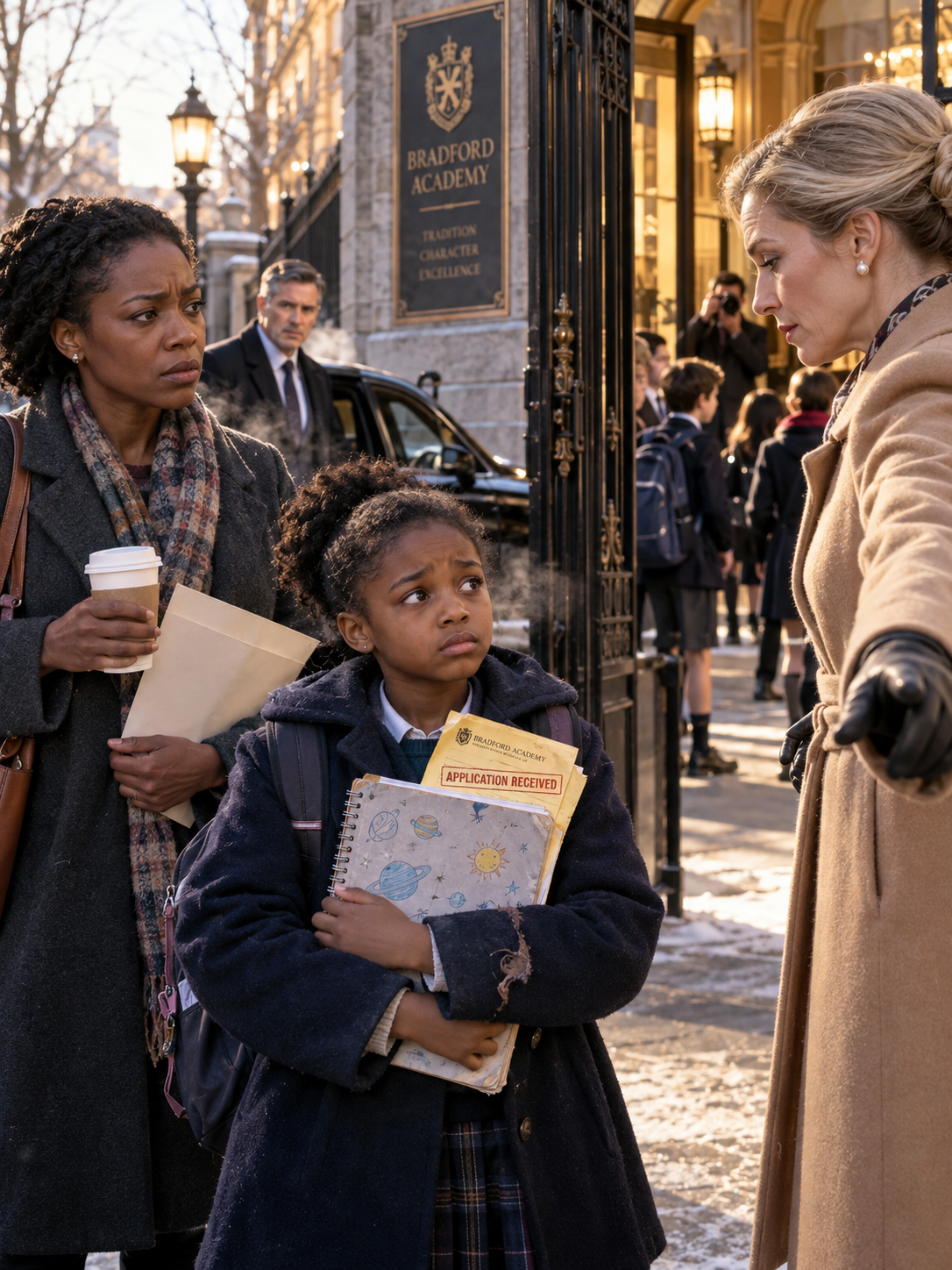
THE SCHOOL TOLD AN EIGHT-YEAR-OLD GIRL TO LEAVE ITS GATE BEFORE THE CAMERAS ARRIVED—BUT THE NOTEBOOK SHE CARRIED EXPOSED A PROMISE THE TRUSTEES HAD BURIED – Life Story
The woman in the camel coat pointed at an eight-year-old girl as though she were a stain on the sidewalk....

My Mother Gave Me an Ultimatum Over My House. Days Later, I Found My Gates Destroyed.
Part 1: You are going to let your brother use your house for his engagement party or you are no...