I read my future father-in-law’s prenup to sixty wedding guests instead of signing it at the table.
I read my future father-in-law’s prenup to sixty wedding guests instead of signing it at the table. “Sign it or there’s no wedding tomorrow,” he said, setting the papers on my dinner plate.
He expected me to protect his family’s secrets without reading them, but page three contained a monthly payment I already recognized…
Henrik Halvorsen ordered lunch for both of us before telling me there was an agreement I needed to sign.
We were at a supper club in Sauk Rapids, two weeks before I was supposed to marry his son.
The waitress knew his name, his usual order, and apparently his preferences for the woman sitting across from him.
I had wanted the fish.
He ordered something else.
It seemed too small a thing to interrupt him over.
I was thirty-six years old, perfectly capable of choosing lunch, and still sometimes willing to surrender an ordinary preference rather than make an afternoon uncomfortable.
“Maren, you’re a numbers girl,” he said. “You understand our family has a lot to protect.”
I set my menu down.
Henrik ran four lumberyards and a truss plant in central Minnesota.
More than a hundred people worked for him.
He sponsored Little League teams, handed out Thanksgiving turkeys, and remembered to make his generosity visible.
He also had a saying: “We protect what’s ours.”
It was painted on the wall of the main office.
I had heard it applied to the company, the family, and a fishing spot he considered insufficiently appreciated by other people using the lake.
I had once thought it meant loyalty.
“Evan’s going to bring you a little agreement,” he said. “Standard stuff.
Anders is drawing it up.”
“A prenup?”
“A family agreement.”
I waited.
“My father had Solveig sign one.
My son-in-law signed one.
It’s how we do things.”
There was nothing inherently alarming to me about protecting a family business.
I was a CPA.
I made my living helping people distinguish what they hoped was true from what the paperwork actually said.
“I’d want my own lawyer to read it.”
“Of course.”
He said it easily, almost warmly.
“Of course.
Evan will bring it by.”
I relaxed enough to pick up my water.
That was the strange thing about Henrik.
He could make a reasonable request feel presumptuous, then grant it so generously that you nearly thanked him for letting you make it.
I told myself he was accustomed to running things.
I was accustomed to precise records, quiet offices, and people arriving with receipts in grocery bags while insisting there weren’t very many.
Perhaps we were simply different kinds of particular.
His son and I had met over several such boxes.
My firm had taken on Halvorsen Lumber three years earlier.
Evan, who managed the Sauk Rapids yard, brought in the paperwork and stayed late to help sort it.
He was funny without announcing that he was being funny.
He noticed when people needed a hand.
One evening he fixed the wobbly leg of our conference table while we were waiting for copies.
Nobody had asked him.
.
I liked that about him before I liked the rest: the ease with which he saw a small problem and quietly made it better.
Once we started dating, I handed the account to a colleague.
I documented the change properly.
I could be romantic without requiring an ethics complaint.
Evan knew his contractors’ names and their children’s names.
He could stand in a lumberyard full of noise and make someone feel he had time for their question.
I had come out of a long relationship at thirty and spent several years pretending I was entirely untroubled by the possibility that a family might not happen for me.
On our third date, Evan said he wanted children.
I remembered how carefully I had answered, trying not to sound too relieved.
By the time Henrik took me to lunch, Evan and I had already bought a house.
Or, more accurately, we lived in a house I had helped buy and did not legally own.
I knew the difference.
That is important.
The house was in Sartell, on Juniper Lane, with four bedrooms, a big backyard, and a swing set the previous owners were leaving behind.
I had liked the swing set more than I admitted.
There was nothing wrong with it.
It simply revealed how far ahead I had already allowed myself to imagine.
The price was $389,000.
I put $60,000 of my savings toward the down payment.
Fourteen years of setting money aside had become a number on a closing statement.
Henrik offered to coordinate the closing through Anders Bjerke, the company lawyer.
Faster, easier, less expense.
.
Then, two weeks before closing, he emailed me.
The financing would work better using Evan’s credit alone, he said.
The property would go into Evan’s name, and after the wedding, Anders would add mine.
A quick deed transfer.
Ten minutes.
“You have my word,” he wrote. “We protect what’s ours, and after September, you’ll be one of ours.”
I read the email three times.
My father, Paul DeVries, was a retired dairy farmer and the son of a Dutch immigrant.
He had raised me to read before signing, check before assuming, and remember that a friendly explanation did not amend a written agreement.
He could make a warning sound like a discussion of livestock.
I knew what he would have asked me about that email.
Why wait?
I nearly asked it myself.
But Evan said his father had handled arrangements like this a hundred times.
I loved Evan.
I wanted our home.
I didn’t want to begin my place in his family by announcing that I trusted none of them.
So I accepted a promise where I would have advised a client to insist on something firmer.
We moved in during June.
We painted one room yellow, just in case.
When I thought about the house afterward, it was often that room I pictured first.
Not the money.
Not the deed.
The yellow walls, and the foolish pleasure of standing in an empty room together with plans.
At lunch, Henrik spoke about the agreement as though it concerned distant family assets, matters that had existed long before me.
I could understand those boundaries.
I wanted to marry his son.
I didn’t need to acquire a lumberyard as an additional hobby.
“I’ll have someone review it when Evan brings it,” I said.
Henrik nodded, satisfied, and turned the conversation elsewhere.
I left thinking we had handled an awkward subject reasonably well.
Over the following days, I asked Evan about the agreement twice.
“Anders is still working on it.”
That was the first answer.
Then, during the wedding week, he told me his father had decided it wasn’t necessary after all.
“Really?”
“Really.”
I believed him.
There were a hundred and forty wedding responses to track, people asking where they were sitting, and the particular exhaustion of having to make cheerful decisions about things I no longer cared very much about.
I could distinguish six almost identical shades of table linen by then.
I wasn’t proud of it.
I wanted the wedding to arrive so we could stop preparing to be married and simply be married.
There were other questions I had allowed to settle too easily during our life together.
In January, when we sat down with our finances, Evan showed me his bank app.
I asked to see the whole picture.
He appeared to give it to me.
A recurring transfer caught my attention.
Eleven hundred and fifty dollars, on the first of every month.
The memo said “Duluth storage.”
“What are you storing?”
“Grandpa’s boat.”
He said it was in a heated barn.
A big boat.
He couldn’t bring himself to sell it.
“That’s a great deal of money for storage.”
“It’s heated,” he repeated.
Then he kissed me and closed the app.
I understood attachment to something inherited.
My mother had died when I was twenty-two.
Her veil was upstairs at the lodge now, waiting for my wedding morning.
There were things I would have spent unreasonable money to keep.
Evan drove to Duluth one Saturday a month to check on the boat.
Three hours there, three hours back.
When I offered to go once, he laughed.
“You want to drive six hours to look at shrink-wrap?”
I didn’t press.
In March, I found a green crayon in his truck’s cup holder, softened by the sun.
A contractor’s child must have left it, he said.
That was plausible.
He knew everyone’s children.
I threw the crayon away.
I didn’t put these moments together then.
They belonged to different days, separated by dinners, work, laundry, and all the harmless things that make a relationship feel known.
By the rehearsal dinner, I thought the only remaining uncertainty was whether I could sleep enough to look human in the photographs.
The lodge stood beside a lake north of St.
Cloud.
Sixty people had come to dinner: relatives, friends, people from the company, our minister.
My father sat at the next table.
Beth, my maid of honor, was nearby.
Evan was beside me.
I remember the ordinary comfort of that before anything else.
His shoulder close to mine, our guests eating, the wedding close enough that there were no more weeks left to count.
Henrik stood to make a toast.
He held a glass of aquavit and spoke about his father opening the first lumberyard in 1961.
He spoke about roots, family, taking care of one another.
People applauded.
My father applauded.
I did, too.
Then Henrik came down the head table toward me.
I thought, absurdly, that he might want another photograph.
Instead, he reached inside his sport coat and took out a stapled document.
He laid it on my dinner plate.
Right on the walleye I had finally been able to order for myself.
Across the papers he placed a green ballpoint pen with Halvorsen Lumber printed along its side.
“Sign it or there’s no wedding tomorrow.”
He said it loudly enough that the tables nearest us stopped talking.
“We protect what’s ours.”
For a moment, I could only look at the paper touching my food.
Then I looked at Evan.
He was staring at his plate.
He didn’t ask his father what he was doing.
He didn’t look surprised.
That was the first thing that truly frightened me.
“Evan?”
He didn’t answer.
I could hear a glass being set down somewhere.
My father’s fork was suspended over his plate.
People farther away were turning to see what had happened.
The wedding was fourteen hours away.
My dress was upstairs.
My mother’s veil was with it.
There were guests already checked into rooms and people driving up in the morning.
Henrik had chosen a moment when saying no would require me to disappoint an entire room.
I picked up the agreement.
Butter had reached one corner.
I wiped it with my napkin because the alternative was to sit there holding a legal document with dinner dripping from it.
Eleven pages.
“I asked to have my own lawyer review this.”
Henrik’s expression barely changed.
It was here now.
The pen was here.
Everyone was watching.
I looked at Evan once more.
Still nothing.
Then I stood.
“If I’m signing it in front of everybody,” I said, “everybody should hear what I’m signing.”
There was a nervous laugh near the back.
Henrik returned to his chair.
He seemed to think I was making a small display before doing what I had been told.
I began in the voice I used at work when walking a client through something important.
The first page identified the parties.
Then it stated that each of us had been given an opportunity to consult independent counsel.
“I haven’t,” I said. “This is the first time I’ve seen it.”
I let that sit before continuing.
The next provisions concerned company shares, the family trust, and property held through the business.
Separate ownership.
Waivers.
Retirement accounts.
Some of it was entirely ordinary.
I said that, too.
“I understand protecting a family business.”
Henrik nodded as though I had finally reached the sensible part.
Then I turned the page.
Disclosures.
My accounts.
My car.
Evan’s assets.
Existing obligations.
I saw the amount before I understood the rest.
“Child support,” I read, “by order of the District Court of St.
Louis County, Minnesota.
Eleven hundred and fifty dollars per month for the minor child, Nils Halvorsen, aged six.”
I stopped.
Duluth storage.
I looked at Evan, waiting for him to look at me.
Our minister, Pastor Ruth Dahl, stood at the end of the table.
“Evan,” she asked gently, “is this true?”
He finally raised his head.
“Yes.”
“You have a son?”
“Yes.
He’ll be seven in November.”
My father set his fork down.
I heard the small sound clearly.
I was still holding page three, and the man I was supposed to marry in the morning had just confirmed that the boat payment was for a child.
Continue below
Chapter 2/6
Pastor Ruth took off her reading glasses.
“We sat together four times this summer,” she said. “I asked whether there was anything your partner needed to know before the wedding.”
“I know.”
“Why didn’t you tell her?”
Evan looked at me then.
His eyes were wet.
I had seen that expression when something hurt him, and some bewildered part of me still wanted to comfort him.
“Dad said to wait.”
Henrik shifted in his chair.
Evan kept speaking.
His father had said that once we were married, I would understand.
That if Evan told me beforehand, I might leave.
I stood with the document in both hands.
Nobody needed to explain what the timing meant.
They had wanted the decision made before I received the information.
Henrik got up.
“That’s a private legal document.”
He gestured toward the room, apparently remembering privacy now that other people knew what the paper said.
“You put it on my plate.”
“This is family business.”
“In front of sixty people.”
His face had gone red.
Then he said Anders was never supposed to have included that information.
The sentence reached the room before he could retrieve it.
Evan turned toward him.
“You told me he’d left it out.”
“I told you to handle it after the wedding.”
“You told me not to tell her.”
His voice cracked.
“For three years.”
Solveig, his mother, sat very straight beside the empty chair Henrik had left.
Her napkin rested in her lap.
She was looking at me.
I had rarely heard her disagree with her husband.
She was a small, courteous woman, a retired piano teacher who seemed able to move through an entire evening without inconveniencing anyone.
Now she watched while her husband came around the table toward me.
His voice changed.
“Maren, listen.
You’re upset.”
He wanted us to stop doing this in front of everyone.
I was suddenly aware of how carefully he had chosen the audience for my compliance and how quickly he wanted it removed from my refusal.
He told me to sign that evening.
After the wedding, we could sit down as a family and discuss the boy.
“He’s a good boy.
You’ll like him.”
I looked at Evan.
He had a son.
A child with a birthday coming in November, a life somewhere three hours away, a name I had learned from a payment obligation.
There was no version of signing that paper in which I could still pretend this was merely an uncomfortable rehearsal dinner.
I picked up the green pen.
Henrik’s attention went straight to my hand.
“We protect what’s ours,” I said. “So do I.”
I offered it back.
He didn’t take it.
I set it on the table, placed the agreement beside it, and removed my engagement ring.
My finger felt oddly bare before I had even put the ring down.
I laid it on page three.
Then I turned toward Pastor Ruth.
“I’m sorry you drove up for nothing.”
“I didn’t,” she said. “I think I drove up for exactly this.”
My father was already coming toward me.
He took my elbow.
Beth collected my purse and sweater, and we walked through the lodge lobby together.
I remember the fireplace, a stuffed loon, photographs of men holding fish.
Ordinary decorations that had no reason to remain so clear.
Behind us, the dining room began talking all at once.
Outside, mosquitoes gathered under the parking lot lights.
Dad looked at me.
“Your mother would have read it, too.”
That was when I cried.
Beth took me to her apartment and gave me her bed.
Dad found a motel room nearby.
I didn’t go back to Juniper Lane.
Late that night, Beth discovered three loose pages beneath my sweater in her car.
The schedules had pulled free when I lifted the agreement.
I had carried them without noticing.
I sat at her kitchen table and read them.
Schedule A listed Evan’s separate property.
His truck.
His shares.
His retirement.
And the house on Juniper Lane.
The house I had put $60,000 into.
I pulled up Henrik’s email and placed the phone beside the page.
Chapter 3/6
I read the promise and the property schedule until the room began to lighten.
The house would be his alone.
That was what the agreement wanted me to accept.
Henrik’s email said my name would be added after the wedding.
I could not make those two things fit.
When Dad answered at the motel, I told him I needed a lawyer.
Then ten o’clock passed.
I was supposed to be walking toward Evan in my mother’s veil.
Instead, I was sitting in borrowed clothes at Beth’s table, realizing the veil was still at the lodge.
My grandmother had made its lace.
My mother had worn it at her wedding.
I wasn’t leaving it there.
Beth drove me back at noon.
Outside, staff were stacking the white chairs that should have held our wedding guests.
I looked away before I finished counting the rows.
The desk clerk gave me the bridal suite key and squeezed my hand.
She had been serving dinner the night before.
Upstairs, Solveig was sitting on the bed.
My mother’s veil was in her lap.
“I didn’t want it put in a box,” she said.
Henrik had intended to have everything packed and sent to my father.
She smoothed the lace with her thumb.
“Your grandmother made this.”
I asked how she knew.
“You told me at your shower.”
She had listened.
That small fact undid me more than I expected.
I sat by the window while she folded the veil and handed it over.
Then she told me about her own agreement.
Before her wedding, Henrik’s father had placed it beside her plate at a family Christmas meal.
She was twenty.
She signed without reading while the food continued moving around the table.
She had been crying.
“It’s how they do it,” she said.
She also told me she had overheard Henrik speaking to Anders before our rehearsal dinner.
He wanted the agreement airtight.
Everything listed.
The house included.
When Anders raised something she couldn’t hear, Henrik laughed.
He didn’t think I would read it.
“He said you’d be crying.”
I looked down at the lace.
“I should have called you,” Solveig said. “I picked up the phone twice.”
“Why didn’t you?”
She watched the men stacking chairs outside.
“Forty-one years.”
She turned back.
“It isn’t a good reason.”
From her purse, she produced a copy of the house closing statement.
My contribution was there, identified plainly.
Henrik kept copies in his den.
Now, she said, so did she.
“He’ll know you gave me this.”
“Yes.”
She didn’t say it bravely.
She said it as though she had considered the consequence and come anyway.
At the door, she told me Evan kept a photograph of his son behind his driver’s license.
She had found it doing laundry.
“He’s been a father in secret,” she said.
That evening, Evan came to Beth’s apartment.
I shook my head when she looked through the peephole.
She left the chain on.
He asked whether he could slide something beneath the door.
A school photograph appeared on the floor.
A blond little boy grinned against a blue background.
The corners were worn soft.
On the back, Evan had written his name and “kindergarten.”
His mother was Claire, Evan told me through the door.
Their relationship had ended years earlier.
He had visited his son every month.
He wasn’t asking forgiveness.
He didn’t want the child to remain only a line in a document.
I held the photograph and said I would return it.
On Monday, Dad’s lawyer, Judith Voss, read everything in her office above a bakery.
She asked whether I had signed.
“No.”
She warned me recovering the money would take work and cost money.
Then she picked up Henrik’s email again.
This, she said, gave her something solid to work with.
Chapter 4/6
Judith sent a demand for the return of my contribution.
Henrik responded elsewhere.
Within a week, versions of his story reached me through a client, someone at Dad’s church, and the man who repaired my car.
I had known about the child.
I had staged the surprise.
I wanted the family’s money and had chosen to humiliate them when they tried to protect themselves.
It was astonishing how quickly I acquired a detailed motive from people who had never asked me a question.
Dad heard it at the co-op from a man who had attended the dinner.
“He’s telling people you knew.”
His voice shook.
I wanted to reassure him, but I was tired of making the people who loved me feel better about things I was still struggling to bear.
“I didn’t know, Dad.”
“I know you didn’t.”
On Thursday, Walter Brenner, our managing partner, called me into his office.
He closed the door.
Walter rarely closed his door.
Henrik was taking the company’s account to a Minneapolis firm.
All four yards and the truss plant.
Then Walter told me the rest.
Henrik had suggested I was a liability: an employee who aired a client family’s private legal papers in public.
I began explaining the account transfer I had made three years earlier.
“I know,” Walter said. “I signed the memo.”
He removed his glasses.
“Did you sign anything?”
“No.”
“Did you read it first?”
“Yes.”
“Then you did what I expect you to do.”
He told me to go back to work.
The firm would survive losing the account.
I sat at my desk for several minutes before I could trust my hands.
Then I finished a dairy farm’s depreciation schedule.
The work was a relief precisely because none of the numbers cared what Henrik had said about me.
Anders’s response arrived soon afterward.
The $60,000 had been a gift, he wrote.
I had voluntarily contributed to property titled to Evan.
Judith arranged a meeting.
We met in October at her office, six chairs around a table, the bakery’s back entrance visible through the window.
Henrik stood by it as though he owned the view.
Anders opened his folder.
Evan sat at the far end, thinner than I remembered.
Henrik wanted the meeting brief.
I had transferred the money willingly, he said.
Now I was unhappy.
Anders began explaining the absence of a written agreement.
“There is a written promise,” Judith said.
She slid Henrik’s email across the table.
Anders read it twice.
Judith read it aloud.
The better financing.
My name added after the wedding.
Ten minutes.
His word.
Henrik called it family talk.
Judith placed the property schedule beside it.
Anders turned toward him.
“You didn’t show me this.”
Henrik said he hadn’t thought it mattered.
“You told me she’d agreed the house was Evan’s.”
Then Henrik blamed him for including the child.
Anders closed his folder.
He had been asked to list the obligations, he said.
He had done so.
From the end of the table, Evan spoke.
“I’ll pay her back.”
His father told him to sit down.
“I am sitting down, Dad.”
Evan put his hands on the table.
The deed was in his name.
The money was mine.
He would return all of it by December first.
Henrik objected.
Evan said he was thirty-eight, with a son nearly seven, and he was finished allowing his father to make these decisions.
For once, Henrik left the room without everyone rearranging themselves to stop him.
The lawyers put the repayment agreement in writing.
I read it.
Then I signed with my own pen.
Chapter 5/6
Evan stopped me at the stairs.
“I should have told you on our third date.”
I knew which conversation he meant.
He had told me he wanted children while already having a son.
“Why didn’t you?”
He was afraid I would leave.
Then every month made telling me harder.
His father kept supplying another deadline.
After the engagement.
After the house.
After the wedding.
“I’m done waiting for Dad.”
I believed he meant it.
I didn’t offer to marry him again.
In early November, an email arrived at work.
“I’m Nils’s mom.”
Claire was a dental hygienist in Duluth.
She had heard about the dinner through a cousin who knew someone at the lodge.
She believed we had both been lied to.
Would I meet her?
That Saturday, I drove north.
At a coffee shop near the lift bridge, she showed me a photograph before I had properly settled into my chair.
Nils stood in front of a mirror wearing a gray suit and a clip-on bow tie.
His grin had a gap where his front teeth had been.
Evan had told him in the spring he could be the ring bearer.
For months, he practiced walking slowly down their hallway.
Then Henrik called Claire.
She had never spoken to him before.
He had never met his grandson.
He told her I knew about Nils and didn’t want him at the wedding.
Or in my life.
He said Evan was too ashamed to explain it himself.
Claire looked at me across the table.
“I hated you.”
“I didn’t know he existed.”
“I know that now.”
She had told her son the wedding had become too small.
I looked again at the child dressed for an occasion adults had taken away from him.
Had she discussed Henrik’s call with Evan?
No.
Henrik asked her not to.
Evan had enough to manage.
But Evan later told her his father said she didn’t want Nils attending because it would confuse him.
We sat quietly as the arrangement became visible.
Different explanations, given separately, keeping people from asking one another the simplest questions.
With Claire’s permission, I called Evan and put him on speaker.
She told him about the call.
I watched the bridge rise outside while he listened.
When she finished, he asked whether Nils still had the suit.
It was in his closet.
He wouldn’t let her give it away.
“Tell him to keep it,” Evan said. “I’ll need him for something.”
There wasn’t a reconciliation between Evan and me at that table.
There was a mother finally telling a father what had been said about his son, without Henrik explaining either of them to the other.
On December first, the money arrived.
All $60,000.
That same day, Evan gave notice at the lumberyard.
Solveig later told me Henrik laughed at first.
Then he threatened the trust.
Then he offered Evan the company presidency.
Evan refused.
In March, he sold the Juniper Lane house and moved to Duluth.
He found work managing another building-supply yard, earning much less.
His rental was six blocks from Claire’s apartment.
He began having Nils every Wednesday night and every other weekend.
I learned these things gradually.
They didn’t restore our relationship.
They did make the school photograph I had returned to him feel less lonely in my memory.
His son was no longer being fitted into one Saturday a month beneath the name of a boat.
Final chapter 6/6
In April, I bought a house.
Mine was small, with two bedrooms, a crabapple tree in front, and a kitchen narrow enough that I could touch both walls.
After months of uncertainty, I found the kitchen’s dimensions strangely reassuring.
There was nothing in it pretending to be grander than it was.
I used the recovered money and some retirement savings.
At the closing, Dad sat beside me in his good jacket.
The title officer slid thirty-one pages across the table and offered me a pen.
“Just sign by the flags,” she said. “I’ll walk you through.”
“I’m going to read it first.”
She glanced at the clock.
“All of it,” I added.
Then she looked at me properly.
“Take your time.”
I did.
Dad waited without speaking, hands resting on his knees.
He had spent enough years beside me to know that hurrying would only make me start a paragraph again.
It took forty minutes.
On the last page, I signed my name on the deed.
Only my name.
Dad’s eyes were wet when I looked up.
“Allergies,” he said.
I didn’t point out that we were indoors.
He had earned the explanation he preferred.
The house didn’t erase what had happened.
There were still moments when I remembered the yellow room on Juniper Lane and had to let myself be sad about a future I had genuinely wanted.
I had loved Evan.
Knowing why I couldn’t marry him did not make that love foolish or imaginary.
It made unpacking slower on certain evenings.
I put my mother’s veil away carefully.
It had come through the whole affair better than I had: lace intact, no butter stains, still something belonging to the women in my family rather than the wedding that hadn’t happened.
In June, a Christmas card arrived from Solveig.
She had bought it in December and been afraid to mail it.
Inside was a photograph of her in a sun hat, standing on a dock beside Nils and holding his hand.
She had written on the back that it was the first time they met.
Seven years late.
Then another line.
“Thank you for reading page three.”
I sat with that photograph for a while.
At the lodge, she had told me she listened even when nobody noticed.
Now she was doing something that would be noticed, whether her husband liked it or not.
Evan told me she drove to Duluth twice a month.
Henrik didn’t accompany her.
She went anyway.
In July, Evan sent another picture.
This one showed an old green-and-white fishing boat on a trailer.
Nils stood in the bow wearing a life jacket, grinning.
“Grandpa’s boat,” Evan had written.
It really existed.
It had been in Henrik’s machine shed the whole time.
They had taken it out that weekend.
I laughed aloud at my desk.
A colleague asked what was funny.
I looked at the photograph again, at the child standing in the boat that had once explained him away.
It was too much to explain between client files.
“Something turned out better than I expected,” I said.
That evening, I went home to my little kitchen.
There were still things to put away, ordinary decisions to make about where I wanted them.
I set my bag down and opened the drawer holding my closing papers.
The deed was where I had left it.
I tucked Solveig’s card into the same folder, with the photograph facing up, and closed the drawer.
THE END.
I’ve shared the complete story, and I truly hope it touched your heart.
If this story moved you, please , like, and share the post.
Thank you for reading! ❤️
Recommended Stories

MY WIFE CALLED ME A TERRIBLE HUSBAND WHILE I RECOVERED FROM AN INJURY—THEN I SAW HER BOSS AT OUR FRONT DOOR AND LEARNED HOW LONG EVERYONE HAD LIED – Life Story
I came home from the emergency room with thirty-nine stitches and found my wife kissing her boss on our front...

My sister drove a silver tiara into my scalp—then I noticed every camera was still recording.
Part 1: The metal struck before I even saw Delaney move. One second, I was sitting at the edge of...
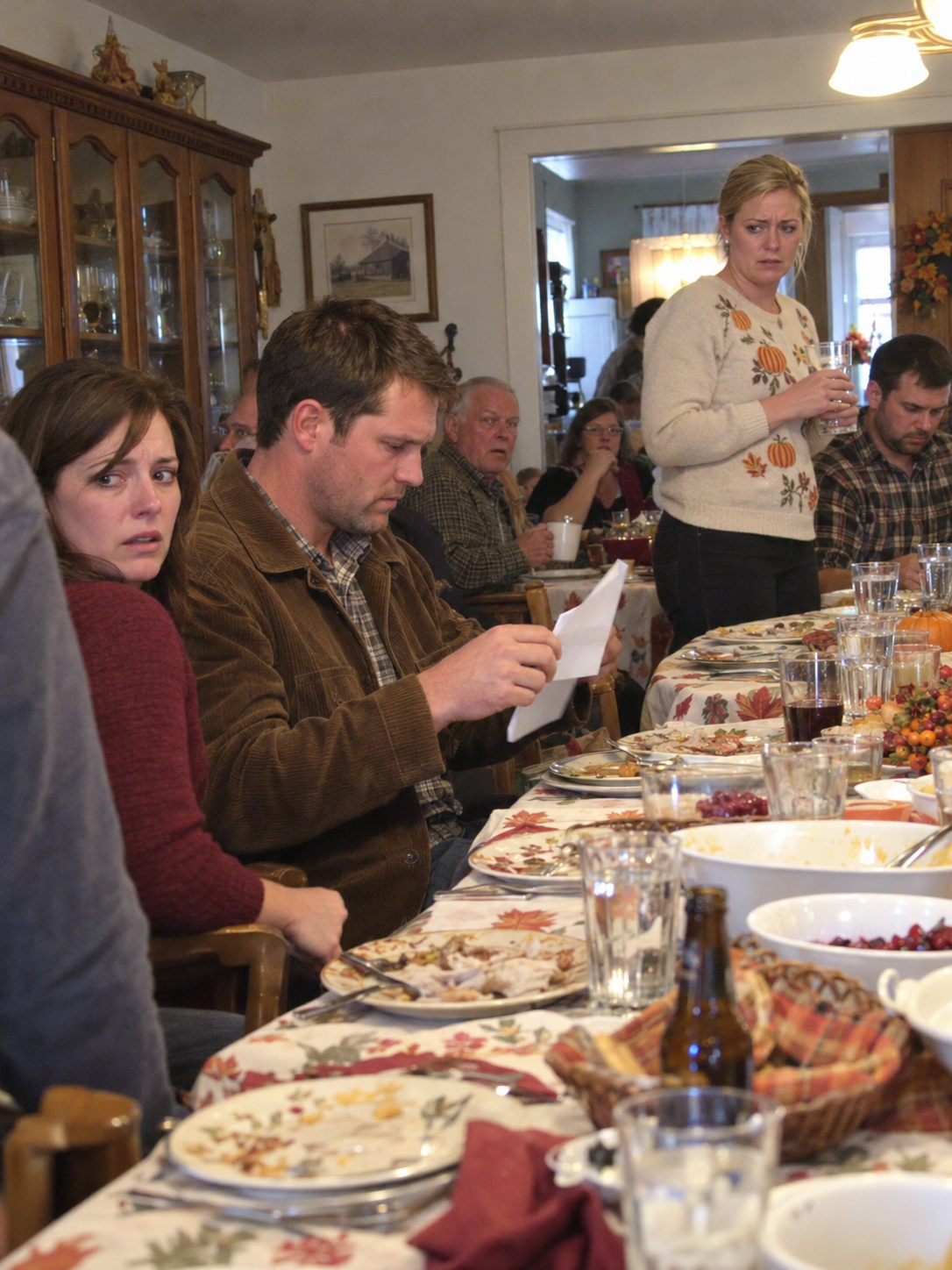
At Thanksgiving, my sister-in-law tapped her water glass and announced to 19 relatives that my red-haired son wasn’t my husband’s child.
At Thanksgiving, my sister-in-law tapped her water glass and announced to 19 relatives that my red-haired son wasn’t my husband’s...