March 22, 1966. A U.S. Senate hearing room in Washington, D.C. James Roche, president of General Motors—the company that sold nearly half the cars in America—sits at the witness table. Across the room is Ralph Nader, a 32-year-old lawyer from a small town in Connecticut. No engineering degree. No corporate army. Just a book.
Roche admits on the record that GM hired private detectives to investigate Nader’s life. Then the head of the most powerful automaker on Earth does something almost no one expected. He apologizes.
The car behind all of this isn’t in the room. By May 1969, it was dead. By July 1972, the federal government had tested it, studied it, and handed down its verdict: the early Corvair was no more likely to spin out of control than the cars it competed against. General Motors won every argument about the Corvair—in court, on the test track, in a federal report. It lost the only one that mattered.
The Corvair was acquitted three years after its execution.
This is the story of the car America convicted before the evidence came in. And the villain of this one is not who you think it is.
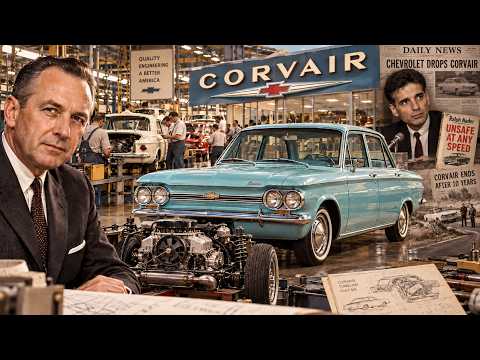
To understand the Corvair, you have to understand the man who willed it into existence. His name was Edward Nicholas Cole. Born September 17, 1909, in Marne, Michigan—a farming town where his parents ran a dairy farm. That meant early mornings, cold barns, and machines that had to work because no one else was coming to fix them.
As a teenager, Cole found two worn-out automobiles and rebuilt them himself, bolt by bolt. By 16, he was one of the few people in Marne who owned two cars—not because his family was rich, but because he had brought two dead machines back to life with his own hands.
Here’s the strange part. Ed Cole didn’t set out to be an engineer. He wanted to be a lawyer. He enrolled at Grand Rapids Junior College with a courtroom in mind. Keep that detail close. More than three decades later, the greatest machine of his career would be put on trial—and the man prosecuting it would be a lawyer.
But something pulled Cole away from the law. In 1930, he transferred to the General Motors Institute in Flint—a cooperative school where GM trained the engineers it planned to promote. He was sponsored by Cadillac. He was so good that Cadillac pulled him out before he graduated and put him straight to work. No diploma. Just a drafting table and a reputation moving faster than he was.
That speed became his signature. People who worked with him said Ed Cole had only one setting: full throttle. He walked fast, decided fast, and expected everyone around him to keep up.
Then the world went to war. Cadillac’s plants turned to military production—light tanks for the U.S. Army. Cole became one of the key design engineers on GM’s light tank program. Machines that had to start in mud, run in snow, and keep moving under fire. It was the farm all over again, only now the stakes were soldiers’ lives.
When the war ended, Cadillac went back to building luxury cars, and Cole kept climbing. In 1946, he became Cadillac’s chief engineer. He was part of the team behind the 1949 overhead-valve V8—a lighter, higher-compression engine that pushed the entire American industry toward modern V8 power. In 1950, he was promoted to works manager. Then a new call came. Chevrolet’s general manager wanted Cole as his chief engineer. In 1952, Ed Cole arrived at Chevrolet.
The timing could not have been better—or worse. Chevrolet sold enormous numbers of cars, but its engineering had grown old and cautious. Cole brought urgency. Under his watch, Chevrolet developed the small-block V8 that debuted in 1955—an engine so compact, light, and powerful that many still call him its father. He also protected a fragile two-seat sports car called the Corvette at a moment when it could easily have been canceled. He backed a brilliant, difficult engineer named Zora Arkus-Duntov, who would spend years turning the Corvette into a true performance machine.
Ed Cole had a gift. He could see what a car might become before anyone else in the building believed it. In 1956, at just 46, he was named general manager of Chevrolet and a vice president of General Motors. He was now running the biggest-selling car brand in America inside the largest automaker on Earth. He had the money, the engineers, the factories, and the confidence of a man who had never really failed.
But something was happening on American roads that worried the men in Detroit. Small foreign cars were starting to appear in driveways. Odd little cars—cheap, simple, and unlike anything Detroit was building. One of them in particular had its engine in the back and its cooling done by air. Most executives looked at it and saw a fad. Ed Cole looked at it and saw the future.
And he was about to bet Chevrolet’s reputation on building America’s answer to it. A car so radical that years later, one book would call it a corpse.
In the late 1950s, Detroit had a simple philosophy: bigger was better. Every year American cars grew longer, lower, and wider. Tailfins climbed toward the sky. Chrome spread across every surface. V8 engines swelled in size and horsepower. To the men who ran the Big Three, this was what Americans wanted, and the sales numbers had proved them right for more than a decade.
Then the numbers started to crack. In 1958, a recession hit the country. Families tightened their budgets, and many of them began to notice a strange little car from Germany rolling quietly past the dealerships full of chrome. The Volkswagen Beetle. It was small, it was slow, it had its engine in the back, and that engine was cooled by air instead of water. No radiator to boil over. No antifreeze to buy. It was cheap to own, simple to fix, and built with a stubborn, almost military kind of quality.
Detroit laughed at it at first, then it stopped laughing. Imported cars were taking a growing share of the American market, and it was not only foreigners. American Motors brought back its compact Rambler American. Studebaker, fighting for survival in South Bend, Indiana, launched the compact Lark for 1959 and got a desperately needed sales boost. Small cars were no longer a joke. They were a threat.
So each of the Big Three made the same decision. Each would build a compact car for the 1960 model year. Ford would build the Falcon, Chrysler would build the Valiant, and Chevrolet would build the car that came out of Ed Cole’s head.
Here is where the paths split. Ford and Chrysler took the logical route. They shrank what they already knew. A water-cooled engine in the front, driving the rear wheels through a conventional drive shaft. Familiar, cheap to build, easy for any mechanic in America to understand. In plain terms, a regular American car, just smaller.
Ed Cole did the opposite. He did not want to copy Detroit at a smaller size. He wanted to beat the Beetle at its own game, with American engineering and American scale. So Chevrolet threw out almost everything Detroit took for granted. The engine went in the back. It would be a six-cylinder, laid flat, with the cylinders facing each other in two rows. A horizontally opposed engine, often called a boxer. It would be built largely from aluminum to save weight. And like the Beetle, it would be cooled by air, with a large fan pulling air across the cylinders. No radiator, no water pump, no conventional grill at the front. The body would be built as one welded structure, with no separate frame underneath. And at the rear, each wheel would swing independently on its own half axle. Engineers called this a swing axle suspension. Volkswagen used one. So did some of the most famous sports and racing cars in Europe, including the Mercedes-Benz 300SL.
On paper, it was brilliant. With the engine sitting right over the driven wheels, the car would have strong traction in snow and mud. With no drive shaft running to the back, the floor could be flatter. With aluminum and no radiator, the car could stay light. Inside General Motors, it was the most radical passenger car the company had ever attempted to mass produce. The name blended two of Chevrolet’s proudest badges, Corvette and Bel Air: the Corvair.
When it went on sale, a base Corvair sedan was priced at $2,038. For that money, an American family could buy a car with its engine in the trunk, its spare tire up front, and engineering that had more in common with Stuttgart and Wolfsburg than with Detroit. It was a magnificent gamble, and buried inside it was a problem almost no one outside the engineering offices yet understood.
Put the heavy engine at the back, and most of the car’s weight sits over the rear wheels. Pair that weight with a swing axle suspension, and the car’s behavior near its limits changes. A driver who enters a corner too fast and suddenly lifts off the gas can feel the rear end of the car begin to step out. Racing drivers knew how to handle that. They had spent years learning it. The average American driving home from work in 1960 had never felt anything like it.
The same choices that made the Corvair clever, light, and unlike anything else from Detroit were the choices that would one day put it in front of a jury. But first, Chevrolet had to build it. And the place it chose to build it had a history all its own.
Twenty-five miles west of Detroit, near Ypsilanti, Michigan, stands a factory with a past. During World War II, Willow Run was one of the most famous industrial buildings in the world. Ford built it to mass-produce the B-24 Liberator bomber, a four-engine heavy aircraft rolling off an assembly line like an automobile. At its peak, the plant turned out bombers at a pace the world had never seen. When the war ended, the bombers stopped. The plant passed to Kaiser Frazer, the ambitious post-war automaker that tried to challenge the Big Three and failed. Then in 1953, General Motors bought it after a fire destroyed one of its transmission plants, and the company needed floor space fast.
Now, in the summer of 1959, Willow Run was about to build something it had never built before. A car with its engine in the wrong end.
In July 1959, Corvair production began at Willow Run. Engineers had spent years on this machine. The chassis work had been led by Robert Schilling, an experienced suspension engineer from GM’s research staff, who had to make a rear-engine car with swing axles behave like something an ordinary American family could drive. The body was a first of its own. Fisher Body, the GM division that built the bodies for nearly every car in the corporation, had never mass-produced a unibody before. No separate frame. One welded steel shell carrying all the loads. The Corvair was Fisher’s first.
On October 7, 1959, Chevrolet unveiled the Corvair to the public. The reaction was electric. Here was General Motors, the most conservative giant in Detroit, putting an air-cooled engine in the trunk. Magazines rushed to test it. Time magazine put Ed Cole himself on its cover with the Corvair beside him. For a man who had started out rebuilding junk cars on a dairy farm, it was the summit. The farm boy from Marne was now the face of American innovation.
But there was a problem. One day later, on October 3, 1959, Ford introduced the Falcon. And the Falcon was everything the Corvair was not. It was ordinary, almost aggressively ordinary. A small, light inline six-cylinder engine in the front. Water cooling. A conventional drive shaft to the rear wheels. Round tail lights that announced without apology that this was a Ford. Inside, it was designed to seat six people like a full-size family car, just in a smaller package. There was nothing to learn, nothing to fear, nothing to explain to your mechanic.
America voted with its checkbook. By the end of the 1960 model year, Ford had built 456,703 Falcons, counting its Ranchero pickup version. That was more than the Chevrolet Corvair and the Plymouth Valiant combined. The Corvair, the car on the cover of Time, the most advanced machine General Motors had ever put into mass production, came in at roughly 250,000 units.
On paper, a quarter of a million cars is a success. Most companies in the world would have celebrated a number like that. But this was Chevrolet. And Chevrolet did not lose to Ford. Inside General Motors, the verdict was harsh. The Corvair was too unusual, too expensive to build, and too different for the buyers it was meant to win. The economy-minded family that walked into a dealership in 1960 did not want an engineering lesson. It wanted a cheap, roomy, familiar car. Ford had given them one. Chevrolet had given them a revolution.
Here was the first humbling lesson of the Corvair story. Being brilliant is not the same as being chosen.
General Motors responded the way large corporations do when they feel embarrassed. It quietly started work on a second answer. A conventional compact. Front engine, water cooling, nothing radical at all. It would arrive for 1962 as the Chevy II, later known as the Nova. Think about what that meant. Before the Corvair was even two years old, its own company was preparing a replacement for the job it had been built to do.
And yet buried inside those disappointing first-year numbers, there was something the accountants could not easily see. At Ford, the Falcon was a hit. But many of its buyers were people who might otherwise have bought a full-size Ford. The new car was eating into its own family’s sales. The Corvair was different. A large share of the people buying it were not Chevrolet customers trading down. They were new to the brand. Some had been shopping for imports. Some had never considered an American car at all. The Corvair was not stealing from Chevrolet. It was bringing in people Chevrolet had never reached.
Ed Cole’s machine was failing at the job it had been designed for, but it was quietly attracting a different kind of driver: younger, more curious, people who did not mind a car that felt different, people who might actually enjoy it. Nobody at General Motors fully understood that yet.
The Corvair’s story ends not with a bang, but with a whisper. The last one rolled off the line in 1969, and the government report that cleared its name gathered dust. Yet the car refused to die. Enthusiasts formed clubs, raced them, and kept the flame alive.
Ed Cole died in a plane crash in 1977, but his creation outlived him. Ralph Nader became a legend, and the Corvair became a symbol of corporate overreach and design hubris. But for those who drove it, it was simply a car that felt alive.
Today, a well-kept Corvair turns heads at car shows, a reminder of a time when Detroit dared to be different. The car that was convicted before the evidence came in now stands as a testament to the cost of innovation and the power of public perception.
What do you think? Was the Corvair a victim of circumstance or a flawed design that deserved its fate? Share your thoughts below.






