March 17th, 1941. North Atlantic, 03:37 hours. Commander Donald McIntyre gripped the frozen steel of HMS Walker’s bridge, his knuckles white. Below, 41 merchant ships—Britain’s lifeline—pushed eastward through 30-foot swells. Behind them, at least five German U-boats circled like wolves. In 1940 alone, U-boats had sent 471 Allied ships to the ocean floor. At this rate, Britain would starve by Christmas.
The Royal Navy’s response: depth charges. Barrels packed with 300 pounds of TNT, rolled off the stern, preset to explode at specific depths. The official kill rate: 3%. Three out of every hundred attacks resulted in a confirmed U-boat sinking. Tonight, McIntyre’s ASDIC operator called out a contact: U-99, commanded by Otto Kretschmer, the most successful U-boat ace in history. 44 ships destroyed.
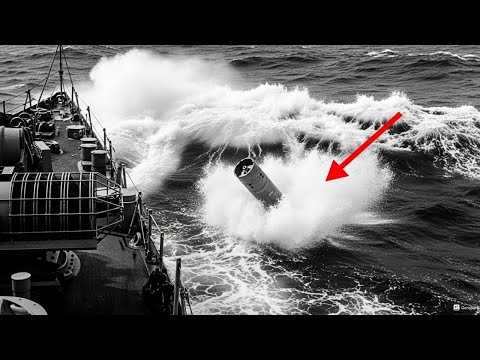
They had been hunting this ghost for two hours. Walker’s depth charge team prepared the standard attack: 10 charges set to detonate at 150 and 300 feet, dropped in the regulation diamond pattern. The explosions erupted—geysers of white water climbing toward the stars. Nothing. Another attack. Another miss. Kretschmer’s U-99 dived beneath the blast zone, escaping at angles the rigid pattern could not cover.
In the wardroom below, a young lieutenant named Frederick Walker watched the plot with mounting frustration. He had been tracking these failures for months, filling notebooks with calculations, questioning the doctrine that was killing his friends. What Walker didn’t know was that their depth charge tactics contained a fatal flaw—a mathematical error built into procedures designed 20 years earlier for slower, shallower submarines. The settings were wrong. The patterns were wrong. The entire system ensured failure.
But Walker had seen the truth in the numbers. He had designed something different—a modification so simple, so obvious, yet so contrary to established doctrine that when he proposed it, the Admiralty’s response would be swift and absolute: “That is illegal. You are forbidden to implement these changes.”
What happened next would save 10,000 lives and turn the tide of history’s longest battle. But before that, Walker had to defy the very institution he served. And the Navy would make him pay for it.
September 3rd, 1939. The day Britain declared war, German submarine U-30 torpedoed the passenger liner SS Athenia, killing 117 civilians. It was the opening shot of what Winston Churchill would call “the only thing that ever really frightened me during the war.” The depth charge seemed like the answer—developed in World War I, perfected through the 1920s, standardized across the fleet. The theory was elegant: detect the submarine with ASDIC sonar, steam toward it at high speed, pass directly overhead, roll charges off the stern set to explode at the submarine’s estimated depth.
But theory collided with reality in the cold mathematics of the North Atlantic. Problem one: the moment a destroyer began its high-speed attack run, ASDIC lost contact. Captains were dropping depth charges blind, hoping the submarine hadn’t turned or dived in the 30 seconds between last contact and weapon release. Problem two: standard doctrine called for settings of 150 and 300 feet—depths calculated for WWI-era submarines with maximum operating depths of 200 feet. But Type VII U-boats could dive to 750 feet. German commanders quickly learned to simply go deep. Problem three: the diamond pattern assumed submarines traveled in straight lines. They didn’t. U-boat captains executed radical maneuvers the instant they went deep, rendering the patterns useless.
The expert consensus was unanimous. At the Admiralty’s anti-submarine warfare division, senior officers reviewed the statistics and concluded the depth charge was working as designed. “3 to 5% kill rate is acceptable given the technological limitations,” read one 1940 report. “Further improvements will require new weapon systems, not tactical modifications.”
But one man believed he had the answer. Not an admiral or an engineer, not a weapons designer or a sonar specialist. Lieutenant Commander Frederick John Walker had spent three years in career purgatory. His promotion blocked, his ideas dismissed. He had no advanced degree, no research laboratory, no official authority. What he had was a notebook filled with calculations and a simple question that would change naval warfare forever: What if we’re using depth charges completely wrong?
Frederick John Walker was born June 3rd, 1896, in Plymouth. Naval blood ran through three generations. He joined the Royal Navy at 13, served on cruisers in WWI, earned his command at 33. By every measure, he should have been an admiral by 1940. Instead, he was a lieutenant commander with a stalled career and a reputation for asking uncomfortable questions. The problem wasn’t competence—Walker’s seamanship was exceptional, his tactical mind sharp. The problem was his refusal to accept established doctrine without examination.
In 1937, serving on HMS Shropshire in the Far East, he submitted a 40-page analysis of convoy protection methods that contradicted Admiralty policy. The response was polite and devastating: “Lieutenant Commander Walker’s observations are noted, but exceed his current posting scope of responsibility. No action required.” Translation: Shut up and follow orders.
By September 1939, Walker commanded the destroyer HMS Stork—not a frontline posting, not a career-advancing role. While contemporaries received promotions to cruiser commands, Walker escorted convoys and watched U-boats escape. But Walker did something unusual for a frustrated officer: he studied his failures. After each unsuccessful depth charge attack, he interviewed ASDIC operators, measured time delays, calculated probable submarine positions. He collected attack reports from other destroyers—not just the rare successes, but the constant failures. Within six months, his cabin aboard Stork contained notebooks filled with data, sketches, mathematical models. The pattern emerged slowly, then undeniably.
December 1940, North Atlantic. HMS Volunteer attacked a U-boat contact, dropped 10 charges, no result. Walker reviewed the track chart that night. The ASDIC operator had lost contact 400 yards before weapon release. Standard procedure called for maintaining course and speed—but U-boats didn’t maintain course. They turned 90 degrees and went deep the instant they detected the destroyer’s approach. Walker did the math. A Type VII U-boat traveling at six knots submerged, executing a 90-degree turn, covered 200 yards in 30 seconds—exactly the blind time between ASDIC loss and depth charge release. The standard diamond pattern covered a circle 150 feet in diameter. The actual probability of a U-boat remaining in that circle after evasive maneuvers: less than 10%.
The solution seemed obvious to Walker: stop dropping charges blind. January 1941: Walker submitted a proposal to Western Approaches Command. His idea: split escort groups into teams. One ship maintains slow-speed ASDIC contact from a distance, tracking the submarine’s actual movements, radioing continuous position updates. A second ship makes the attack run, dropping charges not in a preset pattern, but based on real-time corrections.
The response came back within 48 hours. Stamped REJECTED in red ink: “Proposed modifications violate established anti-submarine warfare doctrine Para 7.3.4. Multiple vessel coordination introduces unacceptable communication delays and collision risks. Request denied.” Walker appealed. Denied again. He revised the proposal, adding calculations, probability models, estimated kill rate improvements. Third denial: “No further submissions on this matter will be entertained.”
What Frederick Walker didn’t know was that his rejected proposal had reached someone’s desk who actually understood what it meant. February 1941, Liverpool, Western Approaches Command, basement level. Commander Gilbert Roberts ran his hand across a floor painted to resemble the North Atlantic. Around him, WRENS pushed model ships with long poles, simulating convoy movements. This was the Western Approaches Tactical Unit—Britain’s secret wargaming laboratory.
Roberts held Walker’s rejected proposal. He read it three times. The official Admiralty position was clear: doctrine exists for a reason. Modifications require extensive testing. Individual commanders cannot implement tactical variations without central approval. But Roberts saw something else in Walker’s numbers—a pattern of systematic thinking that matched his own operational analysis. Roberts set up a test. Over the next week, WATU ran 47 simulated attacks using standard doctrine versus Walker’s modification. Standard method: 4% kill rate. Walker’s method: 11% kill rate.
Roberts took the results to Admiral Sir Percy Noble, Commander-in-Chief of Western Approaches. Noble’s response was immediate: “If this works, why isn’t Walker implementing it?” “Because, sir, the Admiralty forbade him to.” Noble stared at the test results. “This says we could triple our kill rate at minimum.” What happened next violated every principle of naval hierarchy. Noble didn’t submit Walker’s idea through official channels. He didn’t convene a committee. On February 28th, 1941, he issued a private memorandum directly to escort group commanders: “Commanding officers are authorized to develop and implement tactical variations in anti-submarine warfare at their discretion without requiring prior Admiralty approval.” It was a bureaucratic end-run—giving captains permission to ignore the rules without officially changing them.
Walker received the memorandum on March 3rd, 1941. He immediately began experimenting—not with the two-ship system the Admiralty rejected, but with something simpler: depth charge settings. Standard doctrine: 150 and 300 feet, designed for WWI submarines. Walker’s calculation: Type VII U-boats, upon detecting a destroyer, execute crash dives at 45-degree angles. Maximum crash dive speed: 280 feet per minute. Time from periscope depth to 150 feet: 32 seconds—exactly the delay between ASDIC loss and weapon release. The U-boat isn’t at 150 feet when the charges explode. It’s at 75 feet, still diving through the shallow zone the Navy assumes is cleared.
Walker’s modification: set 40% of charges to 50 feet, 40% to 100 feet, 20% to 200 feet. Create a vertical barrier through the dive path. He tested it on March 8th, attacking a submarine contact west of Ireland. ASDIC confirmed U-boat diving. Walker ordered the new settings. The depth charges erupted. Oil slick spread across the surface. No confirmed kill—the U-boat escaped—but Walker’s sonar team heard sounds they’d never recorded before: hull buckling, water flooding, damage.
Word reached the Admiralty within 48 hours. On March 12th, 1941, Walker received an official communique: “You are ordered to cease non-standard depth charge settings immediately. Such modifications pose unacceptable risks to surface vessels and have not been approved for fleet implementation.” The Navy hadn’t just rejected his innovation—they’d banned it.
March 15th, 1941, Liverpool. Western Approaches Command conference room. Admiral Noble summoned Walker to explain himself. Also present: three Admiralty representatives from London, two anti-submarine warfare specialists, and Commander Roberts from WATU. Captain Reginald Thornton, Admiralty anti-submarine division, opened the questioning. “Lieutenant Commander Walker, are you aware that unauthorized modifications to weapons protocols violate the Naval Discipline Act?”
“Yes, sir.”
“Yet you deliberately implemented non-standard depth charge settings.”
“Yes, sir.”
“Why?”
“Because the standard settings don’t work, sir.”
The room erupted. Thornton’s voice cut through: “Don’t work? We’ve sunk 47 U-boats using these procedures.” Walker remained calm. “With respect, sir, we’ve prosecuted 1,037 submarine contacts since September 1939. 47 kills represents a 2.6% success rate. The submarines are diving below safe engagement depths, which is precisely why shallow settings are necessary, sir.”
Walker pulled out his notebook. “Type VII U-boats execute crash dives at 280 feet per minute. Our ASDIC loses contact 30 seconds before weapon release. During those 30 seconds, the submarine travels through depths between 50 and 150 feet—exactly the zone our current settings miss.”
Commander Stevens, weapons specialist, interjected: “Your modification places depth charges in the surface layer where our own propellers operate. You’re risking the attacking ship.” “The charges detonate 200 yards astern, sir. Our propellers are forward and 15 feet below the waterline. There’s no intersection risk if we maintain standard attack speed.”
“You can’t know that without controlled testing.”
“I’ve conducted 11 attacks using the modified setting, sir. HMS Stork has sustained zero damage, but we’ve recorded pressure hull buckling on six occasions—sounds we never heard using standard doctrine.”
Thornton stood. “This is exactly the problem. Individual commanders implementing personal theories creates chaos. Doctrine exists for uniformity, for coordination across the fleet. If every captain invents his own tactics, how do we maintain operational cohesion?”
Roberts spoke for the first time. “Captain Thornton, WATU has run extensive simulations of Commander Walker’s modifications. The projected kill rate improvement is 278%.” Silence. “278%,” Noble repeated. “Yes, sir. If Walker’s analysis is correct and U-boats spend the first 30 seconds of crash dives between 50 and 150 feet, then setting charges to bracket that zone creates a far higher probability of—” Thornton cut him off. “Simulations aren’t combat. These improvements haven’t been tested under controlled conditions. The Commander-in-Chief cannot authorize fleetwide implementation based on one officer’s hunches.”
“Then let me continue testing,” Walker said quietly. Every eye turned to him. “Give me six months, sir. Let me apply the modifications in actual combat conditions. If the kill rate doesn’t improve, I’ll accept whatever disciplinary action the Admiralty deems appropriate. But if it works—if we can actually start sinking U-boats—how many merchant seamen will die while we’re running controlled tests?”
Thornton’s face reddened. “That’s emotionally manipulative.”
“That’s 3,000 men who went into the Atlantic last month alone,” Walker snapped, command presence forgotten, frustration breaking through. “I’ve watched ships burn because we can’t kill submarines. I’ve pulled bodies from oil slicks because our doctrine is wrong. So, yes, sir. I’m emotionally invested in finding something that actually works.”
The room erupted again. Thornton demanded Walker’s removal from command. The weapons specialist insisted on immediate Admiralty review. Roberts and Noble argued for field testing. Finally, Noble raised his hand for silence. “Commander Walker, you will continue experimenting with depth charge modifications. Captain Thornton, the Admiralty will receive monthly reports on effectiveness. If after six months Walker’s methods show no measurable improvement, they will be discontinued and he will face appropriate consequences. If they work—” Noble paused, letting the weight settle. “If they work, we will implement them fleetwide immediately.” He turned to Walker. “Don’t make me regret this.”
March 17th, 1941, 03:37 hours. The convoy battle that opened our story. HMS Walker and HMS Vanoc had been hunting Otto Kretschmer’s U-99 for three hours. Standard attacks had failed. Now Commander McIntyre decided to try something different. He’d heard whispers about Walker’s modifications. He ordered Vanoc to circle wide, maintaining slow-speed ASDIC contact. Walker would make the attack run—but instead of charging blindly at high speed, they’d coordinate. Vanoc radioed continuous position updates. Walker adjusted course based on real-time tracking. At 300 yards, Walker released depth charges: 40% set to 50 feet, 40% to 100 feet, 20% to 200 feet.
The ocean erupted. Not the usual white geysers—this time the water turned black with oil. Debris surfaced. Then, incredibly, U-99 herself broke the surface at a steep angle, water cascading off her conning tower. Crews scrambled topside with hands raised. Kretschmer’s war diary, recovered later: “Depth charges exploded in close succession at various levels. Pressure hull fractured forward. Flooding uncontrollable. No choice but surface. British tactics unlike anything encountered before.”
Forty-five minutes later, same night, same tactics. HMS Walker attacked U-100, commanded by Joachim Schepke, Germany’s second-highest scoring ace. Coordinated tracking, modified depth charge settings. U-100 surfaced. Vanoc rammed, cutting the submarine in half. Schepke died in the collision. Two of Germany’s three top aces eliminated in one night—using methods the Admiralty had ordered Walker to abandon.
The news reached London within 48 hours. The ban on Walker’s modifications quietly disappeared.
April through December 1941, Walker refined his methods obsessively. After each attack he interviewed crews, reviewed sonar tapes, calculated blast effects. His notebooks filled with density equations, shockwave models, probability matrices. The numbers told the story: kill rates climbed from 3.4% to 7.6%, more than double the effectiveness of existing weapons.
June 1943. Now a captain aboard HMS Starling, Walker perfected the creeping attack—one ship holding ASDIC contact, the other approaching in silence, guided by radio until depth charges bracketed the U-boat with nowhere to run. U-119 was the first victim. Six more followed.
Dönitz’s war diary betrayed the panic: “Conventional crash dive no longer effective. Shallow evasion compromised.” The wolfpacks were being hunted in their own element.
July 9th, 1944. Captain Frederick John Walker died of a stroke—exhaustion, his crew said, from fighting every U-boat in the Atlantic personally. He never received a knighthood. The Admiralty used his tactics but never forgave his insubordination. His gravestone reads simply: “He was the best of us.”
So here’s my question for you: should a man who breaks the rules to save thousands be punished—or promoted? Tell me in the comments below.






