In the early 1990s, the skies above China were dominated by outdated aircraft, and the People’s Liberation Army Air Force (PLAAF) faced a daunting gap. The world had just witnessed the emergence of the F-22 Raptor, a stealth fighter that seemed untouchable. For China, a developing nation still struggling with manufacturing reliability, the idea of building a fifth-generation fighter seemed like a distant dream. But dreams, when fueled by ambition and necessity, can become reality faster than anyone expects.
By the early 2000s, the PLAAF launched a competition known as the FXX program, seeking a design that could rival the best the West had to offer. The winner was Chengdu Aerospace Corporation with their concept, Project 718. This was not just a fighter; it was a statement of intent. Chengdu had already proven its mettle with the J-10 and JF-17, but the J-20 would be their magnum opus.
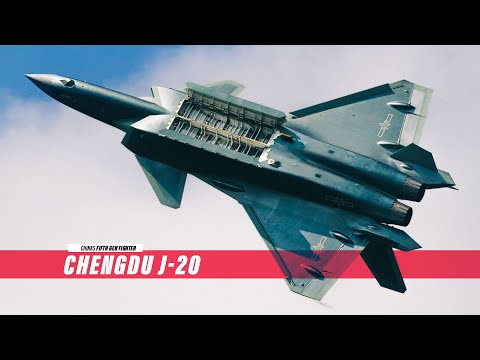
In December 2010, the first prototype underwent high-speed taxi tests, and just three months later, it took to the skies. The pace was staggering. While other nations spent decades refining their stealth fighters, China seemed to be moving at warp speed. By 2016, the J-20 made its public debut at the China International Aviation and Aerospace Exhibition, with eight aircraft already operating at PLAAF bases. The world watched in awe and skepticism.
But the J-20 was not just a copy of the F-22. It was a rapidly evolving platform. By 2017, it was officially in service, and upgrades came thick and fast. The J-20B variant introduced a domestic WS-10 engine, replacing Russian reliance. Then, in 2021, a twin-seat variant, the J-20S, emerged, signaling a shift toward multirole capabilities and drone teaming. This was no longer just an air superiority fighter; it was a networked weapon system.
The production numbers were equally impressive. By 2022, over 150 aircraft had been delivered, and by 2023, production was ramping up to 150 per year. The J-20 was becoming the most rapidly produced fifth-gen fighter outside the F-35 program. This speed raised eyebrows and questions: How had China, once known for cheap knockoffs, managed to build a world-class fighter so quickly?
As the J-20 continues to evolve, with new engines, thrust vectoring, and advanced sensors, one thing is clear: the dragon has awakened. The story of the J-20 is far from over, and the skies are no longer unchallenged.
To understand how the J-20 reached this point, one must look at the engine saga that defined its early years. The Russian AL-31FN provided the initial thrust, but it was always a stopgap. Chinese engineers knew that true independence required a domestic powerplant, and the WS-10 Taihang was their first serious attempt. The early WS-10 variants were plagued by reliability issues, but Chengdu persisted. By the J-20B, the Taihang had matured enough to replace the Russian engines entirely.
Yet the real breakthrough came with the WS-15. This engine, long in development, promised supercruise without afterburners and thrust vectoring that could dramatically enhance agility. When the WS-15 entered production in 2023, it marked the end of China’s dependence on foreign propulsion. For the first time, a Chinese fifth-gen fighter would fly with a fully native engine from nose to tail.
But engines are only one piece of the puzzle. The J-20’s avionics suite represents perhaps its most significant leap. The distributed aperture system—six electro-optical sensors scattered around the airframe—provides the pilot with spherical infrared vision, a capability once exclusive to the F-35. Combine that with the EOD-31 infrared search and track system and the EOTS-86 targeting pod, and the J-20 becomes a sensor fusion powerhouse.
The cockpit itself reflects this philosophy. Four liquid crystal touchscreens dominate the panel, and the pilot wears a helmet-mounted display that queues weapons to wherever the head points. Voice command integration and artificial intelligence assistance have been rumored, though unconfirmed. If true, the J-20 could reduce pilot workload to a degree that even Western analysts find unsettling.
Weapons integration follows the same domestic-first logic. The PL-15 long-range missile, with its dual-pulse motor and active radar seeker, outranges the American AIM-120D. The PL-10 handles close-quarters combat with high off-boresight capability. And the PL-21, a ramjet-powered missile, may extend the J-20’s reach to over 300 kilometers. These are not export-grade weapons; they are designed for peer conflict.
Internal carriage remains the primary mode, with the main bay accommodating four PL-15s and side bays holding single PL-10s each. External hardpoints exist for drop tanks or additional ordnance, but using them transforms the J-20 from a stealth fighter into a bomb truck. The PLAAF understands this trade-off, and stealth remains the default configuration.
The twin-seat J-20S, however, changes the calculus entirely. With a weapon systems officer in the rear seat, the aircraft can manage drone swarms, electronic warfare, and complex sensor networks simultaneously. China’s Dark Sword loyal wingman program is the obvious partner, and GJ-11 stealth drones have been mentioned as potential teammates. The J-20S is not just a trainer; it is a command node for future aerial combat.
Analysts have noted that this mirrors the American concept of manned-unmanned teaming, but with a key difference. China is fielding these capabilities faster and at greater scale. While the U.S. Air Force experiments with Skyborg and collaborative combat aircraft, the PLAAF appears to be integrating drone control into an operational fighter squadron.
What remains unclear is how well these systems work in practice. Chinese media broadcasts show sleek animations of J-20s commanding drone formations, but real-world testing data is classified. The Pentagon’s 2023 report noted ‘significant progress’ but stopped short of declaring the capability combat-ready. Still, the direction is unmistakable.
As production continues and upgrades accumulate, the J-20 is no longer just a Chinese F-22. It is becoming something else entirely—a networked, multirole, drone-controlling stealth platform that reflects Beijing’s vision of future warfare. And with 300 airframes already delivered and 1,000 projected by 2030, the question is no longer whether China can build fifth-gen fighters. The question is what they will do with them.
The answer may lie in how the J-20 is being employed doctrinally. Unlike the F-22, which was designed for solitary air dominance sweeps, the J-20 appears to be woven into a broader kill chain. Chinese military writings describe the J-20 not as a lone wolf but as a ‘node’ in a distributed combat network. Ground-based radars, airborne early warning platforms like the KJ-500, and even satellites feed data to the fighter, allowing it to remain radar-silent while still receiving a god’s-eye view of the battlespace.
This networked approach extends to the aircraft’s electronic warfare suite. Analysts have identified several antennas along the J-20’s fuselage consistent with a comprehensive EW system, capable of jamming and spoofing enemy radars. The J-20 may be able to blind an opponent before ever launching a missile. In exercises, PLAAF pilots have reportedly practiced ’emission control’ tactics—operating for extended periods without radiating, relying entirely on offboard sensor data.
But perhaps the most intriguing development is the integration of artificial intelligence. Chinese defense contractors have publicly discussed AI-assisted decision-making systems for fighter aircraft, and the J-20S’s second seat may be less about flying and more about managing these intelligent assistants. An AI co-pilot could prioritize threats, recommend weapon-target pairings, and even autonomously control drone wingmen. If fielded, this would represent a genuine leap beyond current Western capabilities.
Yet for all its advances, the J-20 still faces unresolved questions. Its stealth characteristics, while improved, are unlikely to match the F-22 or F-35 in all aspects. The canard configuration, while aerodynamically advantageous, complicates radar cross-section management. Chinese engineers have mitigated this with flight control software, but physics cannot be entirely cheated. The aircraft’s large size—over 21 meters—also presents challenges for carrier operations and dispersal across rugged airfields.
Maintenance and readiness rates remain unknown. Rapid production means little if aircraft sit idle waiting for spare parts or engine overhauls. The WS-15, while promising, has not yet demonstrated the longevity of Western engines. Chinese industry has improved dramatically, but sustained high-tempo operations will test whether that improvement translates into reliability under stress.
Pilot training is another variable. The PLAAF has invested heavily in realistic exercises like Red Sword and Golden Helmet, but the J-20 community is still building experience. Western pilots have centuries of combined combat heritage; Chinese J-20 pilots are writing their doctrine from scratch. How quickly they master the aircraft’s complexities will determine its true combat effectiveness.
Then there is the question of export. Unlike the F-35, which has been sold to dozens of allies, the J-20 is unlikely to appear in foreign air forces anytime soon. China guards its crown jewel closely, and the aircraft’s systems are too sensitive for export. Instead, Beijing offers the J-35 to partners, keeping the J-20 as a purely national asset. This limits its geopolitical reach but ensures technological secrecy.
As the program matures, one thing is certain: the J-20 has already changed the strategic calculus in the Indo-Pacific. American planners now must account for a stealth fighter fleet that could number in the hundreds by mid-decade. Allies like Japan and Australia are accelerating their own fifth-gen acquisitions in response. The dragon’s shadow stretches across the region.
And yet, for all the analysis and speculation, the J-20’s ultimate legacy may be less about the aircraft itself and more about what it represents. It is proof that a nation once dismissed as a copier could, within a single generation, master the most complex aerospace engineering on Earth. The factories that once churned out unreliable goods now produce stealth fighters at a pace that rivals the F-35.
Whether the J-20 is truly a match for the F-22 or F-35 in combat remains an open question—one that analysts will debate for years. But the numbers speak for themselves: 300 airframes delivered, 1,000 projected by 2030, and a steady drumbeat of upgrades. No other country outside the United States has fielded fifth-generation fighters at this scale.
As the WS-15 engines mature and the twin-seat J-20S integrates drone swarms, the Mighty Dragon will only grow more capable. The skies above the Pacific are no longer a Western monopoly. The dragon has not just awakened—it has taken flight, and it is learning to hunt in packs.
What do you think—will the J-20 prove to be a true peer competitor, or is its reputation still more hype than substance? Share your thoughts in the comments below.






