Canadians today are stereotyped as polite, hockey-loving, maple syrup enthusiasts. But when the word ‘war’ is uttered, something primal awakens. Their enemies in both World Wars trembled at the mention of Canadian troops, who transformed from gentle civilians into some of the most feared soldiers on any front.
This is the story of that transformation—a tale of savagery, heroism, and the dark side of combat that defined Canada’s wartime legacy.
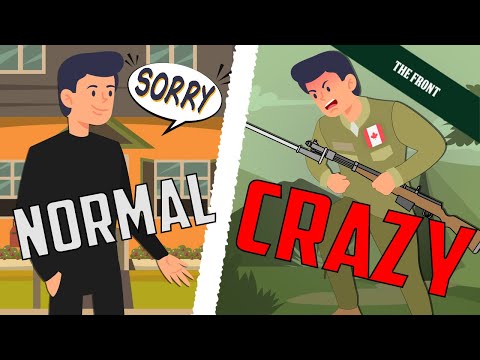
In the First World War, the Canadians earned their reputation as ‘Shock Troopers’ through brutal trench raids. Under the cover of night, with painted faces, they crept through barbed wire and unleashed hell on enemy positions. They took no prisoners and killed the wounded, earning a fearsome reputation that spread through German lines.
Lieutenant R.C. Germaine wrote home after losing half his company: ‘They had the nerve to throw their hands up and cry “Kamerad.” I gave them a foot of cold steel and blew their brains out with my revolver.’ Such was the vengeful fury of the Canadians.
But the Canadians were also innovators. They devised improvised explosives from jam jars and pipe bombs, and used temporary truces—even on Christmas Day—to catch the enemy off guard. Their ferocity was matched only by their cunning.
As World War II loomed, Canada’s involvement was marked by a desire to assert independence from Britain. After declaring war on Germany in September 1939, over a million Canadians would serve, mostly as volunteers. They fought in every major theater, from Hong Kong to Normandy, and their ferocity stood out.
In Italy, the Canadians pioneered ‘mouse-holing’—blowing holes through buildings to avoid enemy fire—and engaged in brutal room-to-room fighting. At Juno Beach, they penetrated further inland than any other Allied force on D-Day. In the Battle of the Scheldt, they suffered over 6,000 casualties to open a vital supply route.
Yet, the Canadians also showed compassion, sharing rations with starving civilians in the Netherlands. This duality—savage in battle, humane in victory—defined their wartime character.
But not all actions were heroic. The burning of Lesotho, Germany, in revenge for a rumored civilian sniper, remains a dark stain. Such atrocities, though rare, remind us that war can bring out the worst in even the most principled soldiers.
Still, the heroism of individual Canadians shines through. Men like Captain Paul Triquet, who inspired his men at Casa Berardi, and Major David Currie, who held off relentless German counter-attacks at Falaise. And then there’s Corporal Leo Major—a one-eyed French Canadian who single-handedly captured 93 Germans and later liberated the city of Zwolle by himself.
These stories of courage and ferocity are what made the Canadians legendary. But what drove them to such extremes? Was it vengeance, duty, or something deeper?
The answer, perhaps, lies in the nature of the men themselves. Many were not professional soldiers but farmers, lumberjacks, and factory workers—men accustomed to hard labor and harsh winters. They brought with them a frontier resilience, a stubborn independence, and a deep-seated loyalty to their comrades. When thrust into the crucible of war, these traits forged a fighting force unlike any other.
Take, for instance, the story of Sergeant Aubrey Cosens of the Queen’s Own Rifles of Canada. On February 25, 1945, during the fight for the Hochwald Gap in Germany, Cosens’ platoon was pinned down by murderous fire from three enemy machine-gun nests. Without hesitation, Cosens dashed forward alone, armed only with a PIAT anti-tank weapon and a Sten gun.
He silenced the first nest with a grenade, then the second. Wounded in the process, he pressed on to the third, killing its crew. But the objective—a farmhouse—still held. Cosens rallied his men, led the assault, and was killed by a sniper’s bullet just as victory was within reach. He was posthumously awarded the Victoria Cross.
Such acts of individual valor were not isolated. They were emblematic of a broader Canadian ethos: a refusal to back down, a willingness to sacrifice everything for the man beside you. This ethos was tested to its limits in the frozen, flooded polders of the Netherlands.
In the final months of the war, the Canadians faced a new kind of hell. The Germans had deliberately flooded the countryside, turning fields into icy lakes. Soldiers fought waist-deep in freezing water, often for days on end, with little sleep and constant shelling. It was here that the Canadian reputation for endurance reached its zenith.
One such soldier was Private Ernest ‘Smokey’ Smith of the Seaforth Highlanders. During the Battle of the Scheldt, Smith’s unit was cut off and surrounded. For three days, he held a vital dyke alone, armed with a Bren gun and a handful of grenades, repelling wave after wave of German infantry. When relief finally came, they found Smith wounded, exhausted, and surrounded by over forty dead enemy soldiers.
Stories like Smith’s spread through the ranks, bolstering morale and cementing the legend. The Germans, already wary of Canadian ferocity, learned to dread the sight of the maple leaf. Prisoners often expressed relief at being captured by Canadians rather than the Soviets, yet they still spoke of Canadian troops with a mixture of respect and fear.
But the war was not without its moral complexities. The killing of prisoners, the burning of towns—these acts haunted some veterans for decades. Many returned home to a country that celebrated their heroism but could not understand the darkness they had witnessed, or the darkness they had become capable of.
Leo Major, the one-eyed hero of Zwolle, rarely spoke of the war in his later years. When asked about his exploits, he would shrug and say he was just doing his job. Yet his actions—capturing 93 Germans single-handedly, liberating a city with nothing but audacity and a Sten gun—spoke to something profound about the Canadian soldier: a willingness to improvise, to take insane risks, and to never, ever give up.
As the war in Europe drew to a close, the Canadians found themselves in the role of liberators. In the Netherlands, they were greeted with tears of joy, flowers, and gratitude that has never faded. The Dutch still remember. Every year, children place flowers on the graves of Canadian soldiers who died to free their country.
It is this legacy—of savagery in battle and compassion in victory—that defines the Canadian soldier. They were not saints, nor were they monsters. They were ordinary men thrust into extraordinary circumstances, who answered the call with a ferocity that shocked the world and a humanity that healed it.
Yet for all the legends that have grown around them, the Canadians were not invincible. The Dieppe Raid of August 19, 1942, stands as a brutal reminder of that. Nearly 5,000 Canadians took part in the assault on the French port, and within hours, more than 900 were dead and nearly 2,000 captured. It was the single bloodiest day in Canadian military history.
The lessons of Dieppe were bitter, but they were not wasted. What the Canadians learned in that slaughter—about naval support, about air cover, about the sheer folly of a frontal assault on a fortified port—shaped the planning for D-Day. The ghosts of Dieppe rode with every soldier who waded ashore at Juno Beach two years later.
And Juno Beach was no easy victory. The Canadians hit the sand at 7:45 that morning, seasick and soaked, into a wall of machine-gun fire from the 716th Infantry Division. The first wave suffered grievous casualties. But the Regina Rifles, the Royal Winnipeg Rifles, the Queen’s Own—they kept moving. They cleared the beach in hours and pushed inland, and by nightfall they had advanced further than any other Allied force.
One tank commander, Sergeant Leo Gariépy of the Sherbrooke Fusiliers, famously drove his Sherman straight through the wall of a German strongpoint and out the other side, guns blazing, before looping back for another pass. His crew called it ‘the mad minute.’ The Germans called it something less polite.
But the fighting that followed in the Norman hedgerows—the bocage—was a different kind of war. Here, the Canadians faced the fanatical 12th SS Panzer Division Hitlerjugend, made up of teenage soldiers indoctrinated to the core. The SS murdered Canadian prisoners in cold blood at the Abbaye d’Ardenne, and the Canadians did not forget.
When the fighting grew close and the stakes were highest, the old First World War instinct returned. There were whispered orders not to take SS prisoners, and more than one Canadian unit was said to have fulfilled those orders without hesitation. The line between justice and vengeance blurred in the Norman mud.
But in the end, the Canadians were not defined by their brutality, but by their resilience. They fought through the bocage, the flooded polders, and the ruined cities, and they never lost their humanity. When the war ended, they went home to build a country, not to relive the horrors they had seen.
The veterans of the Canadian army returned to their farms, their factories, and their families. They rarely spoke of the war, but the war never truly left them. It lived on in the scars they carried, both visible and invisible.
Today, the maple leaf flies over a nation that remembers. The Dutch still send tulips every year, a symbol of gratitude that transcends generations. And in the quiet cemeteries of Europe, row upon row of white headstones mark the price of freedom.
So the next time you see a Canadian, remember: behind the polite smile and the hockey jersey lies a legacy of courage, sacrifice, and a ferocity that once turned the tide of history.
What do you think? Does the Canadian soldier deserve his legendary status, or is it just a story we tell to make sense of war? Share your thoughts in the comments below.






