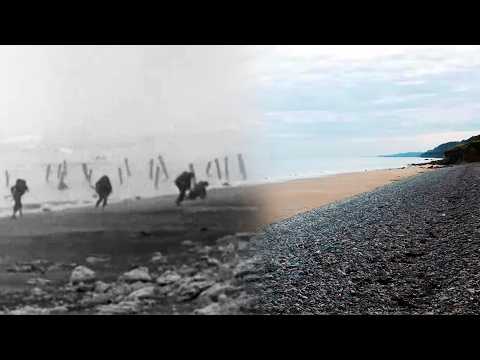
The camera shakes violently as two men fall, cut down by machine gun fire. It’s the morning of June 6, 1944, and Sergeant Richard Taylor of the US Signal Corps is filming the chaos of Omaha Beach. Despite being wounded in the arm, he keeps rolling—capturing the only motion picture footage taken during the assault waves. But what exactly is happening around him? And how did the men in that footage manage to fight their way off D-Day’s deadliest beach?
Omaha Beach was a killing ground. Fifty- to hundred-foot bluffs loomed over four miles of sand, punctuated by sheer cliffs. The Germans had turned the coastline into a fortress, with interlocking strongpoints called Widerstandsneste (WN)—each bristling with machine guns, barbed wire, minefields, and up to fifty defenders. Nine of the fifteen WNs on Omaha clustered around the four main draws, the valleys that offered the only exits from the beach. But there were smaller paths, too—mere footpaths up the escarpment—and one of them, Exit F1, would become the focal point of a desperate struggle.
Just above F1 sat WN60, a crescent-shaped network of trenches and guns commanded by 29-year-old Gefreiter Alfred Eberhardt. Two Belgian 75-mm field guns, two concrete mortar tobruks, and a panzerturm with a French tank turret made it a formidable obstacle. The terrain itself was a defender’s dream: three- to four-meter rock cliffs funneled any attacker into a narrow break, fully exposed to the guns of WN60 and WN61 to the west. No plan had called for a direct assault here—but war rarely follows the script.
The Americans had divided Omaha into sectors, with the eastern half—Easy Red, Fox Green, and Fox Red—assigned to the battle-tested US 1st Infantry Division, the Big Red One. Leading the assault on Fox Green was Company L, 3rd Battalion, 16th Infantry Regiment. Captain John Armellino, a 23-year-old veteran of North Africa and Sicily, commanded the 187 men. His second-in-command was Lieutenant Jimmy Monteith, a Virginian known for his leadership and calm under fire. Their objective: WN61, the strongpoint guarding the eastern half of the Colleville draw, with its powerful 88-mm anti-tank gun.
But from the start, nothing went according to plan. A massive naval bombardment was supposed to soften the defenses, but most shells missed their targets. Smoke and dust obscured the coastline, and landing craft struggled to find their markers. Company L’s boats were delayed and off course. One LCA capsized in the rough seas, drowning eight men before they even reached the beach. When the remaining five boats touched down at 7:00 a.m.—thirty minutes late—they were scattered along Fox Red, some 700 yards east of their intended landing point, directly under the guns of WN60.
Lieutenant Klenk’s boat was hit by artillery fire as soon as it landed. Men were killed outright, and survivors clamored over the dead and wounded to get out. The other boats dropped their ramps into a hail of machine gun fire. Private John Sweeney remembered: “All of a sudden, I got hit by machine gun fire coming from the left front. I was turned completely around. The bazooka I was carrying was full of holes and the life belt I was wearing was taken right off me.” Staff Sergeant Vincent McKinney, the last to leave his sinking LCA, recalled: “I didn’t see a soul. I thought how eerie this was. I could see little puffs coming out of the sand where they were shooting at me.”
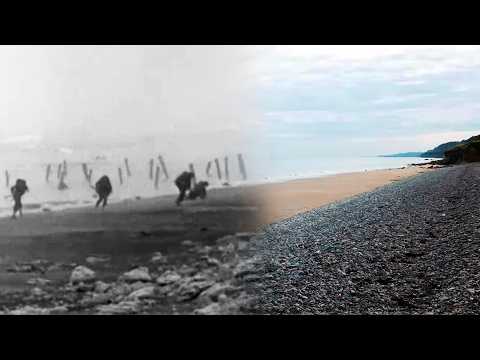
Those who survived the run across the sand reached the base of the cliffs, where they huddled, pinned down by fire from above. Among them were Armellino, Klenk, and Monteith. They knew they couldn’t stay put. Armellino spotted two Sherman tanks—deep-wading models that had made it ashore—and ordered Monteith to make contact. Racing across open ground, Monteith hammered on the turret of the lead tank and pointed out the key targets in WN60. The tanks began to fire, and for a moment, the Americans had a chance.
But the tide was rising, and more troops were being landed into the meat grinder. Command and control was falling apart. Armellino, attempting to establish contact with the tanks himself, was gravely wounded by a mortar fragment that severed an artery in his thigh. Command fell to Lieutenant Cutler, with Monteith and Klenk in support. They decided that the only hope was to push up the F1 draw—a narrow break in the cliffs just 100 yards from WN60’s guns.
Monteith again raced to the tanks, directing their fire onto the strongpoint. Then, with two .30-caliber machine guns providing cover, the men began to climb. It was a slow, terrifying advance, moving from cover to cover under constant fire. Monteith led from the front, stopping frequently to study the terrain and direct the tanks. At one point, he ran back to the beach to further coordinate the fire. The Shermans knocked out the two 75-mm guns that had been shelling the beach all morning.
Yard by yard, the Americans clawed their way up the bluffs. A patrol led by PFC Joseph Liebowitz found itself in a grenade duel with German defenders in WN60’s western trench. Lieutenant Klenk ordered his men to fix bayonets and clear it out. Fifteen Germans, exhausted and outnumbered, surrendered. Meanwhile, survivors of Company L under Cutler forced their way towards the summit, with 17-year-old Private Joe Artensio silencing a machine gun with a well-placed grenade.
By late morning, the leading men of the 16th had passed beyond WN60 and were pushing towards the hamlets of Cabourg and Le Grand Hamel. The fight had been a drawn-out, confusing affair—more a series of individual skirmishes than a coherent battle. But the tide had turned. German counterattacks came, determined to drive the Americans back into the sea, but the GIs held on. In the thick of that final fight was Jimmy Monteith. His Medal of Honor citation would later recall how he repeatedly crossed open terrain under heavy fire to strengthen his defensive line. When the enemy surrounded his unit, he led the fight out of the trap and was killed by enemy fire.
When night fell on the eastern end of Omaha Beach, WN60 and that small patch of ground remained in Allied hands. Today, Jimmy Monteith and 9,387 other US personnel lie buried in the Normandy American Cemetery, just a stone’s throw from WN60, overlooking the beach they helped to take. Not far away, 21,000 German servicemen are buried, including Alfred Eberhard, who commanded WN60 that day. The only surviving footage of the assault waves, shot by Sergeant Richard Taylor, remains a testament to the chaos and courage of that morning. But the story of Omaha Beach is far from over. The men of Company L had breached the Atlantic Wall—but ahead lay the fields of Normandy, and a long, bloody summer.
Yet for the men crouched in the shelter of that narrow draw, the morning’s ordeal was already reshaping them in ways no training had prepared them for. Sergeant Taylor’s camera had captured only a sliver of the truth. The footage shows men falling, but it cannot show the hours of terror that followed—the slow, grinding climb, the grenades tossed at close range, the whispered orders to fix bayonets.
What the film also fails to convey is the sheer confusion of the German defense. Gefreiter Alfred Eberhardt, the acting commander of WN60, had never expected his position to be assaulted directly. The cliffs below his guns were supposed to make that impossible. His orders had been to pour enfilade fire along the beach, not to fight off infantry climbing his own bluff. When the first Americans appeared in the draw, his men were caught off guard.
By the time Klenk’s bayonet charge cleared the western trench, Eberhardt’s garrison was already fracturing. Fifteen men surrendered in that first rush. Others slipped away through the communication trenches, falling back toward the rear of the position. But the fight was far from finished. The panzerturm—the concrete tobruk topped with its French tank turret—still commanded the crest, and its machine gun continued to sweep the approach.
It was here that the Shermans proved decisive. From their position on the shingle, the two tanks lobbed 75-mm rounds directly into the German emplacements. The panzerturm was struck and silenced. The fire control bunker, built into the crest to direct artillery from inland batteries, was hit next. With their communications cut and their guns knocked out one by one, the remaining defenders of WN60 began to break.
But the cost had been staggering. Company L had landed with 187 men. By the time the bluffs were secure, fewer than half were still standing. Some were dead. Others were wounded, lying in the sand or along the draw, waiting for medics who were themselves pinned down by fire. The survivors were exhausted, their uniforms soaked with seawater and blood, their ammunition running low.
And still the Germans counterattacked. Just after midday, a determined push came from the direction of Cabourg. Grenadiers of Regiment 726, supported by mortars, tried to retake the high ground. The Americans—now reinforced by elements of Company K and the newly arrived M Company—held. Monteith was everywhere, moving from foxhole to foxhole, redistributing ammunition, directing fire, steadying shaken men.
His Medal of Honor citation would later state that he repeatedly crossed two to three hundred yards of open terrain under heavy fire. That afternoon, those crossings were made under the eyes of men who had already seen too much death. They watched him go, time and again, and they followed him because he asked them to.
By evening, the position was secure. WN60 had fallen. The F1 draw was open. But the men who held it knew the truth: they had won a foothold, not a victory. Beyond the bluffs lay the hedgerows and fields of Normandy, where the fighting would grind on for weeks. And behind them, on the beach, the tide had long since covered the bodies of those who had fallen in the first waves.
As dusk settled, Sergeant Richard Taylor—his arm still bandaged—climbed back down toward the shingle to retrieve his camera. He had filmed the chaos, the falling men, the desperate crawl up the draw. But he had also seen what the lens could never hold: the way a wounded man pulled himself forward anyway, the way strangers became brothers in the space of a few yards.
Decades later, historians would freeze those frames and argue over exact positions. But the men who were there never needed the film to remember. They carried the morning in their bones—the smell of cordite, the taste of salt and fear, the sound of Monteith’s voice cutting through the din.
Today, the bluffs above Omaha are quiet. The concrete bunkers of WN60 still stand, cracked and overgrown, overlooking a beach where families now walk at low tide. And somewhere in the archives, a reel of shaky black-and-white film still runs—two men falling, a camera rolling, a story refusing to end.
What do you think the men of Company L would want us to remember most about that morning—the horror they endured, or the courage that carried them up the draw?






