Major Coleman had seen plenty of disgrace in his career, but nothing prepared him for the sight that greeted him at Nui Dat base in March 1969. Five men stood before him, their uniforms so tattered they looked like they’d been dragged through a swamp—which, in fact, they had. Their skin was caked in layers of mud and something that smelled suspiciously like rotting fish. Coleman, a West Point graduate who believed hygiene was next to godliness, barely suppressed a gag. He pulled out his notebook and wrote a single word: amateurs.
He couldn’t have been more wrong. These five Australians were the most lethal predators in the Vietnam jungle, and that unbearable stench was the only thing that would save his life. In 72 hours, they would make him burn with shame and rewrite special forces history forever.
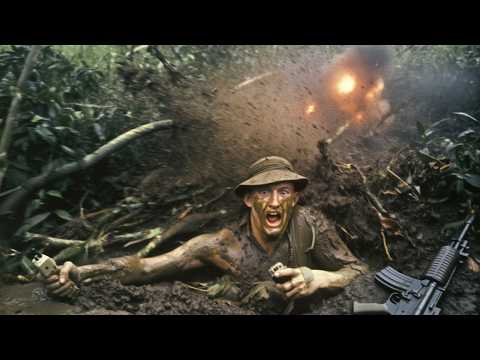
To understand the catastrophe unfolding in Phuoc Tuy Province, you first had to grasp the colossal arrogance of the American war machine. The Pentagon’s doctrine stood on three pillars: overwhelming firepower, helicopter mobility, and technological superiority. When a patrol made contact, they retreated, called in air support, and incinerated the grid square. It had worked in Korea. It would crush Vietnam.
But the Viet Cong had rewritten the rules. Their counter-doctrine was called “grabbing them by the belt buckle.” When Americans opened fire, the Viet Cong charged—closing to 20 meters, then 10. At that range, American air power was useless. Pilots couldn’t drop payloads without killing their own troops. By 1967, close-contact casualty rates had skyrocketed by 40%. The enemy had turned America’s greatest advantage into a fatal weakness.
Worse still, the Americans couldn’t even find the enemy. The 274th Viet Cong Regiment—over 1,000 hardened fighters—had operated with impunity for two years. Every search-and-destroy mission returned with nothing but bug bites. The triple-canopy jungle blocked sunlight and hid entire armies. Tunnels allowed the enemy to move underground for kilometers. Thermal imagers, motion sensors, chemical detectors—all useless in this primitive hell of vines and rotting vegetation.
Desperate, the command called in the Australians. Not because they believed in their methods, but because every other method had failed. The Australian contingent was small—only 8,000 men at its peak—but within it existed a unit shrouded in unsettling rumors: the Special Air Service Regiment. Their statistics were shocking. From 1966 to 1971, SASR patrols conducted over 1,200 deep-recon operations. For every Australian lost, they eliminated between 50 and 70 enemy combatants—five to seven times more lethal than American special forces. And they achieved this without heavy air support.
But the most astonishing fact was their supernatural ability to see everything. They returned with exact coordinates of hidden bases, supply routes, guard schedules. They seemed to look right through the jungle canopy. Major Coleman was sent to uncover the mystery, expecting high-tech equipment. Instead, he found men who looked like vagrants.
What he witnessed on his first day solidified his skepticism. Sergeant Terry O’Brien wasn’t inspecting boot polish—he was checking compliance with a protocol called “the unwash.” Each soldier had ceased all Western hygiene products three days before deployment. No soap. No shampoo. No deodorant. Instead, they coated their skin and uniforms with a paste of river mud, crushed rotting leaves, and nuoc mam—fermented fish sauce that smelled like death itself.
Coleman barely suppressed a laugh. “Why is your elite unit playing in the mud like children?” he asked. O’Brien’s answer was calm and devastating. The human nose is a survival tool, and Viet Cong trackers were masters of using it. American soldiers were walking beacons of olfactory information. The standard-issue soap had a sharp chemical scent that didn’t exist in nature. Marlboro smoke had a sweet aroma completely different from local tobacco. Even American sweat—rich in red meat, processed sugar, and dairy—had a distinct chemical composition. To a tracker 300 meters away, an American patrol screamed its presence through the wind.
Coleman wrote it down but marked the procedure as “unnecessary.” He was convinced the real secret lay in classified technology. The idea that the most powerful military in history was losing because of bath soap sounded like a fairy tale.
The next shock came when he examined their equipment—or rather, what they’d left behind. An American patrol carried 40 to 50 kilograms per man: M16, pistol, grenades, claymores, extra magazines, heavy radio, medical kit, rations. They were walking tanks. The Australians looked like they were going for a hike. Their philosophy was ruthless: every gram was a liability. They carried sawed-off L1A1 rifles, stripped of flash suppressors and carrying handles. They used soft plastic bladders instead of metal canteens—no clinking sounds. They even cut slits in their boots to let water drain out, preventing trench foot.
O’Brien offered Coleman a simple test: walk 100 meters through camp in standard American gear while the Australians listened with their backs turned. Coleman accepted confidently. He hadn’t covered 30 meters when O’Brien stopped him. They had counted 27 distinct unnatural sounds—metal buckles scraping, nylon trousers swishing, boots thudding, dog tags clinking. “27 sounds is a death sentence,” O’Brien said. A Viet Cong sentry could identify that signature from 150 meters away. The Australians moved in silence because they carried nothing that could make a sound.
For the first time, Coleman’s confidence cracked. These men weren’t amateurs. They were professionals of a game he didn’t even know he was playing.
But the most terrifying weapon wasn’t equipment. It was a man: Billy Nungara, a tracker from the Yanichara people of central Australia. The US Army had trackers—South Vietnamese scouts who learned to spot broken twigs. Nungara moved with his eyes half-closed, feeling the earth. “16 men moving northwest. Passed here four hours ago. Two carrying heavy loads. One limping on his right leg.” When instructors checked the records, he was right about everything. His ancestors had honed these skills for 40,000 years. The Viet Cong could fool thermal sensors and sniffer dogs, but they had no defense against a human radar who could hear heartbeats through the soles of his feet.
Coleman realized he was standing in the presence of a predator who played by rules the Pentagon didn’t know existed. But the real test was yet to come—and it would push his sanity to the breaking point.
Two days later, the theory ended and the nightmare began. Patrol Sierra Two, led by Sergeant O’Brien, received its orders: locate the forward base of the elusive 274th Viet Cong Regiment in Sector Charlie Seven Bravo and transmit coordinates for an artillery strike. An American commander would have planned a helicopter assault—quick insertion, rapid search, immediate extraction, all wrapped up in six to eight hours. The Australians intended to stay in the jungle for ten full days.
They would infiltrate forty kilometers deep into enemy territory, far beyond quick extraction range. Their drop zone was deliberately chosen twenty kilometers from the target so the enemy would never connect the sound of a helicopter with their destination. When Coleman saw the operational map, he thought he was looking at a suicide note. Five men, light rifles only, no heavy support weapons, walking into the backyard of a thousand enemy soldiers. No air cover. No armored backup. No retreat.
Coleman couldn’t stay silent. He told the squadron commander this wasn’t reconnaissance—it was a death sentence. The commander looked at him with a gaze both weary and pitying. “While you Americans spend all your time hunting for the enemy,” he said, “we’ve learned it’s much more effective to let the enemy find us.” The words sounded like gibberish. Coleman had no idea that in seventy-two hours he would see exactly what they meant.
The first three days passed in a silence that was almost deafening. O’Brien’s patrol moved at a pace that would have seemed agonizingly slow to any American—barely three kilometers a day. They moved only under cover of darkness, creeping forward for fifteen to twenty minutes before freezing for a full hour to listen to the breathing of the forest. During daylight they lay motionless in foxholes, natural depressions painstakingly camouflaged with local vegetation. Radio contact was kept to two short bursts of coded static every twenty-four hours.
Signs of the enemy were everywhere—old campfires, cut vines, well-worn trails marked by the distinctive tread of Ho Chi Minh sandals. But on the fourth day, the game changed. Billy Nungara stopped dead and pointed to a patch of disturbed earth invisible to everyone else. The track was fresh, made less than six hours ago, but the person who made it was moving strangely—walking backward, placing his heel first to create the illusion he was moving in the opposite direction. This was no clumsy peasant. This was a professional Viet Cong tracker.
The Australians instantly realized the grim truth: they were being hunted by someone just as skilled as they were. Sergeant O’Brien made a decision Coleman would have classified as pure insanity. Instead of retreating or calling for emergency extraction, he ordered the patrol to continue deeper into enemy territory. But now he gave a new, terrifying order: leave traces. Not clumsy, obvious signs that would look like a trap—subtle imperfections. A broken twig here, a slightly crushed patch of grass there, just enough for an expert eye to find. The patrol was deliberately transforming itself from hunter into bait.
But this was no ordinary bait. It was the setup for a lethal trap known as “the anvil.” The plan was audacious: allow the enemy to track them, lure the pursuing force into a specific geographical kill zone, then unleash an artillery barrage so intense nothing inside the perimeter could survive. The only problem was that the nearest friendly artillery battery was thirty kilometers away through dense jungle. Standard American field guns at that range had a margin of error of fifty to seventy meters—any shell fired had an equal chance of obliterating the Australians along with the Viet Cong.
But the Australians had an ace up their sleeve: the 161st Battery of the Royal New Zealand Artillery. These gunners, known affectionately as “the Kiwis,” were legends among the SASR for their supernatural precision. They specialized in danger-close fire missions, dropping high explosives dangerously close to their own troops. Their accuracy allowed them to place shells within twenty-five meters of a target. In practice, this meant the patrol could call down fire literally on top of their own position and survive—provided they were dug in deep enough. But this required absolute blind trust. Five men in the mud had to believe a gunner thirty kilometers away wouldn’t sneeze while aiming. Americans didn’t operate on trust. Their doctrine required a minimum safety distance of three hundred meters. Anything closer was considered suicide. The Australians didn’t ask for permission. They just did it.
On the fifth day, a Viet Cong scout emerged silently from the undergrowth, moving ahead of the main force. He stopped less than a meter from where O’Brien lay buried under leaves and mud. Then he flared his nostrils and sniffed the air. This was the moment of truth for the unwash. If O’Brien had used a single drop of American soap, he would be dead in the next second. But all the scout smelled was damp earth and the faint, pungent odor of fermented fish sauce—a smell as natural to Vietnam as the rain itself. Satisfied, the scout melted back into the shadows.
By the sixth day, the trap was set. A reinforced company of over one hundred Viet Cong was moving to encircle the hill. Then disaster struck: the radio died, its contacts corroded by humidity. With the enemy less than two hundred meters away, the radio operator scraped the battery terminals with his knife until static hissed back to life. When the first wave hit the fifty-meter mark, twenty claymore mines detonated at once. The survivors charged again, closing to twenty meters—and then the radio man screamed two words: “Fire mission.”
Thirty kilometers south, the New Zealand gunners pulled their lanyards. Forty-five seconds of eternity passed. Then the sky fell. For ten minutes the Kiwis walked their fire back and forth, churning the jungle into a wasteland. When the smoke cleared, seventy-three enemy soldiers lay motionless. The Australians emerged shaken but alive—and followed the retreating survivors straight to the 274th’s main base, which was obliterated by air strikes the next morning.
On the tarmac, Coleman stared at the five filthy men and felt his West Point certainties crumble. He extended his hand. “I was a fool,” he said. “Calling you amateurs was the biggest mistake of my career.” O’Brien simply nodded and walked toward the showers.
Years later, Coleman’s buried report resurfaced—and became the foundation of Delta Force. So tell me: what outdated assumption are you still clinging to?






