Friedrich Jeckeln stood in the courtyard of a former officer’s house in Riga on the 3rd of February, 1946. A noose hung above him. Beneath his boots, a wooden platform. In front of him, a crowd of more than 4,000 people. Many of them were survivors. Many of them had lost their entire families because of decisions this man had made. Some had stood in the very pits he was about to be sent to. And only luck had kept them alive when the bullets came.
The man who had organized the murder of more than 100,000 Jews, Roma, Slavs, and Soviet prisoners stood waiting to die in the city where he had run his killing machine. And the resistance that put him there was made of survivors, partisans, and Red Army investigators who had spent months building the case against him.
His name was Friedrich August Jeckeln. He had served in the First World War as an artillery officer and a pilot trainee. He had been wounded. He had won the Iron Cross. Then he had joined the Nazi Party in 1929 and entered the SS in early 1931. By the time the Second World War began, he was an SS-Obergruppenführer. He commanded the higher SS and police forces in the occupied Soviet Union. And he had developed something he called the Jeckeln system.
Here is how the Jeckeln system worked. SD men dragged victims out of their houses. The victims, almost always Jews, were forced into columns of 500 to 1,000 people. Order police marched them 10 km to pits that had been dug in advance. The victims were stripped of clothing and valuables. They were forced to run through a double cordon of armed guards. Then they were forced to lie face down in the trench, often on top of the bodies of the people who had been shot just minutes before. The Germans called it Sardinenpackung. Sardine packing. 12 shooters did the killing. One bullet per person.
Jeckeln used this system at Kamianets-Podilskyi in August 1941: 23,600 people died in 2 days. He used it at Babi Yar outside Kiev in late September 1941. 33,771 Jews died in 2 days. Then Heinrich Himmler grew frustrated with the slower pace of killing in the Baltic states. He pulled Jeckeln out of Ukraine and dropped him into Riga with one order: Finish the Jews of Latvia.
Jeckeln arrived on the 15th of November 1941. He drove the area himself looking for a site. He needed elevated ground because the water table around Riga was too high to bury thousands of bodies properly. He needed sandy soil. He needed something close to the ghetto so the victims could walk there. He drove south one afternoon toward a half-built concentration camp at Salaspils. And along the way he saw it: a pine forest near a village called Rumbula. Raised ground, sandy soil. About 10 km from the Riga ghetto. Perfect.
On the 30th of November 1941, Jeckeln stood at the edge of those pits and watched as roughly 13,000 Latvian Jews were marched into the forest, stripped of everything they owned, and shot. On the 8th of December, he watched another 11,000 die the same way. 1,000 more victims were German Jews who had arrived by train from Berlin and other cities. About 25,000 people killed in 2 days. Only three are known to have survived by hiding under the corpses or under the heaps of shoes the killers piled up.
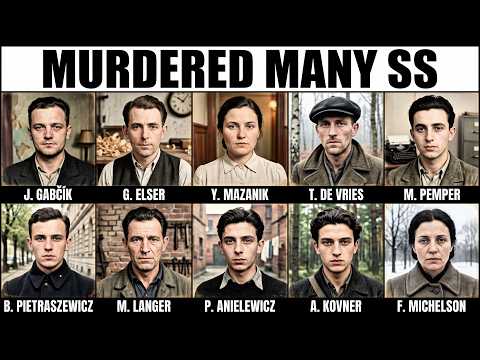
One of those survivors was a woman named Frieda Michelson. She lay frozen and barely breathing under a mountain of footwear that had been stripped from the doomed. She heard a child cry out for its mother. She heard a few shots, then silence, then more silence. She survived to testify.
Jeckeln did not just run killings; he ran anti-partisan operations across Belarus that depopulated entire regions. Operation Swamp Fever in August and September 1942. Operation Winter Magic in February and March 1943. Villages burned, civilians shot or deported as slave labor. More than 10,000 people taken from their homes during Winter Magic alone. Jeckeln approached each of these operations as engineering problems, mathematics of murder. He had been awarded the War Merit Cross First Class with Swords in January 1942, specifically for the Rumbula killings. The citation said he had done it on orders from the highest level.
When the war ended, Jeckeln did not escape. Soviet troops captured him near Halbe, outside Berlin, on the 28th of April 1945. They knew exactly who they had. They moved him to Latvia, the territory of his worst crimes. From the 26th of January 1946 to the 3rd of February 1946, he stood trial in a Soviet military tribunal in Riga along with seven other German officers. They were charged with war crimes committed during the German-Soviet War.
The prosecutors had something the Nuremberg trials sometimes lacked. They had Jeckeln on the record. They had survivors, they had documents, and they had Jeckeln himself, who in his last words before the court did not bother to deny anything. He admitted his guilt. He agreed to bear full responsibility for the actions of the police, the SS, and the SD across the entire Ostland region. He described Rumbula at his trial with the detachment of a clerk reporting on a delivery. He confirmed that 10 or 12 SD soldiers had done the shooting. He confirmed that the Jews had been forced to walk on foot from the Riga Ghetto to the pits. He confirmed that the victims had been stripped of clothing that was washed, sorted, and shipped back to Germany.
All eight defendants were sentenced to death. Seven of them, including Jeckeln, were taken straight from the courtroom to a public square. The eighth, Wolfgang von Ditfurth, had a weak heart and was sent back to prison instead. He died of heart failure a few weeks later. The other seven were hanged in front of the crowd.
Friedrich Jeckeln died on the 3rd of February, 1946. One day after his 51st birthday, in the city where he had run the killing pits at Rumbula. The resistance against him was not a single dramatic ambush. It was something harder and slower. It was Frida Michelson surviving. It was Soviet partisans collecting evidence in the forests. It was Jewish survivors who refused to disappear and who showed up at the trial to look him in the eye. It was investigators piecing together documents that proved exactly which orders he had signed and which units he had commanded. It was the entire weight of memory pressing down on a man who had spent four years convinced he was untouchable.
When the trapdoor opened beneath his boots in Riga, the people who put him there were the people he had spent the war trying to erase. They had outlived him. That alone was a kind of victory.
Number nine. He was a poet. That is the first thing to understand about Abba Kovner. He was a 23-year-old art student who wrote verse in Hebrew and Yiddish and walked the streets of Vilna with notebooks in his coat pockets. He was small, thin, with dark, intense eyes that made people listen when he spoke.
The Germans called Vilna the Jerusalem of Europe before they destroyed it. They marched into Lithuania in June 1941 with Operation Barbarossa. And within months, 40,000 of the city’s 70,000 Jews were dead. Most had been taken to a pine forest outside the city called Ponary. They had been forced to undress. They had been shot.
Most Jews in the Vilna Ghetto did not know what Ponary was. They believed the Germans when they were told relatives had been resettled. Mothers waved goodbye to children and assumed they would meet again. Husbands kissed wives. They told each other letters would come. No letters came. But because no one inside the ghetto had a complete picture of what was happening, the truth refused to settle into people’s minds.
Abba Kovner had heard rumors and had pieced them together. By December of 1941, he understood. And he did something almost no one else did at that moment in history. He named it.
On the 31st of December 1941, in a soup kitchen in the Vilna Ghetto, Kovner stood up and read out a manifesto. Some accounts say he wrote it himself. Some say it was a group effort. Either way, he was the voice that delivered it. The manifesto told the Jews of Vilna that their relatives had not been resettled. They had been shot at Ponary. The manifesto told them that what was happening in Vilna was not a local horror. Hitler had decided to kill every Jew in Europe.
And then came the phrase that would echo across every ghetto in Eastern Europe for the rest of the war. Let us not go like sheep to the slaughter.
It was the first time anywhere in occupied Europe that a target of the Holocaust had publicly identified the German plan for what it actually was. The total murder of the Jewish people. Couriers, mostly young women in the youth movements, smuggled the message from Vilna to Warsaw, to Bialystok, to dozens of ghettos. The Warsaw Ghetto uprising months later would carry echoes of Kovner’s words. The phrase became a kind of password for those who refused to walk quietly toward the pits.
Three weeks after the manifesto, on the 21st of January, 1942, Kovner and others formed the Fareynikte Partizaner Organizatsye, the United Partisan Organization, the FPO. It was the first armed Jewish resistance organization in any ghetto in Nazi-occupied Europe. Its first commander was a communist named Yitzhak Wittenberg. Kovner served alongside him.
Their goal was simple: build an army inside the wire, smuggle weapons, train fighters, sabotage German operations, and when the Germans came to liquidate the ghetto, fight. The FPO worked in cells, five fighters per unit. Each cell drew members from across the political spectrum: Zionists, Bundists, Revisionists, Communists. People who would have argued in cafes before the war now built bombs together in attics.
The young woman Vitka Kempner, who would later marry Kovner, carried out the FPO’s first sabotage. She smuggled a homemade bomb out of the ghetto and blew up a German train line outside Vilna. The Germans did not even suspect that ghetto Jews were responsible. Organized Jewish armed resistance simply did not exist in their imagination yet.
The FPO smuggled weapons through the sewers. They smuggled weapons inside false-bottom coffins. They printed underground newspapers. They trained fighters in attics and cellars. They watched the city’s collaborators and made notes. They began to take their own quiet justice on traitors who had betrayed Jews to the Germans. Through the spring and summer of 1943, they prepared for the moment when the Germans would come.
That moment almost arrived in July 1943. The Gestapo discovered Wittenberg’s identity through a tortured prisoner. They demanded the head of the Judenrat, Jacob Gens, hand him over or they would liquidate the ghetto. Gens called Wittenberg to a meeting and arrested him there. FPO fighters rescued Wittenberg in the street. The Gestapo responded by threatening to kill every Jew in the ghetto. Gens went to the FPO and begged. Many of the ghetto’s residents, terrified, also pressured Wittenberg to surrender himself to save the ghetto. He did.
Before he walked out the gate, he named Abba Kovner as his successor as commander of the FPO. Wittenberg was tortured by the Gestapo and found dead the next morning. He had bitten down on a cyanide capsule Kovner had personally pressed into his hand.
Kovner now led the FPO. He spent the next 2 months trying to convince the Jews of Vilna to rise up with him when the Germans came. Most refused. They were too tired, too frightened, too convinced that resistance would only speed the destruction.
On the 23rd of September 1943, the Germans began the final liquidation of the Vilna ghetto. The popular uprising Kovner had hoped for did not happen. 12,000 Jews walked out of the ghetto and were deported to camps in Estonia and Latvia, where most were eventually murdered. The FPO had a backup plan. Kovner led the fighters through the sewers, under the streets of Vilna, and out into the forests beyond the city. They reached the Rudniki Forest. There they joined Soviet partisan brigades and formed four predominantly Jewish units. The Avengers. To victory. Death to fascism.
In the fight, Kovner commanded the Avengers along with Vitka Kempner and Roschka Korczak. From September 1943 until July 1944, the Avengers fought a guerrilla war from the forests. They destroyed more than 180 miles of train track. They blew up five bridges. They derailed 40 German trains carrying troops, weapons, and supplies for the front. They ambushed German patrols and convoys. They killed an estimated 212 enemy soldiers, including SS personnel. They rescued at least 71 Jews from hiding places and ghettos and farms across the region and brought them safely into the forest.
Kovner refused to be absorbed into Russian or Lithuanian partisan formations. He insisted that Jews must fight as Jews. He insisted that the units carry Jewish names, Jewish symbols, Jewish identity. He believed something that would shape Jewish history for generations afterward. Jews could regain their self-respect through fighting. He would not bury that belief in someone else’s uniform.
When the Red Army returned to Vilna on the 7th of July 1944, the Avengers were with them. They liberated their own city. They walked through streets where their families had been rounded up. They visited Ponary. They counted what was left. Of the 70,000 Jews of Vilna before the war, fewer than 3,000 survived. The Avengers were among them.
After the war, Kovner went further than any other partisan leader. He formed a secret organization called Nakam, vengeance. Its goal was to kill 6 million Germans in retaliation. Plan A involved poisoning the water supplies of Hamburg, Frankfurt, Munich, and Nuremberg. Plan B was to poison bread destined for SS prisoners in Allied POW camps.
Kovner traveled to Mandate Palestine to obtain poison from the Haganah. He sailed back toward Europe with the poison hidden aboard. British authorities arrested him before he reached land. The water poisoning plan died with that arrest. The bread poisoning plan went ahead in the spring of 1946 in a POW camp near Nuremberg. Accounts of casualties vary. Some say hundreds of SS prisoners fell ill. Some accounts say no. One died. The exact number remains contested.
Kovner married Vitka Kempner in 1946. They settled in Kibbutz Ein HaHoresh. He fought in the Israeli War of Independence in 1948. He became one of the most important Hebrew poets of his generation. He won the Israel Prize for literature in 1970. He testified at the trial of Adolf Eichmann in 1961. He died in 1987.
The young poet who had stood up in a Vilnius soup kitchen and named the Holocaust before most of the world knew the word lived long enough to see the state of Israel exist. The Vilnius Ghetto did not. The Ponary Forest is still there.
Which of these acts of resistance do you think history has forgotten most — and why?






