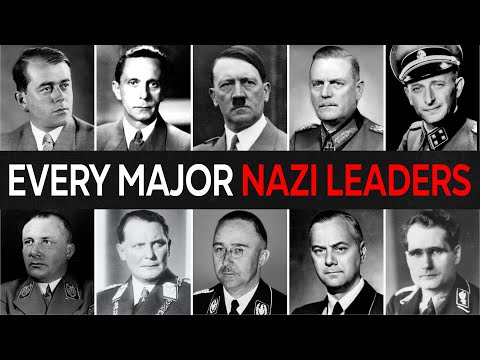
What happens when a government becomes a machine and every cog is a willing man? Behind Hitler’s myth stood 31 architects of control, cruelty, and calculation. Not monsters in the shadows, but ministers, governors, generals, and secretaries. Men who turned genocide into governance. Some wore medals. Some wore suits. All left fingerprints on the system. This isn’t about madness. It’s about structure and the men who built it.
Welcome to the anatomy of power, every major Nazi leader explained.
One, Adolf Hitler. It always starts with a man who talks too much and listens too little. For Adolf Hitler, that was a feature, not a bug. A failed artist with a god complex, he stumbled his way into power by mixing wounded nationalism with pseudo-mystical race theories and just enough theatricality to fill a stadium. He didn’t invent the hatreds he exploited. He simply professionalized them. Hitler centralized authority so completely that entire genocides were conducted with vague nods and rhetorical flourishes. No direct memo required. His power wasn’t just political. It was gravitational. Ministers, generals, and technocrats orbited him not out of loyalty, but because proximity to him meant power, and distance meant irrelevance. He built a regime where initiative and cruelty was the currency of promotion and moral collapse was the job description. And when the house of cards finally burned, he folded himself into the wreckage. Unaccounted for but never absolved. Yet for all his theatrical centrality, Hitler wasn’t the only architect. His inner circle didn’t just follow orders. They rehearsed them in advance.
Two, Herman Göring. If Hitler was the messianic illusionist, Herman Göring was the opportunistic showman who understood that style could be mistaken for substance and often was. A decorated WWI ace turned political predator, Göring slid into power on charisma, ambition, and a well-fed stomach. His tailored uniforms grew more extravagant as his waistline did. But behind the vanity was a ruthless power broker. Göring was instrumental in creating the Gestapo, directing the four-year plan, and supervising early Jewish persecution. He called dibs on plundered art while directing the machinery that made plundering possible. He saw state terror as logistics, not tragedy. By the time he was named Reich’s Marshall, his influence was waning, but not his sense of entitlement. At Nuremberg, he styled himself as the clever villain who lost the war, not the architect of state-organized misery. The irony? For a man obsessed with appearances, he died behind bars, denied even the stage for his final act. And yet, in the shadows of his fall, another voice was still whispering fire into the public mind.
Three, Joseph Goebbels. Joseph Goebbels understood something few others did. Reality was negotiable, but narrative was sacred. As propaganda minister, he didn’t just sell the lies. He choreographed them. Every film, radio broadcast, and school book carried the fingerprints of his manic precision. Goebbels weaponized despair and hope alike, turning defeat into martyrdom and cruelty into duty. He didn’t just mask the regime’s crimes. He made the public complicit in celebrating them. Brilliant, bitter, and inexhaustibly ideological, he turned language itself into an accomplice. His Berlin was a stage, his speeches a form of spell-casting, and when the curtain fell, he chose to vanish into the flames with his illusions intact. But like any good storyteller, he left a final trick. A culture so warped by narrative, it couldn’t always tell the difference between fact and belief. Still, for all his rhetorical grip, Goebbels never controlled the palace. The man just outside the spotlight, the trusted deputy, once stood a heartbeat from Hitler and then fell off the edge of history with a thud.
Four, Rudolf Hess. Rudolf Hess was the kind of loyalist every dictator dreams of until he became the kind of embarrassment every regime tries to forget. As Hitler’s deputy Führer, Hess helped steer the early Nazi apparatus, overseeing party appointments and internal decrees. He wasn’t flashy, but in the bureaucratic bloodbath of Nazi politics, loyalty sometimes beat cunning until it didn’t. In 1941, Hess boarded a plane and flew solo to Scotland in a bizarre, unauthorized attempt to broker peace with Britain. Why? Historians still disagree. Delusion, desperation, or private diplomacy. What’s clear is that Hitler was furious and publicly humiliated. Hess was arrested and vanished into Allied custody, never again touching the levers of power. Yet, despite his marginalization, he remained a symbolic ghost of the regime. A man who had stood next to Hitler, only to vanish midwar into a prison cell and eventually historical irrelevance. But while Hess drifted into obscurity, another man was silently rising within Hitler’s shadow, gaining control not by flying planes, but by guarding doors.
Five, Martin Bormann. Martin Bormann didn’t give speeches. He didn’t wear dramatic uniforms. He rarely appeared in photographs. And yet, by the end of the war, his signature could decide the future of any Nazi official. As head of the party chancellory and Hitler’s personal gatekeeper, Bormann mastered the art of power by proximity. He controlled who got facetime with the Führer, shaped party appointments, and filtered information flowing both in and out of Hitler’s bunker. No ideology, just pure access. Bormann’s genius wasn’t in strategy or charisma. It was in becoming indispensable. As others jockeyed for the spotlight, he became the pipeline through which influence flowed. By 1945, he was arguably more powerful than most ministers without ever needing public acclaim. Then he disappeared into the ruins of Berlin, his death unconfirmed for decades, an appropriate end for someone who thrived on invisibility. But outside Bormann’s corridors of influence, another man was dealing in foreign policy with blunt instruments and broken treaties.
Six, Joachim von Ribbentrop. Joachim von Ribbentrop entered Nazi politics with expensive suits, fluent French, and a delusion of diplomacy. He fancied himself a global strategist, but mostly served as Hitler’s international yes-man. As foreign minister, Ribbentrop was instrumental in negotiating the Molotov-Ribbentrop Pact, which bought time for Hitler’s invasions and sealed Poland’s fate. He didn’t craft ideology. He facilitated it, turning backroom agreements into green lights for aggression. Diplomacy under Ribbentrop wasn’t about peace. It was about rearranging the map under a veneer of legitimacy. He treated treaties like stage props. Useful, disposable, and often sabotaged by the next act. Despite his eagerness, even Hitler came to view him as a pompous lightweight, but by then the damage had been done. At Nuremberg, Ribbentrop tried to claim he was just a diplomat. The court disagreed. He died not as a statesman, but as a functionary of destruction. Still, while he spoke for the Reich abroad, another official was reshaping it from within by turning laws into instruments of repression.
Seven, Wilhelm Frick. Wilhelm Frick looked like the kind of man who might quietly ruin your life and then file the paperwork. As Reich Minister of the Interior, he didn’t rant on balconies or design uniforms. He wrote laws, lots of them. Frick was a crucial figure in transforming Weimar Germany into the Nazi state, not with tanks, but with regulations. He coordinated the purge of democratic institutions, oversaw civil service reorganization, and helped codify racial policy into the legal bloodstream of the Reich. His genius, if you can call it that, was bureaucratic weaponization. He gave the regime’s terror a bureaucratic face, one that looked disturbingly like your average office manager. Even after he was sidelined from the interior ministry, he resurfaced as protector of Bohemia and Moravia, overseeing occupation policy with the same cold precision. At Nuremberg, his defense was predictably dull, just following orders, just doing his job. But history doesn’t always care about tone. And speaking of tone, the man responsible for coordinating the Reich’s administrative tempo is up next. A man whose desk controlled the rhythm of dictatorship.
Eight, Hans Lammers. Hans Lammers was what you’d get if you combined a filing cabinet with blind obedience. As head of the Reich Chancellery, he wasn’t the face of Nazi power, but he was its nervous system. Every law, decree, and Führer directive passed through his office. He didn’t make the decisions, but he made sure they happened and that no one could claim they hadn’t. Lammers wasn’t an ideologue. He was a lubricant for tyranny. His job was to smooth the gears, to ensure that Hitler’s chaotic overlapping commands translated into action across the Reich’s sprawling bureaucracy. He was one of the few who could claim daily access to Hitler, though he rarely used it for policy debate. He was a facilitator, not a challenger. At his trial, Lammers claimed he never really had power. He just relayed. But dictatorships don’t run on speeches alone. They need people like him to keep the system humming, even when it’s committing crimes. And while Lammers filed papers, one man was retooling the entire war machine, one blueprint at a time.
Nine, Albert Speer. Albert Speer was the regime’s favorite contradiction. Cultured, efficient, and disturbingly clean-cut for a man whose genius helped fuel total war. Appointed as Minister of Armaments and War Production in 1942, Speer took a collapsing logistics system and turned it into a brutal machine of efficiency. He streamlined weapons output, prolonged Germany’s ability to fight, and expanded the use of forced labor to terrifying industrial scales. But Speer didn’t scream ideology. He wore the mask of the technocrat. Rational, distant, almost apologetic. At Nuremberg, he presented himself as the good Nazi, claiming ignorance of the worst atrocities and expressing regret. It worked well enough to spare his life. But history’s interest in Speer only grew colder with time. Scholars now view him not as an innocent bystander to horror, but as an active enabler whose sleek blueprints rested on shattered lives. Speer is proof that atrocity doesn’t always wear a snarling face. Sometimes it wears tailored suits and drafts industrial schedules. And speaking of tailored ideology, one man quite literally wrote the instruction manual for empire.
Ten, Alfred Rosenberg. Alfred Rosenberg was the intellectual the Nazis didn’t need but desperately wanted. As chief ideologue and later minister for the occupied Eastern territories, Rosenberg fused pseudo-science, racism, and geopolitical fantasy into a comprehensive worldview. His book, The Myth of the Twentieth Century, was dense, unreadable, and widely ignored, but his influence was real. Rosenberg helped justify the conquest of Eastern Europe not just as strategy but as destiny. His ministry oversaw vast regions of occupied land where his racial theories collided violently with brutal administration. He wasn’t an efficient bureaucrat nor a skilled leader. But his ideological framework gave the regime a script for colonization and extermination. He believed in a Germanic utopia built atop the rubble of Slavic and Jewish communities. At Nuremberg, Rosenberg tried to dress his role in philosophical detachment, as if he were just a theorist. But ideas have consequences, and his were soaked in blood. Still, even ideologues need mass organizations to carry their visions. Enter the regime’s most intoxicated enforcer of labor unity.
Eleven, Robert Ley. Robert Ley was drunk on power—and also just drunk. As head of the German Labor Front, he replaced independent trade unions with a state-run apparatus that turned workers into instruments of national duty. His speeches were slurred, his conduct erratic, and even fellow Nazis found him unbearable. But chaos can coexist with cruelty. Under Ley, millions were corralled into labor service, stripped of bargaining rights, and drafted into total mobilization. He was captured and slated for trial, but never made it—his story ended behind bars, appropriately in silence.
Twelve, Heinrich Himmler. Himmler was what happens when fanaticism meets bureaucracy. Pale, bespectacled, unnervingly methodical, he built the SS into a parallel empire with its own laws, economy, and worldview. He didn’t rant. He systematized. He believed he was crafting a new civilization purified by suffering and order—that he considered this humane only makes it more chilling. Captured in 1945, he took poison before he could stand trial. His legacy is sterile horror: not rage-fueled destruction, but administrative murder.
Thirteen, Reinhard Heydrich. Cold, calculating, viciously competent, he rose through the SS like a knife through silk. As head of the Reich Main Security Office, he unified the Gestapo, SD, and criminal police into a single all-seeing machine. He chaired the Wannsee Conference where the Final Solution was organized with chilling detachment. His assassination in 1942 was one of the rare moments the regime flinched. Hitler called him “the man with the iron heart,” and history didn’t disagree.
Fourteen, Ernst Kaltenbrunner. Kaltenbrunner stepped into Heydrich’s shoes and had the chilling willingness to grow into them. Under his watch, deportations expanded, surveillance deepened, and brutality became routine. At Nuremberg, he protested his innocence loudly, claiming ignorance of the crimes he helped supervise. The court wasn’t convinced. His conviction was swift, his execution inevitable.
Fifteen, Adolf Eichmann. Eichmann didn’t invent genocide. He organized it. A mid-level SS functionary with a knack for details, he coordinated transports of Jews from across Europe to ghettos, camps, and killing centers. He wasn’t a theorist or a general. He was a scheduler, an administrator of disappearance. His 1961 trial in Jerusalem became a global spectacle, revealing just how banal evil could appear when wrapped in efficiency and paperwork.
Sixteen, Heinrich Müller. The man who led the Gestapo was so deeply embedded in the terror apparatus that when the Reich collapsed, he simply vanished. No confirmed body, no trial, no closure—just one of history’s darkest ghosts. He wasn’t a visionary. He was the blunt edge of state power, more feared than seen. His disappearance remains one of the war’s final unresolved riddles.
Seventeen, Kurt Daluege. Daluege looked like the model of Prussian order—upright, disciplined, thoroughly terrifying. As head of the Order Police, he oversaw uniformed forces deployed across occupied Eastern Europe, where policing blurred into warfare. He liked to talk about order, but what he enforced was a brutal new normal where law and violence were indistinguishable. Czechoslovakia tried him for war crimes and carried out the sentence.
Eighteen, Oswald Pohl. Pohl was the regime’s accountant of atrocity. As head of the SS economic office, he ran the business side of the camp system—budgets, construction, labor exploitation. To Pohl, camps were assets. He helped turn human suffering into spreadsheets. At his trial, he tried to defend his work as technical management. The court saw through the euphemisms. He was convicted and executed in 1951.
Nineteen, Odilo Globocnik. Globocnik operated at the intersection of ideology and logistics and made both worse. As SS and police leader in Lublin, he was a central architect of Operation Reinhard, supervising extermination camps like Belzec, Sobibor, and Treblinka. He treated Poland as both a racial battleground and a plunder economy. Captured in 1945, he took his secrets with him, dying before he could face trial.
Twenty, Wilhelm Keitel. Keitel was a general who rose not by brilliance but by obedience. As chief of the armed forces high command, he was the military’s top administrator, an enabler of Hitler’s decisions. He signed off on directives that stripped enemy combatants and civilians alike of protections. At Nuremberg, he cut a tragic figure—not a misunderstood strategist, but a symbol of military obedience turned complicity. He died admitting he should have disobeyed.
Twenty-one, Alfred Jodl. Jodl was the OKW’s operations chief, the man behind the maps. He translated Hitler’s political fantasies into military orders down to the movement of divisions. The infamous criminal orders that deprived Soviet POWs of protection bore his initials. Wars of aggression don’t just happen. They are planned, scheduled, and signed off with care. He was convicted and executed in 1946.
Twenty-two, Karl Dönitz. Dönitz was a naval officer through and through, with little interest in politics until politics handed him the Reich. His wolfpack tactics made him a legend in naval circles. When Hitler died, Dönitz led the brief Flensburg government, a collapsing echo of the Third Reich. His case blurs the line between military professionalism and service to a criminal regime.
Twenty-three, Erich Raeder. Raeder was the man who brought the Navy to Hitler and paid the price when reality outran ambition. He pushed for naval rearmament and strategic projection on the seas. But the war he helped start didn’t follow his plans. At Nuremberg, he was convicted for planning and waging wars of aggression, though released in 1955 due to illness.
Twenty-four, Hans Frank. Frank liked to call himself a lawyer of the rich—an impressive title for a man who turned occupied Poland into a personal fief of terror and plunder. He fancied himself an intellectual, kept diaries, quoted philosophy. At Nuremberg, his own diaries were used against him—an unintended confession written in real time. Cruelty doesn’t always come screaming. Sometimes it arrives with stamped documents and polished speeches.
Twenty-five, Arthur Greiser. Greiser was not content to follow policy. He wanted to escalate it. As Gauleiter of the Wartheland, he embraced radical Germanization with near-religious fervor. His region became a testing ground for racial policy, where cruelty was framed as administrative efficiency. After the war, he was tried in Poland—one of the few regional leaders whose victims stood directly in judgment.
Twenty-six, Erich Koch. Koch governed Ukraine as if it were a conquered planet. He ruled with open contempt, famously declaring that Ukrainians existed only to serve German interests. He didn’t pretend to be a reformer. He was a conqueror. His brutality drew complaints from other Nazis—not out of moral concern, but because it undermined control. He died in custody long after the regime he served had collapsed.
Twenty-seven, Josef Terboven. Terboven was the face of occupation in Norway. He ruled through decrees, censorship, and coercion, sidelining Norway’s institutions with rigid discipline. Less theatrically brutal than some counterparts, but no less authoritarian. His career highlights a quieter form of domination—less chaotic, more procedural, still devastating.
Twenty-eight, Fritz Sauckel. Sauckel was the regime’s chief recruiter—though recruitment is far too gentle a word. He organized mass deportations from occupied territories, tearing people from homes and sending them into factories across the Reich. His orders were explicit, his system vast. His work extended the war by sustaining production long after Germany should have collapsed.
Twenty-nine, Baldur von Schirach. Von Schirach didn’t need tanks or decrees. He had teenagers. As leader of the Hitler Youth, he turned education into a pipeline and loyalty into curriculum. His legacy is unsettling not because he commanded armies, but because he proved how early and effectively ideology can take root. At Nuremberg, he attempted regret and remorse. It wasn’t enough to save him from prison.
Thirty, Walther Funk. Funk had the unassuming air of a man who belonged in a bank lobby, not on a list of war criminals. But as Reich Minister of Economics, he sat at the financial crossroads of Nazi policy. Under Funk, the lines between fiscal policy and criminal policy blurred completely. The Reichsbank accepted and processed valuables seized from victims, integrating theft into the state budget. Behind every act of destruction, someone manages the ledger.
Thirty-one, Konstantin von Neurath. Von Neurath was the old guard’s last man standing. An aristocrat and career diplomat, he brought a veneer of traditional conservatism to the regime. If he hoped to moderate it from within, he failed spectacularly. His life illustrates how old elites rationalized their complicity until they were discarded.
And with him, the list closes. Thirty-one architects. Thirty-one alibis. The machine didn’t run on madness alone—it ran on résumés, org charts, and men who claimed they were just doing their jobs. So here’s the question that lingers long after the last name fades: if the machinery of atrocity is built by ordinary ambition, what stops it from being built again? Tell us in the comments—where are you watching from, and what time is it there?






