In 1947, the most powerful nation on earth had a problem—not a military one, but an economic one. The United States produced half the world’s industrial output, its currency was the only one backed by gold, and its factories were humming. Yet something was deeply wrong. Europe, the continent that had just been liberated, was broke, starving, and on the brink of collapse. And when everyone else is broke, even the strongest nation finds itself staring into an abyss.
Because a world that cannot afford to buy your goods is not a world that makes you rich—it is a world that drags you down with it. This is the story of how America turned that crisis into the greatest financial power play in modern history: the Marshall Plan.
The year is 1945. Europe lies in ruins. Dresden has been firebombed into oblivion, Warsaw systematically demolished, and London still bears the scars of the Blitz. But the physical destruction is only part of the story. The deeper crisis is economic. Industrial production has cratered, food is rationed, and coal—the fuel that powers everything—is critically scarce.
Unemployment is rampant, inflation is spiraling, and governments are running on empty. The war has left Europe with a gaping hole in its finances, and the only currency that can buy the goods it desperately needs is the American dollar. But Europe has almost no dollars at all. This is the dollar gap—a trap with no obvious exit.
By the winter of 1946, the situation becomes desperate. Britain’s power stations shut down, factories close, and the government rations electricity. In France and Italy, communist parties surge in popularity, feeding on despair. Greece is embroiled in a civil war. And across the continent, the Soviet Union watches and waits, its influence already absorbing Eastern Europe.
Then, in spring 1947, Britain makes a quiet announcement that sends shockwaves through Washington: it can no longer afford to support Greece and Turkey. If the United States does not step in, both countries could fall under Soviet influence within months. And if they fall, who is next?
This is the moment the Marshall Plan is born—not from generosity, but from fear and calculation. But to understand it, we must go back three years earlier, to a small resort town in New Hampshire.
In July 1944, delegates from 44 nations gather at the Mount Washington Hotel in Bretton Woods. Officially, it is a conference on post-war monetary order. In reality, it is the moment the United States engineers itself into the center of the global financial system. The key agreement: the American dollar becomes the world’s reserve currency, pegged to gold at $35 an ounce. Every other currency is pegged to the dollar.
The practical effect is staggering. If you want to trade internationally, you need dollars—and only the United States produces dollars. This gives America what French economist Valéry Giscard d’Estaing later calls the exorbitant privilege: the ability to print money, spend it globally, and have the world accept it as if it were gold.
Bretton Woods also creates the International Monetary Fund and the World Bank, both headquartered in Washington, both structured to give the United States disproportionate influence. The message is subtle but unmistakable: the financial future of the world will run through America. But there is a problem. The system only works if other countries have enough dollars to participate—and Europe has almost none.
The dollar gap is not just a humanitarian crisis; it is a structural threat to Bretton Woods. If Europe cannot accumulate dollars, it cannot trade freely. If it cannot trade freely, the open, American-centered global economy will never take hold. The Soviet model of closed, state-directed economies will look increasingly attractive. This is why the Marshall Plan is not an add-on to American foreign policy—it is central to it.
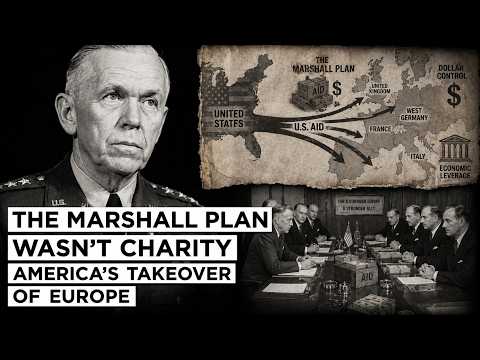
George C. Marshall is not a financial wizard. He is a general—methodical, clear-eyed, strategic. As Secretary of State, he returns from a Moscow conference in spring 1947 deeply shaken. He has watched Soviet foreign minister Molotov stall negotiations while Europe deteriorates. Marshall is convinced Stalin is simply waiting for Western Europe to collapse so Soviet influence can fill the vacuum without a single bullet.
His response is the speech at Harvard on June 5, 1947. Marshall proposes a comprehensive program of American economic assistance to Europe. He deliberately frames it in the broadest, most generous terms—even offering it to the Soviet Union and its satellites. This is either a genuine gesture or a calculated move, because American strategists are virtually certain Stalin will refuse. Which he does, immediately and forcefully.
Stalin not only rejects the Marshall Plan for the Soviet Union but pressures Eastern European governments, notably Poland and Czechoslovakia, to reject it as well. He creates the Cominform and later Comecon, a Soviet economic bloc. The world is being divided in real time, and the Marshall Plan is the dividing line.
On April 3, 1948, President Truman signs the Economic Cooperation Act into law. The Marshall Plan—officially the European Recovery Program—is now real. Congress approves $13.3 billion in aid for 17 Western European nations over four years. In today’s money, that is roughly $150 billion. It is about 5% of America’s annual economic output. Congress passes it with overwhelming bipartisan majority—sold as a national security imperative, not philanthropy.
Now the story gets interesting. The mechanics of the Marshall Plan reveal a program far more sophisticated and conditional than its public image suggests. The first thing to understand: it is not a blank check. The program is administered by the Economic Cooperation Administration (ECA), which sets up offices in every recipient country and stations American officials—often senior businessmen—as de facto overseers. They review funding requests, approve or deny allocations, and direct money toward projects that align with American strategic goals.
The second mechanism is counterpart funds. When America sends $100 million worth of goods to France, the French government must deposit an equivalent amount of francs into a special fund. That fund can only be used for domestic investment with ECA approval. This gives American officials control not only over what goods Europe receives but over how European governments deploy their own money. In Germany, 40% of investment in the coal industry between 1949 and 1950 came from these funds. The system evolved into the KFW Bank, which still operates today.
The third condition is trade liberalization. Recipient nations must dismantle protectionist barriers. This opens European markets to American corporations that had been locked out before the war. The ECA’s official mission statement: to promote European production, stabilize currencies, and facilitate international trade—especially with the United States. Europe needed to become wealthy enough to import American goods. That was a stated goal, not a byproduct.
And here is a detail rarely mentioned: countries importing under the Marshall Plan often had to source goods from American suppliers. So a substantial portion of the $13.3 billion returned to the American economy almost immediately—payments to American farmers, manufacturers, and corporations. In the first year, half of all Marshall Aid was spent on food and agricultural products, much of it American. Kiplinger Magazine even printed a guide on how to profit from the Marshall Plan.
On top of this, the Marshall Plan includes extensive technical assistance. American experts are dispatched to European factories and farms; European managers tour American plants. This is about cultural transmission—spreading the American model of industrial capitalism. American advisers show Dutch soap manufacturers how to cut processing time from 5 days to 2 hours. Norwegian fishermen get new net designs. In France, Marshall Plan aid puts 200,000 tractors into the field by 1949—most made in America. American corporations build commercial networks and brand presences that endure long after the aid ends.
None of this is to say the Marshall Plan failed Europe. Quite the opposite. Between 1948 and 1952, Western European industrial production increases by 35%, reaching 25% above pre-war levels. Agricultural production recovers by 1949. Per capita GNP grows by 33.5% between 1948 and 1951. Inflation is controlled, currencies stabilized, trade volumes recover. The psychological transformation is perhaps as important: confidence. In France and Italy, where communist parties had been polling alarmingly, stabilization blunts their political appeal. The Marshall Plan does not simply rebuild economies—it saves democratic governments.
But the institutional legacy is where the story becomes most revealing. Marshall Plan recipients must coordinate through the Organization for European Economic Cooperation (OEEC), created in 1948. For the first time, rival governments agree on common production targets, share economic data, and align currency practices. This is sold as a path to integration, and it is—but it is also a path to an open, interconnected European market that American goods and capital can flow through freely. Paul Hoffman, who runs the ECA, predicts this will lead to a European Common Market. He is right. The OEEC becomes the direct ancestor of the European Economic Community, which evolves into the European Union.
Similarly, the European Payments Union in 1950 lifts capital controls and creates the first framework for free currency exchange. The Marshall Plan effectively builds the on-ramp through which Western Europe enters the American-designed global economic order. And once you are on that highway, it is very difficult to take an exit.
The connection to NATO is equally direct. As historian Ben Steil argues, NATO is in many ways a direct consequence of the Marshall Plan. When American efforts to stabilize France run into political resistance, Marshall, Truman, and Acheson decide a permanent military alliance is necessary to provide the security framework for economic recovery. Military and economic dominance are two sides of the same coin.
By the early 1950s, when the Marshall Plan ends six months ahead of schedule, Western Europe has been absorbed into a dollar-centered, trade-liberalized, American-managed global economic order. Its currencies are pegged to the dollar. Its trade is conducted under rules written largely in Washington. Its institutions—the forerunners of the EU—are shaped by American pressure and American money. American corporations have established footholds they will deepen for decades.
The Soviet Union understands all of this perfectly. Stalin’s response is vehement. Molotov calls it a mechanism for American economic penetration of Europe—with some accuracy. The Soviets create Comecon as a counter, but it can never compete with the productivity and abundance of the American-connected Western European economies. The economic divergence between Western and Eastern Europe over the next four decades is, in a direct sense, a divergence between the world the Marshall Plan built and the world Comecon tried to build. History records the result plainly enough.
The American economy itself benefits enormously. The fear in the immediate post-war period is a new depression—that wartime stimulus will evaporate and unemployment will surge. The Marshall Plan, by creating vast European demand for American goods at precisely the moment the wartime boom risks cooling, helps prevent that outcome. The short-term slump of 1946–47 gives way to the long post-war boom. Between 1945 and 1975, American GDP grows from $228 billion to just under $1.7 trillion. Causation is complex, but the Marshall Plan is unambiguously a contributing factor.
And the dollar’s dominance—that exorbitant privilege—generates returns that are almost impossible to quantify. Lower borrowing costs, the ability to run persistent trade deficits without currency crises, the power to impose sanctions that genuinely hurt. The Marshall Plan does not create dollar hegemony, but it cements it, operationalizes it, and makes it structurally irreversible for a generation.
Critics have been many. On the left, some argue the Marshall Plan is straightforwardly an instrument of American imperialism—a 1948 analysis describes the ECA administrator as a virtual economic czar. On the right, Senator Robert Taft worries about the cost to taxpayers. But the national security framing overrides objections: the alternative is a Soviet-dominated Europe, which would cost far more.
More nuanced scholarship notes that Marshall Aid, at roughly 2.5% of recipient GNP, may not have been large enough on its own to explain the scale of recovery. The psychological effect—the confidence it inspired, the signal that America was committed—may have been as important as the dollars. This is plausible. But it does not diminish the strategic purpose or outcome. Whether transformative in itself or primarily as a signal, the signal achieved its intended effect.
Today, more than 70 years later, the world it helped build is still very much our world. The dollar is still the dominant reserve currency. Western European economies are still integrated into the open, trade-liberalized order. The EU still bears the fingerprints of the cooperative frameworks Marshall Aid made mandatory. NATO still stands. American corporations are still deeply embedded in European markets.
What the Marshall Plan accomplished at its deepest level was the successful externalization of the American economic model. It took open markets, free trade, dollar-denominated exchange, and American-influenced corporate governance, and embedded them into the foundations of Western Europe at the precise moment those foundations were being rebuilt from scratch. You do not get a better opportunity than that. When someone’s house burns down and you help them rebuild it, the new house tends to look a lot like the house you think they should be living in.
The United States spent $13.3 billion—roughly $150 billion today—and in return got something no amount of military spending could purchase directly: a Western Europe that was economically open, politically stable, institutionally aligned with American interests, and thoroughly integrated into a dollar-centered global financial order. It got trading partners wealthy enough to buy American goods. It got allies stable enough to resist Soviet pressure. And it got a global financial architecture that amplified American power for decades—and still does.
Was it charity? For the Europeans who ate American food in the winter of 1948 and 1949, whose factories were rebuilt with Marshall Plan machinery, whose children grew up in countries that did not fall to communism—for them, it certainly felt like something. Call it calculated charity, enlightened self-interest, or the most successful investment the U.S. government ever made. All of those are true. But what it was not, in any simple sense, was generosity for its own sake. Behind every shipment of wheat, every efficiency expert, every dollar deposited into a counterpart fund, there was a system being built, a world being organized, a hierarchy being established. And at the top of that hierarchy, occupying a position of dominance that no empire had achieved quite so smoothly, quite so cooperatively, and quite so profitably, sat the United States of America.
The Marshall Plan was not charity. It was architecture. And it stands as the most impressive feat of financial engineering the 20th century produced. But how did this architecture shape the decades that followed? And what cracks would eventually appear in the system it built? That is where the story continues.
Those cracks appeared slowly, then all at once. By the late 1960s, the dollar’s gold anchor was straining under the weight of Vietnam and domestic spending. In 1971, Nixon severed the link entirely—closing the gold window that Bretton Woods had opened.
Yet the dollar survived. It survived because the architecture was already built. The habits, the institutions, the trade networks—they held even when the foundation shifted.
“The Marshall Plan was the moment America learned that its currency could be its most powerful weapon,” one historian later observed. And that lesson was never forgotten.
So here is the question worth asking: if the United States could rebuild Europe tomorrow with the same tools—counterpart funds, trade conditions, institutional scaffolding—would it? Or has the world grown too fractured for such elegant engineering?
Drop a dollar sign below if you spotted the pattern. And tell me—what do you think the next great financial power play will look like?