In the early 1400s, Europe’s battlefields were dominated by the thunder of hooves and the gleam of armor. Heavily armored knights on horseback were the ultimate weapon, and no infantry force dared to stand against them. But in Bohemia, a ragtag army of farmers and city dwellers was about to turn the tide with an invention so simple yet so revolutionary that it would challenge the very foundations of medieval warfare.
This is the story of the Hussite wagon forts—a desperate solution that became a military marvel.
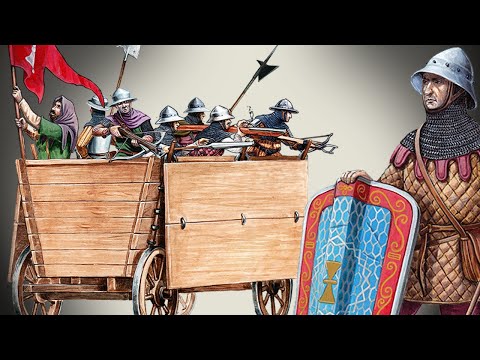
Jan Žižka, a seasoned military leader, faced a daunting challenge: how to defeat well-trained knights with an army of ill-equipped peasants. His men had no training in knightly combat, but they had something else—unwavering faith and a genius for improvisation. Žižka looked at his farmers and city dwellers and saw potential where others saw weakness.
He realized he had two things going for him: his men’s trust in their leaders and their exceptionally high fighting morale. Instead of forcing them into traditional combat, he turned their daily tools into weapons of war—pitchforks, flails, and axes became instruments of defense. And the wagons they used for transport? They became mobile fortresses.
The first test came at the Battle of Sudoměř in 1420. Žižka’s 400 Hussites faced an overwhelming force of knights. But he used the terrain to his advantage, positioning his wagons between lakes and swamps. With just twelve wagons, they repelled the first charge. When the Imperials tried to outflank them, they blundered into a swamp, forcing them to dismount. Stripped of their cavalry advantage, the knights were no match for the flail-wielding Hussites.
That was just the beginning. Žižka refined his tactics, creating specialized war wagons—bigger, sturdier, with reinforced walls and embrasures for firearms. Each wagon carried about 20 men: crossbowmen, hand cannons, and flail-wielding infantry. The wagons could be chained together in minutes, forming a fort on any terrain. This mobile fortress allowed the Hussites to take defensive warfare to the open battlefield, turning a defensive strategy into an offensive weapon.
But the true genius lay in the firepower. Small cannons and hand cannons mounted on wagons delivered devastating volleys of scatter shot—nails, rocks, and lead bullets—at close range. At an average fighting distance of 100 meters, such shots had a devastating effect on both cavalry and foot soldiers. The Hussites could concentrate their fire on the expected direction of attack, breaking the enemy’s momentum before they even reached the wagons.
After the artillery disrupted the enemy, the infantry would launch a counter-attack through sally ports, while cavalry would ride out from the rear to flank the disorganized enemy. It was a coordinated dance of death that left knightly armies reeling.
The wagon fort was so effective that it left a lasting impression on military leaders of the time. Yet, as firearms grew more powerful, the wooden wagons became obsolete. But for a brief, shining moment, the Hussites proved that ingenuity and determination could overcome the mightiest cavalry in Europe.
This is the story of how a band of rebels changed the face of war—and how their legacy echoes through the ages.
Yet the wagon fort’s story did not end with the Hussites. Its echoes rippled across the continent, and military commanders from Hungary to Muscovy studied the Bohemian model with hungry eyes. Until the seventeenth century, wagon forts appeared again and again as an integral part of armies—from the Hungarian light cavalry who adapted the concept against Ottoman raiders to the Cossacks of the steppe who built their own fortified camps in the field.
But no one ever implemented them as efficiently as the Hussites. The reason was not merely technical. Žižka’s system was welded to the social fabric of his army—the religious cohesion, the strict hierarchy within each wagon crew, the shared experience of defending city walls and farmsteads. Copy the wagons without the culture, and you had only a clumsy barricade on wheels.
Foreign observers, however, were slow to grasp this. Contemporary chroniclers described the wagon forts with a mixture of horror and fascination. One Italian diplomat wrote that the Hussites fought “like men who had made a pact with death itself.” Knights who had spent their lives training for the charge found themselves trapped in a maze of chained timber, pelted by stone balls and nails, then swarmed by peasants swinging iron-banded flails.
Even the Church’s crusading armies began to dread the sight of a Hussite convoy. The four-column marching order, the engineers clearing the path, the flags passing orders down the line—all of it spoke to a discipline that rivaled any professional force. When the wagons halted and the chains rattled into place, veteran knights knew what was coming.
And yet the Hussites themselves were not invincible. Internal divisions among the various factions—the moderate Utraquists and the radical Taborites—grew sharper with every victory. Žižka himself, blind in one eye and later completely blind, still led his armies from a wagon, relying on his officers to relay the terrain ahead. His death in 1424 from plague did not end the movement, but it marked the beginning of the end for the wagon fort’s golden age.
His successors, notably Prokop the Great, defended the legacy with skill. At the Battle of Domažlice in 1431, the mere sight of the Hussite wagon formation and the sound of their chorales caused the crusading army to break and flee before a single cannon fired. It was a victory won by reputation as much as by gunpowder.
But the tide was turning. The Hussites’ enemies learned to bring heavier artillery of their own, and the wooden walls that had once stopped knights now splintered under sustained cannon fire. The wagon fort, like the knight it was built to defeat, was becoming a relic of a vanishing age.
By the 1430s, the Hussite wars had ground into a bitter stalemate. The radical Taborites and the moderate Utraquists, once united against a common enemy, now turned their flails and cannons on one another. The very discipline that had made the wagon fort unstoppable now made civil war all the more brutal. At the Battle of Lipany in 1434, the moderate faction allied with Catholic forces and finally crushed the Taborite field army—using, in part, the same wagon tactics their enemies had once feared.
Prokop the Great died in that slaughter, and with him the last great commander of the wagon era. The surviving Hussite factions reconciled with the Church, and the Bohemian lands settled into an uneasy peace. The wagon fort did not vanish overnight, but its days as a war-winning weapon were numbered.
What killed it was not any single defeat but the relentless march of technology. Field artillery grew lighter, more mobile, and far more powerful. A cannonball that once cracked a wagon plank could now shatter the whole structure and kill the crew inside. Armies began to deploy their own mobile guns in the open field, and the slow, lumbering wagon convoy became a target rather than a fortress.
Yet the Hussite experiment left deeper marks than any single battle. Military thinkers across Europe absorbed its lessons without always admitting the source. The idea of a disciplined infantry force holding its ground against cavalry, of massed firepower breaking a charge, of fortification carried into the open field—these principles would echo in the tercios of Spain, the pike-and-shot formations of the Dutch, and eventually the drilled line infantry of the eighteenth century.
In Bohemia itself, the wagon fort became something more than a tactic. It entered folklore and song, a symbol of a small people who had defied emperors and popes with nothing but faith, timber, and iron. Villagers told stories of blind Žižka, riding into battle on his wagon, his officers guiding him by voice as he called out orders that turned farmers into soldiers.
And on the old battlefields, where the grass had grown over the ruts of countless wagon wheels, a strange quiet settled. The chained carts, the stone balls, the iron-banded flails—all of it passed into memory.
But memory, as any historian knows, is never truly silent. In the centuries that followed, the wagon fort reemerged in unexpected corners of the world. Bohemian mercenaries carried the old songs and the old drills into foreign service, and more than one Renaissance prince, reading the chronicles, ordered his engineers to build “a la Hussite”—only to abandon the effort when his men proved unwilling to chain themselves to timber and trust their lives to a peasant’s discipline.
The lesson, it seemed, could be copied but not transplanted. The wagon fort was never merely a machine; it was a covenant. It worked because the people inside the wagons believed that the ground beneath them was holy and the men beside them were brothers. Strip away that belief, and all you had left was firewood.
By the eighteenth century, professional armies had learned to do with drill and bayonets what the Hussites had done with faith and flails. The wagon fort faded from the manuals, dismissed as a curiosity of a cruder age. Yet every time an infantry square formed against cavalry, every time gunners massed their fire to break a charge, something of Žižka’s spirit marched on.
Today, if you walk the fields near Sudoměř or Lipany, you will find no trace of the chains or the sally ports. Only the wind moving through the grass, and perhaps a weathered stone marking where the dead fell. But the story refuses to die—because it is, at heart, the story of ordinary people discovering that the world’s mightiest weapons are not always made of steel.
And so the wagon fort endures, not as a relic but as a question. What would you build, if the only tools you had were the ones already in your hands—and the only army you had was the one standing beside you?
Would you dare to chain your wagons together and stand?
Tell us in the comments: which moment in this story surprised you most—and what would you have done differently if you had stood in Žižka’s boots?






