In the spring of 1945, as the smoke of battle still hung over a defeated Germany, American interrogators sat across from the most decorated generals of the Wehrmacht. These were men who had commanded hundreds of thousands, who had come closer to victory than history cares to admit. They were asked, again and again, a single question: What happened? Their answers, given without evasion, kept circling back to one baffling observation. Your men never looked tired. We never understood how.
This is the story of how. It begins in a farmhouse east of Avranches in August 1944, where a German sergeant woke up hungry for the forty-third morning in a row. And it begins on a road in Normandy the same night, where a twenty-six-year-old man from Memphis drove a truck without headlights through the dark, carrying ammunition, keeping himself awake with pills, holding an entire army’s advance together with his hands on a steering wheel. Neither man knew the other existed. The war had already decided everything that mattered about both of them.
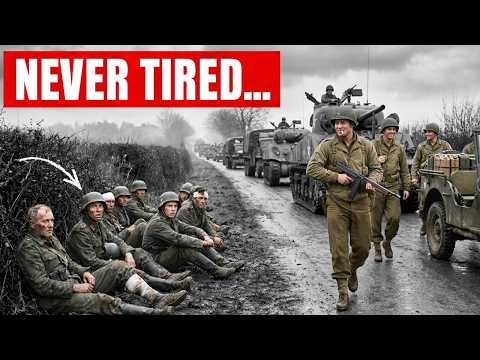
Unteroffizier Cortenhouse woke up hungry on the morning of August 3rd, 1944. This was not unusual. He had been waking up hungry for most of the past six weeks. What was unusual was that this particular morning, he was also waking up alive, which given what had happened to Panzer Lehr Division over the previous nine days, was not something any man in his unit took for granted anymore. He was twenty-three years old. He had been in uniform since 1941, served on the Eastern Front in 1942 and 1943, survived the brutal winter campaigns there, been transferred to France in early 1944 with the cadre that would form Panzer Lehr, and spent the spring of 1944 in Normandy, waiting for an invasion that everyone knew was coming, but nobody could quite prepare for.
He was not a fanatic. He was not a coward. He was a professional soldier doing a professional soldier’s job in circumstances that had grown steadily, systematically, catastrophically worse. He was part of Panzer Lehr, the armored formation that had been called at its formation in early 1944, arguably the most elite tank division Germany would send to the Western Front. Handpicked instructors, the best tanks, the best training. When the division was assembled in early 1944, its commander, General Fritz Bayerlein, had called it the finest armored division in the German army. That assessment had been accurate. That was before July 25th, 1944, before Operation Cobra.
What happened on that day was not a battle in the traditional sense. It was an erasure. At 9:38 in the morning, the sky above the hedgerow country of Normandy went dark. Not with clouds, with aircraft. Nearly 2,500 American bombers, B-17 Flying Fortresses and B-24 Liberators, formed a procession so vast that soldiers on the ground reported the sound arriving before the planes were visible. A low continuous thunder that seemed to come from the Earth itself rather than the sky. Then the bombs fell.
For roughly three hours, waves of US Army Air Force bombers dropped more than 4,000 tons of high explosives onto a strip of French countryside approximately 7,000 yards wide. The target was the area directly in front of VII Corps, the American ground forces preparing to break out of Normandy. The obstacle between them and open France was Panzer Lehr. Cortenhouse survived it by being 300 meters behind the main line, sheltering in a farmhouse cellar that held together through the concussion that turned the cellar walls to chalk dust and cracked every stone in the floor.
He emerged into a landscape that no longer resembled anything he recognized. The hedgerows that had defined this part of Normandy for centuries had been replaced by a moonscape of craters. The trees were stripped to bare white poles. The roads were gone. The farmhouses were powder, and his division, the finest armored division in the German army, had been reduced in a single morning to a collection of stunned survivors wandering through smoke and rubble, trying to locate anyone with a rank higher than their own. When the count was taken over the following days, Panzer Lehr had lost 2,200 men and the majority of its armored vehicles, not through tactical defeat, through simple industrial annihilation from the sky.
Bayerlein himself would later describe the aftermath to American interrogators in stark terms. His front line, he said, resembled a lunar landscape. Organized resistance had become impossible, and his men were either dead, wounded, or simply scattered beyond recovery. That was the moment the Western Front broke.
What followed was a rout. The Americans called it the breakout. The Germans called it the catastrophe. The French called it liberation. What it actually was for men like Cortenhouse was a forced march that never seemed to end. Always going east, always going faster than human legs were designed to travel, always with the sound of American fighter-bombers somewhere above the clouds. The P-47 Thunderbolts were the particular terror of the retreat. They hunted in pairs and fours along every road, every column, every group of men larger than a squad. They came down fast and low, and they did not distinguish between tanks and supply trucks and ambulances and men walking in groups of more than three. Anything that moved on an open road in daylight in France during August 1944 was a target, so the Germans moved at night.
Cortenhouse walked. His unit had possessed twelve trucks at the start of the Normandy campaign. Three remained operational by the first week of August, and two of those ran on a mixture of standard fuel and confiscated French agricultural diesel that played havoc with the engines. The horses that pulled the supply wagons, and it is important to understand that the German army in 1944 was still heavily dependent on horse transport, a fact conveniently absent from most post-war mythology. The horses were dying faster than they could be replaced from exhaustion and from the same aerial attacks that killed the men. He walked.
He carried a rifle, sixty rounds of ammunition, a mess tin, a blanket that had not been washed since June, and a personal pack that had been reduced by necessity to its absolute minimum. The extra socks were gone. The spare bootlaces were gone. The small personal items, a photograph, a book, had been discarded somewhere on the road between St. Lô and the next village whose name he had not bothered to learn. His boots were the particular problem. German infantry boots in 1944 were not the same quality as German infantry boots in 1940. The leather was thinner. The soles were a composite material that wore unevenly. By August, Cortenhouse’s boots had approximately 400 kilometers on them and were beginning to separate at the toe of the left foot. He had bound the separation with wire from a field telephone cable. The wire cut into his foot when it rained. It rained frequently.
Feeding a fighting division in retreat is one of the most difficult logistical problems in conventional warfare. The supply system runs forward. It is designed to deliver material to a front line that stays approximately where it is or advances. When the front line moves backward and moves quickly, the supply system is left delivering to positions that no longer contain any friendly forces. The trucks arrive. The soldiers are gone. The trucks turn around. By the time new delivery coordinates are established, those positions have also been abandoned.
Cortenhouse’s daily ration during the retreat averaged, by his own subsequent account, something between 800 and 1,200 calories. The German army’s own nutritional guidelines required a minimum of 2,500 calories per day for a soldier in active combat operations. A soldier consuming 800 to 1,200 calories while walking twenty to thirty kilometers per day and occasionally fighting defensive engagements is not a soldier being sustained. He is a soldier being spent.
The body under these conditions begins consuming itself. Muscle mass degrades. Reaction times slow. Decision-making becomes unreliable. The ability to process stress, the core psychological requirement of sustained combat, deteriorates. A man who has been eating 1,000 calories a day for six weeks does not just feel hungry. He becomes, in a measurable physiological sense, a diminished version of the soldier he was when he was being properly fed.
Cortenhouse knew none of this in any clinical sense. What he knew was that his legs felt wrong. Not painful. He had been in enough pain to know the difference, but wrong. Heavy in a way that had nothing to do with tiredness. He knew that when he tried to read a map at night, his eyes took longer to focus than they used to. He knew that he had stopped dreaming, which he had been told was a sign that the body was spending all available resources on repair and had nothing left for the luxury of unconscious narrative.
He knew that the Americans never seemed to look like this. The ones he had seen, prisoners mostly, and the occasional glimpse of advancing troops before position was abandoned, moved differently. They stood differently. They did not have the particular forward lean that develops in men whose center of gravity has shifted from months of carrying too much weight on insufficient food. Their equipment was new or close to it. Their boots were whole. He had noticed this in June, in the first weeks after the invasion. He had assumed it would change. That the Americans would begin to look the way soldiers always looked after weeks of sustained combat, worn down, depleted, carrying the weight of their experiences in their bodies as much as in their minds. They never did.
Three thousand miles away from Normandy, in the shipyards and factories and assembly lines of a country that had not been bombed, had not been invaded, had not had its agricultural land turned to crater fields, the reason for this was being manufactured twenty-four hours a day, seven days a week. The United States in 1944 was producing material on a scale that had no historical precedent and would have no successor until the nature of warfare itself changed.
The numbers exist in the record books, but they resist comprehension. In 1944 alone, American industry produced 96,318 aircraft, more than 20,000 tanks, and roughly 600,000 trucks. The artillery shell output was beyond easy visualization: hundreds of millions of rounds in a single year. But perhaps the most consequential thing it produced for men like Cortenhouse was food.
The US Army field ration in 1944 delivered between 3,000 and 3,600 calories per day in packaging designed to survive the same conditions the soldier survived. Each ration contained something with no German equivalent: a small bar of Hershey’s Field Chocolate, formulated to resist melting and provide 600 calories in a package small enough to fit in a shirt pocket. It tasted, by all accounts, terrible, designed to be saved for genuine need. American soldiers complained about it constantly. Cortenhouse would not have complained.
A private first class of the 3,888th Quartermaster Truck Company had been awake for nineteen consecutive hours when his convoy crossed the checkpoint at Avranches on the night of August 28th, 1944. He had been issued Benzedrine tablets and taken two at the fourteen-hour mark, when the road began to perform the optical illusion of exhausted night driving. The drug worked. It also had effects the army treated as acceptable operational costs.
Of the roughly 6,000 drivers who operated the Red Ball Express at its peak, about 75 percent were African-American soldiers from the segregated truck companies the Army’s racial policies had created. They served in an army that prohibited them from combat roles, that billeted them separately, that treated their capabilities as inherently inferior. They were, in the assessment of every serious logistical historian, the people most responsible for keeping the Allied advance moving.
Far to the east, the ammunition Ransom carried would eventually be used on Cortenhouse, though in the opposite direction. The gap between them was not just geographical, but systemic, industrial, nutritional. One man was waking up hungry. The other was driving through the night without headlights, carrying the tools of the former’s defeat, sustained by a system so vast it would not stop for exhaustion or for the small personal catastrophes of men who fell asleep at the wheel.
Cortenhouse bound the wire around his boot. Ransom took his second Benzedrine. The war moved east, and somewhere in a document that would not be declassified for decades, a German general was writing down what all of them had seen. The Americans, he wrote, never looked tired. He was trying to understand why. The answer was on a road in Normandy, driving without headlights, carrying ammunition, keeping itself awake with pills and the particular stubbornness of men who had been given a job and intended to finish it. The answer had a name, but nobody asked for it.
So the question remains, buried under the monuments and the memoirs: when we tell the story of how the war was won, whose names do we choose to remember, and whose do we let the darkness swallow?






