The transport truck lurched to a stop, and 24-year-old Clara Hoffman braced herself for the worst. She had been told Americans were barbarians. She had believed it. But as the gates of Camp Hearn swung open under a vast Texas sky, nothing matched the horror she had rehearsed in her mind.
No snarling guards. No starvation rations. Just wooden barracks and a strange, unsettling calm. Beside her, nineteen-year-old Marie Zimmerman clutched a family photograph, her hands trembling. Twenty-one-year-old Hannah Mueller stared ahead, fighting tears. They were enemies of America, and they knew it.
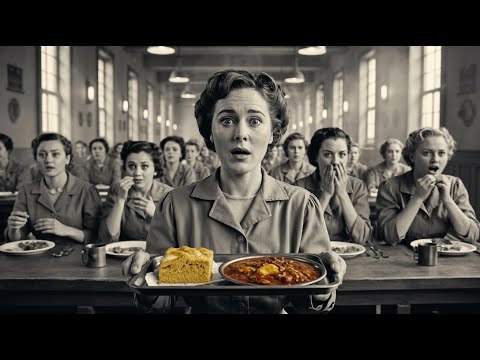
When the dinner bell rang, the women exchanged nervous glances. They had heard the stories—prisoners starved, humiliated, treated worse than animals. Clara steeled herself to endure whatever meager scraps awaited them, determined to keep her dignity intact.
Then the food arrived.
Private Carlos Ramirez, a young Mexican-American soldier with kind eyes, ladled a thick, reddish-brown stew into their bowls. Beside it, he placed squares of golden bread that glistened with butter. The smell was intoxicating—spices, meat, something sweet.
Clara stared at her tray in complete confusion. This was not prisoner food. This was something else entirely.
Marie lifted a spoonful of the chili to her lips. Her eyes widened in shock. The taste was rich, complex—heat, tomatoes, beans, spices dancing on her tongue in ways German food never had. She took another spoonful, then another, unable to stop.
Around the table, the same stunned expressions. The same guilty pleasure.
Clara broke off a piece of the golden bread. It was still warm, crumbling slightly in her fingers. She took a small bite and felt her eyes prickle with unexpected emotion. The cornbread was slightly sweet, buttery, with a texture both cake-like and substantial. When she dipped it into the chili, the combination was almost magical—the sweet bread balancing the spicy sauce.
Across the mess hall, cook Pearl Jenkins watched with quiet satisfaction. The 56-year-old Black woman had been feeding prisoners for two years, and she had seen this expression many times before—the shock of discovering that their captors weren’t monsters, that American food could be generous and flavorful, that perhaps everything they had been told was a lie.
She nodded to Carlos, who continued serving second helpings to any woman who timidly raised her hand.
Twenty-seven-year-old Lotte Braun, the radio operator from Frankfurt, refused to let herself enjoy the meal. She ate because she was hungry, but kept her face carefully neutral. This was a trick, she told herself. They were fattening the prisoners up for some purpose or trying to win their cooperation through false kindness. Real enemies didn’t feed you their own food. She would not be manipulated by American propaganda—even if it came in the form of surprisingly good chili.
But even as Lotte maintained her defensive walls, she couldn’t help noticing small details that chipped away at her certainty. The guards ate the same food the prisoners did, sitting at nearby tables. Private Ramirez smiled when he offered second helpings—a genuine smile that reached his eyes. Corporal Helen Parker, one of the few female guards, walked through the mess hall, asking in slow, simple English if they needed anything. There was no cruelty in her face, no mockery—just professional concern.
Three weeks into their captivity, the routines of camp life had begun to feel almost normal. The women woke at dawn, attended roll call, performed assigned duties, and gathered for meals that continued to surprise them.
But it was Clara Hoffman who experienced the most unexpected transformation when Sergeant Jack Coleman approached her one morning with an unusual request. The 35-year-old Texan had been watching the prisoners carefully, noting which ones showed initiative. Clara had caught his attention not just for her English skills, but for the way she examined everything in the mess hall with the curiosity of someone trying to understand rather than simply endure.
“Miss Hoffman,” Coleman said through a mixture of English and gestures. “Cook Jenkins needs help. You interested in kitchen work?”
Clara’s heart hammered. Working in the kitchen meant access to food preparation, meant learning about American cooking, meant extended contact with the camp staff. It felt dangerous and thrilling at the same time. She nodded slowly, and Coleman smiled. “Good. Report to the kitchen after roll call tomorrow.”
The next morning, Clara stood in the large camp kitchen, overwhelmed by the industrial-sized pots, the enormous stove, and the array of ingredients she had never encountered. Pearl Jenkins stood at the center of it all, a commanding presence in her white apron, her dark hands moving with practiced efficiency as she prepared breakfast for two hundred people.
She looked at Clara with eyes that had seen a lifetime of both hardship and joy, and nodded toward a pile of vegetables. “Can you chop?” Pearl asked simply.
Clara nodded and picked up a knife, grateful for a task she understood. As she worked, she watched Pearl and Carlos prepare the morning meal—scrambled eggs, bacon, biscuits, and gravy. The amount of butter and cream that went into American cooking shocked her. In Germany, such ingredients had been rationed for years. Here they were used with abandon, as if abundance was just the normal state of things.
Pearl noticed Clara’s wide-eyed observation and chuckled. “Never seen so much food in one place, have you?” She didn’t wait for an answer. “In America, we believe in feeding people proper. Don’t matter if you’re a soldier or a prisoner. Everybody eats.”
She paused and looked directly at Clara. “My people know what it’s like to be treated less than human. I don’t hold with that, no matter who you are or where you come from.”
The words hung in the air between them, heavy with meaning that Clara was only beginning to understand. Pearl Jenkins was Black, which meant she faced discrimination in her own country. Yet here she was, showing kindness to German prisoners from a nation that had built its entire philosophy on racial hierarchy. The irony wasn’t lost on Clara, and it made her deeply uncomfortable in ways she couldn’t fully articulate.
As the days passed, Clara became Pearl’s unofficial apprentice. She learned to make cornbread from scratch, memorizing the proportions of cornmeal, flour, eggs, buttermilk, and the secret ingredient—a spoonful of honey that made all the difference. She learned that chili wasn’t just one recipe but a thousand variations, each cook adding their own touch.
But more than recipes, Clara learned something else. She learned that kindness could be a weapon more powerful than any bomb—that a shared meal could break down walls that politics had built.
Word of the kitchen spread through the barracks. Greta Klene, the former nurse from Hamburg, began arriving early to help, her hands steady and methodical as she kneaded dough. She said little, but Clara noticed how her shoulders loosened in the warmth of the kitchen, how the crease between her brows softened when Pearl hummed while she worked.
Hannah Mueller came next, then Marie. The young woman had been crying herself to sleep most nights, but in the kitchen she found something to hold onto. Pearl let her crack the eggs and measure the cornmeal, and when Marie’s first pan of cornbread came out golden and perfect, she nearly wept with pride.
“Look at that,” Pearl said, admiring the skillet. “That’s yours, child. Nobody can take that from you.”
Carlos taught them Tex-Mex cooking, his hands moving with practiced ease as he showed them how to press flour tortillas, how to cook them on the hottest part of the griddle until they puffed up like small pillows. Hannah repeated the words slowly—griddle, tortilla, puff up—and Carlos grinned at her efforts.
“Your turn. Don’t be scared. You can’t mess it up too bad.”
The exchange went both ways. Greta showed Pearl how to make Kartoffelpuffer, explaining how the potatoes had to be grated fine, the water squeezed out, the eggs and flour mixed just right. Pearl watched with genuine interest.
“We make something similar,” she said. “Hash browns, or latkes if you’re talking to Jewish folks. Funny how people all over the world figure out good ways to cook potatoes.”
Corporal Helen Parker joined them during her breaks, teaching the women about southern hospitality—how you never let a stranger leave your house hungry, no matter who they were or where they came from. The kitchen became a classroom where languages mixed freely, where German words for ingredients blended with English cooking terms.
November 23rd arrived with a crisp autumn morning. Clara had mentioned to the others that the Americans were planning something special, but the women were skeptical. They had learned not to expect much, even if their treatment had been surprisingly humane.
When they entered the mess hall that afternoon, they stopped in collective amazement.
The tables were decorated with autumn leaves and small pumpkins. Real plates replaced the usual metal trays. And the smell—roasted meat, fresh bread, sweet spices—filled the entire building like a promise of something they had forgotten existed.
Marie clutched Hannah’s arm, her eyes wide. This couldn’t be real. This had to be some kind of elaborate joke.
It was no joke. Pearl and her kitchen staff, including Clara, had spent two days preparing a traditional Thanksgiving feast. Roasted turkey with rich brown gravy. Cornbread stuffing seasoned with sage and onions. Mashed potatoes swimming in butter. Green beans cooked with bacon. Sweet potato casserole topped with pecans. And Pearl’s famous buttermilk biscuits that seemed to melt on the tongue.
Greta sat staring at her plate, unable to process what she was seeing. This wasn’t prisoner food. This was celebration food, the kind of meal families shared on special occasions. She looked around and realized with a start that the American soldiers were eating the exact same meal at nearby tables. There was no separate better food for the captives. Everyone was being served from the same pots.
Captain Edward Morrison stood up to address the room. The 41-year-old commander from Boston had wrestled with whether this celebration was appropriate. Some of his superiors had questioned the wisdom of treating enemy prisoners to American holiday traditions. But Morrison had decided that showing these women what American values actually meant was more powerful than any propaganda pamphlet.
“Today is Thanksgiving,” he said, with Clara translating. “A day when Americans give thanks for our blessings and share what we have with others. You are far from your homes and families, and we know that is difficult. But while you are here under American care, you will be treated with the dignity that all people deserve. We are not your enemies today. Today, we are simply people sharing a meal together.”
His words were met with stunned silence, then tears. Lotte felt her carefully constructed walls beginning to crumble. She had been so certain the decent treatment was temporary, that the real cruelty would eventually emerge. But this—this abundance, this inclusion in an American sacred tradition—was something else entirely.
After the meal, Clara found Pearl in the kitchen, scraping plates. The older woman looked up and smiled.
“You did good today, child. Real good.”
Clara wanted to say something—to thank her, to explain what this day had meant—but the words wouldn’t come. Pearl seemed to understand anyway. She handed Clara a warm biscuit and squeezed her hand.
“One meal at a time,” Pearl said softly. “That’s how you change the world.”
December brought cold winds and the first glimpse of Texas winter, mild compared to the brutal German Decembers the women remembered. Clara had become indispensable in the kitchen, and Pearl had begun teaching her not just how to cook American food, but the stories and traditions behind each dish.
But January would bring news that shattered the fragile sense of normalcy the camp had achieved—news that would force every woman there to confront the true nature of the country she had served.
When the newspapers arrived, Clara read the headlines until her hands shook. “Nazi death camp liberated—thousands found dead.” The photographs showed horrors she could not unsee. Hannah whispered, “Did we… did Germany really do these things?” Clara had no answer.
That night, Pearl found her alone in the dark kitchen. “You didn’t do those things, child. But now you know. What you do with that knowledge—that’s what defines you.”
When repatriation orders came in May 1945, Clara stood before Captain Morrison. “Some of us do not wish to return to Germany.” Eleven women rose with her. In July, Washington approved their request—sponsored, reclassified as displaced persons.
Twenty-five years later, Clara raised her glass at Thanksgiving. “To Pearl,” she said. The others echoed it, tears glistening.
What if that first meal had been scraps instead of chili and cornbread—would their hearts have opened at all?






