They were the best-trained soldiers of Canada’s most storied regiment, the Black Watch. “There’s no ordinary blood in my veins. It’s Black Watch blood,” says Corporal Dale Sharpe. They survived impossible odds. They had the highest casualty rate of any battalion. And among the fewer than 50 men left, four were snipers. “Funny thing. We’re always the first to go in. The sniper goes out to cause chaos.” As long as they weren’t shooting at you, you had to keep moving. If you weren’t accurate, you were dead. You only had one shot.
They risked everything to save the world from the Nazis. “You were often terrified. But it had to be done.” This is the story of Jimmy and Ross. “One thing kept us going: we looked after each other. That’s how we survived.” My name is Corporal Dale Sharpe. This is our story.
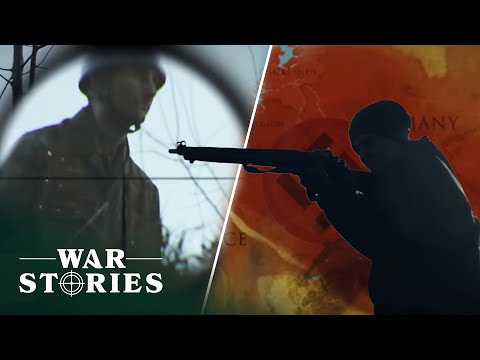
It was the summer of ’44, a month after D-Day. The Nazis held Europe, and they weren’t giving it up easily. As soon as the Black Watch landed, we were sent 20 miles to drive the Germans off Hill 140, but they were waiting for us with everything they had. “I don’t know how I survived, but I should have been dead. I’ll never forget that. Never.” Anyone who tells you they know what’s going on is lying. They don’t tell you the truth. What I’m telling you is the truth. You don’t know what’s happening. Your buddies can be killed 30 feet away. You don’t see them. You don’t care about them. You only think of yourself.
I could hear the guns firing shells and bullets flying around me. “They were falling like flies on the grass. It was terrible.” Whole companies were wiped out. Hundreds and hundreds just gone. We were down to 20 or so. Our first big battle. 300 killed, wounded, or captured. The worst day the regiment ever had. It took two more weeks and nearly a thousand Allied dead before we finally drove the Germans off that goddamn hill.
That’s when I left the navy company and transferred to the scout platoon. The commanders asked me to find volunteers for the scout platoon. A sergeant came and said, “I’ll tell you the truth. It’s… it’s dangerous. A scout is someone who goes forward, checks out the enemy’s position, and fights them if he has to.” The advantage was you wouldn’t have to do guard duty right away. I was in my early twenties. I kind of hated having to fight all day and then guard all night. I’ll join them.
The Germans were moving, and the Canadian Army’s job was to pursue them. The Black Watch marched north through France on foot. Jimmy Bennett was only 21, a farm boy from the Prairies. He didn’t know it yet, but we scouts weren’t like the regular infantry soldiers he’d fought with before. We didn’t have to wear helmets or carry heavy gear. We were snipers and observers. We didn’t fight in the front lines. We fought ahead of them.
“Hey Jimmy, you joined the scouts? Yeah. You’re crazy.” They couldn’t understand why I was foolish enough to join the snipers. That’s why no one wanted my job. No one offered to take my place. Jimmy was put under my charge. He’d seen his share of war at Hill 140, but not the way he’d see it with us. “I don’t know what they told you, but this isn’t like an infantry company. You’ll actually have to look at your target through the scope. You’ll get used to seeing them alive before you pull the trigger.”
His training was the task of our 21-year-old corporal from Montreal, Jim Wilkinson. Without a doubt the best shot in my platoon. We just called him “Hawk.” Always Hawk. It was because of my nose size, and most people never knew my first name. I hate to brag, but I was one of the best shots in the regiment. Then there was Mike Brunner, 21, also from Montreal. But Mike was born in Hungary, and he was the only one of us who spoke German. I was a good soldier because I did exactly what they wanted and I listened. I was good at listening. Considering who we were up against, understanding German was very useful, especially on patrols.
Me, I was 26. The old man of the team. At least that’s how the youngsters saw me. I was a big man, broad as an ox and strong as one. Dale Sharpe was the kind you’d follow anywhere. My home was in Corbeil, Ontario, where I drove a truck for the local distillery. I had two kids. My daughter Dale Jr. and little Teddy. And a third on the way from my light of life, Zelma Jean. Many reasons to stay home, but this mission had to be done for my family and everyone.
By the end of August, we’d caught up with the Germans. We knew every French town we reached was swarming with the bastards. The trick was to find them and flush them out so our boys could finish them off. That was the job of the scout platoon we belonged to. We had to enter every village, keep advancing until one of them shot at us. If they missed, fine. If they hit you, it was over. That’s the kind of work I did. You become numb, armored. It has to be done. Some people can’t handle that kind of thing. I don’t know. I just pushed it out of my mind and went and did what I was supposed to do.
We made our way along the Channel coast of France to Belgium, to the port of Antwerp, the largest in Western Europe, for a decisive battle. The Allies had already taken the port, but the Germans controlled the Scheldt River. That meant none of our ships could pass from the North Sea. Without food, weapons, and ammunition reaching our men, we were in a bind. Command headquarters was set up just outside Antwerp. Our scout platoon was called in. On the map, you could see the river. They wanted us to pinpoint exactly where the Germans were positioned. That’s what controls the entrance. We gather as much info as we can and relay it to HQ for their attack. They couldn’t ask that of new recruits, so the task fell to me and Hawk.
Our orders were to sneak behind enemy lines across the Albert Canal. Joe Nixon, our commander at the time, said, “We have a small boat for you and Dale, but once you’re across, I’ll have to pull the boat back. We can’t risk it falling into German hands. So you’ll have to find your own way back.” “Understood, sir.” We reached this little cluster of trees. There was a German soldier on guard duty. I told Dale, we have to get rid of this guy. I’ll jump him and you stab him. And that’s when everything went wrong. There was a whole platoon of Germans inside having dinner. As he was being stabbed, he let out a loud scream. I told Dale, “You’d better start taking off your boots and some of your clothes because we’re swimming across that Albert Canal.” I’ll stay here. Come on. Get up. We were just trying to save our lives.
We reached the bank, and surprise, the boat was still there. The rope they used was too short to pull it back. The Lord looks after us. Over the next two nights, with more scouting, we began to get a clear picture of where the Germans were positioned along the bank. They were everywhere. Our scout platoon needed reinforcement. Command sent reinforcements, but they weren’t enough. Most were just kids who couldn’t even reload a damn weapon, let alone fire one. That’s when Sandy Russell Sanderson appeared. At that age, you think you’re invincible and you can solve the problem by going and helping. That’s what I wanted to do. “I’m with you, sir.” Sandy was 18 and from Niagara Falls. He’d been trying to volunteer since the war broke out. I had a piece of paper with me that said I was 18, and I wasn’t yet. It was my brother’s paper. I was caught in the recruitment tent twice. Sandy seemed like the impetuous type. Go here. Go there. Let’s go. He was ready to win the war by himself.
That Corporal Sharpe decided to call me in and told me, “Anything Neil asks you to do, do it.” My job was to take these kids, Jimmy Bennett, Sandy Sanderson, and the others, and turn them into killing machines. And if they listened to me, they might come home alive. I was very impressed working with this man. “Take off your helmet. Stay with me.” He was very dedicated in teaching and in his honor in dealing with things. I’m alive today because of what Dale taught me. What I knew about shooting, I learned back home when I was teaching my little brother Billy. My brother Dale was nine years older and a great hero to me. He was an excellent marksman. He was my role model.
“All right. Straight ahead. Reference point. The gray building. The window on the left. Third floor.” A sniper quickly learns that the best Nazi target is the highest ranking. If you cut off the snake’s head, the rest of the platoon is blinded. I sometimes trained in a German uniform. Infantry wear a white stripe. Artillery wear a red stripe. “What do you see? I see a German soldier. What is he wearing? What’s his uniform? Infantry. What’s his rank? A junior officer. Not bad.” We didn’t want any fool from the infantry companies. He had to be a disciplined man like me. “All right. So, use the rifle sling as a rest. Put your arm through it. That’s it.” But spotting Jerry is only half the job. “Deep in the shoulder. Do you see that bottle there? If you can’t aim accurately, you’re dead. Focus on your breathing. You only have one shot. Take a deep breath.” I was skilled with the rifle. “Yes. Let out half the air. Mount a scope on it. Squeeze the trigger.” You could easily hit a man’s head at 300 yards without effort. “I thought I’d do it, Hawk. Show me again.” All the training in the world can only take you so far.
“Where are we going, Dale? You’ll know when we get there. Stay quiet.” He takes me far away from our men. Lying along the river. “All right, Sanderson, take off your helmet. Get ready to aim. At your 12 o’clock. Find the broken tree.” We weren’t here to shoot bottles or paper targets. There’s Jerry on the other side of the river. “Get ready to aim, Sanderson. Look through the scope. Sanderson. You don’t know how a person will react until you try it. All right. Don’t worry about the other person. Your only worry is the one target. It’s either him or you. Breathe slowly.” Your hand stiffens as if paralyzed and your fingers move very slowly and you squeeze the trigger. It’s like squeezing an orange. Calmly and slowly. And you see that poor soul fall. And you know that was your first target. It’s sad to say, but we have to get used to this. It’s a necessity. “Stop counting now. Stop after the first. It’s a dirty war we didn’t start, but we had to fight it. So you do the job.”
“Sanderson, we’re leaving. All right. Glad to have you, Sandy. We’ve got our team. The closest thing to family we might get here. Let’s go.”
We were sent to the town of Walcheren, just a mile from the front. Jerry had just been driven out. For four years, the people here had been starved and beaten, but now they were free. And then we saw something we never expected in this hell of war: ice cream. The man who ran the place hadn’t seen milk in three years. He’d found a farmer with a cow and was smuggling the milk in. So yes, food mattered because the Germans took everything. We slept in ice cream and soda that night.
“Black Watch. Black Watch.” The little kids came, starving to death. It was awful. They got thinner every day and there was nothing we could do. When the Germans withdrew, they looted these poor people clean. It reminded us why we were there: to crush Hitler and set the world right for these children and mine.
We moved on to Holland. The land was flat and flooded, and the Germans were waiting. “You just hope for the best and pray you come out of it.” We worked at night, in the dark, wearing different camouflage. You never expected to live long.
October came, and we were exhausted, sniping and patrolling around the clock. “The only thing that kept us going was each other.” You face the same risks and hardships, and you become closer than family. That was how it was with Jimmy Bennett. He was the best man in the world. But that’s war. Even coming back to your own lines, you were never completely safe.
We were returning through the lines of the Maisonneuve, a French-speaking regiment from Montreal. We still needed a password to pass the checkpoint. “Don’t shoot!” The password that night was ‘steamer trunk.’ We couldn’t remember the damn word. Without it, we were dead. “We’re Black Watch!” I always carried my badge inside my sniper jacket. It was your identification. No one else had it. “Show me the feather, boy.” He looked at it. “Black Watch. Old Black Watch. The password is ‘trunk.’ You can pass.” We thought they were going to shoot us. But if we’d known what was waiting around the corner, none of us would have been laughing.
Black Friday was about to hit us. The Germans were dug in just outside the Dutch town of Woensdrecht, on a bank about half a mile across open ground. It was like a funnel: high ground on one side, high ground on the other. The Black Watch was sent to fight, but this time the scout platoon went too. The reinforcements were still green, so we called everyone up. They were former gunners, drivers, cooks, everything. We taught them how to use a weapon and how to keep their heads down.
But that wasn’t the worst of it. Moving through water and mud was slow, and it ruined our timing. The whole countryside was flooded because the Germans had blown the dikes. When we finally arrived, we waited what felt like forever. We were supposed to go in at 5:30 a.m. When we finally moved across that big open field, it was 6:30 and the light was up. There’s a big difference between the last dark and the first light. You can see everything moving.
We went out there and it was a slaughter. We were up against German paratroopers, and they fought with unbelievable ferocity. Every time we moved, mortars or rifle fire poured in. We were stuck in no man’s land. Men were falling everywhere. I wondered: am I dreaming, or is this real? How will I get out of this mess? It was another black day for the Black Watch. Thanks to the mortar platoon that filled the field with smoke, the five of us survived. But most weren’t so lucky. Dozens died around us. There was nothing we could do. It hurts when you can’t help a man and you know his escape route has just been cut off. It was our second worst day ever. We lost 100 men there.
Now we were angry. We stepped up the fight. Wherever the Germans wanted to fight, we fought them. We kept the pressure on, harder and harder. We intensified our sniper patrols. Our men fought bravely. We took back the town, one flooded field after another, one small town after another. It was a feeling you could almost taste. Hitler’s luck was finally running out.
With every Dutch town we liberated, we collected prisoners and more souvenirs. And as we advanced, I found a swastika. It was a small war trophy, a simple spoil. “Are you enjoying yourselves?” Your confidence grows, and you show off a little. After all we’d been through, you couldn’t blame us for wanting to humiliate them. One way or another, the war had to end. It’s a real shame that only one of us would be there to see it.
We moved northwest toward the Dutch town of Goost. We needed to know if it was safe to bring the battalion in. Were there still any Germans roaming around? That’s when they sent Hawk. I was the first Allied soldier to enter Goost. I was on patrol, a single patrol all by myself. It was a very strange day.
I remember everything about the war, everything. And the liberation. On liberation day, a man came out to us wearing something on his head. It was the first Canadian soldier he’d seen. He threw his hands in the air and said, “Don’t shoot! I’m Dutch. The Germans just left.” We drove the Germans out of the town that had lived for four years under the dirty Nazi boot. War is strange. One day you bury your best friends. The next day you liberate hundreds of total strangers. They were so happy to finally be rid of the Germans.
My mother screamed, “Here come the liberators! Here come the liberators!” We were free. We were free. Even flags appeared on the fronts of houses we hadn’t seen in four and a half years. It was unbelievable. I can barely tell it without feeling that emotion again. You can’t believe how much the Dutch appreciated what the Canadians did for them. These girls came up. I said, “Mike, you speak Dutch. Tell her I love her.” “Good.”
From Goost, we headed east toward the German border. We knew that if the war didn’t end by Christmas, we’d have to invade Germany and crush the enemy in his own home. But the winter of ’44 was brutal. Bitter cold, Canadian cold. Everyone was completely exhausted. To make the final push into Germany, the Black Watch needed to recover its strength. Command billeted us in a small Dutch town called Kwaak, a few miles from the German border. The Germans were on one side of the Maas River, and we were on the other. Staying with the locals was a nice break from sleeping on the ground.
When we were in Kwaak, Jim and I ended up in the home of a very old couple. They slept in the cellar, while we lucky ones slept in their bedrooms. Every morning we woke up, our boots were polished and oiled and everything. She washed our shirts at night and hung them to dry. When we woke in the morning, our shirts were washed and dry. In the ten months I spent on the front lines, that was the only time I slept in a bed. It was Christmas, and for the first time in a long time, we felt almost normal.
There was a café in Kwaak run by a middle-aged woman with two daughters. I’ve always loved girls. But I won’t go into that. Jimmy, you know, was trying to tell her different things and I kind of had to translate for him. Whatever he said, I wasn’t going to translate it. I always thought of him as the Dean Martin type: dark and handsome. He always said, “Why do you get all the girls?” He’d just met the girl and he’d already told her, “I love you.”
I was young then. My dear little family, I hope you’re all well and not causing too much trouble. I bet you wear your mother out all the time. Be good for your father, and when I come home, we’ll have a lot of fun. My dear Joan, Merry Christmas and a Happy New Year with all the love in my heart. Dale.
Kwaak was a pretty safe place, but the Nazi bastards never forgot that the war wasn’t over. So we thought we’d remind them we were here too. They and Sandy were on this hill. We were working together that day. “There’s nothing there. The Germans are out there somewhere. They’re just hiding. My God, look at that, a German. That bastard is watching us, Jim. He’s aiming right at Sandy. Keep your head down.” I killed them clean or finished them off. I thanked them. I thanked them very gratefully. “Sorry, Dad. Sorry.” We looked after each other. That’s how we survived.
Orders came from command to prepare for the push into Germany. But first they asked our platoon to scout ahead and see what we could find. Dale Sharpe and I were tasked with getting information, like capturing a prisoner or prisoners. We reached a farmyard that was actually on the German side. I saw a body. We got closer and closer and it didn’t move. Nothing. I was about to put my hand on it. “No, it might be booby-trapped.” Oh, they booby-trapped their own mothers if they had the chance. And that’s when we saw them. Two Germans. I said, “Dale, we’ll kill one and take the other prisoner.” “All right. On the count of three.” One problem with that plan. One, two. Bang. I was hit in the right leg. And the second in my kneecap. I said, “I can’t move, Dale. I’m done for.” Dale managed to take out those two men from behind. He carried me like a sack of potatoes. Neil said, “Don’t worry.” He saved my life when he carried me across the valley. “You’re doing fine, Hawk. You’re doing fine. They’ll get you back to the doctor.” My leg was hanging. The bone was broken. “Hey, Dale. Thanks, buddy. Take care of the boys. Goodbye, Hawk.” He saved my life. A wonderful man. For Hawk, the war was over. He was lucky. At least he was going home.
For the rest of the Black Watch, they had to go back to the fight. In February 1945, we crossed into Germany. Goddamn Germany. It wasn’t about liberating anyone anymore. Now it was time for revenge. Payback. You’re damn right. Payback. They started this and someone had to pay. We watched the engineers move forward to bulldoze houses and blow them up completely. It wasn’t nice, but it was necessary. It had to be done.
But in this Reichswald forest, the enemy had the advantage of the ground. There were booby traps, land mines, and machine-gun nests. Our job was to pave the way for our boys. The infantry company was having trouble advancing. Every time they showed up at the edge of the company, the enemy opened up with a hail of machine-gun fire. My job was to take out the machine gun and put a bullet in the bastard operating it. I could tell he was going to wipe out the infantry company. The men in the company started moving and he opened up with about five or six rounds. I was ready. I aimed my rifle right over his right ear. No mercy. You couldn’t show it anymore.
By the first week of April, we’d chased the Germans across the Rhine and pushed north back into Holland near the town of Lorin. We set up camp just outside the town, near their main line. We could finally see the light at the end of the tunnel. We had these Nazi bastards cornered exactly where we wanted them. But sometimes it’s just being in the wrong place at the wrong time. The door burst open and two men came in carrying someone who turned out to be Dale Sharpe. “I’m sorry, Mike. I’ve been hit bad by shrapnel. Help me here. Pressure. I need to stop the bleeding.” The medic asked me to hold something and put his intestines back in. They were kind of outside his belly. I was scared. I didn’t know if Dale Sharpe was going to live or die. “Brunner, the colonel wants you now. On the double.” That’s when Mike was called away. My field medical card listed his injury as evisceration. All I knew was that it wasn’t good.
Things weren’t going well for Mike and Jimmy either. They were about to walk straight into an ambush. There were still thousands of Germans trapped there. One of them hit me in the chest. “Move, move, move, move. Everybody go.” We all started running. Mike fired again. He hit me in the back of the head once. A piece of my ear and a piece of my skull flew off. “Mike, I’ve been hit in the head. What just happened? I’m going to die.” “No, you’ll be fine.” I could taste blood coming out of my mouth and nose and I knew the bullet had pierced my lung. “I’m going to die. I know it. Hold on. Hold on.”
A jeep came. A Red Cross jeep. “This is my friend. He’s been hit in the chest and in the head. Help us.” “No use, son. He’s gone.” “You’re a medic. Do something.” “There’s nothing I can do.” And I said, “Damn you, the man is hit, do something.” “If you care about your safety, you’ll put him in your jeep.” I think he was definitely shot. “All right, Jimmy. They’re coming. They’re coming. Stay with us.” I just hoped he’d stay alive until we reached the doctor. That was all I could think about. Those two days were the worst of my life. And it seems I cried most of the night, but I don’t remember anything about it. I guess it just shocked me. That was the first time I cried over anything.
Three of us were hit and out of action. Only Mike and Sandy were left standing. The Black Watch headed north to Groningen to wipe out what was left of the Germans. By then they were desperate, like a wild animal cornered, and more dangerous than ever. They’d withdrawn somewhere. So I was called in: find them for us. We want to know what, and where, and who, and how many, Sandy. Everything. There are no forces of ours over there. I’m alone on that side of the city. Now there’s no movement in the streets. “Raise your hands or I’ll shoot.” Suddenly, a German soldier appeared. I estimated about 20 of them, maybe a little more, 20 or 25. “All right, boys, bring the Bren guns forward. Let’s go.” And I was cursing. Bring that machine gun over there. Put the Bren gun there. You guys go that way. And I was yelling at imaginary troops. I want two columns. One on the left, one on the right. And you guys in the back. There’s no one there. I’m alone in the middle of that street. “Bring up the carriers. Bring up the carriers.” I was bluffing completely. “Drop your weapons.” And I thought, are they going to buy it now? “Let’s go. Put your weapons on the ground. Face the wall. Hands up against the wall. Let’s go. Let’s go.” Something in the notes that mentions Canada in the best light for heaven’s sake. Keep moving. Let’s go. I made them line up in three columns in the street. “Let’s go. Move.” Oh, yes. Two days later, we drove the last lousy German out of Groningen.
For Sandy, it was time to celebrate, and he found just the right thing. It was a bottle of wine from ’33. “Do you want some?” But the party didn’t last long. He paid the price. I ended up in the British General Hospital 109 in Deauville, Belgium. “Are you ready to drink it because the damn wine was poisoned?” It was laced with poison. The Germans left it behind and I was the only fool who drank it. On May 5, 1945, 19 days after Sandy drank the bad wine, Germany finally surrendered. Now the lucky ones were going home. But not me. I was never going home.
I’m not ashamed of my tears. He was a good man. A good man. Many good men went, but Dale Sharpe was an exception. Oh, I want to cry. Yes. It’s so tragic. I can’t tell you more about him. Yes. Near his mustache. That’s where it came from. I revered Dale. I revered him. Certainly, sir. I remember my mother was very sad. Oh, she cried a lot. I felt empty after I realized what had happened. I guess I literally wandered for a few days as if in a fog. I didn’t know if I was coming or going, or what was happening to me. I was very disturbed inside at the thought that I would never see him again. I try to do good for my dad because my dad is my hero.
I’ve never been to Holland. It’s one of the most important things in my life. I’ve always wanted to be here and see this. I never thought I would. Once I touch his gravestone, maybe I’ll feel a really strong connection. “I would be dead. He was always my hero. I’m sorry you died so young. I’ve grown old enough to be your grandfather now. Rest in peace.”
Death is close to me. The day after the war ended, I had the biggest scare of my life. There were supposed to be some Canadian soldiers held by German forces who might not have known the war was over. I hope these men know death awaits me. But I remember I prayed, and I don’t know in what language I prayed, but I prayed, and all I could think was that I was lucky. I’ve lived my nine lives. Now I’d meet my end. The end was near. I started screaming, “The war is over!” Oh, death lurks and you know I’m really waving that white flag. There was no response. Hello. You could see what looked like a campfire over there, and that was it. A big sigh of relief. I raised the flag. I slowly made my way back to the carriers, back to their home city of Montreal.
The Canadian Black Watch returned to a hero’s welcome. When the war ended, I was very happy. The famous Royal Highland Regiment suffered the highest number of casualties of any Canadian unit on the Western Front. I was glad I survived it. It was a relief. The killing was over. The nurses came and gave us all a bottle of Younger’s beer. When the war ended, I knew it was the end of the road. I didn’t jump for joy, and I couldn’t get out of bed. I was in a hospital in England when I came home. My family never asked me what happened over there, and I never told them. I never told them.
I had a knife with a long blade, an automatic knife, you know. I took it out and threw it in the ground and buried it. I had a brother who was only 7, 8, or 10 years old. I didn’t want those kids to find that knife. They didn’t even know what war was. I’m glad I was able to tell someone what had been bottled up inside me all my life.
Oh, Sandy. You rascal. The Black Watch is my life. “Come here, you little rascal.” There’s no ordinary blood in my veins. It’s Black Watch blood. It’s been a long time, Sandy. My God. How are you, Mike? Oh my God. Good to see him. Overall, the best thing that ever happened to me was being assigned to the Black Watch. Just being alive. Sandy, I’m very proud to be Black Watch. “Good to see you, buddy. I mean, as long as you wake up alive.” “Yeah, we’re still alive. What a bunch of rascals we are. We’re very proud. And here we are. We’re still here. Damn. Old rascals.”
“End every conversation, every phone call. I love you, Jim. And I love you too. Thank you. But I really wish Dale and Jimmy Bennett were with us. I love that man.” We kept each other alive and we did our job. We did our job and I’m very proud of that. Not bad for an old drunk. Good. Just wait for the rest of the boys.
Do you know these? I’ll take this rifle, it’s exactly like the one I used. Oh, wonderful. Thank you. Yes, I hit the target. Four out of five. Aim. Aim. Good morning. Aim. Aim.
So here we are, the last of the Black Watch, still standing, still remembering. The blood in our veins never faded. “We looked after each other. That’s how we survived.” And that is the truth, the only truth that matters.
What will you carry forward from their story?






