The night was calm, the sea flat, and the USS Saratoga—a floating fortress of steel and nuclear might—cut through the Mediterranean like a shadow. Then, without warning, a fuel line ruptured deep within her hull. In seconds, the number two machinery space erupted in flames, and seven sailors were about to die. It was January 23, 1961, and the supercarrier had just tasted her first real tragedy. But this was only the beginning.
For the Saratoga, the 1960s would be a decade of triumph and terror. She was the second of the Forrestal-class supercarriers, a 1,070-foot behemoth designed to carry up to 100 aircraft—a leap forward from the Midway class that preceded her. Commissioned in 1956, she was the sixth U.S. Navy ship to bear the name, following in the wake of the legendary CV-3. But unlike her predecessor, Saratoga CV-60 was built for the nuclear age.
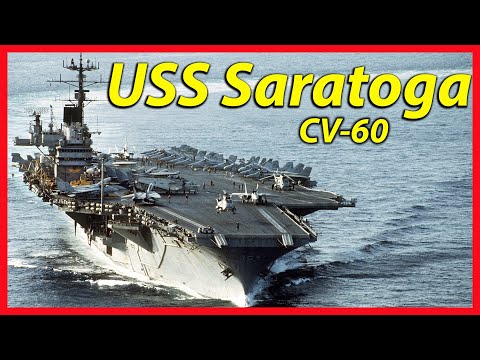
By 1967, she was a seasoned veteran of the Sixth Fleet, patrolling the Mediterranean with an air wing capable of unleashing hell. But on June 8, 1967, hell came calling. The USS Liberty, a technical research ship, was attacked by Israeli forces in international waters off the Sinai Peninsula. Thirty-four Americans were killed, 171 wounded. The Saratoga was immediately ordered to the eastern Mediterranean, her medical facilities transformed into a triage ward for the survivors. “We treated them as best we could,” one corpsman later recalled. “But the wounds were unlike anything we’d seen.”
Israel apologized, claiming mistaken identity. But for the crew of the Saratoga, the memory of that day would never fade. It was a stark reminder that even in peacetime, the sea was a dangerous place.
Two years later, the Saratoga found herself face-to-face with the Soviet Navy. While transiting the Atlantic for her ninth Mediterranean deployment, she passed dangerously close to a Soviet surface force and a November-class submarine. Then, near the Azores, Soviet long-range aircraft from Kipelovo began shadowing her. “They wanted to see what we could do,” recalled an officer. “We showed them.” Saratoga launched interceptors, escorting the Soviet bombers until they turned away. It was a game of cat and mouse, played out in the skies over the Atlantic.
But the real test came in 1972. By May of that year, Saratoga was in the Philippines, replenishing at Subic Bay before heading to Vietnam. She arrived at Yankee Station on May 18 and began launching strike missions over North Vietnam. For the rest of the year, she would rotate on and off station, her aircraft pounding enemy targets. “We flew hundreds of sorties,” said one pilot. “Some of us didn’t come back.” On January 7, 1973, she left Yankee Station for the last time, returning to Mayport, Florida, on February 13. She had been reclassified as a multi-purpose aircraft carrier, CV-60, and her role in the war was over.
The 1980s brought new challenges. In 1985, Saratoga was in the Mediterranean when the Italian cruise liner Achille Lauro was hijacked by Palestinian terrorists. They murdered a wheelchair-bound American tourist, Leon Klinghoffer, and threw him overboard. “We were ordered to intercept the airliner carrying the hijackers,” remembered an F-14 pilot. “We had our orders.” Seven Tomcats scrambled from Saratoga’s deck, supported by an E-2C Hawkeye and KA-6D tankers. Off the coast of Crete, they caught up with the EgyptAir Boeing 737, dipped their wings in the international signal for a forced landing, and escorted it to Sigonella, Sicily. The hijackers were arrested by Italian authorities. It was a rare victory, but a victory nonetheless.
Just six months later, tensions with Libya boiled over. President Gaddafi had drawn a “line of death” across the Gulf of Sidra, and the U.S. Navy was determined to cross it. On March 23, 1986, aircraft from Saratoga, Coral Sea, and America crossed the line. The next day, Libyan forces launched SA-5 missiles at U.S. aircraft. They missed, but the message was clear. “We were ready for a fight,” said one sailor. “And we got one.” Saratoga’s aircraft struck back, destroying Libyan missile patrol boats and a key radar installation. It was a show of force that echoed around the world.
But the Saratoga’s story was far from over. In 1987, during a NATO exercise, a tragic mistake would cost lives—and careers. And in 1990, a ferry accident would claim 21 of her crew. The supercarrier had survived collisions, fires, and missile attacks, but the human cost was mounting.
The 1987 incident during NATO exercise Display Determination would become one of the most infamous cases of friendly fire in naval aviation history. A U.S. Air Force RF-4C Phantom was tasked with hunting Saratoga’s battle group, and two F-14 Tomcats were scrambled to intercept. “Red and free on your contact,” came the radio call—a standard exercise phrase that Lieutenant Timothy Dorsey, at the controls of one Tomcat, misread as authorization for a live engagement.
His radar intercept officer confirmed the order, and Dorsey squeezed the trigger. A Sidewinder missile streaked from under the Tomcat’s wing. “I heard the whoosh, then saw the Phantom’s rear end erupt in a ball of flame,” the RIO later recalled. Both Phantom crew members ejected safely and were rescued—ironically, by the very ship they had been hunting. The incident ended several careers and left a stain on the exercise that took years to fade.
By late 1990, Saratoga was back in the Middle East, her crew bracing for war. On the night of December 21, 102 sailors were returning from shore leave in Haifa, Israel, aboard a chartered ferry. Just 200 yards from the carrier, the vessel capsized in rough seas. Twenty-one of Saratoga’s crew drowned in the darkness, their lives lost within sight of home. It was a gut punch that no amount of combat training could prepare them for.
Then came Desert Storm. On the first night of the air campaign, Lieutenant Commander Scott Speicher launched in his F-18 Hornet. He never returned. For years, the Navy claimed a surface-to-air missile brought him down, but a declassified CIA report later revealed the truth: Speicher had been shot down in air-to-air combat, most likely by an Iraqi MiG-25. His remains were not recovered until 2009.
Saddam Hussein appeared on television claiming Iraqi forces had sunk the Saratoga. In reality, a Scud missile had been fired in her direction and missed by more than 100 nautical miles. “We watched the TV and laughed,” one sailor remembered. “We were still here.” The carrier conducted 11,000 aircraft launches and recoveries during the conflict, a staggering tempo that cemented her place in naval history.
But the worst was yet to come. In September 1992, during another NATO exercise, Saratoga’s crew would fire two live Sea Sparrow missiles at a Turkish destroyer, killing five sailors. The incident shocked the fleet and ended the careers of the carrier’s commanding officer and several others. “It was a nightmare that never ended,” said one officer who served aboard at the time.
By 1994, the Saratoga’s eventful service life was drawing to a close. She sailed to Mayport, Florida, on August 20 and was decommissioned. Efforts to turn her into a museum in Jacksonville fell apart when the city won an NFL franchise and committed its funds to a new stadium instead. On August 21, 2014, the mighty supercarrier began her final voyage—to the scrapyard in Brownsville, Texas.
The end came quietly, as it does for most great ships. Tugboats nudged her through the Gulf of Mexico, her flight deck stripped bare, her island silent. “She looked smaller than I remembered,” said one former crewman who watched her pass. “Like a ghost of herself.” The Saratoga arrived in Brownsville on September 16, 2014, and the torches began their slow, patient work.
For nearly five years, workers cut her apart piece by piece. The steel that had once shrugged off a Scud missile, survived a collision with a German freighter, and launched thousands of combat sorties was fed into the furnace. By March 31, 2019, the scrapping was complete. Nothing remained but memories and photographs.
But the story of the Saratoga did not end in a Texas scrapyard. In a strange twist of fate, her two massive anchors—each weighing tens of thousands of pounds—were saved from the melt. In 1998, they were reused in the construction of a new supercarrier, the USS Harry S. Truman. “Part of her is still at sea,” one naval historian noted. “Her anchors hold another ship to the same waters she once ruled.”
The Forrestal-class carriers had begun the long line of American supercarriers, and Saratoga had been the second of her kind. She had carried presidents and prime ministers, launched nuclear-capable missiles, and hunted Soviet submarines. She had lost sailors to fire, to drowning, and to friendly fire. She had been shot at by Libyans and mocked by Saddam Hussein.
Yet through it all, she remained a symbol of American power—flawed, dangerous, and undeniably human. “She wasn’t just a ship,” said one retired admiral. “She was a city. A family. A weapon. And sometimes a tragedy.”
In the end, the USS Saratoga was not preserved as a museum or a memorial. No bronze plaque marks her final resting place. But somewhere in the dark waters of the Atlantic and the Mediterranean, her story still echoes—in the logbooks of old sailors, in the memories of pilots who flew from her deck, and in the steel of the Truman that still cuts through the waves.
The supercarrier had lived a life of fire and glory. And like all great ships, she passed into legend not with a bang, but with the quiet hiss of a cutting torch—and the distant, enduring sound of the sea.
And yet, the Saratoga’s legacy was never truly about steel and rivets. It was about the men and women who walked her decks, who trusted her to bring them home, and who sometimes paid the ultimate price. “You don’t forget a ship like that,” said one veteran, his voice cracking. “She was alive to us.”
Her anchors now ride the waves beneath the Truman, a silent echo of a carrier that once ruled the Mediterranean. Her name lives on in the memories of thousands of sailors, in the yellowed photographs of flight deck crews, and in the quiet pride of those who served aboard the sixth ship to bear the name Saratoga.
She was a supercarrier born in the Cold War, tested by fire and tragedy, and ultimately undone not by enemy action but by the relentless march of time and budgets. Yet her story—of collisions and hijackings, of Desert Storm and friendly fire, of lives lost and legends born—remains a testament to the human cost of sea power.
What do you think—should the USS Saratoga have been saved as a museum, or was her fate in the scrapyard inevitable?






