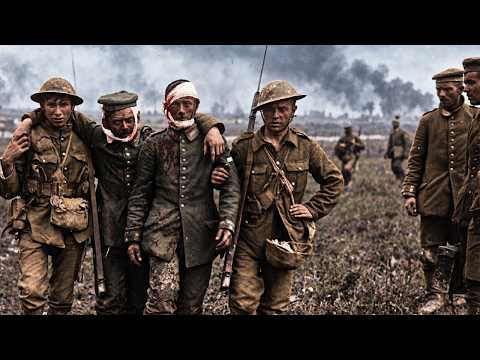
At 7:30 a.m. on July 1, 1916, whistles blew along an 18-mile front, and tens of thousands of British soldiers climbed out of their trenches into a hail of machine-gun fire. Within hours, 57,470 of them were dead, wounded, or missing—the worst single day in British military history. But the true story of the Somme’s first day is far more complex than the familiar narrative of incompetent generals and doomed volunteers.
To understand why the attack happened at all, you have to start at Verdun, not the Somme. By spring 1916, the German army had been pounding the French fortress town for months, determined to “bleed France white.” With the French army on the brink of collapse, British commander Douglas Haig was pressured to launch an offensive to draw German divisions away. The plan was rushed, the artillery inadequate, and the men—mostly volunteers from the same towns and streets—were sent into a defensive system that had been years in the making. German dugouts, some 30 feet deep with electric lights and ventilation, sheltered machine-gun crews from the week-long bombardment. When the shelling stopped, those crews emerged, set up their guns, and waited.
What happened next was not uniform. In some sectors, like Serre, entire battalions were cut down within minutes. The Accrington Pals lost 585 of 720 men in half an hour. At Beaumont Hamel, the Newfoundland Regiment was virtually annihilated, with only 68 of 801 answering roll call the next morning. But further south, near Montauban, the story was different. Careful planning, effective artillery, and flexible tactics allowed some units to achieve their objectives. The 18th Division took Mametz on schedule, and Captain Wilfred Nevill famously kicked footballs across no man’s land to rally his men. These successes were overshadowed by the disaster elsewhere, but they prove that the outcome was not inevitable.
The day’s events were shaped by decisions made far from the front. Brigadier General Hubert Rees warned that the wire opposite his sector was uncut, but was told the attack would proceed regardless. Lieutenant General Hunter-Weston blew the Hawthorn Ridge mine ten minutes early, giving German defenders crucial warning. And Haig, miles behind the lines, wrote in his diary that casualties “could not be considered severe” given the scale of the attack. The real figure—57,470—would not be known for days.
As the sun set on July 1, 1916, the full scale of the catastrophe became clear. But the battle was far from over. It would grind on for another four and a half months, through Delville Wood, Pozières, and Flers-Courcelette, claiming over a million casualties on all sides. The Somme would change the nature of the war—and the men who survived it would carry its scars forever.
What the survivors carried was not only the memory of the dead but the weight of a silence that would define the rest of their lives. Private Reginald Glenn of the Sheffield City Battalion, who had written to his mother that he was “a bit afraid” but that “all the lads were together,” came home in 1918. According to his daughter, he rarely spoke of the war. Late in life, he told her once, “There were too many of them,” and never explained what he meant. She never thought to ask before he died.
Glenn’s silence was not unusual. Lieutenant Alfred Bundy, whose diary ended with “I am alive and I do not entirely understand why,” survived the war but never published his account. Many men who lived through July 1, 1916, gave only a single flat sentence when pressed, then nothing more for decades. The gap between what they had seen and what peacetime could comprehend was too wide to bridge.
Behind the lines, the wounded kept arriving for days. Captain A.L. Ravenscroft of the Royal Army Medical Corps described a casualty clearing station built for 100 men receiving thousands, forcing doctors to decide without time to think who could be saved and who could not. Stretcher-bearers worked at night under fire, crawling across ground the enemy had pre-registered. Private Arthur Wrensch, a stretcher-bearer with the 2nd Scottish Rifles, wrote that a man wounded for twelve hours in the July heat calls out in a different way from a man just hit—and that he heard both, and they were not the same sound.
For families at home, the word “missing” brought a particular agony. It could mean a prisoner, a wounded man in an unknown hospital, or a body never found. Officers wrote letters with whatever detail they had, often very little. Comrades sometimes wrote to say a man had died quickly and without suffering, whether or not they could actually know that. Some wounded men lay in no man’s land for two or three days, staying motionless in daylight, crawling at night. One private of the York and Lancaster Regiment survived nearly sixty hours in a shell hole, rationing water a mouthful at a time, using a dead man’s coat for shade.
The battle that began on July 1 did not end that day. Beaumont Hamel, which had not fallen that morning, was not taken until July 13. Serre was never captured at all during the entire campaign. The ground the Accrington, Sheffield, Bradford, and Leeds Pals died trying to reach in July was never held by British forces in 1916. The fighting moved south, through Delville Wood, where a South African Brigade of just over 3,000 men held the position for six days against continuous counter-attacks. When relieved on July 20, only 750 came out.
At Pozières, Australian divisions took over 23,000 casualties in six weeks of fighting for a single ridge. Charles Bean, the official Australian war historian, later described the Pozières fighting as the heaviest strain the Australian forces endured in the whole war. In September, at Flers-Courcelette, tanks appeared in battle for the first time—too few and too unreliable to change much that year, but the beginning of something that would matter greatly by 1918.
By the time the battle ended in mid-November, the British and Commonwealth advance had gained about seven miles at its deepest point. Total casualties for the whole campaign came to roughly 420,000 British and Commonwealth, 200,000 French, and 450,000 German. Historians still disagree about how much the battle weakened the German army for 1917 and 1918, but the losses on the German side were real. German officers who fought through the campaign wrote that the Somme had a different character—one that consumed entire divisions in weeks, a scale even Verdun had not quite matched.
In October 1916, the German Second Army produced a report on lessons learned from the Somme, later published as The Defensive Battle. It argued that holding the front line in strength against such artillery was too costly and recommended a new system: a lightly held front line with the main defensive strength concentrated further back. This became the basis for elastic defense in depth, applied on parts of the Western Front from 1917 onward. The Somme did not just cost the German army men—it changed how the German army thought about fighting.
Today, the ground itself remains the most eloquent witness. The Thiepval Memorial, designed by Edwin Lutyens, carries the names of 72,195 men who died on the Somme and were never found, organized by regiment rather than alphabetically. The arch stands about 45 meters tall, visible across the flat landscape. The land at Beaumont Hamel is still Newfoundland’s, given to the dominion in 1925. The trenches are still there, grassed over but visible, and so is the gap known as St. John’s Road. A bronze caribou monument overlooks the field, and from its base you can see the entire route the regiment took that morning.
The Lochnagar Crater outside La Boisselle, 90 meters across and 70 feet deep, is still there, privately preserved since 1978. A memorial service is held there every July 1, with a single piper playing and wreaths laid around the rim. Farmers in the region still turn up unexploded shells from that bombardment every year, and bomb disposal teams are still called out regularly. The Commonwealth War Graves Commission maintains 242 cemeteries across the old battlefield, every one tended. Some headstones carry no name at all, only the words “Known unto God.”
The battlefields are a short drive from Calais and draw a steady stream of visitors—relatives tracing family history, schoolchildren on organized trips, and people with no personal connection who simply want to see the ground. Walking between Serre and Beaumont Hamel and Thiepval in a single afternoon gives a sense of scale that casualty figures alone cannot. The distances the men were asked to cross were often only a few hundred yards. Standing at the edge of one of these fields, looking across at where the German line was, it is hard not to notice how short that walk actually is—and how completely it was covered by gunfire the moment the whistles blew.
Accrington still marks the anniversary every year. The Accrington Pals have a memorial in the town and another on the battlefield at Serre, a plain brick monument built with brick brought over from Lancashire so that the monument on French soil is made from the same material as the town the men came from. Whether the attack should have gone ahead as it did, and whether the men who died achieved anything by dying, is a question historians will keep arguing about. What is not in dispute is the number: 57,470 casualties, 19,240 of them dead, in one day on one stretch of the Western Front in the summer of 1916.
But the silence of the survivors is its own kind of record. Private Percy Boswell’s mother kept the letter he wrote four days before the attack, asking her not to worry too much. She kept it until she died. Private Hubert Ambrose, wounded in both legs and lying in the open for a day and a night, later said the hardest part had not been the pain but the stillness required to avoid drawing fire. He survived, one of the few who came back from that specific stretch of ground. And Lieutenant Colonel Ambrose Ricardo, who watched his men go forward in perfect order into fire he knew most would not walk back out of, wrote that command after July 1 felt different from anything he had expected—because the men who had followed him into the attack were not the same men in the months after it, not in number and not in kind.
The Somme was not a single day of senseless slaughter, nor a simple story of lions led by donkeys. It was a battle shaped by pressure from Verdun, by rushed planning, by inadequate artillery, and by the courage of volunteers who walked into machine-gun fire because they had been told the guns would be silenced. In some sectors, they achieved their objectives. In others, they were annihilated. The truth lies in the specifics—the units, the ground, the decisions, and the men who wrote about it afterward. And the ground itself, still scarred, still yielding its iron harvest, still tended by gardeners who maintain graves a century on, remains the most honest witness to what happened there.
The cemeteries are not only graves; they are a map of the day’s geography. Serre Road Cemetery No. 2, its headstones shoulder to shoulder, sits close to where the Accrington Pals were cut down. Walking its rows, you can trace the line of the attack by the names and dates on the stones. Nearby, the Sheffield Memorial Park, on the ground where the city battalion fell, is small and quiet, its trenches still visible under the grass.
At Thiepval, Lutyens’s great arch carries the missing of the Somme, and among them are men from every unit that attacked on July 1. The memorial’s register allows visitors to find a name, but the stones themselves are arranged by regiment, so a walk along the base becomes a journey through the order of battle. It is a deliberate design, and it works: you meet the dead in the way they met the enemy, unit by unit.
What remains, then, is not a single verdict but a set of places and stories. The Somme was a catastrophe and a learning curve, a day of unimaginable loss and a battle that changed how wars were fought. The men who walked into the machine guns were not fools; they were soldiers doing what they were told, in a plan that failed them. Their courage is not diminished by the failure of the plan, nor is the plan excused by their courage.
So when you stand at Serre or Beaumont Hamel or Thiepval, and look across the few hundred yards of open ground, you are seeing what they saw. The distance is short. The walk is not. And the question that lingers, a century on, is not whether they died for nothing, but whether we have learned to see the ground as they did.
What do you think: does the Somme still teach us something today, or is it simply a warning from a world we can no longer understand? Share your thoughts in the comments.






