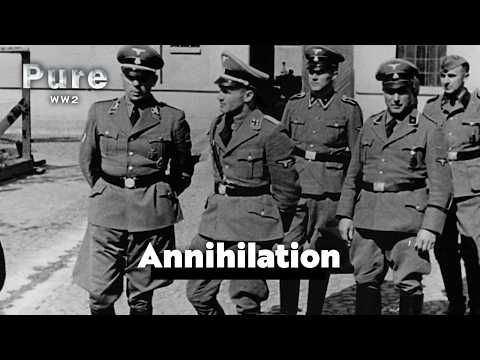
The train wheels clattered against the tracks, a rhythmic drumbeat of doom for the thousands packed inside the cattle wagons. No one knew where they were going, only that the journey was a one-way trip into the heart of darkness. Inside, the air was thick with fear, the stench of sweat, and the cries of children. This was the reality of the Final Solution—a euphemism for the systematic annihilation of an entire people.
As the trains rolled towards the extermination camps, the world outside remained largely silent. But within the ghettos, a different kind of resistance was brewing—not with weapons, but with words. Emanuel Ringelblum, a Polish historian, understood that the truth must be preserved, even if no one survived to tell it.
In the Warsaw Ghetto, Ringelblum and his team worked tirelessly, collecting documents, diaries, and testimonies. They buried these treasures in milk cans and tin boxes, hoping that one day, the world would know the full extent of the horror. “Nothing should be hidden,” Ringelblum wrote. “It should all be written down.”
The Nazis, meanwhile, were perfecting their methods. Operation Reinhardt, the code name for the extermination of Polish Jews, was in full swing. Belzec, Sobibor, Treblinka—these camps were built with one purpose: to kill efficiently. The gas chambers, disguised as showers, were designed to deceive victims until the very end.
But the Jews were not blind. News of the massacres spread through the ghettos, carried by escapees and couriers. In January 1942, Yakov Grojanowski escaped from Chelmno and reached Warsaw, where he described the gas vans and the mass graves. His testimony was one of the first to reach the ghetto.
The Jewish leadership faced an impossible choice. Some argued for armed resistance, but others believed that compliance might save lives. “How could a few Jews with some old guns fight the German army?” they asked. And so, many chose to hope—hope that the war would end, hope that they would survive.
But the deportations continued. In July 1942, the great deportation from the Warsaw Ghetto began. Thousands were rounded up and sent to Treblinka, where they were murdered in the gas chambers. The Nazis went to great lengths to conceal their crimes, even rounding up geese to drown out the screams of the dying.
Despite the horror, Ringelblum’s archivists continued their work. They wrote diaries, collected photographs, and documented every detail of life and death in the ghetto. They knew they might not survive, but they believed that their words would.
“I do not know if anyone will be left to tell of it,” one wrote. “But the story must be told.”
As the trains continued to roll, the world remained largely indifferent. But in the ghettos, the resistance of the spirit refused to be extinguished. The archives of the Warsaw Ghetto became a silent testament to the courage and resilience of those who refused to let their story die.
And as the final solution reached its crescendo, the question remained: would anyone survive to uncover the truth? The answer lay buried beneath the rubble, waiting to be found.
But the archives were not the only front. In the forests of Belarus and the swamps of Polesie, another kind of resistance was taking shape. Jewish partisans, many of them teenagers who had fled the ghettos, formed units that sabotaged railway lines and ambushed German patrols. They lived in constant hunger and cold, but they fought.
“We had no choice,” one partisan later recalled. “It was fight or die. And we had already seen too much death.” The Bielski brothers, Tuvia, Asael, and Zus, built a camp deep in the Naliboki Forest that sheltered more than a thousand Jews—men, women, and children. It was not just a fighting unit; it was a community, a floating village of the dispossessed.
Back in the ghettos, the young resisters grew bolder. In Warsaw, the Jewish Fighting Organization, the ŻOB, was formed in July 1942. Its members were barely in their twenties—Mordechai Anielewicz, a quiet young man with a burning gaze, became its commander. They had almost no weapons: a handful of pistols, a few rifles smuggled in at enormous cost, homemade grenades.
“We cannot save everyone,” Anielewicz told his comrades. “But we can choose how we die. And we can make them pay.”
The Nazis, for their part, were not finished. Heinrich Himmler, the architect of the killing machine, visited Auschwitz in July 1942 and ordered the expansion of its gas chambers. The camp was to become the largest killing center in history. Trains from all over Europe—France, Holland, Greece, Hungary—would soon converge on its ramps.
At the same time, the death camps of Operation Reinhardt were working at full capacity. At Treblinka, the gas chambers could kill 10,000 people a day. The bodies were burned on massive grates, the smoke visible for miles. The smell of burning flesh hung over the countryside like a curse.
Yet even in this hell, there were moments of humanity. In the Warsaw Ghetto, a young teacher named Janusz Korczak ran an orphanage. When the deportations came for his children, he refused to abandon them. He walked with them to the Umschlagplatz, holding two small children by the hand, and boarded the train to Treblinka. He died with them.
“You may not believe in God,” Korczak had told his staff, “but you must believe in the child.”
As the summer of 1942 wore on, the ghettos were emptied one by one. Lublin, Lwów, Kraków, Radom—each was liquidated with brutal efficiency. The Jews were marched to the trains, beaten, shot, and gassed. By the end of the year, more than a million Polish Jews had been murdered.
But the story was not over. In the Warsaw Ghetto, the remaining Jews were preparing for something the Nazis had not expected: a revolt. They had seen the truth. They knew that deportation meant death. And they had decided that they would not go quietly.
The first shots of the Warsaw Ghetto Uprising were fired on January 18, 1943. The Germans had entered the ghetto to round up another group for deportation, expecting the same docile compliance they had met for months. Instead, a group of young Jews from the ŻOB, armed with a few pistols and a stolen rifle, opened fire from a rooftop.
The Germans retreated in confusion. For the first time, a deportation action had been met with organized resistance. “The Jews have fired!” one SS officer reported back, incredulous. The news spread through the ghetto like wildfire. “We have shown them that we can fight,” Anielewicz wrote in a message smuggled to the Aryan side.
But the Nazis would not be humiliated for long. Himmler himself ordered the complete destruction of the ghetto. On the eve of Passover, April 19, 1943, German troops entered Warsaw with tanks, artillery, and flamethrowers. They expected to finish the job in three days.
They were wrong. The Jews fought back with a ferocity born of despair. They had built bunkers, tunnels, and hidden fighting positions. They had smuggled in weapons at enormous cost—rifles, grenades, even a few machine guns. They knew they could not win, but they could choose how they died.
“We are fighting for our lives and our honor,” Anielewicz wrote to a comrade. “We know we will not survive, but we will not go like sheep to the slaughter.” The fighters moved through the sewers, ambushing German patrols, setting traps, and burning the workshops that had made the ghetto useful to the Nazis.
The Germans were stunned. “The Jews are fighting like partisans,” one officer reported. Jürgen Stroop, the SS commander sent to crush the uprising, wrote in his daily reports of “bandits” and “terrorists” who fought from rooftops and cellars. He ordered the ghetto burned street by street.
The Great Synagogue on Tłomackie Street was blown up on May 16, 1943. Stroop reported to Berlin that the ghetto was “no longer in existence.” But the fighters had held out for nearly a month—far longer than anyone had expected.
Anielewicz died in the bunker at Miła 18, surrounded by German troops, along with dozens of his comrades. “The dream of my life has become a reality,” he had written. “I have seen Jewish self-defense in the Warsaw Ghetto.”
Some fighters escaped through the sewers to the Aryan side, where they joined the Polish resistance. Marek Edelman, one of the last surviving commanders, later said: “We knew we would die. But we wanted to leave a mark.”
And they did. The uprising was the largest act of Jewish resistance during the Holocaust. It did not stop the killing. But it shattered the Nazi illusion of total control.
The ghetto was gone, but the killing went on. Treblinka, Sobibor, Belzec—the Operation Reinhardt camps continued their grim work through 1943, fed by transports from across Europe. At Sobibor, in October 1943, a group of Jewish prisoners staged a revolt, killing eleven SS guards and cutting the camp’s power lines. Of the six hundred prisoners, about three hundred escaped into the surrounding forests. Most were hunted down, but a few survived the war to testify.
In the Warsaw Ghetto, the ruins held secrets. On September 18, 1946, two Polish workers digging through the rubble pulled up a milk can sealed with wax. Inside were the first of Ringelblum’s archives—thousands of pages of diaries, testimonies, and documents. A second cache was found in 1950. The third has never been located.
Ringelblum himself did not live to see it. He escaped the ghetto with his wife and son, hiding on the Aryan side, but was betrayed in 1944 and executed in the ruins of Warsaw along with his family and the Poles who had sheltered them. He was forty-four years old.
Yet his archive survived. In the milk cans, the voices of the murdered spoke again. A fourteen-year-old girl named Rutka Laskier wrote: “I want to put here in this notebook everything that’s happening inside me.” Another diarist, an anonymous mother, scribbled a farewell to her children: “I hold you to my heart and weep.”
These were not statistics. They were people. The Nazis tried to erase not just lives but memory itself—and they failed. The milk cans of Warsaw, the diaries buried in bunkers, the testimonies smuggled to the Aryan side—these were acts of defiance more powerful than any rifle.
When the war ended, the world learned the truth. The word “genocide” was coined to describe what had happened. The trials at Nuremberg exposed the machinery of murder. And the survivors—those few who emerged from the camps and the forests—began to speak.
But the question that hangs over all of it remains unanswered. How could ordinary people become killers? How could a nation of poets and philosophers build factories of death? “The ordinary men who become not only killers but become cruel killers,” one historian observed, “had dehumanized the people they were killing before they killed them.”
And what of us, who read these words decades later? Do we remember the milk cans, the diaries, the children who wrote their last thoughts in the shadow of the gas chambers? Or do we let their voices fade into the silence of history?
The archives were buried beneath the streets of Warsaw so that we would know. The question is: will we listen?






