Joe Toye was the toughest of the tough, a man who seemed indestructible. But on a cold January day in 1945, a German shell would test his resilience in ways no one could have imagined. “I lost my leg, wounded in the stomach, chest, and both arms,” he later recalled, his voice steady, as if describing someone else. That moment in Bastogne marked the end of his war—but the beginning of a far more personal fight.
In Band of Brothers, we see Joe Toye’s war end abruptly, his leg shattered, his body broken. But the series never tells us what happened next. This is the story of the man behind the uniform—a story of survival, love, and an unbreakable spirit that would be tested again and again.
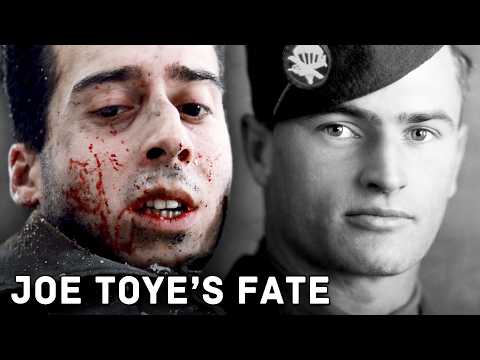
Joseph John Toye was born on March 14, 1919, in Hustontown, Pennsylvania, the youngest of nine children in a devout Catholic family. His father died when Joe was just 13, forcing him to drop out of school and take a job in the coal mines to help support his family during the Great Depression. Those early years forged him into the man he became: hardworking, humble, and fiercely loyal.
When Pearl Harbor was attacked, Joe enlisted, eventually volunteering for the paratroopers. He joined Easy Company at Camp Toccoa, where he quickly earned a reputation as a soldier’s soldier. “Next to Floyd Talbert, Sergeant Joe Toye was the best soldier in Easy Company,” Dick Winters later wrote. But Joe was more than just a tough guy—he was a man of deep faith and compassion, who sang Irish songs to lift his comrades’ spirits and once threatened a man who dared to pull a knife on Don Malarkey.
Joe’s war was marked by close calls and multiple wounds. He earned four Purple Hearts—more than any other member of Easy Company. He was wounded on D-Day, in Operation Market Garden, and twice during the Battle of the Bulge. But it was the last wound that changed everything. On January 3, 1945, Joe was hit by German artillery while ensuring his men were safely in their foxholes. The blast nearly killed him, taking most of his right leg and leaving shrapnel throughout his body.
Evacuated to England, Joe underwent two amputations—first below the knee, then above—as gangrene set in. He returned to the States weighing just 110 pounds, a shadow of the 180-pound boxer he’d been. But Joe was a fighter. During his recovery at the England General Hospital in Atlantic City, he met Eleanor Lux, a Philadelphia native who would become his wife. They married in January 1946, and Joe began the long journey of rebuilding his life.
Adjusting to life with one leg was not easy. Joe learned to walk on a wooden prosthesis, but finding work was hard. He took jobs in a textile plant and later at Bethlehem Steel, where he worked as a drill bit grinder for over 20 years. He and Eleanor had four children: Anita, Pete, Steve, and Jonathan. It was Jonathan, born in 1959 with severe cerebral palsy, who would become the center of Joe’s world.
Jonathan was both mentally and physically disabled—unable to walk, talk, or care for himself. At age three, he was placed in a state-run home an hour away. Joe visited him almost every day, feeding him and looking after him. “No son ever had a father more dedicated and faithful,” Dick Winters later wrote to Joe. Despite his own challenges, Joe never complained. He never considered himself handicapped, refusing handicap plates and free licenses. “If I’m going to do it, I’m going to do it,” he’d say.
But the war had left invisible scars. Joe struggled with what we now call PTSD, self-medicating with alcohol. He and Eleanor divorced in 1963, and Joe later remarried a widow named Mary Vogel, embracing her children as his own. Through it all, he remained devoted to Jonathan, who defied doctors’ expectations and lived to age 32. Joe told his son Steve, “I just want to live long enough to bury Jonathan and then I’ll be happy.”
Joe Toye died of pancreatic cancer on September 3, 1995, at age 76. Richard Winters delivered his eulogy. Joe had once said he didn’t feel he’d done much with his life—a statement that left his son Steve stunned. But Joe’s legacy is not just in the battles he fought, but in the quiet, daily acts of love he showed his family. As Winters wrote, “My respect for you over all these years has never mellowed. It has only grown stronger.”
This is the story of Joe Toye—a hero not just in war, but in life.
Joe’s story, however, did not end with his death. The values he embodied—resilience, humility, and unconditional love—continued to ripple through the lives of those who knew him. His children grew up carrying the weight of his example, each in their own way trying to live up to the quiet standard he set.
Steve Toye, who had once reminded his father that his sacrifices were beyond what most people accomplish in a lifetime, became a teacher. He often thought about his father’s words and the way Joe had carried himself—never asking for recognition, never complaining about his own pain. “He taught us more by what he did than by what he said,” Steve later reflected.
Joe’s stepson George, who had been so moved by the discovery of those four Purple Hearts buried in a dresser drawer, kept the memory of Joe’s quiet heroism alive. He often spoke to his own children about their grandfather, a man who had walked down to a lake on a wooden leg, refusing to let anything define him but his own will.
And then there was Jonathan. Though he had passed away in 1993, his life had been a testament to Joe’s devotion. The doctors had predicted he wouldn’t live past childhood, but Joe’s daily visits—the hour-long drives, the feeding, the quiet presence—had given Jonathan years that no one had thought possible. “Jonathan knew he was loved,” Steve said. “That was my father’s greatest gift to him.”
In the years after Joe’s death, the legacy of Easy Company grew. The book and miniseries Band of Brothers brought new attention to the men who had fought in Europe, and Joe Toye’s name became known to a new generation. But for his family, the spotlight was a strange thing. They were proud, yes, but they also remembered the man behind the legend—the father who fell asleep in his chair, moaning from nightmares, the man who never spoke of the war but whose body bore its marks forever.
Dick Winters, who had delivered Joe’s eulogy, remained close to the Toye family. In his later years, Winters often spoke of Joe with a reverence that went beyond military respect. “Joe was the best of us,” he once said. “Not just because he was tough, but because he was good.”
In 2011, a memorial was dedicated in Bastogne to honor the men of Easy Company. Among the names engraved was Joe Toye’s. His children attended, standing together in the cold Belgian air, remembering the father who had survived so much and given so much. They thought of his wooden leg, his shrapnel scars, his quiet faith, and the way he had never let any of it stop him.
As the years pass, the story of Joe Toye continues to inspire. He is remembered not only for his bravery on the battlefield but for his unwavering dedication to his son, his humility, and his refusal to be defined by his injuries. His life serves as a reminder that true heroism is not always found in grand gestures, but in the quiet, daily choices to love and to persevere.
And perhaps that is the greatest lesson of Joe Toye’s life: that even in the face of unimaginable loss, a man can still stand tall—not on two legs, but on strength of character, on faith, and on love.
But the story of Joe Toye does not end with tributes and memorials. There is another chapter—one that unfolded quietly in the years after his death, as his family continued to grapple with his legacy and the lessons he left behind.
Steve Toye, now a father himself, often found himself thinking of his dad during the simplest moments: fixing a leaky faucet, cooking a Sunday dinner, or watching his own children play. “He was always there for us, even when he wasn’t,” Steve said. “His presence was like a shadow—you didn’t always see it, but you felt it.”
That shadow loomed largest over Jonathan’s memory. Though Jonathan had passed away in 1993, Joe had never stopped visiting the Hamburg Center until his son’s death. After Joe’s own passing, Steve and his siblings made a point to return to the center, donating time and resources to the staff who had cared for their brother. “Dad would have wanted that,” Steve explained. “He never forgot the people who helped Jonathan.”
In 2015, the Toye family gathered in Reading to mark what would have been Joe’s 96th birthday. They shared stories, laughed over old photos, and raised a glass to the man who had shaped them all. George, Joe’s stepson, brought along a worn leather journal he had found among Joe’s belongings—a diary Joe had kept sporadically during the war and after.
The entries were sparse, often just a few words scrawled in Joe’s neat handwriting. But one entry, dated June 6, 1944, stood out. “Jumped into hell today. Made it out. God was with us.” Another, from January 4, 1945—the day after he was wounded—read simply: “Lost my leg. Still here. Grateful.”
Steve read the words aloud, his voice breaking. “He never talked about the war,” he said. “But here it is. He was grateful. Even then.”
The discovery of the diary sparked a new wave of reflection for the family. They realized that Joe’s silence about his experiences had not been a refusal to remember, but a way of protecting them from the weight of his pain. “He carried it so we didn’t have to,” said his daughter Anita. “That was his gift to us.”
In the years since, the Toye family has continued to honor Joe’s memory in their own quiet ways. They established a small scholarship in his name at the local community college, awarded annually to a student who has overcome adversity. They also became advocates for veterans’ mental health, speaking openly about the hidden wounds of war that Joe had struggled with.
And every year, on the anniversary of his death, they gather at Gethsemane Cemetery in Laureldale. They stand by his grave, share a few words, and then—just as Joe would have wanted—they go out for a good meal and tell stories that make them laugh until their sides ache.
Because that, too, was part of Joe Toye’s legacy: the ability to find joy after sorrow, to keep moving forward even when the road was hard. He had done it on the battlefield, and he had done it at home, one day at a time, with a wooden leg and a heart full of love.
The diary became a quiet touchstone for the family. Steve photocopied its pages for each sibling, and Anita placed hers in a frame beside a photo of Joe in his jump boots, young and unbroken. “He was grateful,” she would say to visitors. “Even then.”
In 2019, a century after Joe’s birth, the town of Reading declared March 14th Joseph Toye Day. George accepted the proclamation on the family’s behalf, holding it aloft with a grin. “He’d have hated the fuss,” he told the crowd. “But he’d have loved the free lunch.”
The laughter that followed was the truest tribute of all. Joe Toye never asked to be remembered as a hero—only to live long enough to bury his son, and to do right by those he loved. He did both.
So what does it mean to be tough? Was it the brass-knuckle grit of legend, or the quiet man with a wooden leg who drove an hour each day just to feed his boy? Tell us in the comments: what part of Joe Toye’s story moved you most?






