Between 1955 and 1975, the Vietnamese nation was torn apart by a civil war that soon involved several countries. During the war, the contenders became accustomed to all kinds of horrors and aberrations. Naming enemies, seeing entire jungles being leveled by a poison, and hearing piercing screams at night became part of the daily routine. Don’t leave your screen because in the next few minutes we’ll show you the five scariest things that became normal in Vietnam.
Number one, Agent Orange. Throughout the war, the United States deployed a biological warfare program that ruined the country and doomed future generations. The communist guerrillas used the jungle as a place to retreat and ambush the US troops. So, depriving them of this resource was a fundamental task.
To do this, the invaders used Agent Orange, a herbicide and defoliant with which they poisoned thousands of hectares of jungle and destroyed its vegetation. There were many similar chemicals such as green, purple, white, and blue agents, but orange was the most potent and did the most damage. It owed its name to the color of the barrels in which it was transported.
It is estimated that the United States dumped almost 80 million liters of this poison, with which the fauna and flora of Vietnam were completely devastated. On the other hand, it was also used to destroy the cultivated fields of Vietnamese peasants, who in many cases gave shelter to the Viet Cong.
Agent Orange affected more than 3 million people on both sides. Since although the Vietnamese were the majority, the Americans also suffered its consequences. The chemical caused skin irritations, diabetes, prostate cancer, and leukemia in those who came into contact with it. The controversy generated by its use forced the US government to approve financial aid and pensions for war veterans who handled the herbicide and who returned with compromised health.
In subsequent years, hundreds of thousands of babies in the region were born with genetic defects because of this. At present, Vietnam has not managed to get rid of the harmful effects of the poison and the population continues to battle against them.
Number two, the children of the dust. When the United States entered the war, it sent tens of thousands of soldiers who mixed with the native population. As a result, there were many births resulting from the union of American soldiers and local women. In some cases, they were sincere relationships based on affection, but in many others, they were abuse.
Vietnamese society nicknamed them children of the dust and treated them as outcasts for being descendants of the invaders. Sometimes, the mothers abandoned them in orphanages since they did not want to bear the shame of raising them. The vast majority became homeless and beggars, and the hatred for them was so great that in 1975, the Viet Cong announced that they would kill anyone with American blood in their veins.
This was one of the reasons why the US government organized Operation Baby Lift, with which they evacuated more than 3,000 babies from South Vietnam. At present, the children of the dust continue to be viewed with mistrust by their compatriots and treated with contempt.
Number three, psychological warfare operations. One of America’s most powerful weapons was terror and the ability to alter the psyche of its enemies. In this war, not only weapons and firepower counted, but also emotionally destabilizing the guerrillas and breaking their willpower.
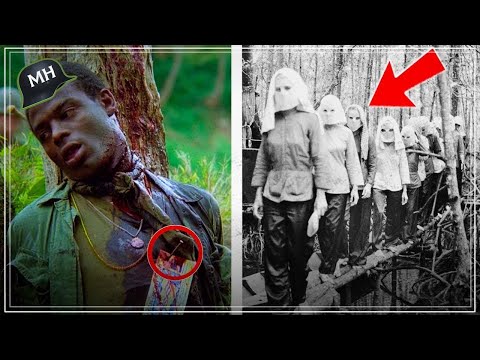
This was the task of the fourth psychological operations group, an army unit whose goal was to destroy Viet Cong morale through setups and deception. According to Vietnamese tradition, a deceased person must be honored through a careful religious ritual, and the body must be buried at the place of birth. Otherwise, if the corpse is left out in the open, then it is believed that its spirit will forever roam the earth stalking the living.
The fourth group exploited the religious beliefs of Vietnam as a weak point and organized, among other operations, a campaign of psychological terror under the name of wandering soul. They recorded artificially manipulated voices and mixed them with horror movie sound effects to create a haunting atmosphere.
The protagonists of the recordings claimed to be the ghosts of guerrillas who fought against the United States and died on the battlefield. They lamented that no one had given them a decent burial, so now they were condemned to wander aimlessly around the world with no chance of going to paradise. The supposed spirits warned the living not to repeat their mistakes and avoid confronting the Americans. The US Army considered the operation a success and served to discourage many people from joining the ranks of the Viet Cong.
Number four, helicopters. The Battle of Ia Drang Valley occurred in November 1965, marking the first time the US Army had come face-to-face with North Vietnamese troops. All seemed lost for the Americans since the enemy had three times as many men, but just then, the sky clouded over from one moment to the next.
It was the first large-scale helicopter attack in history, something that had never happened before. Over the course of 5 days, 2,500 communists were attacked from the air with powerful minigun machine guns, wreaking havoc among their ranks. Meanwhile, the air artillery rained down on their heads with bombs and explosives, providing cover for the American infantry.
Outnumbered was no problem with the right technology, and the North Vietnamese learned a hard lesson. They could not attack the Americans in the open without any prior strategy since the use of helicopters to carry out assaults had become routine. When the battle ended, it became clear that the outcome was catastrophic for the communists, who lost about 1,700 men, while the Americans suffered just 240 casualties.
Number five, ear necklaces. Shortly after entering the war, Americans realized that this war would not be like fighting the Nazis. Now, they were fighting against an invisible enemy hidden in the jungle and that killed them when they least expected it. That is why they decided to fight fire with fire and created the Tiger Force, a small guerrilla unit whose task would be to imitate the methods of the Viet Cong and hunt down the communists.
It began its operations in 1965, but over the months, bloodlust seized its members, who became accustomed to death and murder as a way of life. Their hatred of the Vietnamese was intense, and they lost the ability to discern between innocent civilians and members of the Viet Cong. Everyone who came across the Tiger Force, regardless of gender, age, or origin, had their minutes counted.
Among the unit’s many crimes were the torture and clandestine execution of prisoners, the shooting of unarmed people, the abuse of women, and the beheading of babies. The only thing that mattered to them was sowing terror among the population.
One of the creepiest tiger customs was to cut off the ears of the dead and attach them to a necklace. Despite the fact that certain officers were aware of these crimes, they decided to hide them so that the scandal would not negatively affect the army. These aberrational facts came to light in 2003 after a journalist investigated a classified military file. It is unknown what the exact number of victims of the Tiger Force was, since they did not even keep count themselves, although it is estimated that hundreds of people suffered at their hands.
But the ear necklaces were only the visible tip of a far deeper darkness. Investigators who later reviewed the testimonies described a unit that had crossed a line from which there was no return. Some soldiers reportedly wore their gruesome trophies openly during patrols, a silent warning to anyone who crossed their path.
And yet, the Tiger Force was not an isolated case. It was the product of a war that had taught its participants to see the enemy as something less than human. Once that lesson was learned, the distinction between soldier and butcher blurred beyond recognition.
Meanwhile, the psychological operations of the fourth group continued to evolve. They dropped leaflets depicting fallen guerrillas with their bodies torn apart, accompanied by warnings that the same fate awaited anyone who resisted. The messages were designed not to persuade, but to haunt.
Some of these leaflets featured the image of a grieving mother weeping over an empty grave, implying that her son’s spirit would never find rest. The Viet Cong, in turn, began to fear that their own dead would be denied proper burial.
And there was another weapon that became terrifyingly ordinary: the sound of helicopters. Long before the gunships opened fire, the distant thumping of rotor blades was enough to empty entire villages. Peasants learned to recognize the different engine pitches and knew which ones carried troops and which ones carried death.
The Huey became the soundtrack of the war. Children in the Mekong Delta reportedly ran for the treeline at the first echo, even before the aircraft appeared on the horizon. For them, the sky itself had become a threat.
But the most unsettling transformation was perhaps the quietest one. Agent Orange did not scream or fire bullets; it simply fell like mist and left behind a poisoned earth. Villagers who survived the spraying returned to fields that no longer grew rice, only withered stalks and silence.
Years later, doctors in the affected regions began documenting patterns that defied explanation at the time. Children were born with limbs missing, with heads too large or too small, with eyes that never opened. The poison had entered the bloodline itself, and no treaty or peace agreement could undo that.
And then there were the children of the dust, who grew up in a country that had every reason to hate them. Some were taken abroad; most were not. They lived in the margins of cities, doing whatever work they could find, carrying the faces of a foreign enemy in a land that had never forgiven.
Many of them spent decades searching for a father who had long since forgotten them, or who had died without ever knowing they existed. Their story became one of the war’s longest and quietest tragedies, outlasting the bombs and the headlines.
Together, these five facts painted a picture of a conflict where the line between combatant and civilian, between soldier and monster, had been erased. What happened in Vietnam did not stay in Vietnam. It lingered in the soil, in the blood, and in the memories of those who survived.
The war ended, but its ghosts did not. In the decades that followed, Vietnam rebuilt its cities and replanted its forests, yet the past kept surfacing in unexpected places. Veterans from both sides returned to the battlefields, some seeking closure, others seeking forgiveness they were not sure they deserved.
At the Cu Chi tunnels, former Viet Cong fighters now guide tourists through the narrow passages where they once hid from American patrols. Some of them smile and shake hands with American veterans who come back to visit. Reconciliation, where it happened, was slow and personal, never official.
The children of the dust grew old. Some found families in America through DNA testing and late-discovered records. Others died in the same alleys where they had been abandoned, never learning their father’s name. Their story remains one of the war’s least told chapters, buried beneath the louder narratives of battles and politics.
Agent Orange still lingers in the soil around former airbases, and cleanup efforts continue to this day. Scientists work alongside local farmers to test the earth and water. The poison has outlived the war by more than half a century, and it may outlive many of us still.
Perhaps that is the most unsettling truth of all: wars do not end when the guns fall silent. They end when their consequences finally do—and for Vietnam, that day has not yet come.
Which of these five facts do you think left the deepest scar on Vietnam, and why? Share your thoughts in the comments below—we read every one.






