In the summer of 1934, a bodyguard unit murdered the men it was created to protect—and used their corpses to become the most dangerous organization in the Third Reich. Before the death camps, before the Gestapo’s files on half of Europe, there was a street gang in brown shirts. And it did the regime’s dirtiest work in broad daylight.
That gang was the Sturmabteilung—the SA, the storm detachment formally organized in 1921. To understand what the SS eventually became, you have to start with the men who filled the brown shirt ranks. They were not clerks, and they were not soldiers. They were ex-fighters left over from the chaos after the First World War. Unemployed veterans with nothing to do and someone to blame. Brawlers who had found a movement that paid them by giving their fists a target.
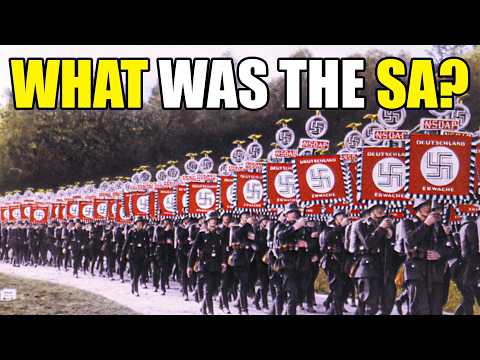
The SA existed to break up the meetings of rival parties, to storm into a hall where communists or social democrats were speaking and turn it into a bloodbath of overturned chairs and cracked skulls. They beat trade unionists in the street. They attacked Jews, Roma, and anyone the movement had marked as an enemy—often while the police looked the other way. This was the whole point of the organization: organized violence against unarmed civilians, carried out in public so that everyone watching would learn to be afraid.
The brown shirts themselves came from a cheap batch of surplus uniforms—tropical kit originally meant for German colonial troops. There was nothing elite about any of it. Size was the strategy. The more men in brown you could put on a street corner, the more meetings you could shut down, the more terror you could spread. By the time Hitler was reaching for national power, the SA was the muscle that made it possible. Without those fists, there is no rise.
In 1925, while the SA was swelling into something close to a small army, a handful of men were quietly pulled aside for a very different kind of job. There were only about eight of them at the start. Their task was narrow and personal: protect Adolf Hitler himself. Close up at all times. This little detachment was called the Schutzstaffel—the protection squad—and it was placed under the authority of the SA. It answered to the SA’s command. On the org chart, it was a small branch of a much larger tree.
If you had stood in a crowd in 1925 and someone had pointed out the SS, you would have struggled to see it at all. Picture the SA as a giant and the SS as a single seed buried somewhere inside it. But that seed was being grown around a principle the SA never had. The SA was loyal to a movement, to a cause, to the idea of revolution. The SS was built to be loyal to one man and only one man. That difference sounds small. It was the most important difference in the entire story.
People talk about the SS and the SA as if they were two versions of the same thing, two Nazi armies that happened to wear different colors. They were not. They were engineered to be opposites. The SA took almost anyone—mass recruitment, any able-bodied man who wanted a uniform and a fight. Numbers over selection. When Heinrich Himmler took over the SS in 1929, it was tiny, only around 280 men, and he began shaping it into the reverse of the brown shirt mob. He screened recruits for so-called racial background. He checked their health, their ancestry, their family lines. He demanded not enthusiasm but total unconditional obedience. From 1932, the SS wore black and took as its guiding line a single idea: its honor was its loyalty.
So the difference was never really the size and it was never the color of the shirt. The difference was what each organization was designed to be at its core. And that design decided everything that followed. How a bodyguard squad ended up destroying the mass movement it was built to protect. And why that flip mattered more than any uniform ever could is the whole story here.
By 1934, the SA had a problem that no amount of brown-shirted muscle could fix. It had grown too large for the very man it helped lift to power. The turning point came in 1931 when Ernst Röhm took over as the SA’s chief of staff. Röhm was an old street fighter, one of Hitler’s earliest allies. Under him, the SA exploded. It had counted a few hundred thousand men at the start of 1933. By the middle of 1934, it numbered somewhere between three and four million.
Think about that scale. Millions of armed, organized, angry men who believed the revolution they had been promised was only half finished. And Röhm said so out loud. He began demanding what he called a second revolution. In his vision, the SA would not be disbanded now that Hitler was in charge—it would swallow the regular German army whole. The professional soldiers, the trained officer corps, would be folded into the SA and reduced to little more than instructors for a vast people’s militia. The brown shirts were the true engine of the movement, and they deserved to become the armed heart of the new state.
To Germany’s traditional military and its conservative elites, this was a nightmare. The officer corps had centuries of pride and no intention of taking orders from a mob of street brawlers. And so the very thing that had made the SA powerful—its enormous, unruly size—was quietly turning it into a threat. Not a threat to Hitler’s enemies anymore. A threat to Hitler himself.
Newly installed as chancellor, Hitler needed one thing above everything else. And the SA was standing directly in the way of it. That thing was the army. Real rearmament, the kind that would let Germany fight the war Hitler was already dreaming of, could only come through the professional military with its trained officers and its institutional discipline. But the generals had made their position clear. They would not accept a future in which Röhm’s millions absorbed them. Hitler could have the army or he could have the SA’s ambitions. He could not have both.
Around him, three men saw an opportunity in that deadlock. Himmler, who ran the SS. Hermann Göring, who commanded enormous power in Berlin. And Reinhard Heydrich, the cold intelligence chief, who built cases the way other men built machines. Together, they began feeding Hitler a steady stream of reports warning that Röhm was preparing a coup, that the SA was about to move against the regime itself. They assembled lists of names—targets to be dealt with when the moment came.
Whether Röhm was actually planning anything is a question we will come back to, because it matters enormously. Layered on top of these coup reports came a campaign against Röhm’s private life, including his homosexuality, folded in by the regime as a kind of moral cover for what it intended to do. Historians treat that material as exactly that—a pretext dressed up as principle—and its true weight in Hitler’s decision is still debated. What is not debated is the shape of the choice in front of him. Hitler had to move against the street army that had built him in order to keep the professional army that could finish the job.
At dawn on the 30th of June 1934, Hitler walked into a quiet hotel on a Bavarian lake and personally arrested the man who had commanded his brown shirts for years.
The place was Bad Wiessee, where Röhm and a number of SA leaders were staying. Hitler arrived in the early morning with an armed escort and had Röhm pulled from his bed. Over the next three days—from the 30th of June to the 2nd of July—SS and Gestapo units fanned out across Munich and Berlin and elsewhere, seizing the leadership of the SA and killing them. Men who had marched under the same banner for a decade were dragged from homes and offices and shot against walls and in cells. The offshoot was executing the parent. The bodyguard had become the executioner.
Röhm himself was taken to Stadelheim prison. He was offered a pistol and the chance to take his own life, and he refused. So Theodor Eicke, the commandant of Dachau, walked into his cell and shot him. The man who had built the SA into a force of millions died on a stone floor, killed on the orders of the movement he had helped create.
And the killing reached well beyond the SA. Kurt von Schleicher, a former chancellor of Germany, was gunned down in his home along with his wife. Gregor Strasser, once one of the most important figures in the Nazi Party, was murdered too. This was not a surgical strike against one organization. It was a settling of every score at once under the cover of a single bloody weekend.
How many died? Officially, the regime later listed the number at 85. Almost no serious historian believes that figure. The real toll is thought to have run far higher—into the hundreds—and the true number has never been pinned down. A thread deliberately left frayed, because the men who could have counted the bodies were the same men who ordered them made.
Three days after the shooting stopped, the German cabinet sat down at a table and made all of it legal retroactively. On the 3rd of July 1934, the government passed a law declaring that the killings had been a lawful act of state self-defense. No trials, no evidence tested in any court—just a stroke of the pen that reached backward in time and turned mass murder into official policy.
And here we have to be careful about two stories people tell about this weekend, because both of them are wrong. The first wrong story is that Hitler heroically stopped a real coup. He did not. Historians widely regard the so-called Röhm Putsch as a fabricated pretext—an uprising invented to justify a purge that had already been decided. There is a minority view that the SA under Röhm was genuinely destabilizing the regime and could not be left as it was, and that view deserves an honest hearing. But the idea of an imminent SA attack, a plot in motion that had to be crushed that very night, has not survived the evidence.
The second wrong story runs in the opposite direction: that Röhm was a victim, a martyr cut down by a jealous dictator. He was not that either. Röhm was the boss of a violent militia that had spent years beating and terrorizing people in the street. He was eliminated in a preemptive grab for power, dressed up as law. There are no clean hands anywhere in this room.
And the legalizing was, in a way, the more dangerous act than the killing itself. Anyone can order a murder. What Hitler did was stand before the Reich afterward and style himself the supreme judge of the German people—establishing that the leader could kill without law and then simply declare it lawful. That precedent would poison everything that came after.
Then came the reward. As payment for carrying out the purge, the SS was cut free of the SA entirely and made an independent organization, answering directly to Hitler and to no one else. This was the launch point for everything the name SS now means. Within two years it would absorb the German police. It would run the Gestapo. It would build and operate the concentration camps, spawn the armed Waffen-SS, and construct the bureaucratic machinery of the Holocaust.
Years later, in a secret speech at Posen in 1943, Himmler would point back to the SS’s role in this very purge as proof of what his organization had always been willing to do—proof, in his mind, that it could be trusted to carry out the murder of Europe’s Jews. The purge had not removed the danger in the Nazi state. It had concentrated it, poured it into the one organization built from the ground up to be merciless.
Here is the part almost nobody expects. The SA was gutted that weekend, but it was never dissolved. After Röhm’s death, the Brown Shirts were placed under a new chief, Viktor Lutze—a loyal and far less ambitious man. Under him, the SA shrank steadily, its millions draining away, its dream of a second revolution dead. It became a second-tier body, a shell used for paramilitary training and marching and little else.
But do not mistake diminished for harmless. In November 1938, during Kristallnacht, when synagogues burned across Germany and Jewish homes and shops were smashed and looted in a single coordinated night of violence, the SA was there—one of the lead perpetrators, back in the streets doing the thing it had always done best.
And that sets up the twist that closes this whole story. When the war ended and the surviving leadership stood trial at Nuremberg, the SS was condemned as a criminal organization. The SA was indicted too—but the tribunal reached a different verdict. It found that the SA was not a criminal organization. Sit with how strange that is. The mob that helped burn the synagogues walked away without that label, while the bodyguard squad that started as eight men protecting one politician was branded criminal to its core.
It is not that the SA was innocent. Its record of violence is written in the blood of everyone it beat and burned and terrorized. It is that history’s judgment landed in a place almost no one would have predicted in 1925.
Which brings us back to where we started. The question was never which of these two wore the more sinister uniform, the brown or the black. The real question is how a tiny bodyguard unit turned on the giant that raised it, murdered its masters, had those murders declared lawful, and rode that one weekend of betrayal all the way to becoming the engine of genocide. The SS didn’t beat the SA because it was bigger or angrier or better armed. It won because of what it had been built to be from the very first day—loyal to one man and willing to do anything he asked. That is the difference that decided everything. And it started with eight men and a promise.
So here’s the question for you: knowing that the SS began as a mere bodyguard squad, does that make its later crimes more chilling—or does it simply prove that absolute loyalty, unchecked, is the most dangerous weapon of all? Tell us in the comments.






