Television has always sold itself as a family-friendly medium, carefully managed by network executives who policed exactly what America was allowed to see. But every so often, a performer pushed too far, said the wrong thing at the wrong moment, or simply became too much of a liability for a network to keep associating with. What happened next wasn’t always a headline. Sometimes it was a quiet phone call, a canceled contract, or a single bad news cycle that ended a career built over decades of work.
These are 15 classic television stars who found themselves effectively banned—and the real, documented stories behind exactly why. From comedy provocateurs to beloved icons, their downfalls reveal the brutal, often hidden machinery of an industry that can turn on its own overnight.
Andy Kaufman built a reputation on Saturday Night Live as one of the strangest, most polarizing performers ever to appear on the show, alternating between absurdist bits and genuinely confrontational stunts that left studio audiences uncertain whether they were watching comedy or a real breakdown. By 1982, producer Dick Ebersol had grown convinced that Kaufman’s act had become more alienating than funny. Rather than simply cutting him, the show staged an elaborate and ultimately real referendum on his future.
NBC set up two call-in numbers—one to keep Kaufman on the show, one to remove him permanently—and asked America to decide his fate live on air. The vote came in decisively against him: 195,544 to 169,186, and cast member Gary Kroeger announced on air that Andy Kaufman would never appear on Saturday Night Live again. Because committing fully to a bit was the entire foundation of Kaufman’s comedy, he actually honored the result. He never appeared on the show again for the rest of his life.
What made the whole situation even stranger is that the feud between Kaufman and Ebersol that led to the vote was, by most accounts, staged from the very beginning—a piece of elaborate performance art that both men had apparently agreed to ahead of time. The genuinely bizarre part is that once the actual votes came in against him, everyone involved simply decided to honor the outcome as if it had been real all along, turning a scripted bit into a permanent, career-ending consequence that nobody had fully anticipated.
Joan Rivers spent years as Johnny Carson’s most trusted guest host on The Tonight Show, a position that made her one of the most powerful women in American comedy and put her in line to potentially take over the desk herself one day. In 1986, without telling Carson in advance, Rivers accepted a $10 million deal from Fox to host her own competing late-night show, becoming the first woman to headline a major network late-night program.
Carson found out secondhand rather than from Rivers directly. And by her own account, when she finally called him, he simply hung up the phone and never spoke to her again for the rest of his life. NBC made it clear that any celebrity who appeared on Rivers’s new Fox show would no longer be welcome on The Tonight Show, effectively strangling her ability to book major guests. Rivers didn’t set foot on The Tonight Show again for nearly 30 years, only returning in 2014 once Jimmy Fallon had taken over as host.
Her Fox show, The Late Show Starring Joan Rivers, struggled badly without the ability to book guests who feared crossing Carson, and it was cancelled within a year—a professional collapse that coincided with the even more devastating personal tragedy of her husband’s suicide not long afterward.
The Smothers Brothers hosted one of the most popular variety shows on American television in the late 1960s. But The Smothers Brothers Comedy Hour became just as famous for its constant battles with CBS censors over political content, particularly material critical of the Vietnam War. Network sensors regularly pulled segments, including an entire episode featuring anti-war folk singer Joan Baez, replacing it with a rerun rather than let it air as scheduled.
In April of 1969, CBS abruptly cancelled the show, officially citing the brothers’ failure to submit an episode in time for censor review. Behind the scenes, CBS chief executive William Paley had personally ordered the cancellation, tired of the constant friction with a show that kept pushing past what the network considered acceptable. The Smothers Brothers sued CBS for breach of contract and ultimately won roughly $900,000 in damages—a legal victory that did nothing to bring their show back to the air.
Nat King Cole made television history in 1956, becoming the first Black performer to host his own network variety show—a genuinely groundbreaking moment for NBC. The show never struggled with ratings or critical reception. It struggled to find national advertisers willing to sponsor it, since many companies worried that Southern white audiences would boycott products associated with a Black-hosted program.
NBC actually stood behind Cole longer than most networks of that era would have, airing episodes without paid sponsorship on weeks when no advertiser could be found, essentially subsidizing the show itself rather than pull it immediately. It was ultimately Cole himself, not NBC, who made the decision to end the show in December of 1957 after over a year of fighting for sponsorship that simply never fully materialized. Cole later summed up the entire experience with a single pointed line to reporters: “Madison Avenue was afraid of the dark.”
Morton Downey Jr. pioneered a loud, aggressive, confrontational style of talk show that became hugely popular in the late 1980s, built around screaming matches between guests and audience members that Downey happily provoked from his host chair. The show’s popularity was already fading by its second season when, in April of 1989, Downey emerged from a San Francisco airport bathroom with a swastika drawn on his face, claiming he’d been attacked by neo-Nazis.
Police investigators found no witnesses, no suspects, and a crucial detail that undid the entire story: the swastika had been drawn backward, exactly as it would appear if Downey had drawn it on his own face while looking in a mirror. Investigators concluded he had staged the attack himself. His syndicated show was pulled entirely by July of that same year, officially due to collapsing ratings and advertiser support—though the timing left little doubt about what had actually finished off his career.
Lenny Bruce built his reputation as one of the most influential stand-up comedians in American history, tackling religion, race, and sexuality with a directness that virtually no other performer of his era dared attempt on stage. That same directness made him almost entirely unwelcome on network television throughout the late 1950s and early 1960s, with most major shows refusing to book him out of fear that his material would trigger obscenity complaints.
Bruce was arrested on obscenity charges multiple times across the country, including a conviction in Chicago in 1963 and another following a pair of 1964 performances in Greenwich Village that ended with a four-month jail sentence. By 1966, virtually every nightclub in the country had blacklisted him as well. Bruce died later that same year, largely shut out of both television and the club circuit that had once made him famous—a fate that free speech advocates would later hold up as a genuine cautionary tale about censorship in American entertainment.
These are just the first six of fifteen stories—and the pattern is already clear. Some of these bans came down to a single reckless comment. Others were the result of years of mounting political tension or allegations serious enough that no amount of past popularity could outweigh them. But what all of them share is proof that no amount of ratings, awards, or decades of built-up goodwill has ever been enough to guarantee a permanent place on American television once a network decided the cost of keeping someone on the air had finally outweighed the benefit.
Chevy Chase was part of the original cast that launched Saturday Night Live into a cultural phenomenon in 1975, and he remained closely associated with the show for decades afterward, returning periodically as a guest host. His relationship with the show soured dramatically after a 1997 hosting appearance during which he reportedly slapped cast member Cheri Oteri during a sketch rehearsal—an incident that effectively ended his welcome as a guest host going forward.
Chase has made brief cameo appearances on the show in the years since, but has not returned as a full guest host, and producer Lorne Michaels has reportedly maintained real reservations about inviting him back in any larger capacity. The tension became public again decades later when Chase was excluded from the show’s 50th anniversary special, prompting him to confront Michaels directly about the snub. Michaels responded only that concerns had been raised about Chase’s focus—a vague explanation that left the exact nature of his continued exclusion largely unresolved.
Phil Donahue pioneered the modern daytime talk show format decades before hosts like Oprah Winfrey and Jerry Springer built entire empires on the template he created. By the early 2000s, he had moved into cable news, hosting a nightly program on MSNBC. In 2003, as the United States prepared to invade Iraq, Donahue’s show was consistently one of the network’s highest-rated programs, featuring frequent guests critical of the coming war.
MSNBC cancelled the show anyway, and an internal network memo later leaked to the press explained the reasoning bluntly, describing Donahue as “a difficult public face for the network” during a moment of intense national patriotism, warning that his show could become a home for anti-war voices at a time when NBC wanted to project unquestioning support for the war effort. The cancellation became one of the most cited examples of a major news outlet sidelining a popular host specifically over the political tone of his programming rather than his actual ratings, which remained strong right up until the day the show was pulled.
Dan Rather anchored the CBS Evening News for nearly a quarter century, becoming one of the most trusted and recognizable faces in American broadcast journalism. In September of 2004, Rather reported a story questioning President George W. Bush’s National Guard service record based on documents that were later shown to be of questionable authenticity—a mistake that quickly became a full-blown scandal for CBS News.
CBS launched an independent investigation into the reporting, ultimately forcing out several producers and pressuring Rather himself to step down as anchor earlier than planned, a departure that effectively ended his decades-long run at the network in 2005. Rather later sued CBS, alleging the network had made him a scapegoat to protect its own corporate relationships. Though the lawsuit was eventually dismissed, he never returned to a major broadcast network afterward, spending his remaining television career on smaller cable outlets far removed from the anchor desk that had defined most of his working life.
Don Imus built a decades-long career as a radio shock jock whose morning show was simulcast on MSNBC, giving him a genuine foothold in television as well as radio broadcasting. In April of 2007, he referred to the Rutgers University women’s basketball team—a group of mostly Black student athletes who had just played in the national championship game—using a racially and sexually degrading slur on the air.
The remark triggered immediate widespread public outrage, and within days both CBS Radio and MSNBC severed ties with him entirely, cancelling his simulcast and firing him from the platforms that had carried his voice for years. Imus issued a public apology and met personally with members of the Rutgers team, and he eventually returned to radio and a smaller cable outlet the following year—though he never regained the level of mainstream network visibility he’d held before the incident.
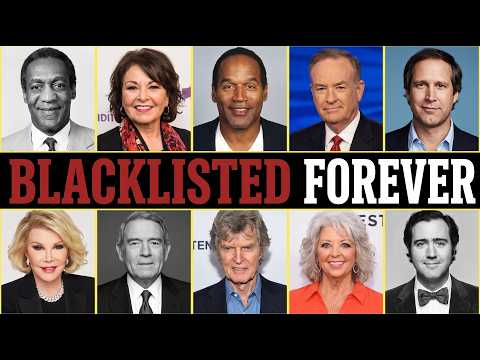
Roseanne Barr starred in and produced one of the most successful sitcoms in television history throughout its original run. And decades later, ABC revived the show to strong ratings, betting that audiences still wanted more of the working-class Conner family. In May of 2018, Barr posted a racially charged tweet about former Obama administration official Valerie Jarrett, comparing her to a fictional ape-human hybrid character.
The backlash was immediate and severe, and within hours, ABC announced it was cancelling the newly revived show entirely, despite its strong ratings and despite Barr being the title character and driving creative force behind it. The network went on to produce a spin-off, The Conners, that continued without her involvement at all, killing off her character entirely in the opening minutes of the new show’s premiere as a way of formally writing her out of the world she had created decades earlier.
Bill Cosby was for decades one of the most beloved figures in American television, first through I Spy and later as the creative force behind The Cosby Show. Starting in 2014, dozens of women came forward alleging he had drugged and sexually assaulted them across several decades. Networks and syndication partners moved quickly to distance themselves, pulling reruns and cancelling projects. In 2018 he was convicted on charges related to one allegation—a conviction later overturned on a legal technicality in 2021, rather than any finding that the allegations were false. Despite that, Cosby has remained effectively frozen out of mainstream television entirely.
Paula Deen built an enormously popular cooking empire around her Southern comfort food, becoming one of the Food Network’s biggest stars. In 2013, during a deposition connected to an employment discrimination lawsuit, Deen admitted under oath to having used a racial slur in the past. Once the deposition became public, the Food Network announced it would not renew her contract, and major retailers pulled entire lines of branded cookware from shelves within days. She attempted a comeback through smaller platforms but never returned to her previous level of major network visibility.
Bill O’Reilly hosted The O’Reilly Factor for over 20 years, making it consistently the highest-rated program on Fox News. In April of 2017, a New York Times investigation revealed that O’Reilly and Fox had paid out roughly $13 million to settle multiple sexual harassment claims. Within weeks, more than 50 advertisers pulled their commercials, and on April 19th, 2017, Fox News announced O’Reilly would not be returning—even though his show remained a top performer right up until his departure.
OJ Simpson built a broadcasting career as an NFL analyst long before his 1994 arrest for the murders of Nicole Brown Simpson and Ronald Goldman. Following his acquittal, his broadcasting and acting opportunities effectively dried up. The clearest example came in 2006 when Fox planned to air a special titled If I Did It, in which Simpson described in hypothetical terms how he might have carried out the killings. The backlash was immediate and overwhelming, with numerous local Fox affiliates announcing they would refuse to air the special regardless of what the network decided—a level of open affiliate revolt that remains genuinely rare in American broadcast television.
Fifteen different stars, fifteen different decades, and fifteen completely different reasons why a network ultimately decided a performer simply wasn’t worth the risk anymore. A couple of these stories, particularly Nat King Cole’s, aren’t really about anyone getting banned in the traditional sense at all, but about an entire industry too afraid of public backlash to keep supporting someone who deserved far better than what he actually got.
A few of these stars eventually found their way back, at least partially—whether through smaller platforms, independent projects, or in Joan Rivers’s case, a genuinely full and celebrated return decades later. Others never really did. Their names quietly retired from network consideration for good. Either way, these stories are a reminder that television has never actually been the stable, predictable business it likes to present itself as—and that the same audience capable of making someone a household name has, in every single one of these cases, also proven just as capable of deciding when that name simply wasn’t welcome anymore.
So which of these fifteen downfalls do you think was the most justified—and which one still feels like a genuine injustice all these years later? Let us know in the comments below.






